Economics-Watching: Kuwait: GDP Returns to Growth in Q1 2025 as Impact of Oil Output Cuts Fades

[from NBK Economic Research, 21 July, 2025]

by Mohammad Al-Shehri, Assistant Economist & Omar Al-Nakib, Head of MENA Research

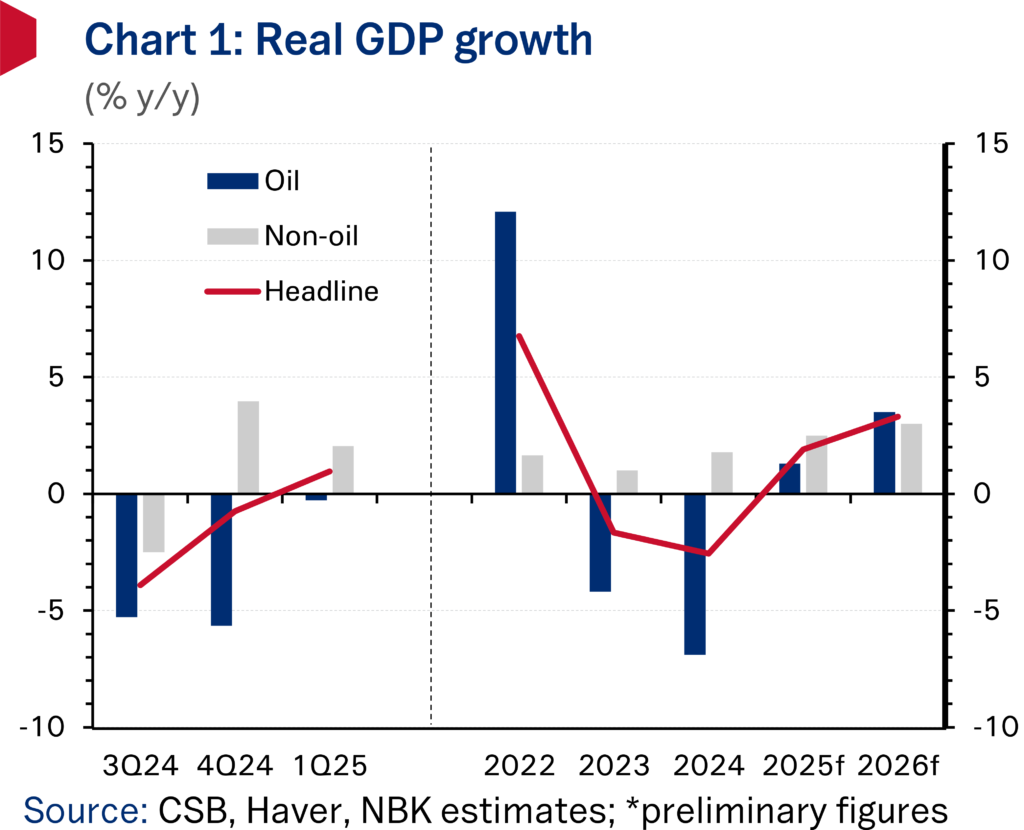
Preliminary official figures show GDP expanding 1% y/y in Q1 2025 following seven consecutive quarters of contraction, helped by a less severe downturn in oil output. With the negative effects of earlier voluntary oil production cuts beginning to fade, oil GDP recorded only a marginal decline, the softest since Q2 2023. Growth in non-oil activity remained positive though eased, weighed by a moderation in the manufacturing, real estate, and transport sectors. The near-term outlook for GDP is one of positive growth, lifted by rising oil production after Kuwait started to restore 135 kb/d of oil output cuts between April and September 2025, while the non-oil sector should also register further steady gains.

Non-oil GDP growth softens in Q1 2025 after strong performance in Q4 2024

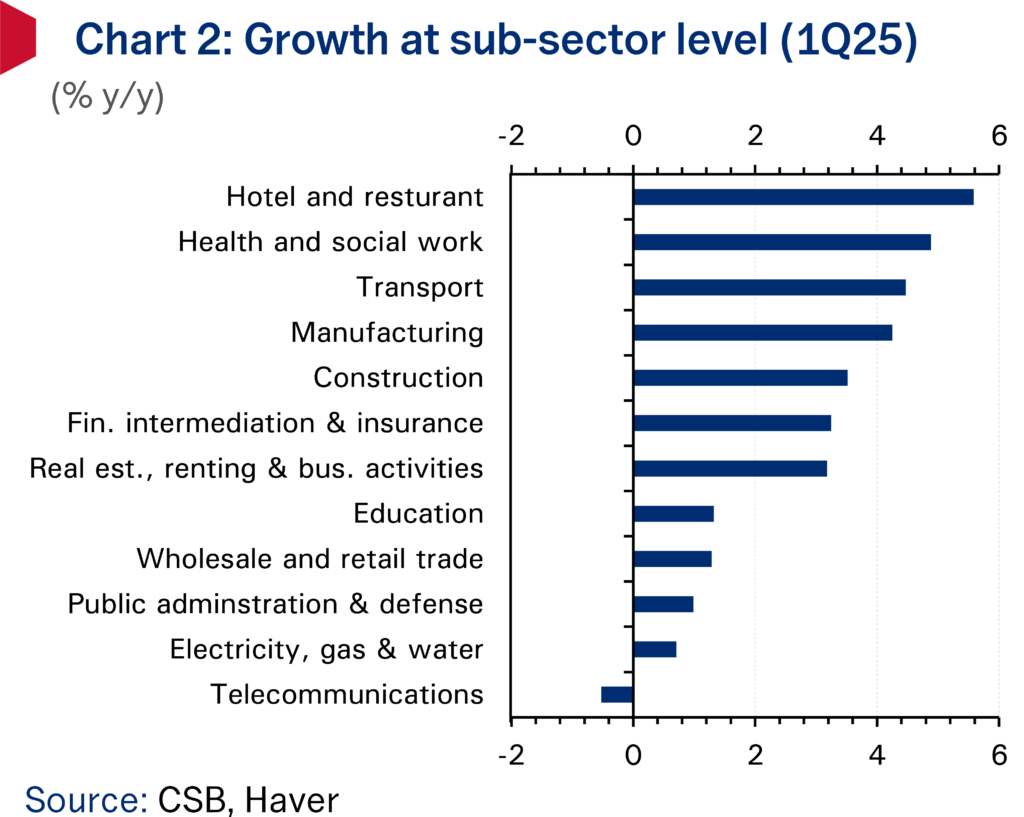
Growth in the non-oil sector weakened in Q1 2025, slowing to 2% y/y compared to 4% recorded in the prior quarter. (Chart 1.) The softer expansion in non-oil activity reflected, among other things, a moderation in the manufacturing sector, where activity grew at a still-solid 4.3% despite a decline in refined petroleum products output but slowed notably from the 12.2% reading registered in Q4 2024. Growth in other sectors including real estate, wholesale & retail trade, transport, and education also slowed. Offsetting the slowdown was stronger expansion in the non-oil economy’s largest segments: public administration and defense as well as financial intermediation and insurance, which grew 1% and 3.2% y/y, respectively. (Chart 2.)

Chart 1: Real GDP growth

Chart 2: Growth at sub-sector level (1Q25)

Oil sector logs marginal contraction, set to return to growth in Q2

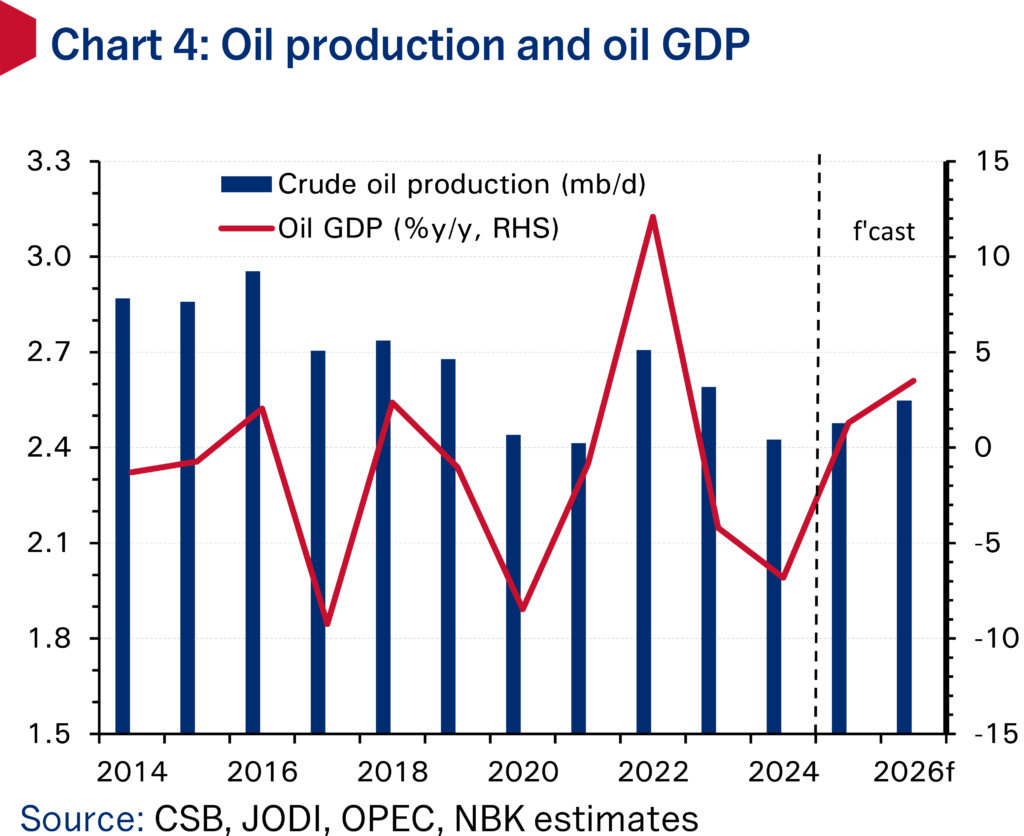
The contraction in oil GDP eased significantly to -0.3% y/y from -5.7% y/y in Q4 2024, registering the softest rate of decline since Kuwait embarked on cutting oil production in Q2 2023 after participating in the voluntary cuts scheme with 7 other OPEC+ members. (Chart 4.) Kuwait’s oil production averaged 2.415 mb/d in Q1 2025, a 0.7% decline from the same quarter last year, according to OPEC secondary sources. However, oil sector fortunes are set to shift in Q2 2025 and thereafter, after the OPEC-8 member alliance started unwinding the 2.2 mb/d voluntary cut tranche in April 2025. Originally planned to be unwound over the course of 18 months, OPEC+ has accelerated the pace of supply hikes with output now on a path to be fully restored in September, a full year ahead of schedule. For Kuwait, crude production rose by 0.5% q/q in Q2 to 2.426 mb/d and is set to accelerate further to average 2.533 mb/d in H2 2025. With the oil market so far able to absorb the additional OPEC and global supply and oil prices currently holding near $70/bbl, an upside risk to our oil sector outlook involves the potential unwinding of the outstanding OPEC-8 voluntary cuts (1.66 mb/d), of which Kuwait’s share is 128 kb/d.

Growth heading back into positive territory in 2025

Growth in total GDP is set to remain on a positive trajectory in the near term, buoyed by further steady expansion in non-oil economic activity and increased oil production. Non-oil GDP is set to benefit from the government’s reform drive which includes the recent passing of the debt law that could catalyze the implementation of key development projects and the potential approval of the ‘mortgagelaw later in 2025, which could spur higher household borrowing and consumer spending. Economic indicators for Q2 2025 pointed to a healthy pace of non-oil economic activity. The key ‘output’ and ‘new orders’ balances in the non-oil private sector PMI gauge both averaged a very robust 57+ in Q2 2025, real estate activity continued to expand at a robust pace with earlier price falls in the residential sector abating, while credit growth stood at a healthy 5.5% y/y in May, and could benefit in coming months if interest rates are reduced further.

Nonetheless, there are also downside risks to the outlook. Local consumer spending growth (according to central bank card transactions data) turned negative in Q1 2025, extending the weakening trend now observed for more than a year. The government’s ongoing fiscal consolidation push will also weigh on wage and job growth. Overall, we see GDP growing 1.9% this year, boosted by expansions in both the oil and non-oil sectors of 1.2% and 2.5%, respectively.

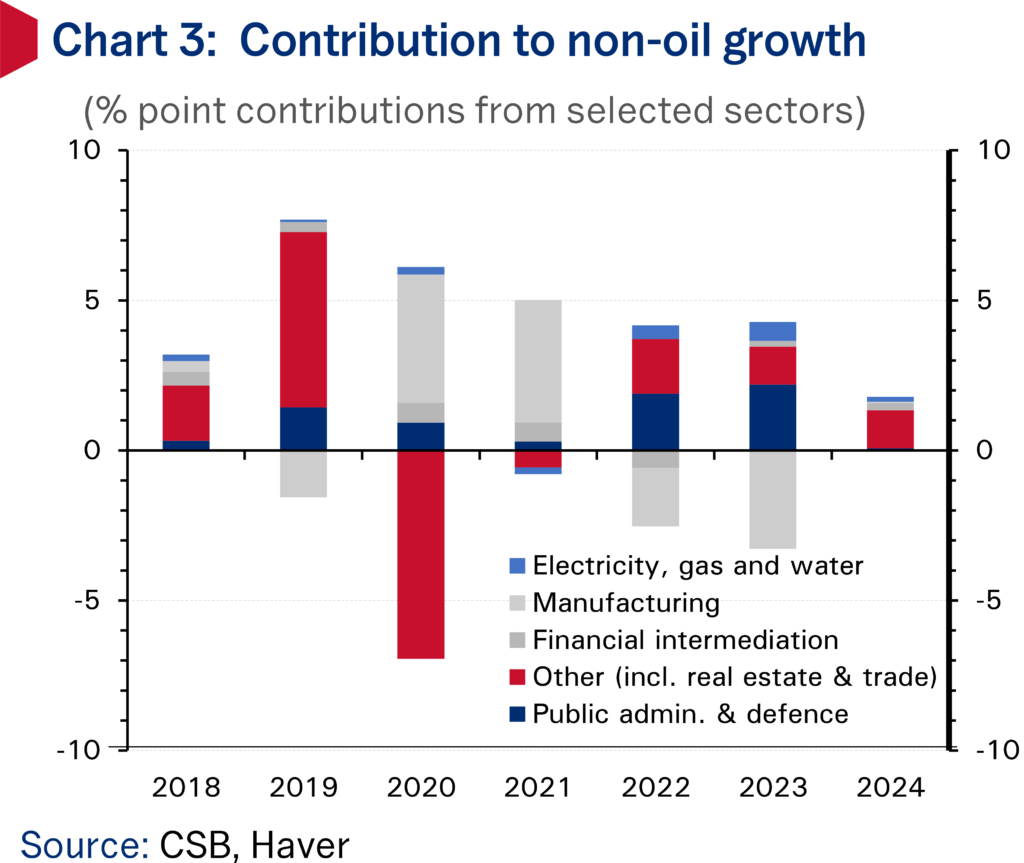
Chart 3: Contribution to non-oil growth

Chart 4: Oil production and oil GDP

Read this article as an archived PDF.

Problems of Perspective, Michel Foucault

Michel Foucault was one of the leading French philosophers of the 20th century. Often considered a postmodernist, he did not believe there was a final perspective that human knowledge could achieve. This immediately contrasts with the outlook of leading physicists like Stephen Hawking. In his 1988 classic, A Brief History of Time, Hawking concludes the book by saying, once science has achieved a theory of everything, which is not far off, we will “know the mind of god.”

In his 1966 key work, The Order of Things: An Archaeology of the Human Sciences (French: Les Mots et les Choses: Une archéologie des sciences humaines), Foucault argued that the so-called order of things is invented, not discovered, by us. This is contrary to scientific thought.

Foucault sets up this limit in his surprising interpretation of the Diego Velázquez masterpiece painting, Las Meninas (Spanish: The Ladies-in-waiting). The painting is deliberately elusive in its use of perspective.

The great German thinker, Jürgen Habermas, explained this Foucault/Velázquez perspective difficulty:

This picture portrays the painter in front of a canvas not visible to the spectator; the painter is evidently looking, as are the two ladies-in-waiting next to him, in the direction of his two models, King Philip IV and his spouse. These two personages standing as models are found outside the frame of the picture; they can be identified by the spectator only with the help of a mirror pictured in the background. The point that Velázquez apparently had in mind is a confusing circumstance of which the spectator becomes aware by inference: The spectator cannot avoid assuming the place and the direction of the gaze of the counterfeit but absent royal pair — toward which the painter captured in the picture gazes — as well as the place and the perspective of Velázquez himself, which is to say, of the .painter who actually produced this picture. For Foucault, in turn, the real point lies in the fact that the classical picture frame is too limited to permit the representation of the act of representing as such — it is this that Velázquez makes clear by showing the gaps within the classical picture frame. left by the lack of reflection on the process of representing itself.29

29. Foucault constructs two different series of absences. On the one hand, the painter in the picture lacks his model, the royal couple standing outside the frame of the picture; the latter are in turn unable to see the picture of themselves that is being painted — they only see the canvas from behind; finally, the spec­tator is missing the center of the scene, that is, the couple standing as models, to which the gaze of the painter and of the courtesans merely directs us. Still more revealing than the absence of the objects being represented is, on the other hand, that of the subjects doing the representing, which is to say, the triple absence of the painter, the model, and the spectator who, located in front of the picture, takes in perspectives of the two others. The painter, Velázquez, actually enters into the picture, but he is not presented exactly in the act of painting — one sees him during a pause and realizes that he will disappear behind the canvas as soon as he takes up his labors again. The faces of the two models can actually be recognized unclearly in a mirror reflection, but they are not to be observed directly during the act of their portrayal. Finally, the act of the spectator is equally unrepresented — the spectator depicted entering into the picture from the right cannot take over this function. (See Foucault, The Order of Things, pp. 3-16, 307-311.)

Critique and Power: Recasting the Foucault/Habermas Debate, Michael Kelly, editor, MIT Press, 1994, pages 67, 77 [archived PDF].

Let us conclude by saying one way of specifying the disagreement between scientists and these thinkers is that sciences see themselves as “objective” while the thinkers feel science lacks objectivity because of the human observer. Kant, centuries ago, argued that concepts like causality, space and time are imposed by the human mind on the world. Similarly, Heisenberg, in Physics and Philosophy: The Revolution in Modern Science, similarly said that science does not finally answer questions about an objective reality, but can only answer questions posed by us.

World-Watching: U.S. Greenlighted H20 Chips Export on Its Own Initiative, China Says

Beijing clarifies its deal with Washington didn’t include NVIDIA’s 4th-best AI chip, disputing widely-reported comments by U.S. Commerce Secretary Howard Lutnick

by Zichen Wang, from Pekingnology

The U.S. greenlighted NVIDIA’s China-specific Artificial Intelligence chip, known as the H20, for export to China on its own initiative, China said on Friday.

In a statement dedicated to the recent U.S. approval of the semiconductor giant’s 4th-best Artificial Intelligence chip, China’s Ministry of Commerce said on its website that in early July, the U.S. had already lifted restrictions on China under the agreement reached between the two countries in London.

“We have taken note that Washington has now taken the initiative to announce it will authorize sales of NVIDIA’s H20 chips to China,” the trade ministry added.

Beijing’s clarification stands in stark contrast to widely reported public comments earlier this week by U.S. Commerce Secretary Howard Lutnick, who told Reuters on Tuesday that “We put that in the trade deal with the magnets,” referring to the agreement made to restart Chinese rare earth shipments to U.S. manufacturers. He did not provide additional details, according to Reuters.

NVIDIA’s H20 was designed to be technologically inferior. The company also sells three other chips that far surpass the H20’s power.

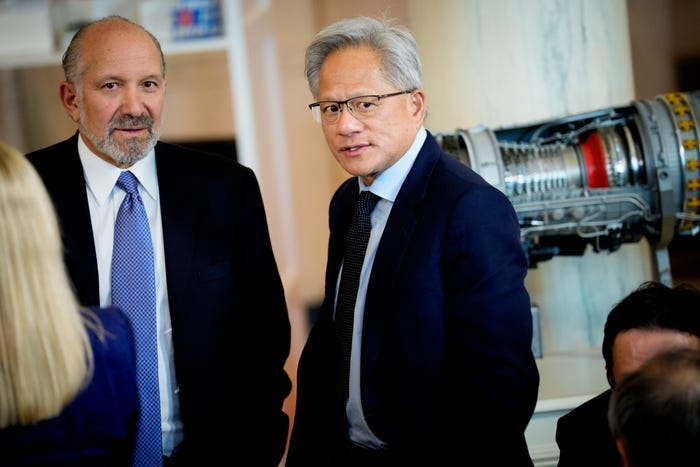
Commerce Secretary Howard Lutnick echoed NVIDIA CEO Jensen Huang’s view of why a U.S. company should sell chips to China. Andrew Harnik/Getty Images

On Monday, July 14, the Silicon Valley company announced in a blog post that the U.S. government had approved the sale of the H20, three months after the Donald Trump administration shut down NVIDIA’s artificial intelligence chip sales to China, after CEO Jensen Huang met President Trump in Washington D.C., and before he departed for Beijing.

Huang dominates Chinese headlines this week with his speech at an industry conference and public events with Chinese AI leaders. He visited China’s Ministry of Commerce and was received by Wang Wentao, the minister, on Thursday.

商务部新闻发言人就美批准对华销售英伟达H20芯片有关情况答记者问

MOFCOM Spokesperson Responds to Questions on the U.S. Approval of NVIDIA H20 Chip Sales to China

2025-07-18 13:43

Question:

U.S. officials have recently stated that Washington’s decision to approve sales of NVIDIA’s H20 chips to China is part of ChinaU.S. economic and trade negotiations. They also claimed that Chinese firms, including Huawei, are already producing equivalent chips domestically and that the United States does not want China to achieve full import substitution. How does the Ministry of Commerce (MOFCOM) view this?

Answer:

Following the ChinaU.S. economic and trade consultations in London, the two sides have maintained close communication, finalized the “London framework,” and moved forward with implementation. China, in accordance with its laws and regulations, approves export applications for controlled items that meet the necessary criteria. In early July, the United States reciprocally lifted the restrictions on China that had been discussed during those talks.

We have taken note that Washington has now taken the initiative to announce it will authorize sales of NVIDIA’s H20 chips to China. Beijing believes the United States should abandon a zero-sum mentality and continue to roll back a range of unwarranted trade and technology restrictions on China.

Cooperation and mutual benefit are the only viable path; suppression and containment lead nowhere. In May, the United States issued new export-control guidelines targeting Huawei’s Ascend chips, tightening restrictions on Chinese semiconductor products under unfounded pretexts. By wielding administrative power to distort fair market competition, these measures severely undermine the legitimate rights and interests of Chinese companies. China has made its position clear and firmly opposes such actions.

We look forward to the United States working with China in a spirit of equality to correct these erroneous practices, foster a sound environment for mutually beneficial cooperation between the two countries’ enterprises, and jointly safeguard the stability of global semiconductor supply chains.

Economics-Watching: BRICS Currency Creates Dilemma for the Dollar

by Christopher Whalen, from China Daily

The term “BRICS currency” typically refers to a hypothetical or proposed unified currency for the BRICS grouping. It’s not a single, physical currency currently in use, but rather a concept for a potential future monetary system that some suggest will reduce the dominance of the U.S. dollar in international trade and finance.

Is BRICS currency cooperation about immediate de-dollarization or long-term financial sovereignty? The answer is that BRICS cooperation may include reducing long-term dependence on the dollar as a means of exchange. The dollar is involved in more than half of all trade and 80 percent of all foreign exchange transactions. BRICS currency cooperation aims to gradually reduce the group’s dollar dependency, but challenges remain.

The BRICS concept came about not because the dollar is unsuitable as a means of exchange or unit of account, but rather because of the use of the dollar by Washington as a weapon. As I note in my book, Inflated: Money, Debt and the American Dream, the special role of the dollar in U.S. finance allows the U.S. government to impose harsh compliance and reporting requirements on foreign nationals and institutions. The U.S. is an arbitrary hegemon and does not follow reciprocity with other countries.

The global role of the dollar is an anomaly, the byproduct of two world wars had left the other antagonists broke by the time the Bretton Woods Agreement was signed in July 1944.

Choosing the fiat paper dollar as the default global reserve currency more than seven decades ago reflected the fact that the United States was one of the victors and possessed the wealth that gave Washington unchallenged economic leadership. Prior to World War I, the United Kingdom’s pound sterling was the global standard, but importantly, this paper currency was backed by gold — the only money that is not debt. The dollar, too, was backed by gold — until 1933, when the Franklin Roosevelt administration confiscated gold in private hands to prevent his government from collapsing.

Pound notes started to circulate in England in 1694, shortly after the establishment of the Bank of England. The paper pound helped to fuel the expansion of the British Empire, in large part because the only competing form of money was physical gold. When Britain and other nations left the gold standard in the 1930s, it was due to the deflation caused by the Great Depression rather than a deliberate choice.

The 19th-century rule attributed to English journalist and businessman Walter Bagehot says that in times of crisis, lend freely at a high rate against good collateral. Yet since the currency devaluation and gold seizures of 1933, fiat currencies and below-market interest rates have been the rule. In a global scheme in which the government occupies the prime position, the operative term remains “financial repression”, whereby governments control markets and artificially suppress rates of return on debt. For this reason, the dollar is losing its role as a store of value to gold.

The fact that the dollar continues to trade strongly versus other currencies reflects the reality that as the main means of exchange globally, the dollar cannot be easily replaced. One reason for this continued support for the dollar is that the trade in petroleum and other commodities is so large that it requires an equally large currency to accommodate it. Also, neither the Europeans nor the Japanese, the only two possible alternatives, are willing to risk the external deficits or inflation that the U.S. suffers as the host for the global currency.

What global currency will replace the fiat paper dollar? None. As this article is being written, gold is the second-largest reserve asset for central banks after the dollar. “The initiation in 2002 of the Shanghai Gold Exchange was of great strategic significance, both for gold and the global monetary system,” notes veteran gold fund manager Henry Smyth in an interview in The Institutional Risk Analyst. “Now it is completely clear what happened.”

Smyth and many other observers see the creation of the SGE in 2002 as the return of gold to the international monetary system. But while gold is growing in importance as a reserve asset for many countries, it does not mean that the role of the dollar as a global means of exchange or unit of account is about to change.

The dollar will remain the dominant asset. And even then, displacing the dollar will require a major change in the international monetary system, a change that is already underway.

The author is the chairman of Whalen Global Advisors LLC in New York and the author of Inflated: Money, Debt and the American Dream published by Wiley Global (2025).

World-Watching: Science First Release, 10 July 2025

[from Science]

Accepted papers posted online prior to journal publication.

NASA Earth Science Division provides key data

by Dylan B. Millet, Belay B. Demoz, et al.

In May, the US administration proposed budget cuts to NASA, including a more than 50% decrease in funding for the agency’s Earth Science Division (ESD), the mission of which is to gather knowledge about Earth through space-based observation and other tools. The budget cuts proposed for ESD would cancel crucial satellites that observe Earth and its atmosphere, gut US science and engineering expertise, and potentially lead to the closure of NASA research centers. As former members of the recently dissolved NASA Earth Science Advisory Committee, an all-volunteer, independent body chartered to advise ESD, we warn that these actions would come at a profound cost to US society and scientific leadership.

[read more]

Spin-filter tunneling detection of antiferromagnetic resonance with electrically tunable damping

by Thow Min Jerald Cham, Daniel G. Chica, et al.

Antiferromagnetic spintronics offers the potential for higher-frequency operations and improved insensitivity to magnetic fields compared to ferromagnetic spintronics. However, previous electrical techniques to detect antiferromagnetic dynamics have utilized large, millimeter-scale bulk crystals. Here we demonstrate direct electrical detection of antiferromagnetic resonance in structures on the few-micrometer scale using spin-filter tunneling in PtTe2/bilayer CrSBr/graphite junctions in which the tunnel barrier is the van der Waals antiferromagnet CrSBr. This sample geometry allows not only efficient detection, but also electrical control of the antiferromagnetic resonance through spin-orbit torque from the PtTe2 electrode. The ability to efficiently detect and control antiferromagnetic resonance enables detailed studies of the physics governing these high-frequency dynamics.

[read more]

Scalable emulation of protein equilibrium ensembles with generative deep learning

by Sarah Lewis, Tim Hempel, et al.

Following the sequence and structure revolutions, predicting functionally relevant protein structure changes at scale remains an outstanding challenge. We introduce BioEmu, a deep learning system that emulates protein equilibrium ensembles by generating thousands of statistically independent structures per hour on a single GPU. BioEmu integrates over 200 milliseconds of molecular dynamics (MD) simulations, static structures and experimental protein stabilities using novel training algorithms. It captures diverse functional motions—including cryptic pocket formation, local unfolding, and domain rearrangements—and predicts relative free energies with 1 kcal/mol accuracy compared to millisecond-scale MD and experimental data. BioEmu provides mechanistic insights by jointly modeling structural ensembles and thermodynamic properties. This approach amortizes the cost of MD and experimental data generation, demonstrating a scalable path toward understanding and designing protein function.

[read more]

Negative capacitance overcomes Schottky-gate limits in GaN high-electron-mobility transistors

by Asir Intisar Khan, Jeong-Kyu Kim, et al.

For high-electron-mobility transistors based on two-dimensional electron gas (2DEG) within a quantum well, such as those based on AlGaN/GaN heterostructure, a Schottky-gate is used to maximize the amount of charge that can be induced and thereby the current that can be achieved. However, the Schottky-gate also leads to very high leakage current through the gate electrode. Adding a conventional dielectric layer between the nitride layers and gate metal can reduce leakage; but this comes at the price of a reduced drain current. Here, we used a ferroic HfO2ZrO2 bilayer as the gate dielectric and achieved a simultaneous increase in the ON current and decrease in the leakage current, a combination otherwise not attainable with conventional dielectrics. This approach surpasses the conventional limits of Schottky GaN transistors and provides a new pathway to improve performance in transistors based on 2DEG.

[read more]

Is the World Broken?

Gabriel Marcel was a famous 20th century existence-watcher. He kept circling back to conundrums which preoccupied him his entire life.

The first was how to explain the profound difference between a problem and a mystery. He says, for example, that a problem is something that you can surround, but a mystery is something that surrounds you. He also calls into doubt the ideology of scientism (the belief that science and the scientific method are the best or only way to render truth about the world and reality). According to scientism, the story of mankind since the rise of modern science, with people such as Galileo, is the transformation of all mysteries into problems. With the passage of time, those problems would be solved. However, when we look around us at such science-thinkers like Roger Penrose, Neil Turok and Carlo Rovelli, we find that science is becoming more mysterious and the mysteries are increasingly deep, as anyone who follows quantum mechanics can see.

For the second he kept asking, how it is that I both have a body but that I am a body? Think of the phrase “I am somebody” and notice the last word. The physical body cannot be disentangled from personhood.

In 1933, Marcel published the famous play, Le Monde cassé (French: The Broken World). Compare that to the previous article, “Why Is the World So Nightmarish?” discussing Céline’s 1932 Journey to the End of the Night (FrenchVoyage au bout de la nuit). Both of these works describe a human world which is completely adrift, disoriented and soulless.

As an existential thinker, Marcel always watched humanity and did a soul-audit. He was not particularly attentive to the other dimension of our earthly stay, namely political economy. In order to make up for this semi-absence, we bring in Gustav Stresemann, who gives us the lens for it. Stresemann died within weeks of the Wall Street crash of 1929.

A few days before his death, Stresemann, the leading German statesman of his time, gave a speech at the League of Nations. In this, he gave an update on the German economic situation of the moment. He stated that the numbers were superficially encouraging, but that Germany, under the surface, was “dancing on a volcano.”

The concept of a country or indeed the whole world in these straits is very profound. It tells us that as people like Céline and Marcel warn us, the world is potentially broken at all moments because the people do not even have a concept of self-possession. Furthermore, the cracks underneath the foundation of the world economy indicate a dangerous fragility at all times. In this larger sense, Marcel’s concept of the broken world combined with Stresemann’s dancing on a volcano, allow us to glimpse an instability that current education does not cover.

Why Is the World So Nightmarish?

The phrase, “La Belle Époque” (French: “The Beautiful Era”) refers to the atmosphere in Europe and especially France, the high point of which lasted from 1900 to 1914, with the outbreak of World War I. The whole era was characterized by the phrase, “la douceur de la vie” (French: “the sweetness of life”). People of the time would say that if you weren’t alive then, they could not communicate how charming life was at the time.

The sinking of the Titanic in April, 1912 is the symbolic catastrophe that heralded the end of the era. Anyone who watched Downton Abbey would perhaps remember the opening scene, which depicts the newspaper announcing it with a screaming headline.

The great masterpiece, Journey to the End of the Night (FrenchVoyage au bout de la nuit, 1932), describes the whole world around World War I as a nightmarish battlefield of previously unseen scope. Céline’s protagonist, Ferdinand, travels the world, from battles in Europe to Africa, then to New York and Detroit’s Ford assembly line before returning to France, finding that the nightmare is global and inescapable.

Céline died within 24 hours of Ernest Hemingway. Hemingway is famous for the quote from The Sun Also Rises (set in the 1920s), “The world breaks everyone and afterward many are strong at the broken places. But those that will not break it kills.”

The question is how could we ever explain complete evaporation of the sweetness of life and transformation into such a nightmare, culminating into the world of today.

Lastly, think of the point made in Sebastian Haffner’s The Meaning of Hitler, how Hitler fit into this nightmarization of the world. Haffner writes:

It is impossible for a serious historian to maintain that without Hitler world history in the twentieth century would have taken the course it has taken. It is by no means certain that without Hitler a second world war would even have taken place; it is quite certain that if it had taken place it would have taken a different course — possibly even with different alliances, fronts and outcomes. Today’s world, whether we like it or not, is the work of Hitler. Without Hitler there would have been no partition of Germany and Europe; without Hitler there would be no Americans and no Russians in Berlin; without Hitler there would be no Israel; without Hitler there would be no de-colonization, at least not such a rapid one; there would be no Asian, Arab or Black African emancipation, and no diminution of European preeminence. Or, more accurately, there would be none of this without Hitler’s mistakes. He certainly did not want any of it.

(The Meaning of Hitler, Harvard University Press, 1979, page 100)

No-one has yet captured how the nightmarish feeling of 2025 is itself downstream from the preceding era.

Kierkegaard and Existence

There are various striking intuitions about human existence. For example, in his brilliant memoirs, Speak, Memory, Nabokov begins with the deep reflection where human existence is compared to a baby in a cradle, rocking, completely vulnerable and uncertain. All of this is bracketed by two episodes of infinite darkness. The first episode took place before you were born and the second takes place after you’re gone. Your existence is a temporary flame, like that of a lit match.

A MetaIntelligent comment on this would be that the profound ingenuity of the 19th century mathematicians analyzing the size and nature of infinity (e.g., Richard Dedekind or Georg Cantor) cannot in the last analysis wrestle down human existence into mathematics.

The modern progenitor of this kind of human existence-watching is the Danish genius Søren Kierkegaard. In one of his masterpieces, Concluding Unscientific Postscript to Philosophical Fragments (1846), he makes the claim that knowledge, theory, speculative thinking and infinity-watching à la Dedekind and Cantor, cannot possibly explain human existence, because it subsumes all of these.

In 2025, this would mean that the Kierkegaard sense of things would tell you that neuroscience can never really explain how existence is sensed by a living person.

Kierkegaard writes, “in my view the misfortune of the age was precisely that it had too much knowledge, had forgotten what existence means, and what inwardness signifies.” He continues, “for a knowledge-seeker, when he has finished studying China he can take up Persia; when he has studied French he can begin Italian; and then go on to astronomy, the veterinary sciences, and so forth, and always be sure of a reputation as a tremendous fellow.”

By way of contrast, “inwardness in love does not consist in consummating seven marriages with Danish maidens, then cutting loose on the French, the Italian, and so forth, but consists in loving one and the same woman, and yet being constantly renewed in the same love, making it always new in the luxuriant flowering of the mood.” (Concluding Unscientific Postscript to Philosophical Fragments, page 232.)

Kierkegaard’s kind of existence-watching can be understood as a turning-upside-down of the famous phrase from Descartes, “I think, therefore I am.” For Kierkegaard, “I am, therefore I think.” Notice that “I think” is an epistemological statement or knowledge-watching. “I am” is an ontological statement.

This existentialist tradition of putting ontology before epistemology finds its culmination in Heidegger. As he says in his opus, Being and Time (1927), “human being is ultimately the being for whom being itself is an issue.”

China: Deep History

Winston Churchill says somewhere (if we paraphrase) that the further back you are able to look, the more secure your ability to analyze the present and the future. Without these ‘historical smarts’, your sense of direction is very feeble. Let us use the novel, Lost Illusions, by Honoré de Balzac as a back door into historical smarts.

This novel was originally published in three parts between 1837 and 1843 and is set mostly in the 1820s, primarily in provincial France. It is unique because it starts with technology and commerce.

At the time when this story begins, the Stanhope press and inking-rollers were not yet in use in small provincial printing-offices. Angoulême, although its paper-making industry kept it in contact with Parisian printing, was still using those wooden presses from which the now obsolete metaphor ‘making the presses groan’ originated. Printing there was so much behind the times that the pressmen still used leather balls spread with ink to dab on the characters. The bed of the press holding the letter-filled ‘forme’ to which the paper is applied was still made of stone and so justified its name ‘marble’. The ravenous machines of our times have so completely superseded this mechanism — to which, despite its imperfections, we owe the fine books produced by the Elzevirs, the Plantins, the Aldi and the Didots — that it is necessary to mention this antiquated equipment which Jérôme-Nicolas Séchard held in superstitious affection; it has its part to play in this great and trivial story.

Not only do we get this conceptual framework about printing technology, but later on in the novel, Balzac gives us a further insight into paper-making and textiles, including a long discussion of China.

In England, where four-fifths of the population use cotton to the exclusion of linen, they make nothing but cotton paper. The cotton paper is very soft and easily creased to begin with, and it has a further defect: it is so soluble that if you seep a book made of cotton paper in water for fifteen minutes, it turns to a pulp, while an old book left in water for a couple of hours is not spoilt. You could dry the old book, and the pages, though yellow and faded, would still be legible, the work would not be destroyed.

“There is a time coming when legislation will equalize our fortunes, and we shall all be poor together; we shall want our linen and our books to be cheap, just as people are beginning to prefer small pictures because they have not wall space enough for large ones. Well, the shirts and the books will not last, that is all; it is the same on all sides, solidity is drying out. So this problem is one of the first importance for literature, science, and politics.

“One day, in my office, there was a hot discussion going on about the material that the Chinese use for making paper. Their paper is far better than ours, because the raw material is better; and a good deal was said about this thin, light Chinese paper, for if it is light and thin, the texture is close, there are no transparent spots in it. In Paris there are learned men among the printers’ readers; Fourier and Pierre Leroux are Lachevardiere’s readers at this moment; and the Comte de Saint-Simon, who happened to be correcting proofs for us, came in in the middle of the discussion. He told us at once that, according to Kempfer and du Halde, the Broussonetia furnishes the substance of the Chinese paper; it is a vegetable substance (like linen or cotton for that matter). Another reader maintained that Chinese paper was principally made of an animal substance, to wit, the silk that is abundant there. They made a bet about it in my presence. The Messieurs Didot are printers to the Institute, so naturally they referred the question to that learned body. M. Marcel, who used to be superintendent of the Royal Printing Establishment, was umpire, and he sent the two readers to M. l’Abbe Grozier, Librarian at the Arsenal. By the Abbe’s decision they both lost their wages. The paper was not made of silk nor yet from the Broussonetia; the pulp proved to be the triturated fibre of some kind of bamboo. The Abbe Grozier had a Chinese book, an iconographical and technological work, with a great many pictures in it, illustrating all the different processes of paper-making, and he showed us a picture of the workshop with the bamboo stalks lying in a heap in the corner; it was extremely well drawn.

“Lucien told me that your father, with the intuition of a man of talent, had a glimmering of a notion of some way of replacing linen rags with an exceedingly common vegetable product, not previously manufactured, but taken direct from the soil, as the Chinese use vegetable fibre at first hand. I have classified the guesses made by those who came before me, and have begun to study the question. The bamboo is a kind of reed; naturally I began to think of the reeds that grow here in France.

Labor is very cheap in China, where a workman earns three halfpence a day, and this cheapness of labor enables the Chinese to manipulate each sheet of paper separately. They take it out of the mould, and press it between heated tablets of white porcelain, that is the secret of the surface and consistence, the lightness and satin smoothness of the best paper in the world. Well, here in Europe the work must be done by machinery; machinery must take the place of cheap Chinese labor. If we could but succeed in making a cheap paper of as good a quality, the weight and thickness of printed books would be reduced by more than one-half. A set of Voltaire, printed on our woven paper and bound, weighs about two hundred and fifty pounds; it would only weigh fifty if we used Chinese paper. That surely would be a triumph…

In 2025, we are to some extent, back to China, going from the proto-industrial world to our industrial and even digital world.

To educate oneself on all of this, you should look at the supreme scholarly achievement of the 20th century, namely Professor Joseph Needham’s masterpiece, Science and Civilisation in China.

India: Deep History

In his lectures, Professor Amartya Sen, the Harvard Nobel Prize in Economics winner, mentions Sir Mortimer Wheeler, Director-General of the Archaeological Survey of India. Wheeler wrote, while reporting on the excavation of the Indus Valley Civilization (of India), that the plumbing and sewerage were advanced, in some ways surpassing modern equivalents.

Sen’s larger point is that history is characterized by phases of rise and fall and not just classes and class struggles à la Marx.

Consider the following depiction of the East India Company, from The Anarchy: The Relentless Rise of the East India Company (also subtitled The East India Company, Corporate Violence, and the Pillage of an Empire) by William Dalrymple.


On 28 August 1608, Captain William Hawkins, a bluff sea captain with the Third Voyage, anchored his ship, the Hector, off Surat, and so became the first commander of an EIC vessel to set foot on Indian soil.

India then had a population of 150 million — about a fifth of the world’s total — and was producing about a quarter of global manufacturing; indeed, in many ways it was the world’s industrial powerhouse and the world’s leader in manufactured textiles. Not for nothing are so many English words connected with weaving — chintz, calico, shawl, pyjamas, khaki, dungarees, cummerbund, taffetas — of Indian origin. It was certainly responsible for a much larger share of world trade than any comparable zone and the weight of its economic power even reached Mexico, whose textile manufacture suffered a crisis of ‘de-industrialisation’ due to Indian cloth imports. In comparison, England then had just 5 per cent of India’s population and was producing just under 3 per cent of the world’s manufactured goods. A good proportion of the profits on this found its way to the Mughal exchequer in Agra, making the Mughal Emperor, with an income of around £100 million,* by far the richest monarch in the world.

The Mughal capitals were the megacities of their day: ‘They are second to none either in Asia or in Europe,’ thought the Jesuit Fr Antonio Monserrate, ‘with regards either to size, population, or wealth. Their cities are crowded with merchants, who gather from all over Asia. There is no art or craft which is not practised there.’ Between 1586 and 1605, European silver flowed into the Mughal heartland at the astonishing rate of 18 metric tons a year, for as William Hawkins observed, all nations bring coyne and carry away commodities for the same’. For their grubby contemporaries in the West, stumbling around in their codpieces, the silk-clad Mughals, dripping in jewels, were the living embodiment of wealth and power — a meaning that has remained impregnated in the word ‘mogul’ ever since.

By the early seventeenth century, Europeans had become used to easy military victories over the other peoples of the world.

* Over £10,000 million today.

Think of the larger point: what you just read is the story of Indian de-industrialization and its negative results. Ask yourself whether American de-industrialization is something of an echo of this, as manufacturing is offshored.