Japan-Watching: Still Dreaming: Kon Satoshi’s “Paprika” and Other Visions

by Miyamoto Yūko [宮本 裕子]

Anime (アニメ) director KON Satoshi (今 敏) died in 2010 at the age of 46, but his works remain highly influential. His final film Paprika, released 20 years ago, highlights his preoccupations with the divided self and the blurring of the lines between dreams and reality.

Dream Analysis

After starting out as a manga artist in 1985, KON Satoshi [今 敏] honed his skills in the anime production teams of OSHII Mamoru [押井 守] and ŌTOMO Katsuhiro [大友 克洋], and then made his feature-length direction debut with Perfect Blue, which was released in Japan in 1998. His fourth feature, the 2006 Paprika, is an adaptation of the novel of the same name by TSUTSUI Yasutaka [筒井 康隆]. Kon was public in his admiration of the book and he is said to have aimed to produce “something like the novel Paprika” in his previous anime. Indeed, Kon’s Paprika adaptation has many factors in common with his earlier works.

KON Satoshi [今 敏]

KON Satoshi [今 敏] in Venice in September 2006, when Paprika was showing in competition at the Venice International Film Festival. (© Reuters)

Tsutsui studied psychology at university, and motifs and ideas from Freudian and Jungian psychoanalysis feature regularly in his novels. Dream analysis plays a central role in the story in Paprika. In psychoanalysis, psychologically repressed material is thought to be banished to the unconscious before emerging in a different form in dreams. Analysis of dreams has been seen as a valuable way of resolving psychological problems by bringing the repressed matter into the open.

Paprika is set in a near-future Japan, where it is possible to monitor other people’s dreams on a screen. The main character is a therapist called Chiba Atsuko, who provides treatment via her alter ego Paprika, a dream detective. The technology is abused, however, forcing people to experience nightmares, and eventually these flood into the real world.

While Kon follows the broad outline of the original work, his adaptation incorporates numerous changes. The biggest of these is the chaotic parade of electronic goodsbeckoning cats (“maneki-neko” [招き猫]), Buddhist statues, torii gates [鳥居], and other marching objects. This symbolizes nightmares spilling out of control, but there is nothing like it in Tsutsui’s book. Kon explained that the parade is made up of old-fashioned appliances and forgotten religious and traditional elements.

In Freud’s The Uncanny, he describes the titular subject as something familiar that has been estranged through repression. In the film, the members of the parade have become estranged from the conscious minds of people today, but are resurrected, and symbolize the uncanny nature of nightmares.


The parade that invades the dreams of patients. (© 2006 Madhouse/Sony Pictures Entertainment Japan, Inc.)

Integrating the Self

Alongside its Freudian elements, Kon’s Paprika shows Jungian influences. Carl Jung did not think that it was best to bring repressed aspects of the psyche under control, instead emphasizing the importance of integrating them into the self. This integration process can be seen in several of the characters.

While Konakawa, a character suffering from anxiety issues, searches through his dreams together with Paprika, he realizes that a mysterious person he repeatedly encounters is an old friend with whom he once shared the ambition of becoming a film director. This friend, who died of illness, appears in Konakawa’s dreams as his other self—the one who wanted to be a director. Konakawa overcomes his anxiety by recognizing and reconciliating with the repressed and forgotten self, represented by his old friend.

The division and antagonism between Chiba Atsuko and her alter ego Paprika are similar to those seen between Konakawa and his old friend. In the original book, Paprika was Chiba in disguise as a dream detective, but in Kon’s anime, they are like entirely different characters. In the finale, when dreams are flooding into the real world, they divide completely, existing at the same time in the same space. After this split, Chiba comes together again temporarily with the uninhibited Paprika when she no longer holds back her suppressed love for her colleague Tokita Kōsaku.

Chiba Atsuko with her divided self Paprika reflected in the glass. (© 2006 Madhouse/Sony Pictures Entertainment Japan, Inc.)

Chiba and Paprika do not divide in Tsutsui’s novel, and Konakawa’s old friend does not represent another self. This aspect of the divided self, added by Kon during the adaptation process, can be taken as a Jungian motif.

Books by the late KAWAI Hayao [河合 隼雄], renowned as a Jungian psychologist, were widely read in Japan from the 1980s until the 1990s, and Kon was among his readers. He is said to have become an avid reader of the psychologist for a time because he wanted to understand the music and lyrics of HIRASAWA Susumu (平沢 進), the former vocalist of the techno-pop band P-Model, who was influenced by Kawai. Hirasawa later created soundtracks for anime by Kon, including Paprika.

Kon also stated that he was influenced by the novels of MURAKAMI Haruki (村上 春樹), who himself developed a friendly relationship with Kawai through interviews and other encounters. Kon is said to have claimed that he was the only person who could adapt A Wild Sheep Chase [羊をめぐる冒険] and The Wind-Up Bird Chronicle [ねじまき鳥クロニクル] to anime.

Kon’s Themes

The anime Paprika could be seen as a later stage in the Kawai-led Jungian psychology boom in Japan, as well as a culmination of Kon’s characteristic themes. For example, the following aspects regularly appear in Kon’s work.

First, there is the depiction of another self. These include Chiba and Paprika in Paprika, Chiyoko and the old woman who appears at key moments and symbolizes Chiyoko’s future self in Millennium Actress (2002), and idol-turned-actress Mima and the apparition of her former pop star self in Perfect Blue.

Second, there are departures from heterosexual norms. In Paprika, the title character announces the wedding of Tokita and Chiba, which maintains the existence of this free-spirited “dream detective,” so that the film deviates subtly from the typical closed ending of heterosexual marriage. The ending of Millennium Actress suggests that Chiyoko’s long search for an artist she meets in her youth is her goal in itself, rather than a romantic relationship with him. In Tokyo Godfathers [東京ゴッドファーザーズ] (2003), alongside a caricatured depiction of a transgender character, we see the struggles of heterosexual couples and their families.

The third aspect is how media and technology blur the lines between reality and the unreal world. In Paprika, the DC Mini device erodes the boundary between reality and the dreams it is used to view, while Mima’s double in Perfect Blue appears in mirrors, PC monitors, and internet browsers. In Millennium Actress, Chiyoko’s acting roles are intertwined with her real life. In Kon’s anime series Paranoia Agent [妄想代理人] (2004), rumors transform into reality through the actions of the mass media and the characters, who in themselves are a kind of media commodity.

During a scene in Paprika when Konakawa goes to the movie theater, posters for Kon’s other films are on display. This shot shows Millennium Actress and Perfect Blue. (© 2006 Madhouse/Sony Pictures Entertainment Japan, Inc.)

Robot Adventure?

While there are clearly repeating themes in Kon’s works, Dreaming Machine [夢みる機械], which remains unfinished due to his sudden death from cancer, shows signs of an apparent major change of course. At one point it was announced that another director would complete the movie, but the producer later backtracked, saying that there was no director capable of realizing Kon’s vision.

Based on the remaining materials, this appeared set to be an action-adventure story about robots hunting down precious electricity in a near-future setting when humans are extinct. Paprika was also set in the near future, but Dreaming Machine features more overtly futuristic urban landscapes. The main characters are smaller, cartoonish robots, compared with the relatively tall humans of Kon’s other films. While it seems to have been aiming for a different kind of movie in terms of both content and visuals, was this really going to be a standard adventure story, without any twists?

Kon said that one of his influences was the manga [漫画] creator MOROHOSHI Daijirō (諸星 大二郎). In a short 1974 work by Morohoshi, also called “Dreaming Machine” (“Yume miru kikai [夢みる機械]”), robots go about their daily lives in the place of humans, who dream in a form of suspended animation. Kon’s unpublished 1984 manga Toriko covered similar ground. Can it be simple coincidence that his unfinished work has the same title as Morohoshi’s manga?

Beyond what looks on the surface like a robot action adventure, in Dreaming Machine,  Kon may have planned to depict a world of cryofrozen, dreaming humans. Or perhaps the robots were intended to be controlled consciously or subconsciously by humans. This is pure speculation, but I cannot help thinking that Kon may have intended to continue his theme of technology blurring the boundaries between dreams, or fantasy, and reality.

Some people may consider it unproductive to imagine what Kon’s works may have been, but this imaginative act helps carry his vision forward. Kon’s direct and indirect influence can be found in films like Darren Aronofsky’s Requiem for a Dream (2000) and Black Swan (2010), Christopher Nolan’s Inception (2010), and Edgar Wright’s Last Night in Soho (2021). While we will never see another KON Satoshi (今 敏) film, his vision lives on.

(Originally published in Japanese on July 10, 2026. Banner image from Paprika; © 2006 Madhouse/Sony Pictures Entertainment Japan, Inc.)
World-Watching: U.S. Greenlighted H20 Chips Export on Its Own Initiative, China Says

Beijing clarifies its deal with Washington didn’t include NVIDIA’s 4th-best AI chip, disputing widely-reported comments by U.S. Commerce Secretary Howard Lutnick

by Zichen Wang, from Pekingnology

The U.S. greenlighted NVIDIA’s China-specific Artificial Intelligence chip, known as the H20, for export to China on its own initiative, China said on Friday.

In a statement dedicated to the recent U.S. approval of the semiconductor giant’s 4th-best Artificial Intelligence chip, China’s Ministry of Commerce said on its website that in early July, the U.S. had already lifted restrictions on China under the agreement reached between the two countries in London.

“We have taken note that Washington has now taken the initiative to announce it will authorize sales of NVIDIA’s H20 chips to China,” the trade ministry added.

Beijing’s clarification stands in stark contrast to widely reported public comments earlier this week by U.S. Commerce Secretary Howard Lutnick, who told Reuters on Tuesday that “We put that in the trade deal with the magnets,” referring to the agreement made to restart Chinese rare earth shipments to U.S. manufacturers. He did not provide additional details, according to Reuters.

NVIDIA’s H20 was designed to be technologically inferior. The company also sells three other chips that far surpass the H20’s power.

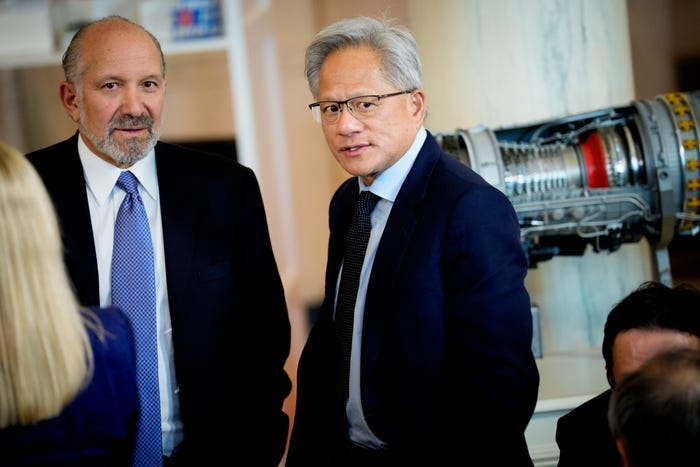
Commerce Secretary Howard Lutnick echoed NVIDIA CEO Jensen Huang’s view of why a U.S. company should sell chips to China. Andrew Harnik/Getty Images

On Monday, July 14, the Silicon Valley company announced in a blog post that the U.S. government had approved the sale of the H20, three months after the Donald Trump administration shut down NVIDIA’s artificial intelligence chip sales to China, after CEO Jensen Huang met President Trump in Washington D.C., and before he departed for Beijing.

Huang dominates Chinese headlines this week with his speech at an industry conference and public events with Chinese AI leaders. He visited China’s Ministry of Commerce and was received by Wang Wentao, the minister, on Thursday.

商务部新闻发言人就美批准对华销售英伟达H20芯片有关情况答记者问

MOFCOM Spokesperson Responds to Questions on the U.S. Approval of NVIDIA H20 Chip Sales to China

2025-07-18 13:43

Question:

U.S. officials have recently stated that Washington’s decision to approve sales of NVIDIA’s H20 chips to China is part of ChinaU.S. economic and trade negotiations. They also claimed that Chinese firms, including Huawei, are already producing equivalent chips domestically and that the United States does not want China to achieve full import substitution. How does the Ministry of Commerce (MOFCOM) view this?

Answer:

Following the ChinaU.S. economic and trade consultations in London, the two sides have maintained close communication, finalized the “London framework,” and moved forward with implementation. China, in accordance with its laws and regulations, approves export applications for controlled items that meet the necessary criteria. In early July, the United States reciprocally lifted the restrictions on China that had been discussed during those talks.

We have taken note that Washington has now taken the initiative to announce it will authorize sales of NVIDIA’s H20 chips to China. Beijing believes the United States should abandon a zero-sum mentality and continue to roll back a range of unwarranted trade and technology restrictions on China.

Cooperation and mutual benefit are the only viable path; suppression and containment lead nowhere. In May, the United States issued new export-control guidelines targeting Huawei’s Ascend chips, tightening restrictions on Chinese semiconductor products under unfounded pretexts. By wielding administrative power to distort fair market competition, these measures severely undermine the legitimate rights and interests of Chinese companies. China has made its position clear and firmly opposes such actions.

We look forward to the United States working with China in a spirit of equality to correct these erroneous practices, foster a sound environment for mutually beneficial cooperation between the two countries’ enterprises, and jointly safeguard the stability of global semiconductor supply chains.

“2022 Monkeypox Outbreak: Situational Awareness” with Syra Madad [Zoom]

[from Harvard Kennedy School’s Belfer Center, part of Harvard University]

Thursday, July 21, 2:30-4:00 PM EDT

RSVP (Required)

The 2022 Monkeypox outbreak continues to expand with case counts mounting in many countries. This seminar will cover where we are in the global fight against monkeypox, where we may be headed as a nation, and what we need to do right now to mitigate the growing threat of monkeypox. Join Belfer Fellow Dr. Syra Madad in conversation with Kai Kupferschmidt, Dr. Krutika Kuppalli, Dr. Anne Rimoin, Dr. Boghuma Kabisen Titanji, and Dr. Jay K. Varma.

About the Speakers

Dr. Anne Rimoin is a Professor of Epidemiology at the UCLA Fielding School of Public Health. She is the Gordon-Levin Endowed Chair in Infectious Diseases and Public Health. Dr. Rimoin is the director of the Center for Global and Immigrant Health and is an internationally recognized expert on emerging infections, global health, surveillance systems, and vaccination.

Rimoin has been working in the DRC since 2002, where she founded the UCLA-DRC Health Research and Training Program to train U.S. and Congolese epidemiologists to conduct high-impact infectious disease research in low-resource, logistically-complex settings.

Dr. Rimoin’s research focuses on emerging and vaccine-preventable diseases. It has led to fundamental understandings of the epidemiology of human monkeypox in post-eradication of smallpox, long-term immunity to Ebola virus in survivors and durability of immune response to Ebola virus vaccine in health workers in DRC. Her current research portfolio includes studies of COVID-19, Ebola, Marburg, Monkeypox and vaccine-preventable diseases of childhood.

Boghuma Kabisen Titanji (MD, MSc., DTM&H, PhD) is a Cameroonian born physician-scientist and Assistant Professor of Medicine at Emory University in Atlanta. She obtained her MD from the University of Yaoundé I in Cameroon and worked for two years after graduation as a medical officer, before pursuing post-graduate research training in London, United Kingdom. As an awardee of the prestigious Commonwealth Scholarship program, she obtained a Masters Degree in Tropical Medicine and International Health from the London School of Hygiene and Tropical Medicine, a diploma in Tropical Medicine and Hygiene from the Royal College of Physicians and a Ph.D. in Virology from University College London. Dr. Titanji joined Emory University School of Medicine in 2016 where she completed a residency in Internal Medicine, on the ABIM research pathway and a fellowship Infectious Diseases. She has three parallel career interests: translational and clinical research in HIV and emerging virus infections, science communication, and global health. Her clinical focus is general infectious diseases and people with HIV. Her current research focuses on chronic inflammation as a mediator of cardiovascular disease in people with HIV. She is passionate about leveraging translational research to improve the care of people with HIV, global health equity and using science to influence health policy through science communication and advocacy.

Jay K. Varma, MD is a Professor of Population Health Sciences and Director of the Cornell Center for Pandemic Prevention and Response at Weill Cornell Medicine. Dr. Varma is an expert on the prevention and control of diseases, having led epidemic responses, developed global and national policies, and led large-scale programs that have saved hundreds of thousands of lives in China, Southeast Asia, Africa, and the United States. After graduating magna cum laude with highest honors from Harvard, Dr. Varma completed medical school, internal medicine residency, and chief residency at the University of California, San Diego School of Medicine. From 2001-2021, he worked for the U.S. Centers for Disease Control and Prevention with postings in Atlanta, Thailand, China, Ethiopia, and New York City. From April 2020 – May 2021, he served as the principal scientific spokesperson and lead for New York City’s COVID-19 response. Dr. Varma has authored 143 scientific manuscripts, 13 essays, and one book.

Kai Kupferschmidt is a science journalist based in Berlin, Germany. He is a contributing correspondent for Science where he often covers infectious diseases. Kai received a diploma in molecular biomedicine from the University of Bonn, Germany and later visited the Berlin Journalism School. He has won several awards for his work, including the Journalism Prize of the German AIDS Foundation. Together with two colleagues he runs a podcast on global health called Pandemia [German]. He has also written two books, one about infectious diseases and one about the science of the color blue.

Krutika Kuppalli, MD, FIDSA is a Medical Officer for Emerging Zoonotic Diseases and Clinical Management in the Health Emergencies Program at the World Health Organization where she currently supports activities for the Monkeypox outbreak and COVID-19 pandemic. She completed her Internal Medicine residency and Infectious Diseases fellowship at Emory University, a Post-Doctoral Fellowship in Global Public Health at the University of California, San Diego and the Emerging Leader in Biosecurity Fellowship at the Johns Hopkins Center for Health Security. Dr. Kuppalli currently serves on the American Society of Tropical Medicine and Hygiene (ASTMH) Trainee Committee and is the Chair of the Infectious Diseases Society of America (IDSA) Global Health Committee.

Dr. Kuppalli was previously awarded the NIH Fogarty International Clinical Research Fellowship and conducted research in Southern India to understand barriers to care and how emerging infections impacted persons living with HIV/AIDS. She was the medical director of a large Ebola Treatment Unit in Sierra Leone during the 2014 West Africa Ebola outbreak, helped lead the development and implementation of pandemic response preparedness activities in resource limited settings, and has consulted on the development of therapeutics for emerging pathogens. Her clinical and research interests focus on health systems strengthening in resource limited settings, research and clinical care for emerging infections, outbreak preparedness and response, and policy. She has worked in numerous countries including Ethiopia, India, Sierra Leone, Uganda, and Haiti.

During the COVID-19 pandemic Dr. Kuppalli served as a consultant for the San Francisco Department of Health and helped develop and operationalize a field hospital. She served as an expert witness to the U.S. Congress, Financial Services Committee Task Force on Artificial Intelligence (AI) about how digital technologies may be leveraged for exposure notification and contact tracing to improve the pandemic response. She also collaborated with the Brennan Center for Justice to develop guidelines to inform “Healthy in-person Voting” in advance of the 2020 U.S. election and testified before the U.S. House Select Subcommittee regarding these recommendations. Prior to her position at WHO, she was the medical lead for COVID-19 vaccine rollout at the Medical University of South Carolina (MUSC) and helped coordinate vaccine education events for the staff and community and oversaw the reporting of adverse vaccine events.

Since joining WHO in August 2021, Dr. Kuppalli has been part of the WHO headquarters incident management team (IMST) for COVID-19, the clinical characterization and management working group for COVID-19, the COVID-19 therapeutics steering committee, and is the technical focal point for the post COVID-19 condition (Long COVID) steering committee. She is a member of the secretariat on the scientific advisory group on the origins of emerging and re-emerging infectious diseases (SAGO) which was convened by the Director General to understand and investigate the origins of SARS-CoV-2 and other novel pathogens. More recently since the development of the multi-country monkeypox outbreak she has been part of the IMST at WHO as one of the clinical management focal points. In this capacity she was part of the WHO core group that helped write the recently published Clinical Management and Infection Prevention and Control guidelines for Monkeypox and advising on the clinical endpoints for the global CORE therapeutics protocol.

Dr. Kuppalli is recognized as a scientific expert in global health, biosecurity and outbreak response. She was recognized by NPR Source of The Week early in the pandemic as an expert to follow and named to Elemental’s 50 Experts to Trust in a Pandemic. She has been a frequent contributor to numerous domestic and international media outlets including The New York Times, NPR, Reuters, The Washington Post, Vox, Stat News, San Francisco Chronicle, Forbes, NBC Bay Area, BBC News.