Chance and Necessity

If we free-associate the word “chance” you may arrive at “I’ll take my chances” before potentially arriving at Thomas Bayes’ “Doctrine of Chances”. Jacques Monod was an early explorer of the collision of probability and chance in biology.

THE PRINCE OF CHANCE

Jacques Monod grew up just down the coast from Monte Carlo in Cannes, France, another town famous for its casinos and, later, its film festival. Graced with movie star looks—one prominent French journalist described him as a “prince” who resembled Hollywood icon Henry Fonda, as well as considerable musical talent, and an exceptional intellect, Monod struggled to decide on a career path through his twenties. After distinguishing himself in the French Resistance, Monod rose to fame not as an actor or musician, but as a brilliant biologist. He shared the 1965 Nobel Prize in Physiology or Medicine for seminal discoveries about how genes work.

A pioneer in the field of molecular biology, Monod was privy to the blizzard of discoveries in the 1950s and early 1960s about the molecules that determined the characteristics of living things—what Monod and others dubbed “the secrets of life.” He kept close company with a relatively small international community of leading researchers. For example, when James Watson and Francis Crick cracked the structure of DNA (deoxyribonucleic acid) in 1953, Monod was one of the first with whom Watson shared the breakthrough.

But as a Frenchman steeped in his culture’s deep philosophical traditions, Monod was interested in science for more than just science’s sake. After the war, Monod befriended France’s leading philosopher-writer Albert Camus, and the two men pondered questions of human existence in Left Bank cafés. Monod felt that the public misunderstood the principal purpose of science as being the creation of technology. Rather, Monod believed technology was merely a by-product. He said, “the most important results of science have been to change the relationship of man to the universe, or the way he sees himself in the universe”—a relationship of equally intense interest to his friend Camus.

Monod thought that there were profound philosophical implications of the new molecular biology, particularly in the realm of heredity, which had gone largely unnoted in the broader culture. Several years after his Nobel Prize and Camus’ untimely death, he decided to write a book to try to bring the meaning of modern biology to laypersons.

“[T]he ‘secret of life’…has been laid bare,” he wrote.

“This, a considerable event, ought certainly to make itself strongly felt in contemporary thinking.”

Monod used several chapters to describe the insights that had very recently emerged from the study of DNA and the deciphering of the genetic code. He understood this knowledge would be unfamiliar to most readers, so he included an appendix with chemical structures of proteins and nucleic acids, and a primer on how the genetic code worked.

In a matter-of-fact style, he explained genetic mutations as accidental alterations—substitutions, additions, deletions, or rearrangements—in the text of DNA, in the sequence of the long strings of chemical bases (ACTTGATAA, etc.) that make up genes.

Then, almost without warning, he turned to the broader implications of how mutations arise in DNA. It is worth quoting him at length for after 111 pages of background, he delivered one of the most powerful ideas in five centuries of science (all italics are original):

“We call these events accidental; we say they are random occurrences. And since they constitute the only possible source of modifications in the genetic text, itself the sole repository of the organism’s hereditary structure, it necessarily follows that chance alone is at the source of every innovation, of all creation in the biosphere.

“Pure chance, absolutely free but blind, at the very root of the stupendous edifice of evolution: this central concept of modern biology is no longer one among other possible or even conceivable hypotheses. It is today the sole conceivable hypothesis, the only one that squares with observed and tested fact. And nothing warrants the supposition—or the hope—that on this score our position is likely ever to be revised.

“There is no scientific concept, in any of the sciences, more destructive of anthropocentrism than this one.”

In essence, heretofore obscure discoveries in biochemistry and genetics (largely studied at that time in simple bacteria) had upended two millennia of philosophy and religion that put humans at the center or apex of creation. “Man was the product of an incalculable number of fortuitous events,” Monod wrote. “The result of a huge Monte Carlo game, where our number eventually did come out, when it might not well have appeared.”

Le Hasard et la nécessité (Chance and Necessity) appeared in France in October 1970. It was a fairly technical book with several chapters on philosophy and genetics, and those appendices full of chemical diagrams. A first-time author, Monod did not know what reactions to expect.

The merde hit the fan.

The book received dozens of reviews across France and quickly became a bestseller—second only to the French translation of Erich Segal’s Love Story (this was France after all. After it was translated into English, reviews and interviews with Monod were featured in several of the most prominent British and American newspapers and magazines.

Many commentators immediately recognized the threat chance posed to traditional ideas of humanity’s origins and purpose. To Arthur Peacocke, a British biochemist turned prominent theologian, Monod had put forth “one of the strongest and most influential attacks of the century on theism.” A flurry of articles and books appeared with titles such as Anti-Chance: A Reply to Monod’s Chance and Necessity, Beyond Chance and Necessity, and God, Chance, and Necessity. Monod was invited to debate philosophers and theologians both in France and abroad, on television, radio, and in print.

American Calvinist theologian and pastor R.C. Sproul summed up the high stakes posed by chance in the first page of his book Not A Chance:

“It is not necessary for chance to rule in order to supplant God. Indeed, chance requires little authority at all if it is to depose God; all it needs to do the job is to exist. The mere existence of chance is enough to rip God from his cosmic throne. Chance does not need to rule; it does not need to be sovereign. If it exists as a mere impotent, humble servant, it leaves God not only out of date, but out of a job.” More than two hundred pages later, Sproul concluded:

“Chance as a real force is a myth. It has no basis in reality and no place in scientific inquiry. For science and philosophy to continue to advance in knowledge, chance must be demythologized once and for all.”

Sproul and other critics argued that what scientists perceived as chance merely reflected a lack of knowledge of true causes. Perhaps that was the expression of hope to which Monod alluded—the hope that as scientists learned more, our position on the role of chance would somehow be revised.

A SECOND CHANCE

The ensuing fifty years have not played out as either Monod or his detractors hoped. The Frenchman thought that the new insights from molecular biology should be a turning point for modern society-away from traditional beliefs about causes in the natural world toward one that embraced randomness and our chance existence.

Ha! Fat chance. The excitement and fuss stirred by Chance and Necessity simmered down, and Monod passed away a few years later. Surveys reveal that the majority of Americans, for example, continue to believe that everything on earth happens for His reasons.

But Monod’s critics should take no comfort. The province of chance in the biosphere and human life has been revised, although not at all in the scope or direction that they hoped.

The domain of chance has expanded into realms neither Monod nor anyone else imagined.

As we have learned much more about the history and workings of the planet, we have been startled to discover how the course of life has been buffeted by a variety of cosmological and geological accidents—without which we would not be here. As we have explored human history, we have seen how pandemics, droughts, and other civilization-changing episodes have been triggered by random, singular events in nature that easily might not have happened. And as we have probed human biology and the factors that impact our individual lives, we have caught chance red-handed, reigning over the often-thin line between life and death.

This book tells the stories that Monod could not—of astonishing discoveries from the planetary to the molecular scale, from great upheavals across the globe to the machinery of chance that operates within every cell of every creature, including ourselves. And while these discoveries vaporize the comforts of anthropocentrism, the story of chance, I hope you will come to agree, is much more than highfalutin philosophy or the refutation of theologians’ wishful thinking.

I hope that you are awed—awed by the power and the drama of asteroids slamming into the planet, of continents colliding, and of the rapid rising and falling of ice and oceans; awed by the realization that we live on (and are at the mercy of a planet that is far more unstable than our short lives perceive; awed by the knowledge of how random chance is at the source of all of the beautiful and wondrous creatures with whom we share the planet; awed by the unique invisible accidents that made each one of us; and awed by the fact that we humans, recent descendants of bands of hunter-gatherers who persevered through a period of exceptional chaos, have in just the last fifty years or so, figured all of this out!

My goal here is to be comprehensible without being comprehensive. It is almost trivial to claim that the world is the way it is or that we are here because of a long chain of chance, albeit fortunate, events. The explanatory power I seek comes from specificity. It is essential to unpack some of those events to appreciate how they shape the direction of life. The layout of the book follows a simple three-part logic. I’ll begin with inanimate, external chance events that have shaped the conditions for life (Part One, “Stuff Happens”), and then turn to the internal random mechanism within every creature that generates the adaptations to those conditions (Part Two, “A World of Mistakes”). Then, I bring the story to the personal level (Part Three, “23 and You”) and how chance impacts our natural lives, as well as our deaths. Our chance-driven existence shatters long-held beliefs about humanity’s place and raises challenging questions about the meaning and purpose of our lives. In the Afterword, I’ll offer some possible replies with the help of some special guests.

This is a relatively small book for a really big idea. Science has given us a handful of really big ideas over the centuries, but they have been received in funny ways. Darwin had a huge idea that was very simple to understand, and even though the evidence is massive and everywhere, many refuse to believe it. Einstein had a brand new idea, and even though few understand it or the evidence for it, most everyone seems to believe it. Monod had a great idea, but these days most people (other than scholars) have not heard of it, or of him.

My greatest hope, then, is that this short book might be chance’s second chance.

Sean B. Carroll, A Series of Fortunate Events: Chance and the Making of the Planet, Life, and You, Princeton University Press, 2020, pp. 6-12.

Modern biology as described by Monod pushes the linkage of probability, randomness and chance to the center. At the time, this was a very radical and profound way of looking at biology. If we combine Monod’s biology with theoretical physics like Lawrence KraussA Universe from Nothing: Why There Is Something Rather than Nothing, we realize that accidentality is the bedrock on which our knowledge of the universe is built.

Modernity and its Nightmares

Scholars console themselves with the notion that calamitous acts of death and destruction such as The Holocaust, the Bengal famine, and the atomic bombings of Hiroshima and Nagasaki are freak, singular aberrations. Psychologically, it’s reassuring to pigeonhole these as exotic historical events for academic study and push them away.

In 1989, Zygmunt Bauman published Modernity and the Holocaust, in which he argues the opposite: that these events are intrinsically linked to modernity. A symptom of the nightmare of modernity can be seen in Shlomo Sternberg’s Dynamical Systems, where he includes a photo of Felix Hausdorff, with a caption explaining the latter’s suicide (to avoid an extermination camp) amid his brilliant mathematical analysis.

At the end of World War IIAllied forces agents detained ten leading German scientists who were thought to have worked on Nazi Germany’s nuclear program. When one of these men, the Nobel Prize-winning chemist Otto Hahn, heard about the atomic bombings of Hiroshima and Nagasaki, he is said to have had a nervous breakdown, feeling guilt for his discovery and its use in this tragedy.

The Harvard Nobel Prize-winning economist Amartya Sen focused on the Bengal famine. In Poverty and Famines: An Essay on Entitlement and Deprivation, he explained that the Bengal famine was not the result of food shortages due to flooding, locusts or crop failures, but rather resulted from income shortages and lack of political clout.

The rise of bureaucracy, entwined with modernity, has removed any sense of culpability, as technological breakthroughs can be used to cause horrific events. You may have seen the 2023 film Oppenheimer, which depicts the American theoretical physicist’s guilt over developing atomic weapons amid Congressional hearings. In this framework, Fritz Haber was instrumental in developing the large-scale synthesis of fertilizers and explosives and is considered the “father of chemical warfare” in contrast to the advances he gave us in agriculture.

To quote Stephen Dedalus from James Joyce’s Ulysses, “History is a nightmare from which I am trying to awake.”

Science-Watching: From Ignition to Energy

[from Science & Technology Review July/August 2025 Research Highlights, by Noah Pflueger-Peters]

Achieving ignition at the National Ignition Facility (NIF) proved that harnessing the power of the Sun in a laboratory may be possible. The Sun’s extreme temperatures and pressures cause light elements to fuse together to create heavier ones, releasing enormous energy and sustaining conditions for more thermonuclear reactions. NIF replicates these conditions with inertial confinement fusion, in which lasers compress and heat a target capsule filled with deuterium and tritium (DT), “heavy” isotopes of hydrogen that contain extra neutrons. When the isotopes fuse, they create helium and a neutron, and the lost mass is converted into inertial fusion energy (IFE), which can be harnessed for energy production.

Nuclear fusion produces significantly more energy than either nuclear fission or burning fossil fuels for equivalent amounts of fuel. Since the input materials for fusion energy are plentiful on Earth, an IFE power plant could produce safe, abundant, power grid-compatible energy without highly radioactive byproducts.

Although significant work remains to harness fusion energy, pursuing the development and deployment of IFE is crucial for the nation’s energy security, enabling the United States to shape implementation worldwide, avoid technological surprises from adversaries, and influence technical leadership in other energy-intensive technologies such as AI, machine learning (ML), and supercomputing.

IFE research stretches back to the early days of Lawrence Livermore, and today the Laboratory is fostering the overall fusion ecosystem. Livermore’s unique capabilities, expertise, and connections will be critical to laying the technical, logistical, and legal groundwork to make IFE possible. “IFE is a grand scientific and engineering challenge, something that is so incredibly difficult and high-risk and takes enormous expertise,” says Tammy Ma, Livermore’s IFE Institutional Initiative lead. “This challenge makes it the right kind of problem for national laboratories to pursue.”

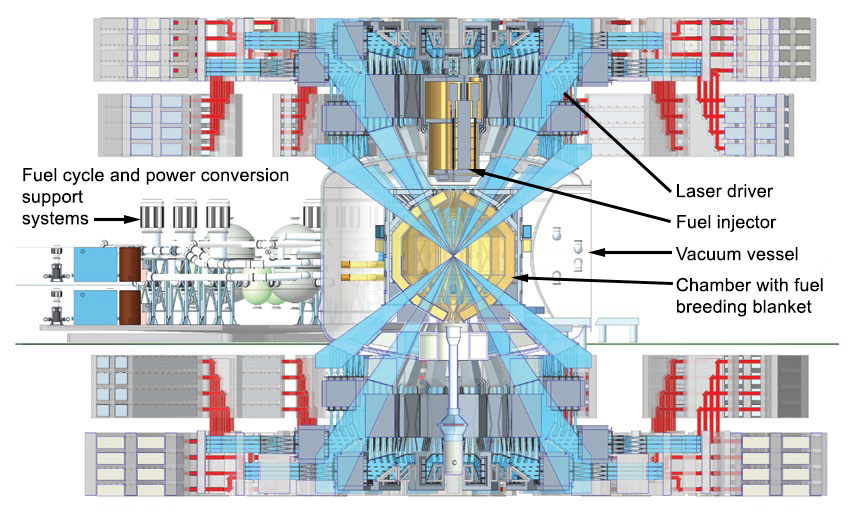
This artist’s rendering shows the concept for an inertial fusion energy (IFE) power plant design, with a cutaway to show the plant’s target chamber in the center. Livermore researchers are laying the groundwork for private fusion companies to build similar designs. (Illustration by Eric Smith.)

Designing for Viability

NIF is the only facility to date to demonstrate the ignition and burning plasma conditions that are prerequisites for IFE, but it is an experimental facility for stockpile stewardship research, not a power plant. To be commercially viable and produce the energy to offset costs and meet demands (baseload power), IFE plants will need to generate more than 30 times the energy they deliver to the fusion target on every shot while firing 10 or more shots per second, compared to NIF’s rate of one or two shots per day.

The Laser Inertial Fusion Energy (LIFE) study, conducted between 2008 and 2013, aimed to build directly on technology developed for NIF to achieve IFE and took a systematic approach to this requirement by developing the Integrated Process Model (IPM). (See S&TR, April/May 2009 [archived PDF], pp. 6-15.)

IPM is a technoeconomic model of an IFE power plant with detailed technical and cost breakdowns and interdependencies of key systems and subsystems. “The work done under LIFE was fantastic,” says Ma. “IPM lays out engineering and physics requirements for the entire system to test out different scenarios and see the impact. Now, we not only get to expand on all that but also leverage 15 years of new data from NIF, better codes, and high-performance computing (HPC), as well as new work in AI, ML, advanced manufacturing, diagnostics, and nonproliferation across the Laboratory.”

IPM describes an IFE power plant that requires a solid-state laser driver system to “pump” lasers with optical energy using laser diodes instead of flashlamps as at NIF. The plant will also need to fabricate and fill target capsules onsite and send them into its target chamber at a high enough frequency to produce baseload power. “We will have to repeatedly inject targets into the chamber, so the targets must be able to withstand and survive that process,” explains Ma. “Then, the lasers will track the moving targets, and when one gets to the center of the chamber, they would fire on the centered target, repeating 10 to 20 times per second.”

The facility would convert fusion energy into heat and then electricity via steam turbines, sending most of the electricity to the power grid and recycling the rest to power operations on subsequent shots. Neutrons from the reaction would produce tritium needed for the DT fuel by bombarding lithium isotopes in a “breeding blanket” material lining its target chamber. By closing both the power and fuel cycles, IFE plants are expected to be self-sustaining.

Thanks in part to IFE STARFIRE (IFE Science and Technology Accelerated Research for Fusion Innovation and Reactor Engineering), a Department of Energy (DOE)-funded multi-institutional IFE research and development hub, researchers across the Laboratory are working to meet the new system’s demands. IPM can help identify key challenges, test the viability of new designs, and direct future research. “Many technical models and cost models exist for IFE, but very few, if any, pair systems and cost models together at the same depth as IPM,” says Mackenzie Nelson, a technoeconomic systems analyst in the Computational Engineering Division. “This type of tool offers such an advantage because we can assess design choices from both a technical and economic standpoint and create blueprints for what an IFE plant could look like.”

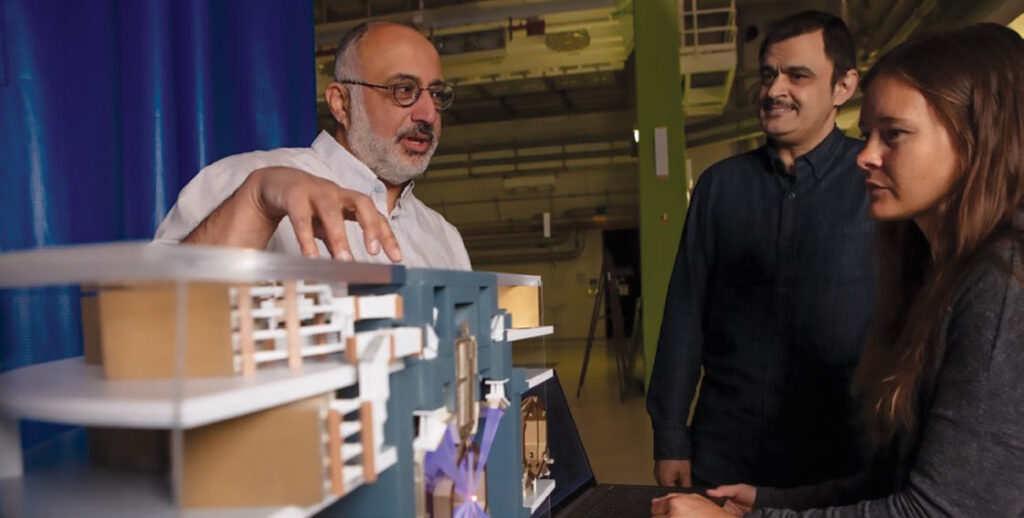
(left to right) Livermore researchers Bassem El Dasher, Claudio Santiago, and Mackenzie Nelson discuss a 3D model of a proposed IFE power plant design alongside the Integrated Process Model (IPM). IPM has more than 270 potential user inputs that researchers and collaborators can use to assess different IFE design choices to see the technical and cost impact on the entire design.

Operational Demands

NIF’s target capsules are extremely precise, fragile, and can take weeks to fabricate, fill, and position. Researchers are trying to reconcile that factor with the estimated demand of more than 800,000 capsules per day produced at less than $0.50 each to achieve IFE plant viability. To do this, they are examining optimal target designs for IFE and exploring advanced manufacturing methods such as microfluidics, volumetric additive manufacturing, and two-photon polymerization. (See S&TR, April/May 2025 [archived PDF], pp. 16-19.) Additional projects involve developing diagnostic instruments that can collect, analyze, and combine data with other diagnostics at the 10 to 20 shot per second frequency and use it to improve lasers in real time.

Fusion energy systems such as IFE are also a regulatory challenge, as they generate high-energy neutrons capable of breeding plutonium or uranium-233 and rely on large quantities of tritium. “Pure fusion energy systems do not require fissile material, but there are still ways to misuse these technologies that pose proliferation risk,” says Yana Feldman, the associate program leader for international safeguards. Bad actors may only need small amounts of tritium to make nuclear weapons, and some breeding blanket designs may inadvertently produce traces of plutonium that may be diverted for military purposes.

Nuclear fission reactors are regulated through international agreements and export control rules, and the independent International Atomic Energy Agency (IAEA) verifies that nuclear material and facilities are only being used for peaceful purposes. Neither treaties nor the IAEA address fusion energy, and no consensus has been reached on whether fusion energy systems need an international verification program. Verification methods for safeguarding tritium are also far less developed than for plutonium and uranium and focus more on contamination and transfers than analytical accounting for discrepancies. The precise scale of allowable tritium unaccounted for without posing proliferation risk is also unclear.

Fusion systems can be designed for proliferation resistance, but not having an existing design remains a challenge.

International security analyst Anne-Marie Riitsaar and her colleagues are exploring these complexities and starting conversations with international fusion experts and private industry to raise awareness. Riitsaar also plans to collaborate with the IPM team to map tritium diversion vulnerabilities and identify high-risk points where researchers could incorporate surveillance methods into plant designs to detect and prevent potential misuse. “People sometimes ask me why I’m thinking about fusion energy regulations and proliferation risks at this point, but it’s not too early,” says Riitsaar. “Reaching a multinational consensus on regulating sensitive technologies takes considerable time and effort.”

The National Ignition Facility is an experimental facility and not a power plant, so a commercial IFE plant design has vastly different requirements—many of which are being studied by Livermore researchers and their collaborators.

NIFViable IFE plant (estimated)
Repetition rateOne shot per day10 to 20 shots per second
Energy gain4.13 times (as of April 2025)30 times (minimum), 50 times to 100 times (ideal)
How lasers gain energyFlashlampsDiode pumping
Target fabrication and fuel fillingFabricated offsite over several weeks and filled manually in 1 to 5 daysMass-manufactured and filled in a target factory within the facility
Target deliveryPositioned manually within the Target ChamberShot into the plant’s target chamber approximately 10 to 20 times per second
Laser alignmentComputationally in real time, taking up to 8 hoursIn real time
Power cycleOpen, requiring outside energy sourcesClosed, applying reused energy to power laser and ancillary plant operations
Fuel cycle (tritium)Produced offsiteBred onsite

The Laser Driven Fusion Integration Research and Science Test Facility (LD-FIRST) is a proposed blueprint for a proof-of-concept IFE facility that will test all the key IFE subsystems in an integrated fashion. A public-private partnership will likely be necessary to build the facility and will help the IFE community address the main subset of risks and the technological challenges of building a commercial plant.

Converging on a Solution

The team seeks to make IPM as accurate and comprehensive as possible by meeting with subject matter experts across the Laboratory to incorporate the latest research. “We’re trying to evolve the model so it has the same level of high detail across every single functional area to tell us where we can focus research and help us find optimized solutions that we could propose to industry,” says Nelson.

Computer scientist Claudio Santiago and his colleagues also modernized IPM by porting its framework from Microsoft Excel to Python in December 2024, making it compatible with AI, ML, design optimization, and HPC to further inform designs. “Once we think about all the forcing functions such as minimum shot yield and materials requirements pinning us in from every direction, we end up with an optimized solution space. As we sharpen the pencil more with these tools, that optimized solution box gets smaller until eventually we’ve converged on a point design,” says IFE lead systems engineer Justin Galbraith. Galbraith and his team’s point design is called the Laser Driven Fusion Integration Research and Science Test Facility, or LD-FIRST, a proof-of-concept physics demonstration facility for IFE. “That point design, we anticipate, will serve as the foundation for a future public-private partnership that would facilitate building and realizing a physical facility to focus the IFE community in pursuit of fusion power on the grid,” says Galbraith.

Livermore is leading the charge in IFE, helping the United States develop a technological roadmap, growing and coordinating science and technology efforts within the Laboratory, and fostering partnerships across the fusion industry, academia, and government.

Ma chaired DOE’s “Basic Research Needs for IFE” workshop and report in 2022 and co-chairs the subcommittee providing recommendations on the nation’s fusion activities through DOE’s Fusion Energy Sciences Advisory Committee. She and her team travel often to Washington, D.C., working with DOE and legislators to expand fusion energy research and advocacy in the nation. Livermore also leads a “Collaboratory” with other DOE national laboratories to connect research project leads and facilitate public-private partnerships. The Collaboratory has hosted multiple events with industry, and the Laboratory has partnered with three private companies who aim to design pilot IFE plants.

Meanwhile, Galbraith and other IFE leaders have served as technical advisors for engineering design teams at Texas A&M University and given them IFE-relevant problems to solve, including advanced chamber and blanket design. Galbraith is working with Nelson to develop the IFE plant design portion of a high-energy-density science summer school program, which Nelson is leading in 2025 at the University of California at San Diego, and they have developed IFE curriculum that has been deployed at six universities starting in spring 2025. “We’re hoping we can get a group of students really excited about fusion and start to build up the next generation of engineers and scientists that will make fusion a reality,” says Galbraith. The team has led IFE strategic planning exercises at the Laboratory, and Lawrence Livermore will stand up a new fusion institute—named “LIFT,” for Livermore Institute for Fusion Technology—a research and development center that will coordinate and centralize institutional fusion energy research.

Harnessing IFE will be a massive undertaking, but Livermore’s broad and deep expertise, facilities, and capabilities put the Laboratory in a unique position to lead and play an impactful role. “If we can set it up correctly, IFE will be a big piece of the Laboratory’s long-term vision,” says Ma. “IFE plays off of our history and all of our strengths, and it is critical for long-term national security.”

Problems of Perspective, Michel Foucault

Michel Foucault was one of the leading French philosophers of the 20th century. Often considered a postmodernist, he did not believe there was a final perspective that human knowledge could achieve. This immediately contrasts with the outlook of leading physicists like Stephen Hawking. In his 1988 classic, A Brief History of Time, Hawking concludes the book by saying, once science has achieved a theory of everything, which is not far off, we will “know the mind of god.”

In his 1966 key work, The Order of Things: An Archaeology of the Human Sciences (French: Les Mots et les Choses: Une archéologie des sciences humaines), Foucault argued that the so-called order of things is invented, not discovered, by us. This is contrary to scientific thought.

Foucault sets up this limit in his surprising interpretation of the Diego Velázquez masterpiece painting, Las Meninas (Spanish: The Ladies-in-waiting). The painting is deliberately elusive in its use of perspective.

The great German thinker, Jürgen Habermas, explained this Foucault/Velázquez perspective difficulty:

This picture portrays the painter in front of a canvas not visible to the spectator; the painter is evidently looking, as are the two ladies-in-waiting next to him, in the direction of his two models, King Philip IV and his spouse. These two personages standing as models are found outside the frame of the picture; they can be identified by the spectator only with the help of a mirror pictured in the background. The point that Velázquez apparently had in mind is a confusing circumstance of which the spectator becomes aware by inference: The spectator cannot avoid assuming the place and the direction of the gaze of the counterfeit but absent royal pair — toward which the painter captured in the picture gazes — as well as the place and the perspective of Velázquez himself, which is to say, of the .painter who actually produced this picture. For Foucault, in turn, the real point lies in the fact that the classical picture frame is too limited to permit the representation of the act of representing as such — it is this that Velázquez makes clear by showing the gaps within the classical picture frame. left by the lack of reflection on the process of representing itself.29

29. Foucault constructs two different series of absences. On the one hand, the painter in the picture lacks his model, the royal couple standing outside the frame of the picture; the latter are in turn unable to see the picture of themselves that is being painted — they only see the canvas from behind; finally, the spec­tator is missing the center of the scene, that is, the couple standing as models, to which the gaze of the painter and of the courtesans merely directs us. Still more revealing than the absence of the objects being represented is, on the other hand, that of the subjects doing the representing, which is to say, the triple absence of the painter, the model, and the spectator who, located in front of the picture, takes in perspectives of the two others. The painter, Velázquez, actually enters into the picture, but he is not presented exactly in the act of painting — one sees him during a pause and realizes that he will disappear behind the canvas as soon as he takes up his labors again. The faces of the two models can actually be recognized unclearly in a mirror reflection, but they are not to be observed directly during the act of their portrayal. Finally, the act of the spectator is equally unrepresented — the spectator depicted entering into the picture from the right cannot take over this function. (See Foucault, The Order of Things, pp. 3-16, 307-311.)

Critique and Power: Recasting the Foucault/Habermas Debate, Michael Kelly, editor, MIT Press, 1994, pages 67, 77 [archived PDF].

Let us conclude by saying one way of specifying the disagreement between scientists and these thinkers is that sciences see themselves as “objective” while the thinkers feel science lacks objectivity because of the human observer. Kant, centuries ago, argued that concepts like causality, space and time are imposed by the human mind on the world. Similarly, Heisenberg, in Physics and Philosophy: The Revolution in Modern Science, similarly said that science does not finally answer questions about an objective reality, but can only answer questions posed by us.

Education and the Triple Helix underneath It

We want to restate the basic instinct and intuitions of this education or re-education project.

To get at the “schema” it will help you if you digress for a second and absorb this writeup of Professor Richard Lewontin’s (Harvard biology) 2002 masterpiece, The Triple Helix: Gene, Organism and Environment.

The blurb from Harvard University Press tells us:

“One of our most brilliant evolutionary biologists, Richard Lewontin has also been a leading critic of those—scientists and non-scientists alike—who would misuse the science to which he has contributed so much. In The Triple Helix, Lewontin the scientist and Lewontin the critic come together to provide a concise, accessible account of what his work has taught him about biology and about its relevance to human affairs. In the process, he exposes some of the common and troubling misconceptions that misdirect and stall our understanding of biology and evolution.

The central message of this book is that we will never fully understand living things if we continue to think of genes, organisms, and environments as separate entities, each with its distinct role to play in the history and operation of organic processes. Here Lewontin shows that an organism is a unique consequence of both genes and environment, of both internal and external features. Rejecting the notion that genes determine the organism, which then adapts to the environment, he explains that organisms, influenced in their development by their circumstances, in turn create, modify, and choose the environment in which they live.

The Triple Helix is vintage Lewontin: brilliant, eloquent, passionate and deeply critical. But it is neither a manifesto for a radical new methodology nor a brief for a new theory. It is instead a primer on the complexity of biological processes, a reminder to all of us that living things are never as simple as they may seem.”

Borrow from Lewontin the idea of a “triple helix” and apply it to the ultimate wide-angle view of this process of understanding. The educational triple helix includes and always tries to coordinate:

  1. The student and their life (i.e., every student is first of all a person who is playing the role of a student). Every person is born, lives, and dies.
  2. The student and their field are related to the rest of the campus. (William James: all knowledge is relational.)
  3. The student and the world. (Container ships from Kaohsiung, Taiwan are bringing Lenovo and Acer computers to Bakersfield, California in a world of techno-commerce, exchange rates, insurance, customs, contractual arrangements, etc. In other words, always with some sense of the global political economy.)

The student keeps the triple helix “running” in the back of the mind and tries to create a “notebook of composite sketches” of the world and its workings and oneself and this develops through a life as a kind of portable “homemade” university which stays alive and current and vibrant long after one has forgotten the mean value theorem and the names and sequence for the six wives of Henry VIII).

The reader should think of Emerson’s point from his Journals of Ralph Waldo Emerson: 1824–1832—“The things taught in schools and colleges are not an education, but the means to an education.”

Science-Watching: Why Do Batteries Sometimes Catch Fire and Explode?

[from Berkeley Lab News, by Theresa Duque]

Key Takeaways
  • Scientists have gained new insight into why thermal runaway, while rare, could cause a resting battery to overheat and catch fire.
  • In order to better understand how a resting battery might undergo thermal runaway after fast charging, scientists are using a technique called “operando X-ray microtomography” to measure changes in the state of charge at the particle level inside a lithium-ion battery after it’s been charged.
  • Their work shows for the first time that it is possible to directly measure current inside a resting battery even when the external current measurement is zero.
  • Much more work is needed before the findings can be used to develop improved safety protocols.

How likely would an electric vehicle battery self-combust and explode? The chances of that happening are actually pretty slim: Some analysts say that gasoline vehicles are nearly 30 times more likely to catch fire than electric vehicles. But recent news of EVs catching fire while parked have left many consumers – and researchers – scratching their heads over how these rare events could possibly happen.

Researchers have long known that high electric currents can lead to “thermal runaway” – a chain reaction that can cause a battery to overheat, catch fire, and explode. But without a reliable method to measure currents inside a resting battery, it has not been clear why some batteries go into thermal runaway, even when an EV is parked.

Now, by using an imaging technique called “operando X-ray microtomography,” scientists at Lawrence Berkeley National Laboratory (Berkeley Lab) and UC Berkeley have shown that the presence of large local currents inside batteries at rest after fast charging could be one of the causes behind thermal runaway. Their findings were reported in the journal ACS Nano.

“We are the first to capture real-time 3D images that measure changes in the state of charge at the particle level inside a lithium-ion battery after it’s been charged,” said Nitash P. Balsara, the senior author on the study. Balsara is a faculty senior scientist in Berkeley Lab’s Materials Sciences Division and a UC Berkeley professor of chemical and biomolecular engineering.

“What’s exciting about this work is that Nitash Balsara’s group isn’t just looking at images – They’re using the images to determine how batteries work and change in a time-dependent way. This study is a culmination of many years of work,” said co-author Dilworth Y. Parkinson, staff scientist and deputy for photon science operations at Berkeley Lab’s Advanced Light Source (ALS).

The team is also the first to measure ionic currents at the particle level inside the battery electrode.

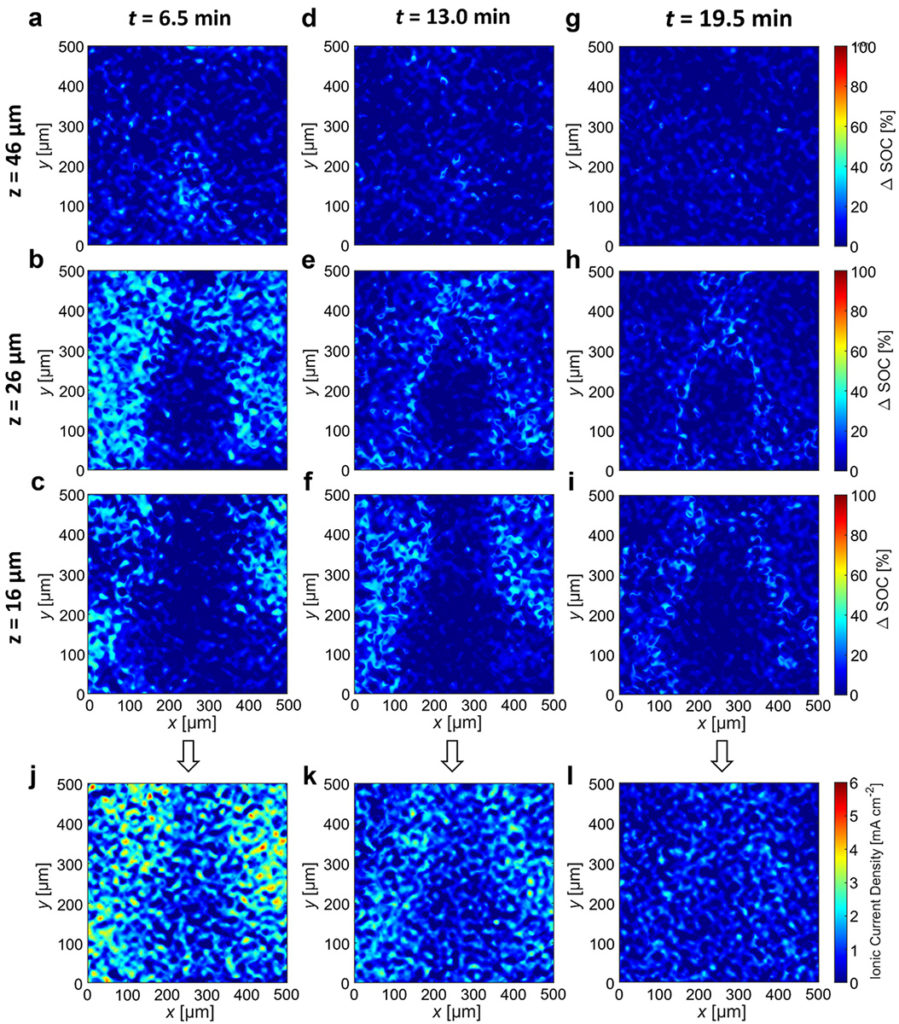
3D microtomography experiments at the Advanced Light Source enabled researchers to pinpoint which particles generated current densities as high as 25 milliamps per centimeter squared inside a resting battery after fast charging. In comparison, the current density required to charge the test battery in 10 minutes was 18 milliamps per centimeter squared. (Credit: Nitash Balsara and Alec S. Ho/Berkeley Lab. Courtesy of ACS Nano)
Measuring a battery’s internal currents

In a lithium-ion battery, the anode component of the electrode is mostly made of graphite. When a healthy battery is charged slowly, lithium ions weave themselves between the layers of graphite sheets in the electrode. In contrast, when the battery is charged rapidly, the lithium ions have a tendency to deposit on the surface of the graphite particles in the form of lithium metal.

“What happens after fast charging when the battery is at rest is a little mysterious,” Balsara said. But the method used for the new study revealed important clues.

Experiments led by first author Alec S. Ho at the ALS show that when graphite is “fully lithiated” or fully charged, it expands a tiny bit, about a 10% change in volume – and that current in the battery at the particle level could be determined by tracking the local lithiation in the electrode. (Ho recently completed his Ph.D. in the Balsara group at UC Berkeley.)

A conventional voltmeter would tell you that when a battery is turned off, and disconnected from both the charging station and the electric motor, the overall current in the battery is zero.

But in the new study, the research team found that after charging the battery in 10 minutes, the local currents in a battery at rest (or currents inside the battery at the particle level) were surprisingly large. Parkinson’s 3D microtomography instrument at the ALS enabled the researchers to pinpoint which particles inside the battery were the “outliers” generating alarming current densities as high as 25 milliamps per centimeter squared. In comparison, the current density required to charge the battery in 10 minutes was 18 milliamps per centimeter squared.

The researchers also learned that the measured internal currents decreased substantially in about 20 minutes. Much more work is needed before their approach can be used to develop improved safety protocols.

Researchers from Argonne National Laboratory also contributed to the work.

The Advanced Light Source is a DOE Office of Science user facility at Berkeley Lab.

The work was supported by the Department of Energy’s Office of Science and Office of Energy Efficiency and Renewable Energy. Additional funding was provided by the National Science Foundation.

The Levinas Facial Theme in Novels

[a continuation of Education and Spontaneous Learning]

The Face of Another (Japanese: 他人の顔, HepburnTanin no kao) is a 1964 novel written by the Japanese novelist Kōbō Abe. Like other stories written by this author, the novel explores the alienation of modern man from urban society.[1] It is written in the first person narrative mode, and is divided into a prologue, three “notebooks” (black, gray, and white), and a concluding letter from the protagonist’s wife.[2] In 1966, it was adapted into a film directed by Hiroshi Teshigahara.[3]

An industrial accident has severely burned the face of an unnamed plastics scientist. His wife is repulsed by his disfigurement and refuses to have sexual contact with him. To regain the affection of his wife, he attempts to create a prosthetic mask in a rented apartment. With this new “face,” the protagonist sees the world in a new way and begins a clandestine affair with his estranged wife. Although the mask gives the man newfound freedom, at the end of the story, it becomes difficult to determine if the mask has taken ownership of the man or the man has taken ownership of the face.[1][2][4]

There is also a subplot following a hibakusha woman who has suffered burns to the right side of her face. In the novel, the protagonist sees this character in a film; in the film version, this is deliberately obscured.

References
  1. Hoover, William (2019). Historical Dictionary of Postwar Japan, 2nd edition. Lanham, MD: Rowman & Littlefield. p. 11. ISBN 9781538111550.
  2. Abe, Kobo (1980). The face of another. Internet Archive. New York: Perigee Books. ISBN 978-0-399-50484-6.
  3. Teshigahara, Hiroshi (1967-06-09), Tanin no kao (Drama, Horror, Sci-Fi), Teshigahara Productions, Tokyo Eiga Co. Ltd.
  4. Rush, Zachariah (2014). Beyond the Screenplay: A Dialectical Approach to Dramaturgy. Jefferson, NC: McFarland. p. 59. ISBN 9780786466030
See Also

La Belle Image by Marcel Aymé, a novel with a similar premise.

Education and Finality Claims

Stephen Hawking kept saying he wanted to discover the ultimate world-equation. This would be the final “triumph of the rational human mind.”

This would presumably imply that if one had such a world-equation, one could infer or deduce all the formalisms in a university physics book with its thousand pages of equations, puzzles and conundrums, footnotes and names and dates.

While hypothetically imaginable, this seems very unlikely because too many phenomena are included, too many topics, too many rules and laws.

There’s another deep problem with such Hawking-type “final equation” quests. Think of the fact that a Henri Poincaré (died in 1912) suddenly appears and writes hundreds of excellent science papers. Think of Paul Erdős (died in 1996) and his hundreds of number theory papers. Since the appearance of such geniuses and powerhouses is not knowable in advance, the production of new knowledge is unpredictable and would “overwhelm” any move towards some world-equation which was formulated without the new knowledge since it was not known at the time that the world-equation was formalized.

Furthermore, if the universe is mathematical as MIT’s Professor Max Tegmark claims, then a Hawking-type “world-equation” would cover all mathematics without which parts of Tegmark’s universe would be “unaccounted for.”

In other words, history and the historical experience, cast doubt on the Stephen Hawking “finality” project. It’s not just that parts of physics don’t fit together. (General relativity and quantum mechanics, gravity and the other three fundamental forces.) Finality would also imply that there would be no new Stephen Hawking who would refute the world-equation as it stands at a certain point in time. In other words, if you choose, as scientists like Freeman Dyson claim that the universe is a “vast evolutionary” process, then the mathematical thinking about it is also evolving or co-evolving and there’s no end.

There are no final works in poetry, novels, jokes, language, movies or songs and there’s perhaps also no end to science.

Thus a Hawking-type quest for the final world-equation seems enchanting but quixotic.

Meaningfulness versus Informativeness

The Decoding Reality book is a classic contemporary analysis of the foundations of physics and the implications for the human world. The scientists don’t see that physics and science are the infrastructure on which the human “quest for meaning” takes place. Ortega (Ortega y Gasset, died in 1955) tells us that a person is “a point of view directed at the universe.” This level of meaning cannot be reduced to bits or qubits or electrons since man is a “linguistic creature” who invents fictional stories to explain “things” that are not things.

The following dialog between Paul Davies (the outstanding science writer) and Vlatko Vedral (the distinguished physicist) gropes along on these issues: the difference between science as one kind of story and the human interpretation of life and self expressed in “tales” and parables, fictions and beliefs:

Davies: “When humans communicate, a certain quantity of information passes between them. But that information differs from the bits (or qubits) physicists normally consider, inasmuch as it possesses meaning. We may be able to quantify the information exchanged, but meaning is a qualitative property—a value—and therefore hard, maybe impossible, to capture mathematically. Nevertheless the concept of meaning obviously has, well… meaning. Will we ever have a credible physical theory of ‘meaningful information,’ or is ‘meaning’ simply outside the scope of physical science?”

Vedral: “This is a really difficult one. The success of Shannon’s formulation of ‘information’ lies precisely in the fact that he stripped it of all “meaning” and reduced it only to the notion of probability. Once we are able to estimate the probability for something to occur, we can immediately talk about its information content. But this sole dependence on probability could also be thought of as the main limitation of Shannon’s information theory (as you imply in your question). One could, for instance, argue that the DNA has the same information content inside as well as outside of a biological cell. However, it is really only when it has access to the cell’s machinery that it starts to serve its main biological purpose (i.e., it starts to make sense). Expressing this in your own words, the DNA has a meaning only within the context of a biological cell. The meaning of meaning is therefore obviously important. Though there has been some work on the theory of meaning, I have not really seen anything convincing yet. Intuitively we need some kind of a ‘relative information’ concept, information that is not only dependent on the probability, but also on its context, but I am afraid that we still do not have this.”

For a physicist, all the world is information. The universe and its workings are the ebb and flow of information. We are all transient patterns of information, passing on the recipe for our basic forms to future generations using a four-letter digital code called DNA.

See Decoding Reality.

In this engaging and mind-stretching account, Vlatko Vedral considers some of the deepest questions about the universe and considers the implications of interpreting it in terms of information. He explains the nature of information, the idea of entropy, and the roots of this thinking in thermodynamics. He describes the bizarre effects of quantum behavior—effects such as “entanglement,” which Einstein called “spooky action at a distance” and explores cutting edge work on the harnessing quantum effects in hyper-fast quantum computers, and how recent evidence suggests that the weirdness of the quantum world, once thought limited to the tiniest scales, may reach into the macro world.

Vedral finishes by considering the answer to the ultimate question: Where did all of the information in the universe come from? The answers he considers are exhilarating, drawing upon the work of distinguished physicist John Wheeler. The ideas challenge our concept of the nature of particles, of time, of determinism, and of reality itself.

Science is an “ontic” quest. Human life is an “ontological” quest. They are a “twisted pair” where each strand must be seen clearly and not confused. The content of your telephone conversation with your friend, say. is not reducible to the workings of a phone or the subtle electrical engineering and physics involved. A musical symphony is not just “an acoustical blast.”

The “meaning of meaning” is evocative and not logically expressible. There’s a “spooky action at a distance” between these levels of meaning versus information but they are different “realms” or “domains.”

Education and Intuition

The 2014 PBS TV series, How We Got to Now is a good miniseries on improvements in glass-making, sewage, water management, etc. that serve as the material/organizational basis for this modern world.

At one point in the series, the host Steven Johnson, a kind of historian of innovation, reveals his idea of how innovation occurs and he focuses on mavericks whose breakthrough is not a sudden “Eureka!” moment, but rather what Johnson calls “a slow hunch.” In other words, the innovators struggle along with a partially understood sense of possibility, very inchoate in the beginning, that comes into better focus with the passage of years and decades, via missteps and boondoggles.

The science writer Arthur Koestler shines a different “flashlight” on this problem of intuitive creativity and its bearing fruit:

Arthur Koestler, CBE (UK: 5 September 1905 – 1 March 1983) was a Hungarian British author and journalist. Koestler was born in Budapest. His masterful book, The Sleepwalkers, is a kind of defense of the way people in the past benefited from a productive sleepwalking on their journeys to scientific advance.

The Sleepwalkers: A History of Man’s Changing Vision of the Universe is a 1959 book by Arthur Koestler. It traces the history of Western cosmology from ancient Mesopotamia to Isaac Newton. He suggests that discoveries in science arise through a process akin to sleepwalking. Not that they arise by chance, but rather that scientists are neither fully aware of what guides their research, nor are they fully aware of the implications of what they discover.

A central theme of the book is the changing relationship between faith and reason. Koestler explores how these seemingly contradictory threads existed harmoniously in many of the greatest intellectuals of the West. He illustrates that while the two are estranged today, in the past the most ground-breaking thinkers were often very spiritual.

Another recurrent theme of this book is the breaking of paradigms in order to create new ones. People—scientists included—hold on to cherished old beliefs with such love and attachment that they refuse to see the wrong in their ideas and the truth in the ideas that are to replace them.

The conclusion he puts forward at the end of the book is that modern science is trying too hard to be rational. Scientists have been at their best when they allowed themselves to behave as “sleepwalkers,” instead of trying too earnestly to ratiocinate.

Add to this overview the “creativity” discussion on The Charlie Rose Show in The Brain Series (2010), where Professor Eric Kandel, the Nobel-prize physiologist, states forthrightly that brain research has no idea about creativity and the prospect of explaining creativity in terms of the brain is very distant indeed.

The arrival of a “slow hunch” (Steven Johnson) and “productive sleepwalking,” as opposed to unproductive kinds of woolgathering (Arthur Koestler), are mind, personality and spirit issues, although they do have brain-chemical “correlations” that cannot be explained mechanistically.

Mysteries all have physical/chemical “correlations” but cannot be simplistically reduced to biochem or genomics.