The year 1900 was a wonderful one, when men were proud to be middle-class, and to be Europeans. The fate of the whole world was decided around green baize-covered tables in London, Paris or Berlin. Rubber trees from the Amazons were shipped to Malaya, the vast coal seams of the Upper Hwang-Ho were being exploited at the expense of the wretched labourers, and in the north of the Upper Vaal a mining city sprang up in a few short weeks. Mobilized by steam, the planet’s riches were being shifted ‘from one side of the world to the other’, to quote Le Bateau Ivre, on orders flashed by telegraph in two or three minutes. Decisions reached by boards of directors in London, Paris or Berlin affected the lives of millions of human beings who did not suspect that their right to happiness depended on quotations scribbled on blackboards in three noisy exchanges built like temples, in which raged the battles of unbridled financial ambition. Not a single detail escaped the notice of Europe’s financial capitals: they fixed the price of a tram ticket in Rio de Janeiro, and the working hours of a coolie in Hong Kong. So much power had never before been concentrated in so few hands within so small an area of the globe. It was the age of triumph of the Europeanmiddle classes.
In an era moving towards electronicpayment systems and replacing physical currency, it can be educational to look back at checks and how we arrived here. As Winston Churchill observed, “The longer you can look back, the farther you can look forward.”
…In the ten years following 1850, the world production of gold was ten times greater than in the ten preceding years. As is well known, the French had always preferred metal currency, and welcomed the gold with a special enthusiasm; the state struck an impressive quantity of coins, striking five hundred million in 1845, for the world’s gold found its way more readily to France where it fetched the highest price. The circulation of gold increased in other European countries also, and the banks of issue, in particular, filed their vaults. In this gold rush the English were more cautious after their long acquaintance with problems of values, and the upheaval in the gold market brought hardly any changes in the prices of the metal there. It is true England also minted new coins, but took advantage of it chiefly to establish her banking system more firmly. The influx of gold, which was exclusively Australian, had at first little effect on the prices of goods, but it developed credit with a paper currency. The minting of this money increased England’s metallic circulation by almost fifty percent, but the use of the banknote and especially of the cheque increased by a far higher proportion. The use of the cheque became so widespread in England that shopkeepers and farmers adopted it as the only possible way of doing business although it was almost unknown on the continent. Cheques were often used for amounts of less than two pounds. Even if he had an income of only fifty pounds a year, the Englishman immediately opened a bank account. In 1885, payments in metal currency represented only one per cent of the LondonBankpayments and six per cent of those in Manchester.
The Act of 1826 granted complete freedom of issue, except in an area of twenty-six miles around London, where the privilege of the Bank was absolute. There was a good deal of argument about the exact meaning of this privilege; for example the question arose as to whether provincial banks could open an office in London, the main centre of business, without losing their rights of issue.
When it was ruled that they could not, many banks nevertheless settled in London and forfeited their privilege of printing. Only the Scottishbanks put up a firmer resistance to this extension of the privileges of the Bank of England. On the other hand, the right of issue was losing much of its significance, since the remarkable development of payment by cheque meant that there was less resort to the note. Settlements between the great depositbanks were made neither in metal nor in notes, but were transacted in the accounts of a clearing house, which dealt with transactions amounting to several hundreds of thousands of pounds every year.
Not all these new banks were as prudent as their English counterparts by any means and this point is worth dwelling on. After 1848 the Banque de France had the monopoly of issuing notes for the whole of France, because the local issuing banks created by Napoleon I and Louis-Philippe had been absorbed by the Banque de France, whose notes were the only ones in circulation. It was the state which had made this decision and had settled the problem of monetary unity by authoritarian measures. A few bankers, under the Second Empire, protested against the right of monopoly exercised by the Banque de France, which had been imposed on the whole of the country by the state. Very little use was made of payment by cheque, and compensation was meagre. The wide circulation of metal currency was a sign of a restricted paper currency, but this meant that credit was scarce and was based entirely on the Banque de France. The latter, taking no risks, consequently piled up in its coffers considerable reserves of precious metals, proud of the fact that it could now maintain a steady discount rate more easily than England. It also gained great satisfaction from being the gold-controller of Europe. Whenever a sudden drastic rise in the Englishbank rate sent businessmen, and even the Bank of England itself, as we have seen, hastening to Paris in search of precious metals, it was to the Banque de France that they turned. Although it was attacked by those who accused it of stifling credit, on the other hand it was defended by those who found its caution reassuring. It was a difference of opinion which further enlivened the quarrel between the Pereires and the Rothschilds.
As we know, Jewishbankers played a vital part in the building of the railways. Pereire, a railway enthusiast, and Rothschild, the largest holder of free capital in France, had at first been prepared to undertake the great task in complete agreement. Rothschild, content with holding the Nord and the English connections, was one of the directors whose word carried most weight in the Banque de France, while the Pereire brothers, their heads still full of Saint-Simonist projects, were interested in vast plans covering Austria, Spain and the Mediterranean. They financed the great development of the economy of the south although even so they were obliged to open a credit institution, the well-known Crédit Mobilier. But because they could not use it for the issue of paper notes, and had tied up the funds entrusted to them too quickly, the Pereires embarked on a struggle to deprive the Bank of its privilege of issue. They believed that the mere right of mintingmoney would enable them to possess the wide credit necessary for the bold financial policy on which they were launching out. It so happened that when Savoy was annexed to France, the Banque de Chambéry brought its banknotes and its privileges within French frontiers. The Pereires and their friends seized the shares of this bank and tried to turn its notes into rivals of those of the central bank. The Banque de France then asserted its rights, Chambéry lost its rights of issue, and soon afterwards the Crédit Mobilier went into liquidation.
This incident occasioned a great quarrel between theorists for or against privilege; it was above all a demonstration of the solidity of the rights the Bank had acquired, while no-one doubted the right of the state to confirm its privileges any longer. This situation was all the more paradoxical since the state was in the hands of Napoleon III who was a firm supporter of the Pereires and the Crédit Mobilier. The underlying cause of this paradox lay in Frenchscepticism about cheques, for the development of bank money lagged more than half a century behind England. It was to be chiefly the work of Henri Germain, founder of the Crédit Lyonnais. His patron of 1863 was mainly anxious to attract large deposits by guaranteeing them against theft and fire so that he insisted on the effective help the Bank could give industrialists and merchants by insuring their cash service itself. By making wise use of these deposits and by a cautious policy, the Crédit Lyonnais was able to open branches in Paris and Marseilles, so that it was soon as powerful as the Crédit Industriel et Commercial and then outstripped it. It even surpassed the Comptoir d’Escompte, and soon the Crédit Lyonnais became the leading Frenchdepositbank. From 1860 it was the major bank to introduce cheques.
But there is little reason for surprise in the difficulties encountered by the cheque between 1860 and 1870.
The Banque de France was regarded as the most reliable of all issuing authorities, and Frenchspeciereserves as the most powerful stock of gold in the world; between notes and gold as the two methods of payment, there was very little room for the cheque. It is difficult to believe that France’s reserves could not have kept the depositbanks generously supplied, perhaps as much as, and even more than, the Englishreserves. But it kept a good part of its cash-balance in gold, which held up the full development of Frenchcredit institutions until the closing years of the nineteenth century.
In England there was security and in France hesitation, but in Germany there was an irresistible wave of enthusiasm which led to the rapid growth of credit institutions from 1840. There were a great many note-issuing banks in the Germany of the confederation, because each prince had his own currency. Hamburg had one of the soundest banks of issue, whose marc banco was esteemed throughout Europe and served as a standard for the whole of Germany. Nuremberg still had its old seventeenth-century bank and its florin, while a large number of private establishments were also manufacturing notes with a restricted circulation. In this scheme of things the Bank of Prussia held a pre-eminent position which was strengthened by the place Prussia had assumed in the Zollverein, but it still could not contest the superiority of Hamburg. In short, the legal position of the Germanbanks was similar to that of the English, in that there was plurality of issue.
Bankmoney, and banknotes, increased in competition with each other, and the future of the four great and famous banks which were to dominate the destiny of capitalistGermany after 1880 had already begun to take shape.
Notice that in the discussion above, events are never monocausal. They are always part of a swirling tornado of change. If you become accustomed to this, the way the world works and the way the world changes will become more accessible to you.
For example, “The use of the cheque became so widespread in England that shopkeepers and farmers adopted it as the only possible way of doing business although it was almost unknown on the continent. Cheques were often used for amounts of less than two pounds.”
Although significant work remains to harness fusion energy, pursuing the development and deployment of IFE is crucial for the nation’s energy security, enabling the United States to shape implementation worldwide, avoid technological surprises from adversaries, and influence technical leadership in other energy-intensive technologies such as AI, machine learning (ML), and supercomputing.
IFE research stretches back to the early days of Lawrence Livermore, and today the Laboratory is fostering the overall fusion ecosystem. Livermore’s unique capabilities, expertise, and connections will be critical to laying the technical, logistical, and legal groundwork to make IFE possible. “IFE is a grand scientific and engineering challenge, something that is so incredibly difficult and high-risk and takes enormous expertise,” says Tammy Ma, Livermore’s IFE Institutional Initiative lead. “This challenge makes it the right kind of problem for national laboratories to pursue.”
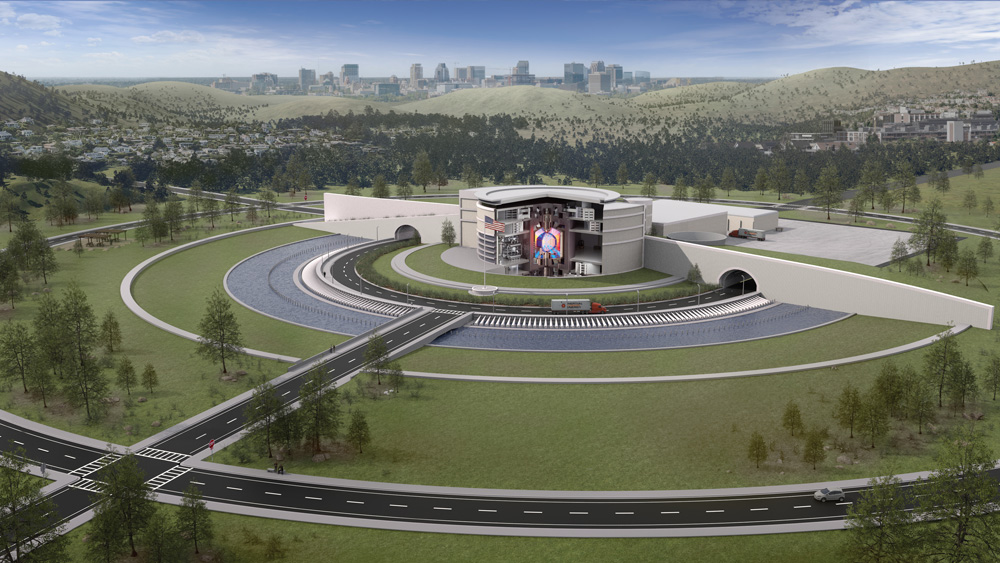
This artist’s rendering shows the concept for an inertial fusion energy (IFE) power plant design, with a cutaway to show the plant’s target chamber in the center. Livermore researchers are laying the groundwork for private fusion companies to build similar designs. (Illustration by Eric Smith.)
Designing for Viability
NIF is the only facility to date to demonstrate the ignition and burning plasma conditions that are prerequisites for IFE, but it is an experimental facility for stockpile stewardship research, not a power plant. To be commercially viable and produce the energy to offset costs and meet demands (baseload power), IFE plants will need to generate more than 30 times the energy they deliver to the fusion target on every shot while firing 10 or more shots per second, compared to NIF’s rate of one or two shots per day.
The Laser Inertial Fusion Energy (LIFE) study, conducted between 2008 and 2013, aimed to build directly on technology developed for NIF to achieve IFE and took a systematic approach to this requirement by developing the Integrated Process Model (IPM). (See S&TR, April/May 2009 [archived PDF], pp. 6-15.)
IPM is a technoeconomic model of an IFE power plant with detailed technical and cost breakdowns and interdependencies of key systems and subsystems. “The work done under LIFE was fantastic,” says Ma. “IPM lays out engineering and physics requirements for the entire system to test out different scenarios and see the impact. Now, we not only get to expand on all that but also leverage 15 years of new data from NIF, better codes, and high-performance computing (HPC), as well as new work in AI, ML, advanced manufacturing, diagnostics, and nonproliferation across the Laboratory.”
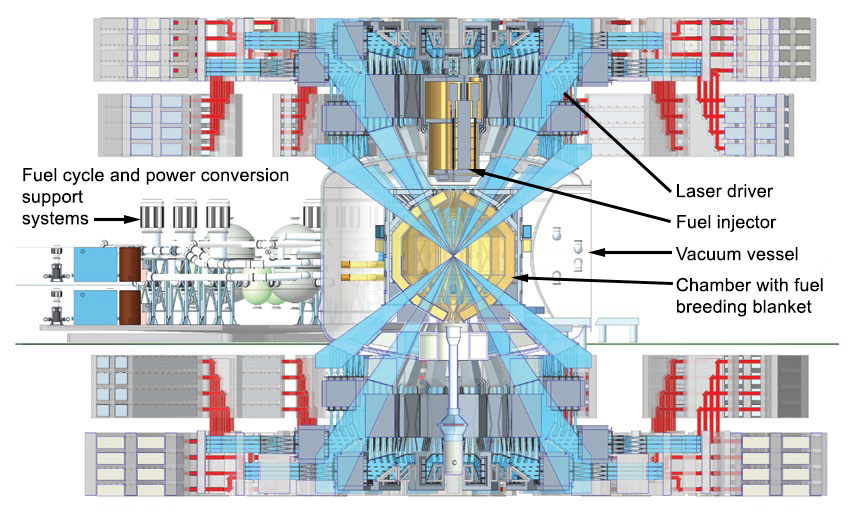
IPM describes an IFE power plant that requires a solid-state laser driver system to “pump” lasers with optical energy using laser diodes instead of flashlamps as at NIF. The plant will also need to fabricate and fill target capsules onsite and send them into its target chamber at a high enough frequency to produce baseload power. “We will have to repeatedly inject targets into the chamber, so the targets must be able to withstand and survive that process,” explains Ma. “Then, the lasers will track the moving targets, and when one gets to the center of the chamber, they would fire on the centered target, repeating 10 to 20 times per second.”
The facility would convert fusion energy into heat and then electricity via steam turbines, sending most of the electricity to the power grid and recycling the rest to power operations on subsequent shots. Neutrons from the reaction would produce tritium needed for the DT fuel by bombarding lithium isotopes in a “breeding blanket” material lining its target chamber. By closing both the power and fuel cycles, IFE plants are expected to be self-sustaining.
Thanks in part to IFE STARFIRE (IFE Science and Technology Accelerated Research for Fusion Innovation and Reactor Engineering), a Department of Energy (DOE)-funded multi-institutional IFE research and development hub, researchers across the Laboratory are working to meet the new system’s demands. IPM can help identify key challenges, test the viability of new designs, and direct future research. “Many technical models and cost models exist for IFE, but very few, if any, pair systems and cost models together at the same depth as IPM,” says Mackenzie Nelson, a technoeconomic systems analyst in the Computational Engineering Division. “This type of tool offers such an advantage because we can assess design choices from both a technical and economic standpoint and create blueprints for what an IFE plant could look like.”
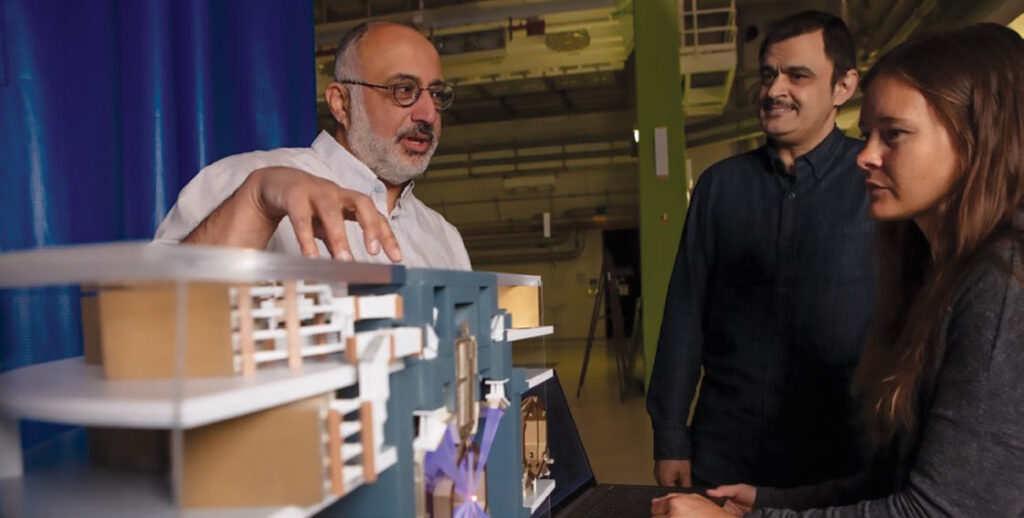
(left to right) Livermore researchers Bassem El Dasher, Claudio Santiago, and Mackenzie Nelson discuss a 3D model of a proposed IFE power plant design alongside the Integrated Process Model (IPM). IPM has more than 270 potential user inputs that researchers and collaborators can use to assess different IFE design choices to see the technical and cost impact on the entire design.
Operational Demands
NIF’s target capsules are extremely precise, fragile, and can take weeks to fabricate, fill, and position. Researchers are trying to reconcile that factor with the estimated demand of more than 800,000 capsules per day produced at less than $0.50 each to achieve IFE plant viability. To do this, they are examining optimal target designs for IFE and exploring advanced manufacturing methods such as microfluidics, volumetric additive manufacturing, and two-photon polymerization. (See S&TR, April/May 2025 [archived PDF], pp. 16-19.) Additional projects involve developing diagnostic instruments that can collect, analyze, and combine data with other diagnostics at the 10 to 20 shot per second frequency and use it to improve lasers in real time.
Nuclear fissionreactors are regulated through international agreements and export control rules, and the independent International Atomic Energy Agency (IAEA) verifies that nuclear material and facilities are only being used for peaceful purposes. Neither treaties nor the IAEA address fusion energy, and no consensus has been reached on whether fusion energy systems need an international verification program. Verification methods for safeguarding tritium are also far less developed than for plutonium and uranium and focus more on contamination and transfers than analytical accounting for discrepancies. The precise scale of allowable tritium unaccounted for without posing proliferation risk is also unclear.
Fusion systems can be designed for proliferation resistance, but not having an existing design remains a challenge.
International security analyst Anne-Marie Riitsaar and her colleagues are exploring these complexities and starting conversations with international fusion experts and private industry to raise awareness. Riitsaar also plans to collaborate with the IPM team to map tritium diversion vulnerabilities and identify high-risk points where researchers could incorporate surveillance methods into plant designs to detect and prevent potential misuse. “People sometimes ask me why I’m thinking about fusion energyregulations and proliferation risks at this point, but it’s not too early,” says Riitsaar. “Reaching a multinational consensus on regulating sensitive technologies takes considerable time and effort.”
The National Ignition Facility is an experimental facility and not a power plant, so a commercial IFE plant design has vastly different requirements—many of which are being studied by Livermore researchers and their collaborators.
The Laser Driven Fusion Integration Research and Science Test Facility (LD-FIRST) is a proposed blueprint for a proof-of-concept IFE facility that will test all the key IFE subsystems in an integrated fashion. A public-private partnership will likely be necessary to build the facility and will help the IFE community address the main subset of risks and the technological challenges of building a commercial plant.
Converging on a Solution
The team seeks to make IPM as accurate and comprehensive as possible by meeting with subject matter experts across the Laboratory to incorporate the latest research. “We’re trying to evolve the model so it has the same level of high detail across every single functional area to tell us where we can focus research and help us find optimized solutions that we could propose to industry,” says Nelson.
Computer scientist Claudio Santiago and his colleagues also modernized IPM by porting its framework from Microsoft Excel to Python in December 2024, making it compatible with AI, ML, design optimization, and HPC to further inform designs. “Once we think about all the forcing functions such as minimum shot yield and materials requirements pinning us in from every direction, we end up with an optimized solution space. As we sharpen the pencil more with these tools, that optimized solution box gets smaller until eventually we’ve converged on a point design,” says IFE lead systems engineer Justin Galbraith. Galbraith and his team’s point design is called the Laser Driven Fusion Integration Research and Science Test Facility, or LD-FIRST, a proof-of-concept physics demonstration facility for IFE. “That point design, we anticipate, will serve as the foundation for a future public-private partnership that would facilitate building and realizing a physical facility to focus the IFE community in pursuit of fusion power on the grid,” says Galbraith.
Ma chaired DOE’s “Basic Research Needs for IFE” workshop and report in 2022 and co-chairs the subcommittee providing recommendations on the nation’s fusion activities through DOE’s Fusion Energy Sciences Advisory Committee. She and her team travel often to Washington, D.C., working with DOE and legislators to expand fusion energyresearch and advocacy in the nation. Livermore also leads a “Collaboratory” with other DOEnational laboratories to connect research project leads and facilitate public-private partnerships. The Collaboratory has hosted multiple events with industry, and the Laboratory has partnered with three private companies who aim to design pilot IFE plants.
Meanwhile, Galbraith and other IFE leaders have served as technical advisors for engineering design teams at Texas A&M University and given them IFE-relevant problems to solve, including advanced chamber and blanket design. Galbraith is working with Nelson to develop the IFE plant design portion of a high-energy-density science summer school program, which Nelson is leading in 2025 at the University of California at San Diego, and they have developed IFE curriculum that has been deployed at six universities starting in spring 2025. “We’re hoping we can get a group of students really excited about fusion and start to build up the next generation of engineers and scientists that will make fusion a reality,” says Galbraith. The team has led IFE strategic planning exercises at the Laboratory, and Lawrence Livermore will stand up a new fusion institute—named “LIFT,” for Livermore Institute for Fusion Technology—a research and development center that will coordinate and centralize institutional fusion energyresearch.
Harnessing IFE will be a massive undertaking, but Livermore’s broad and deep expertise, facilities, and capabilities put the Laboratory in a unique position to lead and play an impactful role. “If we can set it up correctly, IFE will be a big piece of the Laboratory’s long-term vision,” says Ma. “IFE plays off of our history and all of our strengths, and it is critical for long-term national security.”