Science-Watching: From Ignition to Energy

[from Science & Technology Review July/August 2025 Research Highlights, by Noah Pflueger-Peters]

Achieving ignition at the National Ignition Facility (NIF) proved that harnessing the power of the Sun in a laboratory may be possible. The Sun’s extreme temperatures and pressures cause light elements to fuse together to create heavier ones, releasing enormous energy and sustaining conditions for more thermonuclear reactions. NIF replicates these conditions with inertial confinement fusion, in which lasers compress and heat a target capsule filled with deuterium and tritium (DT), “heavy” isotopes of hydrogen that contain extra neutrons. When the isotopes fuse, they create helium and a neutron, and the lost mass is converted into inertial fusion energy (IFE), which can be harnessed for energy production.

Nuclear fusion produces significantly more energy than either nuclear fission or burning fossil fuels for equivalent amounts of fuel. Since the input materials for fusion energy are plentiful on Earth, an IFE power plant could produce safe, abundant, power grid-compatible energy without highly radioactive byproducts.

Although significant work remains to harness fusion energy, pursuing the development and deployment of IFE is crucial for the nation’s energy security, enabling the United States to shape implementation worldwide, avoid technological surprises from adversaries, and influence technical leadership in other energy-intensive technologies such as AI, machine learning (ML), and supercomputing.

IFE research stretches back to the early days of Lawrence Livermore, and today the Laboratory is fostering the overall fusion ecosystem. Livermore’s unique capabilities, expertise, and connections will be critical to laying the technical, logistical, and legal groundwork to make IFE possible. “IFE is a grand scientific and engineering challenge, something that is so incredibly difficult and high-risk and takes enormous expertise,” says Tammy Ma, Livermore’s IFE Institutional Initiative lead. “This challenge makes it the right kind of problem for national laboratories to pursue.”

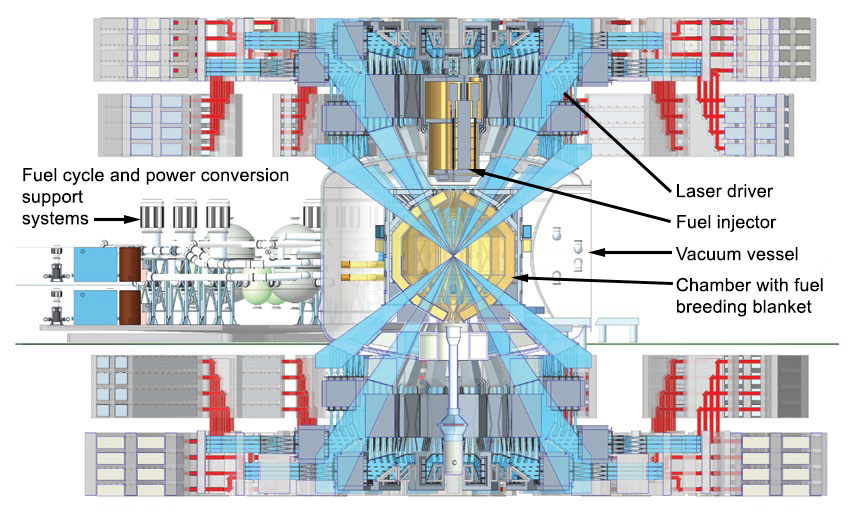
This artist’s rendering shows the concept for an inertial fusion energy (IFE) power plant design, with a cutaway to show the plant’s target chamber in the center. Livermore researchers are laying the groundwork for private fusion companies to build similar designs. (Illustration by Eric Smith.)

Designing for Viability

NIF is the only facility to date to demonstrate the ignition and burning plasma conditions that are prerequisites for IFE, but it is an experimental facility for stockpile stewardship research, not a power plant. To be commercially viable and produce the energy to offset costs and meet demands (baseload power), IFE plants will need to generate more than 30 times the energy they deliver to the fusion target on every shot while firing 10 or more shots per second, compared to NIF’s rate of one or two shots per day.

The Laser Inertial Fusion Energy (LIFE) study, conducted between 2008 and 2013, aimed to build directly on technology developed for NIF to achieve IFE and took a systematic approach to this requirement by developing the Integrated Process Model (IPM). (See S&TR, April/May 2009 [archived PDF], pp. 6-15.)

IPM is a technoeconomic model of an IFE power plant with detailed technical and cost breakdowns and interdependencies of key systems and subsystems. “The work done under LIFE was fantastic,” says Ma. “IPM lays out engineering and physics requirements for the entire system to test out different scenarios and see the impact. Now, we not only get to expand on all that but also leverage 15 years of new data from NIF, better codes, and high-performance computing (HPC), as well as new work in AI, ML, advanced manufacturing, diagnostics, and nonproliferation across the Laboratory.”

IPM describes an IFE power plant that requires a solid-state laser driver system to “pump” lasers with optical energy using laser diodes instead of flashlamps as at NIF. The plant will also need to fabricate and fill target capsules onsite and send them into its target chamber at a high enough frequency to produce baseload power. “We will have to repeatedly inject targets into the chamber, so the targets must be able to withstand and survive that process,” explains Ma. “Then, the lasers will track the moving targets, and when one gets to the center of the chamber, they would fire on the centered target, repeating 10 to 20 times per second.”

The facility would convert fusion energy into heat and then electricity via steam turbines, sending most of the electricity to the power grid and recycling the rest to power operations on subsequent shots. Neutrons from the reaction would produce tritium needed for the DT fuel by bombarding lithium isotopes in a “breeding blanket” material lining its target chamber. By closing both the power and fuel cycles, IFE plants are expected to be self-sustaining.

Thanks in part to IFE STARFIRE (IFE Science and Technology Accelerated Research for Fusion Innovation and Reactor Engineering), a Department of Energy (DOE)-funded multi-institutional IFE research and development hub, researchers across the Laboratory are working to meet the new system’s demands. IPM can help identify key challenges, test the viability of new designs, and direct future research. “Many technical models and cost models exist for IFE, but very few, if any, pair systems and cost models together at the same depth as IPM,” says Mackenzie Nelson, a technoeconomic systems analyst in the Computational Engineering Division. “This type of tool offers such an advantage because we can assess design choices from both a technical and economic standpoint and create blueprints for what an IFE plant could look like.”
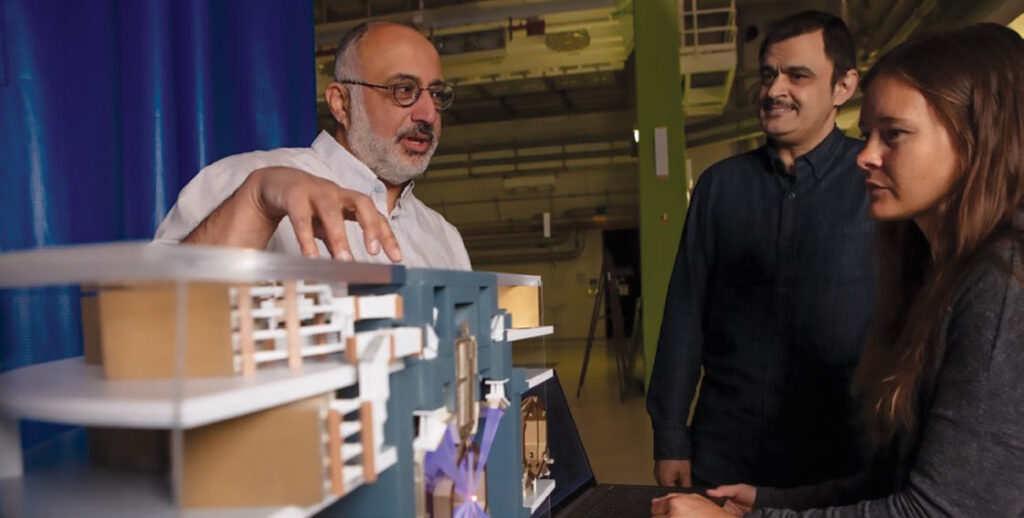
(left to right) Livermore researchers Bassem El Dasher, Claudio Santiago, and Mackenzie Nelson discuss a 3D model of a proposed IFE power plant design alongside the Integrated Process Model (IPM). IPM has more than 270 potential user inputs that researchers and collaborators can use to assess different IFE design choices to see the technical and cost impact on the entire design.

Operational Demands

NIF’s target capsules are extremely precise, fragile, and can take weeks to fabricate, fill, and position. Researchers are trying to reconcile that factor with the estimated demand of more than 800,000 capsules per day produced at less than $0.50 each to achieve IFE plant viability. To do this, they are examining optimal target designs for IFE and exploring advanced manufacturing methods such as microfluidics, volumetric additive manufacturing, and two-photon polymerization. (See S&TR, April/May 2025 [archived PDF], pp. 16-19.) Additional projects involve developing diagnostic instruments that can collect, analyze, and combine data with other diagnostics at the 10 to 20 shot per second frequency and use it to improve lasers in real time.

Fusion energy systems such as IFE are also a regulatory challenge, as they generate high-energy neutrons capable of breeding plutonium or uranium-233 and rely on large quantities of tritium. “Pure fusion energy systems do not require fissile material, but there are still ways to misuse these technologies that pose proliferation risk,” says Yana Feldman, the associate program leader for international safeguards. Bad actors may only need small amounts of tritium to make nuclear weapons, and some breeding blanket designs may inadvertently produce traces of plutonium that may be diverted for military purposes.

Nuclear fission reactors are regulated through international agreements and export control rules, and the independent International Atomic Energy Agency (IAEA) verifies that nuclear material and facilities are only being used for peaceful purposes. Neither treaties nor the IAEA address fusion energy, and no consensus has been reached on whether fusion energy systems need an international verification program. Verification methods for safeguarding tritium are also far less developed than for plutonium and uranium and focus more on contamination and transfers than analytical accounting for discrepancies. The precise scale of allowable tritium unaccounted for without posing proliferation risk is also unclear.

Fusion systems can be designed for proliferation resistance, but not having an existing design remains a challenge.

International security analyst Anne-Marie Riitsaar and her colleagues are exploring these complexities and starting conversations with international fusion experts and private industry to raise awareness. Riitsaar also plans to collaborate with the IPM team to map tritium diversion vulnerabilities and identify high-risk points where researchers could incorporate surveillance methods into plant designs to detect and prevent potential misuse. “People sometimes ask me why I’m thinking about fusion energy regulations and proliferation risks at this point, but it’s not too early,” says Riitsaar. “Reaching a multinational consensus on regulating sensitive technologies takes considerable time and effort.”

The National Ignition Facility is an experimental facility and not a power plant, so a commercial IFE plant design has vastly different requirements—many of which are being studied by Livermore researchers and their collaborators.

NIFViable IFE plant (estimated)
Repetition rateOne shot per day10 to 20 shots per second
Energy gain4.13 times (as of April 2025)30 times (minimum), 50 times to 100 times (ideal)
How lasers gain energyFlashlampsDiode pumping
Target fabrication and fuel fillingFabricated offsite over several weeks and filled manually in 1 to 5 daysMass-manufactured and filled in a target factory within the facility
Target deliveryPositioned manually within the Target ChamberShot into the plant’s target chamber approximately 10 to 20 times per second
Laser alignmentComputationally in real time, taking up to 8 hoursIn real time
Power cycleOpen, requiring outside energy sourcesClosed, applying reused energy to power laser and ancillary plant operations
Fuel cycle (tritium)Produced offsiteBred onsite

The Laser Driven Fusion Integration Research and Science Test Facility (LD-FIRST) is a proposed blueprint for a proof-of-concept IFE facility that will test all the key IFE subsystems in an integrated fashion. A public-private partnership will likely be necessary to build the facility and will help the IFE community address the main subset of risks and the technological challenges of building a commercial plant.

Converging on a Solution

The team seeks to make IPM as accurate and comprehensive as possible by meeting with subject matter experts across the Laboratory to incorporate the latest research. “We’re trying to evolve the model so it has the same level of high detail across every single functional area to tell us where we can focus research and help us find optimized solutions that we could propose to industry,” says Nelson.

Computer scientist Claudio Santiago and his colleagues also modernized IPM by porting its framework from Microsoft Excel to Python in December 2024, making it compatible with AI, ML, design optimization, and HPC to further inform designs. “Once we think about all the forcing functions such as minimum shot yield and materials requirements pinning us in from every direction, we end up with an optimized solution space. As we sharpen the pencil more with these tools, that optimized solution box gets smaller until eventually we’ve converged on a point design,” says IFE lead systems engineer Justin Galbraith. Galbraith and his team’s point design is called the Laser Driven Fusion Integration Research and Science Test Facility, or LD-FIRST, a proof-of-concept physics demonstration facility for IFE. “That point design, we anticipate, will serve as the foundation for a future public-private partnership that would facilitate building and realizing a physical facility to focus the IFE community in pursuit of fusion power on the grid,” says Galbraith.

Livermore is leading the charge in IFE, helping the United States develop a technological roadmap, growing and coordinating science and technology efforts within the Laboratory, and fostering partnerships across the fusion industry, academia, and government.

Ma chaired DOE’s “Basic Research Needs for IFE” workshop and report in 2022 and co-chairs the subcommittee providing recommendations on the nation’s fusion activities through DOE’s Fusion Energy Sciences Advisory Committee. She and her team travel often to Washington, D.C., working with DOE and legislators to expand fusion energy research and advocacy in the nation. Livermore also leads a “Collaboratory” with other DOE national laboratories to connect research project leads and facilitate public-private partnerships. The Collaboratory has hosted multiple events with industry, and the Laboratory has partnered with three private companies who aim to design pilot IFE plants.

Meanwhile, Galbraith and other IFE leaders have served as technical advisors for engineering design teams at Texas A&M University and given them IFE-relevant problems to solve, including advanced chamber and blanket design. Galbraith is working with Nelson to develop the IFE plant design portion of a high-energy-density science summer school program, which Nelson is leading in 2025 at the University of California at San Diego, and they have developed IFE curriculum that has been deployed at six universities starting in spring 2025. “We’re hoping we can get a group of students really excited about fusion and start to build up the next generation of engineers and scientists that will make fusion a reality,” says Galbraith. The team has led IFE strategic planning exercises at the Laboratory, and Lawrence Livermore will stand up a new fusion institute—named “LIFT,” for Livermore Institute for Fusion Technology—a research and development center that will coordinate and centralize institutional fusion energy research.

Harnessing IFE will be a massive undertaking, but Livermore’s broad and deep expertise, facilities, and capabilities put the Laboratory in a unique position to lead and play an impactful role. “If we can set it up correctly, IFE will be a big piece of the Laboratory’s long-term vision,” says Ma. “IFE plays off of our history and all of our strengths, and it is critical for long-term national security.”

India and the Russia-Ukraine War: The Paradox of Military Dependence, Traditional Loyalty and Strategic Autonomy

[from India in Transition, published by the Center for the Advanced Study of India (CASI) of the University of Pennsylvania, by Arndt Michael]

India, long-established as the world’s most populous democracy, has been quite instrumental over the years in assisting various countries dealing with democratic struggles. This support has included a blend of bilateral and multilateral initiatives, and especially economic development projects. Yet, India’s recent attitude toward the Russian attack on Ukraine and its concomitant behavior in the United Nations Security Council (as a non-permanent member) seems to contradict its support of democracy. By abstaining, rather than explicitly voting in favor of UN resolutions condemning Russian aggression at the beginning of the war, India angered several UN member-countries.

In order to substantiate its abstention from voting, India felt compelled to issue a so-called “Explanation of Vote” (EoV). In it, India asked for a “return to the path of diplomacy” and an immediate cessation of “violence and hostilities.” Crucially, India stated in the EoV that “the contemporary global order has been built on the UN Charter, international law, and respect for the sovereignty and territorial integrity of states…all member states need to honor these principles in finding a constructive way forward. Dialogue is the only answer to settling differences and disputes, however daunting that may appear at this moment.” 

While these statements and the call for dialogue are in accordance with India’s professed stance toward the relevance and objectives enshrined in the UN Charter, the discrepancy between rhetoric and practice is still conspicuous. At first glance, a “good” relationship with Russia seems to be more significant than the expectations of the world-community as represented in the United Nations. And, more importantly, by abstaining, India seemingly violated one of its central foreign and strategic policies: to always strive for strategic autonomy.

However, from a strategic perspective, India is precisely replicating what it did when the Soviet Union invaded Afghanistan. For India, its own national security is at stake, as well as its current and future geostrategic influence in Asia and the world. The military dependence that currently exists between India and Russia is nothing short of gigantic and has created a dangerous conundrum. Since the “Indo–Soviet Treaty of Peace, Friendship and Cooperation” was signed in 1971, defense agreements and long-term supply contracts have been in place. And while India and Russia have shared a strategic relationship since October 2000, this was upgraded in December 2020 to a “Special and Privileged Strategic Partnership.” 

Although there was a marked reduction of Russian imports in past years, official data from the Stockholm International Peace Research Institute (SIPRI) reveal that between 1996-2015, the Russian proportion of Indian military imports was almost 70 percent, and between 2016-20 it still hovered around 49 percent. In fact, 70 percent of all Indian military equipment currently in use has been directly produced in Russia, was manufactured with the majority of parts coming from Russia, or licensed by Russia. In 2020, this included the majority of Indian tanks, the only aircraft carrier (the INS Vikramaditya, a heavily modified Kiev-class aircraft carrier) with all of its combat aircraft MiG-29s, six frigates, four destroyers and the only nuclear-powered submarine. Additionally, eight out of fourteen Indian Navy submarines belong to the Russian Kilo-class. The Indian Air Force flies Sukhoi Su-30MKIs and Mil Mi-17s, which, respectively, constitute the largest share of the combat aircraft and utility helicopters, in addition to Russian tanker planes. India also just recently purchased the S-400 missile system.

Even though India has begun to reorient itself militarily toward other countries—the U.S., Israel, France and Italy—and has substituted foreign imports by slowly developing its own capabilities, a large number of new Indo-Russian projects are in the conceptual or implementation stages. In December 2021, in the frame of the so-called “2+2 Dialogue” (foreign and defense ministers), India and Russia began a new phase in their militarytechnological cooperation. Incidentally, India has used this very format for furthering cooperation in strategic, security and intelligence issues with four of its key strategic partners: Australia, the U.S., Japan and the newly added Russia. Russia and India agreed upon a further deepening of mutual military relations for ten years (until 2031). What is new is that next to the traditional purchase of Russian weapons systems, many common research projects and the development of new weapons systems—with their production taking place equally in both countries—have been agreed upon. This production includes new frigates, helicopters, submarines, cruise missiles and even Kalashnikovs

The depth of this mutual engagement, and especially India’s dependence, highlights a huge dilemma that might not only have drastic strategic consequences, but also long-lasting regional repercussions. The worldwide sanctions issued against Russia aim at the Russian economy and military. When it comes to the procurement of such crucial components as microchips or airline parts, Russia is soon expected to face shortages, essentially crippling its capacity to repair, construct, or have spare parts available (let alone construct new equipment). Unless other countries, such as China, circumvent international sanctions and step-in, the expected Russian inability to take care of its own military will have a spill-over effect. Russia is unlikely to be able to fulfill its contractual obligations toward India, and the lack of spare parts also has the potential to cripple India’s own military with regards to the Russian weapons equipment. The procurement agreements and common projects are, hence, all in jeopardy and India, now more than ever, depends on Russian goodwill. 

Next to military dependence, there are other concomitant effects in the economic and political sphere that influence Indian voting behavior. The worldwide sanctions have already led to dramatic increases in oil and gas prices, with India relying on imports of up to 80 percent. India will, therefore, have to pay much more for such crucial imports. Military imports from other countries aimed at substituting Russian equipment will also be much more expensive. All of this deals the Indian economy another blow—an economy that has been especially hit hard by the COVID-19 pandemic. And politically, Indian hegemony in South Asia has been markedly under pressure, in no small part because of the ChinaPakistan axis. In the eyes of India, this axis poses a serious threat to an already highly volatile IndoPakistan relationship. In addition, the IndoChina relationship reached a new low in May 2020 when Chinese infrastructure projects along the Himalayan borderlands led to fighting and the killing of soldiers. In addition, the Chinese claims to the South China Sea are categorically disputed by India. Chinese overtures toward Sri Lanka, the Maldives, and especially Pakistan in the frame of the Road Initiative are also regarded with growing discontent, as India claims that China is following a policy of encircling India.

In its 75th year of independence, India is following a classic realpolitik in trying not to alienate Russia while pledging rhetorical support for Ukraine. The contradictory consequence is that Russia has now offered more discounted oil, gas, and investments, while at the same time, the UK has suggested its military relationship with India could be upgraded—and has offered weapons made in the UK. For the Indian political establishment, India cannot forgo Russian support, militarily or as a producer of cheap oil and gas. Going forward, India’s military will need to protect its national security and project Indian influence and power well beyond its borders.

Arndt Michael is a Lecturer in the Department of Political Science, University of Freiburg (Germany), author of the multi-award-winning book India’s Foreign Policy and Regional Multilateralism (Palgrave Macmillan, 2013), and co-editor of Indien Verstehen (Understanding India, Springer, 2016). His articles have been published in Asian Security, Cambridge Review of International Affairs, Harvard Asia Quarterly, India Quarterly and India Review.

WANG Huiyao: To Save Global Trade, Start Small

[from the Center for China and Globalization]

by WANG Huiyao (王辉耀), Founder of the Center for China and Globalization

The global economy is being rocked by war, sanctions and spiraling commodity prices—not to mention the ongoing strain of the pandemic, geopolitical tensions and climate change. These compounding risks present a serious challenge to the system of open trade that the World Trade Organization was designed to uphold. But it also offers a chance for the beleaguered organization, which is holding its first ministerial conference since 2017, to prove its continuing relevance.

The WTO has traditionally focused on combating protectionism—measures designed to insulate producers from international competition. Now, though, the biggest threats to free trade come from policies meant to safeguard national security and protect citizens from risks, such as those related to health, the environment or digital spaces.

Former WTO Director-General Pascal Lamy has called this growing use of export controls, cybersecurity laws, investment blacklists, reshoring incentives and the like “precautionism.” It’s been on the rise since the start of the pandemic, when many countries moved to restrict exports of medical supplies and other essentials. COVID-19 has also raised concerns about the vulnerability of supply chains, particularly those dependent on geopolitical rivals.

The world’s two biggest trading nations, the United States and China, have both engaged in precautionism. The U.S. is actively pursuing a policy of “friend-shoring”—shifting trade flows from potentially hostile countries to friendlier ones. China’s “dual circulation” strategy aims in part to reduce dependence on foreign imports, especially technology, while its government has long imposed limits on data flows in and out of the country.

With Russia’s invasion of Ukraine, the momentum toward friend-shoring has grown. Meanwhile, food shortages and surging prices have triggered another round of precautionary measures: Since the war began, 63 countries have imposed a more than 100 export restrictions on fertilizer and foodstuffs.

While the impulse driving such policies is understandable, the trend could cause great harm if allowed to run unchecked. It will increase inflation and depress global growth, especially if it involves costly redeployment of supply chains away from efficient producers such as China. A recent WTO study estimated that decoupling the global economy into “Western” and “Eastern” blocs would wipe out nearly 5% in output, the equivalent of $4 trillion.

As a recent study by the International Monetary Fund points out, the way to make global value chains more resilient is to diversify, not dismantle them. Turning away from open trade will only make states more vulnerable to economic shocks such as war, disease or crop failures.

The WTO is an obvious vehicle to rally collective action on these issues. However, like other global institutions, it has been weakened by years of deadlock. At this week’s meeting, countries should start to build positive momentum with some small but symbolically significant breakthroughs to show the WTO can still mobilize joint action.

Given current threats to food security, at the very least members should agree not to restrict exports of foodstuffs purchased for the World Food Programme. A step further would be a joint statement calling on members to keep trade in food and agricultural products open and avoid imposing unjustified export restrictions. There should also be closer coordination to smooth supply chains and clogged logistics channels.

Another low-hanging fruit is finally securing a  waiver covering intellectual property rights for COVID-19-related products. This proposal has languished for over 18 months but has now been redrafted to address concerns from the U.S. and European Union. Signing it would go some way to expanding global access to vaccines, which are still sorely needed in many parts of the world.

Beyond this week, the WTO secretariat and members need to develop a work program to reform the organization. This should include developing a framework to ensure that if states do take precautionary measures, they do so in a transparent, rules-based manner that does not slide into more harmful forms of protectionism.

Reviving the WTO’s defunct dispute settlement mechanism is a clear priority. Twenty-five members have agreed to an interim arrangement that would function in a similar way. More members should join this agreement, ideally including the U.S., and start negotiating the full restoration of a binding mechanism. They should also set clear criteria for carveouts for legitimate precautionary measures related to national security, healthcare and environmental issues.

No one should expect big breakthroughs in Geneva. But practical agreements on immediate priorities such food security and vaccines would at least help to reassert the WTO’s relevance and show that the world’s trading partners are not simply going to give up on multilateralism. At this dangerous moment, even small victories are welcome.

Education and “Then and Now” Thinking

The great historian A. J. P. Taylor (the ideal historian in the opinion of Professor Niall Ferguson of Harvard/Stanford) shows us the “comfortableness” of the world for at least some people before “the guns of August” and WWI destroyed that social world:

“Until August 1914 a sensible, law-abiding Englishman could pass through life and hardly notice the existence of the state, beyond the post-office and the policeman. He could live where he liked and as he liked. he had no official number or identity card.  He could travel abroad or leave his country for ever without a passport or any sort of official permission.  He could exchange his money for any other currency without restriction or limit.  He could buy goods from any country in the world on the same terms as he bought goods at home.  For that matter, a foreigner could spend his life in this country without permit and without informing the police.  Unlike the countries of the European continent, the state did not require its citizens to perform military service.

“An Englishman could enlist, if he chose, in the regular army, the navy, or the territorials. He could also ignore, if he chose, the demands of national defence.

“Substantial householders were occasionally called on for jury service. Otherwise, only those who helped the state who wished to do so.

“The Englishman paid taxes on a modest scale:  nearly 200 million pounds in 1913-14, or rather less than 8% of national income.  The state intervened to prevent the citizen from eating adulterated food or contracting certain infectious diseases. It imposed safety rules in factories, and prevented women, and adult males in some industries, from working excessive hours.  The state saw to it that children received education up to the age of 13.

“Since 1 January 1909, it provided a meagre pension for the needy over the age of 70. Since 1911, it helped to insure certain classes of workers against sickness and unemployment.  This tendency to more state intervention was increasing. Expenditure on the social services had roughly doubled since the Liberals took office in 1905.

Still, broadly speaking, the state acted only to help those who could not help themselves. It left the adult citizen alone. All this was changed by the impact of the Great War.”

(A. J. P. Taylor, English History 1914-1945, Oxford, 1965, page 1)

It seems hard to argue that life has become more “charming” since then and this pre-WWI seems much more calm, sane and relaxed than the world of 2019.  Thinking about “then and now” gives us a feel for the decay in some domains despite the cascade of technologies, gadgets, things.