Innovative MBARI Technology Offers a Bold New Vision for Monitoring Ocean Health

MBARI’s long-range autonomous underwater vehicle (LRAUV) played a central role in a recent field demonstration that tested how autonomous robots can be deployed for monitoring ocean health. Image: Rose Dalrymple © 2026 MBARI

During a recent field campaign, MBARI mobilized a fleet of autonomous robots to refine the tools and workflows that can be applied to monitoring offshore wind energy development.

[from Monterey Bay Aquarium Research Institute, 19 November, 2026]

On an early October morning, as MBARI’s research vessel Paragon left Moss Landing with three robots loaded on its deck, Monterey Bay was showing off.

Anchovies packed the head of the submarine canyon in a dense school covering several square kilometers. Humpback whales lunged through the school, feeding alongside sea lions and long-beaked common dolphins, while flocks of seabirds worked the bait from above. 

Out on the deep blue waters of the outer bay, MBARI engineers got to work deploying three underwater robots equipped with advanced sensors and software. These state-of-the-art vehicles would spend two weeks at sea gathering comprehensive data about marine life and ecosystems.

Senior Scientist Chris Scholin (left) led MBARI as president and CEO for 17 years before returning to research last year. His vision for a tool for detecting harmful algal blooms evolved into the Environmental Sample Processor that is transforming monitoring of aquatic environments. Image: Rose Dalrymple © 2026 MBARI

MBARI technology is transforming how scientists monitor ocean health. Autonomous robots enable real-time, persistent observation of marine ecosystems. This deployment in early October was part of a field demonstration MBARI conducted with the National Offshore Wind Research and Development Consortium (NOWRDC) that points to a revolutionary new way of monitoring ocean environments.

“Decades of MBARI engineering innovation have helped advance the science of environmental monitoring, providing tools to assess the current and future state of the ocean. Our collaboration with NOWRDC illustrates how this advanced technology can also be used to revolutionize how resource managers monitor marine life and ecosystems and contribute data for regulatory decision-making to ensure the safe and sustainable use of ocean resources,” said MBARI Senior Scientist Chris Scholin, who led the NOWRDC field demonstration.

The challenge

California has made offshore wind a pillar of its plan to decarbonize the grid. The state has identified deep-water lease areas to support arrays of floating turbines, however, these are located in some of the most productive waters along the coast. As state policymakers draft the rules that will govern how those installations are permitted and monitored, many questions about the environmental impact of offshore wind farms remain.

Responsible siting, permitting, and operations depend on understanding how ocean conditions and marine life change over time. Historically, understanding the complex web of ecological interactions in a marine community has required sending a ship and crew of researchers to conduct a detailed scientific survey. But the areas cited for wind energy development in California are frequently rough and relatively far from ports. Conducting routine assessments will require very capable vessels and crew to access these remote waters. Ship-based surveys also require substantial resources, and a crewed vessel can only be in one place at a time, limiting surveys over time and the area covered.

NOWRDC is a non-profit organization that connects key stakeholders in offshore wind energy across the US, including technology innovators, researchers, industry, and policymakers. NOWRDC funds strategic research projects to address barriers and challenges to the development of offshore wind energy, such as routine site monitoring.

Two decades of MBARI engineering innovation offered a solution to the challenge of environmental monitoring of offshore wind farms: autonomous underwater robots.

A platform and a process

About two meters (6.6 feet) long and weighing 110 kilograms (242.5 pounds), the LRAUV is a portable, but powerful, platform for ocean research. It can be outfitted with a variety of payloads, including microbial sampling, bioluminescence sensing, active bio-acoustic imaging, water sampling, and advanced imaging systems. Image: Marike Pinsonneault © 2026 MBARI

The MBARI long-range autonomous underwater vehicle (LRAUV) is a versatile platform for ocean science. These vehicles support industry-standard instrumentation for basic environmental characterizations, as well as custom-designed payloads that leverage MBARI’s expertise in marine technology and engineering innovation to enable more sophisticated observations necessary for comprehensive ecosystem assessments. 

The LRAUV is a proven platform for ocean exploration and science. After more than a decade of development, the LRAUV has become more than a vehicle—it is a tech ecosystem capable of supporting a variety of science missions. From observing pelagic predators to sampling environmental DNA (eDNA), the LRAUV is an ideal tool to meet the growing demand for scalable technologies to monitor the ocean.

MBARI’s proposal to NOWRDC was less about developing a new product, but rather a process. First, the team proposed a field demonstration with MBARI’s LRAUVs to show what a coordinated fleet of ocean robots can observe. With that as background, the team would engage an advisory board comprised of state, federal, and industry representatives to design a future field program to gather data most critical to informing future decision-making about the utility of using uncrewed robotic systems to provide required observations as supplements, or potentially replacements, for what otherwise would rest on routine crewed ship surveys.

Three questions, seven robots

MBARI researchers identified three questions to answer during the demonstration:

They matched each question to a combination of vehicles and sensors and put them in the water.

The demonstration ran in two phases. From August 3 to 13, three vehicles worked a survey circle near the head of Monterey Bay’s submarine canyon: the Wave Glider Hansen, an autonomous surface vessel, mapped the water column with echosounders, while two LRAUVs, Makai and Brizo, imaged animals, collected eDNA, and logged acoustic data. This exploratory phase enabled the team to test and refine methodologies.

The NOWRDC field demonstration saw MBARI’s advanced underwater robots conducting surveys across Monterey Bay, including an upwelling hotspot in the north bay and a long-term time series above Monterey Canyon. Image courtesy of Kelly Benoit-Bird and Kathleen Pitz

Then, from September 21 to October 15, MBARI deployed six LRAUVs in stages across the north bay and two survey circles, one at the canyon head and the other 32 kilometers (20 miles) offshore at MBARI’s MARS cabled observatory. Again, the Wave Glider Hansen conducted complementary echosounder surveys near the canyon head.

The team chose the two sites for contrast. The canyon head is typically a cold, chlorophyll-rich, productive zone. By chance, the MARS site on the day of deployment sat at the convergence of an offshore eddy drifting into the mouth of the bay with a warm tongue of water moving up from the south—the type of front where currents and contrasting water masses concentrate plankton, prey, and the animals that hunt them.

The team also added what a long-term monitoring program would need most: repeatable survey lines that mirrored MBARI’s longstanding Monterey Bay time series, and the ability to recharge the LRAUVs at sea.

Three ways to survey marine life with autonomous robots

Cameras. Planktivore, an underwater microscope, photographs tiny plankton as the vehicle passes through them. Piscivore, an AI-enabled camera system, images ocean predators, like sharks, fishes, seabirds, and marine mammals.

Sound. Echosounders send pulses into the water and read the echoes to map where the biological layers are. A hydrophone listens passively to everything from whale calls to ship noise.

DNA. The Environmental Sample Processor filters seawater and preserves the genetic “fingerprints” marine life leaves behind. Passive samplers on the vehicles collect eDNA continuously as they travel.

No single method sees everything. Six LRAUVs carrying distinct scientific payloads gathered data on different dimensions of ocean health. Together, they provide a comprehensive picture of Monterey Bay.

Innovation in action

In the north bay, LRAUV Pontus carried a bioluminescence sensor alongside its standard oceanographic instruments and used machine learning to predict plankton community composition based on its measurements. 

Twice during the second phase of the demonstration, a pair of LRAUVs ran a transect line from shore and back that approximated the size and scale of a wind energy area. 

Ahi carried Planktivore, an underwater microscope that photographs the plankton it passes through rather than inferring who is there. Daphne carried the Sipper, a payload that draws small water samples through the water column for biogeochemical analysis back on shore. These data connect changes in the physical and chemical environment to the microscopic plants and animals at the base of the food web. Together, these vehicles gathered the same data a monthly research cruise would deliver.

MBARI’s Environmental Sample Processor is a portable lab that can be integrated with the LRAUV to collect eDNA samples for scientists to catalog marine biodiversity. Image: Todd Walsh © 2026 MBARI

Towards a persistent presence

Monitoring ocean processes and ecosystems requires sustained operations. MBARI technologies are up for the challenge.

Over approximately 2,000 operating hours, the fleet of LRAUVs traveled more than 4,000 kilometers (almost 2,500 miles)—roughly the distance from California to Hawaii—and collected more than 100 eDNA samples.

Docking stations at sea can recharge the LRAUV, enabling continuous operations at sea without returning to the lab for battery charging. Image: Paige McKay © 2026 MBARI

Power is a limiting factor for autonomous robots, requiring recovery of vehicles for charging, especially when operating high-power sensors. MBARI engineers have developed a solar-powered docking station that can recharge the LRAUV at sea. Between surveys in the north bay, LRAUV Pontus returned to this docking station to recharge and transfer data 20 times, enabling the vehicle to collect a trove of data for weeks without coming back to shore.

The NOWRDC field demonstration also marked the first docking of an LRAUV with MBARI’s wave energy conversion (WEC) buoy. By harvesting energy from wave motion, this system generates approximately 10 times more power than its solar counterpart. LRAUV Brizo successfully docked with the WEC buoy twice during the field demonstration.

What happens next

MBARI’s field demonstration this fall showed that uncrewed systems can be an efficient and cost-effective tool for monitoring an offshore area. Over the course of three months of fieldwork, MBARI scientists, engineers, and marine operations crew learned what works operationally, from the sensors to the docks to the way data flows back to shore. Now, the team is analyzing the trove of data and samples. 

After recovering the fleet of LRAUVs, the MBARI team will now begin detailed analysis of the data and samples collected by the vehicles over the past three months. Image: Rose Dalrymple © 2026 MBARI

MBARI will report to the project’s primary sponsor, the California Energy Commission, this coming year. A meeting planned for early 2027 will bring the NOWRDC advisory board together to review the demonstration results so that, as they move forward with establishing regulatory and permitting guidance, opportunities for using uncrewed systems to meet monitoring needs can be included.

A hub of discovery and innovation, MBARI develops tools that help scientists better understand the ocean. By making its technologies, scientific expertise, and data broadly available, MBARI supports informed decision-making about marine life, ecosystems, and resources. 

The NOWRDC demonstration is just the latest example of MBARI technology enabling research on a changing planet. MBARI’s partnerships with government agencies and academic peers have previously deployed LRAUVs to monitor harmful algal blooms in Lake Erie and reveal daily rhythms of microbial activity that drive ocean productivity. The technology ecosystem tested for environmental monitoring of offshore wind energy development can be applied across a wide range of ocean uses, including managing fisheries, monitoring marine protected areas, and advancing climate research.

“The technology works the same way whether you’re doing basic research or solving a practical problem,” explained Scholin. “Our job is to build the tools, show that they work, and share the technology, expertise, and data widely so everyone at the table is looking at the same information. We care that the people making decisions are using the best science available.”

This work was made possible by the generous support of the David and Lucile Packard Foundation. Additional support was provided by the National Offshore Wind Research and Development Consortium (NOWRDC), the California Energy Commission (CEC), the New York State Energy Research and Development Authority (NYSERDA), and the Massachusetts Clean Energy Center (MA CEC).
Read logs from the NOWRDC field demonstration.

Science-Watching: From Ignition to Energy

[from Science & Technology Review July/August 2025 Research Highlights, by Noah Pflueger-Peters]

Achieving ignition at the National Ignition Facility (NIF) proved that harnessing the power of the Sun in a laboratory may be possible. The Sun’s extreme temperatures and pressures cause light elements to fuse together to create heavier ones, releasing enormous energy and sustaining conditions for more thermonuclear reactions. NIF replicates these conditions with inertial confinement fusion, in which lasers compress and heat a target capsule filled with deuterium and tritium (DT), “heavy” isotopes of hydrogen that contain extra neutrons. When the isotopes fuse, they create helium and a neutron, and the lost mass is converted into inertial fusion energy (IFE), which can be harnessed for energy production.

Nuclear fusion produces significantly more energy than either nuclear fission or burning fossil fuels for equivalent amounts of fuel. Since the input materials for fusion energy are plentiful on Earth, an IFE power plant could produce safe, abundant, power grid-compatible energy without highly radioactive byproducts.

Although significant work remains to harness fusion energy, pursuing the development and deployment of IFE is crucial for the nation’s energy security, enabling the United States to shape implementation worldwide, avoid technological surprises from adversaries, and influence technical leadership in other energy-intensive technologies such as AI, machine learning (ML), and supercomputing.

IFE research stretches back to the early days of Lawrence Livermore, and today the Laboratory is fostering the overall fusion ecosystem. Livermore’s unique capabilities, expertise, and connections will be critical to laying the technical, logistical, and legal groundwork to make IFE possible. “IFE is a grand scientific and engineering challenge, something that is so incredibly difficult and high-risk and takes enormous expertise,” says Tammy Ma, Livermore’s IFE Institutional Initiative lead. “This challenge makes it the right kind of problem for national laboratories to pursue.”

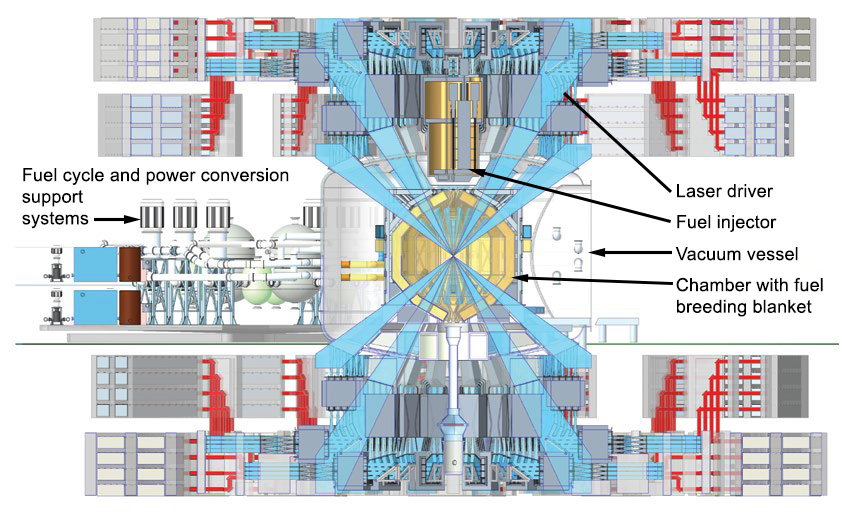
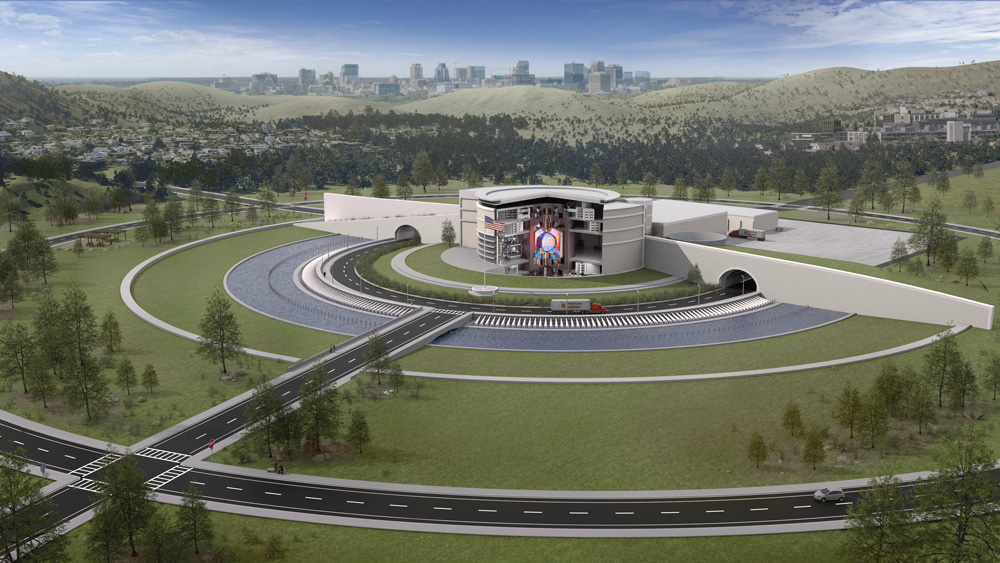
This artist’s rendering shows the concept for an inertial fusion energy (IFE) power plant design, with a cutaway to show the plant’s target chamber in the center. Livermore researchers are laying the groundwork for private fusion companies to build similar designs. (Illustration by Eric Smith.)

Designing for Viability

NIF is the only facility to date to demonstrate the ignition and burning plasma conditions that are prerequisites for IFE, but it is an experimental facility for stockpile stewardship research, not a power plant. To be commercially viable and produce the energy to offset costs and meet demands (baseload power), IFE plants will need to generate more than 30 times the energy they deliver to the fusion target on every shot while firing 10 or more shots per second, compared to NIF’s rate of one or two shots per day.

The Laser Inertial Fusion Energy (LIFE) study, conducted between 2008 and 2013, aimed to build directly on technology developed for NIF to achieve IFE and took a systematic approach to this requirement by developing the Integrated Process Model (IPM). (See S&TR, April/May 2009 [archived PDF], pp. 6-15.)

IPM is a technoeconomic model of an IFE power plant with detailed technical and cost breakdowns and interdependencies of key systems and subsystems. “The work done under LIFE was fantastic,” says Ma. “IPM lays out engineering and physics requirements for the entire system to test out different scenarios and see the impact. Now, we not only get to expand on all that but also leverage 15 years of new data from NIF, better codes, and high-performance computing (HPC), as well as new work in AI, ML, advanced manufacturing, diagnostics, and nonproliferation across the Laboratory.”

IPM describes an IFE power plant that requires a solid-state laser driver system to “pump” lasers with optical energy using laser diodes instead of flashlamps as at NIF. The plant will also need to fabricate and fill target capsules onsite and send them into its target chamber at a high enough frequency to produce baseload power. “We will have to repeatedly inject targets into the chamber, so the targets must be able to withstand and survive that process,” explains Ma. “Then, the lasers will track the moving targets, and when one gets to the center of the chamber, they would fire on the centered target, repeating 10 to 20 times per second.”

The facility would convert fusion energy into heat and then electricity via steam turbines, sending most of the electricity to the power grid and recycling the rest to power operations on subsequent shots. Neutrons from the reaction would produce tritium needed for the DT fuel by bombarding lithium isotopes in a “breeding blanket” material lining its target chamber. By closing both the power and fuel cycles, IFE plants are expected to be self-sustaining.

Thanks in part to IFE STARFIRE (IFE Science and Technology Accelerated Research for Fusion Innovation and Reactor Engineering), a Department of Energy (DOE)-funded multi-institutional IFE research and development hub, researchers across the Laboratory are working to meet the new system’s demands. IPM can help identify key challenges, test the viability of new designs, and direct future research. “Many technical models and cost models exist for IFE, but very few, if any, pair systems and cost models together at the same depth as IPM,” says Mackenzie Nelson, a technoeconomic systems analyst in the Computational Engineering Division. “This type of tool offers such an advantage because we can assess design choices from both a technical and economic standpoint and create blueprints for what an IFE plant could look like.”

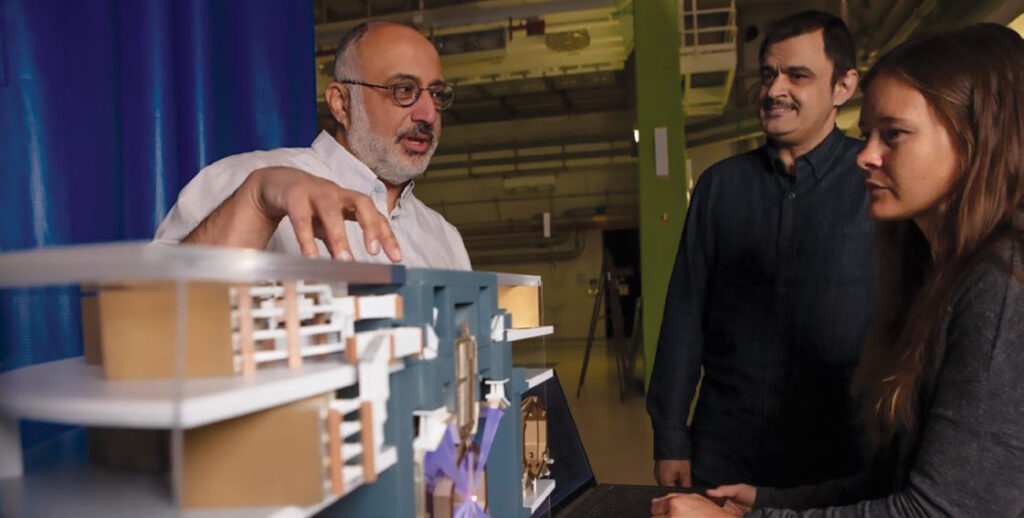
(left to right) Livermore researchers Bassem El Dasher, Claudio Santiago, and Mackenzie Nelson discuss a 3D model of a proposed IFE power plant design alongside the Integrated Process Model (IPM). IPM has more than 270 potential user inputs that researchers and collaborators can use to assess different IFE design choices to see the technical and cost impact on the entire design.

Operational Demands

NIF’s target capsules are extremely precise, fragile, and can take weeks to fabricate, fill, and position. Researchers are trying to reconcile that factor with the estimated demand of more than 800,000 capsules per day produced at less than $0.50 each to achieve IFE plant viability. To do this, they are examining optimal target designs for IFE and exploring advanced manufacturing methods such as microfluidics, volumetric additive manufacturing, and two-photon polymerization. (See S&TR, April/May 2025 [archived PDF], pp. 16-19.) Additional projects involve developing diagnostic instruments that can collect, analyze, and combine data with other diagnostics at the 10 to 20 shot per second frequency and use it to improve lasers in real time.

Fusion energy systems such as IFE are also a regulatory challenge, as they generate high-energy neutrons capable of breeding plutonium or uranium-233 and rely on large quantities of tritium. “Pure fusion energy systems do not require fissile material, but there are still ways to misuse these technologies that pose proliferation risk,” says Yana Feldman, the associate program leader for international safeguards. Bad actors may only need small amounts of tritium to make nuclear weapons, and some breeding blanket designs may inadvertently produce traces of plutonium that may be diverted for military purposes.

Nuclear fission reactors are regulated through international agreements and export control rules, and the independent International Atomic Energy Agency (IAEA) verifies that nuclear material and facilities are only being used for peaceful purposes. Neither treaties nor the IAEA address fusion energy, and no consensus has been reached on whether fusion energy systems need an international verification program. Verification methods for safeguarding tritium are also far less developed than for plutonium and uranium and focus more on contamination and transfers than analytical accounting for discrepancies. The precise scale of allowable tritium unaccounted for without posing proliferation risk is also unclear.

Fusion systems can be designed for proliferation resistance, but not having an existing design remains a challenge.

International security analyst Anne-Marie Riitsaar and her colleagues are exploring these complexities and starting conversations with international fusion experts and private industry to raise awareness. Riitsaar also plans to collaborate with the IPM team to map tritium diversion vulnerabilities and identify high-risk points where researchers could incorporate surveillance methods into plant designs to detect and prevent potential misuse. “People sometimes ask me why I’m thinking about fusion energy regulations and proliferation risks at this point, but it’s not too early,” says Riitsaar. “Reaching a multinational consensus on regulating sensitive technologies takes considerable time and effort.”

The National Ignition Facility is an experimental facility and not a power plant, so a commercial IFE plant design has vastly different requirements—many of which are being studied by Livermore researchers and their collaborators.

NIFViable IFE plant (estimated)
Repetition rateOne shot per day10 to 20 shots per second
Energy gain4.13 times (as of April 2025)30 times (minimum), 50 times to 100 times (ideal)
How lasers gain energyFlashlampsDiode pumping
Target fabrication and fuel fillingFabricated offsite over several weeks and filled manually in 1 to 5 daysMass-manufactured and filled in a target factory within the facility
Target deliveryPositioned manually within the Target ChamberShot into the plant’s target chamber approximately 10 to 20 times per second
Laser alignmentComputationally in real time, taking up to 8 hoursIn real time
Power cycleOpen, requiring outside energy sourcesClosed, applying reused energy to power laser and ancillary plant operations
Fuel cycle (tritium)Produced offsiteBred onsite

The Laser Driven Fusion Integration Research and Science Test Facility (LD-FIRST) is a proposed blueprint for a proof-of-concept IFE facility that will test all the key IFE subsystems in an integrated fashion. A public-private partnership will likely be necessary to build the facility and will help the IFE community address the main subset of risks and the technological challenges of building a commercial plant.

Converging on a Solution

The team seeks to make IPM as accurate and comprehensive as possible by meeting with subject matter experts across the Laboratory to incorporate the latest research. “We’re trying to evolve the model so it has the same level of high detail across every single functional area to tell us where we can focus research and help us find optimized solutions that we could propose to industry,” says Nelson.

Computer scientist Claudio Santiago and his colleagues also modernized IPM by porting its framework from Microsoft Excel to Python in December 2024, making it compatible with AI, ML, design optimization, and HPC to further inform designs. “Once we think about all the forcing functions such as minimum shot yield and materials requirements pinning us in from every direction, we end up with an optimized solution space. As we sharpen the pencil more with these tools, that optimized solution box gets smaller until eventually we’ve converged on a point design,” says IFE lead systems engineer Justin Galbraith. Galbraith and his team’s point design is called the Laser Driven Fusion Integration Research and Science Test Facility, or LD-FIRST, a proof-of-concept physics demonstration facility for IFE. “That point design, we anticipate, will serve as the foundation for a future public-private partnership that would facilitate building and realizing a physical facility to focus the IFE community in pursuit of fusion power on the grid,” says Galbraith.

Livermore is leading the charge in IFE, helping the United States develop a technological roadmap, growing and coordinating science and technology efforts within the Laboratory, and fostering partnerships across the fusion industry, academia, and government.

Ma chaired DOE’s “Basic Research Needs for IFE” workshop and report in 2022 and co-chairs the subcommittee providing recommendations on the nation’s fusion activities through DOE’s Fusion Energy Sciences Advisory Committee. She and her team travel often to Washington, D.C., working with DOE and legislators to expand fusion energy research and advocacy in the nation. Livermore also leads a “Collaboratory” with other DOE national laboratories to connect research project leads and facilitate public-private partnerships. The Collaboratory has hosted multiple events with industry, and the Laboratory has partnered with three private companies who aim to design pilot IFE plants.

Meanwhile, Galbraith and other IFE leaders have served as technical advisors for engineering design teams at Texas A&M University and given them IFE-relevant problems to solve, including advanced chamber and blanket design. Galbraith is working with Nelson to develop the IFE plant design portion of a high-energy-density science summer school program, which Nelson is leading in 2025 at the University of California at San Diego, and they have developed IFE curriculum that has been deployed at six universities starting in spring 2025. “We’re hoping we can get a group of students really excited about fusion and start to build up the next generation of engineers and scientists that will make fusion a reality,” says Galbraith. The team has led IFE strategic planning exercises at the Laboratory, and Lawrence Livermore will stand up a new fusion institute—named “LIFT,” for Livermore Institute for Fusion Technology—a research and development center that will coordinate and centralize institutional fusion energy research.

Harnessing IFE will be a massive undertaking, but Livermore’s broad and deep expertise, facilities, and capabilities put the Laboratory in a unique position to lead and play an impactful role. “If we can set it up correctly, IFE will be a big piece of the Laboratory’s long-term vision,” says Ma. “IFE plays off of our history and all of our strengths, and it is critical for long-term national security.”