Henry Huiyao Wang: A New Compact for China and Europe

CCG President outlines opportunities for China and Europe to deepen cooperation in trade, investment, climate action, and global governance.

[from the Center for China & Globalization, 7 November 2026]

Henry Huiyao Wang [王辉耀], Founder and President of the Center for China & Globalization (CCG), has published an article titled “A New Compact for China and Europe” in the Autumn 2026 issue (No. 36) of Horizons, a journal published by the Center for International Relations and Sustainable Development (CIRSD).

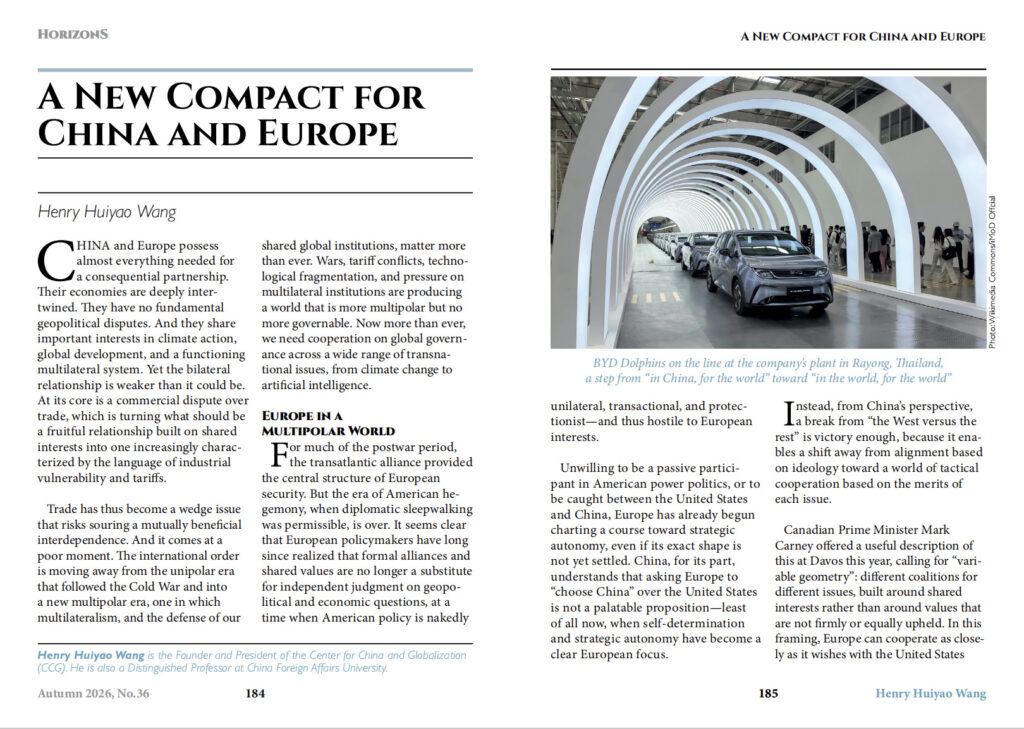
BYD Dolphins on the line at the company’s plant in Rayong, Thailand, a step from “in China, for the world” toward “in the world, for the world”
Wikimedia Commons/iMoD Official

China and Europe possess almost everything needed for a consequential partnership. Their economies are deeply intertwined. They have no fundamental geopolitical disputes. And they share important interests in climate action, global development, and a functioning multilateral system. Yet the bilateral relationship is weaker than it could be. At its core is a commercial dispute over trade, which is turning what should be a fruitful relationship built on shared interests into one increasingly characterized by the language of industrial vulnerability and tariffs.

Trade has thus become a wedge issue that risks souring a mutually beneficial interdependence. And it comes at a poor moment. The international order is moving away from the unipolar era that followed the Cold War and into a new multipolar era, one in which multilateralism, and the defense of our shared global institutions, matter more than ever. Wars, tariff conflicts, technological fragmentation, and pressure on multilateral institutions are producing a world that is more multipolar but no more governable. Now more than ever, we need cooperation on global governance across a wide range of transnational issues, from climate change to artificial intelligence.

Europe in a Multipolar World

For much of the postwar period, the transatlantic alliance provided the central structure of European security. But the era of American hegemony, when diplomatic sleepwalking was permissible, is over. It seems clear that European policymakers have long since realized that formal alliances and shared values are no longer a substitute for independent judgment on geopolitical and economic questions, at a time when American policy is nakedly unilateral, transactional, and protectionist—and thus hostile to European interests.

Unwilling to be a passive participant in American power politics, or to be caught between the United States and China, Europe has already begun charting a course toward strategic autonomy, even if its exact shape is not yet settled. China, for its part, understands that asking Europe to “choose China” over the United States is not a palatable proposition—least of all now, when self-determination and strategic autonomy have become a clear European focus.

Instead, from China’s perspective, a break from “the West versus the rest” is victory enough, because it enables a shift away from alignment based on ideology toward a world of tactical cooperation based on the merits of each issue.

Canadian Prime Minister Mark Carney offered a useful description of this at Davos this year, calling for “variable geometry”: different coalitions for different issues, built around shared interests rather than around values that are not firmly or equally upheld. In this framing, Europe can cooperate as closely as it wishes with the United States on defense, while still finding common cause with China on climate and trade reform, or with India on development. Such flexibility is increasingly the default in our plural world.

A cohesive Europe able to act independently is preferable to a divided continent whose China policy is increasingly shaped elsewhere. But that also means that policymakers in China must address European fears if they are to benefit from engagement and cooperation on shared interests.

The Changing Bargain

The core anxiety facing Europe, and the one undermining a merits-based relationship, is that the old, unspoken economic bargain—European technology and premium manufacturing in exchange for Chinese consumer goods and lower-cost production—is giving way to a more competitive relationship.

China now possesses broad industrial ecosystems, world-class infrastructure, skilled engineering talent, and the capacity for fast commercialization at scale. It no longer competes on wages alone. In electric vehicles, batteries, solar energy, machinery, telecommunications equipment, and, increasingly, advanced digital applications, Chinese firms can combine cost, speed, and technological capability.

But let us not get carried away with catastrophizing. The shared economic foundation between China and the EU remains immense. In 2025, two-way trade in goods and services exceeded €880 billion. Europe imported more than €570 billion in goods from China and exported about €200 billion, producing a large bilateral goods deficit. Yet this figure should be interpreted carefully. The European Union still recorded an overall goods surplus of approximately €128 billion in 2025, as well as a substantial current-account surplus. Nor are all imports finished products: Eurostat data shows that 57 percent of all extra-EU goods imports in 2025 were intermediate products, meaning that much of what Europe imports feeds into value-added production chains from which Europe itself benefits. Europe’s difficulty is that, while its industry remains broadly profitable, certain critical sectors are already under pressure, and the trend seems unlikely to reverse suddenly in favor of European manufacturing.

Europe is not facing this crisis in a vacuum, either. It is compounded by high energy costs, aging populations, fragmented capital markets, and chronic underinvestment. The result is a genuine fear of deindustrialization, with the attendant loss of skilled employment, supplier networks, technological capacity, and social cohesion. This worry is especially potent in the major European economies with large export-oriented manufacturing sectors, such as Germany, France, Italy, and Spain, and it makes the debate over “overcapacity” deeply politically charged.

While the imbalance is a product of industrial excellence, it can also be attributed to weak domestic demand in China. Household consumption there remains around 40 percent of GDP, while families save heavily out of concern over housing, education, health care, and retirement. The 2025 consumption action plan addressed wages, pensions, health care, childcare, paid leave, and benefits for migrant and flexible workers, and China’s first five-year plan devoted specifically to consumption subsequently set a goal of approximately 60 trillion yuan in retail sales by 2030. But it is far too early to call the effort complete. Although per capita disposable income rose by 5 percent and consumption expenditure by 4.4 percent in 2025, the first half of 2026 was weaker, and overall consumption still lags behind where it should be. Stronger pensions, health care, unemployment insurance, childcare, and portable benefits for migrant workers will help reduce precautionary saving, and greater access for foreign goods and services would ensure that stronger Chinese demand creates opportunities for European producers. That transformation, however, is not yet complete.

Europe, for its part, should recognize that competitive success is not in itself an unfair subsidy. The International Energy Agency estimates that producing a battery-electric vehicle costs more than 30 percent less in China than in advanced economies, with only about one-third of the gap attributable to the battery; a similar cost gap exists for conventional vehicles. China’s earlier industrial policies undoubtedly helped establish this ecosystem, but important forms of direct support, including national EV purchase subsidies, have already been phased out.

Rhodium Group estimates that BYD enjoys a cost advantage of approximately $4,700 per vehicle over Tesla’s operations in China, of which grants account for only about $292, while vertical integration and lower research, administrative, and supplier costs explain at least three-quarters of the difference. BYD produces roughly 70 percent of its components in-house, including its batteries. Europe should investigate market-distorting support and is right to insist on transparency, but it should not define the ecosystem, technology, and efficiencies China has built as unfair.

Nor is China’s automobile sector insulated from competition. The number of Chinese electric-vehicle makers was reported at 487 in 2018; by 2025, consolidation had reduced the market to approximately 129 brands produced by about 50 manufacturers, and only 10 to 15 are expected to be profitable by 2030. China exported approximately 5.86 million of the more than 31 million vehicles it sold in 2024, meaning that the large majority were still absorbed at home. By comparison, Volkswagen delivered 9.03 million vehicles worldwide but only 1.12 million in Germany, while Toyota and Lexus sold 10.16 million worldwide and 1.44 million in Japan. Airbus, likewise, sells approximately 68 percent of its aircraft outside Europe. Producing for global markets is accepted as normal when established European or Japanese companies do it; it should not automatically become illegitimate when Chinese firms do the same.

China’s textile industry offers a further precedent. Even as wages rose and some production moved to Vietnam, Bangladesh, and elsewhere, China retained 37 percent of global textile exports and 34 percent of clothing exports in 2017, because supplier clusters, infrastructure, skills, and continual upgrading proved more durable than low labor costs alone.

Beyond economic competition, clearer rules are urgently needed on the securitization of critical industries. The dispute over Nexperia—the Chinese-owned semiconductor company placed under Dutch government control in 2025—rattled supply chains and deepened concern in China about investing abroad. Either the company should not have been sold in the first place, or a clearer regulatory environment might have avoided a quasi-nationalization that rapidly internationalized a corporate dispute, and that still hangs over the mutual investment relationship today.

Likewise, proposals for a European instrument modeled on the United States’ Section 301 powers may offer political reassurance, but Section 301 is a blunt unilateral instrument designed to authorize retaliation. Europe would be better served by an explicitly transitional mechanism. Where an import surge threatens to destabilize domestic markets, temporary safeguards can provide time for adjustment, but they should be evidence-based, reviewable, and subject to firm sunset clauses. Their purpose should be to facilitate adaptation and negotiation, not to turn emergency protection into a permanent wall.

An Industrial Compact for Shared Competitiveness

When I visited Jean Monnet’s house outside Paris this summer, I was reminded of the method that helped build modern Europe: begin with concrete achievements that create the basis for solidarity. That method matters especially now, when trade has become a wedge issue and trust and trade cannot be separated.

We must therefore build a new industrial compact: one that aligns Chinese industrial capacity with Europe’s need for investment, innovation, and employment, and that enables China and Europe to stand together in support of a world of free, fair, and open trade.

First, China should follow through on its ongoing shift from an export– and investment-heavy model toward consumption-led growth. Alongside the social measures described above, this requires reducing the barriers faced by private and foreign businesses, improving market access in services and public procurement, and applying regulation more transparently. European companies should be able to compete in China with confidence that they will receive equal treatment and can protect their intellectual property.

Second, Europe needs to draw a sharper distinction between trade in products that present a genuine security risk and investment that strengthens European productive capacity. Concerns about supply-chain resilience and security in defined strategic sectors are unavoidable, given increasing regionalization. But a presumption against Chinese investment would deprive Europe of capital, technology, competition, and jobs precisely when it needs them most. Instead, Europe could openly welcome investment that meets its requirements on governance, data protection, labor standards, and environmental performance, while increasing the local economic contribution such production provides.

This openness should be anchored by a renewed Comprehensive Agreement on Investment. The agreement reached in principle in 2020 was never implemented and the relationship has changed too much for it simply to be revived unchanged. China and Europe should instead negotiate a new CAI covering market access, national treatment, subsidy transparency, technology transfer, public procurement, and enforceable dispute resolution. It should give European companies more predictable access to China, while establishing clear and consistent conditions for Chinese market access and investment in Europe, with an eye to creating employment and supplier networks there.

China has already demonstrated the value it places on market access by extending tariff-free treatment to goods from 53 African countries, and it could move explicitly to align its standards more closely with Europe’s. Europe, for its part, should reconsider its technology and investment restrictions—especially those implemented specifically to protect U.S. interests, such as the restrictions preventing China from purchasing advanced semiconductor equipment from ASML. Working examples of Chinese investment in Europe already exist. Chinese companies are investing in battery and vehicle production in Hungary, Slovakia, Spain, and Serbia, while European manufacturers—including Volkswagen, BMW, and Mercedes-Benz—continue to deepen their research, production, and partnership networks in China. These investments should not be viewed as isolated commercial transactions. They can become the architecture of a more balanced relationship.

Third, localization must mean more than final assembly. Joint ventures and investment agreements can encourage local supplier development, worker training, research partnerships, and the sharing of production know-how, while respecting intellectual-property rights. Chinese industry was once buoyed by European know-how through joint ventures; in return, European industry can now benefit from Chinese advances. The goal should be a competitive ecosystem in which both Chinese and European firms have a stake.

Fourth, any trade measures should be targeted and temporary. If an import surge threatens serious injury, safeguards can buy time for adaptation. But they should have clear evidentiary thresholds, sunset clauses, and review procedures. Protection without a productivity strategy merely postpones decline and risks marginalization, rather than allowing a dynamic industrial sector to emerge. At the same time, Europe can and should complete its own agenda: lowering energy costs, deepening the single market, mobilizing investment, scaling up innovative companies, and improving infrastructure.

Here, China can become Europe’s “fitness partner.” The phrase may sound counterintuitive at a moment of industrial anxiety, but the underlying idea is important. Healthy competition from China can push European companies and governments to confront long-delayed reforms, reduce costs, and innovate faster. Shelter from competitive pressure does not create health; competition, by contrast, can serve as a yardstick for rebuilding strength. China, meanwhile, gains more from a prosperous and capable Europe than from a weakened market increasingly hostile to Chinese commerce.

Finally, the compact should look beyond the bilateral market. Chinese and European joint ventures could look abroad, toward the product and development needs of the Global South. Joint production for Global South markets could be a starting point, moving in time toward joint financing of development and infrastructure to accelerate green industrialization in Africa, Asia, Latin America, and the Middle East.

This would represent the next stage of globalization: not simply Chinese companies “in China, for the world,” but “in the world, for the world.” It would spread productive capacity more widely, answer concerns about concentrated supply chains, and make development a shared undertaking rather than an arena for geopolitical competition.

From Commercial Trust to Strategic Cooperation

An industrial compact cannot by itself remove all political differences. But it would serve as a springboard, and a trust-building exercise, for deeper commitments and further work on shared interests.

Climate cooperation is the most obvious bridge. China’s manufacturing scale has lowered the global cost of solar panels, batteries, and electric vehicles, in a very real way underwriting the transition away from fossil fuels. At the same time, Europe is suffering under the weight of an energy crisis born of Russia’s invasion of Ukraine and, more recently, of upheavals in the Middle East around the Strait of Hormuz and the Bab al-Mandeb. A natural alignment would be for China and Europe to build a green partnership that helps wean the world off volatile fossil fuels and address the climate crisis. The exact shape of such measures is not yet defined, but using joint ventures, cooperation, and technology exchange to tap Chinese expertise and cost advantages could benefit both sides while buoying the global green transition. A tariff spiral in clean technology, by contrast, would make the energy transition slower and more expensive for everyone.

More broadly, China and Europe share an interest in conflict resolution. China has always been clear that sovereignty and territorial integrity apply universally, that nuclear escalation is unacceptable, and that a negotiated settlement must provide credible security for all parties. But it can do more to ease the concerns of a Europe that feels threatened by a Russia now in its fifth year of fighting in Ukraine. Working together, Europe and China could help provide an off-ramp, each using its leverage to bring the negotiating positions closer together. A truly durable settlement, acceptable to both sides, may eventually require security guarantees involving both European and non-European countries, and China could contribute through reconstruction, nuclear safety, and peacekeeping. The Middle East is another region where common interests are greater than current policy coordination suggests. Continued conflict and volatility around the straits have not only given fresh impetus to the transition away from fossil fuels but also created a new area of shared interest. Together, Europe and China could support a peace architecture with wider international participation.

Artificial intelligence governance is another opportunity. China and Europe approach data, platforms, and regulation differently, but both reject a future in which a handful of private companies set global rules without public accountability. They can work together on safety testing, scientific exchange, interoperable standards, and the application of AI to health, climate, and development. Agreement will be difficult, but building a shared environment for rule-making would help hedge against fragmentation in this rapidly developing field.

Finally, China and the EU have both long advocated restoring the World Trade Organization. A revitalized WTO already contains tools to address subsidies and demonstrable injury. Boeing and Airbus were both found, in WTO disputes, to have benefited from improper support, and those cases were handled through multilateral proceedings rather than through an open-ended campaign against either side’s wider industrial success. The WTO’s dispute-settlement system must now be restored, its rules on subsidies and state enterprises updated, and its development functions strengthened. The United States weakened that system by blocking appointments to the Appellate Body after adverse rulings; but China and Europe are both major beneficiaries of an open trading system, and both can press for reform.

None of this will be sustainable without renewed contact between societies. Direct flights, student exchanges, tourism, university partnerships, city-to-city links, and think-tank dialogue all have their roles to play, for they are the infrastructure of mutual understanding.

China–Europe relations will not always be perfectly aligned, and they will likely continue to contain elements of cooperation, competition, and disagreement. But together, we can put to rest the prospect of weaponized interdependence and move instead toward win-win interdependence.

Europe does not need to become less European in order to cooperate with China, nor does China need to adopt European political mores for cooperation to succeed. Both are now free to cooperate selectively and on the merits of each issue. And a world in which China and Europe cannot find areas of deep mutual interest—despite their deep economic ties and their shared stake in multilateralism—is a world that is measurably poorer for it.


India in Transition: “The Rain that Chases Rhinos”: Community Crisis Communication in the Eastern Himalayas  

[by Mirza Zulfiqur Rahman, Center for the Advanced Study of India]

In the plains of Assam, different kinds of rain are often distinguished through vivid local expressions that reflect their intensity and impact on everyday life. One such term is “sagoli-kheda-borokhun” (the rain that chases goats). It refers to a light shower, enough to send goats hurrying into their sheds while people continue with their daily activities. As the rainfall intensifies, it may be described as “goru-kheda-borokhun” (cow-chasing rain), followed by “manuh-kheda-borokhun” (people-chasing rain), when even humans seek shelter from the downpour. At the extreme end of this scale of vernacular expressions of rainfall intensity lies “gor-kheda-borokhun” (the rain that chases away rhinos), evoking a deluge so intense that even Assam’s iconic one-horned rhinoceroses would retreat and look for shelter. With rapid urbanization and changing rainfall patterns, such beautiful expressions of rain have lost continuous usage, especially among the younger generation, who no longer name types of rains.

These expressions reveal the richly textured ways in which communities inhabiting the water-abundant landscapes of Northeast India have understood and interpreted rainfall. Their environmental imagination is shaped not only by the rains themselves but also by the sounds, movements, and rhythms of the ecosystems around them. Among the most evocative signs of the approaching monsoon was the chorus of frogs inhabiting the “pukhuris” (ponds), “khaals” (natural drainage channels), and “beels” (wetlands). Their persistent croaking, described locally as the rhythmic “tur-tu-rai” of an assembled army of frogs, would fill the night air. Hearing this familiar symphony, people would often remark that the rains were on their way.

In today’s times, such soundscapes have diminished considerably and the traditional knowledge of being able to predict rains by observing sounds and signs in nature have not been passed on. The familiar chorus of frogs on humid nights has grown noticeably quieter as ponds have deteriorated, wetlands have been drained, and traditional water bodies have gradually disappeared from the landscape. Here, I look at the languages and imaginations of communities, and how these interact with the annual rains and storms along the Eastern Himalayas, how they keep record of the changes in the climate patterns in their community lives through their vernacular depictions of storms and rains, and how the current climate crisis has clouded their traditional communication methods.

Water-Abundant Worlds

The Himalayan river-systems and the plains they nourish have always been regarded as a water-abundant environment, with monsoons, storms and rains forming an essential part of the lives and imaginations of communities living there. Nation-state borders, which straddle river-systems and regions across the Himalayas, bring in an additional layer of complexity to the various discourses of climate change disasters and patterns in the region, which are already exacerbated by infrastructural interventions on the river systems.

The languages and imaginations of Himalayan communities through which they describe the monsoons, climate change, storms, and rainfall patterns in their daily lives and natural environment, and how they are shaped by the interventions and narratives deployed by the nation-state in the Eastern Himalayas serve as critical crisis communication, often proving more useful and timely than government communication. The monsoon rains that stream in from the Indian Ocean currents and extend up to the heights of the easternmost fringes of the Himalayas bring most of the Himalayan river-systems to life. The monsoon clouds, after they enter Northeast India, play a veritable ping-pong between the low-lying rolling hills of the Patkai ranges and the towering eastern Himalayan mountain ranges, and the rains and storms that ensue from this match nourish the various communities, sustain the forests, and shape the landscape. This interaction forms an archive of climate disasters in the region.

Modern meteorological forecasting methods have greatly improved with scientific progress and modelling and availability of long-term data. However, from my research, it has been evident that the medium-range and long-range predictions of storms and rainfall patterns have low reliability at the local level, meaning state-led communication methods are not effective or timely. There are externalities of data collection challenges and reliability of what actually constitutes long-term data and the rapid infrastructure push and anthropogenic changes in the context of the fragile and ever-crumbling-and-forming Eastern Himalayas.

Bordoisila is the personified name given to an annual spring storm that ravages the foothills of the Eastern Himalayas, often spanning across Assam, Meghalaya, Arunachal Pradesh, Nagaland, and Bhutan. The community memory of Bordoisila is archived over time through stories of the storm returning to “her maternal home,” Assam, to celebrate Bohag Bihu, the mid-April spring festival, and accounting for the ferocity and devastation it regularly brings along, as well as the variation in timing of the storm’s arrival and when “she returns” after celebrating. Communities provide token offerings of festive food and clothing to Bordoisila, imploring the storm to pass by gently in “her path.” The variation in timing and ferocity of the storm is recorded in recent community memory as the personified storm managing to come home early this year as “she got to leave early from her workplace.” Originating in the Chotanagpur plateau and gathering force from the Bay of Bengal, she again returns in an angry mood as if “she was not treated well by her mother” with festive goodies and good food.

Personified Storms

Over years of research in the region, I have noted that communities rarely rely on modern meteorological forecasting information for the stormy season. They know it only by community memory and their sense of the ferocity of the storm when it passes by—among a series of spring storms—and declare that “she has finally arrived” and “she will soon return after celebrating Bihu.” It is along the trail of Bordoisila that the first wave of floods also arrives in Assam, and the traditional knowledge repository known as “Dakor Boson,” a collection of vernacular prose and poetry sayings, depicting how the coming monsoon and the ensuing agricultural cropping cycle will span out. The first floods were always celebrated with the Bihu dance, and the storm Bordoisila is revered despite its ferocity, as it brings the rain and nutrient-rich silt to nourish the overall landscape. However, with climate change and anthropogenic interventions, the language of climate crises has changed from a sense of celebration and reverence to utter despair.

Over the past several decades, Northeast India has witnessed profound shifts in its monsoon patterns. Periods of unusually intense rainfall have triggered devastating floods, while prolonged dry spells have brought drought-like conditions to many areas. In response to persistent droughts, communities across Assam have continued to observe customs such as frog-marriage ceremonies, invoking these creatures regarded as messengers of the rain-gods, to restore the rains through their renewed croaking. In Meghalaya, rainfall that used to last nine nights and days in a continuous rhythmic pattern, known as “slap-khyndai-miet-khyndai-sngi,” has, over recent years, lost its original community language emphasis, as such long-enduring rainfall patterns have diminished greatly.

Among the Idu-Mishmi of eastern Arunachal Pradesh, traditional ritual specialists are called upon to communicate with rain spirits, seeking their intervention both when the rains fail to arrive and when incessant downpours raise fears of catastrophic flooding. The Idu-Mishmi term for rain, “ayyo or ayyoyo,” carries deep cultural significance within these practices. Jibi Pulu, an Idu-Mishmi community leader and environmental activist, points to how different kinds of rainfall were once understood to perform distinct ecological functions in the forests of the Dibang Valley. Certain rains signaled the shedding of leaves, others supported flowering cycles, while some heralded the arrival of migratory birds that seasonally visited the region’s rich forest ecosystems. However, he observed that such patterns have become increasingly difficult to anticipate, as deforestation, climate change, and human intervention have disrupted environmental rhythms that earlier generations could interpret with a high confidence.

Many Idu-Mishmi elders similarly attribute the growing unpredictability of rainfall and the increasing occurrence of extreme floods on the Dibang River and its tributaries to a deterioration in the relationship between people and the natural world. They regard practices such as the indiscriminate slaughter of animals and the growing trend of winter picnics on dry riverbeds (where meals are prepared directly on the exposed riverbed) as acts that offend river spirits. In their understanding, these transgressions disturb the balance between humans and the spiritual forces inhabiting the landscape, contributing to erratic weather patterns and destructive flooding events. Some historic flooding events are referred to by communities with names of where such flooding originated, such as the “China-paani” of the year 2000 and the recent episodes of “Bhutan-baanpaani” along the Bhutan–Assam border. This vocabulary has expanded to include specific dam-induced floods such as Ranganadi-floods in Assam.

Culturally Grounded Approaches

The diverse linguistic expressions, traditional knowledge systems, and lived experiences through which indigenous communities across Northeast India understand rainfall, storms, climate variability, and recurring flood events deserve to be documented, connected, and amplified within broader conversations on environmental democracy and transboundary cooperation. Bringing these perspectives together can help foster more inclusive dialogues across the Eastern Himalayas and the Patkai mountain ranges, enabling local communities to participate meaningfully in decision-making processes concerning ecology, environmental governance, infrastructure development, disaster preparedness, crisis communication, and other issues that directly shape their everyday lives and livelihoods. For generations, communities have relied on close observation of their surroundings to interpret changes in weather and rainfall patterns, rhythms of rivers, and flood cycles.

As environmental transformations become more pronounced and traditional indicators grow increasingly uncertain, their ability to understand and articulate these changes offers valuable insights into the realities of climate change on the ground. Recognizing and engaging with such lived experiences, local knowledge, and environmental imaginations is, therefore, essential to strengthening civil society participation and building more democratic, responsive, and culturally grounded approaches to environmental governance in the region. Modern meteorological forecasting methods need to learn from traditional wisdom and social innovation and the vast archive of knowledge which have recorded past disasters and also can predict future ones. The rapid pace and scale of transformation along the Eastern Himalayas are rendering traditional knowledge systems incapable of providing climate solutions.

Mirza Zulfiqur Rahman completed his doctoral research on the Brahmaputra River Basin geopolitics from the Indian Institute of Technology, Guwahati, and is currently a Research Associate at Heinrich Böll Stiftung, India and Visiting Associate Fellow at the Institute of Chinese Studies, Delhi, India. 

All photos courtesy of Mirza Zulfiqur Rahman.

[This is the second in a multi-part series published in collaboration with the Centre of Excellence for Himalayan Studies, at the Shiv Nadar University, Delhi NCR, a research center focused on the economy, borders, identities, environment, and regional geopolitics of the wider Himalayan region including the Hindu Kush and the Karakoram.]

Climate-Watching: A Collision of Economics and History: In Pennsylvania, the Debate over Climate Is a Bitter One

The state has both a long history of environmental action and a longstanding dependence on fossil fuels.

[from Inside Climate News, by David Shribman, July 17, 2022]

This is a state where natural gas production reached a record 7.1 trillion cubic feet in 2020, the most of any state outside Texas and more than the energy supplied by the state’s nuclear power plants. It’s a state that has 49 underground gas storage sites, more than any other in the nation.  Its coal production ranks behind only Wyoming and West Virginia, and only Wyoming and Texas export more total energy to other parts of the country.

This is also a state where voters will select a new governor and a new senator in November. No state has more vital elections this year; no state has a more complicated and more contentious political culture; and no state provides a better test case for environmental issues and for the future of the climate-change debate.

Welcome to Pennsylvania.

Don’t pack a sweater: the average temperature in the state has risen by 2.8 degrees Fahrenheit since the first Earth Day, in 1970, a bigger increase than the national average.

Don’t breathe deeply: the state’s two major cities, Philadelphia and Pittsburgh, are among the nation’s worst 25 metropolitan areas for annual particulate air pollution. 

And don’t fail to note the irony—of a state whose economy and lifestyle are unusually dependent on fossil fuels but whose history is unusually rich in the love of nature and the protection of the environment. It is this collision of economics and history that makes environmental issues so emotional, the debate so bitter, the outcome so vital.

Pennsylvania was the home of John J. Audubon, who cultivated in Americans a love of bird life; Rachel Carson, whose clarion call about the environment jolted the country and shook the Kennedy administration; John Chapman, known to school children nationwide as Johnny Appleseed; J. Horace McFarland, a photographer and conservationist celebrated as the Father of the National Park Service; Harold L. Ickes, the pathfinding Secretary of the Interior during the Franklin D. Roosevelt years who shored up perhaps the least effective and most corrupt arm of government while elevating the standards and practices of the National Park Service; and Jerome Rodale, the publisher whose books gave voice to the ethos of sustainable agriculture. And it was the adopted home of William Penn, the founder of the colony that would bear his name and the author of a conservation edict requiring that 20 percent of the land in the Province of Pennsylvania be preserved as wooded. It is no surprise that Pennsylvania was one of the first states to adopt an Environmental Bill of Rights.

But Pennsylvania also was the setting for environmental milestones of an entirely different type. In Donora, a 1948 smog episode killed 20 people and saddled some 40 percent of the town’s population with respiratory disease. A third of a century later, the partial meltdown of Unit 2 of the Three Mile Island nuclear plant in Dauphin County spewed radioactivity into the Harrisburg area. 

The state has had multiple mine disasters and the subsequent contamination of nearby fields and streams. As early as 1883, the explorer and adventure travel writer Willard Glazer wrote that Pittsburgh’s industry was “rendered possible by the coal which abounds in measureless quantity in the immediate neighborhood of the city”—and which contributed to the poisoning of many of the area’s waterways and the despoiling of the air. As late as 1940, 81 percent of the city’s dwellings burned coal. The emissions from the steel mills that helped the country win two world wars and build a robust mass-consumer economy only added to the environmental distress.

This duality is part of, defines all of, Pennsylvania’s natural and political history.  It is embedded in the origin story of Pennsylvania and reinforced in contemporary history. In the WPA Guide to Pennsylvania, the writers of the New Deal-era product of the Federal Writers Project spoke in 1940 of how the main plant of the Pittsburgh Plate Glass Company in Ford City, Pennsylvania, “extends for a mile along Third Avenue in a series of long squat units composed of red brick,” and how the state’s Red Hills were exceeded only in Belgium as “the finest farm section in the world.” Precisely three-quarters of a century ago, in his classic 1947 book, Inside U.S.A., the journalist John Gunther wrote, “To a degree the story of Pennsylvania is the story of iron, coal, and steel. Yet of its 26 million acres, almost half is forest!”

A state known for producing metals and fouling the air is also a state known for hunting grouse, pheasant, deer and bear. A state teeming with factory workers is a state loaded with farmers. A state with two major power centers, Philadelphia and Pittsburgh, is a state where elections often are decided in the agricultural “T” between the two. A state known for building belching steel plants is also a state where, this spring, the owners of Fallingwater, the Frank Lloyd Wright masterpiece, announced that they would install solar panels on the iconic house to offset the power used at the site on Bear Run in Fayette County. And when it comes to environmental issues, Pennsylvania is a state where manufacturing and banking interests have enormous influence in the stately Capitol in Harrisburg, and also a state full of climate activists determined to hold industry in check and battle climate change.

“It is particularly difficult in Pennsylvania to come to any agreement on environmental issues because coal and natural gas have countervailing pressure against attempts to deal with climate change,” said Joel A. Tarr, a Carnegie Mellon University historian who studies the effect of technology on the urban environment. “When you tell people that we have a problem with air quality here, their response is that it used to be much worse. This is a place where we won’t have a water-quality solution until we have a cholera epidemic and we won’t address climate change until we have a major catastrophe that brings it home to Pennsylvania.”

Not that there haven’t been efforts. “A generalized good always takes a back seat to a specific interest,” Gov. Tom Wolf, a Democrat, told me in an interview for this article. “We all benefit from a healthy environment, but there are specific interests that are specifically harmed if we do the right thing. Those specific interests have a lot of power in places like Harrisburg.”

The frequent result of these countervailing impulses and competing interests: paralysis on environmental matters, even as the latest United Nations report, published in April, warned that the world was on a path to a rate of global warming more than double the 2.7-degrees Fahrenheit set as the preferred global goal in 2015 in Paris.

U.N. Secretary General António Guterres warned that the result would be “unprecedented heatwaves, terrifying storms, widespread water shortages and the extinction of a million species of plants and animals,” adding, “This is not fiction or exaggeration. It is what science tells us will result from our current energy policies.”

 A City (and State) in Crisis

As man proceeds toward his announced goal of the conquest of nature, he has written a depressing record of destruction, directed not only against the earth he inhabits but against the life that shares it with him.

— Rachel Carson, in Silent Spring

In many ways, Pittsburgh—once smoky, still gritty, now proud of its “eds-and-meds” economy, its edgy youth culture and yeasty locavore restaurant scene—stands as a symbol of Pennsylvania’s environmental and climate crisis.

In the past half century, the city’s average temperature has risen by 2.8 degrees, according to figures compiled by Climate Central—a jarring result for a city where the local political grandees like to emphasize how the area has moved beyond its heavy-manufacturing past. Even with the dramatic decline in the steel industry, Pittsburgh remains the 10th worst city in the country in terms of the presence of short-term particulate matter, and the Breathe Meter indicator that monitors the area’s air has found that 88.5 percent of metro areas in the country have cleaner air. Moreover, a study by Community Partners in Asthma Care found that the rate of asthma in Pittsburgh-area school children is nearly three times the national average.

For generations, no essay on the environment of Pennsylvania was complete without citing Charles Dickens’ characterization of mid-19th century Pittsburgh as “hell with the lid lifted,” or Lincoln Steffens’ complaint about the city’s “smoky gloom” and the “volcanic light upon the cloud of mist and smoke” that appeared with the periodic opening of the blast furnaces. When my wife and I bought a house in Pittsburgh two decades ago—when almost the entire steel industry had closed down in the area—we paid thousands of dollars to have a century’s worth of soot blasted from the brick facade.

All of that before the word “fracking” was introduced into the lexicon of the Pennsylvania debate.

“There is gas in the ground and people have been taking it out of the ground since before I was governor,” Wolf said in the interview. “If I could snap my fingers, we would go completely to wind and solar. I haven’t figured out how to do this. The job is to manage the transition to that energy future.”

Republicans in recent years have sought to deregulate the natural gas industry, expand drilling, ease stipulations for gas permits, open state parklands for energy extraction and open new opportunities for gas pipelines, having the state subsidize them.

“These things were not always Republican goals,” said David Hess, who was secretary of the Pennsylvania Department of Environmental Protection under Republican Governors Tom Ridge and Mark Schweiker. “Republicans once had environmental issues as a pretty high priority. Only recently have Republicans changed their approach. This issue is no longer bipartisan, and that applies especially to climate change. But the only way we can break the loop we are on is to do something different, and yet industry and their Republican allies want more and more. Putting all the stuff in the air from fossil fuels cannot be good, especially when we have clean alternatives.”

And yet the Keystone State has not been entirely a conscientious objector to environmental initiatives.

At a time when there was so much soot in the air that Pittsburgh kept its street lights on all day long and businessmen were forced to change their soiled shirts after returning from a walk to a lunch appointment, Mayor David Lawrence undertook a dramatic anti-smoke campaign in 1946 that greatly improved the air quality in the city. “I am convinced that our people want clean air,” the mayor said in his first inaugural address. “There is no other single thing which will so dramatically improve the appearance, the health, the pride, the spirit of the city.”

Lawrence was not alone. “The advocates of the Pittsburgh Renaissance conceived of decreased pollution as a means of assisting the transition of the city from a heavy-industry to a service economy by improving, modernizing, and reconstructing its central business district,” Stefano Laconi, who teaches the history of the Americas at the University of Florence, wrote in a 1999 essay in the journal Pennsylvania History. He argued that the initiative provided Lawrence “not only with the foundation of a public-private partnership but also with the basis of a bipartisan political coalition with local Republican moguls like Richard King Mellon.”

Years later, Republican Gov. Ridge, with Democratic support, began his administration with an initiative to clean up and redevelop brownfield sites. At the same time, the legislature won national attention by reorganizing the state’s approach to these issues, creating separate departments of Environmental Protection, which concentrates on protecting the air, water and land from pollution, and Conservation and Natural Resources, focused on state parks and state forests.

“At the beginning of my administration, I issued a challenge to Pennsylvania to become a national leader in finding new ways to protect our environment while promoting economic progress, to provide for the needs of the present without compromising the ability for future generations to meet needs of their own, and to think in terms of sustainability, with both the economy and our environment,” Ridge told me.  

The governor was fond of quoting the adage, “We do not inherit the earth from our ancestors; we borrow it from our children.” As governor, he said that,“I would often remind myself that the air we breathe and the water we drink should never be taken for granted.”

Much to be Done and an Election That Matters

The fact that a man is to vote forces him to think.

— Jonathan Chapman, known as Johnny Appleseed

Ordinarily, the multi-interest collision of jobs and climate, energy and environment, might be top-shelf issues in a state that ranks second only to Texas in energy production and that had the largest increase in natural-gas production in the last decade. But that collision is a side show rather than the main event.

“All of these candidates need to speak up and tell us what they would do about the energy situation and the climate crisis that is growing more critical by the minute,” said Larry Schweiger, a former president of the National Wildlife Federation, PennFuture and the Western Pennsylvania Conservancy. “It is very frustrating to see candidates for governor and the Senate not making an effort to say how they would address these urgent issues. Both parties are guilty of  this, and it is a big omission and a big problem.”

Now Democratic Attorney General Josh Shapiro and Republican state Sen. Douglas Mastriano are facing off for governor and Democratic Lt. Gov. John Fetterman and Republican celebrity doctor Mehmet Oz are fighting for the U.S. Senate seat being relinquished by GOP Sen. Patrick Toomey. 

The four will face questions about their commitment to climate change with new urgency—and new stakes. And the pressure may well come from a newly critical group of voters: young people.

A Harris Poll survey conducted with 4-H found just fewer than half of teenagers believe political and global leaders are taking meaningful action to protect the environment. There is reason to believe that the top tier of teenagers, eligible to vote, and their older brothers and sisters will be motivated and perhaps mobilized by these issues.

“There’s no question that environmental issues are far more critical for younger voters,” said Steven Farnsworth, the political scientist who is director of University of Mary Washington’s Center for Leadership and Media Studies in Virginia. “This has been going on since the first Earth Day. It has to do with the fact that younger people are going to be on this planet longer than older people.”

The approach that these four nominees bring to these matters is important. “It’s not about issues, it’s about values,” said John Della Volpe, director of polling at Harvard Kennedy School of Government’s Institute of Politics and the author of the newly published How Gen Z is Channeling Their Fear and Passion to Save America. “And the degree to which candidates can connect climate change into values, and display that they are thinking about the future, they could affect the turnout of young people and how they do vote.”

There is much to be done. Pennsylvania ranks 19th among the states in the rate of growth for wind power, according to the PennEnvironment Research and Policy Center, and 23rd among the states in the rate of growth for solar power. The potential is great; if solar units were placed on the roofs of Pennsylvania’s big-box stores, for example, the result could be the annual production of more than 3,000 gigawatt-hours of clean electricity. There are bills in the legislature to require the state’s suppliers of electricity to generate nearly a third of their energy from renewable sources by 2030 and to put the state on a course to having 100 percent of its energy needs provided by wind and solar energy and other sources by the middle of the century.

Much of the emphasis will be on the state level, which is why the gubernatorial race between Shapiro, the Democratic attorney general, and GOP state Sen. Mastriano is so critical.

Shapiro speaks easily about clean energy, says he believes that more electric-vehicle infrastructure investments must be made, and pledges strict monitoring of the state’s utility companies. But he has broken with Gov. Wolf over whether the state should join the Regional Greenhouse Gas Initiative, known as RGGI, which puts a price and descending cap on carbon emissions. With an eye toward the power of the state’s building trades, he believes RGGI will be ineffective and will cause hardship among the state’s energy workers and companies.

As the state’s Democratic Senate candidate, Lt. Gov. Fetterman speaks of the climate issue as an “existential crisis” and argues that the jobs-versus-environment calculus represents a false choice. “We still need to make stuff in this country, you know?” A onetime advocate of a moratorium on new fracking sites, he now sees a rationale for a limited, perhaps temporary, expansion. “I have been steadfastly talking about how important it is that we retain the manufacturing jobs and the energy jobs in Pennsylvania that currently provide our energy security,” he said at a debate at Carnegie Mellon University, but added, “We also must acknowledge and recognize that we have to trend …. away from these.”

The Republican candidates in these two high-profile races take substantially different positions from their Democratic rivals. Oz, the Senate candidate, has abandoned his onetime advocacy of strict environmental regulation and calls for the “freedom to frack.” Mastriano, the Republican gubernatorial nominee, has argued that Wolf’s RGGI plan would “do far more harm than good” and this spring he submitted legislation to ban the federal government from regulating coal and gas extraction in Pennsylvania and to exempt the state’s industrial plants from the federal wastewater and air pollution rules. “We’re going to open up our energy sector like you’ve never seen,” Mastriano said at his victory celebration after he won the GOP primary.

A Monumental Figure

Unless we practice conservation, those who come after us will have to pay the price of misery, degradation, and failure for the progress and prosperity of our day.

— Gifford Pinchot

If there is one symbol of the tensions, perspectives, history and impulses of Pennsylvania in environmental matters it is not the gentle Audubon, who nurtured a love of birds in the heart and mind of the nation, nor the hard-faced leaders of power plants and coal mines. It is not the passionate Carson nor the resolute lobbyists who besiege the legislative chambers in Harrisburg. All are part of the Keystone State culture, but none of them personifies the colliding interests in this vital and emotional area of political conflict.

Only one person does, and that is Gifford Pinchot.

Today, Pinchot is largely a forgotten figure, overshadowed as a conservationist by John Muir, eclipsed as a visionary by Theodore Roosevelt. Today, Gaylord Nelson, the late senator from Wisconsin and the founder of Earth Day, is regarded as the political magus of the conservation movement, a title once plausibly claimed by Pinchot. Today the world regards Wangari Maath, the Kenyan activist who founded the Green Belt Movement and won the 2004 Nobel Peace Prize, as the most celebrated troubadour and warrior for the environment.

All these titles once belonged to Pinchot, a monumental figure who was the 28th governor of the Commonwealth of Pennsylvania. He served two terms in the Capitol and lived in a family home named Grey Towers, just outside the tourist town of Milford, Pennsylvania. The home is now a National Historic Site and home to the Pinchot Institute for Conservation, dedicated to fashioning innovative responses to conservation and environmental challenges.

Pinchot, who died in 1946, went to his grave with a green-plated resume: First chief of the U.S. Forest Service. Chief of the U.S. Division of Forestry. Head of the Pennsylvania forestry division. At one time, the term “Pinchotism” was derided in Congress by business interests the way “Reaganomics” was criticized by early 1980s Democrats—until Pinchotism, like Reagonomics, was redeemed in the public eye.

And yet Pinchot does not wear an unblemished hero’s halo in history. Until recent damaging disclosures, that belonged to his chief rival, John Muir, his one-time ally and patron, though the shine on Muir was darkened in 2020, when Michael Brune, executive director of the Sierra Club that Muir helped found in 1892, cited him for having “made derogatory comments about Black people and Indigenous peoples that drew on deeply harmful racist stereotypes, though his views evolved later in his life.”

But in the long-ago conflict between Muir and Pinchot that spanned the period 1908 to 1913 and spilled over into later years is a story that captures the conflict at the heart of the environmental issue in the nation—and in Pinchot’s home state.

In the perspective of today, Pinchot had an ability, in the phrasing of his biographer, Char Miller, “to maintain what might seem like contradictory impulses—the desire to live simultaneously and within nature, to exult in its splendors while exploring its resources.” But in his titanic clash with Muir, Pinchot was cast as the bête noire of the movement he plausibly could claim to have helped create.

“Muir was all about preservation and Pinchot was about wise or multiple uses of the land,” Douglas Brinkley, the Rice University historian who wrote about the Pinchot–Muir conflict in his 2010 The Wilderness Warrior, said in an interview. “The dispute was over what was conservation. Muir became a folk hero through the long shadow of the Sierra Club but Pinchot never had a legacy organization group.”

The venue of the clash was the Hetch Hetchy Valley in Yosemite National Park, but its implications extended nationwide and the forces at play continue to collide in Pennsylvania. Pinchot, a close advisor and friend to Theodore Roosevelt, was caught in the vise created by the moral passion of conservationists and the physical thirst of Californians. San Francisco wanted water, early environmentalists worshiped wilderness. There was no middle ground, though Pinchot was caught in the middle of the struggle.

It was, as the Library of Congress would characterize it a century later, “a division between those committed to preserving the wilderness and those more interested in efficient management of its use.” The two combatants had conflicting profiles: Pinchot was an insider, Muir was an outsider. Thus Muir claimed the moral high ground as the protector of the outdoors. The battle between the two men had its origins in Muir’s evolution to a view that, as Miller characterized it in his monumental 2001 Gifford Pinchot and the Making of Modern Environmentalism, “the practice of forestry and the preservation of wilderness were incompatible, a tentative conclusion that would harden into conviction in the first years of the new century.” The result was temporarily to place Pinchot, politically if not emotionally—and supremely awkwardly—in the same camp as his traditional opponents, business executives with a lust for land and lucre.

Pinchot saw this issue as a struggle between “the extreme desirability of preserving the Hetch Hetchy in its original beauty” against the legitimate water needs of San Francisco and other communities in the Bay area. Muir, in a letter to Pinchot, said the proposal to flood the valley to provide water for “the dear people” was “full of graft,” later characterizing it as a moral outrage and a mortal threat to wilderness values. It was a classic confrontation between a master of the political world and a mystic of the natural world.

The struggle wore on for years. Later Pinchot would tell a congressional hearing that “injury to Hetch Hetchy by substituting a lake for the present swampy shore of the valley…is altogether unimportant when compared with the benefits to be derived from its use from a reservoir.”

In the end, Hetch Hetchy was flooded and, though Pinchot remained prominent in conservation circles—he was advising Franklin Delano Roosevelt on these matters as they related to the future United Nations as late as the World War II years—his reputation was no longer unsullied.

The crosswinds of the Hetch Hetchy controversy—the issues it raised, the passions it ignited, the arguments it prompted—now blow as a gale through Pinchot’s home state. They are the prevailing winds of Pennsylvania.

A Step in the Right Direction

A true conservationist is a man who knows that the world is not given by his fathers, but borrowed from his children.

— John J. Audubon

Coal once accounted for 60 percent of all electricity generated in Pennsylvania, a rate that has declined by more than half; today only a handful of large grid-connected coal-fired electric plants operate in the state. That represents a steep decline, though Homer City Generation said this spring that it would not follow through with tentative plans to deactivate its units in Indiana County. “This decreasing dependence on these sorts of plants shows we are going in the right direction in reducing climate-changing emissions from coal-fired plants,” said Hess, the former GOP environmental commissioner. “But it is mostly because of the competition between natural gas and coal. The problem is that we are now getting down to the point in the power sector that we can’t get additional big emission reductions. There aren’t more plants to close to give us those reductions. So we have to adopt other kinds of strategies.”

Pennsylvania has more than 86,000 miles of streams, more than any state in the lower 48. The miles of these waterways that can support brook trout are dwindling, in part because of climate change and in part because the invasion of the hemlock wooly adelgid insect has infected the shoreline hemlock trees that otherwise would provide shade for the streams.

This is only the latest incarnation of the centuries-long decline in the health of the state’s waterways. In the 18th century, the British army captain Harry Gordon pronounced the site of the confluence of Pittsburgh’s three rivers as “the most healthy, the most pleasant, the most commodious, the most fertile spot of Earth known to European people.” A century later, another British observer said that in Pittsburgh, “Man befouled the streams, bedraggled their banks, ripped up the cliffs, hacked down the trees, and dumped refuse in their stead.”

But the environmental crisis is not confined to western Pennsylvania. To take a random reading of air pollution in the state, Pennsylvania’s worst air quality on April 5 was in Mechanicsburg, outside Harrisburg, in the center of the state, followed by New Bloomfield, 23 miles away, according to IQ Air real-time figures. At the same time, Wilkes-Barre, with an average increased temperature of 3.3 degrees since 1970, substantially beats the average national rate of 2.6 degrees. So does State College, at an increase of 3 degrees.

Over the decades, the emphasis has changed from “conservation” to “stopping climate change,” with the threat of neighborhood contamination (the late 1970s), acid rain (the early 1980s), and the ozone hole (the mid 1980s) joined by global warming, a term introduced into the scientific and then the political lexicon when James Hansen, a NASA atmospheric expert warned a Congressional committee in 1988 that he and a set of climate modelers believed they could “confidently state that major greenhouse climate changes are a certainty.” He told the lawmakers that “the global warming predicted in the next 20 years will make the Earth warmer than it has been in the past 100,000 years.”

Opposition from an Unusual Coalition

To contemplate nature, magnificently garbed as it is in this country, is to restore peace to the mind, even if it does make one realize how small and petty and futile the human individual really is.

— Harold Ickes

Many of the political tensions in Pennsylvania were visible in the debate that began last year—and became even more bitter this year—over RGGI. Gov. Wolf made becoming a part of the alliance of 10 New England and Middle Atlantic states—and, as a result reducing Pennsylvania’s greenhouse gas emissions by as many as 227 million tons by 2030—one of the top priorities of his final year in office.

The result was opposition by an unusual coalition of Republicans and labor unions, who argued that the governor’s plan would reduce jobs in the state.

“The ‘jobs-versus-environment’ framework is almost always part of these debates,” said Christopher Borick, a political scientist at Muhlenberg College in Allentown. “Environmental laws are for the public good—to protect the health and well being of individuals—so it is hard to argue against that. So what do you use as your argument? Jobs. It is sometimes a false choice, and often the environmentally sensitive approach can be a good economic choice. But politically, it is very powerful argument even if the reality isn’t the case.”

Last December, the Republican-controlled legislature passed a resolution that would halt the governor’s effort to join RGGI. The governor then exercised his veto, citing technicalities in the resolution and arguing that joining the group “is a vital step for Pennsylvania to reduce carbon emissions and achieve our climate goals.” When a stay issued by the Commonwealth Court expired in late April, the Wolf administration went ahead and published the regulation, and in less than a day the odd-couple coalition of coal unions and coal companies went to court to fight the order, which required operators of power plants fired by coal and natural gas to buy allowances for every ton of carbon dioxide they emitted.

“I want to give $150 million a year to a board headed by organized labor,” the governor, referring to a trust fund to aid individuals displaced by the transition to sustainable energy sources, told Inside Climate News as the controversy raged. “What don’t they like about this?”

In a separate interview, state Sen. Wayne Fontana, the chairman of the chamber’s Democratic Caucus and a member of the Game and Fisheries Committee, described the resistance mounted by Republicans in the legislature as “a wedge to use against the Democratic gubernatorial candidate in the fall.” He said the state has taken substantial steps to address environmental threats, arguing, “We have done a lot with lead in the water, we have beaten up air and water polluters.”

A Lack of Urgency

And so we live in a time when change comes rapidly—a time when much of that change is, at least for long periods, irrevocable. This is what makes our own task so urgent. It is not often that a generation is challenged, as we today are challenged. For what we fail to do—what we let go by default, can perhaps never be done.

— Rachel Carson, accepting the Audubon Medal of the National Audubon Society in 1963

Now the challenge is global warming, which dwarfs the threat from 19th century industrial pollution and 20th century acid rain.

This past year did not have a silent spring when it came to the climate change issue. Indeed, the reports were more dire, the warnings more urgent, the lack of substantial attention more dangerous. The world, and Pennsylvania, face dramatic alternative outcomes from their actions or inaction. One choice might redound to cities underwater or lower energy consumption as a result of the creation of, in the characterization of the Intergovernmental Panel on Climate Change, of  “compact, walkable cities.” Another might be a continued reliance on private, gasoline-powered automobiles, trucks and buses or the “electrification of transport in combination with low-emission energy sources, and enhanced carbon uptake and storage using nature.”

The April report of the IPCC, the United Nations group that assesses science in relation to global warming, was sobering if not chilling. The bottom line: Net emissions are continuing to rise. “It’s now or never, if we want to limit global warming to 1.5°C [2.7°F] without immediate and deep emissions reductions across all sectors,” said Jim Skea, co-chair of the working group that produced the latest report, “it will be impossible.”

That will require what the IPCC working group co-chair Priyadarshi Shukla described as “the right policies, infrastructure and technology…to enable changes to our lifestyles and behavior.” And it will require a combination of policies and planning.

“We are opposed to long-term planning here in Pennsylvania,” said Professor Tarr of Carnegie Mellon University. “We react to crises, and we do so inadequately. People here generally have no sense of urgency about these kinds of issues.”

David Shribman served as editor of the Pittsburgh Post-Gazette for 16 years and won a Pulitzer Prize for his reporting on American political culture as Washington bureau chief of The Boston Globe. He now writes a nationally syndicated column, contributes a separate column to The Globe and Mail in Canada, and teaches American politics at both McGill University’s Max Bell School of Public Policy and Carnegie Mellon University.

Climate Policy: Loss and Damage from Climate Change

(from Social Watch and Global Policy Watch’s UN Monitor)

Loss and Damage from Climate Change: How Much Should Rich Countries Pay?

(Download UN Monitor #10 [archived PDF])

“The wealthy countries must begin providing public climate finance at the scale necessary to support not only adaptation but loss and damage as well, and they must do so in accordance with their responsibility and capacity to act.” This is the main message of a technical report titled “Can Climate Change-Fueled Loss and Damage Ever Be Fair?” launched on the eve of the UN Climate Change Conference (COP25) to be held in Madrid from 2 to 13 December.

The U.S. and the EU owe more than half the cost of repairing future damage says the report, authored by Civil Society Review, an independent group that produces figures on what a “fair share” among countries of the global effort to tackle climate change should look like.

“The poorer countries are bearing the overwhelming majority of the human and social costs of climate change. Consider only one tragic incident—the Cyclones Idai and Kenneth—which caused more than $3 billion in economic damages in Mozambique alone, roughly 20% of its GDP, with lasting implications, not to mention the loss of lives and livelihoods” argues the report. “Given ongoing and deepening climate impacts, to ensure justice and fairness, COP25 must as an urgent matter operationalize loss and damage financing via a facility designed to receive and disburse resources at scale to developing countries.”

The UN Framework Convention on Climate Change (UNFCCC) has defined loss and damage to include harms resulting from sudden-onset events (climate disasters, such as cyclones) as well as slow-onset processes (such as sea level rise). Loss and damage can occur in human systems (such as livelihoods) as well as natural systems (such as biodiversity).

Eight weeks after Hurricane Dorian—the most intense tropical cyclone to ever strike the Bahamas—Prime Minister of Barbados, Mia Amor Mottley, spoke at the United Nations Secretary General’s Climate Action Summit. She said: “For us, our best practice traditionally was to share the risk before disaster strikes, and just over a decade ago we established the Caribbean Catastrophic Risk Insurance Facility. But, the devastation of Hurricane Dorian marks a new chapter for us. Because, as the international community will find out, the CCRIF will not meet the needs of climate refugees or, indeed, will it be sufficient to meet the needs of rebuilding. No longer can we, therefore, consider this as an appropriate mechanism…There will be a growing crisis of affordability of insurance.”

An April 2019 report from ActionAid revealed the insurance and other market based mechanisms fail to meet human rights criteria for responding to loss and damage associated with climate change. The impact of extreme natural disasters is equivalent to an annual global USD$520 billion loss, and forces approximately 26 million people into poverty each year.

Michelle Bachelet, UN High Commissioner for Human Rights, recently warned that the climate crisis is the greatest ever threat to human rights. It threatens the rights to life, health, housing and a clean and safe environment. The UN Human Rights Council has recognized that climate change “poses an immediate and far reaching threat to people and communities around the world and has implications for the full enjoyment of human rights.” In the Paris Agreement, parties to the UN Framework Convention on Climate Change (UNFCCC) acknowledged that they should—when taking action to address climate change—respect, promote and consider their respective obligations with regard to human rights. This includes the right to health, the rights of indigenous peoples, local communities, migrants, children, persons with disabilities and people in vulnerable situations and the right to development, as well as gender equality, the empowerment of women and intergenerational equity. Tackling loss and damage will require a human-rights centered approach that promotes justice and equity.

Across and within countries, the highest per capita carbon emissions are attributable to the wealthiest people, this because individual emissions generally parallel disparities of income and wealth. While the world’s richest 10% cause 50% of emissions, they also claim 52% of the world’s wealth. The world’s poorest 50% contribute approximately 10% of global emissions and receive about 8% of global income. Wealth increases adaptive capacity. All this means that those most responsible for climate change are relatively insulated from its impacts.

Between 1850 and 2002, countries in the Global North emitted three times as many greenhouse gas (GHG) emissions as did the countries in the Global South, where approximately 85% of the global population resides. The average CO2 emissions (metric tons per capita) of citizens in countries most vulnerable to climate change impacts, for example, Mozambique (0.3), Malawi, (0.1), and Zimbabwe (0.9), pale in comparison to the average emissions of a person in the U.S. (15.5), Canada (15.3), Australia (15.8), or UK (6).

In the 1980s, oil companies like Exxon and Shell carried out internal assessments of the carbon dioxide released by fossil fuels, and forecast the planetary consequences of these emissions, including the inundation of entire low-lying countries, the disappearance of specific ecosystems or habitat destruction, destructive floods, the inundation of low-lying farmland, and widespread water stress.

Nevertheless, the same companies and countries have pursued high reliance on GHG emissions, often at the expense of communities where fossil fuels are found (where oil spills, pollution, land grabs, and displacement is widespread) and certainly at the expense of public understanding, even as climate change harms and risks increased. Chevron, Exxon, BP and Shell together are behind more than 10% of the world’s carbon emissions since 1966. They originated in the Global North and its governments continue to provide them with financial subsidies and tax breaks.

Responsibility for, and capacity to act on, mitigation, adaptation and loss and damage varies tremendously across nations and among classes. It must also be recognized that the Nationally Determined Contributions (climate action plans or NDCs) that have thus far been proposed by the world’s nations are not even close to being sufficient, putting us on track for approximately 4°C of warming. They are also altogether out of proportion to national capacity and responsibility, with the developing countries generally proposing to do their fair shares, and developed countries proposed far too little.

Unfortunately, as Kevin Anderson (Professor of Energy and Climate Change at the University of Manchester and a former Director of the Tyndall Centre for Climate Change Research) has said: “a 4°C future is incompatible with an organized global community, is likely to be beyond ‘adaptation,’ is devastating to the majority of ecosystems, and has a high probability of not being stable.”

Equity analysis

The report assess countries’ NDCs against the demands of a 1.5°C pathway using two ‘fair share’ benchmarks, as in the previous reports of the Civil Society Equity Review coalition. These ‘fair share’ benchmarks are grounded in the principle-based claims that countries should act in accordance with their responsibility for causing the climate problem and their capacity to help solve it. These principles are both well-established within the climate negotiations and built into both the UNFCCC and the Paris Agreement.

To be consistent with the UNFCCC’s equity principles—the wealthier countries must urgently and dramatically deepen their own emissions reduction efforts, contribute to mitigation, adaptation and addressing loss and damage initiatives in developing countries; and support additional sustainable actions outside their own borders that enable climate-compatible sustainable development in developing countries.

For example, consider the European Union, whose fair share of the global emission reduction effort in 2030 is roughly about 22% of the global total, or about 8 Gigatons of CO2 equivalent (GtCO2eq). Since its total emissions are less than 5 GtCO2eq, the EU would have to reduce its emissions by approximately 160% per cent below 1990 levels by 2030 if it were to meet its fair share entirely through domestic reductions. It is not physically possible to reduce emissions by more than 100% domestically. So, the only way in which the EU can meet its fair share is by funding mitigation, adaptation and loss and damage efforts in developing countries.

Today’s mitigation commitments are insufficient to prevent unmanageable climate change, and—coming on top of historic emissions—they are setting in motion devastating changes to our climate and natural environment. These impacts are already prevalent, even with our current global average surface temperature rise of about 1°C. Impacts include droughts, firestorms, shifting seasons, sea-level rise, salt-water intrusion, glacial retreat, the spread of vector borne diseases, and devastation from cyclones and other extreme weather events. Some of these impacts can be minimized through adaptation measures designed to increase resilience to inevitable impacts.

These measures include, for example, renewing mangroves to prevent erosion and reduce flooding caused by storms, regulating new construction so that buildings can withstand tomorrow’s severe weather, using scarce water resources efficiently, building flood defenses, and setting aside land corridors to help species migrate. It is also crucial with such solutions that forest dwelling and indigenous peoples be given enforceable land rights, for not only are such rights matters of basic justice, they are also pragmatic recognitions of the fact that indigenous peoples have successfully protected key ecosystems.

Tackling underlying social injustices and inequalities—including through technological and financial transfers, as well as though capacity building—would also contribute to increasing resilience. Other climate impacts, however, are unavoidable, unmanageable or unpredictable, leading to a huge degree of loss and damage. Experts estimate the financial damage also will reach at least USD$300-700 billion by 2030, but the loss of locally sustained livelihoods, relationships and connections to ancestral lands are incalculable.

Failure to reduce GHG emissions now—through energy efficiency, waste reduction, renewable energy generation, reduced consumption, sustainable agriculture and transport—will only deepen impacts in the future. Avoidable impacts require urgent adaptation measures. At the same time, unavoidable and unmanageable change impacts—such as loss of homes, livelihoods, crops, heat and water stress, displacement, and infrastructure damage—need adequate responses through well-resourced disaster response plans and social protection policies.

For loss and damage financing, developed countries have a considerable responsibility and capacity to pay for harms that are already occurring. Of course, many harms will be irreparable in financial terms. However, where monetary contributions can help restore the livelihoods or homes of individuals exposed to climate change impacts, they must be paid. Just as the EU’s fair share of the global mitigation effort is approximately 22% in 2030, it could be held accountable for that same share of the financial support for such incidents of loss and damage in that year.

The table below provides an illustrative quantification of this simple application of fair shares to loss and damage estimates, and how they change if we compute the contribution to global climate change from the start of the industrial revolution in 1850 or from 1950.

Table 1: Countries’ Share of Global Responsibility and Capacity in 2019, the time of Cyclones Idai and Kenneth, as illustrative application of a fair share approach to Loss and Damage funding requirements.

Country/Group of CountriesFair Share (%) 1950 Medium BenchmarkFair Share (%) 1850 High Benchmark
USA30.4%40.7%
European Union23.9%23.2%
Japan6.8%7.8%
Rest of OECD7.4%8.8%
China10.4%7.2%
India0.5%0.04%
Rest of the World20.6%12.3%
Total100%100%

The advantage of setting out responsibility and capacity to act in such numerical terms is to drive equitable and robust action today. Responsible and capable countries must—of course—ensure that those most able to pay towards loss and damage repairs are called upon to do so through domestic legislation that ensures correlated progressive responsibility. However, it should also motivate mitigation action to ensure that harms are not deepened in the future.

In the Equity analysis used here, capacity—a nation’s financial ability to contribute to solving the climate problem—can be captured by a quantitative benchmark defined in a more or less progressive way, making the definition of national capacity dependent on national income distribution. This means a country’s capacity is calculated in a manner that can explicitly account for the income of the wealthy more strongly than that of the poor, and can exclude the incomes of the poorest altogether. Similarly, responsibility—a nation’s contribution to the planetary GHG burden—can be based on cumulative GHG emissions since a range of historical start years, and can consider the emissions arising from luxury consumption more strongly than emissions from the fulfillment of basic needs, and can altogether exclude the survival emissions of the poorest. Of course, the ‘right’ level of progressivity, like the ‘right’ start year, are matters for deliberation and debate.1

The report acknowledges “the difficulties in estimating financial loss and damage and the limited data we currently have,” but it recommends nevertheless “a minimal goal of providing at least USD$300 billion per year by 2030 of financing for loss and damage through the UNFCCC’s Warsaw International Mechanism for Loss and Damage (WIM).” Given that this corresponds to a conservative estimate of damage costs, the report further recommends “the formalization of a global obligation to revise this figure upward as observed and forecast damages increase.”

The new finance facility should provide “public climate financing and new and innovative sources of financing, in addition to budget contributions from rich countries, that can truly generate additional resources (such as air and maritime levies, Climate Damages Tax on oil, gas and coal extraction, a Financial Transaction Tax) at a progressive scale to reach at least USD$300 billion by 2030.” This means aiming for at least USD$150 billion by 2025 and ratcheting up commitments on an annual basis. Ambition targets should be revised based on the level of quantified and quantifiable harms experienced.

Further, developing countries who face climate emergencies should benefit from immediate debt relief–in the form of an interest-free moratorium on debt payments. This would open up resources currently earmarked for debt repayments to immediate emergency relief and reconstruction.

Finally, a financial architecture needs to be set up that ensures funding reaches the marginalized communities in developing countries, and that such communities have decision making say over reconstruction plans. Funds should reach communities in an efficient and effective manner, taking into account existing institutions as appropriate.

Currently, the Paris Rulebook allows countries to count non-grant instruments as climate finance, including commercial loans, equity, guarantees and insurance. Under these rules, the United States could give a USD$50 million commercial loan to Malawi for a climate mitigation project. This loan would have to be repaid at market interest rates—a net profit for the U.S.—so its grant-equivalence is $0. But under the Paris Rulebook, the U.S. could report the loan’s face value ($50 million) as climate finance. This is not acceptable. COP25 must ensure that the WIM has robust outcomes and sufficient authority to deliver a fair and ambitious outcome for the poorest and most vulnerable in relation to loss & damage.

Note
  1. For more details, including how progressivity is calculated and a description of the standard data sets upon which those calculations are based, see the reference project page.  For an interactive experience and a finer set of controls, see the Climate Equity Reference Calculator. (return to text)

Download UN Monitor #10 [archived PDF]