Henry Huiyao Wang: A New Compact for China and Europe

CCG President outlines opportunities for China and Europe to deepen cooperation in trade, investment, climate action, and global governance.

[from the Center for China & Globalization, 7 November 2026]

Henry Huiyao Wang [王辉耀], Founder and President of the Center for China & Globalization (CCG), has published an article titled “A New Compact for China and Europe” in the Autumn 2026 issue (No. 36) of Horizons, a journal published by the Center for International Relations and Sustainable Development (CIRSD).
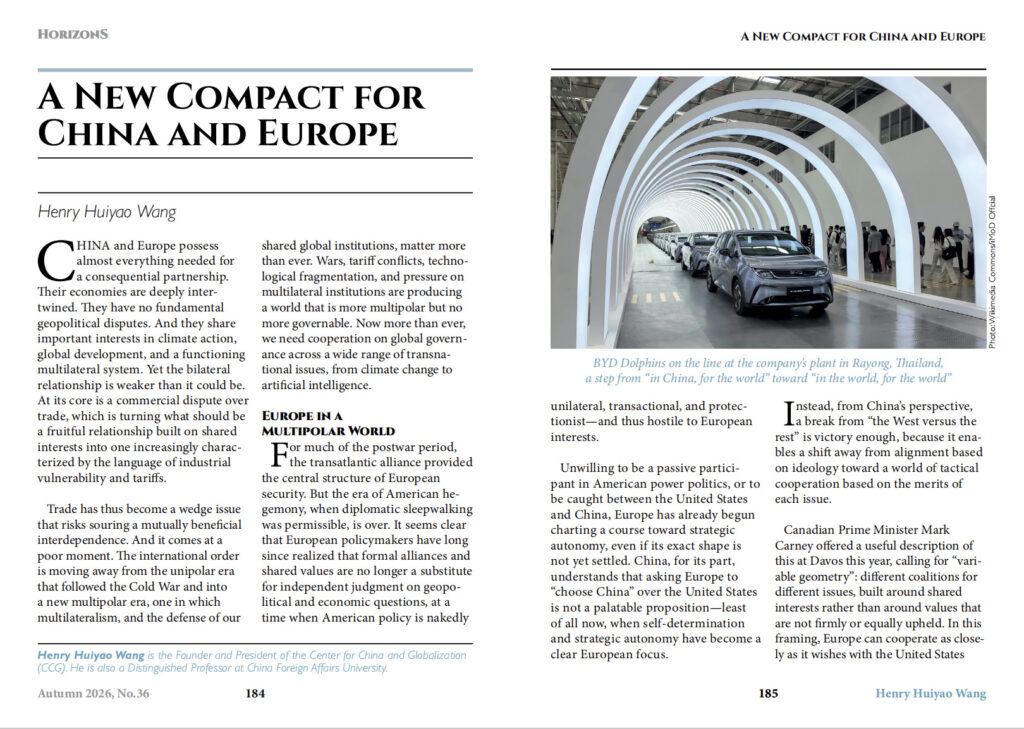
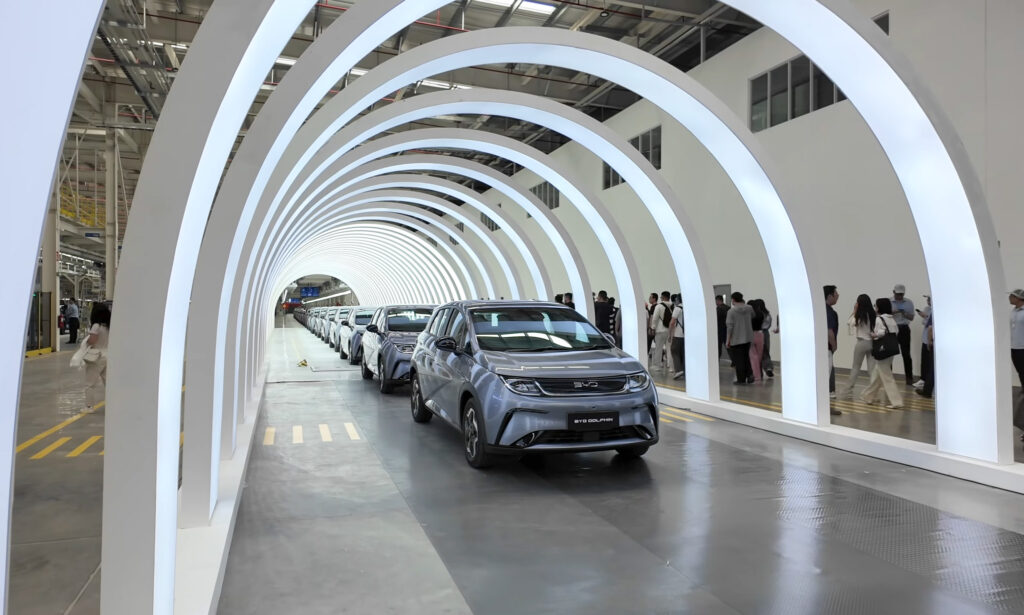
BYD Dolphins on the line at the company’s plant in Rayong, Thailand, a step from “in China, for the world” toward “in the world, for the world”
Wikimedia Commons/iMoD Official

China and Europe possess almost everything needed for a consequential partnership. Their economies are deeply intertwined. They have no fundamental geopolitical disputes. And they share important interests in climate action, global development, and a functioning multilateral system. Yet the bilateral relationship is weaker than it could be. At its core is a commercial dispute over trade, which is turning what should be a fruitful relationship built on shared interests into one increasingly characterized by the language of industrial vulnerability and tariffs.

Trade has thus become a wedge issue that risks souring a mutually beneficial interdependence. And it comes at a poor moment. The international order is moving away from the unipolar era that followed the Cold War and into a new multipolar era, one in which multilateralism, and the defense of our shared global institutions, matter more than ever. Wars, tariff conflicts, technological fragmentation, and pressure on multilateral institutions are producing a world that is more multipolar but no more governable. Now more than ever, we need cooperation on global governance across a wide range of transnational issues, from climate change to artificial intelligence.

Europe in a Multipolar World

For much of the postwar period, the transatlantic alliance provided the central structure of European security. But the era of American hegemony, when diplomatic sleepwalking was permissible, is over. It seems clear that European policymakers have long since realized that formal alliances and shared values are no longer a substitute for independent judgment on geopolitical and economic questions, at a time when American policy is nakedly unilateral, transactional, and protectionist—and thus hostile to European interests.

Unwilling to be a passive participant in American power politics, or to be caught between the United States and China, Europe has already begun charting a course toward strategic autonomy, even if its exact shape is not yet settled. China, for its part, understands that asking Europe to “choose China” over the United States is not a palatable proposition—least of all now, when self-determination and strategic autonomy have become a clear European focus.

Instead, from China’s perspective, a break from “the West versus the rest” is victory enough, because it enables a shift away from alignment based on ideology toward a world of tactical cooperation based on the merits of each issue.

Canadian Prime Minister Mark Carney offered a useful description of this at Davos this year, calling for “variable geometry”: different coalitions for different issues, built around shared interests rather than around values that are not firmly or equally upheld. In this framing, Europe can cooperate as closely as it wishes with the United States on defense, while still finding common cause with China on climate and trade reform, or with India on development. Such flexibility is increasingly the default in our plural world.

A cohesive Europe able to act independently is preferable to a divided continent whose China policy is increasingly shaped elsewhere. But that also means that policymakers in China must address European fears if they are to benefit from engagement and cooperation on shared interests.

The Changing Bargain

The core anxiety facing Europe, and the one undermining a merits-based relationship, is that the old, unspoken economic bargain—European technology and premium manufacturing in exchange for Chinese consumer goods and lower-cost production—is giving way to a more competitive relationship.

China now possesses broad industrial ecosystems, world-class infrastructure, skilled engineering talent, and the capacity for fast commercialization at scale. It no longer competes on wages alone. In electric vehicles, batteries, solar energy, machinery, telecommunications equipment, and, increasingly, advanced digital applications, Chinese firms can combine cost, speed, and technological capability.

But let us not get carried away with catastrophizing. The shared economic foundation between China and the EU remains immense. In 2025, two-way trade in goods and services exceeded €880 billion. Europe imported more than €570 billion in goods from China and exported about €200 billion, producing a large bilateral goods deficit. Yet this figure should be interpreted carefully. The European Union still recorded an overall goods surplus of approximately €128 billion in 2025, as well as a substantial current-account surplus. Nor are all imports finished products: Eurostat data shows that 57 percent of all extra-EU goods imports in 2025 were intermediate products, meaning that much of what Europe imports feeds into value-added production chains from which Europe itself benefits. Europe’s difficulty is that, while its industry remains broadly profitable, certain critical sectors are already under pressure, and the trend seems unlikely to reverse suddenly in favor of European manufacturing.

Europe is not facing this crisis in a vacuum, either. It is compounded by high energy costs, aging populations, fragmented capital markets, and chronic underinvestment. The result is a genuine fear of deindustrialization, with the attendant loss of skilled employment, supplier networks, technological capacity, and social cohesion. This worry is especially potent in the major European economies with large export-oriented manufacturing sectors, such as Germany, France, Italy, and Spain, and it makes the debate over “overcapacity” deeply politically charged.

While the imbalance is a product of industrial excellence, it can also be attributed to weak domestic demand in China. Household consumption there remains around 40 percent of GDP, while families save heavily out of concern over housing, education, health care, and retirement. The 2025 consumption action plan addressed wages, pensions, health care, childcare, paid leave, and benefits for migrant and flexible workers, and China’s first five-year plan devoted specifically to consumption subsequently set a goal of approximately 60 trillion yuan in retail sales by 2030. But it is far too early to call the effort complete. Although per capita disposable income rose by 5 percent and consumption expenditure by 4.4 percent in 2025, the first half of 2026 was weaker, and overall consumption still lags behind where it should be. Stronger pensions, health care, unemployment insurance, childcare, and portable benefits for migrant workers will help reduce precautionary saving, and greater access for foreign goods and services would ensure that stronger Chinese demand creates opportunities for European producers. That transformation, however, is not yet complete.

Europe, for its part, should recognize that competitive success is not in itself an unfair subsidy. The International Energy Agency estimates that producing a battery-electric vehicle costs more than 30 percent less in China than in advanced economies, with only about one-third of the gap attributable to the battery; a similar cost gap exists for conventional vehicles. China’s earlier industrial policies undoubtedly helped establish this ecosystem, but important forms of direct support, including national EV purchase subsidies, have already been phased out.

Rhodium Group estimates that BYD enjoys a cost advantage of approximately $4,700 per vehicle over Tesla’s operations in China, of which grants account for only about $292, while vertical integration and lower research, administrative, and supplier costs explain at least three-quarters of the difference. BYD produces roughly 70 percent of its components in-house, including its batteries. Europe should investigate market-distorting support and is right to insist on transparency, but it should not define the ecosystem, technology, and efficiencies China has built as unfair.

Nor is China’s automobile sector insulated from competition. The number of Chinese electric-vehicle makers was reported at 487 in 2018; by 2025, consolidation had reduced the market to approximately 129 brands produced by about 50 manufacturers, and only 10 to 15 are expected to be profitable by 2030. China exported approximately 5.86 million of the more than 31 million vehicles it sold in 2024, meaning that the large majority were still absorbed at home. By comparison, Volkswagen delivered 9.03 million vehicles worldwide but only 1.12 million in Germany, while Toyota and Lexus sold 10.16 million worldwide and 1.44 million in Japan. Airbus, likewise, sells approximately 68 percent of its aircraft outside Europe. Producing for global markets is accepted as normal when established European or Japanese companies do it; it should not automatically become illegitimate when Chinese firms do the same.

China’s textile industry offers a further precedent. Even as wages rose and some production moved to Vietnam, Bangladesh, and elsewhere, China retained 37 percent of global textile exports and 34 percent of clothing exports in 2017, because supplier clusters, infrastructure, skills, and continual upgrading proved more durable than low labor costs alone.

Beyond economic competition, clearer rules are urgently needed on the securitization of critical industries. The dispute over Nexperia—the Chinese-owned semiconductor company placed under Dutch government control in 2025—rattled supply chains and deepened concern in China about investing abroad. Either the company should not have been sold in the first place, or a clearer regulatory environment might have avoided a quasi-nationalization that rapidly internationalized a corporate dispute, and that still hangs over the mutual investment relationship today.

Likewise, proposals for a European instrument modeled on the United States’ Section 301 powers may offer political reassurance, but Section 301 is a blunt unilateral instrument designed to authorize retaliation. Europe would be better served by an explicitly transitional mechanism. Where an import surge threatens to destabilize domestic markets, temporary safeguards can provide time for adjustment, but they should be evidence-based, reviewable, and subject to firm sunset clauses. Their purpose should be to facilitate adaptation and negotiation, not to turn emergency protection into a permanent wall.

An Industrial Compact for Shared Competitiveness

When I visited Jean Monnet’s house outside Paris this summer, I was reminded of the method that helped build modern Europe: begin with concrete achievements that create the basis for solidarity. That method matters especially now, when trade has become a wedge issue and trust and trade cannot be separated.

We must therefore build a new industrial compact: one that aligns Chinese industrial capacity with Europe’s need for investment, innovation, and employment, and that enables China and Europe to stand together in support of a world of free, fair, and open trade.

First, China should follow through on its ongoing shift from an export– and investment-heavy model toward consumption-led growth. Alongside the social measures described above, this requires reducing the barriers faced by private and foreign businesses, improving market access in services and public procurement, and applying regulation more transparently. European companies should be able to compete in China with confidence that they will receive equal treatment and can protect their intellectual property.

Second, Europe needs to draw a sharper distinction between trade in products that present a genuine security risk and investment that strengthens European productive capacity. Concerns about supply-chain resilience and security in defined strategic sectors are unavoidable, given increasing regionalization. But a presumption against Chinese investment would deprive Europe of capital, technology, competition, and jobs precisely when it needs them most. Instead, Europe could openly welcome investment that meets its requirements on governance, data protection, labor standards, and environmental performance, while increasing the local economic contribution such production provides.

This openness should be anchored by a renewed Comprehensive Agreement on Investment. The agreement reached in principle in 2020 was never implemented and the relationship has changed too much for it simply to be revived unchanged. China and Europe should instead negotiate a new CAI covering market access, national treatment, subsidy transparency, technology transfer, public procurement, and enforceable dispute resolution. It should give European companies more predictable access to China, while establishing clear and consistent conditions for Chinese market access and investment in Europe, with an eye to creating employment and supplier networks there.

China has already demonstrated the value it places on market access by extending tariff-free treatment to goods from 53 African countries, and it could move explicitly to align its standards more closely with Europe’s. Europe, for its part, should reconsider its technology and investment restrictions—especially those implemented specifically to protect U.S. interests, such as the restrictions preventing China from purchasing advanced semiconductor equipment from ASML. Working examples of Chinese investment in Europe already exist. Chinese companies are investing in battery and vehicle production in Hungary, Slovakia, Spain, and Serbia, while European manufacturers—including Volkswagen, BMW, and Mercedes-Benz—continue to deepen their research, production, and partnership networks in China. These investments should not be viewed as isolated commercial transactions. They can become the architecture of a more balanced relationship.

Third, localization must mean more than final assembly. Joint ventures and investment agreements can encourage local supplier development, worker training, research partnerships, and the sharing of production know-how, while respecting intellectual-property rights. Chinese industry was once buoyed by European know-how through joint ventures; in return, European industry can now benefit from Chinese advances. The goal should be a competitive ecosystem in which both Chinese and European firms have a stake.

Fourth, any trade measures should be targeted and temporary. If an import surge threatens serious injury, safeguards can buy time for adaptation. But they should have clear evidentiary thresholds, sunset clauses, and review procedures. Protection without a productivity strategy merely postpones decline and risks marginalization, rather than allowing a dynamic industrial sector to emerge. At the same time, Europe can and should complete its own agenda: lowering energy costs, deepening the single market, mobilizing investment, scaling up innovative companies, and improving infrastructure.

Here, China can become Europe’s “fitness partner.” The phrase may sound counterintuitive at a moment of industrial anxiety, but the underlying idea is important. Healthy competition from China can push European companies and governments to confront long-delayed reforms, reduce costs, and innovate faster. Shelter from competitive pressure does not create health; competition, by contrast, can serve as a yardstick for rebuilding strength. China, meanwhile, gains more from a prosperous and capable Europe than from a weakened market increasingly hostile to Chinese commerce.

Finally, the compact should look beyond the bilateral market. Chinese and European joint ventures could look abroad, toward the product and development needs of the Global South. Joint production for Global South markets could be a starting point, moving in time toward joint financing of development and infrastructure to accelerate green industrialization in Africa, Asia, Latin America, and the Middle East.

This would represent the next stage of globalization: not simply Chinese companies “in China, for the world,” but “in the world, for the world.” It would spread productive capacity more widely, answer concerns about concentrated supply chains, and make development a shared undertaking rather than an arena for geopolitical competition.

From Commercial Trust to Strategic Cooperation

An industrial compact cannot by itself remove all political differences. But it would serve as a springboard, and a trust-building exercise, for deeper commitments and further work on shared interests.

Climate cooperation is the most obvious bridge. China’s manufacturing scale has lowered the global cost of solar panels, batteries, and electric vehicles, in a very real way underwriting the transition away from fossil fuels. At the same time, Europe is suffering under the weight of an energy crisis born of Russia’s invasion of Ukraine and, more recently, of upheavals in the Middle East around the Strait of Hormuz and the Bab al-Mandeb. A natural alignment would be for China and Europe to build a green partnership that helps wean the world off volatile fossil fuels and address the climate crisis. The exact shape of such measures is not yet defined, but using joint ventures, cooperation, and technology exchange to tap Chinese expertise and cost advantages could benefit both sides while buoying the global green transition. A tariff spiral in clean technology, by contrast, would make the energy transition slower and more expensive for everyone.

More broadly, China and Europe share an interest in conflict resolution. China has always been clear that sovereignty and territorial integrity apply universally, that nuclear escalation is unacceptable, and that a negotiated settlement must provide credible security for all parties. But it can do more to ease the concerns of a Europe that feels threatened by a Russia now in its fifth year of fighting in Ukraine. Working together, Europe and China could help provide an off-ramp, each using its leverage to bring the negotiating positions closer together. A truly durable settlement, acceptable to both sides, may eventually require security guarantees involving both European and non-European countries, and China could contribute through reconstruction, nuclear safety, and peacekeeping. The Middle East is another region where common interests are greater than current policy coordination suggests. Continued conflict and volatility around the straits have not only given fresh impetus to the transition away from fossil fuels but also created a new area of shared interest. Together, Europe and China could support a peace architecture with wider international participation.

Artificial intelligence governance is another opportunity. China and Europe approach data, platforms, and regulation differently, but both reject a future in which a handful of private companies set global rules without public accountability. They can work together on safety testing, scientific exchange, interoperable standards, and the application of AI to health, climate, and development. Agreement will be difficult, but building a shared environment for rule-making would help hedge against fragmentation in this rapidly developing field.

Finally, China and the EU have both long advocated restoring the World Trade Organization. A revitalized WTO already contains tools to address subsidies and demonstrable injury. Boeing and Airbus were both found, in WTO disputes, to have benefited from improper support, and those cases were handled through multilateral proceedings rather than through an open-ended campaign against either side’s wider industrial success. The WTO’s dispute-settlement system must now be restored, its rules on subsidies and state enterprises updated, and its development functions strengthened. The United States weakened that system by blocking appointments to the Appellate Body after adverse rulings; but China and Europe are both major beneficiaries of an open trading system, and both can press for reform.

None of this will be sustainable without renewed contact between societies. Direct flights, student exchanges, tourism, university partnerships, city-to-city links, and think-tank dialogue all have their roles to play, for they are the infrastructure of mutual understanding.

China–Europe relations will not always be perfectly aligned, and they will likely continue to contain elements of cooperation, competition, and disagreement. But together, we can put to rest the prospect of weaponized interdependence and move instead toward win-win interdependence.

Europe does not need to become less European in order to cooperate with China, nor does China need to adopt European political mores for cooperation to succeed. Both are now free to cooperate selectively and on the merits of each issue. And a world in which China and Europe cannot find areas of deep mutual interest—despite their deep economic ties and their shared stake in multilateralism—is a world that is measurably poorer for it.
Henry Huiyao Wang: A Xi-Trump-Putin summit in Shenzhen could kick-start peace in Ukraine

CCG’s President says there will be no diplomatic masterstroke in Ukraine’s absence, but serious consideration of a ceasefire can lay the groundwork for peace

[from the Center for China & Globalization, 31 October 2026]

Below is the latest opinion column by Henry Huiyao Wang [王辉耀], founder and President, Center for China and Globalization, published in the South China Morning Post.

At the recent Valdai Discussion Club, I asked Russian President Vladimir Putin if he would be open to meeting Chinese President Xi Jinping and U.S. President Donald Trump at the Asia-Pacific Economic Cooperation (APEC) forum in Shenzhen. I also asked, more broadly, what role China could play in promoting peace in Ukraine, mediating and contributing to peacekeeping.

Putin was receptive, warmly welcoming the idea of a China-hosted meeting. Trump, too, has expressed a willingness to meet Xi and Putin. These expressions of openness offer an opportunity we must seize in pursuit of peace.

Some in the United States and Europe question the value of such a summit. They may fear restoring Putin’s standing or normalising the conflict without yielding any real progress towards an end to the war. That risk is still real but these largely Western fears must be tempered by the very real, very human cost of letting the war continue unabated.

From the very beginning of the war, I have been arguing that China has a constructive role to play. In March 2022, less than three weeks into Russia’s invasion, I wrote an article in The New York Times titled “It’s Time to Offer Russia an Offramp. China Can Help With That.”

In August last year, I extended that train of logic in Foreign Policy, where I proposed a seven-party format for peace negotiations and suggested that a peacekeeping force include troops from European and BRICS countries. A meeting of the three leaders in Shenzhen could help lay the groundwork for these broader diplomatic and peacekeeping efforts.

Without Ukraine’s participation, such a meeting is unlikely to produce a diplomatic masterstroke that ends the war. But the three leaders need not put the war to rest at a table in Shenzhen to make progress. Serious consideration of a ceasefire along the current line of contact—an approach Ukrainian President Volodymyr Zelenskyy has supported—could give peace efforts fresh momentum, leaving the final status of disputed territories for subsequent negotiations.

Further agreement could be sought on the protection of nuclear facilities, or a mutual end to strikes on energy infrastructure, new prisoner exchanges or improved humanitarian access. Of course, issues of sovereignty, security guarantees, Russia’s security concerns and Europe’s security commitments would remain. But these need not all be resolved at once before a ceasefire can begin.

Already, years of war have inflicted immense suffering on both Russia and Ukraine. Neither side achieved its objectives, and both need a dignified way out that protects their core interests. Thus, we must open a path towards peace without requiring either side to concede defeat. China could help bridge this gap by bringing Xi, Trump and Putin together in Shenzhen to explore how a ceasefire and wider negotiations involving Ukraine might work.

The United Nations could stand at the core of such an arrangement by monitoring any ceasefire and preventing a return to fighting by physical peacekeeping if the parties are so inclined.

For a broader negotiation on settlement, I find myself returning to a seven-party format that would bring together the five permanent members of the UN Security Council—China, France, Russia, Britain and the U.S.—alongside Ukraine and the European Union. An understanding reached in Shenzhen could give momentum to this broader negotiating process and free up the Security Council for action.

A peacekeeping force composed entirely of NATO or European troops might be unacceptable to Russia. Yet a mission without European participation would struggle to reassure Ukraine and its neighbours. Any workable arrangement would need to address both concerns.

In my Foreign Policy article, I proposed a peacekeeping force drawing troops from five European countries—Germany, France, Britain, Poland and Italy—and five members of the BRICS grouping, such as China, India and Brazil. And while the exact formulation, from the composition and mandate to the terms of deployment, would need to be negotiated with the consent of Russia and Ukraine, and the agreement of the contributing countries, the core idea remains sound.

As a permanent member of the UN Security Council and the largest contributor of peacekeeping personnel among the five permanent members, China is well positioned to help. Its distinctive role in the global economy and dialogue with Russia, Ukraine, the U.S. and Europe, give it channels through which to coax the parties towards peace. But this process must begin somewhere, and that somewhere could be Shenzhen.

Nor should APEC be the end of the diplomatic effort. With an understanding reached by the leaders in Shenzhen, the Security Council may pick up the momentum by advancing ceasefire and peacekeeping proposals. The Group of 20 could then join the effort to rally support from major economies with an interest in maintaining the deal. Each would play a different role and would not be tasked with settling the entire conflict.

China’s role in the Saudi Arabia-Iran rapprochement in 2023 showed Beijing’s ability to open a door after years of enmity. The Ukraine war is different, and there can be no guarantee of a similar outcome. But diplomacy must begin somewhere, particularly when fighting has brought such destruction.

The central question is whether such a meeting could help bring the war to an end. In that light, any gain in prestige for an individual leader is almost irrelevant. And if the three leaders could agree on practical steps towards peace, they would give the United Nations and the wider international community a material basis upon which peace could be built.

From ASEAN and G20 to APEC, as World Leaders Meet in Person Again, 3 Reasons to Root for Multilateralism

By Wang Huiyao | Founder of the Center for China and Globalization (CCG)

Over the past two weeks, Asia has played host to the most intense sequence of multilateral summits since the pandemic began, as national leaders gathered for meetings organized by ASEAN, the G20 and APEC. Although overshadowed by geopolitical tensions, the meetings marked a welcome return to in-person summit diplomacy, and the better-than-expected outcomes show hope yet for multilateralism.

The conclaves began in Phnom Penh with the annual summit of the Association of Southeast Asian Nations. At the first of such in-person events in almost three years, ASEAN leaders took the positive step of agreeing in principle to admit East Timor as the 11th member of the organization.

As leaders moved on to Bali for the Group of 20 summit, expectations were low after ministerial meetings in the run-up had failed to produce consensus. Earlier in the year, given fractures in the wake of Russia’s invasion of Ukraine, there was a question mark over whether the G20 could even go ahead or survive in its existing form.

In the end, the summit surpassed expectations by producing a joint declaration after intense negotiations, with leaders finding the compromises necessary to unite in declaring that “today’s era must not be of war” and pledging to uphold the multilateral system.

The summit also saw a positive face-to-face meeting between China’s President Xi Jinping and U.S. President Joe Biden, their first as leaders, signaling a willingness to halt the downward trajectory of China-U.S. relations.

In Bangkok, the 21 leaders of the Asia-Pacific Economic Cooperation forum also pledged to uphold and strengthen the rules-based multilateral trading system. Importantly, the group agreed on a multi-year work plan for an Asia-Pacific free trade area.

Reflecting on these three summits, three takeaways give reason for cautious optimism that multilateralism can yet be revived and play a major role in solving our challenges.

First, and perhaps most obviously, the return of in-person summit diplomacy is a welcome uplift for global cooperation. Virtual formats played a useful interim role at the height of the pandemic but were never a substitute for getting leaders in the same room. That is especially when it comes to interactions on the sidelines, often as important as the main event.

China’s return to diplomacy at the highest level was a further boost, both for the nation and the rest of the world.

In addition to Xi’s highly anticipated meeting with Biden, the Chinese leader met over a dozen other leaders at the G20 and APEC summits, including a warmer-than-expected first meeting with Japanese Prime Minister Fumio Kishida and his first meeting with an Australian prime minister since 2016.

Leaders got to meet their new counterparts for the first time or build on existing relationships, which can only help global cooperation.

The second takeaway is that as grave as our challenges are, the threat of escalating conflict and severe economic pressures on all nations seem to be focusing minds and increasing the willingness to engage and cooperate—out of necessity if nothing else.

The G20 summit was the second major one this year to surpass expectations after the 12th World Trade Organization Ministerial Conference in June surprised observers by agreeing on a plan to reform the organization and its dispute settlement mechanism. The G20 statement reiterated support for this WTO reform plan, which will be critical to get the free trade agenda back on track and provide a much-needed boost for the global economy.

Third, and perhaps most significantly for the long term, the recent summits marked an acceleration of the trend towards multi-polarization in international diplomacy, and in particular, the rising influence of non-aligned “middle powers” to shape multilateral outcomes.

The middle powers represented at ASEAN, the G20 and APEC have huge stakes in avoiding a bifurcation of the global economy that might result from a new cold war. They don’t want to be forced to pick sides and many show a growing willingness and ability to build bridges and restore positive momentum for multilateralism.

Indonesia is a prime example. The country’s strategic heft and non-aligned credibility make it well-placed to bridge different camps. President Joko Widodo made a big political bet on the success of the G20 and has won praise for the deft diplomacy that kept the organization alive and got it to a joint statement.

The Indian delegation reportedly also played a big role in achieving consensus on language in the statement, with the BRICS group (Brazil, Russia, India, China and South Africa)—as well as Indonesia—turning out to be crucial swing voters in securing the joint statement. One Indian official said it was “the first [G20] summit where developing nations shaped the outcome.”

There is scope for this trend to continue next year as middle powers continue to rise in stature, and India and Indonesia take over the presidency of the G20 and ASEAN, respectively. Brazil will host the G20 the year after.

Over in Sharm el-Sheikh at the COP27 UN climate summit, another middle power—the host Egypt—also won praise for helping to shepherd a historic financing deal for poor countries affected by climate change. But the ultimate failure to reach a commitment to phase down fossil fuels was a sobering reminder of the huge difficulties that remain in forging the global consensus needed to overcome our shared challenges.

World-Watching: China Globalization Conference

[from the Center for China and Globalization]

The Center for China and Globalization is proud to announce the full program of their upcoming 8th edition of CCG annual China and Globalization Forum 2022 to be held in online-offline hybrid format in Beijing. Everyone is cordially invited to join the events open to public virtually. All sessions open to public will be broadcast live. You will be able to access the sessions on Zoom:

Tuesday, June 21st

09:00-10:00—Forum Special Online Program I: Advancing the 2030 Agenda in Uncertain Times: Sustainability and the Quest for China–U.S. Cooperation – Fireside Chat with Sec. Henry M. Paulson, Jr. and Mr. WANG Shi (王石)

10:30-12:30—Ambassadors’ Roundtable: Global Recovery in Post-Pandemic Times: Trends, Challenges, and Responses

14:00-16:00—China–Europe Roundtable: China–Europe Economic Cooperation: Moving Forward with the Global Quest for Sustainability

17:30-18:30—Forum Special Online Program II: History at a Turning Point: Pandemic, Ukraine, and the Changing Relations between China, Europe, and the United States–Dialogue with Historian Niall Ferguson

20:00-21:30—Forum Special Online Program III: Realigning the U.S.–China Trade and Economic Relationship: Inflation, Tariffs, and the Way Forward – China–U.S. Think Tank Dialogue

Zoom:
Webinar ID: 894 5641 9097
Passcode: 566991

Once you’re admitted into the Zoom meeting, your camera and audio will remain off. Simultaneous interpretation of both English and Chinese languages will be available by selecting the language pane.

Agenda

Monday, June 20th

09:00-10:00—Forum Special Online Program I: Advancing the 2030 Agenda in Uncertain Times: Sustainability and the Quest for China–U.S. Cooperation – Fireside Chat with Sec. Henry M. Paulson, Jr. and Mr. WANG Shi (王石)

Host

WANG Huiyao (王辉耀), CCG President, Vice Chairman of China Association for International Economic Cooperation (CAFIEC)

Speakers

Henry M. Paulson, Jr., former U.S. Treasury Secretary, Founder and Chairman of the Paulson Institute
WANG Shi (王石), CCG Senior Vice President, Founder and Honorary Chairman of China Vanke Co., Ltd., Founder of C-Team

This program will also be livestreamed on the web via the Baidu links and social media platforms below:

English language
Chinese language

Social Media
Youtube
Twitter
Facebook

10:30-12:30—Ambassadors’ Roundtable: Global Recovery in Post-Pandemic Times: Trends, Challenges, and Responses

Chair

WANG Huiyao (王辉耀), CCG President, Vice Chairman of China Association for International Economic Cooperation (CAFIEC)

Opening remarks

LONG Yongtu, CCG Chairman; former Vice Minister of Commerce
LIN Songtian, President of the Chinese People’s Association for Friendship with Foreign Countries, former Chinese Ambassador to South Africa
Siddharth Chatterjee, UN Resident Coordinator, United Nations in China

Participants

(in alphabetic order by country): 
Rahamtalla M. Osman
, Permanent Representative of African Union to China
Graham Fletcher, Ambassador of Australia to China 
Paulo Estivallet de Mesquita, Ambassador of Brazil to China 
Nicolas Chapuis, Ambassador of European Union to China 
Laurent Bili, Ambassador of France to China 
Djauhari Oratmangun, Ambassador of Indonesia to China 
Luca Ferrari, Ambassador of Italy to China 
Raja Dato Nushirwan Zainal Abidin, Ambassador of Malaysia to China 
Clare Fearnley, Ambassador of New Zealand to China 
Signe Brudeset, Ambassador of Norway to China 
Moin ul Haque, Ambassador of Pakistan to China 
Luis Quesada, Ambassador of Peru to China 
José Augusto Duarte, Ambassador of Portugal to China 
James Kimonyo, Ambassador of Rwanda to China 
Alenka Suhadolnik, Ambassador of Slovenia to China 
Siyabonga Cwele, Ambassador of South Africa to China 
Bernardino Regazzoni, Ambassador of Switzerland to China 
Arthayudh Srisamoot, Ambassador of Thailand to China 
Ali Obaid Al Dhaheri, Ambassador of UAE to China

14:00-16:00—China–Europe Roundtable: China–Europe Economic Cooperation: Moving Forward with the Global Quest for Sustainability

Chair

Andy Mok, CCG Senior Fellow

Participants

(in alphabetic order)
Joseph Cash
, Policy Analyst, China–Britain Business Council (CBBC)
CUI Hongjian, CCG Non-Resident Senior Fellow and Director of the Department of European Studies at the China Institute of International Studies (CIIS)
Vivian Ding, CCG Senior Council Member, Founder and CEO of WeBrand Global
FENG Zhongping, Director of Institute of European Studies, Chinese Academy of Social Sciences (CASS)
Allan Gabor, President of Merck China
Archil Kalandia, Ambassador of Georgia to China
LENG Yan, CCG Senior Council Member; Executive Vice President of Daimler Greater China
LIU Chang, Vice President of Knorr-Bremse Asia Pacific
Steven Lynch, Managing Director, BritCham China
Dario Mihelin, Ambassador of Croatia to China
Leena-Kaisa Mikkola, Ambassador of Finland to China
MIN Hao, CCG Senior Council Member; Founder, Chairman, and CEO of the Nanjing Easthouse Electric Ltd.
SUN Yongfu, CCG Senior Fellow; former Director-General of MOFCOM Department of European Affairs
Joerg Wuttke, President of the EU Chamber of Commerce in China
ZHOU Yanli, CCG Advisor; Former Vice Chairman of China Insurance Regulatory Commission
Helen Zhu, CCG Senior Council Member; Vice President of Sanofi China

This program will also be livestreamed on the web via the Baidu links and social media platforms below:

English language
Chinese language

Social Media
Youtube
Twitter
Facebook

17:30-18:30—Forum Special Online Program II: History at a Turning Point: Pandemic, Ukraine, and the Changing Relations between China, Europe, and the United States–Dialogue with Historian Niall Ferguson

Speakers

Niall Ferguson, Milbank Family Senior Fellow at the Hoover Institution, Stanford University
WANG Huiyao (王辉耀), CCG President, Vice Chairman of China Association for International Economic Cooperation (CAFIEC)

20:00-21:30—Forum Special Online Program III: Realigning the U.S.–China Trade and Economic Relationship: Inflation, Tariffs, and the Way Forward – China–U.S. Think Tank Dialogue

Moderator

WANG Huiyao (王辉耀), CCG President, Vice Chairman of China Association for International Economic Cooperation (CAFIEC)

Speakers

(in alphabetic order)
Craig Allen
, President, US-China Business Council (USCBC)
Wendy Cutler, Vice President, Asia Society Policy Institute; former Acting Deputy U.S. Trade Representative
JIN Xu, President, China Association of International Trade (CAIT)
Adam Posen, President, Peterson Institute for International Economics (PIIE)
Jeremie Waterman, President of China Center and Vice President, U.S. Chamber of Commerce
YI Xiaozhun, former Deputy Director-General of World Trade Organization, former Vice Commerce Minister

Tuesday, June 21st

09:30-12:30—China Globalization 30 Roundtable Experts Roundtable: China and Globalization in the 21st Century (Chinese language livestream, not available on Zoom)

Chair

Mabel Miao, CCG Secretary-General

Discussants

(in alphabetic order)
CHEN Zhiwu, Director of Asia Global Institute, Professor of Business School, Hong Kong University
DA Wei, Professor and Director of Center for International Security and Strategy, Tsinghua University
DONG Guanpeng, Vice President of China Public Relations Association, Dean of School of Government and Public Affairs, Communication University of China
GE Jianxiong, Director of Institute of Chinese Historical Geography, Fudan University
GU Xuewu, Director of Center for Globalization, University of Bonn
HU Biliang, Executive Director of the Belt and Road Institute and the Institute of Emerging Markets, Beijing Normal University
LI Xiangyang, Director of Institute of Asia-Pacific and Global Strategy, Chinese Academy of Social Sciences (CASS)
LIU Guoen, Dean of Institute for Global Health and Development, BOYA Distinguished Professor, Peking University
LIU Junhong, Director of Globalization Center, China Institutes of Contemporary International Relations (CICIR)
SU Hao, Director of Center for Strategy and Peace Studies, China Foreign Affairs University
XIE Tao, Dean of School of International Relations and Diplomacy, Beijing Foreign Studies University
XUE Lan, Dean of Schwarzman College, Tsinghua University
WANG Huiyao (王辉耀), President of Center for China and Globalization; Dean of Development Research Institute, Southwest University of Finance and Economics
WANG Ning, Zhiyuan Chair Professor, Shanghai Jiao Tong University, Foreign Member of the European Academy of Sciences
WANG Yiwei, Professor of School of International Relations, Renmin University of China
WANG Yong, Director of Center for International Political and Economic Studies, Peking University
WU Xinbo, Dean of Institute of International Studies, Director of Center for American Studies, Fudan University
WU Zhicheng, Vice President of the Institute of International Strategic Studies, Party School of the Central Committee of CPC (National Academy of Administration)
YANG Xuedong, Senior Professor of Political Science, Tsinghua University
ZHANG Shuhua, Director of Institute of Political Science, Chinese Academy of Social Sciences (CASS)
ZHANG Xudong, Professor of Comparative Literature & East Asian Studies, NYU
ZHANG Yunling, Member of Presidium of Academic Divisions of Chinese Academy of Social Sciences (CASS)

This session will also be livestreamed on the web accessible via this Baidu link (Chinese language only, no simultaneous interpretation).

WANG Huiyao: To Save Global Trade, Start Small

[from the Center for China and Globalization]

by WANG Huiyao (王辉耀), Founder of the Center for China and Globalization

The global economy is being rocked by war, sanctions and spiraling commodity prices—not to mention the ongoing strain of the pandemic, geopolitical tensions and climate change. These compounding risks present a serious challenge to the system of open trade that the World Trade Organization was designed to uphold. But it also offers a chance for the beleaguered organization, which is holding its first ministerial conference since 2017, to prove its continuing relevance.

The WTO has traditionally focused on combating protectionism—measures designed to insulate producers from international competition. Now, though, the biggest threats to free trade come from policies meant to safeguard national security and protect citizens from risks, such as those related to health, the environment or digital spaces.

Former WTO Director-General Pascal Lamy has called this growing use of export controls, cybersecurity laws, investment blacklists, reshoring incentives and the like “precautionism.” It’s been on the rise since the start of the pandemic, when many countries moved to restrict exports of medical supplies and other essentials. COVID-19 has also raised concerns about the vulnerability of supply chains, particularly those dependent on geopolitical rivals.

The world’s two biggest trading nations, the United States and China, have both engaged in precautionism. The U.S. is actively pursuing a policy of “friend-shoring”—shifting trade flows from potentially hostile countries to friendlier ones. China’s “dual circulation” strategy aims in part to reduce dependence on foreign imports, especially technology, while its government has long imposed limits on data flows in and out of the country.

With Russia’s invasion of Ukraine, the momentum toward friend-shoring has grown. Meanwhile, food shortages and surging prices have triggered another round of precautionary measures: Since the war began, 63 countries have imposed a more than 100 export restrictions on fertilizer and foodstuffs.

While the impulse driving such policies is understandable, the trend could cause great harm if allowed to run unchecked. It will increase inflation and depress global growth, especially if it involves costly redeployment of supply chains away from efficient producers such as China. A recent WTO study estimated that decoupling the global economy into “Western” and “Eastern” blocs would wipe out nearly 5% in output, the equivalent of $4 trillion.

As a recent study by the International Monetary Fund points out, the way to make global value chains more resilient is to diversify, not dismantle them. Turning away from open trade will only make states more vulnerable to economic shocks such as war, disease or crop failures.

The WTO is an obvious vehicle to rally collective action on these issues. However, like other global institutions, it has been weakened by years of deadlock. At this week’s meeting, countries should start to build positive momentum with some small but symbolically significant breakthroughs to show the WTO can still mobilize joint action.

Given current threats to food security, at the very least members should agree not to restrict exports of foodstuffs purchased for the World Food Programme. A step further would be a joint statement calling on members to keep trade in food and agricultural products open and avoid imposing unjustified export restrictions. There should also be closer coordination to smooth supply chains and clogged logistics channels.

Another low-hanging fruit is finally securing a  waiver covering intellectual property rights for COVID-19-related products. This proposal has languished for over 18 months but has now been redrafted to address concerns from the U.S. and European Union. Signing it would go some way to expanding global access to vaccines, which are still sorely needed in many parts of the world.

Beyond this week, the WTO secretariat and members need to develop a work program to reform the organization. This should include developing a framework to ensure that if states do take precautionary measures, they do so in a transparent, rules-based manner that does not slide into more harmful forms of protectionism.

Reviving the WTO’s defunct dispute settlement mechanism is a clear priority. Twenty-five members have agreed to an interim arrangement that would function in a similar way. More members should join this agreement, ideally including the U.S., and start negotiating the full restoration of a binding mechanism. They should also set clear criteria for carveouts for legitimate precautionary measures related to national security, healthcare and environmental issues.

No one should expect big breakthroughs in Geneva. But practical agreements on immediate priorities such food security and vaccines would at least help to reassert the WTO’s relevance and show that the world’s trading partners are not simply going to give up on multilateralism. At this dangerous moment, even small victories are welcome.