India in Transition: “The Rain that Chases Rhinos”: Community Crisis Communication in the Eastern Himalayas  

[by Mirza Zulfiqur Rahman, Center for the Advanced Study of India]

In the plains of Assam, different kinds of rain are often distinguished through vivid local expressions that reflect their intensity and impact on everyday life. One such term is “sagoli-kheda-borokhun” (the rain that chases goats). It refers to a light shower, enough to send goats hurrying into their sheds while people continue with their daily activities. As the rainfall intensifies, it may be described as “goru-kheda-borokhun” (cow-chasing rain), followed by “manuh-kheda-borokhun” (people-chasing rain), when even humans seek shelter from the downpour. At the extreme end of this scale of vernacular expressions of rainfall intensity lies “gor-kheda-borokhun” (the rain that chases away rhinos), evoking a deluge so intense that even Assam’s iconic one-horned rhinoceroses would retreat and look for shelter. With rapid urbanization and changing rainfall patterns, such beautiful expressions of rain have lost continuous usage, especially among the younger generation, who no longer name types of rains.

These expressions reveal the richly textured ways in which communities inhabiting the water-abundant landscapes of Northeast India have understood and interpreted rainfall. Their environmental imagination is shaped not only by the rains themselves but also by the sounds, movements, and rhythms of the ecosystems around them. Among the most evocative signs of the approaching monsoon was the chorus of frogs inhabiting the “pukhuris” (ponds), “khaals” (natural drainage channels), and “beels” (wetlands). Their persistent croaking, described locally as the rhythmic “tur-tu-rai” of an assembled army of frogs, would fill the night air. Hearing this familiar symphony, people would often remark that the rains were on their way.

In today’s times, such soundscapes have diminished considerably and the traditional knowledge of being able to predict rains by observing sounds and signs in nature have not been passed on. The familiar chorus of frogs on humid nights has grown noticeably quieter as ponds have deteriorated, wetlands have been drained, and traditional water bodies have gradually disappeared from the landscape. Here, I look at the languages and imaginations of communities, and how these interact with the annual rains and storms along the Eastern Himalayas, how they keep record of the changes in the climate patterns in their community lives through their vernacular depictions of storms and rains, and how the current climate crisis has clouded their traditional communication methods.
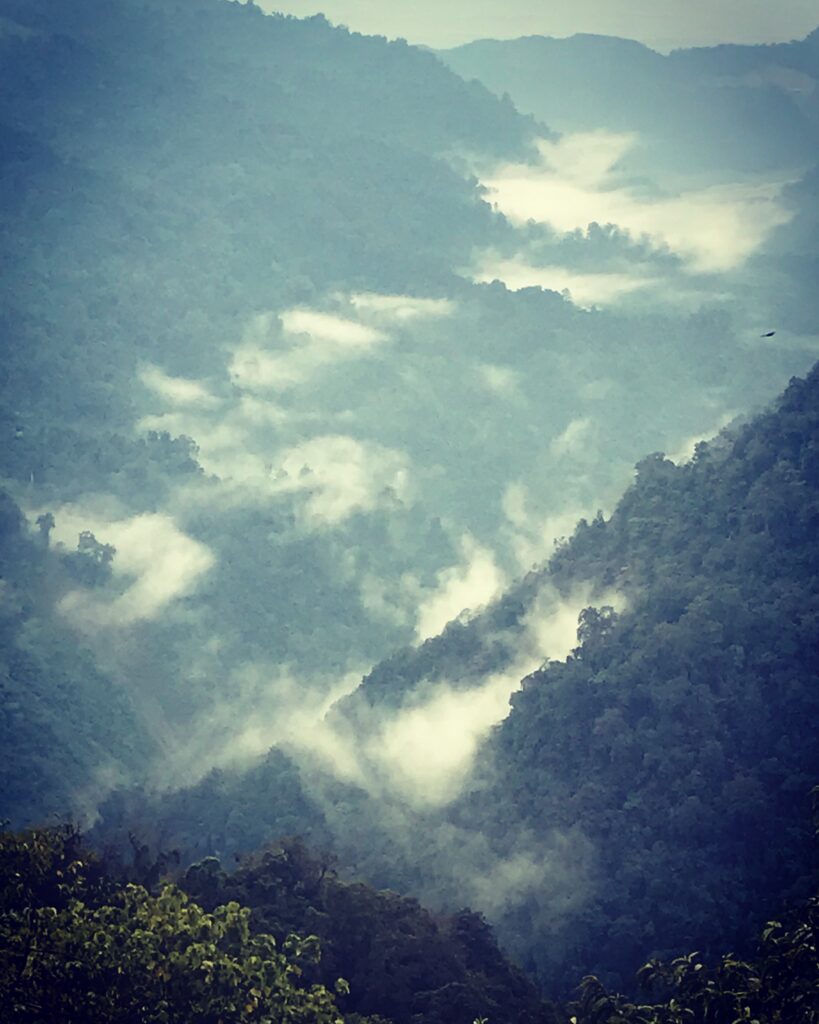
Water-Abundant Worlds

The Himalayan river-systems and the plains they nourish have always been regarded as a water-abundant environment, with monsoons, storms and rains forming an essential part of the lives and imaginations of communities living there. Nation-state borders, which straddle river-systems and regions across the Himalayas, bring in an additional layer of complexity to the various discourses of climate change disasters and patterns in the region, which are already exacerbated by infrastructural interventions on the river systems.

The languages and imaginations of Himalayan communities through which they describe the monsoons, climate change, storms, and rainfall patterns in their daily lives and natural environment, and how they are shaped by the interventions and narratives deployed by the nation-state in the Eastern Himalayas serve as critical crisis communication, often proving more useful and timely than government communication. The monsoon rains that stream in from the Indian Ocean currents and extend up to the heights of the easternmost fringes of the Himalayas bring most of the Himalayan river-systems to life. The monsoon clouds, after they enter Northeast India, play a veritable ping-pong between the low-lying rolling hills of the Patkai ranges and the towering eastern Himalayan mountain ranges, and the rains and storms that ensue from this match nourish the various communities, sustain the forests, and shape the landscape. This interaction forms an archive of climate disasters in the region.

Modern meteorological forecasting methods have greatly improved with scientific progress and modelling and availability of long-term data. However, from my research, it has been evident that the medium-range and long-range predictions of storms and rainfall patterns have low reliability at the local level, meaning state-led communication methods are not effective or timely. There are externalities of data collection challenges and reliability of what actually constitutes long-term data and the rapid infrastructure push and anthropogenic changes in the context of the fragile and ever-crumbling-and-forming Eastern Himalayas.

Bordoisila is the personified name given to an annual spring storm that ravages the foothills of the Eastern Himalayas, often spanning across Assam, Meghalaya, Arunachal Pradesh, Nagaland, and Bhutan. The community memory of Bordoisila is archived over time through stories of the storm returning to “her maternal home,” Assam, to celebrate Bohag Bihu, the mid-April spring festival, and accounting for the ferocity and devastation it regularly brings along, as well as the variation in timing of the storm’s arrival and when “she returns” after celebrating. Communities provide token offerings of festive food and clothing to Bordoisila, imploring the storm to pass by gently in “her path.” The variation in timing and ferocity of the storm is recorded in recent community memory as the personified storm managing to come home early this year as “she got to leave early from her workplace.” Originating in the Chotanagpur plateau and gathering force from the Bay of Bengal, she again returns in an angry mood as if “she was not treated well by her mother” with festive goodies and good food.

Personified Storms

Over years of research in the region, I have noted that communities rarely rely on modern meteorological forecasting information for the stormy season. They know it only by community memory and their sense of the ferocity of the storm when it passes by—among a series of spring storms—and declare that “she has finally arrived” and “she will soon return after celebrating Bihu.” It is along the trail of Bordoisila that the first wave of floods also arrives in Assam, and the traditional knowledge repository known as “Dakor Boson,” a collection of vernacular prose and poetry sayings, depicting how the coming monsoon and the ensuing agricultural cropping cycle will span out. The first floods were always celebrated with the Bihu dance, and the storm Bordoisila is revered despite its ferocity, as it brings the rain and nutrient-rich silt to nourish the overall landscape. However, with climate change and anthropogenic interventions, the language of climate crises has changed from a sense of celebration and reverence to utter despair.

Over the past several decades, Northeast India has witnessed profound shifts in its monsoon patterns. Periods of unusually intense rainfall have triggered devastating floods, while prolonged dry spells have brought drought-like conditions to many areas. In response to persistent droughts, communities across Assam have continued to observe customs such as frog-marriage ceremonies, invoking these creatures regarded as messengers of the rain-gods, to restore the rains through their renewed croaking. In Meghalaya, rainfall that used to last nine nights and days in a continuous rhythmic pattern, known as “slap-khyndai-miet-khyndai-sngi,” has, over recent years, lost its original community language emphasis, as such long-enduring rainfall patterns have diminished greatly.
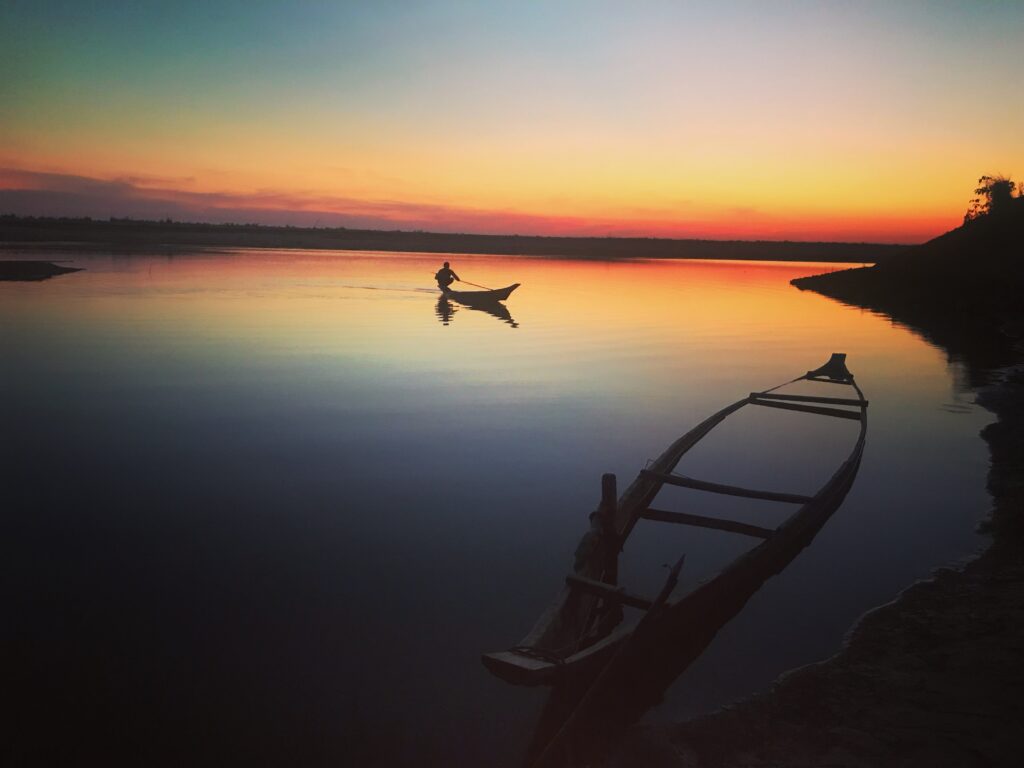
Among the Idu-Mishmi of eastern Arunachal Pradesh, traditional ritual specialists are called upon to communicate with rain spirits, seeking their intervention both when the rains fail to arrive and when incessant downpours raise fears of catastrophic flooding. The Idu-Mishmi term for rain, “ayyo or ayyoyo,” carries deep cultural significance within these practices. Jibi Pulu, an Idu-Mishmi community leader and environmental activist, points to how different kinds of rainfall were once understood to perform distinct ecological functions in the forests of the Dibang Valley. Certain rains signaled the shedding of leaves, others supported flowering cycles, while some heralded the arrival of migratory birds that seasonally visited the region’s rich forest ecosystems. However, he observed that such patterns have become increasingly difficult to anticipate, as deforestation, climate change, and human intervention have disrupted environmental rhythms that earlier generations could interpret with a high confidence.

Many Idu-Mishmi elders similarly attribute the growing unpredictability of rainfall and the increasing occurrence of extreme floods on the Dibang River and its tributaries to a deterioration in the relationship between people and the natural world. They regard practices such as the indiscriminate slaughter of animals and the growing trend of winter picnics on dry riverbeds (where meals are prepared directly on the exposed riverbed) as acts that offend river spirits. In their understanding, these transgressions disturb the balance between humans and the spiritual forces inhabiting the landscape, contributing to erratic weather patterns and destructive flooding events. Some historic flooding events are referred to by communities with names of where such flooding originated, such as the “China-paani” of the year 2000 and the recent episodes of “Bhutan-baanpaani” along the Bhutan–Assam border. This vocabulary has expanded to include specific dam-induced floods such as Ranganadi-floods in Assam.

Culturally Grounded Approaches

The diverse linguistic expressions, traditional knowledge systems, and lived experiences through which indigenous communities across Northeast India understand rainfall, storms, climate variability, and recurring flood events deserve to be documented, connected, and amplified within broader conversations on environmental democracy and transboundary cooperation. Bringing these perspectives together can help foster more inclusive dialogues across the Eastern Himalayas and the Patkai mountain ranges, enabling local communities to participate meaningfully in decision-making processes concerning ecology, environmental governance, infrastructure development, disaster preparedness, crisis communication, and other issues that directly shape their everyday lives and livelihoods. For generations, communities have relied on close observation of their surroundings to interpret changes in weather and rainfall patterns, rhythms of rivers, and flood cycles.

As environmental transformations become more pronounced and traditional indicators grow increasingly uncertain, their ability to understand and articulate these changes offers valuable insights into the realities of climate change on the ground. Recognizing and engaging with such lived experiences, local knowledge, and environmental imaginations is, therefore, essential to strengthening civil society participation and building more democratic, responsive, and culturally grounded approaches to environmental governance in the region. Modern meteorological forecasting methods need to learn from traditional wisdom and social innovation and the vast archive of knowledge which have recorded past disasters and also can predict future ones. The rapid pace and scale of transformation along the Eastern Himalayas are rendering traditional knowledge systems incapable of providing climate solutions.

Mirza Zulfiqur Rahman completed his doctoral research on the Brahmaputra River Basin geopolitics from the Indian Institute of Technology, Guwahati, and is currently a Research Associate at Heinrich Böll Stiftung, India and Visiting Associate Fellow at the Institute of Chinese Studies, Delhi, India. 

All photos courtesy of Mirza Zulfiqur Rahman.

[This is the second in a multi-part series published in collaboration with the Centre of Excellence for Himalayan Studies, at the Shiv Nadar University, Delhi NCR, a research center focused on the economy, borders, identities, environment, and regional geopolitics of the wider Himalayan region including the Hindu Kush and the Karakoram.]

Chance and Necessity from the Perspective of W.B. Yeats

We have just seen “Chance and Necessity” from the perspective of Thomas Bayes and Jacques Monod. Before we get to the case of William Butler Yeats, let’s briefly consider famous non-scientific cases like Joseph Conrad’s Chance, Charles Sanders Peirce’s anthology of essays, Values in a Universe of Chance, and the phrase “nothing but chance,” which was central to the philosophy of Simone Weil.

Yeats attempted to use words to express largely numerical concepts. In the collection Mythologies, he wrote, “I think that all religious men have believed that there is a hand not ours in the events of life, and that, as somebody says in Wilhelm Meister, accident is destiny;…” (p. 336) Here we have chance, but what about necessity? He later states, “I do not doubt those heaving circles, those winding arcs, whether in one man’s life or in that of an age, are mathematical…” (p. 340).

Finally, we read, “I have always sought to bring my mind close to the mind of Indian and Japanese poets, old women in Connacht, mediums in Soho, lay brothers whom I imagine dreaming in some mediaeval monastery the dreams of their village, learned authors who refer all to antiquity; to immerse it in the general mind where that mind is scarce separable from what we have begun to call ‘the subconscious’; to liberate it from all that comes of councils and committees, from the world as it is seen from universities…” (p. 343).

As may be expected from a fundamentally poetic nature, Yeats parts company with the mathematics and science of Bayes and Monod. Like the philosopher Heidegger, who valued equipmental being in use, Yeats is profoundly ruralist, revering the Irish peasant, who has a more primordial connection to nature and folklore. Yeats’ view of “chance and necessity” both mirrors mathematical or scientific thought while trying to remain divorced from it.

Poetry and Tweaking Our Understanding

Consider the poem “Dover Beach” by Matthew Arnold. In the last stanza, Arnold describes a world that remains very familiar to us, even over 150 years later. The “ignorant armies” of the final line describe today’s warfare just as aptly as the conflicts of his time.

The sea is calm tonight.
The tide is full, the moon lies fair
Upon the straits; on the French coast the light
Gleams and is gone; the cliffs of England stand,
Glimmering and vast, out in the tranquil bay.
Come to the window, sweet is the night-air!
Only, from the long line of spray
Where the sea meets the moon-blanched land,
Listen! you hear the grating roar
Of pebbles which the waves draw back, and fling,
At their return, up the high strand,
Begin, and cease, and then again begin,
With tremulous cadence slow, and bring
The eternal note of sadness in.

Sophocles long ago
Heard it on the Ægean, and it brought
Into his mind the turbid ebb and flow
Of human misery; we
Find also in the sound a thought,
Hearing it by this distant northern sea.

The Sea of Faith
Was once, too, at the full, and round earth’s shore
Lay like the folds of a bright girdle furled.
But now I only hear
Its melancholy, long, withdrawing roar,
Retreating, to the breath
Of the night-wind, down the vast edges drear
And naked shingles of the world.

Ah, love, let us be true
To one another! for the world, which seems
To lie before us like a land of dreams,
So various, so beautiful, so new,
Hath really neither joy, nor love, nor light,
Nor certitude, nor peace, nor help for pain;
And we are here as on a darkling plain
Swept with confused alarms of struggle and flight,
Where ignorant armies clash by night.

Matthew Arnold, “Dover Beach”

We can tweak our understanding using poetic tools. In a later poem by Rilke, he begins with an invocation to god before abandoning religious overtones, despairing at the root of modern restlessness.

After the summer’s yield, Lord, it is time
to let your shadow lengthen on the sundials
and in the pastures let the rough winds fly.

As for the final fruits, coax them to roundness.
Direct on them two days of warmer light
to hale them golden toward their term, and harry
the last few drops of sweetness through the wine.

Whoever’s homeless now, will build no shelter;
who lives alone will live indefinitely so,
waking up to read a little, draft long letters,
and, along the city’s avenues,
fitfully wander, when the wild leaves loosen.

Rainer Maria Rilke, “Day in Autumn” (translated by Mary Kinzie)

The first stanza of Bob Dylan’s “The Times They Are A-Changin’” shares the same tone as Matthew Arnold’s “Dover Beach”. The overall intuition of these authors was that the world is coming unstuck and unravelling, leaving the individual metaphorically homeless.

Come gather ’round, people, wherever you roam
And admit that the waters around you have grown
And accept it that soon you’ll be drenched to the bone
If your time to you is worth saving
And you better start swimmin’ or you’ll sink like a stone
For the times, they are a-changin’

Come writers and critics who prophesize with your pen
And keep your eyes wide, the chance won’t come again
And don’t speak too soon, for the wheel’s still in spin
And there’s no tellin’ who that it’s namin’
For the loser now will be later to win
For the times, they are a-changin’

Come senators, congressmen, please heed the call
Don’t stand in the doorway, don’t block up the hall
For he that gets hurt will be he who has stalled
The battle outside ragin’
Will soon shake your windows and rattle your walls
For the times, they are a-changin’

Come mothers and fathers throughout the land
And don’t criticize what you can’t understand
Your sons and your daughters are beyond your command
Your old road is rapidly agin’
Please get out of the new one if you can’t lend your hand
For the times, they are a-changin’

The line, it is drawn, the curse, it is cast
The slow one now will later be fast
As the present now will later be past
The order is rapidly fadin’
And the first one now will later be last
For the times, they are a-changin’

Bob Dylan, “The Times They Are A-Changin’”

Rilke’s metaphorical homelessness is also reflected in Dylan’s “Like a Rolling Stone”, which he expands with “with no direction home.” Rilke wrote about creeping homelessness, where there may or may not be an actual physical home. French philosopher Simone Weil echoes this in her L’Enracinement, prélude à une déclaration des devoirs envers l’être humain (English: The Need for Roots: Prelude to a Declaration of Duties Towards Mankind). There is a need for roots, and in our current world, these roots are often unattainable.

The movie Triumph of the Spirit depicts the life of Salamo Arouch, a Greek-Israeli boxer who survives Auschwitz by fighting in exchange for rations and protection for his family. His German “handler” Rauscher loses his mind and is shown in drunken maudlin hysteria, realizing that the war is lost, stumbling around killing people while reciting Rilke’s poem.

See also: Is Poetry Sometimes Informative in a Special Way? (which also discusses Matthew Arnold’s “Dover Beach”)

Heidegger vs. Marx as World Watchers

Marx (1818-1883) implies that the foundation of human reality is econo-technical, and on that basis society creates thoughts and philosophies, art and poems. This explanation seems appealing when we think of the economic development of China in our time, for example, or the rise of computers and software.

In a way, Heidegger (1889-1976) turns this upside down. At the basis of world history is society producing culture. You can make a simple “cartoon” and say that for Marx, economics shapes everything, and for Heidegger culture replaces economics.

For example, in his book, What Is Called Thinking? (English translation, 1968, Harper & Row), Heidegger argues the foundation of all Western thinking and culture comes from axioms such as logos [Ancient Greek: λόγος] (from which we have logic, cosmology, psychology, epistemology, etc.), as well as legein (the Greek verb λέγειν, “to speak”).

Heidegger states (on page 204), “Without the λέγειν of that logic, modern man would have to make do without his automobile. There would be no airplanes, no turbines, no Atomic Energy Commission.”

Our MI comment on this is that any monocausal explanation of how mankind went from Neanderthal to the Manhattan skyline is completely inadequate. You must create a “double-helix” of Marx and Heidegger, adding the dimensions of surprise and unintended consequences. Without the physics concepts of emergence and complexity, we have no possibility of understanding how we got to now. In the site tagline, we use the word “composite” as a reference to this kind of deeper understanding.

Line from Tennyson Poem: Thinking about Education

Alfred Tennyson, 1st Baron Tennyson FRS (6 August, 1809 – 6 October, 1892) was the Poet Laureate of Great Britain and Ireland during much of Queen Victoria’s reign and remains one of the most popular British poets.

One of his most famous poems is Locksley Hall (1835-1842).

In the poem, Tennyson predicts the rise of both civil aviation and military aviation with the following words:

Saw the heavens fill with commerce, argosies of magic sails,
Pilots of the purple twilight, dropping down with costly bales;
Heard the heavens fill with shouting, and there rain’d a ghastly dew
From the nations’ airy navies grappling in the central blue;

A key line in this poem is: “Knowledge comes, but wisdom lingers.”

This Tennyson line is not identical with what we are attempting here but it is helpful in terms of its basic intuition as to what “evaporates” from the mind and what might remain.

Our quest is more: develop through all these examples a sense of “omnidirectional zooming out” from any one field, lecture, book, movie, topic, question, quiz, discussion in schools and universities and create your own inner “map room.”

One “strange” characteristic of this particular map room is that it does not “banish the intensely personal” but considers that the basis and not some kind of illegitimate distraction. But that’s not all: it proposes that you hold in your mind the truth the education is itself found between the intensely personal and the global surround of techno-commerce, and that means that “the omnidirectional quest to understand” must always be aware of these levels and dimensions at the same time and in the same mind and person. Everything else is specialized training or platitudinous “motivational speaking.”

What we are introducing here is “equidistant” from all that and insists on an “all at once” evolving overview as odd as that may appear when you start.

You can neither “major in everything and all fields” and you also cannot neglect the deepest dimensions, taken together. This is the “razor’s edge” one must walk on.

Education and Finality Claims

Stephen Hawking kept saying he wanted to discover the ultimate world-equation. This would be the final “triumph of the rational human mind.”

This would presumably imply that if one had such a world-equation, one could infer or deduce all the formalisms in a university physics book with its thousand pages of equations, puzzles and conundrums, footnotes and names and dates.

While hypothetically imaginable, this seems very unlikely because too many phenomena are included, too many topics, too many rules and laws.

There’s another deep problem with such Hawking-type “final equation” quests. Think of the fact that a Henri Poincaré (died in 1912) suddenly appears and writes hundreds of excellent science papers. Think of Paul Erdős (died in 1996) and his hundreds of number theory papers. Since the appearance of such geniuses and powerhouses is not knowable in advance, the production of new knowledge is unpredictable and would “overwhelm” any move towards some world-equation which was formulated without the new knowledge since it was not known at the time that the world-equation was formalized.

Furthermore, if the universe is mathematical as MIT’s Professor Max Tegmark claims, then a Hawking-type “world-equation” would cover all mathematics without which parts of Tegmark’s universe would be “unaccounted for.”

In other words, history and the historical experience, cast doubt on the Stephen Hawking “finality” project. It’s not just that parts of physics don’t fit together. (General relativity and quantum mechanics, gravity and the other three fundamental forces.) Finality would also imply that there would be no new Stephen Hawking who would refute the world-equation as it stands at a certain point in time. In other words, if you choose, as scientists like Freeman Dyson claim that the universe is a “vast evolutionary” process, then the mathematical thinking about it is also evolving or co-evolving and there’s no end.

There are no final works in poetry, novels, jokes, language, movies or songs and there’s perhaps also no end to science.

Thus a Hawking-type quest for the final world-equation seems enchanting but quixotic.

There Is No Fixed Entry Road into a Field

We keep emphasizing that the student must find a personal “driving question,” fortified by a sense of enchantment, to really “parachute” into a body of knowledge. Sitting in front of a nine-hundred page textbook, à la school and college, doesn’t do it.

Schools are mostly enervating at best and one has to productively rebel and “go underground” to “enter” a field as opposed to the effort one makes to survive quizzes and exams.

The sense or intuition that there is no set pathway or on-ramp or entry-road into fields or dimensions or aspects of knowledge but that it is always a self-created process of self-education is best expressed by a famous poem by the great Spanish poet, Antonio Machado (died in 1939):

XXIX

“Traveler, there is no path.
The path is made by walking.

Traveller, the path is your tracks
And nothing more.
Traveller, there is no path
The path is made by walking.
By walking you make a path
And turning, you look back
At a way you will never tread again
Traveller, there is no road
Only wakes in the sea.”

(Border of a Dream: Selected Poems of Antonio Marchado, Antonio Machado, Willis Barnstone (translator), Copper Canyon Press, 2003)

“The Parliament of Man, the Federation of the World”

A Visionary Line from Tennyson’s Poem

“Locksley Hall” by Alfred, Lord Tennyson

Among the most optimistic visions ever put in poems or speeches are these words from the poet Tennyson. The line from his poem, “Locksley Hall,” envisions “The Parliament of man, the Federation of the world” which remains a vision of human solidarity that haunts the imagination.

The larger couplet in the poem captures the idea of a post-violent and post-anarchic world:

“Till the war-drum throbb’d no longer, and the battle-flags were furl’d
In the Parliament of man, the Federation of the world.”

“Locksley Hall” (1835/1842)

Comrades, leave me here a little, while as yet’t is early morn:
Leave me here, and when you want me, sound upon the bugle-horn.

’T is the place, and all around it, as of old, the curlews call,
Dreary gleams about the moorland flying over Locksley Hall;

Locksley Hall, that in the distance overlooks the sandy tracts,
And the hollow ocean-ridges roaring into cataracts.

Many a night from yonder ivied casement, ere I went to rest,
Did I look on great Orion sloping slowly to the West.

Many a night I saw the Pleiads, rising thro’ the mellow shade,
Glitter like a swarm of fire-flies tangled in a silver braid.

Here about the beach I wander’d, nourishing a youth sublime
With the fairy tales of science, and the long result of Time;

When the centuries behind me like a fruitful land reposed;
When I clung to all the present for the promise that it closed:

When I dipt into the future far as human eye could see;
Saw the Vision of the world and all the wonder that would be.—

In the Spring a fuller crimson comes upon the robin’s breast;
In the Spring the wanton lapwing gets himself another crest;

In the Spring a livelier iris changes on the burnish’d dove;
In the Spring a young man’s fancy lightly turns to thoughts of love.

Then her cheek was pale and thinner than should be for one so young,
And her eyes on all my motions with a mute observance hung.

And I said, ”My cousin Amy, speak, and speak the truth to me,
Trust me, cousin, all the current of my being sets to thee.”

On her pallid cheek and forehead came a colour and a light,
As I have seen the rosy red flushing in the northern night.

And she turn’d—her bosom shaken with a sudden storm of sighs—
All the spirit deeply dawning in the dark of hazel eyes—

Saying, ”I have hid my feelings, fearing they should do me wrong”;
Saying, ”Dost thou love me, cousin?” weeping, ”I have loved thee long.”

Love took up the glass of Time, and turn’d it in his glowing hands;
Every moment, lightly shaken, ran itself in golden sands.

Love took up the harp of Life, and smote on all the chords with might;
Smote the chord of Self, that, trembling, pass’d in music out of sight.

Many a morning on the moorland did we hear the copses ring,
And her whisper throng’d my pulses with the fulness of the Spring.

Many an evening by the waters did we watch the stately ships,
And our spirits rush’d together at the touching of the lips.

O my cousin, shallow-hearted! O my Amy, mine no more!
O the dreary, dreary moorland! O the barren, barren shore!

Falser than all fancy fathoms, falser than all songs have sung,
Puppet to a father’s threat, and servile to a shrewish tongue!

Is it well to wish thee happy?—having known me—to decline
On a range of lower feelings and a narrower heart than mine!

Yet it shall be; thou shalt lower to his level day by day,
What is fine within thee growing coarse to sympathize with clay.

As the husband is, the wife is: thou art mated with a clown,
And the grossness of his nature will have weight to drag thee down.

He will hold thee, when his passion shall have spent its novel force,
Something better than his dog, a little dearer than his horse.

What is this? his eyes are heavy; think not they are glazed with wine.
Go to him, it is thy duty, kiss him, take his hand in thine.

It may be my lord is weary, that his brain is overwrought:
Soothe him with thy finer fancies, touch him with thy lighter thought.

He will answer to the purpose, easy things to understand—
Better thou wert dead before me, tho’ I slew thee with my hand!

Better thou and I were lying, hidden from the heart’s disgrace,
Roll’d in one another’s arms, and silent in a last embrace.

Cursed be the social wants that sin against the strength of youth!
Cursed be the social lies that warp us from the living truth!

Cursed be the sickly forms that err from honest Nature’s rule!
Cursed be the gold that gilds the straiten’d forehead of the fool!

Well—’t is well that I should bluster!—Hadst thou less unworthy proved—
Would to God—for I had loved thee more than ever wife was loved.

Am I mad, that I should cherish that which bears but bitter fruit?
I will pluck it from my bosom, tho’ my heart be at the root.

Never, tho’ my mortal summers to such length of years should come
As the many-winter’d crow that leads the clanging rookery home.

Where is comfort? in division of the records of the mind?
Can I part her from herself, and love her, as I knew her, kind?

I remember one that perish’d; sweetly did she speak and move;
Such a one do I remember, whom to look at was to love.

Can I think of her as dead, and love her for the love she bore?
No—she never loved me truly; love is love for evermore.

Comfort? comfort scorn’d of devils! this is truth the poet sings,
That a sorrow’s crown of sorrow is remembering happier things.

Drug thy memories, lest thou learn it, lest thy heart be put to proof,
In the dead unhappy night, and when the rain is on the roof.

Like a dog, he hunts in dreams, and thou art staring at the wall,
Where the dying night-lamp flickers, and the shadows rise and fall.

Then a hand shall pass before thee, pointing to his drunken sleep,
To thy widow’d marriage-pillows, to the tears that thou wilt weep.

Thou shalt hear the ”Never, never,” whisper’d by the phantom years,
And a song from out the distance in the ringing of thine ears;

And an eye shall vex thee, looking ancient kindness on thy pain.
Turn thee, turn thee on thy pillow; get thee to thy rest again.

Nay, but Nature brings thee solace; for a tender voice will cry.
’T is a purer life than thine, a lip to drain thy trouble dry.

Baby lips will laugh me down; my latest rival brings thee rest.
Baby fingers, waxen touches, press me from the mother’s breast.

O, the child too clothes the father with a dearness not his due.
Half is thine and half is his: it will be worthy of the two.

O, I see thee old and formal, fitted to thy petty part,
With a little hoard of maxims preaching down a daughter’s heart.

“They were dangerous guides the feelings—she herself was not exempt—
Truly, she herself had suffer’d”—Perish in thy self-contempt!

Overlive it—lower yet—be happy! wherefore should I care?
I myself must mix with action, lest I wither by despair.

What is that which I should turn to, lighting upon days like these?
Every door is barr’d with gold, and opens but to golden keys.

Every gate is throng’d with suitors, all the markets overflow.
I have but an angry fancy; what is that which I should do?

I had been content to perish, falling on the foeman’s ground,
When the ranks are roll’d in vapour, and the winds are laid with sound.

But the jingling of the guinea helps the hurt that Honour feels,
And the nations do but murmur, snarling at each other’s heels.

Can I but relive in sadness? I will turn that earlier page.
Hide me from my deep emotion, O thou wondrous Mother-Age!

Make me feel the wild pulsation that I felt before the strife,
When I heard my days before me, and the tumult of my life;

Yearning for the large excitement that the coming years would yield,
Eager-hearted as a boy when first he leaves his father’s field,

And at night along the dusky highway near and nearer drawn,
Sees in heaven the light of London flaring like a dreary dawn;

And his spirit leaps within him to be gone before him then,
Underneath the light he looks at, in among the throngs of men:

Men, my brothers, men the workers, ever reaping something new:
That which they have done but earnest of the things that they shall do:

For I dipt into the future, far as human eye could see,
Saw the Vision of the world, and all the wonder that would be;

Saw the heavens fill with commerce, argosies of magic sails,
Pilots of the purple twilight dropping down with costly bales;

Heard the heavens fill with shouting, and there rain’d a ghastly dew
From the nations’ airy navies grappling in the central blue;

Far along the world-wide whisper of the south-wind rushing warm,
With the standards of the peoples plunging thro’ the thunder-storm;

Till the war-drum throbb’d no longer, and the battle-flags were furl’d
In the Parliament of man, the Federation of the world.

There the common sense of most shall hold a fretful realm in awe,
And the kindly earth shall slumber, lapt in universal law.

So I triumph’d ere my passion sweeping thro’ me left me dry,
Left me with the palsied heart, and left me with the jaundiced eye;

Eye, to which all order festers, all things here are out of joint:
Science moves, but slowly, slowly, creeping on from point to point:

Slowly comes a hungry people, as a lion, creeping nigher,
Glares at one that nods and winks behind a slowly-dying fire.

Yet I doubt not thro’ the ages one increasing purpose runs,
And the thoughts of men are widen’d with the process of the suns.

What is that to him that reaps not harvest of his youthful joys,
Tho’ the deep heart of existence beat for ever like a boy’s?

Knowledge comes, but wisdom lingers, and I linger on the shore,
And the individual withers, and the world is more and more.

Knowledge comes, but wisdom lingers, and he bears a laden breast,
Full of sad experience, moving toward the stillness of his rest.

Hark, my merry comrades call me, sounding on the bugle-horn,
They to whom my foolish passion were a target for their scorn:

Shall it not be scorn to me to harp on such a moulder’d string?
I am shamed thro’ all my nature to have loved so slight a thing.

Weakness to be wroth with weakness! woman’s pleasure, woman’s pain—
Nature made them blinder motions bounded in a shallower brain:

Woman is the lesser man, and all thy passions, match’d with mine,
Are as moonlight unto sunlight, and as water unto wine—

Here at least, where nature sickens, nothing. Ah, for some retreat
Deep in yonder shining Orient, where my life began to beat;

Where in wild Mahratta-battle fell my father evil-starr’d,—
I was left a trampled orphan, and a selfish uncle’s ward.

Or to burst all links of habit—there to wander far away,
On from island unto island at the gateways of the day.

Larger constellations burning, mellow moons and happy skies,
Breadths of tropic shade and palms in cluster, knots of Paradise.

Never comes the trader, never floats an European flag,
Slides the bird o’er lustrous woodland, swings the trailer from the crag;

Droops the heavy-blossom’d bower, hangs the heavy-fruited tree—
Summer isles of Eden lying in dark-purple spheres of sea.

There methinks would be enjoyment more than in this march of mind,
In the steamship, in the railway, in the thoughts that shake mankind.

There the passions cramp’d no longer shall have scope and breathing space;
I will take some savage woman, she shall rear my dusky race.

Iron-jointed, supple-sinew’d, they shall dive, and they shall run,
Catch the wild goat by the hair, and hurl their lances in the sun;

Whistle back the parrot’s call, and leap the rainbows of the brooks,
Not with blinded eyesight poring over miserable books—

Fool, again the dream, the fancy! but I know my words are wild,
But I count the gray barbarian lower than the Christian child.

I, to herd with narrow foreheads, vacant of our glorious gains,
Like a beast with lower pleasures, like a beast with lower pains!

Mated with a squalid savage—what to me were sun or clime?
I the heir of all the ages, in the foremost files of time—

I that rather held it better men should perish one by one,
Than that earth should stand at gaze like Joshua’s moon in Ajalon!

Not in vain the distance beacons. Forward, forward let us range,
Let the great world spin for ever down the ringing grooves of change.

Thro’ the shadow of the globe we sweep into the younger day;
Better fifty years of Europe than a cycle of Cathay.

Mother-Age (for mine I knew not) help me as when life begun:
Rift the hills, and roll the waters, flash the lightnings, weigh the Sun.

O, I see the crescent promise of my spirit hath not set.
Ancient founts of inspiration well thro’ all my fancy yet.

Howsoever these things be, a long farewell to Locksley Hall!
Now for me the woods may wither, now for me the roof-tree fall.

Comes a vapour from the margin, blackening over heath and holt,
Cramming all the blast before it, in its breast a thunderbolt.

Let it fall on Locksley Hall, with rain or hail, or fire or snow;
For the mighty wind arises, roaring seaward, and I go.

Cultural Influence

The historian Arthur Schlesinger Jr., writing in The Wall Street Journal, quoted the poem to illustrate “a noble dream” that modern US policy decisions may have been neglecting, and he also stated that Winston Churchill considered it “the most wonderful of modern prophecies” and Harry S. Truman carried the words in his wallet.

Lord Tennyson wrote a sequel to “Locksley Hall” in 1886, “Locksley Hall Sixty Years After” [PDF]. In the sequel Tennyson describes how the industrialized nature of Britain has failed to fulfill the expectations of the poem of 1842.

A line in “Locksley Hall” would inspire the title of the historian Paul Kennedy’s 2006 book on the United Nations, The Parliament of Man: The Past, Present, and Future of the United Nations.

…

In a scene from the American film Marathon Man, graduate student Thomas “Babe” Levy (portrayed by actor Dustin Hoffman) attends an exclusive seminar at Columbia University. During the seminar, his irritable professor, played by Fritz Weaver, quotes the line “Let us hush this cry of ‘Forward’ till ten thousand years have gone” from “Locksley Hall Sixty Years After” [PDF] and then asks if anyone recognizes it. Hoffman’s character is the only one who does (he writes down the title in his notes) but does not reveal this to the class. The professor calls him out on this after dismissing the other students.

In the television program Star Trek: Voyager, the dedication plaque of the USS Voyager quotes from the poem: “For I dipt in to the future, far as human eye could see; Saw the vision of the world, and all the wonder that would be.”

…

“Locksley Hall” is also the source of the title of Colum McCann’s 2009 novel, Let the Great World Spin.

Also, it includes one of the most famous lines in all of English poetry, the last of the following four, albeit very few are aware of the poem whence it came, and it is often, perhaps usually, misquoted:

In the spring a fuller crimson comes upon the robin’s breast
In the spring the wanton lapwing gets himself another crest

In the spring a livelier iris changes on the burnished dove
In the spring a young man’s fancy lightly turns to thoughts of love.

James Thurber illustrated this poem for Fables for Our Time and Famous Poems Illustrated.

Elizabeth Gaskell mentions the poem in her 1853 novel Cranford. Lines from it are quoted in the 2007 adaptation of the novel.

(Wikipedia)

Alfred, Lord Tennyson, 1st Baron Tennyson FRS was an English poet. He was the Poet Laureate during much of Queen Victoria’s reign and remains one of the most popular British poets. In 1829, Tennyson was awarded the Chancellor’s Gold Medal at Cambridge for one of his first pieces, “Timbuctoo” [PDF, now more commonly written “Timbuktu”].

Born: August 6, 1809, Somersby, United Kingdom
Died: October 6, 1892, Lurgashall, United Kingdom