Economics-Watching: Second-Quarter GDP Growth Estimate Unchanged

[from the Federal Reserve Bank of Atlanta]

The growth rate of real gross domestic product (GDP) is a key indicator of economic activity, but the official estimate is released with a delay. The Federal Reserve Bank of Atlanta’s GDPNow forecasting model provides a “nowcast” of the official estimate prior to its release by estimating GDP growth using a methodology similar to the one used by the U.S. Bureau of Economic Analysis.

GDPNow is not an official forecast of the Atlanta Fed. Rather, it is best viewed as a running estimate of real GDP growth based on available economic data for the current measured quarter. There are no subjective adjustments made to GDPNow—the estimate is based solely on the mathematical results of the model.

Recent forecasts for the GDPNow model are available here [archived PDF]. More extensive numerical details—including underlying source data, forecasts, and model parameters—are available as a separate spreadsheet [archived XLSX]. You can also view an archive of recent commentaries from GDPNow estimates.

Please note that the Atlanta Fed no longer supports the GDPNow app. Download the EconomyNow app to get the latest GDP nowcast and more economic data.

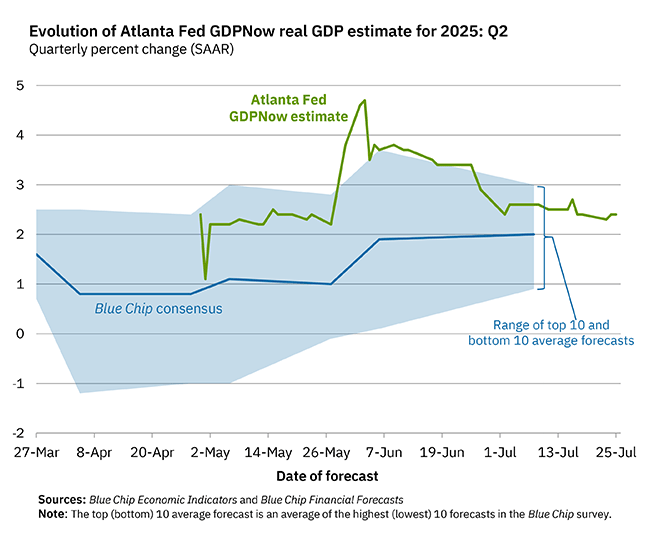
Latest estimate: 2.4 percent — July 25, 2025

The GDPNow model estimate for real GDP growth (seasonally adjusted annual rate) in the second quarter of 2025 is 2.4 percent on July 25, unchanged from July 18 after rounding. The forecasts of the major GDP subcomponents were all unchanged or little changed from their July 18 values after this week’s releases from the U.S. Census Bureau and the National Association of Realtors.

The growth rate of real gross domestic product (GDP) measured by the U.S. Bureau of Economic Analysis (BEA) is a key metric of the pace of economic activity. It is one of the four variables included in the economic projections of Federal Reserve Board members and Bank presidents for every other Federal Open Market Committee (FOMC) meeting. As with many economic statistics, GDP estimates are released with a lag whose timing can be important for policymakers. In preparation for FOMC meetings, policymakers have the Fed Board staff projection of this “advance” estimate at their disposal. These projections—available through 2008 at the Philadelphia Fed’s Real Time Data Center—have generally been more accurate than forecasts from simple statistical models. As stated by economists Jon Faust and Jonathan H. Wright in a 2009 paper, “by mirroring key elements of the data construction machinery of the Bureau of Economic Analysis, the Fed staff forms a relatively precise estimate of what BEA will announce for the previous quarter’s GDP even before it is announced.”

The Atlanta Fed GDPNow model also mimics the methods used by the BEA to estimate real GDP growth. The GDPNow forecast is constructed by aggregating statistical model forecasts of 13 subcomponents that comprise GDP. Other private forecasters use similar approaches to “nowcastGDP growth. However, these forecasts are not updated more than once a month or quarter, are not publicly available, or do not have forecasts of the subcomponents of GDP that add “color” to the top-line number. The Atlanta Fed GDPNow model fills these three voids.

The BEA’s advance estimates of the subcomponents of GDP use publicly released data from the U.S. Census Bureau, U.S. Bureau of Labor Statistics, and other sources. Much of this data is displayed in the BEA’s Key Source Data and Assumptions table that accompanies the “advance” GDP estimate. GDPNow relates these source data to their corresponding GDP subcomponents using a “bridge equation” approach similar to the one described in a Minneapolis Fed [archived PDF] study by Preston J. Miller and Daniel M. Chin. Whenever the monthly source data is not available, the missing values are forecasted using econometric techniques similar to those described in papers by James H. Stock and Mark W. Watson and Domenico Giannone, Lucrezia Reichlin, and David Small. A detailed description of the data sources and methods used in the GDPNow model is provided in an accompanying Atlanta Fed working paper [archived PDF].

As more monthly source data becomes available, the GDPNow forecast for a particular quarter evolves and generally becomes more accurate. That said, the forecasting error can still be substantial just prior to the “advance” GDP estimate release. It is important to emphasize that the Atlanta Fed GDPNow forecast is a model projection not subject to judgmental adjustments. It is not an official forecast of the Federal Reserve Bank of Atlanta, its president, the Federal Reserve System, or the FOMC.

World-Watching: Statement on the Commission’s Status Report in the Climate-Related Disclosure Rules Litigation

[from the U.S. Securities and Exchange Commission]

by Commissioner Caroline A. Crenshaw, July 23, 2025

On April 24, 2025—three months ago—the U.S. Court of Appeals for the Eighth Circuit directed the Commission to provide a status update in the ongoing litigation concerning the Climate-Related Disclosure Rules, which the Commission adopted in March of 2024.[1]

The Court “directed” the Commission to advise whether it “intends to review or reconsider the [R]ules at issue in this case.”[2] And, if the Commission has determined to take no action, the Court ordered the Commission to explain whether it “will adhere to the [R]ules if the petitions for review are denied and, if not, why it will not review or reconsider the [R]ules at this time.”[3]

The Court’s directive was straightforward; our answer is not.

The Commission’s Status Report, filed today, states plainly enough that it has no intention of revisiting the Rules at this time.[4] That, however, is where our responsiveness ends.[5] The Status Report goes on to argue that we cannot expound on what the Commission’s future plans might be in the event the rule-making petitions are denied, because we would be “prejudging” those policy decisions.[6] And, the Status Report explains, any future rule-making should benefit from a court ruling on our statutory authority.[7]

We also weigh in on a number of questions that the Court did not ask of us—for example, we opine that there are “no obstacle[s]” to reaching the merits of the case and that a “live controversy” remains.[8]

This purported response is wholly unresponsive.

The Court asked us in no uncertain terms “will [the Commission] adhere to the [R]ules if the petitions for review are denied[?]” We did not—but should have—answered that question. The unspoken truth under this Commission is that the answer is “no.” Three of the four current Commissioners have been vocal critics of the Rules.[9] They have also withdrawn the Commission from the defense of the Rules in litigation.[10] The Commission simply does not want to say what we all know to be true by now—it has no intention of allowing the Climate-Related Disclosure Rules to go into effect.

Once we acknowledge this answer, the rest of the Commission’s arguments fall away. There are no prejudgment issues, because there is nothing to prejudge. And, we do not need the Court to rule on our statutory authority for the Commission to engage in rule-making. If there is future rule-making in this space—whether to rescind the Rules or otherwise—that rule-making may present different legal issues. Whatever those issues may be, and whomever those aggrieved parties may be, they are not now before the Court. Federal courts are not in the business of giving advisory opinions to agencies.

What is crystal clear, however, is that this Commission is seeking to avoid its legal obligations under the guise of conserving “Commission time and resources.” No matter what, this comes at the expense of judicial resources. As I wrote previously in connection with the Commission’s decision to stop defending these Rules,[11] the Administrative Procedure Act governs the process by which we make and repeal rules. It includes a prescriptive framework for promulgation and rescission. If this Commission wants to rescind, repeal or modify the Rules, which were promulgated by-the-book, then it must do the statutorily-required work. It cannot take the easy way out. It must engage in notice-and-comment rule-making, with the benefit of economic analysis and a public, transparent process, even if inconvenient or if the Commission has other, more pressing priorities.[12] Indeed, other Commissioners have acknowledged that doing the work required to rescind the rule would be a difficult lift.[13] So, instead, we once again ask the Court to do the work for us. By asking the Court to carry water that we should shoulder ourselves, we do a grave disservice to our already taxed judicial system. This is not good governance.

The Commission has effectively ignored the Court’s order and thrown the ball back at the Court. The Court should decline to play these games.


[1] See State of Iowa v. Securities and Exchange Commission, 24-cv-1522 (8th Cir. Apr. 24, 2025) (“Status Update Order”); see also Enhancement and Standardization of Climate-Related Disclosures for Investors [archived PDF], Rel. No. 33-11275 (Mar. 6, 2024), 89 Fed. Reg. 21668 (Mar. 28, 2024) (“Climate-Related Disclosure Rules” or the “Rules”).

[2] Status Update Order.

[3] Id.

[4] Status Report of the Securities and Exchange Commission in Response to the Court’s April 24, 2025 Order, State of Iowa v. Securities and Exchange Commission, 24-cv-1522 (8th Cir. July 23, 2025)(“Status Report”) at 2 (“The Commission does not intend to review or reconsider the Rules at this time.”).

[5] These viewpoints do not reflect upon the efforts of the staff in our Office of the General Counsel.

[6] Status Report at 2.

[7] Id. at 2, 4, 5.

[8] Id. at 2, 3.

[9] See, e.g., Commissioner Hester M. Peirce, Green Regs and Spam: Statement on the Enhancement and Standardization of Climate-Related Disclosures for Investors (Mar. 6, 2025); Commissioner Mark T. Uyeda, A Climate Regulation under the Commission’s Seal: Dissenting Statement on the Enhancement and Standardization of Climate-Related Disclosures for Investors (Mar. 6, 2025); see generally Lesley Clark, “Trump SEC Pick Wants to Ditch Landmark Climate Disclosure Rule,” Politico (Dec. 9, 2024).

[10] See Status Report filed by SEC, State of Iowa v. Securities and Exchange Commission, 24-cv-1522 (8th Cir. Mar. 27, 2025); SEC Press Release No. 2025-58, SEC Votes to End Defense of Climate Disclosure Rules (Mar. 27, 2025) (According to then-Acting Chair Uyeda, “The goal of today’s Commission action and notification to the court is to cease the Commission’s involvement in the defense of the costly and unnecessarily intrusive climate change disclosure rules.”).

[11] Commissioner Caroline A. Crenshaw, Statement Regarding Climate-Related Disclosures Rule Litigation: The Commission has Left the Building (Mar. 27, 2025).

[12] Commissioner Mark T. Uyeda, Remarks at the “SEC Speaks” Conference 2025 (May 19, 2025) (“For the Commission to rescind the climate-related disclosure rule—and address the countless factual findings discussed in that 885-page release—would place a significant strain on the Commission’s resources. This effort would be a difficult lift, and it would potentially take away staff resources needed to advance the regulatory regime with respect to crypto and capital formation.”).

[13] Id.

Economics-Watching: Kuwait: GDP Returns to Growth in Q1 2025 as Impact of Oil Output Cuts Fades

[from NBK Economic Research, 21 July, 2025]

by Mohammad Al-Shehri, Assistant Economist & Omar Al-Nakib, Head of MENA Research

Preliminary official figures show GDP expanding 1% y/y in Q1 2025 following seven consecutive quarters of contraction, helped by a less severe downturn in oil output. With the negative effects of earlier voluntary oil production cuts beginning to fade, oil GDP recorded only a marginal decline, the softest since Q2 2023. Growth in non-oil activity remained positive though eased, weighed by a moderation in the manufacturing, real estate, and transport sectors. The near-term outlook for GDP is one of positive growth, lifted by rising oil production after Kuwait started to restore 135 kb/d of oil output cuts between April and September 2025, while the non-oil sector should also register further steady gains.

Non-oil GDP growth softens in Q1 2025 after strong performance in Q4 2024

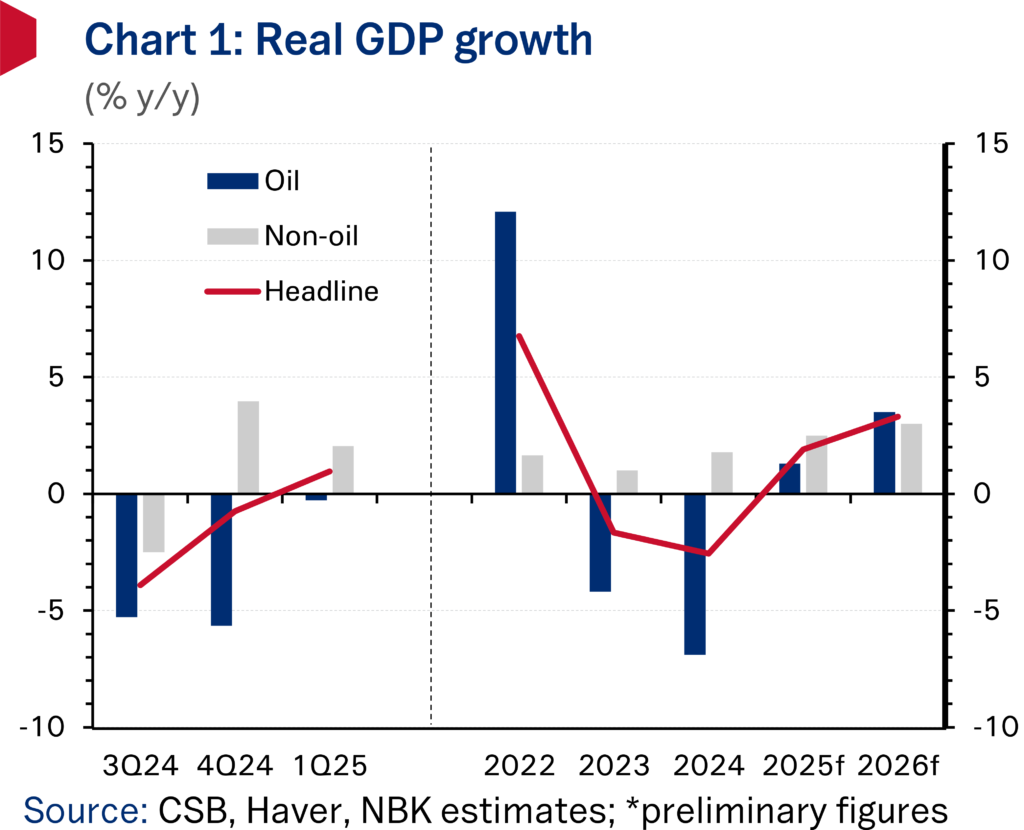
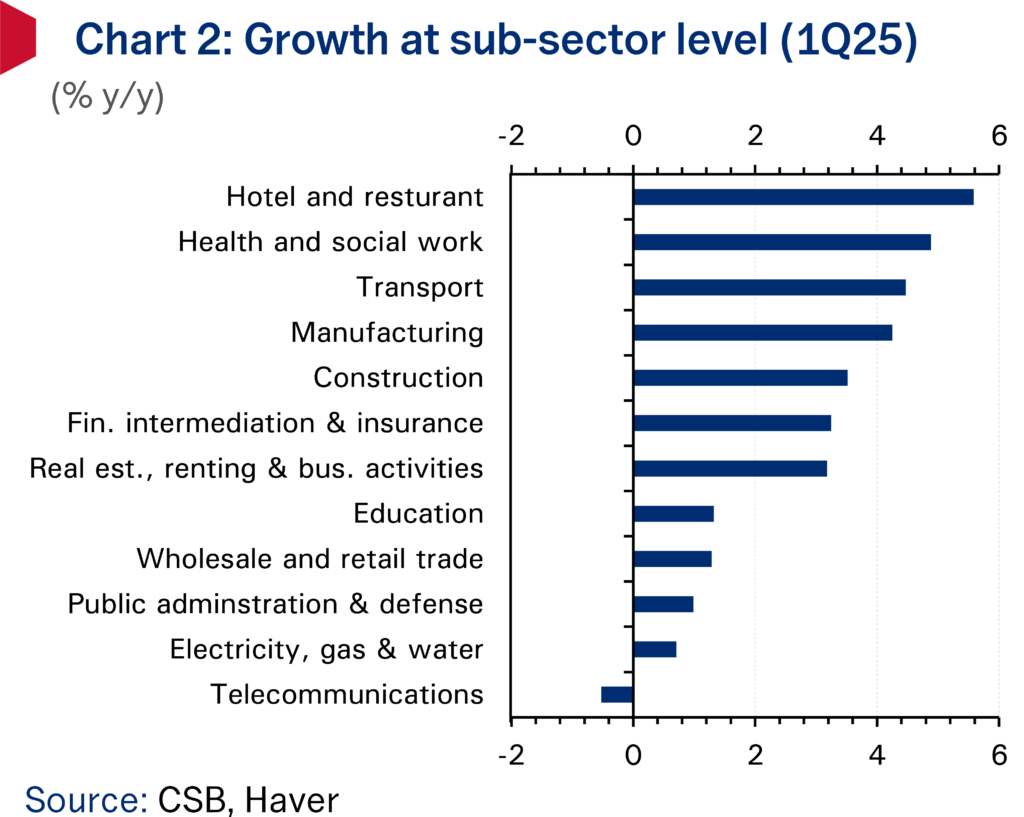
Growth in the non-oil sector weakened in Q1 2025, slowing to 2% y/y compared to 4% recorded in the prior quarter. (Chart 1.) The softer expansion in non-oil activity reflected, among other things, a moderation in the manufacturing sector, where activity grew at a still-solid 4.3% despite a decline in refined petroleum products output but slowed notably from the 12.2% reading registered in Q4 2024. Growth in other sectors including real estate, wholesale & retail trade, transport, and education also slowed. Offsetting the slowdown was stronger expansion in the non-oil economy’s largest segments: public administration and defense as well as financial intermediation and insurance, which grew 1% and 3.2% y/y, respectively. (Chart 2.)

Chart 1: Real GDP growth

Chart 2: Growth at sub-sector level (1Q25)

Oil sector logs marginal contraction, set to return to growth in Q2

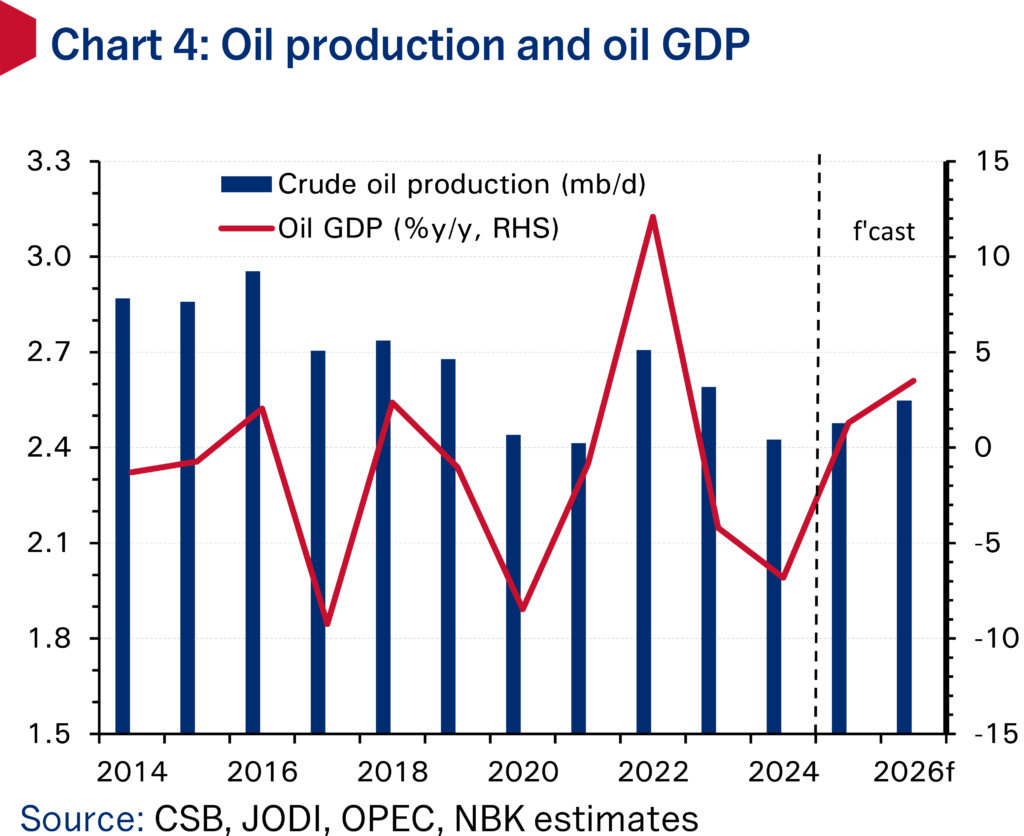
The contraction in oil GDP eased significantly to -0.3% y/y from -5.7% y/y in Q4 2024, registering the softest rate of decline since Kuwait embarked on cutting oil production in Q2 2023 after participating in the voluntary cuts scheme with 7 other OPEC+ members. (Chart 4.) Kuwait’s oil production averaged 2.415 mb/d in Q1 2025, a 0.7% decline from the same quarter last year, according to OPEC secondary sources. However, oil sector fortunes are set to shift in Q2 2025 and thereafter, after the OPEC-8 member alliance started unwinding the 2.2 mb/d voluntary cut tranche in April 2025. Originally planned to be unwound over the course of 18 months, OPEC+ has accelerated the pace of supply hikes with output now on a path to be fully restored in September, a full year ahead of schedule. For Kuwait, crude production rose by 0.5% q/q in Q2 to 2.426 mb/d and is set to accelerate further to average 2.533 mb/d in H2 2025. With the oil market so far able to absorb the additional OPEC and global supply and oil prices currently holding near $70/bbl, an upside risk to our oil sector outlook involves the potential unwinding of the outstanding OPEC-8 voluntary cuts (1.66 mb/d), of which Kuwait’s share is 128 kb/d.

Growth heading back into positive territory in 2025

Growth in total GDP is set to remain on a positive trajectory in the near term, buoyed by further steady expansion in non-oil economic activity and increased oil production. Non-oil GDP is set to benefit from the government’s reform drive which includes the recent passing of the debt law that could catalyze the implementation of key development projects and the potential approval of the ‘mortgagelaw later in 2025, which could spur higher household borrowing and consumer spending. Economic indicators for Q2 2025 pointed to a healthy pace of non-oil economic activity. The key ‘output’ and ‘new orders’ balances in the non-oil private sector PMI gauge both averaged a very robust 57+ in Q2 2025, real estate activity continued to expand at a robust pace with earlier price falls in the residential sector abating, while credit growth stood at a healthy 5.5% y/y in May, and could benefit in coming months if interest rates are reduced further.

Nonetheless, there are also downside risks to the outlook. Local consumer spending growth (according to central bank card transactions data) turned negative in Q1 2025, extending the weakening trend now observed for more than a year. The government’s ongoing fiscal consolidation push will also weigh on wage and job growth. Overall, we see GDP growing 1.9% this year, boosted by expansions in both the oil and non-oil sectors of 1.2% and 2.5%, respectively.

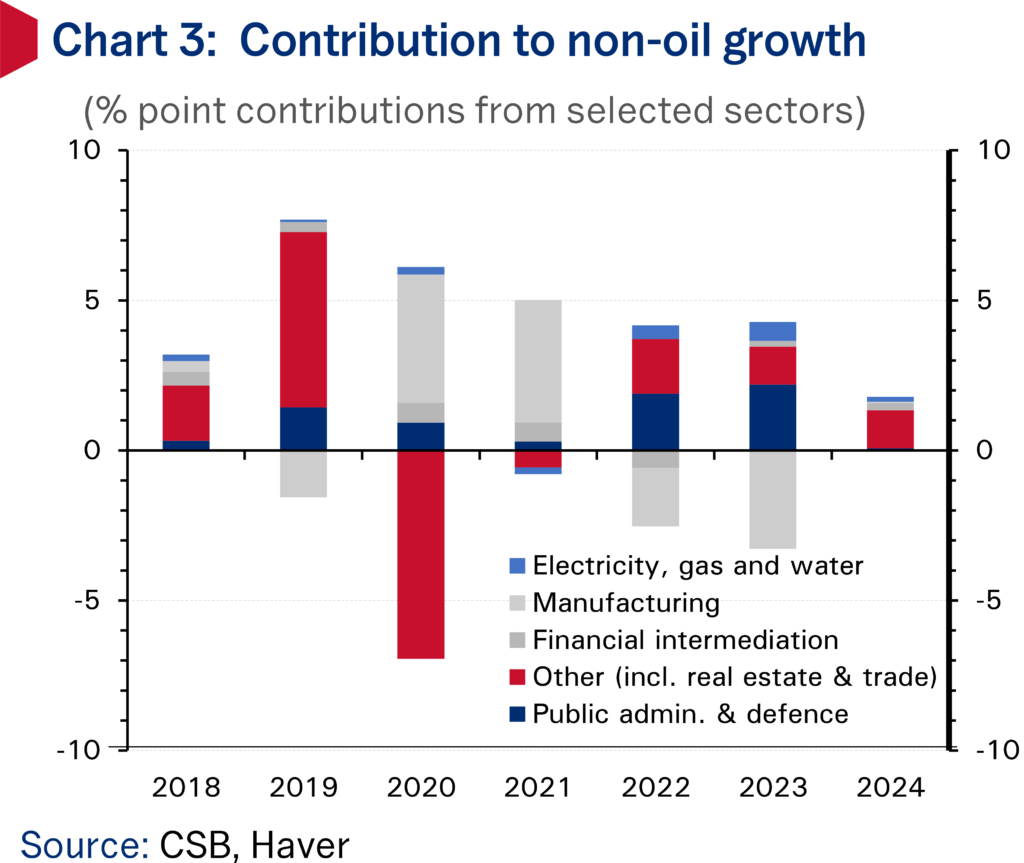
Chart 3: Contribution to non-oil growth

Chart 4: Oil production and oil GDP

Read this article as an archived PDF.

Heidegger vs. Marx as World Watchers

Marx (1818-1883) implies that the foundation of human reality is econo-technical, and on that basis society creates thoughts and philosophies, art and poems. This explanation seems appealing when we think of the economic development of China in our time, for example, or the rise of computers and software.

In a way, Heidegger (1889-1976) turns this upside down. At the basis of world history is society producing culture. You can make a simple “cartoon” and say that for Marx, economics shapes everything, and for Heidegger culture replaces economics.

For example, in his book, What Is Called Thinking? (English translation, 1968, Harper & Row), Heidegger argues the foundation of all Western thinking and culture comes from axioms such as logos [Ancient Greekλόγος] (from which we have logic, cosmology, psychology, epistemology, etc.), as well as legein (the Greek verb λέγειν, “to speak”).

Heidegger states (on page 204), “Without the λέγειν of that logic, modern man would have to make do without his automobile. There would be no airplanes, no turbines, no Atomic Energy Commission.”

Our MI comment on this is that any monocausal explanation of how mankind went from Neanderthal to the Manhattan skyline is completely inadequate. You must create a “double-helix” of Marx and Heidegger, adding the dimensions of surprise and unintended consequences. Without the physics concepts of emergence and complexity, we have no possibility of understanding how we got to now. In the site tagline, we use the word “composite” as a reference to this kind of deeper understanding.

Economics-Watching: Remittances in Times of Uncertainty: Understanding the Dynamics and Implications

[from the International Monetary Fund, by Patrick A. Imam, Kangni R Kpodar, Djoulassi K. Oloufade, Vigninou Gammadigbe]

This paper delves into the intricate relationship between uncertainty and remittance flows. The prevailing focus has been on tangible risk factors like exchange rate volatility and economic downturn, overshadowing the potential impact of uncertainty on remittance dynamics. Leveraging a new dataset of quarterly remittances combined with uncertainty indicators across 77 developing countries from 1999 Q1 to 2019 Q4, the analysis highlights that uncertainty in remittance-sending countries negatively affects remittance flows. In contrast, uncertainty in remittance receiving-countries has a more complex, dual effect. In countries with high private investment ratios, rising domestic uncertainty leads to a decline in remittances. Conversely, in countries with low public spending on education and health, remittances increase in response to uncertainty, serving as a social safety net. The paper underscores the heterogeneous and non-linear effects of domestic uncertainty on remittance flows.

Read the paper [archived PDF].

“De-Globalization?”

The classic study of the “swirl of processes and events” that ended previous globalization episodes is the theme of Princeton Professor Harold James’ 2002 book, The End of Globalization: Lessons from the Great Depression.

Globalization” is here. Signified by an increasingly close economic interconnection that has led to profound political and social change worldwide, the process seems irreversible. In this book, however, Harold James provides a sobering historical perspective, exploring the circumstances in which the globally integrated world of an earlier era broke down under the pressure of unexpected events.

James examines one of the great historical nightmares of the twentieth century: the collapse of globalism in the Great Depression. Analyzing this collapse in terms of three main components of global economicscapital flows, trade and international migrationJames argues that it was not simply a consequence of the strains of World War I, but resulted from the interplay of resentments against all these elements of mobility, as well as from the policies and institutions designed to assuage the threats of globalism.

Could it happen again? There are significant parallels today: highly integrated systems are inherently vulnerable to collapse, and world financial markets are vulnerable and unstable.

While James does not foresee another Great Depression, his book provides a cautionary tale in which institutions meant to save the world from the consequences of globalization—think WTO and IMF, in our own time—ended by destroying both prosperity and peace.

Legitimate fears about “globalization reversal” have been well put by Zakaria:

Davos, Switzerland

President Trump’s speech here at the World Economic Forum went over relatively well. That’s partly because Davos is a conclave of business executives, and they like Trump’s pro-business message. But mostly, the president’s reception was a testament to the fact that he and what he represents are no longer unusual or exceptional. Look around the world and you will see: Trump and Trumpism have become normalized.

Davos was once the place where countries clamored to demonstrate their commitment to opening up their economies and societies. After all, these forces were producing global growth and lifting hundreds of millions out of poverty. Every year, a different nation would become the star of the forum, usually with a celebrated finance minister who was seen as the architect of a boom. The United States was the most energetic promoter of these twin ideas of economic openness and political freedom.

Today, Davos feels very different. Despite the fact that, throughout the world, growth remains solid and countries are moving ahead, the tenor of the times has changed. Where globalization was once the main topic, today it is the populist backlash to it. Where once there was a firm conviction about the way of the future, today there is uncertainty and unease.

This is not simply atmospherics and rhetoric. Ruchir Sharma of Morgan Stanley Investment Management points out that since 2008, we have entered a phase of “deglobalization.” Global trade, which rose almost uninterruptedly since the 1970s, has stagnated, while capital flows have fallen. Net migration flows from poor countries to rich ones have also dropped. In 2018, net migration to the United States hit its lowest point in a decade.

The shift in approach can best be seen in the case of India. In 2018, Prime Minister Narendra Modi came to Davos to decry the fact that “many countries are becoming inward focused and globalization is shrinking.” Since then, his government has increased tariffs on hundreds of items and taken steps to shield India’s farmers, shopkeepers, digital companies and many others from the dangers of international competition. The Office of the U.S. Trade Representative recently called out India for having the highest tariffs of any major economy in the world.

Indian officials used to aggressively court foreign investment, which was much needed to spur growth. Last week, with India’s economy slowing badly, Jeff Bezos announced a $1 billion investment in the country. (Bezos owns The Post.) But the minister of commerce and industry scoffed at the move, saying Amazon wasn’t “doing a great favor to India” and besides was probably engaging in anti-competitive, “predatory” practices. Often, protectionist policies help favored local producers. Malaysian Prime Minister Mahathir Mohamad recently criticized some of Modi’s policies toward Muslims. The Indian government effectively cut off imports of Malaysian palm oil. In a familiar pattern, one of the chief beneficiaries was a local billionaire long associated with Modi.

The Economist notes that Europe, once one of the chief motors for openness in economics and politics, is also rediscovering state intervention to prop up domestic industries. And if you think the Internet is exempt from these tendencies, think again. The European Center for International Political Economy tracks the number of protectionist measures put in place to “localize” the digital economy in 64 countries. It has been surging for years, especially since 2008.

It’s important not to exaggerate the backlash to globalization.

As a 2019 report by DHL demonstrates, globalization is still strong and, by some measures, continues to expand. People still want to trade, travel and transact across the world. But in government policy, where economic logic once trumped politics, today it is often the reverse. Economist Nouriel Roubini argues that the cumulative result of all these measures — protecting local industries, subsidizing national champions, restricting immigration — is to sap growth. “It means slower growth, fewer jobs, less efficient economies,” he told me recently. We’ve seen it happen many times in the past, not least in India, which suffered decades of stagnation as a result of protectionist policies, and we will see the impact in years to come.

Nevertheless, today, nationalism and protectionism prevail.

This phase of deglobalization is being steered from the top. The world’s leading nations are, as always, the agenda-setters. The example of China, which has shielded some of its markets and still grown rapidly, has made a deep impression on much of the world. Probably deeper still is the example of the planet’s greatest champion of liberty and openness, the United States, which now has a president who calls for managed trade, more limited immigration and protectionist measures. At Davos, Trump invited every nation to follow his example. More and more are complying.

The world is de-globalizing. Trump set the example.The Washington Post, Fareed Zakaria

Students should sense that while history does not repeat itself, it sometimes rhymes and this is a major danger. It also might imply that coping with climate change will be all the harder because American-led unilateralism everywhere would mean world policy paralysis.

Economics-Watching: How Green Innovation Can Stimulate Economies and Curb Emissions

[from IMF Blog, by Zeina Hasna, Florence Jaumotte & Samuel Pienknagura]

Coordinated climate policies can spur innovation in low-carbon technologies and help them spread to emerging markets and developing economies

Making low-carbon technologies cheaper and more widely available is crucial to reducing harmful emissions.

We have seen decades of progress in green innovation for mitigation and adaptation: from electric cars and clean hydrogen to renewable energy and battery storage.

More recently though, momentum in green innovation has slowed. And promising technologies aren’t spreading fast enough to lower-income countries, where they can be especially helpful to curbing emissions. Green innovation peaked at 10 percent of total patent filings in 2010 and has experienced a mild decline since. The slowdown reflects various factors, including hydraulic fracking that has lowered the price of oil and technological maturity in some initial technologies such as renewables, which slows the pace of innovation.

The slower momentum is concerning because, as we show in a new staff discussion note, green innovation is not only good for containing climate change, but for stimulating economic growth too. As the world confronts one of the weakest five-year growth outlooks in more than three decades, those dual benefits are particularly appealing. They ease concerns about the costs of pursuing more ambitious climate plans. And when countries act jointly on climate, we can speed up low-carbon innovation and its transfer to emerging markets and developing economies.

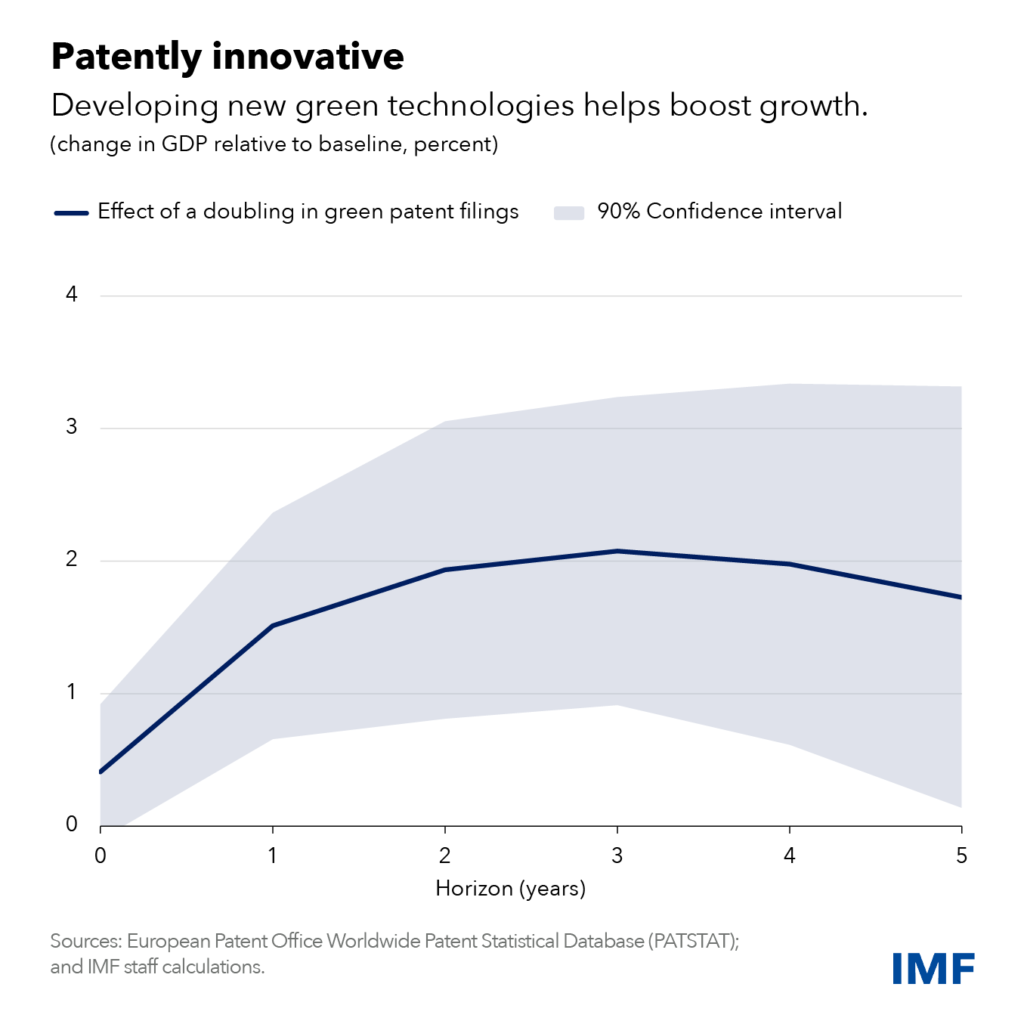
IMF research [archived PDF] shows that doubling green patent filings can boost gross domestic product by 1.7 percent after five years compared with a baseline scenario. And that’s under our most conservative estimate—other estimates show up to four times the effect.

The economic benefits of green innovation mostly flow through increased investment in the first few years. Over time, further growth benefits come from cheaper energy and production processes that are more energy efficient. Most importantly, they come from less global warming and less frequent (and less costly) climate disasters.

Green innovation is associated with more innovation overall, not just a substitution of green technologies for other kinds. This may be because green technologies often require complementary innovation. More innovation usually means more economic growth.

A key question is how countries can better foster green innovation and its deployment. We highlight how domestic and global climate policies spur green innovation. For example, a big increase in the number of climate policies tends to boost green patent filings, our preferred proxy for green innovation, by 10 percent within five years.

Some of the most effective policies to stimulate green innovation include emissions-trading schemes that cap emissions, feed-in-tariffs, which guarantee a minimum price for renewable energy producers, and government spending, such as subsidies for research and development. What’s more, global climate policies result in much larger increases in green innovation than domestic initiatives alone. International pacts like the Kyoto Protocol and the Paris Agreement amplify the impact of domestic policies on green innovation.

One reason policy synchronization has a prominent impact on domestic green innovation is what is called the market size effect. There’s more incentive to develop low-carbon technologies if innovators can expect to sell into a much larger potential market, that is, in countries which adopted similar climate policies.

Another is that climate policies in other countries generate green innovations and knowledge that can be used in the domestic economy. This is known as technology diffusion. Finally, synchronized policy action and international climate commitments create more certainty around domestic climate policies, as they boost people’s confidence in governments’ commitment to addressing climate change.

Climate policies even help spread the use of low-carbon technologies in countries that are not sources of innovation, through trade and foreign-direct investment. Countries that introduce climate policies see more imports of low-carbon technologies and higher green FDI inflows, especially in emerging markets and developing economies.

Risks of protectionism

Lowering tariffs on low-carbon technologies can further enhance trade and FDI in green technologies. This is especially important for middle- and low-income countries where such tariffs remain high. On the flipside, more protectionist measures would impede the broader spread of low-carbon technologies.

In addition, and given evidence of economies of scale, protectionism—with ultimately smaller potential markets—could stifle incentives for green innovation and lead to duplication of efforts across countries.

The risks of protectionism are exacerbated when climate policies, such as subsidies, do not abide by international rules. For example, local content requirements, whereby only locally produced green goods benefit from subsidies, undermine trust in multilateral trade rules and could result in retaliatory measures.

Beyond embracing a rules-based approach to climate policies, the advanced economies, where most green innovation occurs, have an important responsibility: sharing the technology so that emerging and developing economies can get there faster. Such direct technology transfers hold the promise of a double dividend for emerging markets and developing economies—reducing emissions and yielding economic benefits.

—This blog reflects research by Zeina Hasna, Florence Jaumotte, Jaden Kim, Samuel Pienknagura and Gregor Schwerhoff.

Economics-Watching: “Doing Nothing” Is Still Doing a Lot

[from the Federal Reserve Bank of Philadelphia, speech by Patrick T. Harker President and Chief Executive Officer at the National Association of Corporate Directors Webinar, Philadelphia, PA (Virtual)]

Good afternoon, everyone.

I appreciate that you’re all giving up part of the end of your workday for us to be together, if only virtually.

My thanks to my good friend, Rick Mroz, for that welcome and introduction.

I do believe we’re going to have a productive session. But just so you all know, as much as I enjoy speaking and providing my outlook, I enjoy a good conversation even more.

So, first, let’s take a few minutes so I can give you my perspective on where we are headed, and then I will be more than happy to take questions and hear what’s on your minds.

But before we get into any of that, I must begin with the standard Fed disclaimer: The views I express today are my own and do not necessarily reflect those of anyone else on the Federal Open Market Committee (FOMC) or in the Federal Reserve System.

Put simply, this is one of those times where the operative words are, “Pat said,” not “the Fed said.”

Now, to begin, I’m going to first address the two topics that I get asked about most often: interest rates and inflation. And I would guess they are the topics front and center in many of your minds as well.

After the FOMC’s last policy rate hike in July, I went on record with my view that, if economic and financial conditions evolved roughly as I expected they would, we could hold rates where they are. And I am pleased that, so far, economic and financial conditions are evolving as I expected, if not perhaps even a tad better.

Let’s look at the current dynamics. There is a steady, if slow, disinflation under way. Labor markets are coming into better balance. And, all the while, economic activity has remained resilient.

Given this, I remain today where I found myself after July’s meeting: Absent a stark turnabout in the data and in what I hear from contacts, I believe that we are at the point where we can hold rates where they are.

In barely more than a year, we increased the policy rate by more than 5 percentage points and to its highest level in more than two decades — 11 rate hikes in a span of 12 meetings prior to September. We not only did a lot, but we did it very fast.

We also turned around our balance sheet policy — and we will continue to tighten financial conditions by shrinking the balance sheet.

The workings of the economy cannot be rushed, and it will take some time for the full impact of the higher rates to be felt. In fact, I have heard a plea from countless contacts, asking to give them some time to absorb the work we have already done.

I agree with them. I am sure policy rates are restrictive, and, as long they remain so, we will steadily press down on inflation and bring markets into a better balance.

Holding rates steady will let monetary policy do its work. By doing nothing, we are still doing something. And I would argue we are doing quite a lot.

Headline PCE inflation remained elevated in August at 3.5 percent year over year, but it is down 3 percentage points from this time last year. About half of that drop is due to the volatile components of energy and food that, while basic necessities, they are typically excluded by economists in the so-called core inflation rate to give a more accurate assessment of the pace of disinflation and its likely path forward.

Well, core PCE inflation has also shown clear signs of progress, and the August monthly reading was its smallest month-over-month increase since 2020.

So, yes, a steady disinflation is under way, and I expect it to continue. My projection is that inflation will drop below 3 percent in 2024 and level out at our 2 percent target thereafter.

However, there can be challenges in assessing the trends in disinflation. For example, September’s CPI report came out modestly on the upside, driven by energy and housing.

Let me be clear about two things. First, we will not tolerate a reacceleration in prices. But second, I do not want to overreact to the normal month-to-month variability of prices. And for all the fancy techniques, the best way to separate a signal from noise remains to average data over several months. Of course, to do so, you need several months of data to start with, which, in turn, demands that, yes, we remain data-dependent but patient and cautious with the data.

Turning to the jobs picture, I do anticipate national unemployment to end the year at about 4 percent — just slightly above where we are now — and to increase slowly over the next year to peak at around 4.5 percent before heading back toward 4 percent in 2025. That is a rate in line with what economists call the natural rate of unemployment, or the theoretical level in which labor market conditions support stable inflation at 2 percent.

Now, that said, as you know, there are many factors that play into the calculation of the unemployment rate. For instance, we’ve seen recent months where, even as the economy added more jobs, the unemployment rate increased because more workers moved off the sidelines and back into the labor force. There are many other dynamics at play, too, such as technological changes or public policy issues, like child care or immigration, which directly impact employment.

And beyond the hard data, I also have to balance the soft data. For example, in my discussions with employers throughout the Third District, I hear that given how hard they’ve worked to find the workers they currently have, they are doing all they can to hold onto them.

So, to sum up the labor picture, let me say, simply, I do not expect mass layoffs.

do expect GDP gains to continue through the end of 2023, before pulling back slightly in 2024. But even as I foresee the rate of GDP growth moderating, I do not see it contracting. And, again, to put it simply, I do not anticipate a recession.

Look, this economy has been nothing if not unpredictable. It has proven itself unwilling to stick to traditional modeling and seems determined to not only bend some rules in one place, but to make up its own in another. However, as frustratingly unpredictable as it has been, it continues to move along.

And this has led me to the following thought: What has fundamentally changed in the economy from, say, 2018 or 2019? In 2018, inflation averaged 2 percent almost to the decimal point and was actually below target in 2019. Unemployment averaged below 4 percent for both years and was as low as 3.5 percent — both nationwide and in our respective states — while policy rates peaked below 2.5 percent.

Now, I’m not saying we’re going to be able to exactly replicate the prepandemic economy, but it is hard to find fundamental differences. Surely, I cannot and will not minimize the immense impacts of the pandemic on our lives and our families, nor the fact that for so many, the new normal still does not feel normal. From the cold lens of economics, I do not see underlying fundamental changes. I could also be wrong, and, trust me, that would not be the first time this economy has made me rethink some of the classic models. We just won’t know for sure until we have more data to look at over time.

And then, of course, there are the economic uncertainties — both national and global — against which we also must contend. The ongoing auto worker strike, among other labor actions. The restart of student loan payments. The potential of a government shutdown. Fast-changing events in response to the tragic attacks against Israel. Russia’s ongoing war against Ukraine. Each and every one deserves a close watch.

These are the broad economic signals we are picking up at the Philadelphia Fed, but I would note that the regional ones we follow are also pointing us forward.

First, while in the Philadelphia Fed’s most recent business outlook surveys, which survey manufacturing and nonmanufacturing firms in the Third District, month-over-month activity declined, the six-month outlooks for each remain optimistic for growth.

And we also publish a monthly summary metric of economic activity, the State Coincident Indexes. In New Jersey, the index is up slightly year over year through August, which shows generally positive conditions. However, the three-month number from June through August was down, and while both payroll employment and average hours worked in manufacturing increased during that time, so did the unemployment rate — though a good part of that increase can be explained as more residents moved back into the labor force.

And for those of you joining us from the western side of the Delaware River, Pennsylvania’s coincident index is up more than 4 percent year over year through August and 1.7 percent since June. Payroll employment was up, and the unemployment rate was down; however, the number of average hours worked in manufacturing decreased.

There are also promising signs in both states in terms of business formation. The number of applications, specifically, for high-propensity businesses — those expected to turn into firms with payroll — are remaining elevated compared with pre-pandemic levels. Again, a promising sign.

So, it is against this full backdrop that I have concluded that now is the time at which the policy rate can remain steady. But I can hear you ask: “How long will rates need to stay high.” Well, I simply cannot say at this moment. My forecasts are based on what we know as of late 2023. As time goes by, as adjustments are completed, and as we have more data and insights on the underlying trends, I may need to adjust my forecasts, and with them my time frames.

I can tell you three things about my views on future policy. First, I expect rates will need to stay high for a while.

Second, the data and what I hear from contacts and outreach will signal to me when the time comes to adjust policy either way. I really do not expect it, but if inflation were to rebound, I know I would not hesitate to support further rate increases as our objective to return inflation to target is, simply, not negotiable.

Third, I believe that a resolute, but patient, monetary policy stance will allow us to achieve the soft landing that we all wish for our economy.

Before I conclude and turn things over to Rick to kick off our Q&A, I do want to spend a moment on a topic that he and I recently discussed, and it’s something about which I know there is generally great interest: fintech. In fact, I understand there is discussion about NACD hosting a conference on fintech.

Well, last month, we at the Philadelphia Fed hosted our Seventh Annual Fintech Conference, which brought business and thought leaders together at the Bank for two days of real in-depth discussions. And I am extraordinarily proud of the fact that the Philadelphia Fed’s conference has emerged as one of the premier conferences on fintech, anywhere. Not that it’s a competition.

I had the pleasure of opening this year’s conference, which always puts a focus on shifts in the fintech landscape. Much of this year’s conference centered around developments in digital currencies and crypto — and, believe me, some of the discussions were a little, shall we say, “spirited.” However, my overarching point to attendees was the following: Regardless of one’s views, whether in favor of or against such currencies, our reality requires us to move from thinking in terms of “what if” to thinking about “what next.”

In many ways, we’re beyond the stage of thinking about crypto and digital currency and into the stage of having them as reality — just as AI has moved from being the stuff of science fiction to the stuff of everyday life. What is needed now is critical thinking about what is next. And we at the Federal Reserve, both here in Philadelphia and System-wide, are focused on being part of this discussion.

We are also focused on providing not just thought leadership but actionable leadership. For example, the Fed rolled out our new FedNow instant payment service platform in July. With FedNow, we will have a more nimble and responsive banking system.

To be sure, FedNow is not the first instant payment system — other systems, whether operated by individual banks or through third parties, have been operational for some time. But by allowing banks to interact with each other quickly and efficiently to ensure one customer’s payment becomes another’s deposit, we are fulfilling our role in providing a fair and equitable payment system.

Another area where the Fed is assuming a mantle of leadership is in quantum computing, or QC, which has the potential to revolutionize security and problem-solving methodologies throughout the banking and financial services industry. But that upside also comes with a real downside risk, should other not-so-friendly actors co-opt QC for their own purposes.

Right now, individual institutions and other central banks globally are expanding their own research in QC. But just as these institutions look to the Fed for economic leadership, so, too, are they looking to us for technological leadership. So, I am especially proud that this System-wide effort is being led from right here at the Philadelphia Fed.

I could go on and talk about fintech for much longer. After all, I’m actually an engineer more than I am an economist. But I know that Rick is interested in starting our conversation, and I am sure that many of you are ready to participate.

But one last thought on fintech — my answers today aren’t going to be generated by ChatGPT.

On that note, Rick, thanks for allowing me the time to set up our discussion, and let’s start with the Q&A.

[archived PDF of the above speech]

Economy-Watching, USA: Global Supply Chain Pressure Index: April 2023 Update

[from the Federal Reserve Bank of New York]

A new reading of the Global Supply Chain Pressure Index has been posted.

Estimates for March 2023

  • Global supply chain pressures decreased again in March, falling from 0.28 to 1.06 standard deviations below the index’s historical average.
  • There were significant downward contributions by many of the factors, with the largest negative contributions from European Area delivery times, European Area backlogs, and Taiwanese purchases.
  • The GSCPI’s recent movements suggest that global supply chain conditions have largely normalized after experiencing temporary setbacks around the turn of the year.

The GSCPI compiles more than two dozen metrics across seven economies—data on global transportation costs and regional manufacturing conditions—to track shifts in supply chain pressures from 1997 to the present.

The GSCPI is updated regularly at 10 AM ET on the fourth business day of each month.

The GSCPI is a product of the Federal Reserve Bank of New York’s Applied Macroeconomics and Econometrics Center.

View the index.

Economy-Watching, USA: First-Quarter GDP Growth Estimate Decreased

[from the Federal Reserve Bank of Atlanta]

GDPNow

First-Quarter GDP Growth Estimate Decreased

On April 5, the GDPNow model estimate for real GDP growth in the first quarter of 2023 is 1.5 percent, down from 1.7 percent on April 3.

The next GDPNow update is Monday, April 10.

Want to see even more economic data? The Atlanta Fed’s EconomyNow app will put GDPNow and all its data tools right in your hands. Download it today to see the latest data on inflation, growth, and the labor market.