Skip to content
Meta Intelligence

Meta Intelligence

Towards a Composite Understanding of Education

  • About
  • Contact

Tag: deposit account

Japan-Watching: Yen Repatriation: The Tide Is Turning

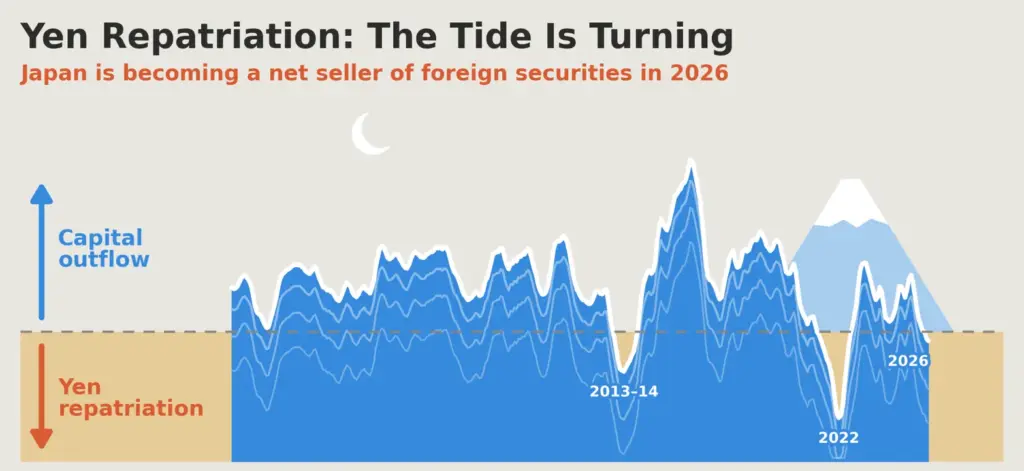
From 2014 to 2025, Japan bought foreign securities worth about 2% of GDP a year. In 2026 the tide is turning. Banks are selling foreign bonds and capital flow has turned to a small net inflow.

[by OKUBO Takuji]
Key takeaways

  • Japan has been an exporter of capital since the 1980s, purchasing 2–3% of GDP worth of foreign assets every year, interrupted by episodes of yen repatriation from time to time. 2026–27 may be turning into such an episode.
  • Banks are selling foreign bonds and buying JGBs. Now that yen yields are higher, their JGB purchases leave less room for duration risk in foreign bonds.
  • Households keep buying foreign stocks, but pension funds are selling against them, offsetting the net purchase of foreign equities.
  • Pension funds are likely to put more money into yen. On my replication of GPIF’s allocation rule, its domestic-bond weight should be much higher than today’s 25%, and foreign bonds are the likely asset class to give way.
  • The weekly survey to 10 October shows foreign-bond selling continuing. In my view, yen repatriation in 2026–27 is a question of how large, not whether.

Japan’s outward flow has turned into a net sale

Japan has been a large provider of capital to the rest of the world since the 1980s. The latest wave began in 2014. From 2014 to 2025, residents bought ¥13.6trn a year on average, about 2.3% of GDP.

Chart 1 shows the flow as a rolling twelve-month sum. The one large exception was 2022, when bond yields rose sharply abroad and Japanese investors sold their holdings, realizing losses on their foreign bonds. They went right back into purchasing foreign securities in 2023 when yield curves in major foreign bond markets stabilized, while domestic bond yields remained close to zero. How Japanese investors behave now that yen yields are respectable is the big question.
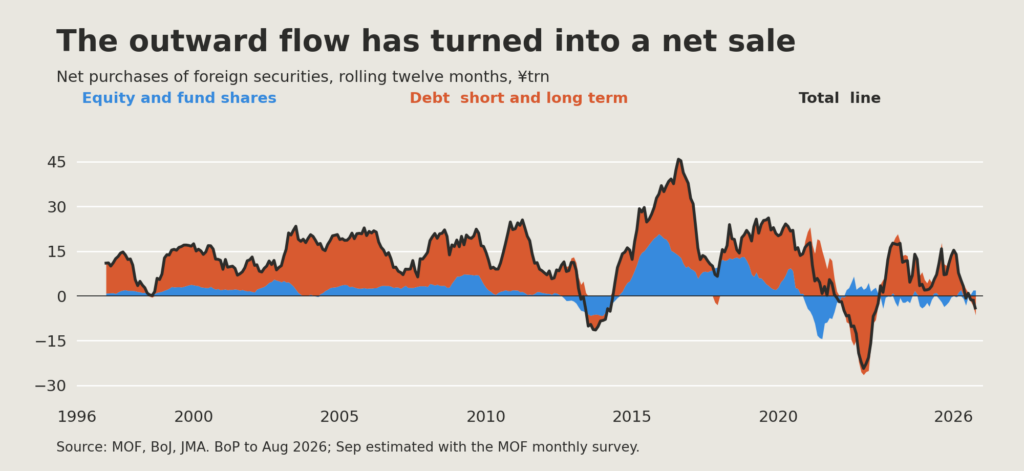
Chart 1: Rolling twelve-month flows, stacked separately above and below zero. Short- and long-term debt combined; black line is the net total. BoP through August 2026; September estimated from the MOF monthly survey. Source: MOF, BoJ, JMA.

The flow is turning again in 2026. By August 2026 the rolling total was a small net sale of ¥1.5trn (see chart 1 above). September’s balance of payments statistics are not out yet, but based on the International Transactions in Securities Survey for September, I estimate that the rolling total would be a net sale of ¥4.5trn. September itself was a small net sale; most of the drop comes from September 2025’s ¥2.8trn of buying leaving the window.

Foreign bonds and foreign equity have different investors

In the rest of the report, I discuss recent developments in Japan’s capital flows. I have organized the discussion by asset class because the investor bases differ. Banks, the FX reserves managed by the government, pensions and insurers hold foreign bonds. In foreign equity, households are now the key investors, alongside pensions and other traditional investors. GPIF and other pensions sit in both markets, so I discuss them in a part of their own.

Part 1 covers foreign bonds, where repatriation would show first. Part 2 covers foreign equity, where households keep buying while pensions sell against them. In Part 3, GPIF is the key mover in both markets. In Part 4, I discuss the most recent developments, using the weekly survey, which runs to 10 October, and what to watch. The focus of this report is return-seeking portfolio investment, so analysis of the Japanese government’s FX reserves is covered in Japan Cashes In Its National Carry Trade (31 July) and Japan Inc.’s real investment is covered in Japan Inc. Now Sells No Yen to Invest Abroad (10 October).

Japan holds 147% of GDP worth of securities abroad

Before moving to discuss recent developments, let me give you a brief historical perspective on Japan’s outward investment. Japan has been a creditor nation since the 1980s. In 1985–89, Japan invested 3–5% of GDP, as Japan was awash with bubble money. Since then, Japan has typically invested 2–3% of GDP a year in foreign securities, with some episodes of repatriation from time to time. At end-2025, Japan held ¥982trn in foreign portfolio securities and official reserve assets: ¥401trn of equity and fund shares, ¥368trn of portfolio debt and ¥214trn of reserves (chart 2). Reserves are mostly US Treasuries plus some deposits and gold. The ¥401trn in equity and fund shares actually includes some bond funds that are categorized inside “equity and fund shares” in official statistics, so we will make some adjustments when we discuss investor behavior by asset class in later parts.
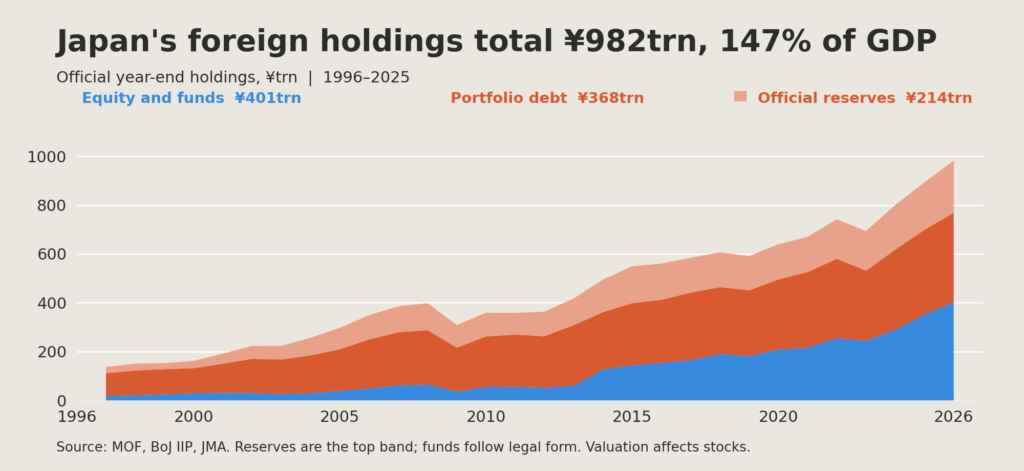
Chart 2: Official year-end holdings, 1996–2025. Equity is the bottom band, portfolio debt the middle band and official reserves the top band. Debt and reserves use related colors. Current BPM6-rearranged IIP; funds classified by legal form. Source: MOF, BoJ, JMA.

Part 1. Selling foreign bonds in 2026

Banks, reserves, pensions and insurers own the bonds

Of the ¥214trn the Japanese government holds as reserves, ¥157trn is debt securities and the rest is gold, deposits and other claims. Add this ¥157trn to the ¥368trn of private debt securities and an estimated ¥47trn of bond funds that are categorized as “equity and fund shares” in the balance of payments statistics, and you get ¥573trn of debt securities held by Japan at end-2025. By my estimate, banks held 32% of it, official FX reserves 27%, public and corporate pensions 19% and insurers 14% (chart 3).
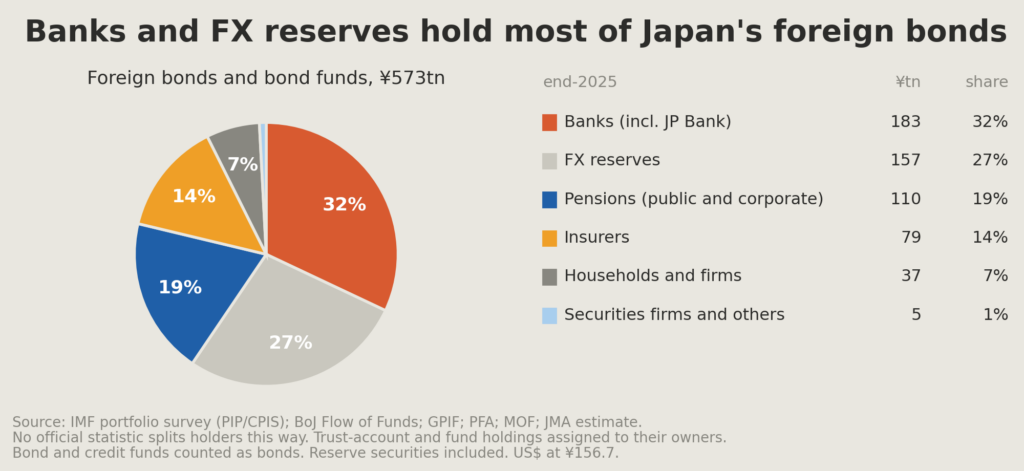
Chart 3: End-2025, JMA estimates. Bonds and bond funds, reserve securities included; trust-account and fund holdings are assigned to their owners. Source: IMF, GPIF, BoJ, MOF, PFA, JMA.

Banks are selling while pensions keep buying

Chart 4 shows movements in foreign long-term bond flows by investors since 2014. We see pension funds as the consistent buyer, with an elevated purchase in 2020 when GPIF raised its foreign-bond asset allocation target from 15% to 25% (see the Japanese Macro Advisors GPIF report for details). On the other hand, life insurers have been consistent net sellers in recent years. Banks seem to be opportunistic swing players. This year’s foreign-bond sale so far is a bank story.
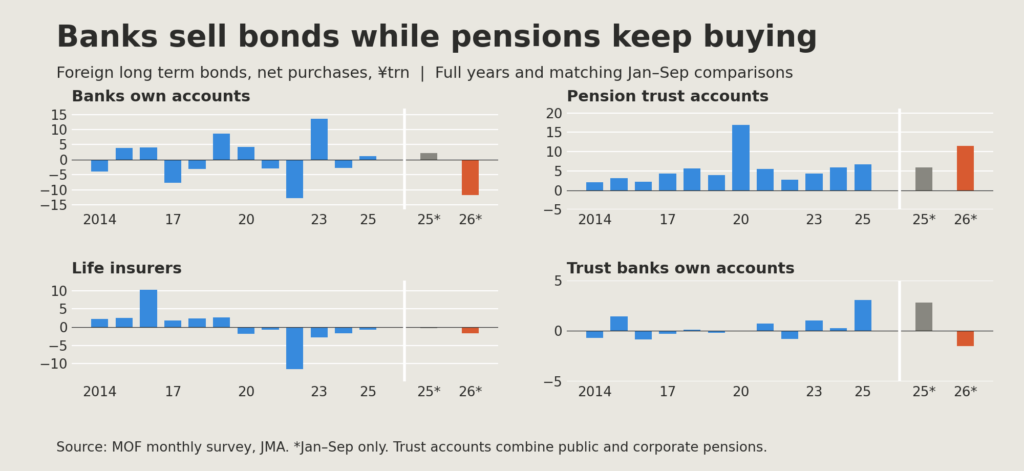
Chart 4: Foreign long-term bonds by investor. Full calendar years 2014–2025; the two separate bars at right compare January–September 2025 and 2026. MOF monthly survey throughout. Source: MOF, JMA.

The bank balance sheets show who is selling. City banks are the dominant players: their foreign securities reached about ¥53trn in late 2024, moved sideways with some swings in 2025, and then fell in 2026. Regional banks’ foreign holdings are small and little changed (chart 5).
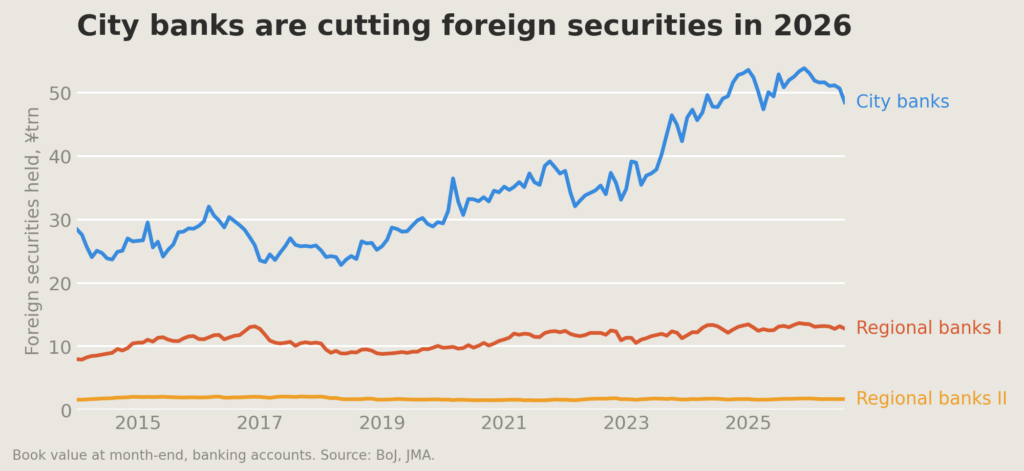
Chart 5: Foreign securities held by city banks and regional banks, month-end book value, banking accounts, through August 2026. Source: BoJ, JMA.

2026 is different from 2022: Yen rates are at 30-year highs

City banks went through a similar repatriation episode in 2022 (see chart 5), but went right back to buying foreign bonds in 2023 as soon as the overseas yield curve stabilized. 2026 offers a different environment. Both city banks and regional banks are buying JGBs, although in different parts of the yield curve. City banks are stepping up their purchases of 10-year bonds on a rolling 12-month basis (chart 6). They were selling the 2–5-year and super-long sectors in early 2026, but their rolling 12-month figures have just come back to neutral. Regional and co-operative institutions are showing strong appetite for the 2–5-year and 10-year sectors. Banks buying at home does not necessarily mean selling bonds abroad, but their JGB purchases do leave less room for duration risk in foreign bonds.
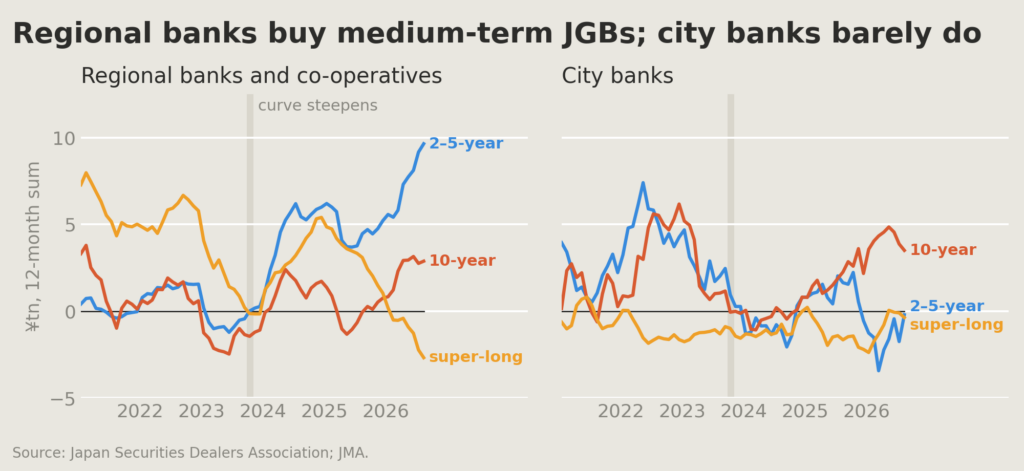
Chart 6: Net secondary-market OTC purchases, twelve months through August. Regional/co-operative group includes regional banks, shinkin and agricultural institutions; auctions and bills excluded. Source: JSDA, JMA.

Part 2. Pension funds are selling foreign equity, offsetting households’ buying

Pension funds and households are the top two owners of foreign equity (chart 7). As you can see in chart 8, households have been showing a strong appetite for foreign equity investment trusts since 2024, and they are still buying. NISA accounts, low-cost funds and retirement savings are behind it, and I expect it to continue. Mrs Watanabe No More (21 September) tells that story in full.
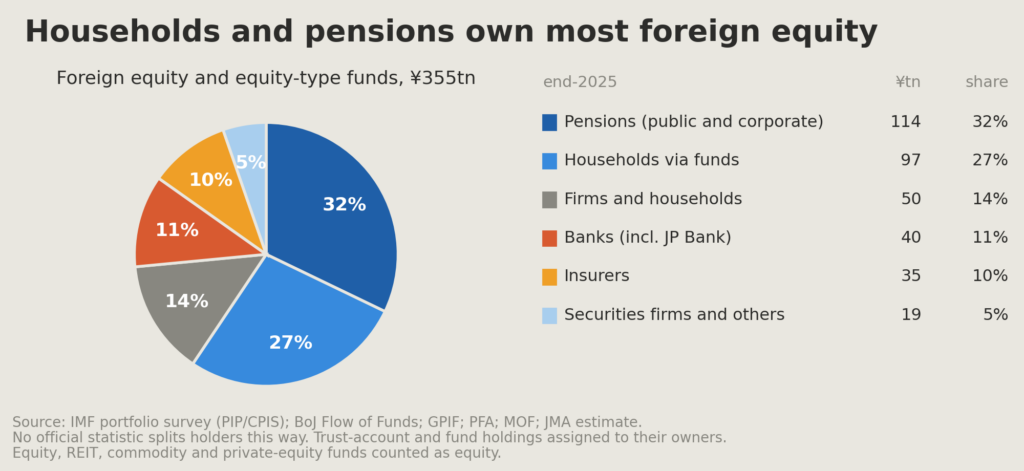
Chart 7: End-2025, JMA estimates. Equity and equity-type funds; trust-account and fund holdings are assigned to their owners. Source: IMF, GPIF, BoJ, MOF, PFA, JMA.
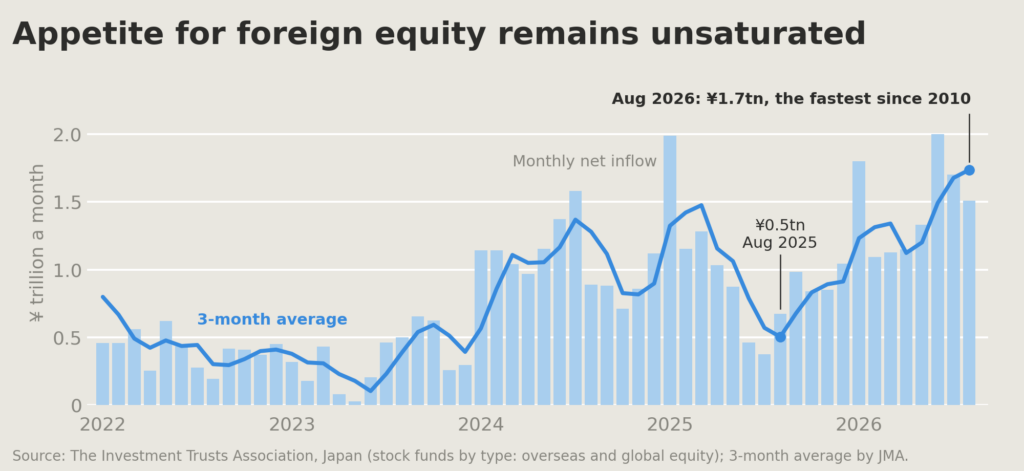
Chart 8: Monthly net purchase of overseas- and global-equity investment funds. Source: ITA, JMA.

The strong appetite of households for foreign equity has been offset by selling by pension funds though. Over the twelve months to August, households bought ¥11.9trn of foreign equity through investment trusts, but pension funds through their trust accounts sold ¥11.5trn (chart 9).
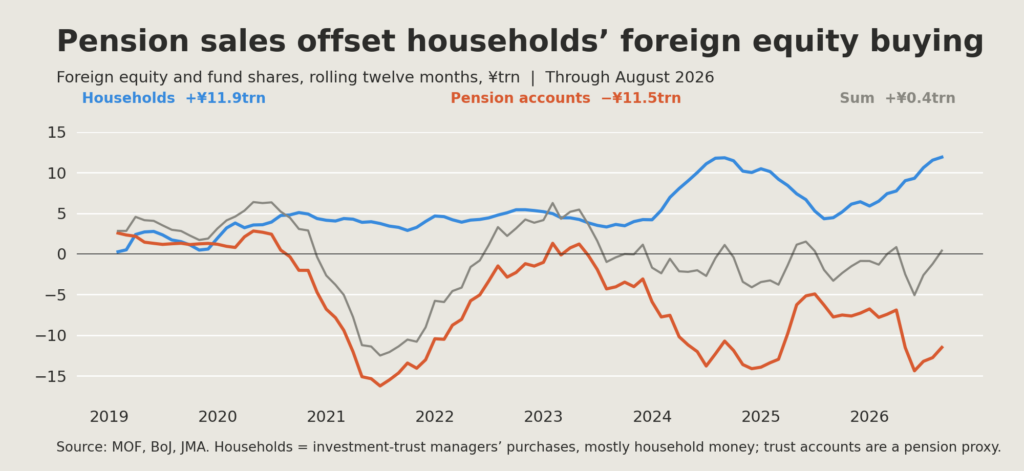
Chart 9: BoP rolling twelve-month flows through August. Households are investment-trust managers’ purchases. Trust accounts are a pension proxy. Source: MOF, BoJ, JMA.

Why do pensions sell what households buy? Pension funds typically manage their assets to target weights. When foreign equities outperform, they sell some and buy other assets to restore the balance.

Part 3. Pension funds to put more money in yen

GPIF likely to raise its asset allocation into yen bonds

As you can see in the two pie charts (charts 3 and 7), GPIF and other pension funds are key players in Japan’s investments in foreign bonds and equity. GPIF, with ¥320trn of assets under management, is the big whale, and changes in its asset allocation have played a significant role in defining Japan’s cross-border capital flows in recent years.

For details on my views on GPIF, I refer readers to the “GPIF the Whale” report. Here is the gist. GPIF reduced its domestic-bond allocation target from 60% to 35% in 2014 and to 25% in 2020, partly to protect the fund from a JGB crash it saw coming (chart 10). The crash has already happened, in slow motion over the last two years. When GPIF last reviewed the asset allocation in early 2025, maintaining the target unchanged at 25% made sense. At the time, JGB yields had more room to “normalize”, and they did. Please see my report The Long Climb in JGB Yields Is Nearly Over (20 July) for why I think the normalization is largely over.

On my simplified replication of GPIF’s allocation rule, a zero expected real return on JGBs points to a domestic-bond weight of about 50%, against 25% today. A move to 50% means about ¥80trn of assets shifting toward yen bonds, and foreign bonds are the likely asset class to give way. For more details, please see Yen Repatriation Starts with the Whale (10 September). It is a tricky shift, as GPIF is a classic whale in financial jargon, and there is a legitimate concern that other investors could front-run it. But GPIF cannot ignore the asset-allocation arithmetic. GPIF’s July–September results, due in early November, are the first place a shift could show, but even if it doesn’t, it is just a matter of time in my view, as GPIF would be doing Japanese pensioners a disservice if it did not change the allocation.
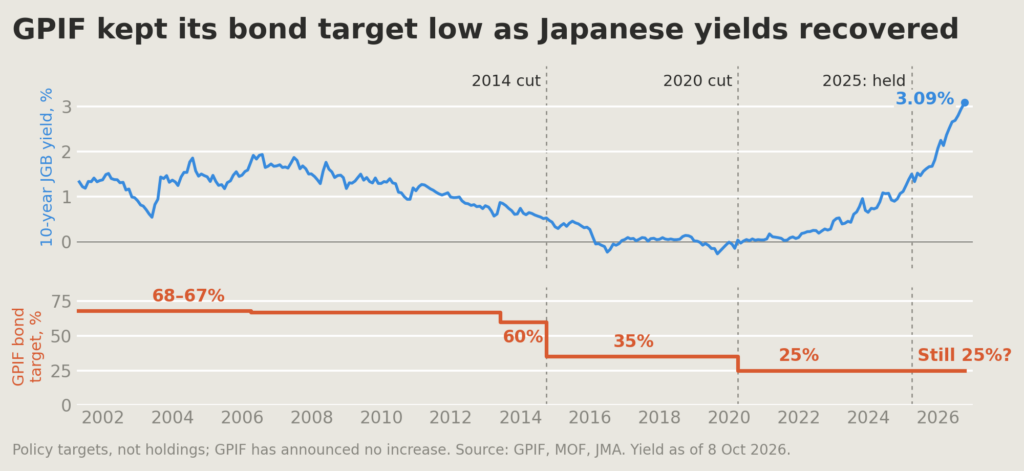
Chart 10: GPIF policy targets for domestic bonds and 10-year JGB yield, through 8 October 2026. Source: GPIF, MOF, JMA.

Part 4. Recent development and what to watch

Weekly data shows bond selling continuing into October

The balance of payments is the key statistic for monitoring cross-border capital flows, but as of mid-October it runs only to August. The Ministry of Finance’s weekly survey of large investors is a good leading indicator and runs to 10 October. In the four weeks to 10 October, Japanese investors sold a net ¥3.3trn of foreign long-term bonds. Chart 11 shows the 52-week and 13-week averages.
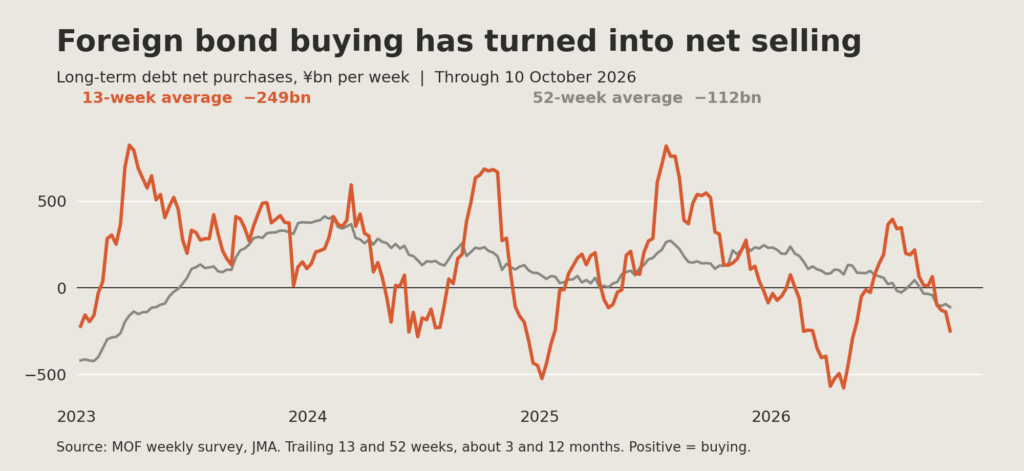
Chart 11: MOF weekly survey of designated major investors. 13- and 52-week trailing averages, approximately three and twelve months, through 10 October. Both lines show average net purchases per week, not cumulative totals. Source: MOF, JMA.

Equity flows have no sustained direction

The same weekly survey includes equity flows. They have some ups and downs, but the 52-week average is hugging the zero line, and I do not see any particular trend upward or downward (chart 12). The equity data add no repatriation signal to the bond evidence.
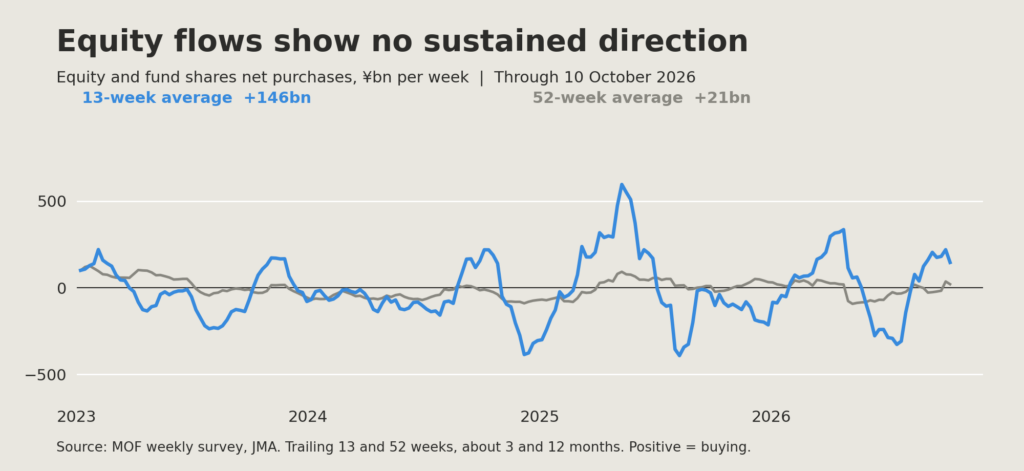
Chart 12: Same weekly survey, smoothing windows, dates and vertical scale as Chart 11; foreign equity and fund shares. The 13-week line shows recent swings; the 52-week line shows the smaller underlying net flow. Source: MOF, JMA.

What to watch

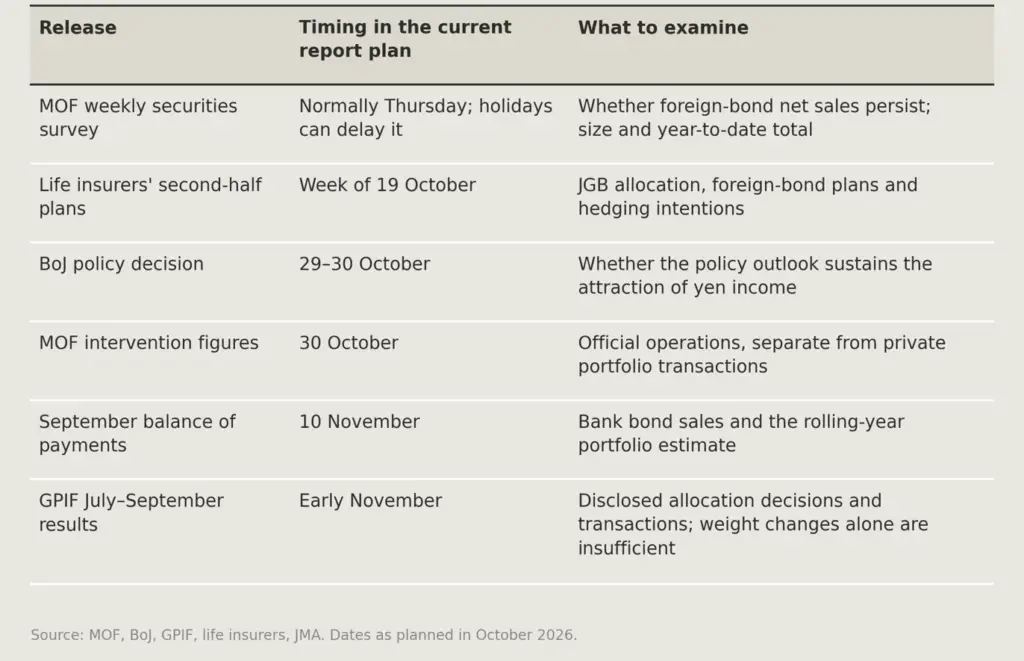
The weekly survey is the first test of whether bond sales persist. The September balance of payments, due in early November, will test the estimate in the opening. The other releases are in the table below.
Conclusion

The capital-flow tide is turning

As this report showed, Japan has been a broadly consistent provider of capital to the rest of the world, and Japan will continue to play that role for many years to come. However, the tide turns from time to time, and 2026 seems to be such a year. Net portfolio flow has narrowed from a sizable outflow in 2024–25 to a small net sale in the latest months, even while households continued to show strong appetite for foreign equity. Banks seem to be increasing their appetite for yen bonds, with good reason. JGB yields have risen to a 30-year high. Some may claim the rise has to do with higher fiscal premia, but my yield-curve analysis in Japan’s Fiscal Vigilantes Are Misreading the Curve (16 July) shows otherwise.

In my view, this shift weakens one of the forces behind the weak yen. Higher yen yields give investors a reason to keep shifting toward domestic bonds. I see a moderate chance that the turn in foreign bonds develops into a larger net repatriation, with GPIF’s asset allocation decision as a potential key mover. If global financial markets were to suffer a setback, whether in the euro bond market or the US stock market, it would further strengthen the case for yen repatriation. In my view, Japan’s capital flows are likely to show yen repatriation in 2026–27; the question is how large, rather than whether it will happen.

Author David ClarkPosted on October 20, 2026October 25, 2026Categories Economics, Essays, World WatchingTags 1980s, 1996, 2014, 2022, 2024, 2025, 2026, 2027, asset, balance of payments, balance sheet, bank, bank account, Bank of Japan [日本銀行], bond (finance), bond fund, book value, capital (economics), custodial account, debt, deposit account, duration (finance), economic bubble, equity (finance), finance, financial market, Government Pension Investment Fund, Gross Domestic Product, household, International Monetary Fund, investment, investment fund, investment trust, Japan [日本], Japanese yen (¥), life insurance, Ministry of Finance (Japan) [財務省], money, national debt of Japan, Nippon individual savings account [少額投資非課税制度], over-the-counter (finance), pension, pension fund, pensioner, portfolio investment, regional bank, secondary market, security (finance), shinkin bank [信用金庫], statistics, stock, stock market, United States, United States Treasury security, yield curve

Central Bank Digital Currency: Stability and Information

Today, the U.S. Office of Financial Research published a working paper, “Central Bank Digital Currency: Stability and Information” [archived PDF]. The working paper looks at how introducing a central bank digital currency (CBDC) would affect the banking system’s stability.

As central banks consider whether the benefits of creating digital cash outweigh the risks, the paper finds that at least one risk—bank runs—is not as significant as initially feared.

First, banks lower their maturity mismatch when depositors have access to CBDC, reducing their exposure to depositor runs. Second, the flow of funds into a CBDC provides policymakers with a new source of real-time information.

Read the working paper. [Archived PDF]

Author David ClarkPosted on July 12, 2022August 1, 2025Categories Economics, Essays, World WatchingTags asset–liability mismatch, bank, bank run, central bank, central bank digital currency, deposit account, digital currency, policy

Economics-Watching IMF RESMF Newsletter (November 2019)

from the IMF:

IMF Research Perspectives, volume 20, number 1

Featured Policy Work

Investigating the Impact of Global Stablecoins

The provision of financial services and products is undergoing rapid transformation, including through the development of stablecoins, which seek to stabilize the price of a digital currency by linking its value to that of a pool of assets. Stablecoins can potentially serve as a means of payment and store of value, and may contribute to the development of global payment arrangements that are faster, cheaper, and more inclusive. Yet these potential benefits can only be realized if significant risks are addressed. Stablecoin initiatives built on an existing big tech platform with a global customer base may have the potential to scale rapidly, and could pose regulatory and oversight challenges and risks related to consumer protection, fair competition, and the combating of money laundering and terrorism financing, among others, as well as have a significant impact on public policy goals such as financial stability and monetary policy transmission. This paper, written jointly by G7 members, the BIS, and the IMF, including RESMF staff, scopes the causes and implications of the adoption of global stablecoins, and the potential policy efforts to rein in the risks they can bring about.

Read the full report [Archived PDF].

Recent Research

IMF Research Perspectives, Volume 20, Number 1 [Archived PDF]

Blog

The Mobilisation Effects of Multilateral Development Banks

by Giulia Lotti & Andrea Presbitero

Filling the investment gap to achieve the sustainable development goals is one of the most important development challenges. Multilateral development banks can play an important role through a stronger engagement to attract additional resources from the private sector. This column uses data on syndicated lending to a large set of developing countries and shows that MDBs are able to crowd in bank credit to sectors to which they lend. The role of MDBs could be relevant, as they can mobilize up to seven dollars in bank credit for each dollar invested.

[Archived PDF]

Working Papers

Designing Central Bank Digital Currencies

by Itai Agur, Anil Ari & Giovanni Dell’Ariccia

We study the optimal design of a central bank digital currency (CBDC) in an environment where agents sort into cash, CBDC and bank deposits according to their preferences over anonymity and security; and where network effects make the convenience of payment instruments dependent on the number of their users. CBDC can be designed with attributes similar to cash or deposits, and can be interest-bearing: a CBDC that closely competes with deposits depresses bank credit and output, while a cash-like CBDC may lead to the disappearance of cash. Then, the optimal CBDC design trades off bank intermediation against the social value of maintaining diverse payment instruments. When network effects matter, an interest-bearing CBDC alleviates the central bank’s tradeoff.

[Archived PDF]

One Ring to Rule Them All? New Evidence on World Cycles

by Eric Monnet & Damien Puy

We estimate world cycles using a new quarterly dataset of output, credit and asset prices assembled using IMF archives and covering a large set of advanced and emerging economies since 1950. World cycles, both real and financial, exist and are generally driven by US shocks. But their impact is modest for most countries. The global financial cycle is also much weaker when looking at credit rather than asset prices. We also challenge the view that synchronization has increased over time. Although this is true for prices (goods and assets), this not true for quantities (output and credit). The world business and credit cycles were as strong during Bretton Woods (1950–1972) as during the Globalization period (1984-2006). For most countries, the way their output co-moves with the rest of the world has changed little over the last 70 years. We discuss the reasons behind these new findings and their policy implications for small open economies.

[Archived PDF]

Optimal Macroprudential Policy and Asset Price Bubbles

by Nina Biljanovska, Lucyna Gornicka & Alexandros Vardoulakis

An asset bubble relaxes collateral constraints and increases borrowing by credit-constrained agents. At the same time, as the bubble deflates when constraints start binding, it amplifies downturns. We show analytically and quantitatively that the macroprudential policy should optimally respond to building asset price bubbles non-monotonically depending on the underlying level of indebtedness. If the level of debt is moderate, policy should accommodate the bubble to reduce the incidence of a binding collateral constraint. If debt is elevated, policy should lean against the bubble more aggressively to mitigate the pecuniary externalities from a deflating bubble when constraints bind.

[Archived PDF]

Doing More for Less? New Evidence on Lobbying and Government Contracts

by Senay Agca, Deniz O Igan, Fuhong Li & Prachi Mishra

Why do firms lobby? This paper exploits the unanticipated sequestration of federal budget accounts in March 2013 that reduced the availability of government funds disbursed through procurement contracts to shed light on this question. Following this event, firms with little or no prior exposure to the federal accounts that experienced cuts reduced their lobbying spending. In contrast, firms with a high degree of exposure to the cuts maintained and even increased their lobbying spending. This suggests that, when the same number of contractors competed for a piece of a reduced pie, the more affected firms likely intensified their lobbying efforts to distinguish themselves from the others and improve their chances of procuring a larger share of the smaller overall. These findings are stronger in government-dependent sectors and when there is intense competition. The evidence is more consistent with a rent-seeking explanation for lobbying.

[Archived PDF]

The Long Shadow of the Global Financial Crisis: Public Interventions in the Financial Sector

by Deniz O Igan, Hala Moussawi, Alexander F. Tieman, Aleksandra Zdzienicka, Giovanni Dell’Ariccia, Paolo Mauro

We track direct public interventions and public holdings in 1,114 financial institutions over the period 2007–17 in 37 countries based on publicly available information. We use aggregate official data to validate this new dataset and estimate the fiscal impact of interventions, including the value of asset holdings remaining in state hands at end-2017. Direct public support to financial institutions amounted to $1.6 trillion ($3.5 trillion including guarantees), with larger amounts allocated to lower capitalized and less profitable banks. As of end-2017, only a few countries had fully divested the initial support they provided during the crisis. Public holdings were divested faster in better capitalized, more profitable, and more liquid banks, and in countries where the economy recovered faster. In countries where the government stake remained high relative to the initial intervention, private investment and credit growth were slower, financial access, depth, efficiency, and competition were worse, and financial stability improved less.

[Archived PDF]

Do Old Habits Die Hard? Central Banks and the Bretton Woods Gold Puzzle

by Eric Monnet & Damien Puy

Why did monetary authorities hold large gold reserves under Bretton Woods (1944–1971) when only the US had to? We argue that gold holdings were driven by institutional memory and persistent habits of central bankers. Countries continued to back currency in circulation with gold reserves, following rules of the pre-WWII gold standard. The longer an institution spent in the gold standard (and the older the policymakers), the stronger the correlation between gold reserves and currency. Since dollars and gold were not perfect substitutes, the Bretton Woods system never worked as expected. Even after radical institutional change, history still shapes the decisions of policymakers.

[Archived PDF]

The Price of Capital Goods: A Driver of Investment Under Threat

by Weicheng Lian, Natalija Novta, Evgenia Pugacheva, Yannick Timmer & Petia Topalova

Over the past three decades, the price of machinery and equipment fell dramatically relative to other prices in advanced and emerging market and developing economies. Using cross-country and sectoral data, we show that the decline in the relative price of tangible tradable capital goods provided a significant impetus to the capital deepening that took place during the same time period. The broad-based decline in the relative price of machinery and equipment, in turn, was driven by the faster productivity growth in the capital goods producing sectors relative to the rest of the economy, and deeper trade integration, which induced domestic producers to lower prices and increase their efficiency. Our findings suggest an additional channel through which rising trade tensions and sluggish productivity could threaten real investment growth going forward.

[Archived PDF]

Credit Supply and Productivity Growth

by Francesco Manaresi & Nicola Pierri

We study the impact of bank credit on firm productivity. We exploit a matched firm-bank database covering all the credit relationships of Italian corporations, together with a natural experiment, to measure idiosyncratic supply-side shocks to credit availability and to estimate a production model augmented with financial frictions. We find that a contraction in credit supply causes a reduction of firm TFP growth and also harms IT-adoption, innovation, exporting, and adoption of superior management practices, while a credit expansion has limited impact. Quantitatively, the credit contraction between 2007 and 2009 accounts for about a quarter of observed the decline in TFP.

[Archived PDF]

The Motives to Borrow

by Antonio Fatás, Atish R. Ghosh, Ugo Panizza & Andrea F Presbitero

Governments issue debt for good and bad reasons. While the good reasons—intertemporal tax-smoothing, fiscal stimulus, and asset management—can explain some of the increases in public debt in recent years, they cannot account for all of the observed changes. Bad reasons for borrowing are driven by political failures associated with intergenerational transfers, strategic manipulation, and common pool problems. These political failures are a major cause of overborrowing though budgetary institutions and fiscal rules can play a role in mitigating governments’ tendencies to overborrow. While it is difficult to establish a clear causal link from high public debt to low output growth, it is likely that some countries pay a price—in terms of lower growth and greater output volatility—for excessive debt accumulation.

[Archived PDF]

Discriminatory Pricing of Over-the-Counter Derivatives

by Harald Hau, Peter Hoffmann, Sam Langfield & Yannick Timmer

New regulatory data reveal extensive price discrimination against non-financial clients in the FX derivatives market. The client at the 90th percentile pays an effective spread of 0.5%, while the bottom quarter incur transaction costs of less than 0.02%. Consistent with models of search frictions in over-the-counter markets, dealers charge higher spreads to less sophisticated clients. However, price discrimination is eliminated when clients trade through multi-dealer request-for-quote platforms. We also document that dealers extract rents from captive clients and market opacity, but only for contracts negotiated bilaterally with unsophisticated clients.

[Archived PDF]

Author David ClarkPosted on December 21, 2020August 5, 2025Categories Economics, Essays, World WatchingTags anti-competitive practices, asset, asset management, bank, Bank for International Settlements, capital good, cash, central bank, central bank digital currency, competition (economics), consumer, consumer protection, corporation, credit, currency, customer, deposit (finance), deposit account, developing country, digital currency, divestment, dollar, economy, emerging market, experiment, financial institution, financial services, financial stability, gold, gold holdings, gold reserve, gold standard, Group of Seven (G7), international financial institution, International Monetary Fund, investment, Italy, machine, market (economics), monetary authority, monetary policy, money laundering, payment, price, private sector, public policy, stablecoin, stimulus (economics), supply-side economics, syndicated loan, tax, terrorism financing, trade, World War II

Economics—Atlanta Fed’s November Notes from the Vault

Financial System of the Future

Notes from the Vault
Larry D. Wall
November 2019

The financial services business is an information technology business that operates in an environment with substantial government involvement. The state of both technology and government intervention have evolved considerably since the financial crisis that began in 2007, with potentially large implications for the future financial system. With that in mind, the Atlanta Fed recently hosted the workshop Financial System of the Future, which was cosponsored by the Center for the Economic Analysis of Risk (CEAR) at Georgia State University.

This post reviews many of the papers and presentations from the workshop dealing with both financial regulation and innovations in financial technology. It also reviews one of the keynote speeches on the important topic of corporate governance. A companion macroblog post summarizes the workshop’s discussion of digital currencies.

Post-crisis changes in regulation

Some banks had difficulty obtaining adequate funding from private financial markets during the crisis of 2007–08, despite being well capitalized by that period’s capital standards. In part, these funding difficulties were a result of bank depositors fearing that banks had not adequately provisioned for their credit losses.

A paper by University of Michigan professors Thomas Flanagan and Amiyatosh Purnanandam examines the question “Why Do Banks Hide Losses?” [PDF] with a particular focus on the role of shareholder monitoring and management incentives. One problem in conducting such a study is that of separating bad investment decisions from deceptive accounting. This paper exploits an unexpected change in regulation in India to help provide such separation. This regulatory change forced all of the banks in that country to detail the extent of their underreporting of loan losses in 2015. The paper finds that weaker shareholder monitoring and higher-power executive compensation contracts are associated with more underreporting of loan losses.1 This paper helps us to understand how banks exploit accounting discretion over loan losses and reinforces the importance of supervisory oversight.

The funding problems encountered by U.S. banks led to runs and ultimately the collapse of a few banks, but these problems had a significant effect on the operations of some banks that survived. One measure of the vulnerability of a bank to a funding shock was its reliance on uninsured, wholesale deposits from large institutions. Professors Sudheer Chava of Georgia Institute of Technology, Rohan Ganduri of Emory University, Linghang Zeng of Babson College, and graduate student Nikhil Paradkar of Georgia Tech examine one effect of these shocks in their paper “Shocked by Bank Funding Shocks: Evidence from 500 Million Consumer Credit Cards” [PDF]. The paper finds that banks that were more exposed to wholesale funding shocks made larger cuts in consumer credit lines than other banks. The authors further find that these cutbacks were made to the most credit-constrained customers (those with lower credit scores and higher utilization of their credit line). The results also suggest that these credit-constrained consumers responded by cutting back their consumption. Overall, these results provide additional support for regulatory policies intended to strengthen banks so that they can continue lending through future crises.

The Federal Reserve was created in 1913 in large part to provide a source of liquidity during periods of stress in bank lending markets. Yet banks proved surprisingly resistant to borrowing from the Fed’s discount window at the start of the funding problems in the fall of 2007. In an attempt to overcome this reluctance to borrow, the Fed created the Term Auction Facility (TAF) in December 2007. A paper by professors Yunzhi Hu of the University of North Carolina at Chapel Hill and Hanzhe Zhang from Michigan State University examines the TAF in a paper titled “Overcoming Borrowing Stigma: The Design of Lending-of-Last-Resort Policies” [PDF]. This paper develops a simple model in which TAF funding is preferred by stronger banks because the funds are only available with a delay (that is, the funds will not help a bank facing an immediate run) and because TAF gives stronger banks the potential to borrow at lower costs. The paper also provides evidence that when both the discount window and TAF were available, the weakest banks borrowed from the discount window and the relatively stronger banks bid for TAF funds. The results of this study may help to inform the Fed’s policies on the provision of emergency liquidity in the future.

In the post-crisis period, the bank supervisors agreed to adopt new liquidity rules and strengthen existing capital requirements at the Basel Committee on Banking Supervision. A paper by Harvard University professor Daniel Roberts and Federal Reserve Bank of New York economists Asani Sarkar and Or Shachar examines the Basel liquidity requirements in the paper “Bank Liquidity Creation, Systemic Risk, and Basel Liquidity Regulations” [PDF]. The paper finds that the new regulation has the cost of reducing bank liquidity creation in normal times but also results in more resilient banks in a crisis. The authors estimate both the costs and benefits of the regulation and find that the benefits in terms of a more stable financial system exceed the costs of the reduction in liquidity.

Josef Schroth, an economist at the Bank of Canada, analyzes the question of how regulators could use capital regulation to smooth bank lending through a recession and financial crisis in his paper “Macroprudential Policy with Capital Buffers” [PDF]. Banks in his model hold sufficient capital in most periods but have insufficient capital to retain uninsured market funding during crises, which leads to severe credit crunches. Bank regulators can smooth lending by requiring banks to hold more capital during good times, also allowing banks to operate with reduced capital during a crisis and rebuild their capital gradually after a crisis. The paper’s findings are consistent with the Basel III’s creation of a capital conservation buffer and countercyclical capital buffer.

Issues related to bank capital have been the subject of ongoing discussion among academics, bankers, and regulators since the crisis. Bank of Finland economists Gene Ambrocio and Esa Jokivuolle, along with professors Iftekhar Hasan from Fordham University and Kim Ristolainen from the University of Turku, surveyed the views of banking and finance academics and reported the results in the paper “Are Bank Capital Requirements Optimally Set? Evidence from Researchers’ Views” [PDF] (slide deck [PDF]). The survey obtained results from 149 leading academic researchers. It found that most respondents believe that higher capital ratios would reduce the likelihood of a crisis and the social costs associated with a crisis. Most respondents thought an increase of 5 percentage points in capital would increase the average cost of capital and reduce bank lending. However, a majority said that this reduction in lending would result in “minimal to no change” in economic activity.

Fintech lending

Banks have historically been important suppliers of credit to consumers and small businesses. However, since the crisis, lending by some fintech firms to these borrowers has grown rapidly. The conference addressed a variety of questions such as the sources of competitive advantage to fintech lenders; competition between fintech lenders, small banks, and large banks; and the impact of fintech lending on consumers. Additionally, the conference looked at post-crisis changes in bank securitization rules, which may have some relevance to fintech lenders’ efforts to fund their loans.

Banks, especially large banks, have long used statistical analysis to help them predict the credit riskiness of consumers and small businesses. However, fintech firms have promoted their use of machine learning techniques as resulting in better credit analysis. Economist J. Christina Wang and former research associate Charles B. Perkins from the Federal Reserve Bank of Boston explore the value added of some machine learning techniques in their paper “How Magic a Bullet Is Machine Learning for Credit Analysis? An Exploration with Fintech Lending Data” [PDF]. In particular, they examine the contribution of tree-based models using data from LendingClub, a fintech lender. Tree-based models provide easily understood decision rules that are valuable for demonstrating compliance with U.S. fair lending rules. The results indicate that tree-based machine learning improves prediction accuracy, in part by uncovering notable interactive effects. These models benefit from additional data (albeit only up to about 5,000 observations) and from the addition of more predictors. However, exactly which tree-based approach worked best varied across different subgroups of consumers.

Many large banks retreated from some types of retail and small business lending. In part, this pullback was likely to due to a combination of the increased riskiness of these loans and the tightening of bank capital requirements. However, fintech lenders have been expanding into some of the same spaces, raising the question of whether the reduced lending by big banks was due in part to competitive pressure from fintech firms. It also raises the question of whether smaller banks were also retreating due to increased competition or expanding to help fill the void left by the larger banks. Two papers examine the rise of fintechs in two different lending markets and analyze what developments in these markets tell us about big versus small banks.

Professors Taylor Begley from Washington University in St. Louis and Kandarp Srinivasan from Northeastern University focus on mortgage market lending in their paper “Small Bank Lending in the Era of Fintech and Shadow Banking: A Sideshow?” [PDF]. Their paper observes that fintech lenders rely largely on government-supported loan securitization programs such as those of Fannie Mae, Freddie Mac, and the Federal Housing Administration. However, not all mortgage loans qualify for these programs in large part due to limits on the maximum size of the loan. Thus, fintech mortgage lenders were able to take nationwide market share in government-supported loans from the large banks. Nevertheless, it was the small banks that stepped in to provide mortgage loans that did not qualify for government-supported securitization. As a result, small banks have proven more responsive to the withdrawal of bigger banks and have maintained nearly constant market share through the period from 2009 to 2013.

The paper “What Is Fueling the Fintech Lending Revolution? Local Banking Market Structure and Fintech Market Penetration” [PDF] by professor Tetyana Balyuk of Emory University and professors Allen N. Berger and John Hackney from the University of South Carolina studies the rise of fintech lenders in small business lending. The authors find that fintech lenders’ market penetration is associated with lower small bank market shares, consistent with the decline of small banks over time and helping to explain fintech lenders’ success. They also find evidence that small banks tend to make safer loans than fintech firms. Finally, looking at the contribution of different lenders to employment, the authors find that fintech matters most for the smallest businesses, small banks matter more for larger small businesses, and neither matters for large businesses.

As fintech lending has grown, the question of whether it is good for consumers has also arisen. This may be a trick question. We have long known that if people are given a choice, some will use it wisely and others will not. Last year’s CEAR–CenFIS conference provided some evidence of how consumers manage their finances after borrowing from fintech lenders (see “Winners and Losers of Marketplace Lending: Evidence From Borrower Credit Dynamics” [PDF] and “The Real Effects of Financial Technology: Marketplace Lending and Personal Bankruptcy” [PDF]). This year, Federal Reserve Board economists Traci Mach and Timothy Dore provided additional evidence in the paper “Marketplace Lending and Consumer Credit Outcomes: Evidence from Prosper” [PDF]. The authors were able to match application data from one lender to credit bureau data. They find that relative to applicants without an origination, borrowers see an increase in their credit scores and total debt, but decreases in their delinquency rates. The increase in mortgage debt balances was especially notable.

An important issue for any type of lender is its access to funding. Banks fund their loans with a combination: (a) their own liabilities in the form of deposits and other market borrowings and (b) loan sales to investors. The risk with on-balance-sheet lending is that too many loans will turn bad, the bank will suffer large loan losses, and depositors will flee the bank. Although some fintech firms fund loans with their own liabilities, most of their loans are funded by sales to investors. The advantage to the loan originator of selling loans is that, if the loan goes bad, the buyers of the loan bear the credit losses. However, such sales can lead to concerns that the bank or fintech originating a loan will not be as careful in underwriting and monitoring as they would be with the loans they retain on their own books. The result can be similar to that discussed in the Chava et al. paper, where originators have to reduce their lending volume.

One alternative that may have the effect of improving banks’ incentives and thereby mitigating investor concerns is that of having the bank retain part of the credit risk on the loans it sells. Professor Martin Hibbeln and graduate student Werner Osterkamp from the University of Duisburg-Essen study the effect of bank loan retention in their paper “The Impact of Skin in the Game on Bank Behavior in the Securitization Market” [PDF]. The authors exploit changes in European Union regulations to study loans sold by European banks in the securitization market. They find evidence that retention of part of the risk of a loan does not improve the quality of the loans being securitized.

Corporate governance

The role of shareholders in corporate governance is important for both financial and non-financial firms. The last few decades have seen shareholder governance power increasingly concentrated in institutional investors such as mutual funds and pension funds. Although a few of these institutional funds are explicitly focused on corporate governance issues, most are not. However, even the funds that are not focused on governance nevertheless have an interest in participating in governance decisions. The problem for these investors is how to keep up with the many issues requiring a shareholder vote. The answer for a large fraction of institutional investors is to seek information and advice from proxy advisory firms. The role of these advisory firms was the topic of Carnegie Mellon University professor Chester Spatt’s dinner speech titled “Proxy Advisory Firms, Governance, Market Failure, and Regulation” [PDF] (See also his related paper [PDF].)

Spatt observed that the importance of proxy advisory firms is easy to understand. All shareholders in a firm face the same questions, and there is similarity in questions across firms. However, any one shareholder obtains only a small fraction of the gains from better governance while potentially paying all of the costs of analysis. In this setting, proxy advisory firms are a predictable market solution to a potential free-riding problem. The increasing returns to scale that arise in this setting also naturally lends itself to the development of a monopoly—or in this case, a duopoly. The result can be reduced incentives for the two proxy advisory firms to avoid factual mistakes and increased power for the advisers to impose their philosophy on firms. Spatt discussed a variety of steps the Securities and Exchange Commission has taken and further actions that could mitigate these concerns. However, the problem of what to do about the role of institutions and proxy advisers in corporate governance is one that may not be totally solvable, but rather requires careful management over time.

Conclusion

The post-crisis period has seen dramatic changes in both information technology and government regulation. The papers presented recently at a workshop at the Atlanta Fed analyzed a number of these changes and contribute to our understanding of how the financial system is likely to evolve in the future.

Larry D. Wall is executive director of the Center for Financial Innovation and Stability at the Atlanta Fed. The author thanks Brian Robertson for helpful comments. The view expressed here are the author’s and not necessarily those of the Federal Reserve Bank of Atlanta or the Federal Reserve System. If you wish to comment on this post, please email atl.nftv.mailbox@atl.frb.org.

1 For further discussion on banks’ reporting of loan losses, see Larry’s recent post on changes to U.S. accounting rules.

Author David ClarkPosted on December 14, 2020August 5, 2025Categories Economics, Essays, Press Release, World WatchingTags accounting, Babson College, balance sheet, bank, Bank of Canada, Bank of Finland, Basel Committee on Banking Supervision, Basel III, capital (economics), Carnegie Mellon University, Center for Financial Innovation and Stability (CenFIS), Center for the Economic Analysis of Risk (CEAR), competition, consumer, corporate governance, credit, credit analysis, credit bureau, credit crunch, credit risk, credit score, creditor, customer, debt, debtor, deposit account, digital currency, duopoly, economic interventionism, economist, Emory University, employment, Europe, European Union, Fannie Mae, Federal Housing Administration (FHA), Federal Reserve, Federal Reserve Bank of Atlanta, Federal Reserve Bank of Boston, Federal Reserve Bank of New York, Federal Reserve Board of Governors, financial crisis, Financial crisis of 2007–2008, financial market, financial regulation, financial services, financial system, Fordham University, Freddie Mac, Georgia Institute of Technology, Georgia State University, Georgia Tech, Harvard University, India, information technology, institutional investor, investment, investor, LendingClub, liability (financial accounting), line of credit, loan, loan origination, loan sale, machine learning, market (economics), market penetration, market share, monopoly, mortgage loan, mutual fund, Northeastern University, pension fund, philosophy, proxy firm, recession, regulation, retail, securitization, shareholder, technology, Term Auction Facility, U.S. Securities and Exchange Commission, underwriting, University of Duisburg-Essen, University of Michigan, University of North Carolina at Chapel Hill, University of South Carolina, University of Turku, voting, Washington University in St. Louis
November 2026
M T W T F S S
 1
2345678
9101112131415
16171819202122
23242526272829
30  
« Oct    

Categories

  • Essays (393)
    • Cinema (9)
    • Literature (2)
    • Mathematics (2)
    • Music (2)
    • Podcast (2)
    • Poetry (3)
    • Press Release (28)
    • Video (1)
    • World Watching (176)
      • Cinema (1)
      • Economics (122)
      • Education (2)
      • Government (2)
      • Mathematics (2)
      • Politics (1)
      • Science (31)
        • Biology (2)
        • Environment (5)
        • Medicine (5)
        • Philosophy (1)
        • Technology (4)
      • Webinar (5)
      • Zoom Meeting (4)

Tags

  • 19th century
  • 20th century
  • bank
  • China
  • climate change
  • consumer
  • COVID-19 pandemic
  • demand
  • Donald Trump
  • economics
  • economy
  • education
  • employment
  • Europe
  • Federal Reserve
  • finance
  • France
  • Germany
  • Gross Domestic Product
  • Harvard University
  • History
  • India
  • inflation
  • investment
  • Japan [日本]
  • loan
  • London
  • manufacturing
  • market (economics)
  • mathematics
  • monetary policy
  • philosophy
  • physics
  • politics
  • Russia
  • science
  • tariff
  • technology
  • trade
  • United Kingdom
  • United States
  • university
  • Western world
  • World War I
  • World War II
  • About
  • Contact
Meta Intelligence Proudly powered by WordPress