CCG’s President says there will be no diplomatic masterstroke in Ukraine’s absence, but serious consideration of a ceasefire can lay the groundwork for peace
Putin was receptive, warmly welcoming the idea of a China-hosted meeting. Trump, too, has expressed a willingness to meet Xi and Putin. These expressions of openness offer an opportunity we must seize in pursuit of peace.
Some in the United States and Europe question the value of such a summit. They may fear restoring Putin’s standing or normalising the conflict without yielding any real progress towards an end to the war. That risk is still real but these largely Western fears must be tempered by the very real, very human cost of letting the war continue unabated.
In August last year, I extended that train of logic in Foreign Policy, where I proposed a seven-party format for peace negotiations and suggested that a peacekeeping force include troops from European and BRICS countries. A meeting of the three leaders in Shenzhen could help lay the groundwork for these broader diplomatic and peacekeeping efforts.
Without Ukraine’s participation, such a meeting is unlikely to produce a diplomatic masterstroke that ends the war. But the three leaders need not put the war to rest at a table in Shenzhen to make progress. Serious consideration of a ceasefire along the current line of contact—an approach Ukrainian PresidentVolodymyr Zelenskyy has supported—could give peace efforts fresh momentum, leaving the final status of disputed territories for subsequent negotiations.
Further agreement could be sought on the protection of nuclear facilities, or a mutual end to strikes on energy infrastructure, new prisoner exchanges or improved humanitarian access. Of course, issues of sovereignty, security guarantees, Russia’s security concerns and Europe’s security commitments would remain. But these need not all be resolved at once before a ceasefire can begin.
Already, years of war have inflicted immense suffering on both Russia and Ukraine. Neither side achieved its objectives, and both need a dignified way out that protects their core interests. Thus, we must open a path towards peace without requiring either side to concede defeat. China could help bridge this gap by bringing Xi, Trump and Putin together in Shenzhen to explore how a ceasefire and wider negotiations involving Ukraine might work.
The United Nations could stand at the core of such an arrangement by monitoring any ceasefire and preventing a return to fighting by physical peacekeeping if the parties are so inclined.
For a broader negotiation on settlement, I find myself returning to a seven-party format that would bring together the five permanent members of the UN Security Council—China, France, Russia, Britain and the U.S.—alongside Ukraine and the European Union. An understanding reached in Shenzhen could give momentum to this broader negotiating process and free up the Security Council for action.
A peacekeeping force composed entirely of NATO or European troops might be unacceptable to Russia. Yet a mission without European participation would struggle to reassure Ukraine and its neighbours. Any workable arrangement would need to address both concerns.
In my Foreign Policy article, I proposed a peacekeeping force drawing troops from five European countries—Germany, France, Britain, Poland and Italy—and five members of the BRICS grouping, such as China, India and Brazil. And while the exact formulation, from the composition and mandate to the terms of deployment, would need to be negotiated with the consent of Russia and Ukraine, and the agreement of the contributing countries, the core idea remains sound.
As a permanent member of the UN Security Council and the largest contributor of peacekeeping personnel among the five permanent members, China is well positioned to help. Its distinctive role in the global economy and dialogue with Russia, Ukraine, the U.S. and Europe, give it channels through which to coax the parties towards peace. But this process must begin somewhere, and that somewhere could be Shenzhen.
Nor should APEC be the end of the diplomatic effort. With an understanding reached by the leaders in Shenzhen, the Security Council may pick up the momentum by advancing ceasefire and peacekeeping proposals. The Group of 20 could then join the effort to rally support from major economies with an interest in maintaining the deal. Each would play a different role and would not be tasked with settling the entire conflict.
China’s role in the Saudi Arabia-Iran rapprochement in 2023 showed Beijing’s ability to open a door after years of enmity. The Ukraine war is different, and there can be no guarantee of a similar outcome. But diplomacy must begin somewhere, particularly when fighting has brought such destruction.
The central question is whether such a meeting could help bring the war to an end. In that light, any gain in prestige for an individual leader is almost irrelevant. And if the three leaders could agree on practical steps towards peace, they would give the United Nations and the wider international community a material basis upon which peace could be built.
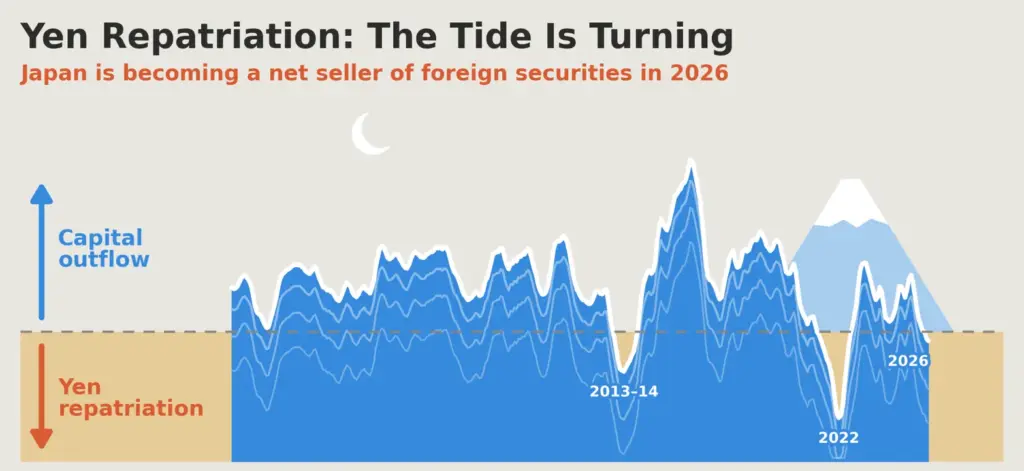
From 2014 to 2025, Japan bought foreign securities worth about 2% of GDP a year. In 2026 the tide is turning. Banks are selling foreign bonds and capital flow has turned to a small net inflow.
[by OKUBO Takuji]
Key takeaways
Japan has been an exporter of capital since the 1980s, purchasing 2–3% of GDP worth of foreign assets every year, interrupted by episodes of yen repatriation from time to time. 2026–27 may be turning into such an episode.
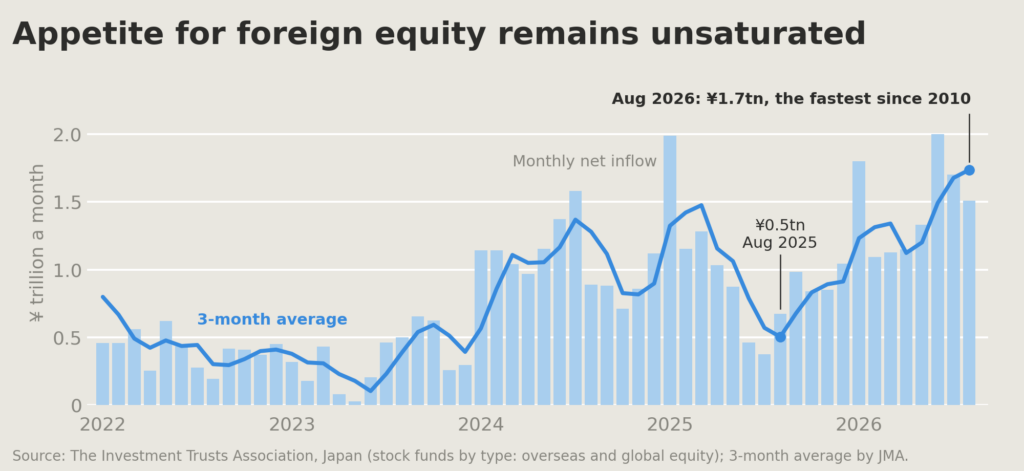
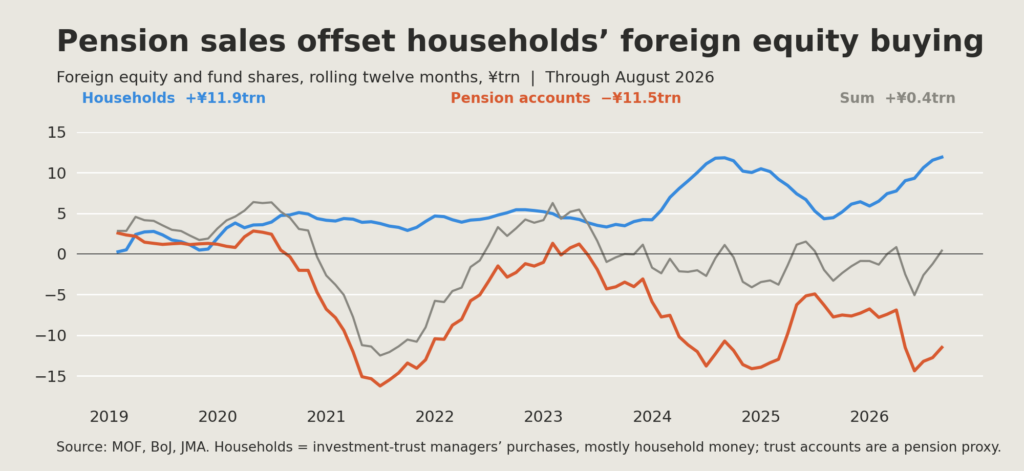
Households keep buying foreign stocks, but pension funds are selling against them, offsetting the net purchase of foreign equities.
Pension funds are likely to put more money into yen. On my replication of GPIF’s allocation rule, its domestic-bond weight should be much higher than today’s 25%, and foreign bonds are the likely asset class to give way.
The weekly survey to 10 October shows foreign-bond selling continuing. In my view, yen repatriation in 2026–27 is a question of how large, not whether.
Japan’s outward flow has turned into a net sale
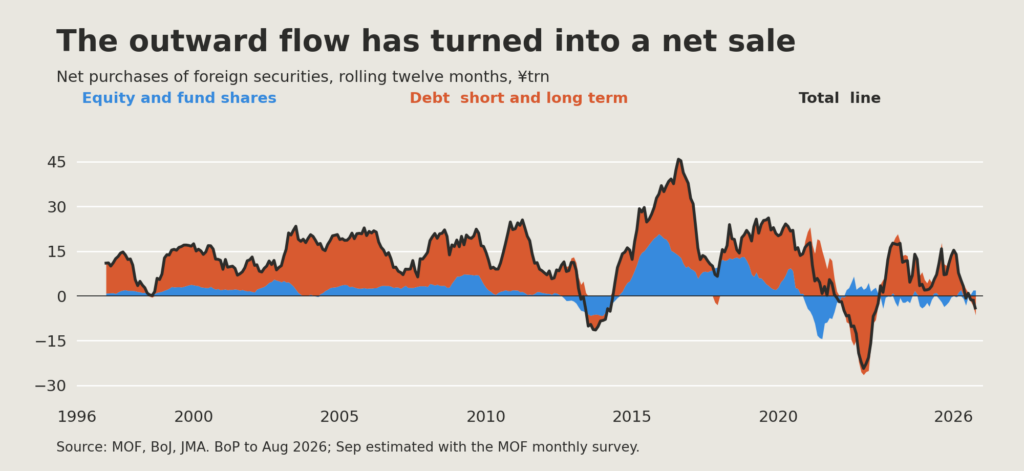
Japan has been a large provider of capital to the rest of the world since the 1980s. The latest wave began in 2014. From 2014 to 2025, residents bought ¥13.6trn a year on average, about 2.3% of GDP.
Chart 1 shows the flow as a rolling twelve-month sum. The one large exception was 2022, when bond yields rose sharply abroad and Japaneseinvestors sold their holdings, realizing losses on their foreign bonds. They went right back into purchasing foreign securities in 2023 when yield curves in major foreign bondmarkets stabilized, while domestic bond yields remained close to zero. How Japaneseinvestors behave now that yen yields are respectable is the big question.
Chart 1: Rolling twelve-month flows, stacked separately above and below zero. Short- and long-term debt combined; black line is the net total. BoP through August 2026; September estimated from the MOF monthly survey. Source: MOF, BoJ, JMA.
The flow is turning again in 2026. By August 2026 the rolling total was a small net sale of ¥1.5trn (see chart 1 above). September’s balance of paymentsstatistics are not out yet, but based on the International Transactions in Securities Survey for September, I estimate that the rolling total would be a net sale of ¥4.5trn. September itself was a small net sale; most of the drop comes from September 2025’s ¥2.8trn of buying leaving the window.
Foreign bonds and foreign equity have different investors
In the rest of the report, I discuss recent developments in Japan’s capital flows. I have organized the discussion by asset class because the investor bases differ. Banks, the FX reserves managed by the government, pensions and insurers hold foreign bonds. In foreign equity, households are now the key investors, alongside pensions and other traditional investors. GPIF and other pensions sit in both markets, so I discuss them in a part of their own.
Japan holds 147% of GDP worth of securities abroad
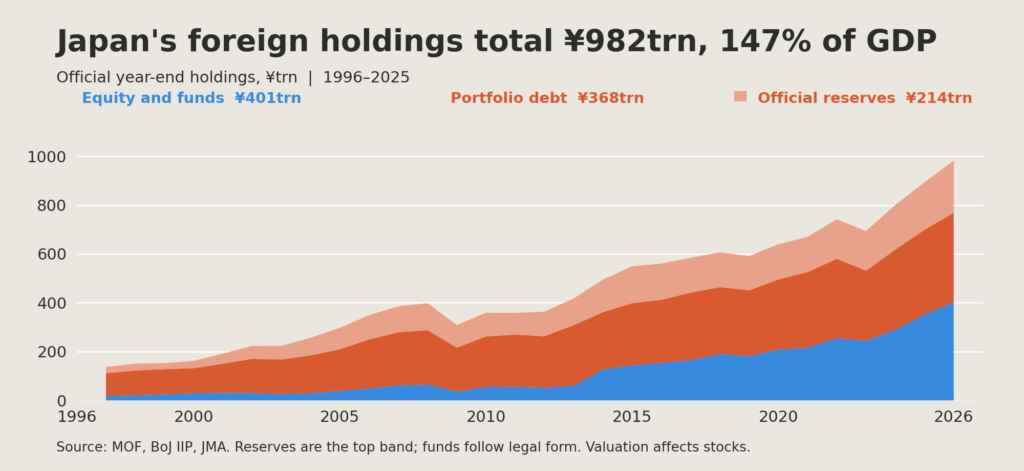
Before moving to discuss recent developments, let me give you a brief historical perspective on Japan’s outward investment. Japan has been a creditor nation since the 1980s. In 1985–89, Japan invested 3–5% of GDP, as Japan was awash with bubblemoney. Since then, Japan has typically invested 2–3% of GDP a year in foreign securities, with some episodes of repatriation from time to time. At end-2025, Japan held ¥982trn in foreign portfolio securities and official reserve assets: ¥401trn of equity and fund shares, ¥368trn of portfolio debt and ¥214trn of reserves (chart 2). Reserves are mostly US Treasuries plus some deposits and gold. The ¥401trn in equity and fund shares actually includes some bond funds that are categorized inside “equity and fund shares” in official statistics, so we will make some adjustments when we discuss investor behavior by asset class in later parts.
Chart 2: Official year-end holdings, 1996–2025. Equity is the bottom band, portfolio debt the middle band and official reserves the top band. Debt and reserves use related colors. Current BPM6-rearranged IIP; funds classified by legal form. Source: MOF, BoJ, JMA.
Part 1. Selling foreign bonds in 2026
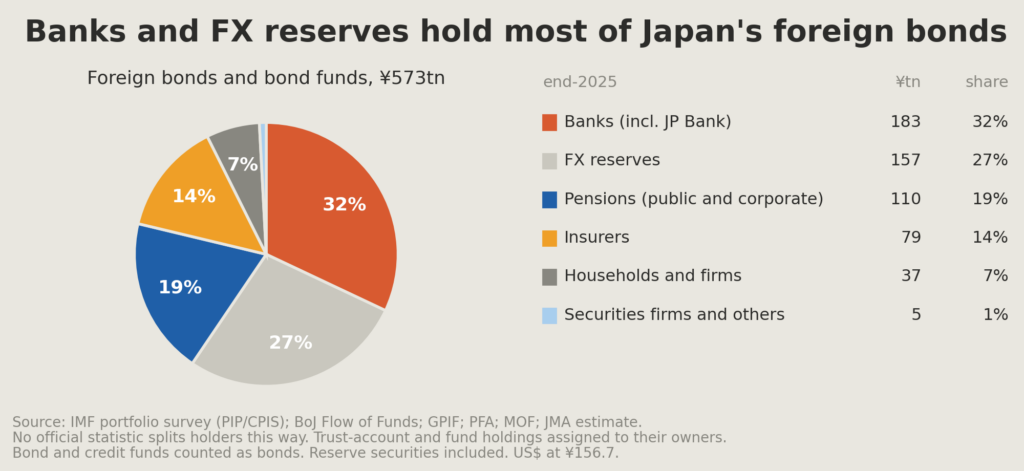
Banks, reserves, pensions and insurers own the bonds
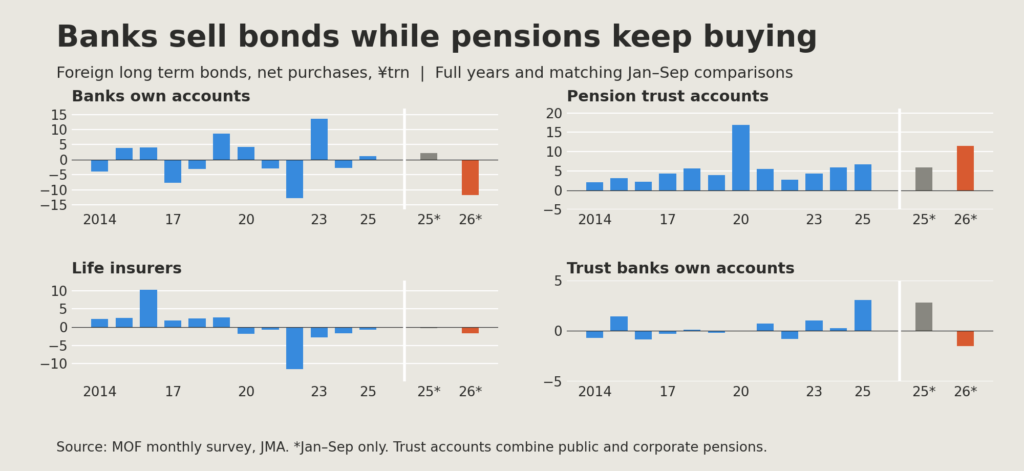
Chart 4 shows movements in foreign long-term bond flows by investors since 2014. We see pension funds as the consistent buyer, with an elevated purchase in 2020 when GPIF raised its foreign-bondasset allocation target from 15% to 25% (see the Japanese Macro Advisors GPIF report for details). On the other hand, life insurers have been consistent net sellers in recent years. Banks seem to be opportunistic swing players. This year’s foreign-bond sale so far is a bank story.
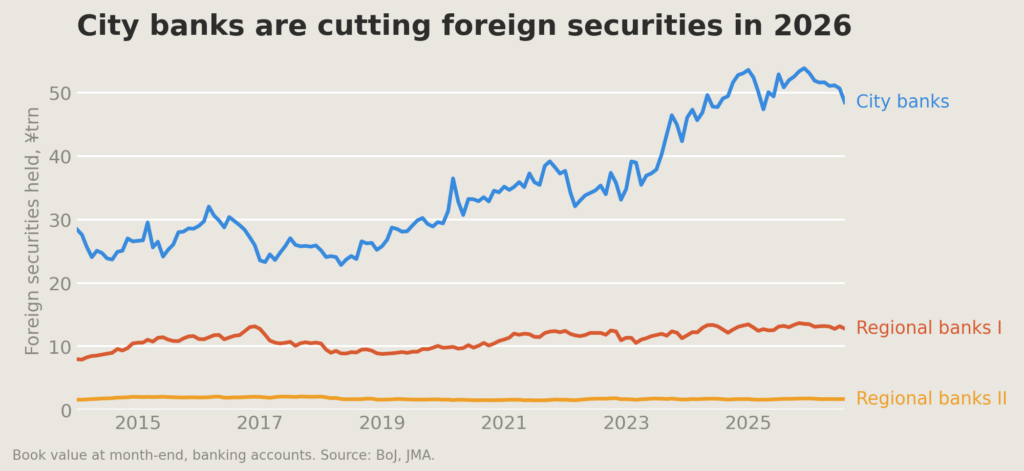
The bankbalance sheets show who is selling. City banks are the dominant players: their foreign securities reached about ¥53trn in late 2024, moved sideways with some swings in 2025, and then fell in 2026. Regional banks’ foreign holdings are small and little changed (chart 5).
2026 is different from 2022: Yen rates are at 30-year highs
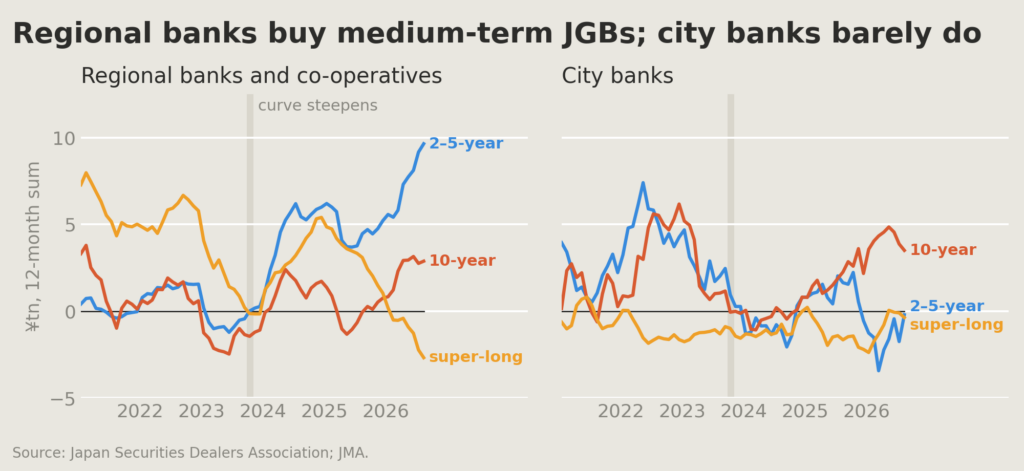
City banks went through a similar repatriation episode in 2022 (see chart 5), but went right back to buying foreign bonds in 2023 as soon as the overseas yield curve stabilized. 2026 offers a different environment. Both city banks and regional banks are buying JGBs, although in different parts of the yield curve. City banks are stepping up their purchases of 10-year bonds on a rolling 12-month basis (chart 6). They were selling the 2–5-year and super-long sectors in early 2026, but their rolling 12-month figures have just come back to neutral. Regional and co-operative institutions are showing strong appetite for the 2–5-year and 10-year sectors. Banks buying at home does not necessarily mean selling bonds abroad, but their JGB purchases do leave less room for duration risk in foreign bonds.
Chart 6: Net secondary-marketOTC purchases, twelve months through August. Regional/co-operative group includes regional banks, shinkin and agricultural institutions; auctions and bills excluded. Source: JSDA, JMA.
Part 2. Pension funds are selling foreign equity, offsetting households’ buying
Why do pensions sell what households buy? Pension funds typically manage their assets to target weights. When foreign equities outperform, they sell some and buy other assets to restore the balance.
Part 3. Pension funds to put more money in yen
GPIF likely to raise its asset allocation into yen bonds
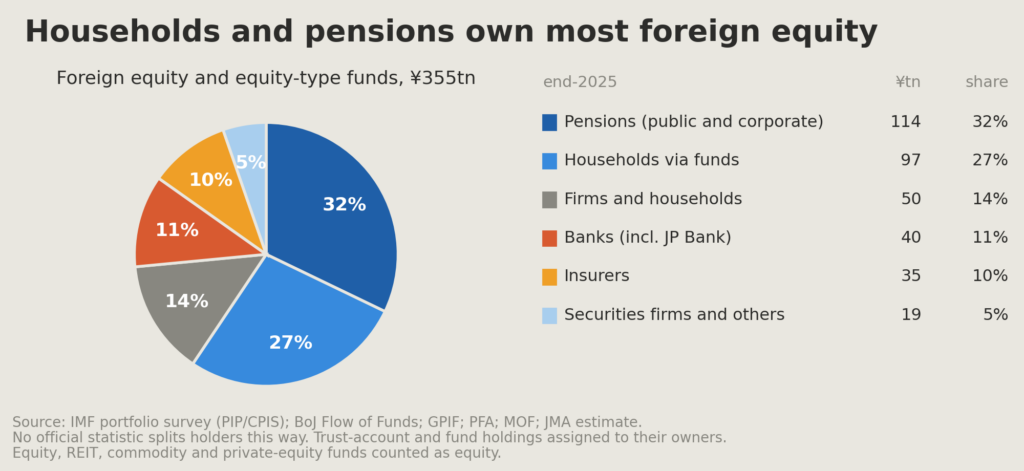
As you can see in the two pie charts (charts 3 and 7), GPIF and other pension funds are key players in Japan’s investments in foreign bonds and equity. GPIF, with ¥320trn of assets under management, is the big whale, and changes in its asset allocation have played a significant role in defining Japan’s cross-border capital flows in recent years.
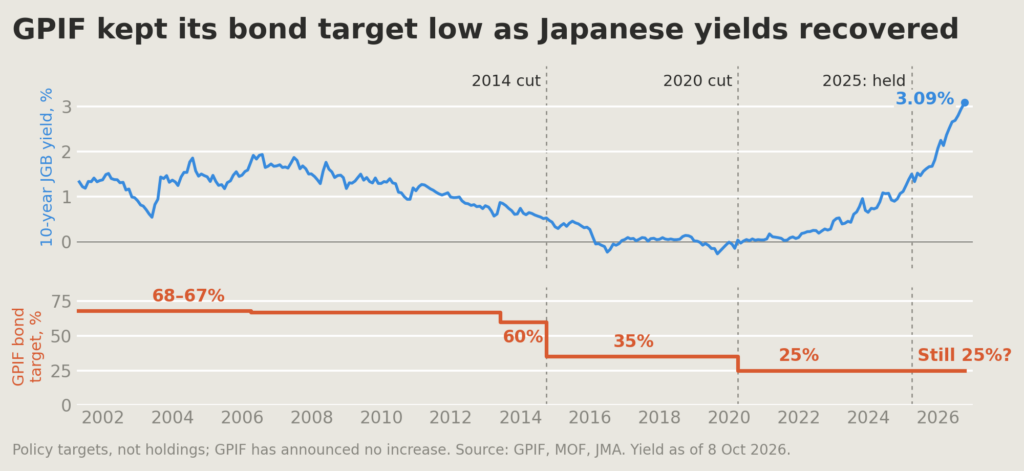
For details on my views on GPIF, I refer readers to the “GPIF the Whale” report. Here is the gist. GPIF reduced its domestic-bond allocation target from 60% to 35% in 2014 and to 25% in 2020, partly to protect the fund from a JGB crash it saw coming (chart 10). The crash has already happened, in slow motion over the last two years. When GPIF last reviewed the asset allocation in early 2025, maintaining the target unchanged at 25% made sense. At the time, JGB yields had more room to “normalize”, and they did. Please see my report The Long Climb in JGB Yields Is Nearly Over (20 July) for why I think the normalization is largely over.
On my simplified replication of GPIF’s allocation rule, a zero expected real return on JGBs points to a domestic-bond weight of about 50%, against 25% today. A move to 50% means about ¥80trn of assets shifting toward yenbonds, and foreign bonds are the likely asset class to give way. For more details, please see Yen Repatriation Starts with the Whale (10 September). It is a tricky shift, as GPIF is a classic whale in financial jargon, and there is a legitimate concern that other investors could front-run it. But GPIF cannot ignore the asset-allocation arithmetic. GPIF’s July–September results, due in early November, are the first place a shift could show, but even if it doesn’t, it is just a matter of time in my view, as GPIF would be doing Japanesepensioners a disservice if it did not change the allocation.
Chart 10: GPIF policy targets for domestic bonds and 10-year JGB yield, through 8 October 2026. Source: GPIF, MOF, JMA.
Part 4. Recent development and what to watch
Weekly data shows bond selling continuing into October
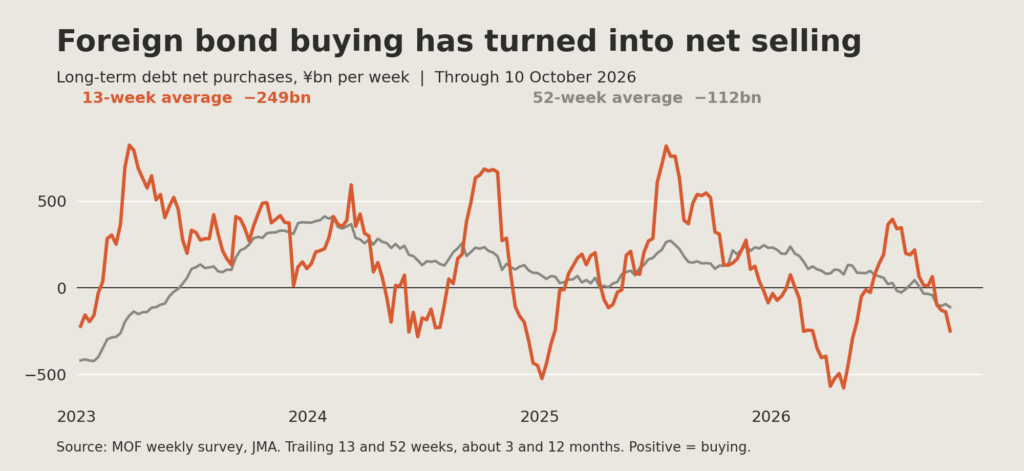
The balance of payments is the key statistic for monitoring cross-border capital flows, but as of mid-October it runs only to August. The Ministry of Finance’s weekly survey of large investors is a good leading indicator and runs to 10 October. In the four weeks to 10 October, Japaneseinvestors sold a net ¥3.3trn of foreign long-term bonds. Chart 11 shows the 52-week and 13-week averages.
Chart 11: MOF weekly survey of designated major investors. 13- and 52-week trailing averages, approximately three and twelve months, through 10 October. Both lines show average net purchases per week, not cumulative totals. Source: MOF, JMA.
Equity flows have no sustained direction
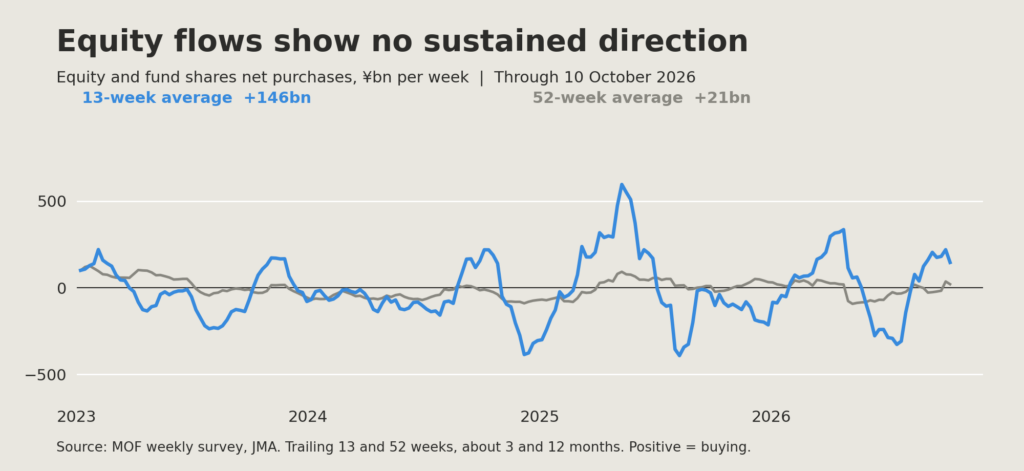
The same weekly survey includes equity flows. They have some ups and downs, but the 52-week average is hugging the zero line, and I do not see any particular trend upward or downward (chart 12). The equity data add no repatriation signal to the bond evidence.
Chart 12: Same weekly survey, smoothing windows, dates and vertical scale as Chart 11; foreign equity and fund shares. The 13-week line shows recent swings; the 52-week line shows the smaller underlying net flow. Source: MOF, JMA.
What to watch
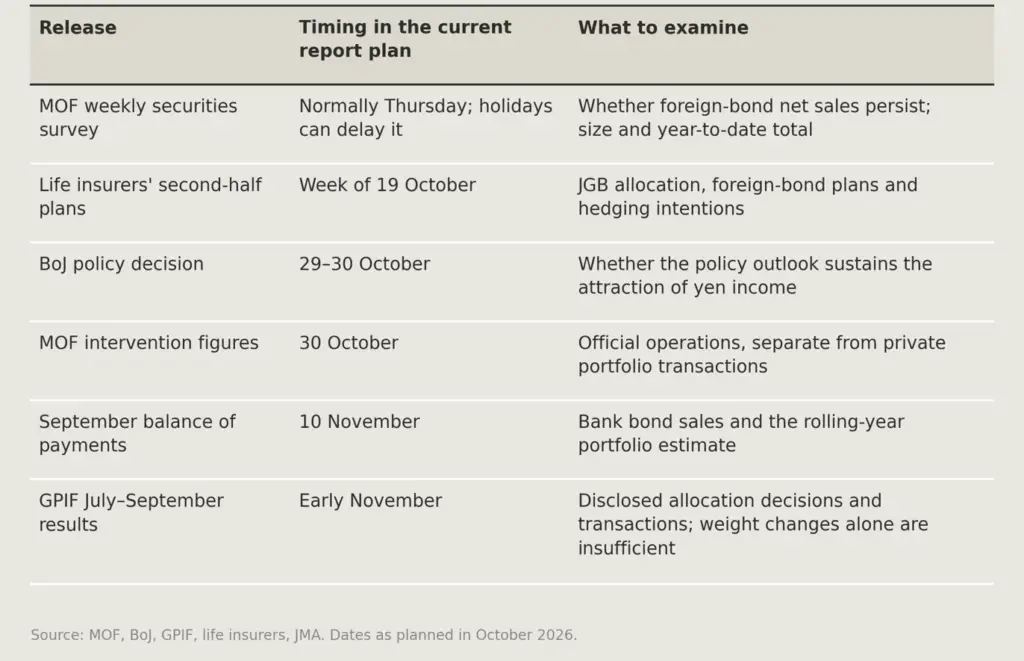
The weekly survey is the first test of whether bond sales persist. The September balance of payments, due in early November, will test the estimate in the opening. The other releases are in the table below.
Conclusion
The capital-flow tide is turning
As this report showed, Japan has been a broadly consistent provider of capital to the rest of the world, and Japan will continue to play that role for many years to come. However, the tide turns from time to time, and 2026 seems to be such a year. Net portfolio flow has narrowed from a sizable outflow in 2024–25 to a small net sale in the latest months, even while households continued to show strong appetite for foreign equity. Banks seem to be increasing their appetite for yenbonds, with good reason. JGB yields have risen to a 30-year high. Some may claim the rise has to do with higher fiscal premia, but my yield-curve analysis in Japan’s Fiscal Vigilantes Are Misreading the Curve (16 July) shows otherwise.
In my view, this shift weakens one of the forces behind the weak yen. Higher yen yields give investors a reason to keep shifting toward domestic bonds. I see a moderate chance that the turn in foreign bonds develops into a larger net repatriation, with GPIF’s asset allocation decision as a potential key mover. If global financial markets were to suffer a setback, whether in the euro bondmarket or the USstock market, it would further strengthen the case for yen repatriation. In my view, Japan’s capital flows are likely to show yen repatriation in 2026–27; the question is how large, rather than whether it will happen.
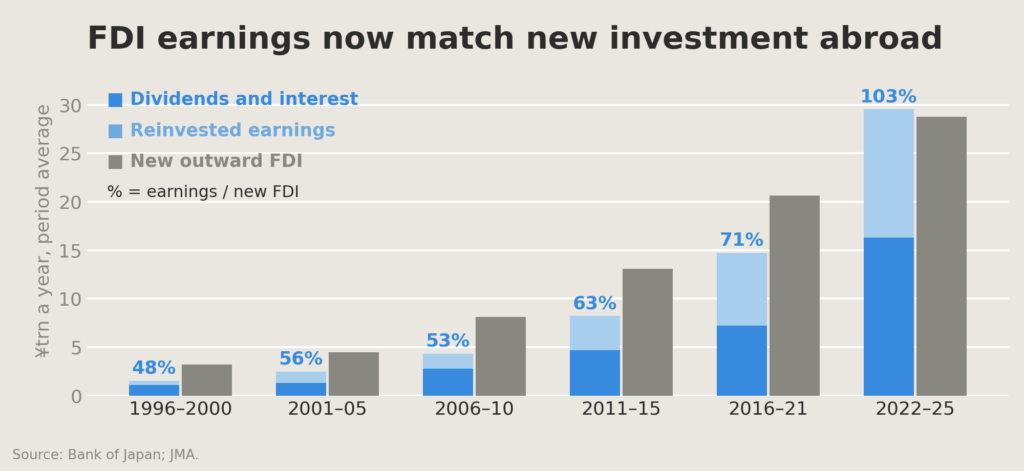
Earnings on Japan’s foreign direct investment (FDI) reached 103% of new FDI in 2022–25. With dividends and retained earnings counted together, Japan Inc. now needs to sell little yen to invest abroad.
[by OKUBO Takuji]
Key takeaways
Foreign affiliates now earn about as much as Japan invests abroad each year. Reinvested earnings, dividends and interest together reached 103% of new outward FDI in 2022–25, against 48% in 1996–2000.
Dividends from foreign affiliates account for a growing share of Japanese corporate profit. We estimate that foreign affiliates contributed 13.4% of Japan Inc.’s earnings in FY2025, up from 1.7% in FY1996.
Corporate investment abroad now involves little net yen selling. After dividends and interest paid home, the estimated outflow has been close to zero since 2022, down from about ¥5 trillion a year, or about 1% of GDP, on average in the 2010s.
Japan’s FDI stock now earns 103% of new investment
“Japan’s ageing and shrinking population depresses expected demand at home. Expected returns remain higher abroad, so Japanese companies have accelerated outward direct investment” (my translation). — MATSUBAYASHI Yōichi [松林 洋一], MOF PRI, chapter 8, p.136.
“Companies invested abroad because they saw no promising investments in Japan; they are unlikely to bring back every return. On a cash-flow basis, the external balance is in deficit and is one factor behind the weak yen” (my translation). — KARAKAMA Daisuke [唐鎌 大輔], MOF PRI, chapter 10, pp.178 and 175.
However, my review of recent data shows that while their premise of low growth prospects in Japan is probably still right, the direct investmentJapan has accumulated abroad has reached a level where it earns enough to cover Japan’s new investment abroad. This changes the exchange-rate implication even if Japan keeps investing abroad.
Overseas affiliates pay interest and dividends to their parent companies in Japan. Those dividends have become a sizable part of corporate Japan’s income: we estimate that they made up 13.4% of Japanese corporate profit in FY2025, up from 1.7% in FY1996.
When foreign affiliates retain their earnings on their balance sheets, Japan’s balance of payments statistics record them as FDI from Japan, even though no money crosses the border. While the companies receiving FDIdividends and the companies paying for new FDI are not necessarily the same, Japan Inc. as a whole is now financing its FDI almost entirely from the earnings of its overseas affiliates. At the current level of FDI, little new yen needs to be converted into foreign currencies as Japan goes about investing abroad.
A strong yen helped drive Japan’s first outward FDI boom
Japan’s outward investment was heavily restricted after WWII, requiring case-by-case permission from the government. Approvals became more and more automatic over the years until outward investment became “free in principle” in 1980. Trade friction with the US-led Japanese carmakers to restrain their exports from 1981, pushing them to build factories abroad. The rapid appreciation of the yen was also a factor. The yen strengthened from ¥242 per dollar before the Plaza Accord in September 1985 to ¥121 by the end of 1987. Japanese producers had to move lower value-added work abroad. The strong yen also gave Japanese financial institutions sizable purchasing power for a while, until the stock and property bubbles burst in 1990 and 1991.
All of these factors contributed to a rapid increase in outward FDI through the 1980s and 1990s (chart 2).
The next phase was sustained by a different pressure. With weak growth and low interest rates at home, Japan Inc. kept investing abroad, across a broader range of industries. Between 1995 and 2025, the stock of FDI rose from 9% of Japan’s GDP to 58% (chart 4). In 2025, it is as large as about 38% of the private sector’s domestic fixed capital, on our estimate.
Chart 4
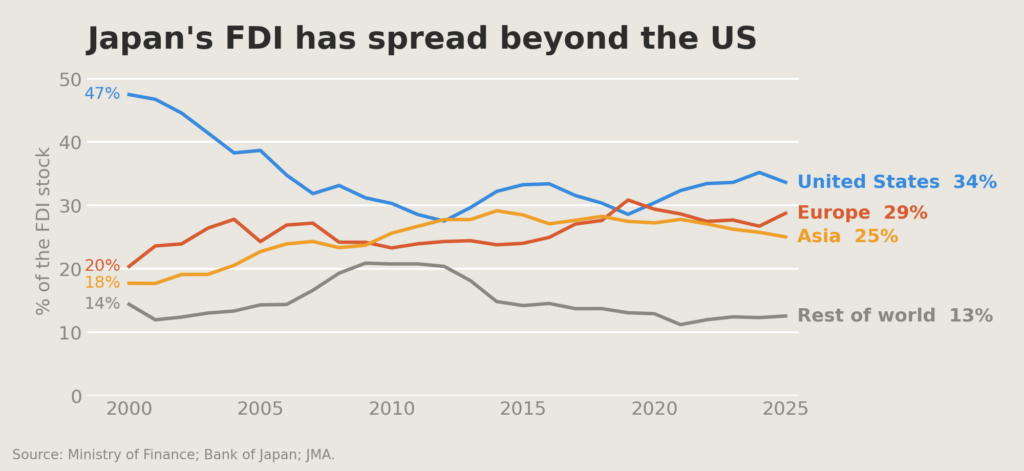
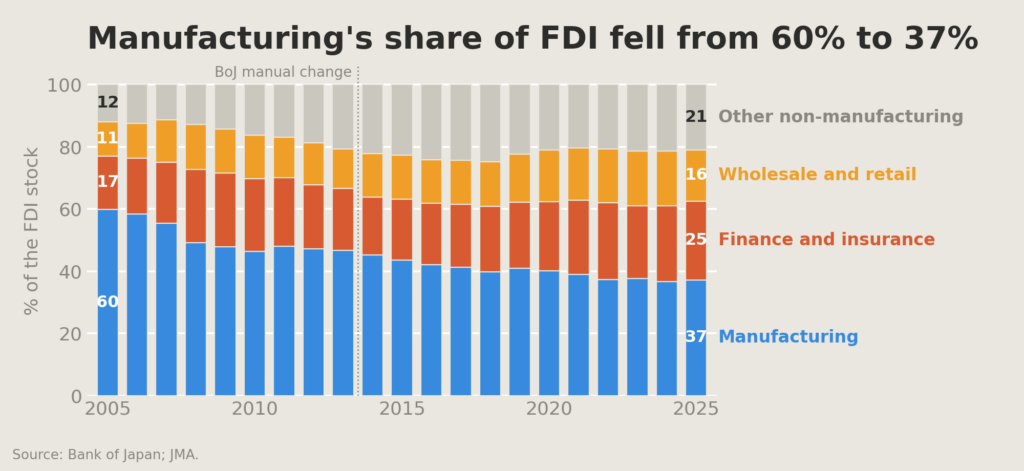
By industry composition and by destination compositions changed over time. Manufacturing’s share of the FDIstock had fallen to 37% by 2025, giving Japan’s FDI more breadth. By destination, we are seeing a revival of FDI toward the United States. It accounted for 34% of the stock in 2025, Europe 29% and Asia 25% (see earlier chart 3).
Thus, after decades of overseas investment, Japan’s FDI stock is now large enough that its earnings are sufficient to finance new investment abroad, at least for now. In the next section, I consider whether this will continue, and in particular whether Japanese companies may bring an even larger share of their overseas earnings back to Japan, given the weak yen, higher borrowing costs in yen and possibly better investment opportunities at home.
The weak yen has slowed offshoring, not reversed it
The real depreciation of the yen over the past 15 years made production in Japan more competitive. There is some evidence that manufacturers are considering bringing production back to Japan. The 2023 manufacturingwhite paper found more firms shifting production back from China than moving there, and they named the weak yen as one reason. We see some signs of reshoring. Japanese manufacturers’ overseas production ratio rose from 18.0% in FY2011 to 27.2% in FY2023, but it may have started to decline or at least stabilize. The ratio fell to 26.7% in FY2024. A Cabinet Office survey of listed manufacturers puts the ratio at 24.5% in FY2025, and their plan for FY2030 is broadly unchanged at 24.7%. The weak yen seems to have stabilized the wave of offshoring, but I see no firm evidence of a move back onshore yet.
Domestic investment has grown slowly despite the weak yen
There are tentative signs that domestic capital spending is starting to grow again. For three decades it grew at a very low speed. In real terms, private business investment rose only 26% between FY1997 and FY2025, less than 1% a year. In comparison, capital spending grew by about 4% a year on average in the United States. In my view, a weak currency is only one of the factors manufacturers weigh in designing their global production chains. The weak yen makes production in Japan competitive today, but they have also seen the exchange rate swing violently within short periods. Japan also has a shrinking population problem. It started to address it by opening a door to immigration, but the door is only tentatively open. Overall, my view is that the weak yen alone is unlikely to give Japan Inc. sufficient incentive to bring its capital back to Japan and to the yen.
Economic security is bringing some production home
The weak yen and non-economic geopolitical factors do point to a halt in Japan’s four-decade offshoring trend, although it is a stabilization, rather than an economy-wide reversal of past offshoring. Japan Inc. will continue to invest more abroad, rather than within its borders. Given the sizable growth in the stock of cumulative FDI, Japan Inc. no longer needs to convert yen into overseas currency to keep investing abroad though. Net of dividends and interest paid home, Japan’s FDI sold about ¥5 trillion of yen a year, or about 1% of GDP, on average in the 2010s; since 2022 the net flow has been close to zero. There is also an interesting development in an effort to allow more share-exchange based M&A for cross-border deals that will further reduce the need for Japanese companies to spend their yen to purchase overseas assets. In my view, Japan Inc.’s FDI is no longer a factor to drive the yen weaker.