
[by Tobias Harris, Japan Daily Briefing]
Prime Minister TAKAICHI Sanae [高市 早苗] faced questioning in the House of Representatives budget committee Tuesday, with opposition and ruling party lawmakers questioning whether Agriculture Minister YANA Kazuo [簗 和生] needs to quit or be dismissed as allegations of political misconduct mount. The prime minister was also pressed for more details on plans to finance the consumption tax cut. A new poll showed that the Yana scandal could be beginning to hurt the government’s support. [Update: On 14 October, 2026, Yana submitted his resignation to Takaichi, which was accepted.
Pressure on Yana to quit grows

(Agriculture Minister YANA Kazuo [簗 和生] answers questions in a lower house budget committee hearing on 13 October. Screenshot by author.)
Japanese lawmakers returned to the business on Tuesday, 13 October following a holiday weekend and resumed their questioning of Prime Minister TAKAICHI Sanae in a meeting of the lower house’s budget committee. Asahi provided a timeline of the day’s deliberations here.
The calls for Takaichi to dismiss Agriculture Minister YANA Kazuo [簗 和生] – in the event that he does not resign voluntarily – have continued to grow. The opposition parties have continued to threaten an upper house censure motion if he does not leave, though they appear to be inclined to wait to see whether he or Takaichi will take the decisive step first (and they may also see some value in Yana staying around longer to give them additional opportunities to attack the government). A censure motion is also not guaranteed to pass the upper house since the opposition parties would need to bring along some of the upper house’s independents.
It is possible that, in response to reporting that Yana violated election law in providing free transportation to his supporters during campaigns, Takaichi may be backing away from her support for her embattled agriculture minister. She said in the committee hearing Tuesday that if Yana had engaged in any illegal activities, she would not hesitate to remove him and suggested that she is seriously considering whether he can contribute to her government’s work, though she also said that she wanted to give him a little more time to account for his actions. Yana, for his part, denied that he had broken election law and also apologized again for the remarks about withholding road funds that started the scandal.
The Liberal Democratic Party (LDP) has not necessarily abandoned Yana, though senior party officials have continued to emphasize that he needs to do more to take responsibility for his actions and provide a full explanation of what happened. Former prime minister Ishiba Shigeru, however, has sharpened his criticism of both Yana and Takaichi, condemning his attitude as “highly questionable” for someone involved in politics. With Takaichi expected to meet with Yana on Wednesday, 14 October following the budget committee hearing, his fate could be decided sooner rather than later. But the longer he remains, the greater the attention not just on his own conduct but on the LDP more broadly.
Takaichi questioned on tax cut funding
While the Yana scandal consumed significant oxygen Tuesday, the prime minister also faced questioning about the consumption tax cut bill that was submitted to the Diet last Friday.
Takaichi has encountered particularly insistent questioning on her government’s plans to fund the estimated JPY 5tn per year bill for the two-year tax cut on foodstuffs. She has repeatedly stated that the tax cut will not be funded by deficit bond issuance, but her government has avoided outlining plans for financing the tax cut until the FY2027 budget is drafted.
She alluded Tuesday to the possibility of using higher tax revenues or proceeds for currency intervention in the Foreign Exchange Fund Special Account (FEFSA) — both options that have been floated before — though it is unclear whether tapping the FEFSA for this purpose is strictly legal (or advisable).
Takaichi was also criticized for the government’s failure to provide details about how it intends to distribute additional payments to low-income households to compensate for the government’s decision to lower the tax to 1% instead of 0%.
The legislation’s path through the Diet is still uncertain as no opposition party has indicated its support. OKAMOTO Mitsunari [岡本 三成], leader of Kōmeitō, reiterated Tuesday that while his party is open to discussions with the government on the bill’s provisions related to the refundable tax credit to be introduced in 2029, it is still opposed to the temporary consumption tax cut and therefore cannot support the legislation.
First post-scandal poll suggests Yana could cost Takaichi
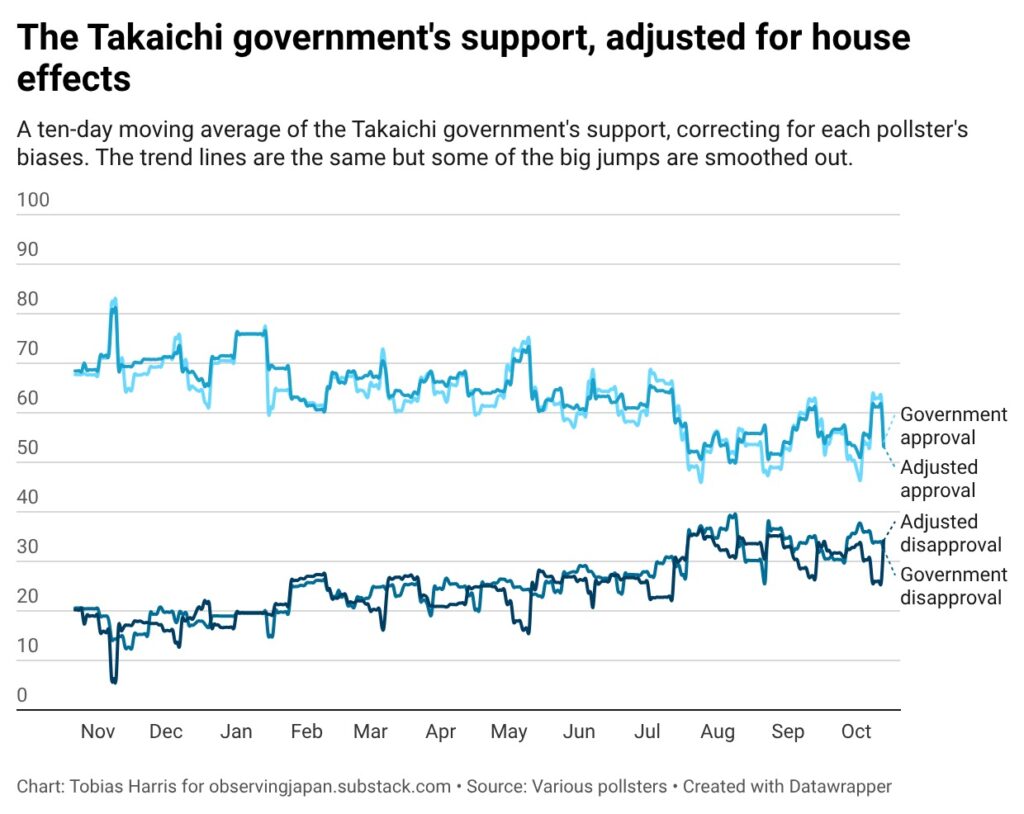
NHK released its latest poll on 13 October, which showed a slight decline in the government’s net approval – down three points, to +19 – and suggested that the Yana scandal could be beginning to weigh on the government’s support. The NHK poll is the first poll in nine days and the first since the scandal emerged. The entrance of the NHK poll into my ten-day moving average, which since 8 October had only included a fairly favorable JNN poll, brings the government’s weighted average support down to +21 (+19 adjusted for pollster bias).
The poll found that the public is relatively dissatisfied with the new cabinet lineup – 42% strongly (4) or somewhat (38%) in favor, 48% strongly (15%) or somewhat (33%) opposed – and overwhelmingly dissatisfied with Yana’s response to the allegations thus far. Only 8% said that they were persuaded by his comments, while 78% said that they were not.
Meanwhile, the poll also recorded one of the more negative findings about the consumption tax cut that I have seen, with only 38% in favor and 44% opposed.
While government supporters back the proposal by a 51% to 35% margin, independents oppose the tax cut by sizable margin, with 50% opposed and only 31% in favor. Support is polarized by age, with voters under 40 the most favorable (56% support); voters in their forties are slightly in favor (47% support to 44% oppose) and voters in their fifties are barely in favor (45% to 44%).
Voters over 60, who have the most to lose from cutting a tax that generates revenue earmarked for social security, are firmly opposed. Finally, 78% of respondents said that they are greatly (34%) or somewhat (44%) affected by rising prices.
Further reading
Former prime minister KISHIDA Fumio [岸田 文雄] spoke with Nikkei and expressed his opposition to a proposal that would allow retail investors to use their tax-advantaged Nippon Individual Savings Accounts (NISAs) to buy Japanese government bonds. He said that this would be at odds with the goal of encouraging savers to invest in riskier assets. He also called on the Takaichi government to be more transparent about how its “growth investments” will deliver and to communicate with markets about growth and fiscal sustainability.
Democratic Party for the People (DPFP) leader TAMAKI Yūichirō [玉木 雄一郎] rejected the idea of recreating the old Democratic Party of Japan through a merger with the Democratic Reform Alliance (DRA).
Prime Minister Takaichi said that her government would respond “appropriately” to a visit to Russian-controlled Etorofu by a Chinese delegation.
In the first part of an interview with Tōyō Keizai, Economic Revitalization Minister KIUCHI Minoru [城内 実] explains that the Takaichi government’s goal has never been reflation but rather using fiscal measures to mobilize private investment as part of a strategy of enabling Japan to compete with other industrial powers.