World-Watching: Minutes of the Monetary Policy Committee — Copom

272nd Meeting – July 29-30, 2025

[from the Central Bank of Brazil, 5 August, 2025]

  1. Update of the economic outlook and the Copom’s scenario1
    1. The global environment is more adverse and uncertain due to the economic policy and economic outlook in the United States, mainly regarding its trade and fiscal policies and their effects.
    2. Therefore, the behavior and the volatility of different asset classes have been impacted, altering global financial conditions. This scenario requires particular caution from emerging market economies amid heightened geopolitical tensions.
    3. Regarding the domestic scenario, the set of indicators on economic activity has shown some moderation in growth, as expected, but the labor market is still showing strength.
    4. In recent releases, headline inflation and measures of underlying inflation remained above the inflation target. Inflation expectations for 2025 and 2026 collected by the Focus survey remained above the inflation target and stand at 5.1% and 4.4%, respectively.
  2. Scenarios and risk analysis
    1. The inflation outlook remains challenging in several dimensions. Copom assessed the international scenario, economic activity, aggregate demand, inflation expectations, and current inflation. Copom then discussed inflation projections and expectations before deliberating on the current decision and future communication.
    2. The global environment is more adverse and uncertain. If, on the one hand, the approval of certain trade agreements, along with recent inflation and economic activity data from the U.S., could suggest a reduction in global uncertainty, on the other hand, the U.S. fiscal policy—and, particularly for Brazil, the U.S. trade policy—make the outlook more uncertain and adverse. The increase of trade tariffs by the U.S. to Brazil has significant sectoral impacts and still uncertain aggregate effects that depend on the unfolding of the next steps in the negotiations and the perception of risk inherent to this process. The Committee is closely monitoring the potential impacts on the real economy and financial assets. The prevailing assessment within the Committee is the increased global outlook uncertainty, and, therefore, Copom should maintain a cautious stance. As usual, the Committee will focus on the transmission mechanisms from the external environment to the domestic inflation dynamics and their impact on the outlook.
    3. The domestic economic activity outlook has indicated a certain moderation in growth, while also presenting mixed data across sectors and indicators.
    4. Overall, some moderation in growth is observed, supporting the scenario outlined by the Committee. This moderation, necessary for the widening of the output gap and the convergence of inflation to the target, is aligned with a contractionary monetary policy. Monthly sectoral surveys and more timely consumption data support a gradual slowdown in growth.
    5. At turning points in the economic cycle, it is natural to observe mixed signals from economic indicators—some leading, others lagging—as well as from comparisons between markets, such as the credit and labor markets.
    6. The credit market, which is more sensitive to financial conditions, has shown clearer moderation. A decline in non-earmarked credit granting and an increase in interest and delinquency rates have been observed. Moreover, regarding household credit, there has been an increase in the household debtservice ratio and a deepening of the negative credit flow—that is, households repaying more debt than taking on. It was emphasized during the discussion that some recent measures, such as private payroll-deducted loans, have had less impact than many market participants expected. Given the implementation agenda in this credit line, as well as the effects of introducing and removing taxes on other credit modalities, the Committee believes it should closely monitor upcoming credit data releases.
    7. In contrast to the credit market, the labor market remains dynamic. Both from the perspective of income—with real gains consistently above productivity—and employment—with a significant decrease in the unemployment rate to historically low levels—the labor market has greatly supported consumption and income.
    8. Thus, the Committee assesses that the signals from demand and economic activity so far suggest that the scenario is unfolding as expected and is consistent with the current monetary policy. The Committee reiterates that the aggregate demand slowdown is an essential element of supplydemand rebalancing in the economy and convergence of inflation to the target.
    9. Fiscal policy has a short-term impact, mainly through stimulating aggregate demand, and a more structural dimension, which has the potential to affect perceptions of debt sustainability and influence the term premium in the yield curve. A fiscal policy that acts counter-cyclically and contributes to reducing the risk premium favors the convergence of inflation to the target. Copom reinforced its view that the slowdown in structural reform efforts and fiscal discipline, the increase in earmarked credit, and uncertainties over the public debt stabilization have the potential to raise the economy’s neutral interest rate, with deleterious impacts on the power of monetary policy and, consequently, on the cost of disinflation in terms of activity. The Committee remained firmly convinced that policies must be predictable, credible, and countercyclical. In particular, the Committee’s discussion once again highlighted the need for harmonious fiscal and monetary policy.
    10. Inflation expectations, as measured by different instruments and obtained from various groups of agents, remained above the inflation target at all horizons, maintaining the adverse inflation outlook. For shorter-term horizons, following the release of the most recent data, there has been a decline in inflation expectations. For longer-term horizons, conversely, there has been no significant change in inflation expectations between Copom meetings, even though measures of breakeven inflation extracted from financial assets have declined. The Committee reaffirmed and renewed its commitment to re-anchoring expectations and to conducting a monetary policy that supports such a movement.
    11. De-anchored inflation expectations is a factor of discomfort shared by all Committee members and must be tamed. Copom highlighted that environments with de-anchored expectations increase the disinflation cost in terms of activity. The scenario of inflation convergence to the target becomes more challenging with de-anchored expectations for longer horizons. When discussing this topic, the main conclusion obtained and shared by all members of Copom was that, in an environment of de-anchored expectations—as currently is the case—greater monetary restriction is required for a longer period than would be otherwise appropriate.
    12. The inflation scenario has continued to show downside surprises in recent periods compared with analystsforecasts, but inflation has remained above the target Industrial goods inflation, which has already been showing weaker wholesale price pressures, continued to ease in the more recent period. Food prices also displayed slightly weaker-than-expected dynamics. Finally, services inflation, which has greater inertia, remains above the level required to meet the inflation target, in a context of a positive output gap. Beyond the changes in items, or even short-term oscillations, the core inflation measures have remained above the value consistent with the target achievement for months, corroborating the interpretation that inflation is pressured by demand and requires a contractionary monetary policy for a very prolonged period.
    13. Copom then addressed the projections. In the reference scenario, the interest rate path is extracted from the Focus survey, and the exchange rate starts at USD/BRL 5.552 and evolves according to the purchasing power parity (PPP). The Committee assumes that oil prices follow approximately the futures market curve for the following six months and then start increasing 2% per year onwards. Moreover, the energy tariff flag is assumed to be “green” in December of the years 2025 and 2026.
    14. In the reference scenario, four-quarter inflation projections for 2025 and for 2026 are 4.9% and 3.6%, respectively (Table 1). For the relevant horizon for monetary policy—2027 Q1—the inflation projection based on the reference scenario extracted from the Focus survey remained at 3.4%, above the inflation target.
    15. Regarding the balance of risks, it was assessed that the scenario of greater uncertainty continues to present higher-than-usual upside and downside inflation risks to the inflation outlook. Copom assessed that, among the upside risks for the inflation outlook and inflation expectations, it should be emphasized (i) a more prolonged period of de-anchoring of inflation expectations; (ii) a stronger-than-expected resilience of services inflation due to a more positive output gap; and (iii) a conjunction of internal and external economic policies with a stronger-than-expected inflationary impact, for example, through a persistently more depreciated currency. Among the downside risks, it should be noted (i) a greater-than-projected deceleration of domestic economic activity, impacting the inflation scenario; (ii) a steeper global slowdown stemming from the trade shock and the scenario of heightened uncertainty; and (iii) a reduction in commodity prices with disinflationary effects.
    16. Prospectively, the Committee will continue monitoring the pace of economic activity, which is a fundamental driver of inflation, particularly services inflation; the exchange rate pass-through to inflation, after a process of increased exchange rate volatility; and inflation expectations, which remain de-anchored and are drivers of future inflation behavior. It was emphasized that inflationary vectors remain adverse, such as the economic activity resilience and labor market pressures, de-anchored inflation expectations, and high inflation projections. This scenario prescribes a significantly contractionary monetary policy for a very prolonged period to ensure the convergence of inflation to the target.
  3. Discussion of the conduct of monetary policy
    1. Copom then discussed the conduct of monetary policy, considering the set of projections evaluated, as well as the balance of risks for prospective inflation.
    2. Following a swift and firm interest rate hike cycle, the Committee anticipates, as its monetary policy strategy, continuity of the interruption of the rate hiking cycle to observe the effects of the cycle already implemented. It was emphasized that, once the appropriate interest rate is determined, it should remain at a significantly contractionary level for a very prolonged period due to de-anchored expectations. The Committee emphasizes that it will remain vigilant, that future monetary policy steps can be adjusted and that it will not hesitate to proceed with the rate hiking cycle if appropriate.
  4. Monetary policy decision
    1. The Committee has been closely monitoring with particular attention the announcements regarding the imposition by the U.S. of trade tariffs on Brazil, reinforcing its cautious stance in a scenario of heightened uncertainty. Moreover, it continues to monitor how the developments on the fiscal side impact monetary policy and financial assets. The current scenario continues to be marked by de-anchored inflation expectations, high inflation projections, resilience on economic activity, and labor market pressures. Ensuring the convergence of inflation to the target in an environment with de-anchored expectations requires a significantly contractionary monetary policy for a very prolonged period.
    2. Copom decided to maintain the Selic rate at 15.00% p.a., and judges that this decision is consistent with the strategy for inflation convergence to a level around its target throughout the relevant horizon for monetary policy. Without compromising its fundamental objective of ensuring price stability, this decision also implies smoothing economic fluctuations and fostering full employment.
    3. The current scenario, marked by heightened uncertainty, requires a cautious stance in monetary policy. If the expected scenario materializes, the Committee foresees a continuation of the interruption of the rate hiking cycle to examine its yet-to-be-seen cumulative impacts, and then evaluate whether the current interest rate level, assuming it stable for a very prolonged period, will be enough to ensure the convergence of inflation to the target. The Committee emphasizes that it will remain vigilant, that future monetary policy steps can be adjusted and that it will not hesitate to resume the rate hiking cycle if appropriate.
    4. The following members of the Committee voted for this decision: Gabriel Muricca Galípolo (Governor), Ailton de Aquino Santos, Diogo Abry Guillen, Gilneu Francisco Astolfi Vivan, Izabela Moreira Correa, Nilton José Schneider David, Paulo Picchetti, Renato Dias de Brito Gomes, and Rodrigo Alves Teixeira.
Table 1

Inflation projections in the reference scenario
Year-over-year IPCA change (%)

Price Index202520262027 Q1
IPCA4.93.63.4
IPCA market prices5.13.53.3
IPCA administered prices4.44.03.9
Footnotes

1 Unless explicitly stated otherwise, this update considers changes since the June Copom meeting (271st meeting).

2 It corresponds to the rounded value of the average exchange rate observed over the ten working days ending on the last day of the week prior to the Copom meeting, according to the procedure adopted since the 258th meeting.

Meeting information
Date: July 29-30 2025
Place: BCB Headquarters’ meeting rooms on the 8th floor (7/29 and 7/30 on the morning) and 20th floor (7/30 on the afternoon) – Brasilia – DF – Brazil
Starting and ending times:
July 29: 10:07 AM – 11:37 AM; 2:17 PM – 5:51 PM
July 30: 10:10 AM – 11:13 AM; 2:37PM – 6:34 PM
In attendance:
Members of the Copom
Gabriel Muricca Galípolo – Governor
Ailton de Aquino Santos
Diogo Abry Guillen
Gilneu Francisco Astolfi Vivan
Izabela Moreira Correa
Nilton José Schneider David
Paulo Picchetti
Renato Dias de Brito Gomes
Rodrigo Alves Teixeira
Department Heads in charge of technical presentations (attending on July 29 and on the morning of July 30)
André de Oliveira AmanteOpen Market Operations Department
Euler Pereira Gonçalves de MelloResearch Department (also attending on the afternoon of 7/30)
Fábio Martins Trajano de ArrudaDepartment of Banking Operations and Payments System
Luís Guilherme Siciliano PontesInternational Reserves Department
Marcelo Antonio Thomaz de AragãoDepartment of International Affairs
Ricardo SabbadiniDepartment of Economics
Other participants (attending on July 29 and on the morning of July 30)
Alexandre de CarvalhoOffice of Economic Advisor
André Maurício Trindade da RochaHead of the Financial System Monitoring Department
Angelo Jose Mont Alverne DuarteHead of Office of the Deputy Governor for Licensing and Resolution (attending on the mornings of 7/29 and 7/30)
Arnaldo José Giongo GalvãoPress Office Advisor
Cristiano de Oliveira Lopes CozerGeneral Counsel
Edson Broxado de França TeixeiraHead of Office of the Deputy Governor for Supervision
Eduardo José Araújo LimaHead of Office of the Deputy Governor for Economic Policy
Fernando Alberto G. Sampaio C. RochaHead of the Department of Statistics
Isabela Ribeiro Damaso MaiaHead of the Sustainability and International Portfolio Investors Unit (attending on the mornings of 7/29 and 7/30)
Julio Cesar Costa PintoHead of Office of the Governor
Laura Soledad Cutruffo CompariniDeputy Head of the Department of Economics
Leonardo Martins NogueiraHead of Office of the Deputy Governor for Monetary Policy
Marcos Ribeiro de CastroDeputy Head of the Research Department
Mardilson Fernandes QueirozHead of the Financial System Regulation Department
Olavo Lins Romano PereiraDeputy Head of the Department of International Affairs
Renata Modesto BarretoDeputy Head of the Department of Banking Operations and Payments System
Ricardo da Costa MartinelliDeputy Head of the International Reserves Department
Ricardo Eyer HarrisHead of Office of the Deputy Governor for Regulation
Ricardo Franco MouraHead of the Prudential and Foreign Exchange Regulation Department
Rogerio Antonio LuccaExecutive Secretary
Simone Miranda BurelloAdvisor in the Office of the Deputy Governor for Monetary Policy

The members of Copom analyzed the recent performance and prospects for the Brazilian and international economies, under the monetary policy framework, whose objective is to comply with the inflation targets established by the National Monetary Council. This document represents Copom’s best effort to provide an English version of its policy meeting minutes. In case of inconsistency, the Portuguese version prevails.
Arguments Without End: A Few Simple Examples

In the previous essay (“Is It Good to Be a Detached Observer?”), we just encountered Geyl’s phrase, “arguments without end.” Here we cover a few simple examples.

Language and the Mind

The twentieth century philosopher, Ludwig Wittgenstein, tells us that his purpose is “to show the fly the way out of the fly-bottle.” Where the fly is, of course, ourselves. He then tells us, that perhaps the main reason is that one is unable to free oneself from bewitchment of the mind by “language games.”

In the song “Hotel California” by the Eagles, there’s the line, “‘We are all just prisoners here / Of our own device.’” In this context, “device” could be interpreted as a bad decision.

My Body and Myself

The American philosophy professor, Samuel Todes, in his book Body and World, analyzes the human body, not as a meat-machine, but more like the silent partner of a person navigating their life. You can get a sense of this from Gabriel Marcel, when he writes:

Is my body my body, for instance, in the same sense in which I would say that my dog belongs to me? The question, let us first of all notice, of how the dog originally came into my hands is quite irrelevant here. Perhaps I found it wandering wretchedly about the streets, perhaps I bought it in a shop; I can say it is mine if nobody else puts in a claim for it—though this is still quite a negative condition of ownership. For the dog to be really, not merely nominally, mine there must exist between us a more positive set of relations. He must live, either with me, or as I, and I alone, have decided he shall live—lodged, perhaps, with a servant or a farmer; whether or not I look after him personally, I must assume the responsibility for his being looked after. And this implies something reciprocal in our relations. It is only it the dog recognizes me, obeys me, expresses by his behaviour towards me some feeling which I can interpret as affection or, at the very least, as wholesome fear, that he is really mine; I would become a laughingstock if I persisted in calling an animal that completely ignored me, that took no notice of me at all, my dog. And the mockery to which I would be exposed in such an instance is very significant. It is linked to a very positive idea of how things must be between my dog and me, before I can really say, ‘This dog is mine’.

Gabriel MarcelThe Mystery of Being, Vol. 1: Reflection & Mystery, Harper Torchbooks, 1965, page 117.

Marcel goes on to explain:

We should recall, at this point, what we said in an earlier lecture about the body; the latter is not merely an instrument, it presents us with a kind of reality which is quite different from the reality of any sort of apparatus, in so far as it, my body, is also my way of being in the world.

Marcel, page 257.

Marcel elaborates:

When I try to make clear to myself the nature of my bond with my body, it appears to me chiefly as something of which I have the use (as one has the use of a piano, a saw, or a razor); but all these uses are extensions of the initial use, which is simply the use of the body. I have real priority to my body when it is a question of active use, but none whatever when it is a question of knowledge. The use is only possible on the basis of a certain felt community. But the community is indivisible; I cannot validly say ‘I and my body.’ The difficulty arises from the fact that I think of my relation with my body on the analogy of my relation with my instruments—whereas in fact the latter presupposes the former.

Gabriel MarcelBeing and Having: An Existentialist Diary, Harper Torchbooks, 1965, page 14.

The connections between the trio of “me, myself and I” and the body is very elusive (as you may sense from your own introspection). This is another “argument without end.”

Psychology and National Moods

The great historian, George Rudé, in his book, Revolutionary Europe, 1783-1815, tries to give a believable and multifactorial explanation of the French Revolution. Based on Ernest Labrousse’s studies of the French economy during that period, Rudé gives a thoughtful and subtle analysis of how wages, prices and other factors correlated to unrest. Interestingly, he concludes on a note of French national mood:

But, of course, it needed more than economic hardship, social discontent, and the frustration of political and social ambitions to make a revolution. To give cohesion to the discontents and aspirations of widely varying social classes there had to be some unifying body of ideas, a common vocabulary, of hope and protest, something, in short, like a common “revolutionary psychology”. In the revolutions of our day, this ideological preparation has been the concern of political parties; but there were no such parties in eighteenth-century France.

George Rudé, Revolutionary Europe, 1783-1815, Wiley, 1964, page 74.

Rudé uses the phrase, “revolutionary psychology.” Apply this to our time and ask yourself, did a demagogue like Donald Trump create a revolutionary psychology, or did it cough up Trump? Notice that in the recent political tract, What’s the Matter with Kansas?, Thomas Frank makes the point that people’s sense of grievance involves not only economics, but also other psychological factors, just as Rudé does with the French Revolution.

World-Watching: 272nd Meeting of the Monetary Policy Committee (“Copom”) of the Central Bank of Brazil Press Release

Copom maintains the Selic rate at 15.00% p.a.

[from the Central Bank of Brazil, 30 July, 2025]

The global environment is more adverse and uncertain due to the economic policy and economic outlook in the United States, mainly regarding its trade and fiscal policies and their effects. Therefore, the behavior and the volatility of different asset classes have been impacted, altering global financial conditions. This scenario requires particular caution from emerging market economies amid heightened geopolitical tensions.

Regarding the domestic scenario, the set of indicators on economic activity has shown some moderation in growth, as expected, but the labor market is still showing strength. In recent releases, headline inflation and measures of underlying inflation remained above the inflation target.

Inflation expectations for 2025 and 2026 collected by the Focus survey remained above the inflation target and stand at 5.1% and 4.4%, respectively. Copom’s inflation projections for the first quarter of 2027, currently the relevant horizon for monetary policy, stand at 3.4% in the reference scenario (Table 1).

The risks to the inflation scenarios, both to the upside and to the downside, continue to be higher than usual. Among the upside risks for the inflation outlook and inflation expectations, it should be emphasized (i) a more prolonged period of de-anchoring of inflation expectations; (ii) a stronger-than-expected resilience of services inflation due to a more positive output gap; and (iii) a conjunction of internal and external economic policies with a stronger-than-expected inflationary impact, for example, through a persistently more depreciated currency. Among the downside risks, it should be noted (i) a greater-than-projected deceleration of domestic economic activity, impacting the inflation scenario; (ii) a steeper global slowdown stemming from the trade shock and the scenario of heightened uncertainty; and (iii) a reduction in commodity prices with disinflationary effects.

The Committee has been closely monitoring the announcements on tariffs by the USA to Brazil, which reinforces its cautious stance in a scenario of heightened uncertainty. Moreover, it continues to monitor how the developments on the fiscal side impact monetary policy and financial assets. The current scenario continues to be marked by de-anchored inflation expectations, high inflation projections, resilience on economic activity and labor market pressures. Ensuring the convergence of inflation to the target in an environment with de-anchored expectations requires a significantly contractionary monetary policy for a very prolonged period.

Copom decided to maintain the Selic rate at 15.00% p.a., and judges that this decision is consistent with the strategy for inflation convergence to a level around its target throughout the relevant horizon for monetary policy. Without compromising its fundamental objective of ensuring price stability, this decision also implies smoothing economic fluctuations and fostering full employment.

The current scenario, marked by heightened uncertainty, requires a cautious stance in monetary policy. If the expected scenario materializes, the Committee foresees a continuation of the interruption of the rate hiking cycle to examine its yet-to-be-seen cumulative impacts, and then evaluate whether the current interest rate level, assuming it stable for a very prolonged period, will be enough to ensure the convergence of inflation to the target. The Committee emphasizes that it will remain vigilant, that future monetary policy steps can be adjusted and that it will not hesitate to resume the rate hiking cycle if appropriate.

The following members of the Committee voted for this decision: Gabriel Muricca Galípolo (Governor), Ailton de Aquino Santos, Diogo Abry Guillen, Gilneu Francisco Astolfi Vivan, Izabela Moreira Correa, Nilton José Schneider David, Paulo Picchetti, Renato Dias de Brito Gomes, and Rodrigo Alves Teixeira.

Table 1

Inflation projections in the reference scenario
Year-over-year IPCA change (%)

Price Index202520261st quarter 2027
IPCA4.93.63.4
IPCA market prices5.13.53.3
IPCA administered prices4.44.03.9

In the reference scenario, the interest rate path is extracted from the Focus survey, and the exchange rate starts at USD/BRL 5.55 and evolves according to the purchasing power parity (PPP). The Committee assumes that oil prices follow approximately the futures market curve for the following six months and then start increasing 2% per year onwards. Moreover, the energy tariff flag is assumed to be “green” in December of the years 2025 and 2026. The value for the exchange rate was obtained according to the usual procedure.

Note: This press release represents the Copom’s best effort to provide an English version of its policy statement. In case of any inconsistency, the original version in Portuguese prevails.

World-Watching: India: Building an Export-Oriented Apparel Sector

[from ICRIER, 28 July, 2025]

The Kotak-ICRIER Centre of Excellence for Agriculture Policy, Sustainability, and Innovations (KICEAPSI) is delighted to present its Agri-Food Trends and Analytics Bulletin (AF-TAB), Volume 5, Issue 1, on “Building an Export-oriented Apparel Sector.” [archived PDF] Amidst an evolving geopolitical landscape and shifting global trade patterns, India’s textiles and apparel (T&A) sector stands at a crucial juncture. The country has a rich cultural heritage in textiles and is one of the few nations with the entire T&A value chain, yet its export share in apparel market remains low and stagnant over the last two decades, at least. With China gradually vacating the export market space and global buyers looking to diversify sourcing, India must act swiftly.

This AF-TAB issue explores this window of opportunity through three interesting articles. The first article, ‘India’s Apparel Sector and the Window of Opportunity’, examines India’s stagnant export performance and the structural constraints that have prevented it from capturing a larger global share. It highlights how fragmentation, poor logistics, and high input costs weigh the sector down, despite strong domestic potential. The second article, ‘Missing the Closet: Is India Exporting What the World Wears?’ analyses India’s export basket against global demand trends. It reveals a mismatch between what India produces–largely cotton-based basics and what the global markets demand—man-made fibres (MMF)-based, fashion-forward garments. This misalignment is most visible in key markets like the U.S. and EU. The third article, ‘PM MITRA Parks—Can They Lift Apparel Exports?’, evaluates the government’s flagship scheme designed to address these inefficiencies. While PM MITRA is a much-needed step to create scale, plug-and-play infrastructure, and attract investment, its success depends on timely execution, policy alignment, and strategic targeting.

Read the bulletin [archived PDF].

Economics-Watching: Second-Quarter GDP Growth Estimate Unchanged

[from the Federal Reserve Bank of Atlanta]

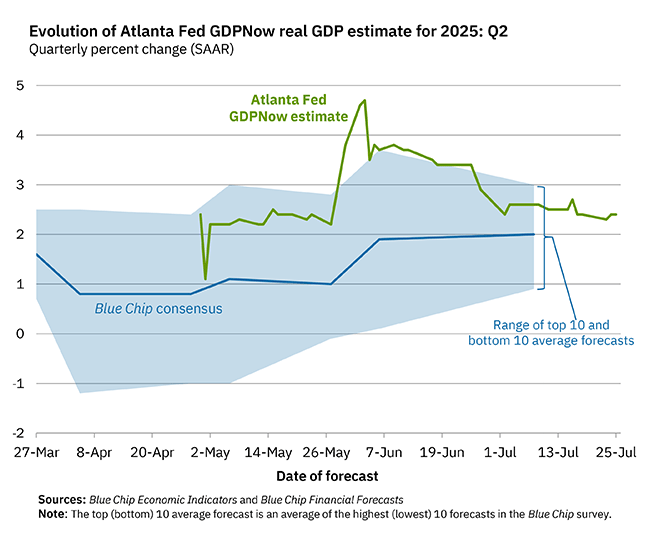
The growth rate of real gross domestic product (GDP) is a key indicator of economic activity, but the official estimate is released with a delay. The Federal Reserve Bank of Atlanta’s GDPNow forecasting model provides a “nowcast” of the official estimate prior to its release by estimating GDP growth using a methodology similar to the one used by the U.S. Bureau of Economic Analysis.

GDPNow is not an official forecast of the Atlanta Fed. Rather, it is best viewed as a running estimate of real GDP growth based on available economic data for the current measured quarter. There are no subjective adjustments made to GDPNow—the estimate is based solely on the mathematical results of the model.

Recent forecasts for the GDPNow model are available here [archived PDF]. More extensive numerical details—including underlying source data, forecasts, and model parameters—are available as a separate spreadsheet [archived XLSX]. You can also view an archive of recent commentaries from GDPNow estimates.

Please note that the Atlanta Fed no longer supports the GDPNow app. Download the EconomyNow app to get the latest GDP nowcast and more economic data.

Latest estimate: 2.4 percent — July 25, 2025

The GDPNow model estimate for real GDP growth (seasonally adjusted annual rate) in the second quarter of 2025 is 2.4 percent on July 25, unchanged from July 18 after rounding. The forecasts of the major GDP subcomponents were all unchanged or little changed from their July 18 values after this week’s releases from the U.S. Census Bureau and the National Association of Realtors.

The growth rate of real gross domestic product (GDP) measured by the U.S. Bureau of Economic Analysis (BEA) is a key metric of the pace of economic activity. It is one of the four variables included in the economic projections of Federal Reserve Board members and Bank presidents for every other Federal Open Market Committee (FOMC) meeting. As with many economic statistics, GDP estimates are released with a lag whose timing can be important for policymakers. In preparation for FOMC meetings, policymakers have the Fed Board staff projection of this “advance” estimate at their disposal. These projections—available through 2008 at the Philadelphia Fed’s Real Time Data Center—have generally been more accurate than forecasts from simple statistical models. As stated by economists Jon Faust and Jonathan H. Wright in a 2009 paper, “by mirroring key elements of the data construction machinery of the Bureau of Economic Analysis, the Fed staff forms a relatively precise estimate of what BEA will announce for the previous quarter’s GDP even before it is announced.”

The Atlanta Fed GDPNow model also mimics the methods used by the BEA to estimate real GDP growth. The GDPNow forecast is constructed by aggregating statistical model forecasts of 13 subcomponents that comprise GDP. Other private forecasters use similar approaches to “nowcastGDP growth. However, these forecasts are not updated more than once a month or quarter, are not publicly available, or do not have forecasts of the subcomponents of GDP that add “color” to the top-line number. The Atlanta Fed GDPNow model fills these three voids.

The BEA’s advance estimates of the subcomponents of GDP use publicly released data from the U.S. Census Bureau, U.S. Bureau of Labor Statistics, and other sources. Much of this data is displayed in the BEA’s Key Source Data and Assumptions table that accompanies the “advance” GDP estimate. GDPNow relates these source data to their corresponding GDP subcomponents using a “bridge equation” approach similar to the one described in a Minneapolis Fed [archived PDF] study by Preston J. Miller and Daniel M. Chin. Whenever the monthly source data is not available, the missing values are forecasted using econometric techniques similar to those described in papers by James H. Stock and Mark W. Watson and Domenico Giannone, Lucrezia Reichlin, and David Small. A detailed description of the data sources and methods used in the GDPNow model is provided in an accompanying Atlanta Fed working paper [archived PDF].

As more monthly source data becomes available, the GDPNow forecast for a particular quarter evolves and generally becomes more accurate. That said, the forecasting error can still be substantial just prior to the “advance” GDP estimate release. It is important to emphasize that the Atlanta Fed GDPNow forecast is a model projection not subject to judgmental adjustments. It is not an official forecast of the Federal Reserve Bank of Atlanta, its president, the Federal Reserve System, or the FOMC.

World-Watching: Statement on the Commission’s Status Report in the Climate-Related Disclosure Rules Litigation

[from the U.S. Securities and Exchange Commission]

by Commissioner Caroline A. Crenshaw, July 23, 2025

On April 24, 2025—three months ago—the U.S. Court of Appeals for the Eighth Circuit directed the Commission to provide a status update in the ongoing litigation concerning the Climate-Related Disclosure Rules, which the Commission adopted in March of 2024.[1]

The Court “directed” the Commission to advise whether it “intends to review or reconsider the [R]ules at issue in this case.”[2] And, if the Commission has determined to take no action, the Court ordered the Commission to explain whether it “will adhere to the [R]ules if the petitions for review are denied and, if not, why it will not review or reconsider the [R]ules at this time.”[3]

The Court’s directive was straightforward; our answer is not.

The Commission’s Status Report, filed today, states plainly enough that it has no intention of revisiting the Rules at this time.[4] That, however, is where our responsiveness ends.[5] The Status Report goes on to argue that we cannot expound on what the Commission’s future plans might be in the event the rule-making petitions are denied, because we would be “prejudging” those policy decisions.[6] And, the Status Report explains, any future rule-making should benefit from a court ruling on our statutory authority.[7]

We also weigh in on a number of questions that the Court did not ask of us—for example, we opine that there are “no obstacle[s]” to reaching the merits of the case and that a “live controversy” remains.[8]

This purported response is wholly unresponsive.

The Court asked us in no uncertain terms “will [the Commission] adhere to the [R]ules if the petitions for review are denied[?]” We did not—but should have—answered that question. The unspoken truth under this Commission is that the answer is “no.” Three of the four current Commissioners have been vocal critics of the Rules.[9] They have also withdrawn the Commission from the defense of the Rules in litigation.[10] The Commission simply does not want to say what we all know to be true by now—it has no intention of allowing the Climate-Related Disclosure Rules to go into effect.

Once we acknowledge this answer, the rest of the Commission’s arguments fall away. There are no prejudgment issues, because there is nothing to prejudge. And, we do not need the Court to rule on our statutory authority for the Commission to engage in rule-making. If there is future rule-making in this space—whether to rescind the Rules or otherwise—that rule-making may present different legal issues. Whatever those issues may be, and whomever those aggrieved parties may be, they are not now before the Court. Federal courts are not in the business of giving advisory opinions to agencies.

What is crystal clear, however, is that this Commission is seeking to avoid its legal obligations under the guise of conserving “Commission time and resources.” No matter what, this comes at the expense of judicial resources. As I wrote previously in connection with the Commission’s decision to stop defending these Rules,[11] the Administrative Procedure Act governs the process by which we make and repeal rules. It includes a prescriptive framework for promulgation and rescission. If this Commission wants to rescind, repeal or modify the Rules, which were promulgated by-the-book, then it must do the statutorily-required work. It cannot take the easy way out. It must engage in notice-and-comment rule-making, with the benefit of economic analysis and a public, transparent process, even if inconvenient or if the Commission has other, more pressing priorities.[12] Indeed, other Commissioners have acknowledged that doing the work required to rescind the rule would be a difficult lift.[13] So, instead, we once again ask the Court to do the work for us. By asking the Court to carry water that we should shoulder ourselves, we do a grave disservice to our already taxed judicial system. This is not good governance.

The Commission has effectively ignored the Court’s order and thrown the ball back at the Court. The Court should decline to play these games.


[1] See State of Iowa v. Securities and Exchange Commission, 24-cv-1522 (8th Cir. Apr. 24, 2025) (“Status Update Order”); see also Enhancement and Standardization of Climate-Related Disclosures for Investors [archived PDF], Rel. No. 33-11275 (Mar. 6, 2024), 89 Fed. Reg. 21668 (Mar. 28, 2024) (“Climate-Related Disclosure Rules” or the “Rules”).

[2] Status Update Order.

[3] Id.

[4] Status Report of the Securities and Exchange Commission in Response to the Court’s April 24, 2025 Order, State of Iowa v. Securities and Exchange Commission, 24-cv-1522 (8th Cir. July 23, 2025)(“Status Report”) at 2 (“The Commission does not intend to review or reconsider the Rules at this time.”).

[5] These viewpoints do not reflect upon the efforts of the staff in our Office of the General Counsel.

[6] Status Report at 2.

[7] Id. at 2, 4, 5.

[8] Id. at 2, 3.

[9] See, e.g., Commissioner Hester M. Peirce, Green Regs and Spam: Statement on the Enhancement and Standardization of Climate-Related Disclosures for Investors (Mar. 6, 2025); Commissioner Mark T. Uyeda, A Climate Regulation under the Commission’s Seal: Dissenting Statement on the Enhancement and Standardization of Climate-Related Disclosures for Investors (Mar. 6, 2025); see generally Lesley Clark, “Trump SEC Pick Wants to Ditch Landmark Climate Disclosure Rule,” Politico (Dec. 9, 2024).

[10] See Status Report filed by SEC, State of Iowa v. Securities and Exchange Commission, 24-cv-1522 (8th Cir. Mar. 27, 2025); SEC Press Release No. 2025-58, SEC Votes to End Defense of Climate Disclosure Rules (Mar. 27, 2025) (According to then-Acting Chair Uyeda, “The goal of today’s Commission action and notification to the court is to cease the Commission’s involvement in the defense of the costly and unnecessarily intrusive climate change disclosure rules.”).

[11] Commissioner Caroline A. Crenshaw, Statement Regarding Climate-Related Disclosures Rule Litigation: The Commission has Left the Building (Mar. 27, 2025).

[12] Commissioner Mark T. Uyeda, Remarks at the “SEC Speaks” Conference 2025 (May 19, 2025) (“For the Commission to rescind the climate-related disclosure rule—and address the countless factual findings discussed in that 885-page release—would place a significant strain on the Commission’s resources. This effort would be a difficult lift, and it would potentially take away staff resources needed to advance the regulatory regime with respect to crypto and capital formation.”).

[13] Id.

Economics-Watching: Kuwait: GDP Returns to Growth in Q1 2025 as Impact of Oil Output Cuts Fades

[from NBK Economic Research, 21 July, 2025]

by Mohammad Al-Shehri, Assistant Economist & Omar Al-Nakib, Head of MENA Research

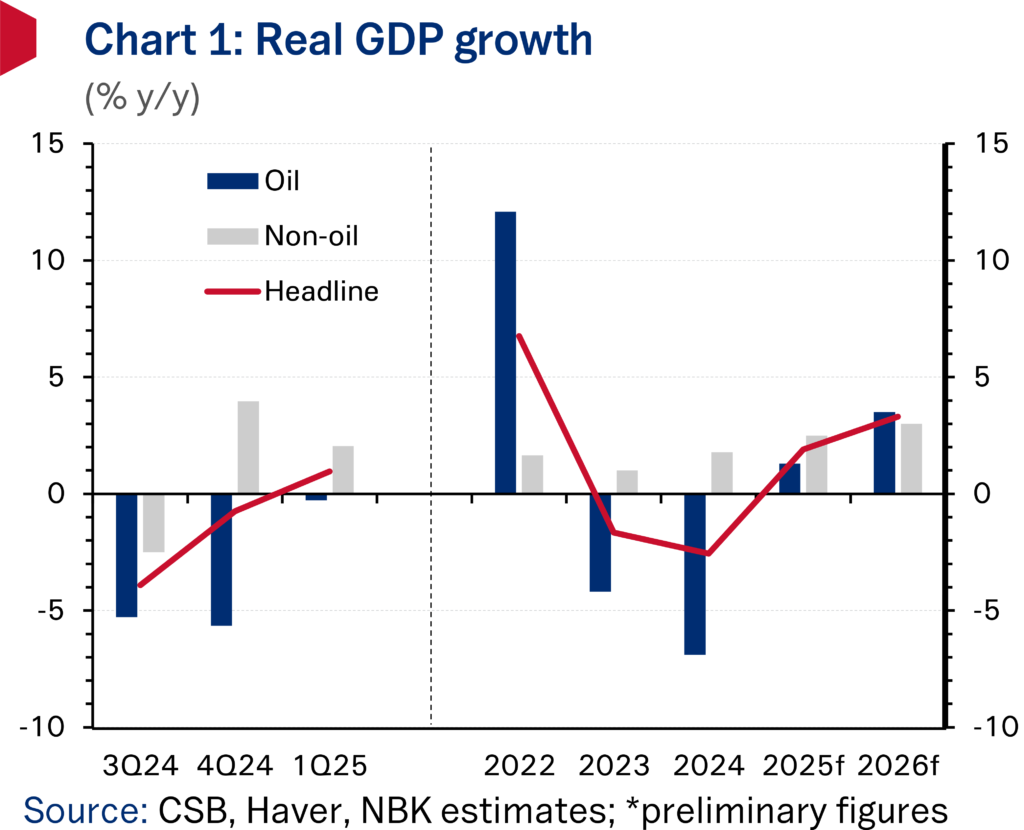
Preliminary official figures show GDP expanding 1% y/y in Q1 2025 following seven consecutive quarters of contraction, helped by a less severe downturn in oil output. With the negative effects of earlier voluntary oil production cuts beginning to fade, oil GDP recorded only a marginal decline, the softest since Q2 2023. Growth in non-oil activity remained positive though eased, weighed by a moderation in the manufacturing, real estate, and transport sectors. The near-term outlook for GDP is one of positive growth, lifted by rising oil production after Kuwait started to restore 135 kb/d of oil output cuts between April and September 2025, while the non-oil sector should also register further steady gains.

Non-oil GDP growth softens in Q1 2025 after strong performance in Q4 2024

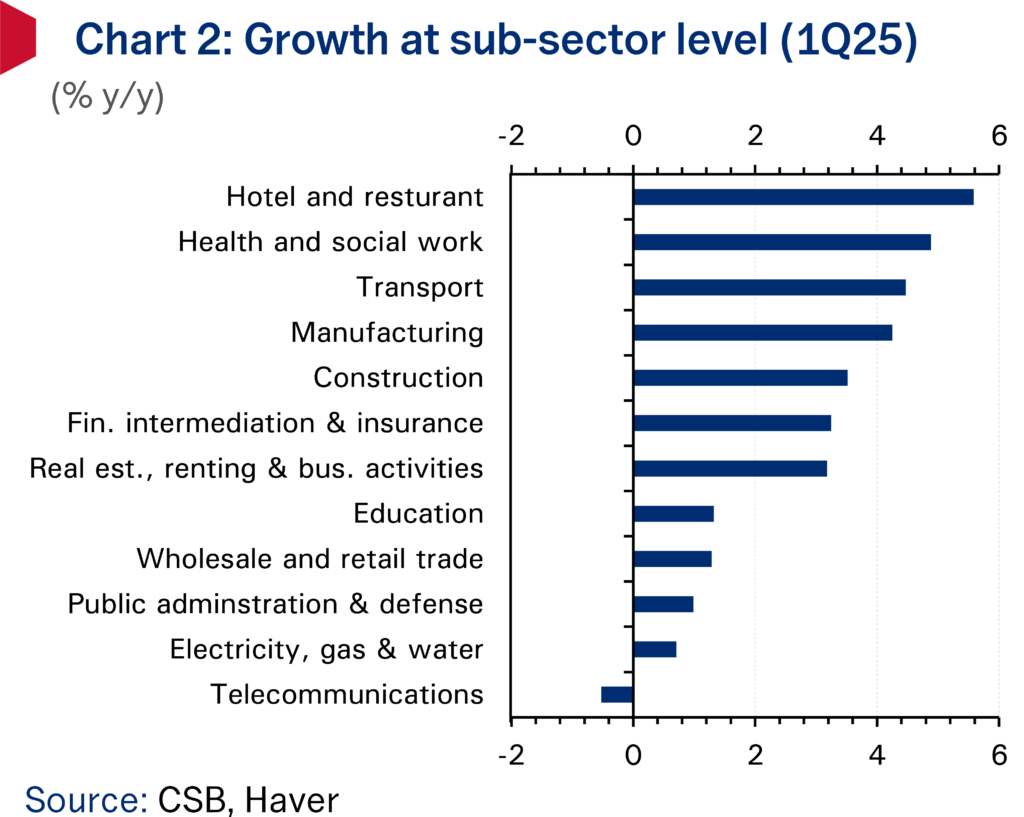
Growth in the non-oil sector weakened in Q1 2025, slowing to 2% y/y compared to 4% recorded in the prior quarter. (Chart 1.) The softer expansion in non-oil activity reflected, among other things, a moderation in the manufacturing sector, where activity grew at a still-solid 4.3% despite a decline in refined petroleum products output but slowed notably from the 12.2% reading registered in Q4 2024. Growth in other sectors including real estate, wholesale & retail trade, transport, and education also slowed. Offsetting the slowdown was stronger expansion in the non-oil economy’s largest segments: public administration and defense as well as financial intermediation and insurance, which grew 1% and 3.2% y/y, respectively. (Chart 2.)

Chart 1: Real GDP growth

Chart 2: Growth at sub-sector level (1Q25)

Oil sector logs marginal contraction, set to return to growth in Q2

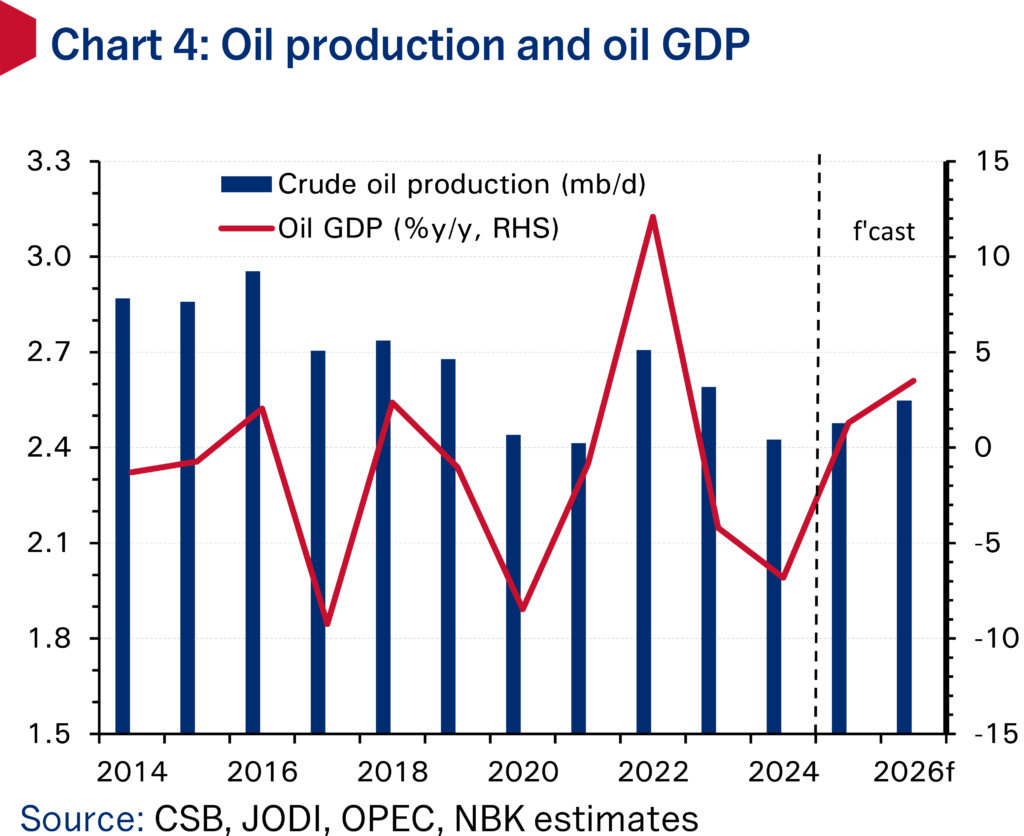
The contraction in oil GDP eased significantly to -0.3% y/y from -5.7% y/y in Q4 2024, registering the softest rate of decline since Kuwait embarked on cutting oil production in Q2 2023 after participating in the voluntary cuts scheme with 7 other OPEC+ members. (Chart 4.) Kuwait’s oil production averaged 2.415 mb/d in Q1 2025, a 0.7% decline from the same quarter last year, according to OPEC secondary sources. However, oil sector fortunes are set to shift in Q2 2025 and thereafter, after the OPEC-8 member alliance started unwinding the 2.2 mb/d voluntary cut tranche in April 2025. Originally planned to be unwound over the course of 18 months, OPEC+ has accelerated the pace of supply hikes with output now on a path to be fully restored in September, a full year ahead of schedule. For Kuwait, crude production rose by 0.5% q/q in Q2 to 2.426 mb/d and is set to accelerate further to average 2.533 mb/d in H2 2025. With the oil market so far able to absorb the additional OPEC and global supply and oil prices currently holding near $70/bbl, an upside risk to our oil sector outlook involves the potential unwinding of the outstanding OPEC-8 voluntary cuts (1.66 mb/d), of which Kuwait’s share is 128 kb/d.

Growth heading back into positive territory in 2025

Growth in total GDP is set to remain on a positive trajectory in the near term, buoyed by further steady expansion in non-oil economic activity and increased oil production. Non-oil GDP is set to benefit from the government’s reform drive which includes the recent passing of the debt law that could catalyze the implementation of key development projects and the potential approval of the ‘mortgagelaw later in 2025, which could spur higher household borrowing and consumer spending. Economic indicators for Q2 2025 pointed to a healthy pace of non-oil economic activity. The key ‘output’ and ‘new orders’ balances in the non-oil private sector PMI gauge both averaged a very robust 57+ in Q2 2025, real estate activity continued to expand at a robust pace with earlier price falls in the residential sector abating, while credit growth stood at a healthy 5.5% y/y in May, and could benefit in coming months if interest rates are reduced further.

Nonetheless, there are also downside risks to the outlook. Local consumer spending growth (according to central bank card transactions data) turned negative in Q1 2025, extending the weakening trend now observed for more than a year. The government’s ongoing fiscal consolidation push will also weigh on wage and job growth. Overall, we see GDP growing 1.9% this year, boosted by expansions in both the oil and non-oil sectors of 1.2% and 2.5%, respectively.

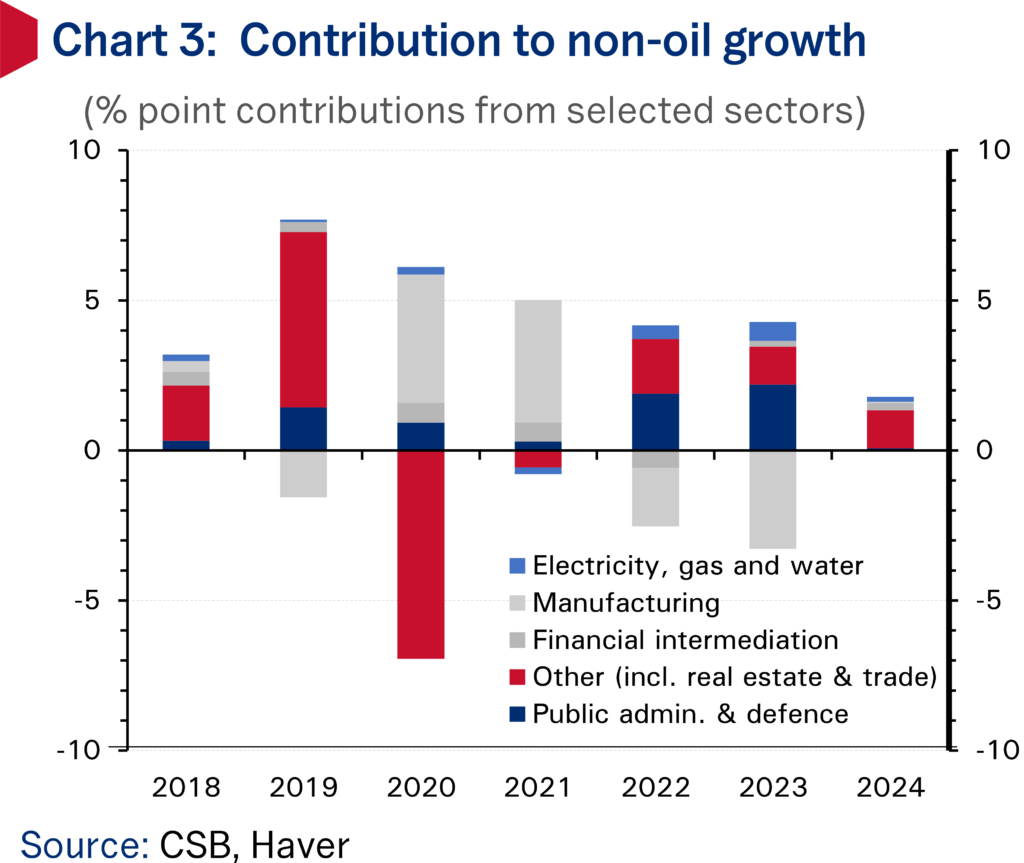
Chart 3: Contribution to non-oil growth

Chart 4: Oil production and oil GDP

Read this article as an archived PDF.

Heidegger vs. Marx as World Watchers

Marx (1818-1883) implies that the foundation of human reality is econo-technical, and on that basis society creates thoughts and philosophies, art and poems. This explanation seems appealing when we think of the economic development of China in our time, for example, or the rise of computers and software.

In a way, Heidegger (1889-1976) turns this upside down. At the basis of world history is society producing culture. You can make a simple “cartoon” and say that for Marx, economics shapes everything, and for Heidegger culture replaces economics.

For example, in his book, What Is Called Thinking? (English translation, 1968, Harper & Row), Heidegger argues the foundation of all Western thinking and culture comes from axioms such as logos [Ancient Greekλόγος] (from which we have logic, cosmology, psychology, epistemology, etc.), as well as legein (the Greek verb λέγειν, “to speak”).

Heidegger states (on page 204), “Without the λέγειν of that logic, modern man would have to make do without his automobile. There would be no airplanes, no turbines, no Atomic Energy Commission.”

Our MI comment on this is that any monocausal explanation of how mankind went from Neanderthal to the Manhattan skyline is completely inadequate. You must create a “double-helix” of Marx and Heidegger, adding the dimensions of surprise and unintended consequences. Without the physics concepts of emergence and complexity, we have no possibility of understanding how we got to now. In the site tagline, we use the word “composite” as a reference to this kind of deeper understanding.

Economics-Watching: Remittances in Times of Uncertainty: Understanding the Dynamics and Implications

[from the International Monetary Fund, by Patrick A. Imam, Kangni R Kpodar, Djoulassi K. Oloufade, Vigninou Gammadigbe]

This paper delves into the intricate relationship between uncertainty and remittance flows. The prevailing focus has been on tangible risk factors like exchange rate volatility and economic downturn, overshadowing the potential impact of uncertainty on remittance dynamics. Leveraging a new dataset of quarterly remittances combined with uncertainty indicators across 77 developing countries from 1999 Q1 to 2019 Q4, the analysis highlights that uncertainty in remittance-sending countries negatively affects remittance flows. In contrast, uncertainty in remittance receiving-countries has a more complex, dual effect. In countries with high private investment ratios, rising domestic uncertainty leads to a decline in remittances. Conversely, in countries with low public spending on education and health, remittances increase in response to uncertainty, serving as a social safety net. The paper underscores the heterogeneous and non-linear effects of domestic uncertainty on remittance flows.

Read the paper [archived PDF].

“De-Globalization?”

The classic study of the “swirl of processes and events” that ended previous globalization episodes is the theme of Princeton Professor Harold James’ 2002 book, The End of Globalization: Lessons from the Great Depression.

Globalization” is here. Signified by an increasingly close economic interconnection that has led to profound political and social change worldwide, the process seems irreversible. In this book, however, Harold James provides a sobering historical perspective, exploring the circumstances in which the globally integrated world of an earlier era broke down under the pressure of unexpected events.

James examines one of the great historical nightmares of the twentieth century: the collapse of globalism in the Great Depression. Analyzing this collapse in terms of three main components of global economicscapital flows, trade and international migrationJames argues that it was not simply a consequence of the strains of World War I, but resulted from the interplay of resentments against all these elements of mobility, as well as from the policies and institutions designed to assuage the threats of globalism.

Could it happen again? There are significant parallels today: highly integrated systems are inherently vulnerable to collapse, and world financial markets are vulnerable and unstable.

While James does not foresee another Great Depression, his book provides a cautionary tale in which institutions meant to save the world from the consequences of globalization—think WTO and IMF, in our own time—ended by destroying both prosperity and peace.

Legitimate fears about “globalization reversal” have been well put by Zakaria:

Davos, Switzerland

President Trump’s speech here at the World Economic Forum went over relatively well. That’s partly because Davos is a conclave of business executives, and they like Trump’s pro-business message. But mostly, the president’s reception was a testament to the fact that he and what he represents are no longer unusual or exceptional. Look around the world and you will see: Trump and Trumpism have become normalized.

Davos was once the place where countries clamored to demonstrate their commitment to opening up their economies and societies. After all, these forces were producing global growth and lifting hundreds of millions out of poverty. Every year, a different nation would become the star of the forum, usually with a celebrated finance minister who was seen as the architect of a boom. The United States was the most energetic promoter of these twin ideas of economic openness and political freedom.

Today, Davos feels very different. Despite the fact that, throughout the world, growth remains solid and countries are moving ahead, the tenor of the times has changed. Where globalization was once the main topic, today it is the populist backlash to it. Where once there was a firm conviction about the way of the future, today there is uncertainty and unease.

This is not simply atmospherics and rhetoric. Ruchir Sharma of Morgan Stanley Investment Management points out that since 2008, we have entered a phase of “deglobalization.” Global trade, which rose almost uninterruptedly since the 1970s, has stagnated, while capital flows have fallen. Net migration flows from poor countries to rich ones have also dropped. In 2018, net migration to the United States hit its lowest point in a decade.

The shift in approach can best be seen in the case of India. In 2018, Prime Minister Narendra Modi came to Davos to decry the fact that “many countries are becoming inward focused and globalization is shrinking.” Since then, his government has increased tariffs on hundreds of items and taken steps to shield India’s farmers, shopkeepers, digital companies and many others from the dangers of international competition. The Office of the U.S. Trade Representative recently called out India for having the highest tariffs of any major economy in the world.

Indian officials used to aggressively court foreign investment, which was much needed to spur growth. Last week, with India’s economy slowing badly, Jeff Bezos announced a $1 billion investment in the country. (Bezos owns The Post.) But the minister of commerce and industry scoffed at the move, saying Amazon wasn’t “doing a great favor to India” and besides was probably engaging in anti-competitive, “predatory” practices. Often, protectionist policies help favored local producers. Malaysian Prime Minister Mahathir Mohamad recently criticized some of Modi’s policies toward Muslims. The Indian government effectively cut off imports of Malaysian palm oil. In a familiar pattern, one of the chief beneficiaries was a local billionaire long associated with Modi.

The Economist notes that Europe, once one of the chief motors for openness in economics and politics, is also rediscovering state intervention to prop up domestic industries. And if you think the Internet is exempt from these tendencies, think again. The European Center for International Political Economy tracks the number of protectionist measures put in place to “localize” the digital economy in 64 countries. It has been surging for years, especially since 2008.

It’s important not to exaggerate the backlash to globalization.

As a 2019 report by DHL demonstrates, globalization is still strong and, by some measures, continues to expand. People still want to trade, travel and transact across the world. But in government policy, where economic logic once trumped politics, today it is often the reverse. Economist Nouriel Roubini argues that the cumulative result of all these measures — protecting local industries, subsidizing national champions, restricting immigration — is to sap growth. “It means slower growth, fewer jobs, less efficient economies,” he told me recently. We’ve seen it happen many times in the past, not least in India, which suffered decades of stagnation as a result of protectionist policies, and we will see the impact in years to come.

Nevertheless, today, nationalism and protectionism prevail.

This phase of deglobalization is being steered from the top. The world’s leading nations are, as always, the agenda-setters. The example of China, which has shielded some of its markets and still grown rapidly, has made a deep impression on much of the world. Probably deeper still is the example of the planet’s greatest champion of liberty and openness, the United States, which now has a president who calls for managed trade, more limited immigration and protectionist measures. At Davos, Trump invited every nation to follow his example. More and more are complying.

The world is de-globalizing. Trump set the example.The Washington Post, Fareed Zakaria

Students should sense that while history does not repeat itself, it sometimes rhymes and this is a major danger. It also might imply that coping with climate change will be all the harder because American-led unilateralism everywhere would mean world policy paralysis.