Chance and Necessity

If you free-associate the word “chance,” you may arrive at “I’ll take my chances” before potentially arriving at Thomas Bayes’ “Doctrine of Chances”. Jacques Monod was an early explorer of the collision of probability and chance in biology.

THE PRINCE OF CHANCE

Jacques Monod grew up just down the coast from Monte Carlo in Cannes, France, another town famous for its casinos and, later, its film festival. Graced with movie star looks—one prominent French journalist described him as a “prince” who resembled Hollywood icon Henry Fonda, as well as considerable musical talent, and an exceptional intellect, Monod struggled to decide on a career path through his twenties. After distinguishing himself in the French Resistance, Monod rose to fame not as an actor or musician, but as a brilliant biologist. He shared the 1965 Nobel Prize in Physiology or Medicine for seminal discoveries about how genes work.

A pioneer in the field of molecular biology, Monod was privy to the blizzard of discoveries in the 1950s and early 1960s about the molecules that determined the characteristics of living things—what Monod and others dubbed “the secrets of life.” He kept close company with a relatively small international community of leading researchers. For example, when James Watson and Francis Crick cracked the structure of DNA (deoxyribonucleic acid) in 1953, Monod was one of the first with whom Watson shared the breakthrough.

But as a Frenchman steeped in his culture’s deep philosophical traditions, Monod was interested in science for more than just science’s sake. After the war, Monod befriended France’s leading philosopher-writer Albert Camus, and the two men pondered questions of human existence in Left Bank cafés. Monod felt that the public misunderstood the principal purpose of science as being the creation of technology. Rather, Monod believed technology was merely a by-product. He said, “the most important results of science have been to change the relationship of man to the universe, or the way he sees himself in the universe”—a relationship of equally intense interest to his friend Camus.

Monod thought that there were profound philosophical implications of the new molecular biology, particularly in the realm of heredity, which had gone largely unnoted in the broader culture. Several years after his Nobel Prize and Camus’ untimely death, he decided to write a book to try to bring the meaning of modern biology to laypersons.

“[T]he ‘secret of life’…has been laid bare,” he wrote.

“This, a considerable event, ought certainly to make itself strongly felt in contemporary thinking.”

Monod used several chapters to describe the insights that had very recently emerged from the study of DNA and the deciphering of the genetic code. He understood this knowledge would be unfamiliar to most readers, so he included an appendix with chemical structures of proteins and nucleic acids, and a primer on how the genetic code worked.

In a matter-of-fact style, he explained genetic mutations as accidental alterations—substitutions, additions, deletions, or rearrangements—in the text of DNA, in the sequence of the long strings of chemical bases (ACTTGATAA, etc.) that make up genes.

Then, almost without warning, he turned to the broader implications of how mutations arise in DNA. It is worth quoting him at length for after 111 pages of background, he delivered one of the most powerful ideas in five centuries of science (all italics are original):

“We call these events accidental; we say they are random occurrences. And since they constitute the only possible source of modifications in the genetic text, itself the sole repository of the organism’s hereditary structure, it necessarily follows that chance alone is at the source of every innovation, of all creation in the biosphere.

“Pure chance, absolutely free but blind, at the very root of the stupendous edifice of evolution: this central concept of modern biology is no longer one among other possible or even conceivable hypotheses. It is today the sole conceivable hypothesis, the only one that squares with observed and tested fact. And nothing warrants the supposition—or the hope—that on this score our position is likely ever to be revised.

“There is no scientific concept, in any of the sciences, more destructive of anthropocentrism than this one.”

In essence, heretofore obscure discoveries in biochemistry and genetics (largely studied at that time in simple bacteria) had upended two millennia of philosophy and religion that put humans at the center or apex of creation. “Man was the product of an incalculable number of fortuitous events,” Monod wrote. “The result of a huge Monte Carlo game, where our number eventually did come out, when it might not well have appeared.”

Le Hasard et la nécessité (Chance and Necessity) appeared in France in October 1970. It was a fairly technical book with several chapters on philosophy and genetics, and those appendices full of chemical diagrams. A first-time author, Monod did not know what reactions to expect.

The merde hit the fan.

The book received dozens of reviews across France and quickly became a bestseller—second only to the French translation of Erich Segal’s Love Story (this was France after all. After it was translated into English, reviews and interviews with Monod were featured in several of the most prominent British and American newspapers and magazines.

Many commentators immediately recognized the threat chance posed to traditional ideas of humanity’s origins and purpose. To Arthur Peacocke, a British biochemist turned prominent theologian, Monod had put forth “one of the strongest and most influential attacks of the century on theism.” A flurry of articles and books appeared with titles such as Anti-Chance: A Reply to Monod’s Chance and Necessity, Beyond Chance and Necessity, and God, Chance, and Necessity. Monod was invited to debate philosophers and theologians both in France and abroad, on television, radio, and in print.

American Calvinist theologian and pastor R.C. Sproul summed up the high stakes posed by chance in the first page of his book Not A Chance:

“It is not necessary for chance to rule in order to supplant God. Indeed, chance requires little authority at all if it is to depose God; all it needs to do the job is to exist. The mere existence of chance is enough to rip God from his cosmic throne. Chance does not need to rule; it does not need to be sovereign. If it exists as a mere impotent, humble servant, it leaves God not only out of date, but out of a job.” More than two hundred pages later, Sproul concluded:

“Chance as a real force is a myth. It has no basis in reality and no place in scientific inquiry. For science and philosophy to continue to advance in knowledge, chance must be demythologized once and for all.”

Sproul and other critics argued that what scientists perceived as chance merely reflected a lack of knowledge of true causes. Perhaps that was the expression of hope to which Monod alluded—the hope that as scientists learned more, our position on the role of chance would somehow be revised.

A SECOND CHANCE

The ensuing fifty years have not played out as either Monod or his detractors hoped. The Frenchman thought that the new insights from molecular biology should be a turning point for modern society-away from traditional beliefs about causes in the natural world toward one that embraced randomness and our chance existence.

Ha! Fat chance. The excitement and fuss stirred by Chance and Necessity simmered down, and Monod passed away a few years later. Surveys reveal that the majority of Americans, for example, continue to believe that everything on earth happens for His reasons.

But Monod’s critics should take no comfort. The province of chance in the biosphere and human life has been revised, although not at all in the scope or direction that they hoped.

The domain of chance has expanded into realms neither Monod nor anyone else imagined.

As we have learned much more about the history and workings of the planet, we have been startled to discover how the course of life has been buffeted by a variety of cosmological and geological accidents—without which we would not be here. As we have explored human history, we have seen how pandemics, droughts, and other civilization-changing episodes have been triggered by random, singular events in nature that easily might not have happened. And as we have probed human biology and the factors that impact our individual lives, we have caught chance red-handed, reigning over the often-thin line between life and death.

This book tells the stories that Monod could not—of astonishing discoveries from the planetary to the molecular scale, from great upheavals across the globe to the machinery of chance that operates within every cell of every creature, including ourselves. And while these discoveries vaporize the comforts of anthropocentrism, the story of chance, I hope you will come to agree, is much more than highfalutin philosophy or the refutation of theologians’ wishful thinking.

I hope that you are awed—awed by the power and the drama of asteroids slamming into the planet, of continents colliding, and of the rapid rising and falling of ice and oceans; awed by the realization that we live on (and are at the mercy of a planet that is far more unstable than our short lives perceive; awed by the knowledge of how random chance is at the source of all of the beautiful and wondrous creatures with whom we share the planet; awed by the unique invisible accidents that made each one of us; and awed by the fact that we humans, recent descendants of bands of hunter-gatherers who persevered through a period of exceptional chaos, have in just the last fifty years or so, figured all of this out!

My goal here is to be comprehensible without being comprehensive. It is almost trivial to claim that the world is the way it is or that we are here because of a long chain of chance, albeit fortunate, events. The explanatory power I seek comes from specificity. It is essential to unpack some of those events to appreciate how they shape the direction of life. The layout of the book follows a simple three-part logic. I’ll begin with inanimate, external chance events that have shaped the conditions for life (Part One, “Stuff Happens”), and then turn to the internal random mechanism within every creature that generates the adaptations to those conditions (Part Two, “A World of Mistakes”). Then, I bring the story to the personal level (Part Three, “23 and You”) and how chance impacts our natural lives, as well as our deaths. Our chance-driven existence shatters long-held beliefs about humanity’s place and raises challenging questions about the meaning and purpose of our lives. In the Afterword, I’ll offer some possible replies with the help of some special guests.

This is a relatively small book for a really big idea. Science has given us a handful of really big ideas over the centuries, but they have been received in funny ways. Darwin had a huge idea that was very simple to understand, and even though the evidence is massive and everywhere, many refuse to believe it. Einstein had a brand new idea, and even though few understand it or the evidence for it, most everyone seems to believe it. Monod had a great idea, but these days most people (other than scholars) have not heard of it, or of him.

My greatest hope, then, is that this short book might be chance’s second chance.

Sean B. Carroll, A Series of Fortunate Events: Chance and the Making of the Planet, Life, and You, Princeton University Press, 2020, pp. 6-12.

Modern biology as described by Monod pushes the linkage of probability, randomness and chance to the center. At the time, this was a very radical and profound way of looking at biology. If we combine Monod’s biology with theoretical physics like Lawrence Krauss’ A Universe from Nothing: Why There Is Something Rather than Nothing, we realize that accidentality is the bedrock on which our knowledge of the universe is built.
Economics-Watching: Tracking the Economy in Real‑Time Through Regional Business Surveys

[from the Federal Reserve Bank of New York’s The Teller Window, 23 September 2025]

by Richard Deitz and Kartik Athreya

Federal Reserve policymakers need current information about economic conditions to make well-informed monetary policy decisions. But hard data, such as GDP and the unemployment rate, is released with a significant lag, making it difficult to get a precise, real-time read on the economy, especially during times of rapid change.

To help fill the gap, the New York Fed conducts two monthly regional business surveys: the Empire State Manufacturing Survey of manufacturers in New York state and the Business Leaders Survey, which covers service sector firms in New York state, northern New Jersey, and Fairfield County, Conn. These surveys provide timely soft data, available well before hard data is released.

Hard data is based on precise quantitative measurements, such as sales figures or the specific prices firms are charging. By contrast, soft data is qualitative, focusing on trends, expectations, and sentiment around economic activity. And while hard data looks backward, soft data from the regional surveys can look forward—providing important information about expectations for the future and emerging trends.

Gathering soft data quickly can be impactful—for example, the Empire State Manufacturing and Business Leaders surveys signaled a sharp downturn in economic activity in early March 2020 [archived PDF], providing a warning weeks before official statistics captured the full extent of the COVID pandemic’s economic impact.  

How the Surveys Work

The New York Fed launched the Empire State Manufacturing Survey in 2001. It was modeled after the Philadelphia Fed’s Business Outlook Survey, a long-running manufacturing survey that has historically been watched by financial markets and policymakers as an early signal about national manufacturing conditions. The Business Leaders Survey was launched later in 2004 and was among the first regional business surveys to target the service sector.

The surveys are sent to over 300 business executives and managers at firms across industries during the first week of every month. While about two-thirds of participating firms have 100 or fewer employees, some have hundreds or thousands of workers.

Leaders at the firms fill out a short questionnaire asking if business activity has increased, decreased, or stayed the same compared to the prior month. The surveys ask about indicators such as prices–yielding insights into inflationary pressures–as well as employment, orders, and capital spending. Respondents answer questions about how they expect these indicators to change over the next six months, offering a forward-looking perspective on the economy’s trajectory.

From the responses, New York Fed researchers construct diffusion indexes by calculating the difference between the percentage of firms reporting increased activity and those reporting decreased activity. Positive values indicate that more firms say activity increased than decreased, suggesting activity expanded over the month. Higher positive values indicate stronger growth, while lower negative values indicate stronger declines.

The surveys include local businesses, like restaurants and car dealerships, as well as firms with national and global reach, such as software manufacturers and shipping enterprises. As a result, the economic indicators derived from the surveys are often early predictors of national economic patterns, frequently aligning with hard data released later.

Getting Answers on Current Issues

The surveys regularly ask supplemental questions about current economic issues to get real-time answers. Over the last few years, the surveys have asked about firms’ experience with tariffs, inflation expectations, if the use of AI is leading to a reduction in employment, how often employees work from home [archived PDF], and whether supply availability was affecting their businesses.

Going Beyond the Indicators

In addition to providing data to track economic conditions, the regional surveys also provide a channel to hear directly from local business leaders. Every month, survey respondents are asked for their comments, offering the opportunity for businesses to share their thoughts, concerns, and experiences with the New York Fed. This helps researchers and policymakers understand how businesses are being affected by economic conditions.

The surveys act as one of the bridges between the New York Fed and the business community, ensuring the voices of regional businesses are considered in economic assessments and policy discussions as well as enhancing the ability of policymakers to make informed decisions to respond effectively to economic challenges.

Executives, owners, or managers of businesses in New York, northern New Jersey, or Fairfield County, Conn., interested in participating in the New York Fed’s monthly business surveys can find more information here. The next survey results will be released on Oct. 15 and 16.

Economics-Watching: Tracking Business Sentiment in the Western United States

[from the Federal Reserve Bank of San Francisco, Economic Letters, 11 August, 2025]

by Hamza Abdelrahman, Luiz Edgard Oliveira and Aditi Poduri

Information the San Francisco Fed collects from businesses and community sources for the Beige Book provides timely insights into economic activity at both the national and regional levels. Two new indexes based on Beige Book questionnaire responses track business sentiment across the western United States. The indexes track data on economic activity and inflation, serving as early indicators of official data releases and helping improve near-term forecasting accuracy. The latest index readings suggest weakening economic growth and intensifying inflationary pressures over the coming months.


The San Francisco Fed serves the 12th District—the largest in the Federal Reserve System, representing nine western states, two territories, and a commonwealth. To better understand and analyze the regional economy, we collect information from a variety of business and community sources to create the San Francisco Fed’s report for the Beige Book. This is compiled with reports from other Districts and published by the Federal Reserve Board of Governors eight times a year. 

Views about the economy from businesses and communities play an important role in shaping economic outcomes. For example, expectations for future inflation can help spur or slow current consumer spending and business investment. Furthermore, economic forecasters rely on models that incorporate both more traditional “hard” quantitative data and “soft” qualitative information on sentiment. Adding these soft measures has been shown to improve the accuracy of economic forecasts (see Shapiro, Moritz, and Wilson 2022 and their cited literature). Among the many sentiment measures available, two popular approaches rely on survey data, as in the University of Michigan’s Surveys of Consumers, or on textual analysis, as in the SF Fed’s Daily News Sentiment Index.

This Economic Letter examines the economic information collected through the SF Fed’s Beige Book questionnaire over the past 10-plus years. We analyze this information by constructing sentiment indexes from the qualitative data and comparing them with quantitative measures of national and regional economic activity and inflation. We introduce two indexes—the SF Fed Business Sentiment Index and the SF Fed Inflation Gauge Index—which track our contacts’ views and expectations for economic growth and inflation, respectively. We find that these new indexes serve as reliable early indicators of official data releases and help improve near-term forecast accuracy. The SF Fed Business Sentiment Index has generally exhibited patterns similar to other recent business and household sentiment indexes, and the SF Fed Inflation Gauge Index has shown a strong uptick in expected inflation. To regularly monitor changes in these two indexes, the San Francisco Fed has launched a new Twelfth District Business Sentiment data page.

Constructing regional sentiment indexes

The San Francisco Fed sends out a Beige Book questionnaire to business and community contacts across the District eight times a year to gather regional information. In addition to answering questions regarding their organizations, respondents share their views on regional and national topics, including economic activity and inflationary pressures.

In two questions, respondents indicate whether they see national output growth and inflation rates increasing, decreasing, or staying stable over the coming year using a standard five-tiered scale. We use these responses since 2014 to formulate two business sentiment indexes, one on economic activity and another on inflation. We assign standard weights to the five-tiered qualitative scale that are symmetrical around zero. For example, we ask if activity is expected to “decrease significantly” = –2, “decrease” = –1, “remain unchanged” = 0, “increase” = 1, or “increase significantly” = 2. We add up the weighted shares of responses for each tier within each index. We then normalize each resulting series by its own average and standard deviation for ease of comparison with traditional economic indicators.

Tracking business sentiment

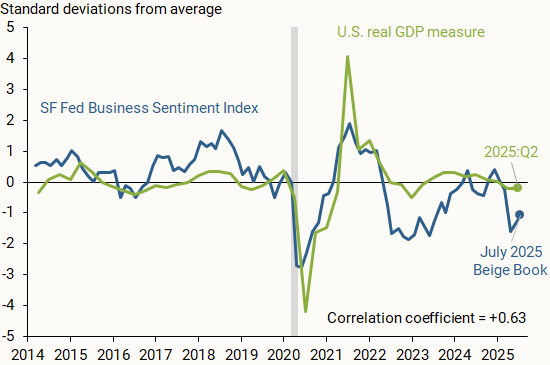
Figure 1 shows how the SF Fed Business Sentiment Index (blue line), compiled from responses to the question on national economic activity, compares with data on changes in national GDP (green line). We measure national output as the four-quarter change in inflation-adjusted, or real, GDP, normalized by its average and standard deviation so that it is centered around zero and, hence, more directly comparable to the SF Fed Business Sentiment Index. The vertical axis shows how many standard deviations away each observation is from its respective measure’s average from 2014 to mid-2025.

Figure 1
Economic growth versus business sentiment

Notes: Indicators normalized by their respective averages and standard deviations based on data from 2014 to present. Gray bar indicates NBER recession dates. Correlation coefficient is calculated between quarterly versions of both indicators.
Source: Bureau of Economic Analysis, FRBSF Beige Book questionnaire responses, and authors’ calculations.

The SF Fed Business Sentiment Index generally tracks the movements in national GDP over the past decade; a correlation coefficient of +0.63 on a scale of –1 to 1 indicates a moderately strong positive relationship between the two measures. A relatively recent exception started in 2022, when our index began showing a considerable decline relative to the national GDP measure. Respondents across the District were downbeat about economic growth and reported expectations of a sharp decline in consumer spending and overall household financial health following the depletion of pandemic-era savings (Abdelrahman and Oliveira 2023). A similar decline appeared in other measures of business and household sentiment. Nevertheless, overall economic growth continued at a solid pace. This decoupling between sentiment and hard data that began in 2022 was dubbed a “vibecession” (Daly 2024, Scanlon 2022).

Another possible reason for the divergence between national real GDP and our Business Sentiment Index is the influence of the regional economy. Although respondents are asked about their views of national GDP, their responses may be affected by regional outcomes. Thus, our index may also reflect a regional perspective from our business and community contacts.

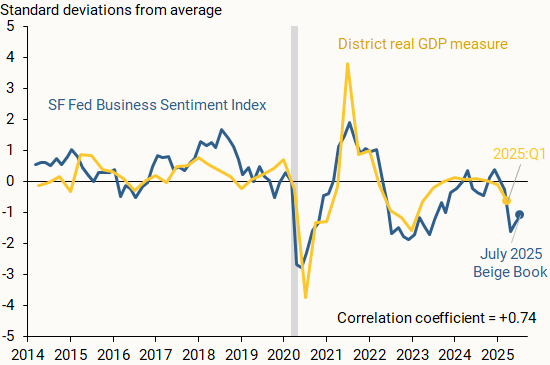
Figure 2 supports this rationale, showing the SF Fed Business Sentiment Index alongside a measure of regional output growth (gold line). We find that the measures closely track one another, including for 2022 and 2023, with a correlation coefficient of +0.74. We define District real GDP growth as the year-over-year percent change in the total output of the District’s nine states as reported by the Bureau of Economic Analysis (BEA). We normalize the series as described before.

Figure 2
Regional economic growth and business sentiment

Notes: Indicators normalized by their respective averages and standard deviations based on data from 2014 to present. Gray bar indicates NBER recession dates. Correlation coefficient is calculated between quarterly versions of both indicators.
Source: Bureau of Economic Analysis, FRBSF Beige Book questionnaire responses, and authors’ calculations.

Our findings indicate that the SF Fed Business Sentiment Index can serve as an accurate early indicator for national and regional output growth. Since the regional Beige Book questionnaire is collected twice each quarter, it provides particularly timely insights into economic activity during the current quarter. By contrast, the first GDP data release for any given quarter usually arrives a full month after that quarter has ended, and initial data releases for state-level output growth arrive with even more delay.

Over the first half of this year, the SF Fed Business Sentiment Index turned negative, with contacts citing elevated uncertainty about trade policy and downbeat expectations for the labor market. This notable decline is also seen in other measures of household and business sentiment, including national measures, such as the University of Michigan’s Surveys of Consumers, and regional measures, such as the Cleveland Fed’s Survey of Regional Conditions and Expectations and the Dallas Fed’s Texas Business Outlook Surveys.

Gauging business views on inflationary pressures

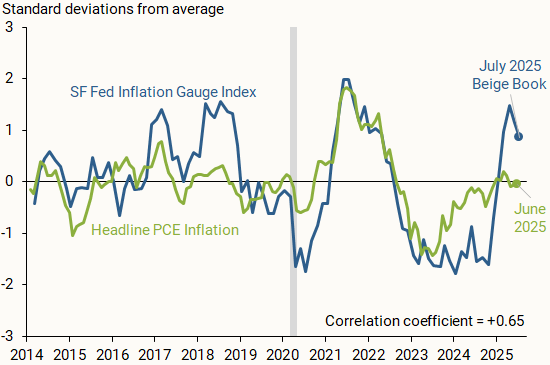
Our Beige Book questionnaire responses also provide insights into how business and community contacts in the District see national inflation evolving. Figure 3 compares the SF Fed Inflation Gauge Index (blue line) with monthly changes in the year-over-year headline personal consumption expenditures (PCE) inflation rate published by the BEA (green line). We normalize the inflation series and index as discussed earlier.

Figure 3
SF Fed Inflation Gauge Index versus realized inflation

Notes: Green line is the percentage point change in year-over-year headline PCE inflation shown as a 6-month moving average. Indicators normalized by their respective averages and standard deviations based on data from 2014 to present. Gray bar indicates NBER recession dates. Correlation coefficient is calculated between quarterly versions of both indicators.
Source: Bureau of Economic Analysis, FRBSF Beige Book questionnaire responses, and authors’ calculations.

Similar to our business sentiment index, the inflation gauge index is an early indicator for official inflation data releases. The index generally tracks changes in headline PCE inflation over the past decade, with a correlation coefficient of +0.65.

The most recent index results suggest a strong uptick in expected inflation among SF Fed business contacts, with several responses citing trade policy adjustments and inflation being persistently above the Federal Reserve’s 2% target. The recent peak resembles the one in 2018, which followed heightened trade tensions with China. The surge tracks other business and household-based measures of short-term inflation expectations, such as the Atlanta Fed’s Business Inflation Expectations and the New York Fed’s Survey of Consumer Expectations.

Making better projections

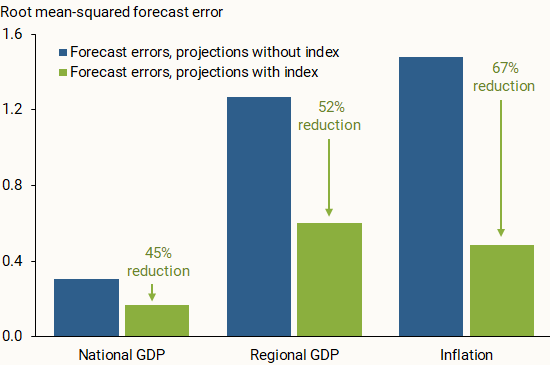
Beyond tracking data on national and regional economic conditions, we consider whether our two indexes can help improve one-year-ahead projections of output growth and overall inflation. We run linear regressions on a 2014–2022 data sample and estimate out-of-sample projections for the period starting in the first quarter of 2023. We run this analysis for the three economic measures—national GDP, regional GDP, and inflation—once with our index included on the right-hand side of the regression equation and once without the index. For this analysis, we use versions of the SF Fed Business Sentiment Index and the SF Fed Inflation Gauge Index that have been aggregated quarterly.

Figure 4 compares the out-of-sample projection accuracy of the two iterations. Across all economic measures, incorporating the SF Fed Business Sentiment Index or the SF Fed Inflation Gauge Index in the regression noticeably reduced the forecast errors for the out-of-sample period. This general result appears to hold when we project output growth and inflation one quarter ahead, in line with other studies that incorporate soft data from the Beige Book in short-term projections (Balke and Petersen 2002). The results are also consistent when using a local projections method from Jordà (2005) for one-year-ahead projections of output growth and shorter-term projections of inflation. This further supports the usefulness of our qualitative measures as early indicators of the future economic landscape over the short term.

Figure 4
Forecast errors with and without SF Fed sentiment indexes

Notes: Root mean-squared errors of out-of-sample projections from 2023:Q1 to 2025:Q2 including and excluding the SF Fed Business Sentiment Index (for GDP) and SF Fed Inflation Gauge Index (for inflation).
Source: Bureau of Economic Analysis, FRBSF Beige Book questionnaire responses, and authors’ calculations.

Conclusion

Information collected from businesses and communities through the San Francisco Fed’s regional Beige Book questionnaire can provide valuable insights into the national and regional economies. Sentiment indexes described in this Letter use responses from Twelfth District Beige Book contacts to generally track economic activity and inflation. Our two indexes serve as reliable early indicators of official data, which could help improve near-term forecast accuracy. The SF Fed Business Sentiment Index remained negative for much of 2022 and 2023, possibly reflecting more subdued growth within the District relative to the United States. Meanwhile, the SF Fed Inflation Gauge Index spiked in recent months following adjustments to trade policy.

References

Abdelrahman, Hamza, and Luiz E. Oliveira. 2023. “The Rise and Fall of Pandemic Excess Savings.” FRBSF Economic Letter 2023-11 (May 8).

Balke, Nathan S., and D’Ann Petersen. 2002. “How Well Does the Beige Book Reflect Economic Activity? Evaluating Qualitative Information Quantitatively.” Journal of Money, Credit and Banking 34 (1), pp. 114–136.

Daly, Mary C. 2024. “Fireside Chat with Mary C. Daly at the San Diego County Economic Roundtable.” January 19.

Jordà, Òscar. 2005. “Estimation and Inference of Impulse Responses by Local Projections.” American Economic Review 95(1), pp. 161–182.

Scanlon, Kyla. 2022. “The Vibecession: The Self-Fulfilling Prophecy.” Kyla Substack (June 30).

Shapiro, Adam Hale, Moritz Sudhof, and Daniel Wilson. 2022. “Measuring News Sentiment.” Journal of Econometrics 228(2), pp. 221–243.