World-Watching: PONARS Eurasia—In the News

[from George Washington University’s Institute for European, Russian and Eurasian Studies/PONARS Eurasia, 8 September 2025]

Robert Orttung, Debra Javeline, Graeme Robertson, Richard Arnold, Andrew Barnes, Edward Holland, Mikhail Troitskiy, Judyth Twigg, and Susanne Wengle argue that the renewed U.S.Russia alignment under Trump and Putin prioritizes fossil fuel development over climate action, and undermines international climate negotiations.

Read the full article [archived PDF].

In a statement to The Kyiv Independent, Peter Rutland echoes the contrast between the West’s diplomatic quarantine of Russia and the possibility of implementing policies without its permission, articulating how differing attitudes between Europe and Putin discourage any kind of escalation. In her recent article, Margarita Zavadskaya explores the “White Coat” narrative, explaining the origin and manipulation of Russian attitudes towards those who have left.

Read the Rutland article / read the Zavadskaya article [archived PDF].

In a recent interview, Volodymyr Dubovyk explains why he believes Putin “wins” the Alaska summit, sharing his perspective on the meeting’s implications and concluding that the dynamics of peace negotiations shift somewhat. Richard Arnold marks the Donbas’ significance, stating that Russian control of the “Fortress Belt” enables havoc on all areas to the west.

Read the Dubovyk interview / read the Arnold article.

Ryhor Nizknikau speaks with TVP World, interpreting the significance of Ukrainian Parliamentary Speaker Parubiy’s assassination. Tymofii Brik’s recent study, together with Oleksii Sereda, Anna Kokoba, and Alina Shmaliuk, appears in Vox Ukraine, covering the participants and reasoning behind the protest against the bill to limit SAPO and NABU’s independence.

Watch the Nizknikau interview / read the Vox Ukraine article.

In the context of Russia’s recent nuclear developments near the Pan’kovo testing range, Pavel Podvig comments that “Skyfall”, the new weapon’s NATO nickname, has likely undergone testing already. During an interview with DW News, Mikhail Alekseev addresses the goals pursued by the Sino-Russian partnership, which range from the tangible benefits of constructing gas infrastructure to the more ideological advantage of presenting an alternative to the U.S.-led world order.

Read the Podvig article / watch the Alekseev interview.

China to Sustain Top-Down, Debt-Fueled Investment in Major Projects and Security Capacities, Ex-Official Says

Dong Yu, now at Tsinghua, says via state media that Beijing-decreed, central govt bond-backed construction will continue into the next five years.

[from the Center for China & Globalization’s Pekingology]

by Zichen Wang, 10 August, 2025

The key concept in today’s newsletter is 国家重大战略实施和重点领域安全能力建设, in abbreviation in Chinese as 两重 liǎng zhòng.

In English, it is translated officially as the implementation of major national strategies and building up security capacity in key areas, hereinafter referred to as “Two Major Undertakings.”

The concept first appeared in official policy documents in the Chinese Premier’s Report on the Work of the Government [archived PDF] in March 2024.

To systematically address funding shortages facing some major projects for building a great country and advancing national rejuvenation, it is proposed that, starting this year and over each of the next several years, ultra-long special treasury bonds be issued. These bonds will be used to implement major national strategies and build up security capacity in key areas. One trillion yuan of such bonds will be issued in 2024.

By the end of the year, the yuan tag, despite being approved by the national legislature, had changed by 300 billion. The People’s Daily newspaper reported in December 2024.

As of now, the 700 billion yuan in ultra-long-term special treasury bonds allocated for the “two major undertakings” has been distributed in three batches to specific projects.

In 2025, the following year, the Report on the Work of the Government [archived PDF] says,

A total of 1.3 trillion yuan of ultra-long special treasury bonds will be issued, 300 billion yuan more than last year.

735 billion yuan will be earmarked in the central government budget for investment. We will put ultra-long special treasury bonds to good use, increase ultra-long-term loans and other types of financing support, and strengthen top-down organization and coordination to ensure greater support for the implementation of major national strategies and security capacity building in key areas.

A simultaneous Finance Ministry budget plan [archived PDF] rounds up the overall central government spending for the Two Major Undertakings to 800 billion yuan in 2025.

In yuan terms, the much-touted new government subsidies to households pale in comparison with the two major undertakings.

Also from the 2025 Report on the Work of the Government [archived PDF]:

Ultra-long special treasury bonds totaling 300 billion yuan will be issued to support consumer goods trade-in programs. This represents an increase of 150 billion yuan over the previous year.

This week, China announced this week that the phased free preschool education policy will cover all children in their final year of kindergartens, saving families 20 billion yuan. Childcare subsidies unveiled in July amount to 90 billion yuan

As Joe Biden repeated over the years,

Don’t tell me what you value. Show me your budget, and I’ll tell you what you value.

The National Development and Reform Commission said last month:

In 2025, a total of 800 billion yuan has been allocated for the “two major undertakings,” supporting 1,459 projects in key areas such as ecological restoration in the Yangtze River Basin, major transportation infrastructure along the Yangtze River, the New Western Land–Sea Corridor, high-standard farmland, major water conservancy projects, urban underground pipeline networks, the “Three-North” shelterbelt program, and the renovation of hospital wards.

Now that the 2025 money has been spent by July and China is drawing up its next Five-Year Plan for 2026-2030, will there be more such projects in the future?

In a column for the state-run China News Service this week, Dong Yu, previously Deputy Director-General of the Second Economic Bureau of the Office of the Central Financial and Economic Affairs Commission and, before that, an official at China’s National Development and Reform Commission (NDRC), pointedly said,

In the next step, during the formulation and implementation of the 15th Five-Year Plan, the “two major undertakings” will continue to occupy an important place, be organically incorporated into the new five-year plan, and form close alignment and sustained momentum with major national strategies, major plans, major projects, and key initiatives…

…Such a major strategy will be pursued with persistence—it will not remain rhetorical, nor will it be reversed abruptly.

He did not cite a source of information in his article.

Continuing with his lecturing style, Dong, now Executive Vice Director of China Institute for Development Planning, Tsinghua University, rebuked some unspecified market analysis that had observed the investments just were a one-time boost shot.

Some market institutions once analyzed that when China’s economy was facing short-term difficulties and challenges, the launch of the “two major undertakings” was mainly aimed at expanding investment in the short term to stabilize growth. Such a view clearly lacks a professional understanding of the decision-making intentions and logic, fails to properly grasp the relationship between the short term and the medium-to-long term, as well as between objectives and means, and inverts the proper order of priorities—a misconception that needs to be pointed out and corrected.

Dong also highlighted what he said was the unusual nature of the “strategic move,” including that central government debts fueled the investments, and they were selected “top-down,” rather than primarily relying on local government proposal or input.

The two undertakings were formally submitted for deliberation at the 2024 National People’s Congress after the central leadership made its decision and arrangements…

The central authorities have shown firm determination in this work, adopting the ultra-long-term special treasury bond—a macro policy tool that has rarely been used. Compared with several past issuances of special treasury bonds, the funding arrangement for the “two major undertakings” spans a longer cycle, has a broader scope of application, and will continue to advance in the next stage. It can be said that the scale and intensity are unprecedented. In 2024, a total of 700 billion yuan in ultra-long-term special treasury bonds was allocated, and in 2025, the figure is 800 billion yuan, all of which have now been fully disbursed.

The organization of the “two major undertakings” construction is top-down, completely different from the past practice in the investment sector where projects were determined through bottom-up applications. The purpose is to facilitate the smoother downward transmission of the needs of major national strategies. Relevant [central] government departments, by identifying shortcomings and weaknesses, specifying key areas, and refining project requirements, have ensured that the project list is no longer a collection of fragmented local items. Instead, projects are planned in an integrated manner by category and sector, with strengthened guidance for key regions, more targeted measures, and clearer standards.

Although an exhaustive list of the 1,459 projects does not appear to be available to the public, the “security capacity” build-up in the two major undertakings should be understood in broad terms, and Dong claims the investments put China on a sounder footing globally now that Donald Trump rules America again.

In recent years, the central authorities have emphasized security awareness and bottom-line thinking in development planning, a shift closely related to changes in the international situation. The closer China’s economy becomes intertwined with the global economy, the more comprehensive its considerations must be regarding issues such as food security, energy security, industrial security, and ecological security. The second “undertaking” in the “two major undertakings”—the strengthening of security capabilities in key areas—is precisely a forward-looking arrangement. The dramatic changes in the international environment since the beginning of 2025 have further underscored and confirmed the necessity of enhancing security capabilities, fully demonstrating that the central authorities’ thinking and deployment have been prescient and ahead of the curve.

Dong’s article via China News Service is fully translated below.

中央这一先手棋很不寻常

This Strategic First Move by the Central Authorities Is Highly Unusual

by Dong Yu, Executive Vice President, Institute for China Development Planning, Tsinghua University

The issuance of ultra-long-term special treasury bonds to support the implementation of major national strategies and the building of security capacities in key areas (hereinafter referred to as the “two major undertakings”) has become one of the hottest topics in China’s economy in recent years. Any observation of China’s present and future economic trajectory must include research and analysis of these two undertakings. More than a year has passed since the initiative was launched, making it both necessary and timely to evaluate its effectiveness, understand its operating mechanisms, and look ahead to its prospects.

The “Two Major Undertakings” Are by No Means Ordinary Policy Measures

In terms of decision-making background and process, as well as policy intensity and scope, the launch and implementation of the two major undertakings stand out from other policies. They represent a top-level design initiative.

Understanding a policy starts with its background. From the sequence of events leading to the proposal, this was a proactive, historic choice. The two undertakings were formally submitted for deliberation at the 2024 National People’s Congress after the central leadership made its decision and arrangements. The timing was significant: the 20th Communist Party of China National Congress had laid out a series of major long- and medium-term strategic initiatives that needed concrete engineering projects to push forward. China was midway through two Five-Year Plans, yet strategic advancement could not wait. The central leadership thus introduced the two major undertakings as a groundbreaking initiative.

Strategically, the undertakings directly address the needs of advancing long-term objectives. From the outset, they have been aimed squarely at the goals of Chinese modernization. By breaking down these goals into specific tasks and identifying the most difficult bottlenecks, the undertakings found their points of focus. Some of these tasks might take decades for other countries to achieve, but China has chosen not to delay—tackling them head-on at the starting stage of the new journey toward modernization. This model is uniquely Chinese and has been proven by history to be a key factor in China’s remarkable development successes.

The undertakings are also highly forward-looking—a “first move” by the central leadership. In recent years, national development planning has placed greater emphasis on security and on guarding the bottom line, in response to changes in the international environment. The closer China’s economy is linked to the global economy, the more comprehensive its considerations must be on food security, energy security, industrial security, and ecological security, and other issues. The second “major” in the initiative—security capacity building in key areas—is an arrangement made in anticipation of future challenges. The sharp changes in the international environment since 2025 have only highlighted and validated the necessity of strengthening security capacities, demonstrating that the central leadership’s thinking and arrangements were ahead of the curve.

The undertakings also have a strong overall and systemic quality, constituting a key move in macroeconomic governance. They focus on areas of outstanding importance to economic and social development and have a high degree of relevance to the overall development landscape. The policy toolkit they employ integrates investment, fiscal, science and technology, education, social, and ecological policies. This comprehensive package embodies the use of systems thinking to drive development and will significantly impact all aspects of the economy and society.

A Manifestation of Central Will

Extraordinary measures are for extraordinary tasks. The strategic objectives of Chinese modernization are long-term undertakings, and the two major undertakings provide the foundational support through systematic design and substantial funding.

The central leadership has committed to this initiative by adopting the rarely used macroeconomic tool of ultra-long-term special treasury bonds. Compared with previous special bond issuances, the funding for the two undertakings spans a longer cycle and serves a wider range of purposes, with plans for continued implementation. In both scale and intensity, this is unprecedented: 700 billion yuan in 2024 and 800 billion yuan in 2025, all of which has already been allocated.

In terms of priorities, it vividly reflects the principle of “concentrating resources to accomplish major undertakings.” The focus areas include urban–rural integration, regional coordination, high-quality population development, food security, energy and resource security, ecological security, and self-reliance and strength in science and technology—all crucial to building a strong nation and achieving national rejuvenation. These require coordinated planning and advancement. In just over a year, the high-level requirements have been translated into batches of concrete projects, reflecting the efficiency of implementation.

Project selection is guided by the principle that only the central government can resolve these issues. Some involve urgent development bottlenecks with significant obstacles that cannot be overcome by conventional means, such as scientific and technological breakthroughs, high-standard farmland construction, and upgrading the quality of higher education. Others are long-desired but previously unachievable projects that lack local willingness or capacity to implement, such as major cross-regional infrastructure, cross-basin wastewater treatment, and urban underground utility upgrades.

The organization of the “two major undertakings” construction is top-down, completely different from the past practice in the investment sector where projects were determined through bottom-up applications. The purpose is to facilitate the smoother downward transmission of the needs of major national strategies. Relevant [central] government departments, by identifying shortcomings and weaknesses, specifying key areas, and refining project requirements, have ensured that the project list is no longer a collection of fragmented local items. Instead, projects are planned in an integrated manner by category and sector, with strengthened guidance for key regions, more targeted measures, and clearer standards.

A Combination of “Hard” and “Soft” Measures

From the start, the undertakings were designed not only to fund “hard” engineering projects but also to include comprehensive arrangements for “soft” institutional and policy measures—an important innovation.

The emphasis on soft measures is pragmatic. Given the high importance and public nature of the projects, long-term mechanisms must be designed to ensure smooth progress during construction and sustainable operation thereafter. This includes drafting specialized plans to provide strategic guidance, introducing targeted policies to improve funding efficiency, and innovating institutional arrangements to safeguard implementation.

The implementation process is thus also a process of improving the investment and financing system, updating project management approaches, and enhancing investment effectiveness. In some sectors, soft-measure experiments have had positive impacts, creating healthy interaction with hard investments.

For example, the healthy operation of urban underground pipelines depends on sound maintenance mechanisms. Some local governments have attracted long-term institutional funds into major pipeline projects through debt or equity investment plans, stabilizing private sector returns via operational rights, government subsidies, and tax incentives. Others have introduced province-wide upstream–downstream gas price linkage, set reasonable water supply return rates based on market profits, and advanced the marketization of gas and water prices—reducing losses for public utilities and encouraging private investment.

Similarly, in the quality undergraduate expansion program, mechanisms play a guiding role: schools effectively implementing expansion plans receive increased support, while those performing poorly see reduced support; universities without expanded undergraduate admission plans are generally excluded from special bond funding. Disciplines and programs are adjusted dynamically to align talent training with economic and societal needs.

Directly Relevant to Everyone

The nature of the undertakings is not determined by project size but by their strategic objectives and significance. As long as they align with major national strategies, they are included—whether as large standalone projects, such as high-speed rail along the Yangtze River, or as “project packages,” such as Yangtze River wastewater treatment composed of multiple treatment facilities. This flexible, problem-oriented approach allows better alignment with public needs.

As projects break ground and enter operation, their benefits to people’s livelihoods will become increasingly evident. Observers should not see the undertakings as distant from daily life; they will bring tangible improvements to everyone’s quality of life.

For example:

  • Urban underground pipelines: Upgrades to gas, water, and heating systems will greatly improve safety and resilience. Renovation of old gas pipelines is nearing completion, reducing accident rates by over 30%. Eliminating hidden risks in unseen places increases residents’ sense of security.
  • Food security: Gradually converting all permanent basic farmland into high-standard farmland will stabilize grain output and enhance food safety. Higher standards mean safer products, so people will eat with greater confidence.
  • Yangtze River protection: Building or upgrading over 60,000 kilometers of sewage pipelines in the Yangtze Economic Belt will greatly improve the river’s ecological environment and resolve long-standing public concerns.
  • Transportation: Creating the shortest ShanghaiChengdu high-speed rail corridor (approx. 1,900 km) will connect the Yangtze River Delta, the middle Yangtze region, and the ChengduChongqing area more quickly, cutting travel time nearly in half and boosting east–west connectivity.
  • Ecological security: Implementing the “Three-North” shelterbelt project over 130 million mu (93 million hectares), with good survival rates for trees, shrubs, and grasses, will safeguard northern ecological security and create new income opportunities.
  • Higher education: “Double First-Class” universities will see markedly improved conditions, with over 500,000 new standard dorm beds. Quality undergraduate enrollment will rise by 16,000 in 2024 and over 20,000 in 2025, giving more students access to quality education and ensuring basic living needs for those from low-income families.
A Bold Stroke in the History of Development

The two major undertakings are a major decision by the CPC Central Committee and the State Council, aimed at the overall strategy of building a strong country and achieving national rejuvenation. They play an irreplaceable role in advancing Chinese modernization.

They are not short-term measures but focus on medium- to long-term development. Some market institutions once analyzed that when China’s economy was facing short-term difficulties and challenges, the launch of the “two major undertakings” was mainly aimed at expanding investment in the short term to stabilize growth. Such a view clearly lacks a professional understanding of the decision-making intentions and logic, fails to properly grasp the relationship between the short term and the medium-to-long term, as well as between objectives and means, and inverts the proper order of priorities — a misconception that needs to be pointed out and corrected.

Since implementation began, the undertakings have provided important support for economic stability. Although their starting point was not short-term growth, the resulting investment has boosted employment and consumption, helping to expand domestic demand and stabilize growth. In the next step, during the formulation and implementation of the 15th Five-Year Plan, the “two major undertakings” will continue to occupy an important place, be organically incorporated into the new five-year plan, and form close alignment and sustained momentum with major national strategies, major plans, major projects, and key initiatives.

They will also bolster the country’s core competitiveness. As foundational support for Chinese modernization, they will strengthen factor security and resolve long-term bottlenecks, with far-reaching significance for shaping China’s development prospects. In an era of intensifying major-power competition, they will provide stable expectations and significantly enhance China’s capacity to manage international uncertainty. Such a major strategy will be pursued with persistence—it will not remain rhetorical, nor will it be reversed abruptly.

Though implementation has only recently begun, the undertakings’ historic role will continue to grow over time. In the future, looking back, they will surely stand as an important part of the “China story” and leave a bold stroke in the history of the People’s Republic’s development.

Arguments Without End: A Few Simple Examples

In the previous essay (“Is It Good to Be a Detached Observer?”), we just encountered Geyl’s phrase, “arguments without end.” Here we cover a few simple examples.

Language and the Mind

The twentieth century philosopher, Ludwig Wittgenstein, tells us that his purpose is “to show the fly the way out of the fly-bottle.” Where the fly is, of course, ourselves. He then tells us, that perhaps the main reason is that one is unable to free oneself from bewitchment of the mind by “language games.”

In the song “Hotel California” by the Eagles, there’s the line, “‘We are all just prisoners here / Of our own device.’” In this context, “device” could be interpreted as a bad decision.

My Body and Myself

The American philosophy professor, Samuel Todes, in his book Body and World, analyzes the human body, not as a meat-machine, but more like the silent partner of a person navigating their life. You can get a sense of this from Gabriel Marcel, when he writes:

Is my body my body, for instance, in the same sense in which I would say that my dog belongs to me? The question, let us first of all notice, of how the dog originally came into my hands is quite irrelevant here. Perhaps I found it wandering wretchedly about the streets, perhaps I bought it in a shop; I can say it is mine if nobody else puts in a claim for it—though this is still quite a negative condition of ownership. For the dog to be really, not merely nominally, mine there must exist between us a more positive set of relations. He must live, either with me, or as I, and I alone, have decided he shall live—lodged, perhaps, with a servant or a farmer; whether or not I look after him personally, I must assume the responsibility for his being looked after. And this implies something reciprocal in our relations. It is only it the dog recognizes me, obeys me, expresses by his behaviour towards me some feeling which I can interpret as affection or, at the very least, as wholesome fear, that he is really mine; I would become a laughingstock if I persisted in calling an animal that completely ignored me, that took no notice of me at all, my dog. And the mockery to which I would be exposed in such an instance is very significant. It is linked to a very positive idea of how things must be between my dog and me, before I can really say, ‘This dog is mine’.

Gabriel MarcelThe Mystery of Being, Vol. 1: Reflection & Mystery, Harper Torchbooks, 1965, page 117.

Marcel goes on to explain:

We should recall, at this point, what we said in an earlier lecture about the body; the latter is not merely an instrument, it presents us with a kind of reality which is quite different from the reality of any sort of apparatus, in so far as it, my body, is also my way of being in the world.

Marcel, page 257.

Marcel elaborates:

When I try to make clear to myself the nature of my bond with my body, it appears to me chiefly as something of which I have the use (as one has the use of a piano, a saw, or a razor); but all these uses are extensions of the initial use, which is simply the use of the body. I have real priority to my body when it is a question of active use, but none whatever when it is a question of knowledge. The use is only possible on the basis of a certain felt community. But the community is indivisible; I cannot validly say ‘I and my body.’ The difficulty arises from the fact that I think of my relation with my body on the analogy of my relation with my instruments—whereas in fact the latter presupposes the former.

Gabriel MarcelBeing and Having: An Existentialist Diary, Harper Torchbooks, 1965, page 14.

The connections between the trio of “me, myself and I” and the body is very elusive (as you may sense from your own introspection). This is another “argument without end.”

Psychology and National Moods

The great historian, George Rudé, in his book, Revolutionary Europe, 1783-1815, tries to give a believable and multifactorial explanation of the French Revolution. Based on Ernest Labrousse’s studies of the French economy during that period, Rudé gives a thoughtful and subtle analysis of how wages, prices and other factors correlated to unrest. Interestingly, he concludes on a note of French national mood:

But, of course, it needed more than economic hardship, social discontent, and the frustration of political and social ambitions to make a revolution. To give cohesion to the discontents and aspirations of widely varying social classes there had to be some unifying body of ideas, a common vocabulary, of hope and protest, something, in short, like a common “revolutionary psychology”. In the revolutions of our day, this ideological preparation has been the concern of political parties; but there were no such parties in eighteenth-century France.

George Rudé, Revolutionary Europe, 1783-1815, Wiley, 1964, page 74.

Rudé uses the phrase, “revolutionary psychology.” Apply this to our time and ask yourself, did a demagogue like Donald Trump create a revolutionary psychology, or did it cough up Trump? Notice that in the recent political tract, What’s the Matter with Kansas?, Thomas Frank makes the point that people’s sense of grievance involves not only economics, but also other psychological factors, just as Rudé does with the French Revolution.

World-Watching: U.S. Greenlighted H20 Chips Export on Its Own Initiative, China Says

Beijing clarifies its deal with Washington didn’t include NVIDIA’s 4th-best AI chip, disputing widely-reported comments by U.S. Commerce Secretary Howard Lutnick

by Zichen Wang, from Pekingnology

The U.S. greenlighted NVIDIA’s China-specific Artificial Intelligence chip, known as the H20, for export to China on its own initiative, China said on Friday.

In a statement dedicated to the recent U.S. approval of the semiconductor giant’s 4th-best Artificial Intelligence chip, China’s Ministry of Commerce said on its website that in early July, the U.S. had already lifted restrictions on China under the agreement reached between the two countries in London.

“We have taken note that Washington has now taken the initiative to announce it will authorize sales of NVIDIA’s H20 chips to China,” the trade ministry added.

Beijing’s clarification stands in stark contrast to widely reported public comments earlier this week by U.S. Commerce Secretary Howard Lutnick, who told Reuters on Tuesday that “We put that in the trade deal with the magnets,” referring to the agreement made to restart Chinese rare earth shipments to U.S. manufacturers. He did not provide additional details, according to Reuters.

NVIDIA’s H20 was designed to be technologically inferior. The company also sells three other chips that far surpass the H20’s power.

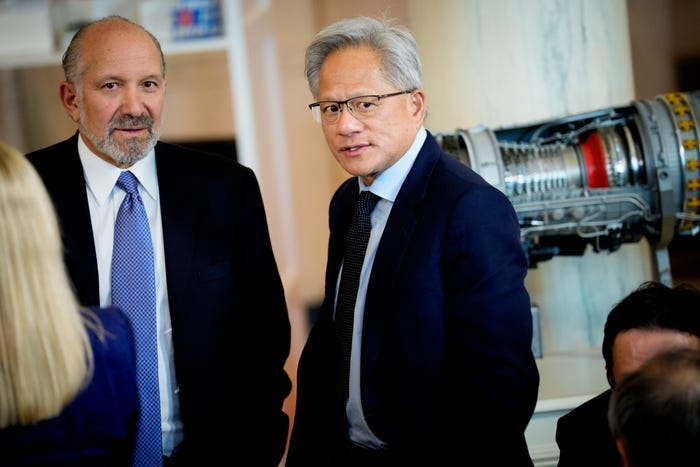
Commerce Secretary Howard Lutnick echoed NVIDIA CEO Jensen Huang’s view of why a U.S. company should sell chips to China. Andrew Harnik/Getty Images

On Monday, July 14, the Silicon Valley company announced in a blog post that the U.S. government had approved the sale of the H20, three months after the Donald Trump administration shut down NVIDIA’s artificial intelligence chip sales to China, after CEO Jensen Huang met President Trump in Washington D.C., and before he departed for Beijing.

Huang dominates Chinese headlines this week with his speech at an industry conference and public events with Chinese AI leaders. He visited China’s Ministry of Commerce and was received by Wang Wentao, the minister, on Thursday.

商务部新闻发言人就美批准对华销售英伟达H20芯片有关情况答记者问

MOFCOM Spokesperson Responds to Questions on the U.S. Approval of NVIDIA H20 Chip Sales to China

2025-07-18 13:43

Question:

U.S. officials have recently stated that Washington’s decision to approve sales of NVIDIA’s H20 chips to China is part of ChinaU.S. economic and trade negotiations. They also claimed that Chinese firms, including Huawei, are already producing equivalent chips domestically and that the United States does not want China to achieve full import substitution. How does the Ministry of Commerce (MOFCOM) view this?

Answer:

Following the ChinaU.S. economic and trade consultations in London, the two sides have maintained close communication, finalized the “London framework,” and moved forward with implementation. China, in accordance with its laws and regulations, approves export applications for controlled items that meet the necessary criteria. In early July, the United States reciprocally lifted the restrictions on China that had been discussed during those talks.

We have taken note that Washington has now taken the initiative to announce it will authorize sales of NVIDIA’s H20 chips to China. Beijing believes the United States should abandon a zero-sum mentality and continue to roll back a range of unwarranted trade and technology restrictions on China.

Cooperation and mutual benefit are the only viable path; suppression and containment lead nowhere. In May, the United States issued new export-control guidelines targeting Huawei’s Ascend chips, tightening restrictions on Chinese semiconductor products under unfounded pretexts. By wielding administrative power to distort fair market competition, these measures severely undermine the legitimate rights and interests of Chinese companies. China has made its position clear and firmly opposes such actions.

We look forward to the United States working with China in a spirit of equality to correct these erroneous practices, foster a sound environment for mutually beneficial cooperation between the two countries’ enterprises, and jointly safeguard the stability of global semiconductor supply chains.

“De-Globalization?”

The classic study of the “swirl of processes and events” that ended previous globalization episodes is the theme of Princeton Professor Harold James’ 2002 book, The End of Globalization: Lessons from the Great Depression.

Globalization” is here. Signified by an increasingly close economic interconnection that has led to profound political and social change worldwide, the process seems irreversible. In this book, however, Harold James provides a sobering historical perspective, exploring the circumstances in which the globally integrated world of an earlier era broke down under the pressure of unexpected events.

James examines one of the great historical nightmares of the twentieth century: the collapse of globalism in the Great Depression. Analyzing this collapse in terms of three main components of global economicscapital flows, trade and international migrationJames argues that it was not simply a consequence of the strains of World War I, but resulted from the interplay of resentments against all these elements of mobility, as well as from the policies and institutions designed to assuage the threats of globalism.

Could it happen again? There are significant parallels today: highly integrated systems are inherently vulnerable to collapse, and world financial markets are vulnerable and unstable.

While James does not foresee another Great Depression, his book provides a cautionary tale in which institutions meant to save the world from the consequences of globalization—think WTO and IMF, in our own time—ended by destroying both prosperity and peace.

Legitimate fears about “globalization reversal” have been well put by Zakaria:

Davos, Switzerland

President Trump’s speech here at the World Economic Forum went over relatively well. That’s partly because Davos is a conclave of business executives, and they like Trump’s pro-business message. But mostly, the president’s reception was a testament to the fact that he and what he represents are no longer unusual or exceptional. Look around the world and you will see: Trump and Trumpism have become normalized.

Davos was once the place where countries clamored to demonstrate their commitment to opening up their economies and societies. After all, these forces were producing global growth and lifting hundreds of millions out of poverty. Every year, a different nation would become the star of the forum, usually with a celebrated finance minister who was seen as the architect of a boom. The United States was the most energetic promoter of these twin ideas of economic openness and political freedom.

Today, Davos feels very different. Despite the fact that, throughout the world, growth remains solid and countries are moving ahead, the tenor of the times has changed. Where globalization was once the main topic, today it is the populist backlash to it. Where once there was a firm conviction about the way of the future, today there is uncertainty and unease.

This is not simply atmospherics and rhetoric. Ruchir Sharma of Morgan Stanley Investment Management points out that since 2008, we have entered a phase of “deglobalization.” Global trade, which rose almost uninterruptedly since the 1970s, has stagnated, while capital flows have fallen. Net migration flows from poor countries to rich ones have also dropped. In 2018, net migration to the United States hit its lowest point in a decade.

The shift in approach can best be seen in the case of India. In 2018, Prime Minister Narendra Modi came to Davos to decry the fact that “many countries are becoming inward focused and globalization is shrinking.” Since then, his government has increased tariffs on hundreds of items and taken steps to shield India’s farmers, shopkeepers, digital companies and many others from the dangers of international competition. The Office of the U.S. Trade Representative recently called out India for having the highest tariffs of any major economy in the world.

Indian officials used to aggressively court foreign investment, which was much needed to spur growth. Last week, with India’s economy slowing badly, Jeff Bezos announced a $1 billion investment in the country. (Bezos owns The Post.) But the minister of commerce and industry scoffed at the move, saying Amazon wasn’t “doing a great favor to India” and besides was probably engaging in anti-competitive, “predatory” practices. Often, protectionist policies help favored local producers. Malaysian Prime Minister Mahathir Mohamad recently criticized some of Modi’s policies toward Muslims. The Indian government effectively cut off imports of Malaysian palm oil. In a familiar pattern, one of the chief beneficiaries was a local billionaire long associated with Modi.

The Economist notes that Europe, once one of the chief motors for openness in economics and politics, is also rediscovering state intervention to prop up domestic industries. And if you think the Internet is exempt from these tendencies, think again. The European Center for International Political Economy tracks the number of protectionist measures put in place to “localize” the digital economy in 64 countries. It has been surging for years, especially since 2008.

It’s important not to exaggerate the backlash to globalization.

As a 2019 report by DHL demonstrates, globalization is still strong and, by some measures, continues to expand. People still want to trade, travel and transact across the world. But in government policy, where economic logic once trumped politics, today it is often the reverse. Economist Nouriel Roubini argues that the cumulative result of all these measures — protecting local industries, subsidizing national champions, restricting immigration — is to sap growth. “It means slower growth, fewer jobs, less efficient economies,” he told me recently. We’ve seen it happen many times in the past, not least in India, which suffered decades of stagnation as a result of protectionist policies, and we will see the impact in years to come.

Nevertheless, today, nationalism and protectionism prevail.

This phase of deglobalization is being steered from the top. The world’s leading nations are, as always, the agenda-setters. The example of China, which has shielded some of its markets and still grown rapidly, has made a deep impression on much of the world. Probably deeper still is the example of the planet’s greatest champion of liberty and openness, the United States, which now has a president who calls for managed trade, more limited immigration and protectionist measures. At Davos, Trump invited every nation to follow his example. More and more are complying.

The world is de-globalizing. Trump set the example.The Washington Post, Fareed Zakaria

Students should sense that while history does not repeat itself, it sometimes rhymes and this is a major danger. It also might imply that coping with climate change will be all the harder because American-led unilateralism everywhere would mean world policy paralysis.

Movies as an Education in Global Looting: The Sea Hawk (1940)

Movies and the World as an Arena of Violent Domination and Global Looting

The classic Warner Brothers swashbuckler, The Sea Hawk, from 1940, within its romantic adventures and intricate swordfights (perhaps comparable to the car chases of later movies) is a partly historical, partly fictional version of a world built on imperial struggles and ransacking and despoiling. The hegemonic power in the West (and perhaps worldwide) is Spain. Phillip II the king-emperor wants to own and dominate and rule the whole world. In 1588, his Spanish Armada loses to England. (The British of course want to compare this to the Battle of Britain against the German Luftwaffe.)

Set in 1585, The Sea Hawk opens with King Philip II of Spain plotting world domination, laughing that all world maps will soon read simply “Spain” — once England is out of the way, of course.

The Spanish ambassador departs for England to escort his niece to Queen Elizabeth’s court, but in a spectacular sea battle, the Spanish galley is soundly damaged, boarded, raided and sunk by a group of pirates led by Captain Geoffrey Thorpe, a Sir Walter Raleigh stand-in played by Erroll Flynn. Thorpe rescues the galley slaves — they row the boat — and spares the crew, taking them aboard and delivering them to England. The jewels and other bounty (or a portion thereof) are a gift to the Queen.

His crew is part of a noble privateer coalition — the Sea Hawks — who justify their piracy as reclamation of English goods (and enslaved sailors) from the Spanish behemoth. The political fallout from Thorpe’s abduction of the ambassador forces Elizabeth to outlaw the Sea Hawks, including an official denial (and private approval) of his mission to Panama to steal a shipment of Aztec gold.

Inca gold is also mentioned in the movie as a target of robbing.

Sir John Hawkins (1532–1595), part of this group of global sailor-pirates and master-mariners, was one of the most notable sailors and naval commanders of the sixteenth century.

He is known for his pivotal role in the maritime history of England and the rise of the global slave trade.

John Hawkins, the son of a merchant, was born in Plymouth in 1532. He became a sea captain and in 1562 became the first Englishman to start capturing people in Sierra Leone and selling them as slaves to Spanish settlers in the Caribbean. (Notice that selling slaves does not discriminate against Spaniards even with Phillip II threatening England. Business is business.)

Stealing Aztec gold as part of colonial or imperial plundering and the slave trade were part of the dark side of history, something the standard history books “skate over” dishonestly.

A key scene between the Spanish aristocratic beauty and Captain Thorpe:

Doña María Álvarez de Córdoba: “I’m not in the habit of conversing with thieves. I thought I made that quite clear, Captain Thorpe.”

Captain Geoffrey Thorpe: “Why, yes, all except your definition. Tell me, is a thief an Englishman who steals?”

Doña María Álvarez de Córdoba: “It’s anybody who steals… whether it’s piracy or robbing women.”

Captain Geoffrey Thorpe: “Oh, I see. I’ve been admiring some of the jewels we found in your chest… particularly the wrought gold. It’s Aztec, isn’t it? I wonder just how those Indians were persuaded to part with it.”

The Sea Hawk (1940)

Donald Trump continues this tradition of looting when he says of Iraq’s oil:

“Think of it as our oil under their sand.”

Thus the whole world is an arena where the weak don’t have any property rights: not the oil or gold, not themselves (slavery) and not their country (colonialism).

This exploitative hierarchy and “world-system” is part of “the way of the world” and even a romantic adventure story like 1940’s The Sea Hawk gives you a Hollywoodized glimpse into its roots. Imperial struggles in the West spill over into colonization and ransacking and looting. History books one sees in high school are dishonest and in that sense uninformative or even disinformative.

The popular PBS travel series Rick Steves’ Europe unintentionally gives us a wonderful example of this notion of plunder and looting as a pillar of world history in the show on Venice. Rick Steves is talking about the various statues in Venice’s central St. Mark’s Square (Piazza San Marco), and comments “I’d call the style ‘Early Ransack.’”

This Rick Steves quip about ransacking and historical wealth-building is very informative.

Facing the Global South: Building a New International System by Yang Ping

“If you raise [the development of the BRI] to the strategic level, there are countries where … you will have to lose money and there are countries where you will be free to make money.”

by Thomas des Garets Geddes, Sinification

Dear Everyone,

How to respond to the growing political divide between China and the West marked by partial decoupling, security alliances, and the risk of sanctions, amongst other things, continues to be a major topic of discussion among China’s intellectual elite. As already evidenced in previous editions of this newsletter, opinions vary considerably. Those presented here so far have ranged from Da Wei (达巍) stressing the importance of preserving if not strengthening ties with the West and Shen Wei (沈伟) arguing in favor of reforming the WTO and building up a network of free trade agreements to Ye Hailin (叶海林) emphasizing the need for China to demonstrate its military might to demobilize U.S. allies and Lu Feng (路风) calling for self-reliance and greater assertiveness in the field of tech. A certain amount of overlap certainly exists among these perspectives but the differences are nonetheless striking.

Today’s edition of Sinification looks at a speech made last month by Yang Ping (杨平), head and editor-in-chief of the highly regarded Beijing Cultural Review (文化纵横, hereafter BCR). Yang is also director of the Longway Foundation (修远基金会) which publishes BCR. The foundation describes its publication as “the most influential magazine of intellectual thought and commentary in China” and sees itself as having a key role in helping shape the direction of intellectual debates in China (“议题的设置就是意识形态斗争成功的一半”). Indeed, BCR often republishes old articles at key junctures as so often highlighted by David Ownby’s wonderful Reading the China Dream.

The following are excerpts from an edited transcript of a speech by Yang made at an event hosted by Renmin University’s Chongyang Institute for Financial Studies, which was attended by China’s Vice-minister of foreign affairs Xie Feng (谢锋). In his speech, Yang advocates building a new international system led by countries in the Global South (which, of course, includes China) rather than the West. His ideas are not particularly novel but are nevertheless noteworthy in that they represent yet another viewpoint in the ongoing debate over how China should respond to the increasing tensions that characterize its relations with the U.S. and other Western countries. Next week, I will be sharing a somewhat longer piece that proposes a way of protecting China from the growing threat of Western sanctions.

Yang’s speech in a nutshell:

  • Capitalist politics” are no longer in line with “capitalist economics.” The former now undermines globalization, while the latter supports it.
  • Sanctions, export controls, friend-shoring and alliance-building are damaging the world economy and further alienating China from the current U.S.-led international order.
  • China must respond to this growing trend by building a “new type of international system” with other countries in the Global South.
  • BRI projects should be increasingly focused on achieving this goal and thus allow more room for loss-making endeavors.

Capitalist politics ≠ Capitalist economics

“Since 2022 and the Russo-Ukrainian conflict, our main focus and topic of discussion has been China’s construction of a new type of international system.

“The most important feature of today’s world is the beginning of a separation between capitalist politics and capitalist economics. The capitalist political order and the capitalist economic order do not support each other [any longer].

“We have witnessed two typical manifestations of the separation of politics and the economy and the impact of politics on the economy:

  1. The first is the conflict between Russia and Ukraine. The sanctions imposed on Russia by the United States and the West have reached unthinkable, abominable [令人发指] and unimaginable proportions. Under established international rules, it was understood that such sanctions could not possibly occur, but now they have. These include the fracturing of the financial system, the expropriation and seizure of Russian private assets and the freezing of Russian foreign exchange reserves. These are all abominable and unimaginable forms of confrontation. At the same time, the Russo-Ukrainian conflict has led to serious disruptions in global food and energy systems and supply chains, with massive food ‘shortages’ and soaring food prices, particularly in developing countries. Sanctions and political repression [政治打压] have severely disrupted the [world’s] economic order.
  2. The second is the conflict between the U.S. and China. Since the Trump era, the U.S. has been engaged in a trade war against China, mainly by raising tariffs. Basically, this was simply about balancing trade [with China] and used mainly economic means. But under Biden, it [has become] a war that mixes politics with economics. Biden’s strategy towards China can basically be summed up in just a few words: one, friend-shoring, [i.e.] only allowing friendly countries into [parts of] its supply chains; two, alliance politics, [i.e.] continuously forging an alliance system involving NATO, the European Union, Japan, AUKUS and the four Asia-Pacific countries [I assume he is referring to South Korea, Japan, New Zealand and Australia taking part for the first time in a NATO summit last year] and constantly opposing China [不断应对中国]; three, its so-called ‘precision strikes’, [i.e.] its radical crackdown on China’s high tech [industry], especially our chip industry.”

China is being pushed out of the U.S.-led international system

“The information I have seen so far is that the number of Chinese companies included in the U.S.’s ‘entity list’ has risen from 132 under Trump to over 530 now. The scope of such point-to-point [点对点] precision strikes is constantly expanding. With such a political impact on the economy, we can feel the [world’s] economic order being disrupted across the board. The world is moving inexorably in the direction of decoupling. The phenomenon of politics affecting the economy and the capitalist political order no longer upholding the capitalist economic order are extremely striking.

“In such a context, the challenges now facing China are extremely serious and varied. We have the pressures of dealing both with containment in the Indo-Pacific and with the U.S.-led politics of alliances across the world. More importantly and fundamentally China faces the strategic task of building a new type of international system [新型国际体系] … The existing Western-dominated international system used to be one in which we tried hard to blend [so as] to become one with it. During this process, we [sought to] absorb the West’s advanced technologies and management [practices] and thus complete our mission of industrialisation and modernization.

“But once you enter the existing international system, he [who is already inside] does not want to play with you, and even wants to drive you back out. He wants to divide both supply chains and the economic system into two parts [搞成两套] and desperately wants to contain and suppress you. This is not something that can be determined by your own subjective preferences. He has made up his mind: you have already become his ‘fated opponent’ [命定的对手]. He has to suppress you and drive you out of the existing system.”

Building a new international system with the Global South

“It is at this point that China is faced with the task of constructing a new type of international system that is not dominated by the West. In today’s so-called strategic quadrangle consisting of the U.S., Europe, Russia and China, how to construct such an international system appears particularly difficult [逼庂 literally means ‘narrow’ or ‘cramped’ rather than ‘difficult’].

“But if we look a little further south, we will find a vast number of developing countries, the Third World and the countries of the global South. They should be our strategy’s depth [我们的战略纵深]. That is to say, [we should] build a new type of international relations and a new type of international system that has strategic depth and in which China and the countries of the global South are jointly integrated. [This] is, in my view, an important strategic task for China’s international relations in the coming decades.”

BRI projects: Strategy trumps profitability

“For China today, especially for businesses and governments at all levels [within China] that are currently working hard to develop BRI trade, there is a very important point to which they should be alerted or reminded about: the development of the BRI has to go beyond mere business, beyond the general export of [China’s excess] production capacity, beyond the partial thinking of industry and the partial thinking at the regional level, or the simple economic way of thinking of business. The development of the BRI should be considered at the strategic level. That is, it should be included into China’s strategy when thinking about Africa, South America, Southeast Asia and Central Asia.

“If you raise [the development of the BRI] to the strategic level, there are countries where you won’t be able to make money and will have to lose money, and there are countries where you will be free to make money. You have to unite the two within your organic strategy.

“The strategic task of building a new type of international system is, in my view, a strategic proposition that Chinese think tanks and research institutes should pay very close attention to with regards to international relations.

“Time is limited today. I just wanted to make a start here. I hope to receive your corrections and criticisms. Thank you!”

[Subscribe to Sinification]

The recessive importance of the Global South was previously explored by Richard and his partner Larry, with input from Supratik Bose, many decades ago as shown here.

Education and Circular Causation: Everything Causes Everything Else

The student will have seen in these educational essays the notion of “Husserl’s rhomboid”:

The great philosopher, Edmund Husserl, who died in 1938, would bring a matchbox to class and show his students they see parts and some surface area of the matchbox (a kind of rhomboid, hence the name “Husserl’s rhomboid”) but never all of it at the same time. Students can walk around the matchbox and see facets. They can twirl the matchbox but whatever they do, the students cannot “espy” or glimpse all of it except in their imaginations, once they have been exposed to all of it, side by side, facet by facet.

Gunnar Myrdal, the Swedish economist who won the Nobel Prize in 1974, has something a bit analogous when he speaks of “circular cumulative causation”:

Circular cumulative causation is a theory developed by Swedish economist Gunnar Myrdal in 1956. It is a multi-causal approach where the core variables and their linkages are delineated. The idea behind it is that a change in one form of an institution will lead to successive changes in other institutions. These changes are circular in that they continue in a cycle, many times in a negative way, in which there is no end, and cumulative in that they persist in each round. The change does not occur all at once, which would lead to chaos, rather the changes occur gradually.

Gunnar Myrdal developed the concept from Knut Wicksell and developed it with Nicholas Kaldor when they worked together at the United Nations Economic Commission for Europe.

In the characteristics relevant to an economy’s development process, Myrdal mentioned the availability of natural resources, the historical traditions of production activity, national cohesion, religions and ideologies, and economic, social and political leadership.

He writes:

“The notion of stable equilibrium is normally a false analogy to choose when constructing a theory to explain the changes in a social system.

What is wrong with the stable equilibrium assumption as applied to social reality is the very idea that a social process follows a direction—though it might move towards it in a circuitous way—towards a position which in some sense or other can be described as a state of equilibrium between forces. Behind this idea is another and still more basic assumption, namely that a change will regularly call forth a reaction in the system in the form of changes which on the whole go in the opposite direction to the first change. The idea I want to expound in this book is that, on the contrary, in the normal case there is no such a tendency towards automatic self-stabilisation in the social system. The system is by itself not moving towards any sort of balance between forces, but is constantly on the move away from such a situation. In the normal case a change does not call forth countervailing changes but, instead, supporting changes, which move the system in the same direction as the first change but much further. Because of such circular causation as a social process tends to become cumulative and often gather speed at an accelerating rate…”

(Gunnar Myrdal, Economic Theory and Underdeveloped Regions, Gerald Duckworth, 1957, pp. 12–13)

Myrdal developed further the circular cumulative causation concept and stated that it makes different assumptions from that of stable equilibrium on what can be considered the most important forces guiding the evolution of social processes. These forces characterize the dynamics of these processes in two diverse ways.

These essays that you are reading here are examples encouraging students to put causes in a kind of circle: history exists because economics exists because psychology exists because society exists because history exists. Everything is causing everything else. There isn’t a simple “linear parade.”

By way of contrast, in a person’s private life, he/she went to the dentist before buying the batteries and after having lunch. There’s a timeline of events.

In history, there are such linear timelines also: John Kennedy was assassinated before Donald Trump became president. You had breakfast before dinner. You slept before you got up in the morning.

However, processes (industrialism, migration, urbanization, inflation, etc.) are not analyzable as events like meals and one-time occurrences but are more like getting old or learning a language.

Multi-causal interpretations and circular causes get the student out of simple, “this happened and that happened” in favor of “this and that caused each other, going both ways and interacting with other pressures too.” Everything is causing and altering everything else in all directions.

Precursors of Trumpism in American Culture: The Great Gatsby

Donald Trump’s brand of “nativist populism” is prefigured very clearly in the 1925 classic American novel The Great Gatsby by F. Scott Fitzgerald, the subject of several film adaptations. The anxiety in the Trump movement is called “The Great Replacement” (i.e., white people supplanted by minoritiesAmerican non-whites will “link up” with Mexicans and Chinese, stealing the place, property and role of white people). It has never occurred to these people that most of the world’s population is non-white. In The Great Gatsby, Tom Buchanan, Daisy’s husband, represents this anxiety.

He links these fears to the anxiety that “the sun is getting hotter.” (That is, he’s being threatened cosmically too, not only by racial demography.) His fears are not of “climate change,” based on something rational, but obsessive and maniacal “threat assessments.” They mirror the “irrational clusters of threats” of Trump and his voters, who “want to be paid in advance forever for their being white, Christian and American.” They demand “racial tenure.” This Tom Buchanan syndrome may be considered a type of “globalization backlash.”

Tom Buchanan lays it out in the novel:

“Civilization’s going to pieces,” broke out Tom violently. “I’ve gotten to be a terrible pessimist about things. Have you read The Rise of the Colored Empires by this man Goddard?…Well, it’s a fine book, and everybody ought to read it. The idea is if we don’t look out the white race will be — will be utterly submerged. It’s all scientific stuff; it’s been proved…This fellow has worked out the whole thing. It’s up to us, who are the dominant race, to watch out or those other races will have control of things…The idea is that we’re Nordics. I am, and you are, and we’ve produced all the things that go to make civilization—oh, science and art, and all that. Do you see?”

(The Great Gatsby, Chapter 1)

“…Nowadays people begin by sneering at family life and family institutions, and next they’ll throw everything overboard and have marriage between black and white.”

Flushed with his impassioned gibberish, he saw himself standing alone on the last barrier of civilization.

“We’re all white here,” murmured Jordan.

Angry as I was, as we all were, I was tempted to laugh whenever he opened his mouth. The transition from libertine to prig was so complete.

(The Great Gatsby, Chapter 7)

The Brexit phenomenon in the United Kingdom is not identical but does overlap (i.e., the “left behind” people in England want “historical ethnic-national tenure” and a kind of re-segregation).

EconoSpeak: Tariffs and Inflation

[from EconoSpeak, posted by Kevin Quinn]

Jason Furman and Janet Yellen have both suggested that cutting Trump’s tariffs would  be anti-inflationary. But most economists agree that the incidence of the tariffs is for the most part on U.S. consumers, not foreign suppliers (pace the treasonous and ignorant former president, who crowed about all the revenues we were raising from China). So how is a tax cut anti-inflationary?  There is a supply-side effect, which is all to the good, but the demand-side effects may well wash that out. So get rid of the tariffs but reverse the Trump tax cuts, which Manchin favors, through reconciliation. Taxes remain the same, so we’ve neutralized the effects on demand; and we still get the good supply side effects of a more rational global division of labor.