Japan’s Deadliest Delicacy Is Getting More Dangerous

Rising sea temperatures are pushing pufferfish species together, spawning hybrids that even specialist chefs cannot safely prepare

[from South China Morning Post]

by Julian Ryall

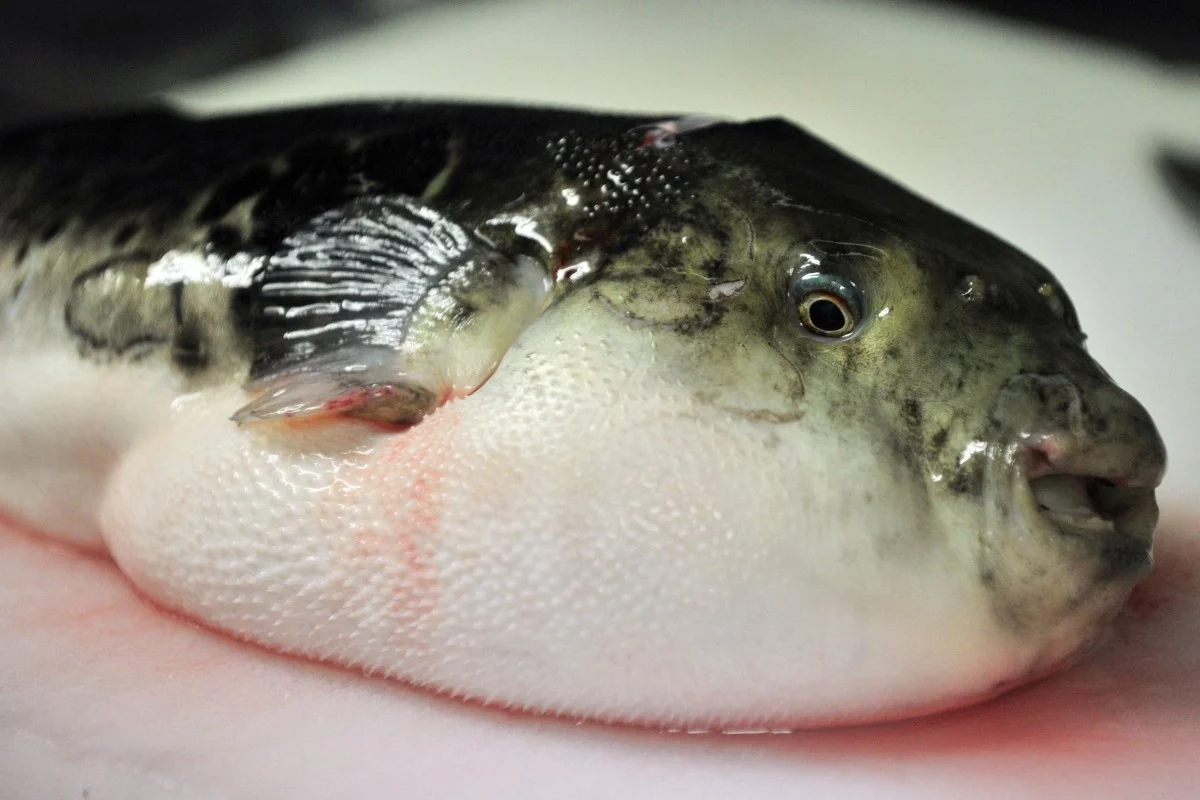
Japan’s most dangerous delicacy is getting harder to prepare safely as warming seas push different pufferfish species into the same waters, where they are inbreeding to produce hybrids whose lethal toxins are not yet fully understood.

Fugu – the collective Japanese name for several species of edible pufferfish – is prized as much for the danger surrounding its preparation as for its subtle flavour.

Many species contain tetrodotoxin, a powerful neurotoxin with no known antidote that can cause paralysis, respiratory failure and death.

Since 1958, anyone wishing to prepare pufferfish for public consumption has had to obtain a licence first, a process that takes at least two years and defeats roughly two-thirds of those who attempt it.
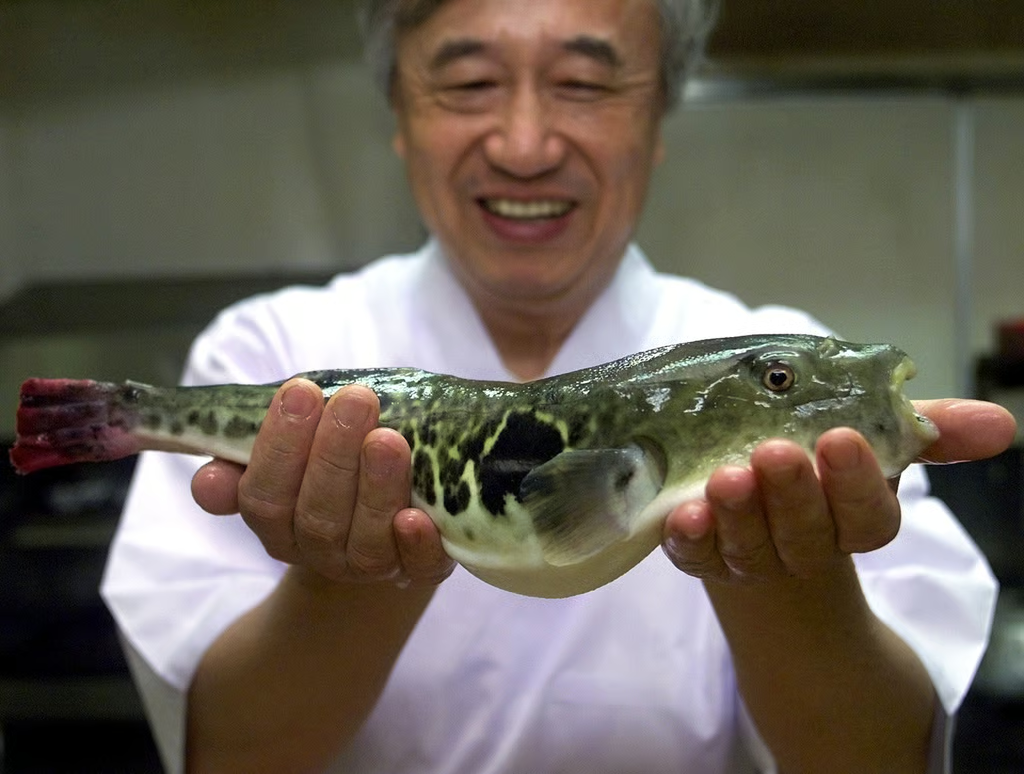
A restaurateur shows off a “fugu”, or pufferfish, at a restaurant in Shimonoseki, Japan. Photo: AP

Chefs learn to strip out the fish’s liver, ovaries, eyes and skin – tissues where the poison concentrates – with the precision of a brain surgeon and the nerve of a bomb-disposal technician.

But that hard-won expertise is now being undermined by climate-induced interbreeding, as experts say Japan’s coastal waters are heating up at roughly twice the global average rate.

Spotted pufferfish, once largely confined to the Sea of Japan, have spent the past decade steadily pushing northward in search of cooler currents. Some slipped through the Tsugaru Strait – the channel separating Honshu from far northern Hokkaido – where they have met and mated with the region’s native pufferfish species.

The resulting hybrids now make up as much as 40 per cent of local catches, according to a recent study of fish caught off Fukushima and Ibaraki prefectures.

“We started seeing these spotted fugu on the Pacific coast in 2012 as temperatures in the Sea of Japan became too high for them,” said Professor Hiroshi Takahashi of the National Fisheries University in Shimonoseki, Yamaguchi prefecture.

Temperatures in the waters there were “among the fastest rising anywhere in the world”, he told This Week in Asia, adding that the changes in pufferfish had been happening just as fast.

Customers visit a seafood market in Japan’s Fukushima prefecture. Photo: AP

Some spotted pufferfish had ventured down the east coast as far south as Tokyo Bay, Takahashi said, only to be driven north again as those waters also warmed.

Tiger pufferfish had likewise moved north from their usual range to interbreed with common pufferfish in and around Tokyo Bay, he added.

The trouble is not that hybrids are more toxic than their ancestors, it is that nobody yet knows how interbreeding has affected the distribution of toxins.

Each species of pufferfish stores tetrodotoxin in a different combination of organs and Japan’s health ministry has not yet been able to establish which parts of the new hybrids are safe to eat and which are not.

Until it does, the government has banned the sale or consumption of hybrid fugu – but this ban is almost impossible to enforce.

“They are very hard to identify,” said Takahashi, whose team has developed a DNA test capable of distinguishing hybrid fish and hopes to make the technology commercially available to fishermen who currently have no reliable way of screening their catch.
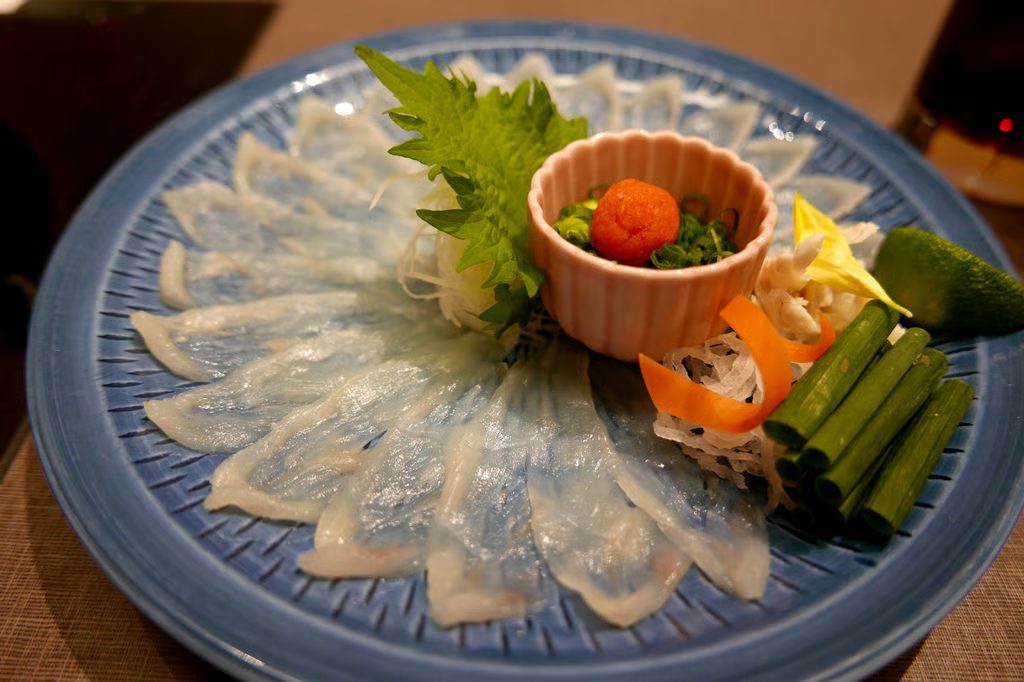
Pufferfish, or “fugu”, sashimi prepared for eating at a restaurant in Japan. Photo: Shutterstock

Fatal attraction

None of this is likely to diminish fugu’s deadly mystique. The dish has been eaten in Japan for centuries, enjoyed despite – or because of – the risks involved.

Every year, new tales emerge of amateur anglers preparing the fish to eat against the advice of anxious relatives and not surviving the attempt.

Diners speak of a faint numbness in the lips as evidence of a narrow escape and the emperor of Japan is barred from eating fugu altogether, lest even a licensed chef makes a mistake.

Urban legend holds that chefs who do poison a customer are honour-bound to end their own life, with their own knife, in atonement – though this is a myth.

For their part, Japanese restaurateurs are, perhaps unsurprisingly, keen to play down the risks.

A spokeswoman for Miyawaki Fugu Club, an upscale restaurant in Tokyo’s Ginza district, said its chef works exclusively with farmed tiger pufferfish from a long-established supplier, which she insisted were “completely safe”.

James Reimer, a professor of marine biology at the University of the Ryukyus, said the fugu phenomenon fit a wider pattern of marine life relocating in response to global warming.

“What happens to marine ecosystems is one of the hot-button issues of the day, particularly in Japan, because the waters here are warming at twice the global average rate,” he said.

During fieldwork off the Izu peninsula, south of Tokyo, three years ago, local fishermen told him that they had lost virtually their entire kelp crop and that the abalone once abundant in those waters had vanished.
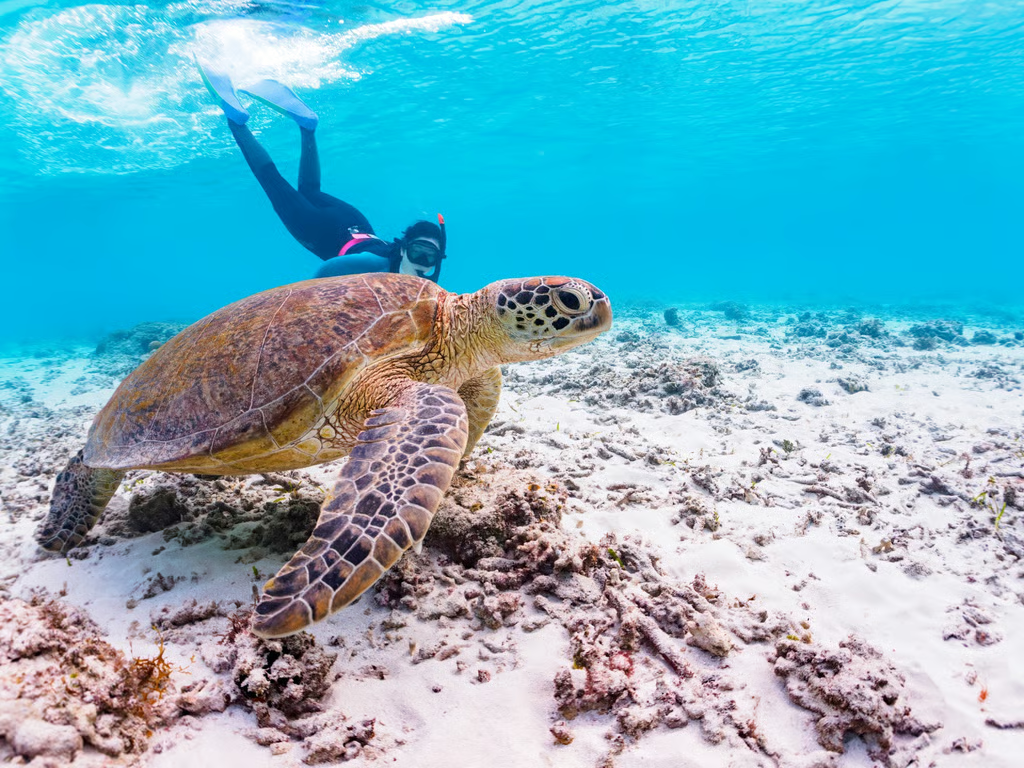
A sea turtles in waters off Japan’s Amami Islands. Turtles are increasingly venturing farther north, fishermen say. Photo: Shutterstock

In their place, they said they were seeing far more sea turtles, as well as large schools of brightly coloured fusiliers – the prefectural fish of Okinawa, some 1,400km (870 miles) to the south.

“Last year, our summer in Okinawa was 30 days longer than average, and we had 120 days when the water temperature was around 30 degrees Celsius (86 degrees Fahrenheit),” Reimer said.

He warns that the picture is not simply one of fish and other marine life swimming steadily north in search of more comfortable temperatures, however.

Global warming is also destabilising weather patterns, making them less predictable. Waters off Kyushu, the southernmost of Japan’s main islands, that might otherwise suit certain species are increasingly prone to temperature swings that could make them unsuitable after all.

Even so, the broader direction is unmistakable. Kyushu’s waters have seen a marked rise in shark sightings in recent years, including large tiger sharks – one more sign of the changes occurring beneath the surface of Japan’s seas.

Chance and Necessity

If you free-associate the word “chance,” you may arrive at “I’ll take my chances” before potentially arriving at Thomas Bayes’ “Doctrine of Chances”. Jacques Monod was an early explorer of the collision of probability and chance in biology.

THE PRINCE OF CHANCE

Jacques Monod grew up just down the coast from Monte Carlo in Cannes, France, another town famous for its casinos and, later, its film festival. Graced with movie star looks—one prominent French journalist described him as a “prince” who resembled Hollywood icon Henry Fonda, as well as considerable musical talent, and an exceptional intellect, Monod struggled to decide on a career path through his twenties. After distinguishing himself in the French Resistance, Monod rose to fame not as an actor or musician, but as a brilliant biologist. He shared the 1965 Nobel Prize in Physiology or Medicine for seminal discoveries about how genes work.

A pioneer in the field of molecular biology, Monod was privy to the blizzard of discoveries in the 1950s and early 1960s about the molecules that determined the characteristics of living things—what Monod and others dubbed “the secrets of life.” He kept close company with a relatively small international community of leading researchers. For example, when James Watson and Francis Crick cracked the structure of DNA (deoxyribonucleic acid) in 1953, Monod was one of the first with whom Watson shared the breakthrough.

But as a Frenchman steeped in his culture’s deep philosophical traditions, Monod was interested in science for more than just science’s sake. After the war, Monod befriended France’s leading philosopher-writer Albert Camus, and the two men pondered questions of human existence in Left Bank cafés. Monod felt that the public misunderstood the principal purpose of science as being the creation of technology. Rather, Monod believed technology was merely a by-product. He said, “the most important results of science have been to change the relationship of man to the universe, or the way he sees himself in the universe”—a relationship of equally intense interest to his friend Camus.

Monod thought that there were profound philosophical implications of the new molecular biology, particularly in the realm of heredity, which had gone largely unnoted in the broader culture. Several years after his Nobel Prize and Camus’ untimely death, he decided to write a book to try to bring the meaning of modern biology to laypersons.

“[T]he ‘secret of life’…has been laid bare,” he wrote.

“This, a considerable event, ought certainly to make itself strongly felt in contemporary thinking.”

Monod used several chapters to describe the insights that had very recently emerged from the study of DNA and the deciphering of the genetic code. He understood this knowledge would be unfamiliar to most readers, so he included an appendix with chemical structures of proteins and nucleic acids, and a primer on how the genetic code worked.

In a matter-of-fact style, he explained genetic mutations as accidental alterations—substitutions, additions, deletions, or rearrangements—in the text of DNA, in the sequence of the long strings of chemical bases (ACTTGATAA, etc.) that make up genes.

Then, almost without warning, he turned to the broader implications of how mutations arise in DNA. It is worth quoting him at length for after 111 pages of background, he delivered one of the most powerful ideas in five centuries of science (all italics are original):

“We call these events accidental; we say they are random occurrences. And since they constitute the only possible source of modifications in the genetic text, itself the sole repository of the organism’s hereditary structure, it necessarily follows that chance alone is at the source of every innovation, of all creation in the biosphere.

“Pure chance, absolutely free but blind, at the very root of the stupendous edifice of evolution: this central concept of modern biology is no longer one among other possible or even conceivable hypotheses. It is today the sole conceivable hypothesis, the only one that squares with observed and tested fact. And nothing warrants the supposition—or the hope—that on this score our position is likely ever to be revised.

“There is no scientific concept, in any of the sciences, more destructive of anthropocentrism than this one.”

In essence, heretofore obscure discoveries in biochemistry and genetics (largely studied at that time in simple bacteria) had upended two millennia of philosophy and religion that put humans at the center or apex of creation. “Man was the product of an incalculable number of fortuitous events,” Monod wrote. “The result of a huge Monte Carlo game, where our number eventually did come out, when it might not well have appeared.”

Le Hasard et la nécessité (Chance and Necessity) appeared in France in October 1970. It was a fairly technical book with several chapters on philosophy and genetics, and those appendices full of chemical diagrams. A first-time author, Monod did not know what reactions to expect.

The merde hit the fan.

The book received dozens of reviews across France and quickly became a bestseller—second only to the French translation of Erich Segal’s Love Story (this was France after all. After it was translated into English, reviews and interviews with Monod were featured in several of the most prominent British and American newspapers and magazines.

Many commentators immediately recognized the threat chance posed to traditional ideas of humanity’s origins and purpose. To Arthur Peacocke, a British biochemist turned prominent theologian, Monod had put forth “one of the strongest and most influential attacks of the century on theism.” A flurry of articles and books appeared with titles such as Anti-Chance: A Reply to Monod’s Chance and Necessity, Beyond Chance and Necessity, and God, Chance, and Necessity. Monod was invited to debate philosophers and theologians both in France and abroad, on television, radio, and in print.

American Calvinist theologian and pastor R.C. Sproul summed up the high stakes posed by chance in the first page of his book Not A Chance:

“It is not necessary for chance to rule in order to supplant God. Indeed, chance requires little authority at all if it is to depose God; all it needs to do the job is to exist. The mere existence of chance is enough to rip God from his cosmic throne. Chance does not need to rule; it does not need to be sovereign. If it exists as a mere impotent, humble servant, it leaves God not only out of date, but out of a job.” More than two hundred pages later, Sproul concluded:

“Chance as a real force is a myth. It has no basis in reality and no place in scientific inquiry. For science and philosophy to continue to advance in knowledge, chance must be demythologized once and for all.”

Sproul and other critics argued that what scientists perceived as chance merely reflected a lack of knowledge of true causes. Perhaps that was the expression of hope to which Monod alluded—the hope that as scientists learned more, our position on the role of chance would somehow be revised.

A SECOND CHANCE

The ensuing fifty years have not played out as either Monod or his detractors hoped. The Frenchman thought that the new insights from molecular biology should be a turning point for modern society-away from traditional beliefs about causes in the natural world toward one that embraced randomness and our chance existence.

Ha! Fat chance. The excitement and fuss stirred by Chance and Necessity simmered down, and Monod passed away a few years later. Surveys reveal that the majority of Americans, for example, continue to believe that everything on earth happens for His reasons.

But Monod’s critics should take no comfort. The province of chance in the biosphere and human life has been revised, although not at all in the scope or direction that they hoped.

The domain of chance has expanded into realms neither Monod nor anyone else imagined.

As we have learned much more about the history and workings of the planet, we have been startled to discover how the course of life has been buffeted by a variety of cosmological and geological accidents—without which we would not be here. As we have explored human history, we have seen how pandemics, droughts, and other civilization-changing episodes have been triggered by random, singular events in nature that easily might not have happened. And as we have probed human biology and the factors that impact our individual lives, we have caught chance red-handed, reigning over the often-thin line between life and death.

This book tells the stories that Monod could not—of astonishing discoveries from the planetary to the molecular scale, from great upheavals across the globe to the machinery of chance that operates within every cell of every creature, including ourselves. And while these discoveries vaporize the comforts of anthropocentrism, the story of chance, I hope you will come to agree, is much more than highfalutin philosophy or the refutation of theologians’ wishful thinking.

I hope that you are awed—awed by the power and the drama of asteroids slamming into the planet, of continents colliding, and of the rapid rising and falling of ice and oceans; awed by the realization that we live on (and are at the mercy of a planet that is far more unstable than our short lives perceive; awed by the knowledge of how random chance is at the source of all of the beautiful and wondrous creatures with whom we share the planet; awed by the unique invisible accidents that made each one of us; and awed by the fact that we humans, recent descendants of bands of hunter-gatherers who persevered through a period of exceptional chaos, have in just the last fifty years or so, figured all of this out!

My goal here is to be comprehensible without being comprehensive. It is almost trivial to claim that the world is the way it is or that we are here because of a long chain of chance, albeit fortunate, events. The explanatory power I seek comes from specificity. It is essential to unpack some of those events to appreciate how they shape the direction of life. The layout of the book follows a simple three-part logic. I’ll begin with inanimate, external chance events that have shaped the conditions for life (Part One, “Stuff Happens”), and then turn to the internal random mechanism within every creature that generates the adaptations to those conditions (Part Two, “A World of Mistakes”). Then, I bring the story to the personal level (Part Three, “23 and You”) and how chance impacts our natural lives, as well as our deaths. Our chance-driven existence shatters long-held beliefs about humanity’s place and raises challenging questions about the meaning and purpose of our lives. In the Afterword, I’ll offer some possible replies with the help of some special guests.

This is a relatively small book for a really big idea. Science has given us a handful of really big ideas over the centuries, but they have been received in funny ways. Darwin had a huge idea that was very simple to understand, and even though the evidence is massive and everywhere, many refuse to believe it. Einstein had a brand new idea, and even though few understand it or the evidence for it, most everyone seems to believe it. Monod had a great idea, but these days most people (other than scholars) have not heard of it, or of him.

My greatest hope, then, is that this short book might be chance’s second chance.

Sean B. Carroll, A Series of Fortunate Events: Chance and the Making of the Planet, Life, and You, Princeton University Press, 2020, pp. 6-12.

Modern biology as described by Monod pushes the linkage of probability, randomness and chance to the center. At the time, this was a very radical and profound way of looking at biology. If we combine Monod’s biology with theoretical physics like Lawrence Krauss’ A Universe from Nothing: Why There Is Something Rather than Nothing, we realize that accidentality is the bedrock on which our knowledge of the universe is built.

Meaningfulness versus Informativeness

The Decoding Reality book is a classic contemporary analysis of the foundations of physics and the implications for the human world. The scientists don’t see that physics and science are the infrastructure on which the human “quest for meaning” takes place. Ortega (Ortega y Gasset, died in 1955) tells us that a person is “a point of view directed at the universe.” This level of meaning cannot be reduced to bits or qubits or electrons since man is a “linguistic creature” who invents fictional stories to explain “things” that are not things.

The following dialog between Paul Davies (the outstanding science writer) and Vlatko Vedral (the distinguished physicist) gropes along on these issues: the difference between science as one kind of story and the human interpretation of life and self expressed in “tales” and parables, fictions and beliefs:

Davies: “When humans communicate, a certain quantity of information passes between them. But that information differs from the bits (or qubits) physicists normally consider, inasmuch as it possesses meaning. We may be able to quantify the information exchanged, but meaning is a qualitative property—a value—and therefore hard, maybe impossible, to capture mathematically. Nevertheless the concept of meaning obviously has, well… meaning. Will we ever have a credible physical theory of ‘meaningful information,’ or is ‘meaning’ simply outside the scope of physical science?”

Vedral: “This is a really difficult one. The success of Shannon’s formulation of ‘information’ lies precisely in the fact that he stripped it of all “meaning” and reduced it only to the notion of probability. Once we are able to estimate the probability for something to occur, we can immediately talk about its information content. But this sole dependence on probability could also be thought of as the main limitation of Shannon’s information theory (as you imply in your question). One could, for instance, argue that the DNA has the same information content inside as well as outside of a biological cell. However, it is really only when it has access to the cell’s machinery that it starts to serve its main biological purpose (i.e., it starts to make sense). Expressing this in your own words, the DNA has a meaning only within the context of a biological cell. The meaning of meaning is therefore obviously important. Though there has been some work on the theory of meaning, I have not really seen anything convincing yet. Intuitively we need some kind of a ‘relative information’ concept, information that is not only dependent on the probability, but also on its context, but I am afraid that we still do not have this.”

For a physicist, all the world is information. The universe and its workings are the ebb and flow of information. We are all transient patterns of information, passing on the recipe for our basic forms to future generations using a four-letter digital code called DNA.

See Decoding Reality.

In this engaging and mind-stretching account, Vlatko Vedral considers some of the deepest questions about the universe and considers the implications of interpreting it in terms of information. He explains the nature of information, the idea of entropy, and the roots of this thinking in thermodynamics. He describes the bizarre effects of quantum behavior—effects such as “entanglement,” which Einstein called “spooky action at a distance” and explores cutting edge work on the harnessing quantum effects in hyper-fast quantum computers, and how recent evidence suggests that the weirdness of the quantum world, once thought limited to the tiniest scales, may reach into the macro world.

Vedral finishes by considering the answer to the ultimate question: Where did all of the information in the universe come from? The answers he considers are exhilarating, drawing upon the work of distinguished physicist John Wheeler. The ideas challenge our concept of the nature of particles, of time, of determinism, and of reality itself.

Science is an “ontic” quest. Human life is an “ontological” quest. They are a “twisted pair” where each strand must be seen clearly and not confused. The content of your telephone conversation with your friend, say. is not reducible to the workings of a phone or the subtle electrical engineering and physics involved. A musical symphony is not just “an acoustical blast.”

The “meaning of meaning” is evocative and not logically expressible. There’s a “spooky action at a distance” between these levels of meaning versus information but they are different “realms” or “domains.”

Physics AI Predicts That Earth Goes Around the Sun

from Nature Briefing:

Hello Nature readers,

Today we learn that a computer Copernicus has rediscovered that Earth orbits the Sun, ponder the size of the proton and see a scientific glassblower at work.

Physicists have designed artificial intelligence that thinks like the astronomer Nicolaus Copernicus by realizing the Sun must be at the center of the Solar System. (NASA/JPL/SPL)

AI ‘Discovers’ That Earth Orbits the Sun [PDF]

A neural network that teaches itself the laws of physics could help to solve some of physics’ deepest questions. But first it has to start with the basics, just like the rest of us. The algorithm has worked out that it should place the Sun at the centre of the Solar System, based on how movements of the Sun and Mars appear from Earth.

The machine-learning system differs from others because it’s not a black that spits out a result based on reasoning that’s almost impossible to unpick. Instead, researchers designed a kind of ‘lobotomized’ neural network that is split into two halves and joined by just a handful of connections. That forces the learning half to simplify its findings before handing them over to the half that makes and tests new predictions.

Next FDA Chief Will Face Ongoing Challenges

U.S. President Donald Trump has nominated radiation oncologist Stephen Hahn to lead the Food and Drug Administration (FDA). If the Senate confirms Hahn, who is the chief medical executive of the University of Texas MD Anderson Cancer Center, he’ll be leading the agency at the centre of a national debate over e-cigarettes, prompted by a mysterious vaping-related illness [archived PDF] that has made more than 2,000 people sick. A former FDA chief says Hahn’s biggest challenge will be navigating a regulatory agency under the Trump administration, which has pledged to roll back regulations.


Do We Know How Big a Proton Is?
[PDF]

A long-awaited experimental result has found the proton to be about 5% smaller than the previously accepted value. The finding seems to spell the end of the ‘proton radius puzzle’: the measurements disagreed if you probed the proton with ordinary hydrogen, or with exotic hydrogen built out of muons instead of electrons. But solving the mystery will be bittersweet: some scientists had hoped the difference might have indicated exciting new physics behind how electrons and muons behave.

Contingency Plans for Research After Brexit

The United Kingdom should boost funding for basic research and create an equivalent of the prestigious European Research Council (ERC) if it doesn’t remain part of the European Union’s flagship Horizon Europe research-funding program [archived PDF]. That’s the conclusion of an independent review of how UK science could adapt and collaborate internationally after Brexit — now scheduled for January 31, 2020.

Nature’s 150th anniversary

A Century and a Half of Research and Discovery

This week is a special one for all of us at Nature: it’s 150 years since our first issue, published in November 1869. We’ve been working for well over a year on the delights of our anniversary issue, which you can explore in full online.

10 Extraordinary Nature Papers

A series of in-depth articles from specialists in the relevant fields assesses the importance and lasting impact of 10 key papers from Nature’s archive. Among them, the structure of DNA, the discovery of the hole in the ozone layer above Antarctica, our first meeting with Australopithecus and this year’s Nobel-winning work detecting an exoplanet around a Sun-like star.

A Network of Science

The multidisciplinary scope of Nature is revealed by an analysis of more than 88,000 papers Nature has published since 1900, and their co-citations in other articles. Take a journey through a 3D network of Nature’s archive in an interactive graphic. Or, let us fly you through it in this spectacular 5-minute video.

Then dig deeper into what scientists learnt from analyzing tens of millions of scientific articles for this project.

150 Years of Nature, in Graphics

An analysis of the Nature archive reveals the rise of multi-author papers, the boom in biochemistry and cell biology, and the ebb and flow of physical chemistry since the journal’s first issue in 1869. The evolution in science is mirrored in the top keywords used in titles and abstracts: they were ‘aurora’, ‘Sun’, ‘meteor’, ‘water’ and ‘Earth’ in the 1870s, and ‘cell’, ‘quantum’, ‘DNA’, ‘protein’ and ‘receptor’ in the 2010s.

Evidence in Pursuit of Truth

A century and a half has seen momentous changes in science, and Nature has changed along with it in many ways, says an Editorial in the anniversary edition. But in other respects, Nature now is just the same as it was at the start: it will continue in its mission to stand up for research, serve the global research community and communicate the results of science around the world.

Features & Opinion

Nature covers: from paste-up to Photoshop

Nature creative director Kelly Krause takes you on a tour of the archive to enjoy some of the journal’s most iconic covers, each of which speaks to how science itself has evolved. Plus, she touches on those that didn’t quite hit the mark, such as an occasion of “Photoshop malfeasance” that led to Dolly the sheep sporting the wrong leg.

Podcast: Nature bigwigs spill the tea

In this anniversary edition of Backchat, Nature editor-in-chief Magdalena Skipper, chief magazine editor Helen Pearson and editorial vice president Ritu Dhand take a look back at how the journal has evolved over 150 years, and discuss the part that Nature can play in today’s society. The panel also pick a few of their favorite research papers that Nature has published, and think about where science might be headed in the next 150 years.

Where I Work

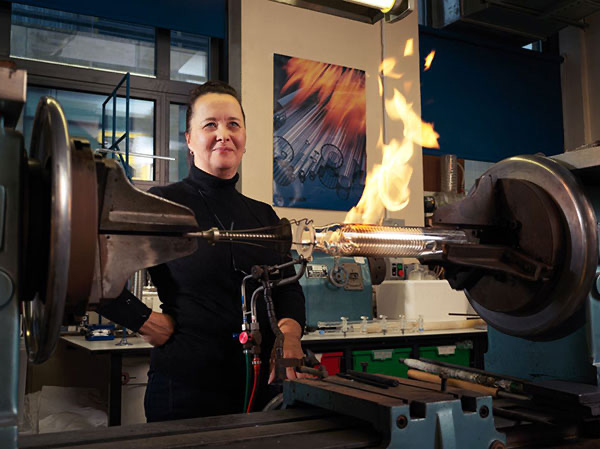
Scientific glassblower Terri Adams uses fire and heavy machinery to hand-craft delicate scientific glass apparatus. “My workbench hosts an array of tools for working with glass, many of which were custom-made for specific jobs,” says Adams. “Each tool reminds me of what I first used it for and makes me consider how I might use it again.” (Leonora Saunders for Nature)

Quote of the Day

“At the very least … we should probably consider no longer naming *new* species after awful humans.”

Scientists should stop naming animals after terrible people — and consider renaming the ones that already are, argues marine conservation biologist and science writer David Shiffman. (Scientific American)

Yesterday was Marie Skłodowska Curie’s birthday, and for the occasion, digital colorist Marina Amaral breathed new life into a photo of Curie in her laboratory. 

(If you have recommended people before and you want them to count, please ask them to email me with your details and I will make it happen!) Your feedback, as always, is very welcome at briefing@nature.com.

Flora Graham, senior editor, Nature Briefing

Knowledge Puzzles of “Far-Fetched Questions”

Heidegger (died in 1976), the German thinker (and Hannah Arendt‘s lifelong boyfriend) is walking along somewhere in France with Jean Beaufret, the French poet-philosopher, and wants to “delimit” what topics should be admitted and discussed and manage to dismiss other kinds of topics.  Heidegger says, “we do not need to ask what the connection is between Newton’s laws and the French national anthem, ‘La Marseillaise’ or between Carnot’s Principle and the sign on the shop across the street, ‘This Store is Now Shuttered.’”

In Gulliver’s Travels, the satirical masterpiece, we find a scene where the Academy of Projectors (mad scientists profs.) are trying to make cucumbers out of moonbeams and have other crazy projects.  The Academy is described in the Laputa/Lagado “flying islands” section of the satire.  Again, we grin when we read these lines in Jonathan Swift and marvel at his inventive genius. It’s not quite as simple to pin down exactly why Heidegger’s or Swift’s examples of “crazy questions or projects” are so comically nutty.  Clearly, there are experiences we all agree on as being indicative of insanity or are at the outer limits, perhaps, of Quixotism (Don Quixote).  If a person tells you he or she plans to go to the roof and reach up and put the moon in their pocket and then go the county Registrar of Deeds and declare it their property, we see multiple impossibilities and figure the person is joking, drunk or insane.

On the other hand, many questions or projects that would seem silly at one point seem less silly now: an example is, say, bringing “dinosaurs” back via DNA “resurrections.”

Thus the “knowledge quest” and its parameters is evolving in strange ways, on top of all the other uncertainties.

The Heidegger/Beaufret dialogue, mentioned above, occurs in the following book:

Dialogue with Heidegger: Greek Philosophy
Jean Beaufret
Series: Studies in Continental Thought
Publication date: 07/06/2006
ISBN: 978-0-253-34730-5