Newspapers and the “Manufacture of Consent”

When we think about newspapers, various associations come to mind. Examples include Jeff Bezos purchasing The Washington Post or William Randolph Hearst inspiring Citizen Kane. Newspapers have, to some extent, devolved into a vehicle for propaganda, as described in Walter Lippmann’s Public Opinion.

Lippmann is famously quoted for advocating the “manufacture of consent.”

Max Weber describes the economic function of newspapers:

The newspaper as an institution came into the service of commerce at an astonishingly late date.

The newspaper, as an institution, is not a product of capitalism. It brought together in the first place political news and then mainly all sorts of curiosities from the world at large. The advertisement, however, made its way into the newspaper very late. It was never entirely absent but originally it related to family announcements, while the advertisement as a notice by the merchant, directed toward finding a market, first becomes an established phenomenon at the end of the 18th century—in the journal which for a century was the first in the world, the “Times.” Official price bulletins did not become general until the 19th century; originally all the exchanges were closed clubs, as they have remained in America virtually down to the present. Hence in the 18th century, business depended on the organized exchange of letters. Rational trading between regions was impossible without secure transmission of letters. This was accomplished partly by the merchant guilds and in part by butchers, wheelwrights, etc. The final stage in the rationalization of transmission of letters was brought about by the post, which collected letters and in connection therewith made tariff agreements with commercial houses. In Germany, the family of Thurn and Taxis, who held the postal concession, made notable advances in the rationalization of communication by letter. Yet the volume of correspondence is in the beginning surprisingly small. In 1633, a million letters were posted in all England while today a place of 4,000 population will equal the number.

Max Weber, General Economic History, Collier Books, 1966 (Third Printing), page 220.

Herbert Hunt provides a useful overview of the newspaper as a political tool in his introduction to Honoré de Balzac’s Lost Illusions (French: Illusions perdues).

The first half of the nineteenth century witnessed the rapid rise to power of the periodical press. Journalism had been active — though dangerous to those engaged in it — during the Revolutionary period. Napoleon had kept the press under his thumb, as Giroudeau points out on page 235. The ‘freedom’ of the press was one of the most controversial issues both under the Restoration and the July Monarchy. Under Louis XVIII and Charles X the struggle between those who, like the Liberals and Bonapartists, wanted to keep the Revolutionary principles and gains intact, and the Conservatives of various hues, especially the ‘Ultras’, who wanted to put the political clock back, was an affair of major importance; likewise, under Louis-Philippe, the conflict between the spirit of stagnation and the parties in favour of ‘movement’. Balzac’s contention is that the majority of journalists under these three monarchs, instead of recognizing that they were called to a serious, even sacred mission, turned the Press into an instrument for self-advancement, prostituted principles to intrigue and used journalism merely as a means of acquiring money, position and power. He is reluctant to admit that there were great, responsible press organs, like Le Journal des Débats, Le Conservateur, Le Constitutionnel and, from 1824, Le Globe, which stood firm on principle; he is above all aware of the vogue which the petits journaux enjoyed after the fall of Napoleon, and of the role they played as political privateers.

The petits journaux were so-called because they were produced in smaller format than the important dailies or weeklies, which were more or less grave, staid and ponderous. They proliferated in Paris once the fall of the Empire had given a relative, though still precarious liberty to the Press — precarious because it was constantly threatened by the increasingly reactionary governments of the time. The politicians of the Right found it difficult to keep the newspapers under control even by such means as stamp-duty, caution-money, fines, suspensions and suppressions, the object of these being mainly to put obstacles in the way of would-be founders of hostile periodicals. The ‘little papers’, short-lived as they often proved to be, were much given to journalistic sharp-shooting. They preferred satire, personal attack, sarcasm and scandal-mongering to serious argument or the affirmation of ideals. They were mostly Opposition journals and were a constant thorn in the flesh of the Government. Balzac’s aim was to expose their addiction to ‘graft’, intrigue, blackmail and the misuse of the feuilleton, namely the bottom portion of the first page or other pages generally reserved for critical articles and frequently devoted to the malicious task of slashing literary reputations. Andoche Finot — the prototype of such later newspaper magnates as Émile de Girardin and Armand Dutacq, pioneers in 1836 in the founding of cheap dailies which relied on advertisement and serialized novels as a chief source of income — acquires a large share in a big daily and hands on to the equally unprincipled Lousteau the editorship of the ‘little paper’ he already owns. Balzac probably had Le Figaro chiefly in mind, a periodical which was constantly going bankrupt or being suppressed but kept popping up again under different editors. Hector Merlin’s royalist Drapeau Blanc, edited by Martainville, really existed, having been founded in 1819; so did Le Réveil. Other examples of ‘little papers’ before 1830 were Le Nain Jaume (Bonapartist), Le Diable Boiteux and Le Corsaire (both Liberal), Le Voleur, La Mode, La Silhouette, and, under Louis-Philippe, not only the phoenix-like Figaro, but also La Caricature, Le Charivari (ancestor of our English Punch), and once more Le Corsaire: a few among many. Louis-Philippe and his Cabinets were easy prey for these stinging gad-flies whose unremitting satire and innuendo remind one of the present-day Canard Enchaîné.

It is an amusing thought that, in the late twenties and early thirties, Balzac had himself been a contributor to these disreputable rags and sometimes had a hand in the running of them; for instance he had helped Philipon to found La Caricature. Throughout his career he contributed many novels in serial form to the more important newspapers, notably those founded by Girardin and Dutacq — La Presse and Le Siècle. But by the time he was writing A Great Man in Embryo he had left the petits journaux far behind him. He himself tried his luck as a newspaper-proprietor and editor: he bought La Chronique de Paris in 1836 and founded La Revue Parisienne in 1840. Both of these ventures failed. We can well imagine therefore what a large amount of bile was accumulating inside him. On the whole, reviews of his works appearing in periodicals had been hostile if not harsh. He suffered much from the disparagement of editors and critics such as Sainte-Beuve and Jules Janin respectively. He was always quarrelling with Émile de Girardin. And so he took his revenge. He had already made a preliminary attack on the periodical press in The Skin. And he followed up his attack of 1839 with his Monograph of the Paris Press (1842).

Honoré de Balzac, Lost Illusions, translated and introduced by Herbert Hunt, Penguin Books, 1971, pages xiv-xvi.

Balzac’s novel is very concerned with all aspects of journalism. For example, chapter 17 is titled “How a news-sheet is edited” and chapter 18 is a symposium on newspapers. Chapter 18 quotes a German guest who states, “I thank god there are no newspapers in my country.” (page 312). Another participant states, “In corporate crimes no one is implicated.” “A newspaper can behave in the most atrocious manner and no one on the staff considers that his own hands are soiled.” (page 314).

‘The influence and power of newspapers are only just dawning,’ said Finot. ‘Journalism is in its infancy; it will grow up. In ten years from now, everything will be subject to publicity. Thought will enlighten the world…’

Honoré de Balzac, Lost Illusions, Penguin Books, 1971, page 313.

Newspapers are an evil,’ said Claude Vignon. ‘An evil which could be utilized, but the Government wants to fight it. There’ll be a conflict. Who will go under? That’s the question.’

Honoré de Balzac, Lost Illusions, Penguin Books, 1971, page 313.

We should heed Vignon’s warning. Nazi Germany’s three main newspapers confirm this danger.
Economics-Watching: SF FedViews: September 4, 2025

[from the Federal Reserve Bank of San Francisco]

Andrew Foerster, senior research advisor at the Federal Reserve Bank of San Francisco, shared views on the current economy and the outlook from the Economic Research Department as of September 4, 2025.

While economic activity in the United States has remained resilient, recent data show some softening in the labor market. Swings in net exports affected GDP in the first half of 2025, with imports surging in the first quarter followed by imports declining in the second quarter. Inflation remains above the Fed’s 2% goal, and a near-term rise from tariffs appears likely. Job gains in recent months have slowed. Downward revisions for recent job growth estimates have been large, but the magnitudes of these revisions are not out of line with historical values. Job growth estimates remain reliable despite data collection challenges. With the balance of risks surrounding the Fed’s dual mandate now shifting, market participants are projecting an easing of monetary policy in coming months.

Read the full article [archived PDF].

Economic-Watching: Fourth District Beige Book

[from the Federal Reserve Bank of Cleveland, 3 September 2025]

Summary of Economic Activity

Fourth District contacts reported a slight increase in overall business activity in recent weeks and expected activity to rise modestly in the months ahead. Consumer spending was flat, with retailers noting continued affordability concerns among consumers. Manufacturers also reported flat demand for goods, citing trade policy uncertainty as the main driver. Demand for professional and business services grew moderately, albeit at a slower pace than in the past three reporting periods. Contacts generally reported flat employment levels and modest wage pressures. Nonlabor cost pressures remained robust, and selling prices continued to grow modestly.

Read the full report [archived PDF].

Economics-Watching: Neutral Interest Rates and the Monetary Policy Stance

[from the Federal Reserve Bank of Cleveland, 2 September 2025]

by Taylor Horn & Saeed Zaman

The neutral interest rate (r-star) is an important input in monetary policy discussions and is commonly used to assess the stance of monetary policy. This Economic Commentary presents estimates of the neutral interest rate from a recently developed model and provides a high-level description of this new model. With data through 2025:Q2, the model estimates the implied (medium-run) nominal neutral interest rate to be 3.7 percent, with a 68 percent coverage band ranging from 2.9 percent to 4.5 percent. Given that the effective nominal federal funds rate is currently in the range of 4.25 percent to 4.5 percent, this model estimates with a high level of certainty (77 percent probability) that the policy stance is in restrictive territory.

Read the full article [archived PDF].

Digitizing Heritage: Exploring the Transformation of Culture to Data

[from India in Transition by the Center for the Advanced Study of India at the University of Pennsylvania, 1 September 2025]

by Krupa Rajangam & Deborah Sutton

“Oh that. We just took some undergraduate history students on board as interns. They provided the content and it was done.

The co-founder of a digital heritage initiative promoting interactive user interfaces offered these opening remarks. Speaking at a Delhi-based museum, he had been asked about the information provided to users as they moved their hands across an interactive board, revealing images and narratives relating to the Indian freedom movement. His response clarified that the physical and digital components of such installations—for example, the 3D-modeling software and hardware, scanning equipment and its resolution and the user interface—were more carefully designed and calibrated than the content they provided.

Contemporary cultural heritage (CH) is rife with digital innovation. The COVID pandemic accelerated this transformation as archivists and curators worked to develop content that would reach remote, locked-down audiences. Within significant limits, digital platforms can democratize and facilitate access to materials previously inaccessible. Instead of being physically siloed, digitized material—as data components and not just content on culture—can be reproduced, combined, and circulated infinitely to achieve a reach previously considered impossible. Accessibility and malleability remain one of the great boons of digital formats. But here, we consider the information economy of CH practice as it exists—and not its extraordinary and often hypothetical potential—in two, overlapping realms of digitized CH: for-profit business enterprises and academic side-hustles, related to more mainstream academic research.

In the former, questions of what is shared are often less significant than the appeal of the format. In the latter, innovation is often the result of short-term projects that languish, abandoned after project completion, and rarely find audiences. Our research builds on our individual experiences and the findings of a scoping exercise examining a number of India-based heritage projects conducted in 2021-22. It suggests the need for more careful consideration of the implications of transforming CH materials into forms of data; the change impacts everything from how we understand “originality” to the reliance on for-profit services to deliver heritage material to the public.

As digitized representations of CH and access to such formats become more widespread, are we, as CH practitioners and academics, giving enough thought to how digital technologies are reshaping the nature of CH and its audience? Beyond questions of wider reach, are we sufficiently acknowledging how these changes challenge a continued focus on originality and notions of academy as primary controllers of access to knowledge and its validity, both in research and practice?

Digitizing for Dissemination

In 2019, one of us—Deborah Sutton—developed a software platform, Safarnama, including an app and authored experiences around Delhi’s CH. The project subsequently extended to Karachi. Generating “original” content, such as audio-visual clips and old photos, to be hosted on the app platform, was key to its attractiveness and usefulness, but permissions proved tricky. Some collaborators who were initially keen to contribute content quietly withdrew, likely due to the unfamiliar format and unknown reach. The app format also raised other questions. Would incorporating content from non-digital but published scholarship require authorial permission or only acknowledgement?

In 2020, Krupa Rajangam held a sponsored incubation at the NSRCEL, a business incubator located at the Indian Institute of Management-Bangalore, to develop a web interface that would host geo-locationed stories of marginalized histories by drawing on both historical facts and lived experiences. Corporate mentors remained skeptical of her ability to source “original” content on an ongoing basis, i.e., content that was both authenticated and validated. They repeatedly advised her to focus on the format, user experience, and appeal for “mass markets” so her prototype would find audiences. Both projects equally raised questions over who would consume the content and what constitutes the public or audience.

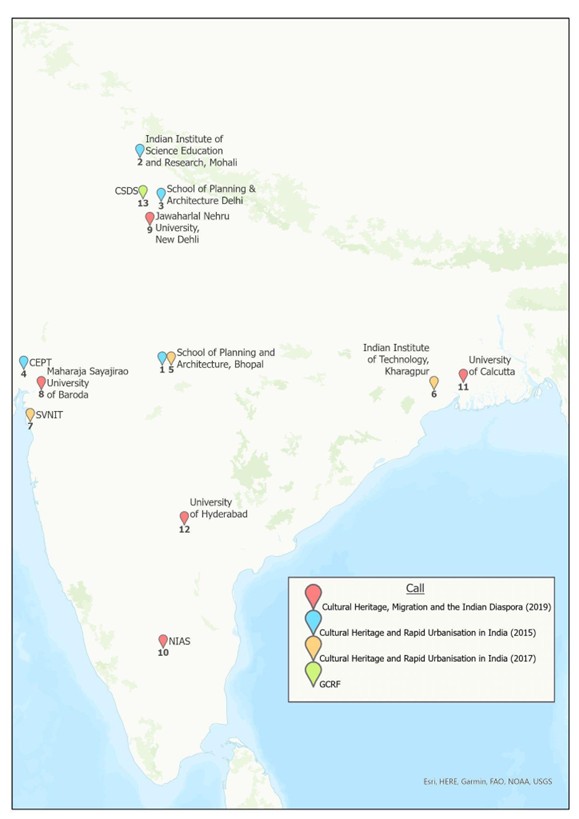
In a scoping exercise undertaken for the Arts and Humanities Research Council (AHRC), UK, in 2021-22, we explored a number of India-based heritage projects funded by the AHRC in partnership with the Newton Fund and Indian Council for Historical Research, since 2015 (figure 1). We were particularly interested in the digital components, which all projects included, even if only a website.

Our exploratory surveys firmly established the divergence in interpreting both CH and digital technologies, which was not surprising. Some projects defined and treated CH as fixed pre-existing material, to be interpreted and presented to audiences through digital technologies. Others re-framed digital formats of CH as components of data, assembling, manipulating, and representing extant archival and other materials. The rest generated digitized CH, effectively altering its nature. Typically, such projects dealt with more ephemeral or less conventional forms of CH.

Fundamental Transformations

Notions of originality remain central to art, architectural and art historical training, and CH practice. Digitization transforms the access and retrieval value of “original” material in physical archives, such as old maps and letters, much lauded in traditional “analog” scholarship, to use value as data. Once the end-user (audience) accesses this data (whether historical facts or stories), it becomes nothing more than bytes occupying valuable space, to be deleted once consumed rather than stored, making it easy to overlook or disregard the source and its context.

For example, in the Safarnama project, the app contained carefully collected and authenticated narratives on “partition memories” in Delhi and Karachi. However, the bite-sized media format meant that users would only explore content once, as snippets. This realization led the team to develop the software and incorporate the ability to download content, which at least meant that users could collect, organize and store (archive) the assembled media.

Digitization also takes away the materiality of the archive, making it more ephemeral. Non-digital materials through, and into which we render CH can (in endless combinations and cycles) be lost, forgotten, sold, recovered, collected, displayed, and stored. Such capacities of digital files are obvious, but maintaining access depends on varied and dynamic software ecologies for existence and sustained end-user access. Digital files created within one software-architecture can be incompatible with, and therefore rendered obsolete, by another. The ethos of software development is constant change.

In another paper, we examined questions of quantity, quality, and reusability of data related to digitization of building-crafts knowledge alongside CARE and FAIR principles of data management. The principles were proposed and adopted by an international consortium of scholars and industry, the former focused on responsible collection, use, and dissemination of data, especially related to vulnerable people and the latter on sustainable data management.

As an example, one AHRC project experimented with methods to capture detailed 3D images of heritage sites and structures in dynamic crowded environments. They used one set of methods to capture the interiors and another for the exteriors, hoping to merge both together and develop holistic imagery for audiences. This proved impossible at first due to issues of software compatibility. Once that was partially resolved, the new software couldn’t handle the sheer volume of data captured—and it was unclear where and for how long such volumes of data would be stored.

New realms of intellectual property remain fuzzy. While the content on digital platforms is governed by licensing and proprietary legal frameworks, it is often hosted on open platforms, through web repositories such as GitHub. Prima facie, such openness appears to challenge the proprietorial nature of archives and other repositories as keepers of knowledge. However, it raises a host of questions about how to maintain a critical understanding of archives.

Digitization may, and should, transform access but should it obliterate the regimes through which the materials were generated and organized and what’s included or excluded? For example, a local coordinator of one project that engaged with artists commented that digital technologies are typically used to document technical skills as forms of intangible heritage and develop artist encyclopedias, saying that “they are hardly used to interrogate the reality that many ‘traditional’ artists hail from marginalized castes.” Similarly, the local coordinator of another project that engaged with communities living in and around a protected heritage site commented on how digital technologies often end up being used to create a record of heritage structures without any reference to their day-to-day setting.

Any and all digital enterprise in CH, we argue, needs to integrate the ambition to use digital methods to not just present but also counter and interrogate the material, its creation, and purpose. Digital platforms and web- and app-based software are now able to manipulate and re-situate information in unprecedented ways. The novelty of such formats can displace original, provocative, and timely considerations of the material. Often, we are so taken by the visual and structural attributes of these formats, that we accept it at face value and lose sight of the tone and content of heritage as a curated message about the past and the present.

Alongside this, digital augmentations and iterations of CH, including storage, have significant financial and infrastructural implications. The creation and maintenance of digital platforms requires either developing “in-house” digital specialization or, more commonly, reliance on private, for-profit platforms. Paying for external provision introduces complexities. Funders, including the AHRC, struggle to devise guidance or policy in relation to software licensing. However, a persistent challenge to projects, and partnerships between academic and non-academic partners, is devising data and software strategies that subsist beyond the life of the funded-research project. Often, the adverse effects of the paucity of longer-term planning around IP issues, sustainability, and data archiving falls disproportionately on the non-academic stakeholder.

While digitization foregrounds the potential and promise of complete openness and equity, maybe this is lost in practice. Or digitization may merely mark the displacement of one set of ethics with another. There is a need for more careful consideration of the implications, complexities, and risks of taking CH materials out of boxes and off shelves and transforming and generating it into data files, which are, in turn, dependent on digital platforms to provide end-user access. However, the question remains of whether heritage-related disciplines are adequately prepared and willing to confront such new ways of working, which have begun to dislodge some of the privileges extant in current forms of research and practice.

Krupa Rajangam is nearing the end of her tenure as a Fulbright Fellow at the Historic Preservation Department, Weitzman School of Design, University of Pennsylvania. Her permanent designation is Founder-Director, Saythu…linking people and heritage, a professional conservation collective based in Bangalore, India.

Deborah Sutton is a Professor in Modern South Asian History at Lancaster University.

Price Revolutions and Their Historical Impact

In 1996, leading economic historian, David Hackett Fischer, published The Great Wave: Price Revolutions and the Rhythm of History. If you ponder the subtitle, you may grasp the work’s ambition.

Nobel Prize-winning economist Paul Krugman has been arguing with Fischer for many years that, in making the transition from business to historical cycles, Fischer’s position is problematic.

There are, of course, detailed histories of prices, such as Thomas Tooke’s A History of Prices and of the State of the Circulation during the Years 1793–1856 (6 volumes, 1838–1857).

In the first four volumes he treats (a) of the prices of corn, and the circumstances affecting prices; (b) the prices of produce other than corn; and (c) the state of the circulation. The two final volumes, written with William Newmarch, deal with railways, free trade, banking in Europe and the effects of new discoveries of gold.

Wikipedia (links added)

Tooke-type price histories are one thing, but what about Fischer’s price revolutions? Max Weber (who predates Fischer by almost a century) seems to endorse this concept. In Weber’s General Economic History (German: Wirtschaftsgeschichte), he writes:

The great price revolution of the 16th and 17th centuries provided a powerful lever for the specifically capitalistic tendencies of seeking profit through cheapening production and lowering the price. This revolution is rightly ascribed to the continuous inflow of precious metals, in consequence of the great overseas discoveries. It lasted from the thirties of the 16th century down to the time of the Thirty Years’ War, but affected different branches of economic life in quite different ways. In the case of agricultural products an almost universal rise in price set in, making it possible for them to go over to production for the market. It was quite otherwise with the course of prices for industrial products. By and large these remained stable or rose in price relatively little, thus really falling, in comparison with the agricultural products. This relative decline was made possible only through a shift in technology and economics, and exerted a pressure in the direction of increasing profit by repeated cheapening of production. Thus the development did not follow the order that capitalism set in first and the decline in prices followed, but the reverse; first the prices fell relatively and then came capitalism.

Max Weber, General Economic History, Collier Books (3rd printing), 1966, pages 230-231.

Notice the last sentence above, Weber explicitly describes price revolutions exactly as Fischer argues.

In the history books we read, the emphasis is always on colorful personalities, inventions and other more theatrical events. This obviously omits the idea of phenomena like price revolutions. We cannot explain history merely by these personalities; we need to zoom out and view the larger picture.

Why Is Technological History So Misleading?

We are conditioned to think of technological history in a very binary way. For thousands of years before motorized transportation, we think of horses and wind-powered ships. We also sense that if we brought great historical minds from before the industrial revolution to a modern city, most likely they would be stunned by the technology surrounding them. Think of a world of medical science before anesthesia and germ theory.

Let’s modify this binary view of human history. David F. Noble gives us a more accurate view:

Augustine, the chief author of Christian orthodoxy, wrote in The City of God, “there have been discovered and perfected, by the natural genius of man, innumerable arts and skills which minister not only to the necessities of life but also to human enjoyment.” Augustine recognized the “astonishing achievements” that had taken place in cloth-making, navigation, architecture, agriculture, ceramics, medicine, weaponry and fortification, animal husbandry, and food preparation; in mathematics, astronomy, and philosophy; as well as in language, writing, music, theater, painting, and sculpture. But he emphasized again that “in saying this, of course, I am thinking only of the nature of the human mind as a glory of this mortal life, not of faith and the way of truth that leads to eternal life… And, remember, all these favors taken together are but the fragmentary solace allowed us in a life condemned to misery.”5

5 St. Augustine, The City of God (Garden City, N.Y.: Doubleday, 1958), pp. 526, 527.

David F. Noble, The Religion of Technology: The Divinity of Man and the Spirit of Invention, Penguin Books, 1999 (originally 1997), pages 11-12.

Note that Augustine wrote The City of God in 426 AD, meaning that even 1600 years ago, they had already made colossal advances. The prejudice that we have, given our scientific training, is utterly misleading. Rather than being blinded by Biblical explanations of how the world came to be, Augustine lauded these scientific advancements. We think of Thomas Edison and the lightbulb, rather than, “Let there be light.”

There are various levels of empirical and artisanal knowledge. In cooking, we rarely worry about molecules that make up ingredients. All these daily life pillars Augustine lists cannot be overlooked, even as we unlock the submicroscopic world of quantum mechanics.

Gov’t-Watching: Newly Issued Comptroller General Legal Decisions, 27 August 2025

[from the United States Government Accountability Office]

The Government Accountability Office (GAO) today issued the following legal decisions and opinions of the Comptroller General:

Bid Protest Decisions

B-422245.6 [archived PDF], Centuria Corporation, August 1, 2025

Centuria Corporation, a service-disabled veteran-owned small business (SDVOSB) of Reston, Virginia, protests the issuance of a task order to DecisionPoint Corporation, known at the time of proposal submission as EmeSec Inc., a SDVOSB of Gaithersburg, Maryland, under fair opportunity proposal request (FOPR) No. FA8773-23-R-0003, issued by the Department of the Air Force for defensive cyber realization, integration, and operational support services. Centuria argues that the Air Force conducted discussions with the awardee without affording it an opportunity to submit a revised proposal as required by Federal Acquisition Regulation (FAR) section 15.307(b).

We deny the protest.

B-423635 [archived PDF], Helgen Industries d/b/a DeSantis Gunhide, August 26, 2025

Helgen Industries, doing business as DeSantis Gunhide, protests the award of a contract to Safariland, LLC, under request for proposals (RFP) No. SHOP-PR-25-001520, issued by the Department of Justice, Federal Bureau of Investigation (FBI), for concealment and tactical holsters. The protester contends that the awardee is an ineligible large business.

We dismiss the protest.

B-422666.2 [archived PDF], Perimeter Security Partners, LLC—Costs, August 8, 2025

Perimeter Security Partners, LLC (PSP), a small business of Brentwood, Tennessee, requests that our Office recommend that it be reimbursed for the costs of filing and pursuing its protest challenging the issuance of a task order to Low Voltage Wiring, Ltd. (LVW), a small business of Colorado Springs, Colorado, under request for quotations (RFQ) No. W912DY-24-R-0008, issued by the Department of the Army, U.S. Army Corps of Engineers (Corps), for preventative and corrective maintenance services for access control points at 19 Army installations in the northeast region of the United States. PSP argues that it should be reimbursed its protest costs because the agency unduly delayed taking corrective action in response to its clearly meritorious protest.

We grant the request.

Congressional Review Act

B-337397 [archived PDF], U.S. Department of Health and Human Services—Applicability of the Congressional Review Act to Policy on Adhering to the Text of the Administrative Procedure Act, August 27, 2025

On March 3, 2025, the U.S. Department of Health and Human Services (HHS) published in the Federal Register a policy statement titled, Policy on Adhering to the Text of the Administrative Procedure Act (2025 Policy Statement or Policy Statement). The 2025 Policy Statement rescinds a prior policy generally requiring HHS agencies and offices to use Administrative Procedure Act (APA) notice-and-comment procedures for rules relating to public property, loans, grants, benefits, or contracts and establishes a new policy giving HHS agencies and offices discretion whether to use notice-and-comment procedures for such rules.

The Congressional Review Act (CRA) requires that before a rule can take effect, an agency must submit the rule to both the House of Representatives and the Senate, as well as the Comptroller General. CRA adopts the definition of “rule” under APA but excludes certain categories of rules from coverage. We conclude that the 2025 Policy Statement is a rule for purposes of CRA because it meets the APA definition of a rule, and no CRA exception applies. Therefore, the Policy Statement is a rule subject to CRA’s submission requirements.

Economics-Watching: Will Tariffs Touch Off an Inflationary Impulse? Business Execs Think So.

[from Federal Reserve Bank of Atlanta, 21 August 2025]

Summary

Following the inflationary surge from 2021 to 2023, which was touched off by supply chain constraints and shipping bottlenecks, we evaluate a new panel of own-firm price and unit cost growth expectations in the Atlanta Fed’s Survey of Business Uncertainty for signs that the anticipated impact from tariffs is broadening beyond directly affected firms. We find evidence for the potential of tariffs to touch off another bout of high inflation. First, firms that are directly exposed to tariffs have increased their year-ahead price growth expectations sharply (by 0.7 percentage points). Second, firms that are not directly exposed to tariffs but are operating in industries that are highly exposed to tariffs anticipate a moderately higher trajectory for year-ahead price growth (0.3 percentage points). Third, this broadening of overall price pressures—a key feature of the pandemic-era inflationary impulse—is only partially offset by lower price increases from tariff-exposed firms that are operating largely in industries not exposed to tariffs.

Key Findings

  1. Firms, en masse, have increased their year-ahead price growth expectations since the end of 2024. This is especially true for firms directly exposed to tariffs.
  2. We find evidence of a broadening out of the influence of tariffs beyond those directly exposed. Unexposed firms in exposed industries anticipate a moderately higher trajectory of year-ahead price growth.
  3. The broadening of anticipated price growth is only partially offset by lower price growth expectations among tariff-exposed firms that are operating in largely unexposed industries.

Read the full article [archived PDF]

Economics-Watching: Drewry Container Shipping Financial Insight, August 2025

[from Drewry Shipping Consultants, 22 August 2025]

Container shipping companies have reported mixed 2Q25 results. Read the article [archived PDF] for key takeaways from 2Q25 results and other key developments shaping the container shipping sector.

About Drewry Maritime Financial Research

Drewry Maritime Financial Research (DMFR), is the marketing name of Drewry Financial Research Services Ltd. DMFR, is an independent equity research service focused on the maritime industry. DMFR’s parent organisation, Drewry Shipping Consultants Holdings Limited was established more than 50 years ago and is now widely regarded as one of the leading independent sources of global industry analysis and insight. This in-depth industry knowledge is fully applied in our analysis of quoted maritime companies.