Japan-Watching: Ministry of Foreign Affairs of Japan

First Meeting of the Study Group on Strengthening Japan-Africa Economic Partnership

At TICAD 9 held last August, Mr. ISHIBA Shigeru (石破 茂), then Prime Minister of Japan, announced the establishment of the “Study Group on Strengthening JapanAfrica Economic Partnership” as one of the concrete initiatives of the Japanese Government’s policy on Africa. The first meeting of this study group is scheduled for June 18 in a hybrid format.

Under the framework of a “Free and Open Indo-Pacific (FOIP)”, this study group will address African economic integration, a top priority for the African Union (AU). Through strengthening economic cooperation between Japan and Africa, the study group aims to support business expansion of Japanese companies in the African market. To this end, the study group will discuss various topics including measures to promote regional economic integration in Africa, review of trade and investment between Japan and Africa, and the strengthening of economic relations between Japan and Africa. The study group will prepare a report by the end of the fiscal year 2027, which will be submitted to the Minister for Foreign Affairs.

(Reference 1) Japanese Members

Prof. WATANABE Yorizumi (渡邊 頼純), Professor Emeritus, Keio University; Dr. KIMURA Fukunari (木村 福成), President, JETRO Asian Economic Research Institute; Mr. FUJITA Ryoji (藤田 亮二), Executive Officer, Toyota Tsusho Corporation (Representative from Keidanren); WATANABE Tatsuro (渡邉 達郎), Managing Executive Officer, Mitsui O.S.K. Lines (Representative from Keizai Doyukai); IGARASHI Katsuya (五十嵐 克也), Director and Head of International Department, the Japan Chamber of Commerce and Industry; and representatives from the Ministry of Foreign Affairs, Ministry of Finance, Ministry of Agriculture, Forestry and Fisheries, and Ministry of Economy, Trade and Industry.

(Reference 2) African Members

Mr. Lacina Koné, Director General and CEO, Smart Africa Alliance; Mr. Kulekani Mathe, CEO, Business Unity South Africa (BUSA); Dr. E. Olawale Ogunkola, Professor of Economics, University of Ibadan, Nigeria; and representatives from the United Nations Economic Commission for Africa (UNECA), the African Continental Free Trade Area (AfCFTA) Secretariat, and the African Union Commission (AUC).

(Note) In addition, relevant Ministries, agencies, and individuals with expertise are expected to attend depending on the agenda.

(Reference 3) Attachment

Establishment of the Study Group on Strengthening Japan-Africa Economic Partnership [Archived PDF]

G7 Evian Summit

Working Session on “Reviving a Balanced, Shared and Sustainable Economic Growth”

On June 17, commencing at 10:30 a.m. (local time. 5:30 p.m. on June 17, Japan time.) for approximately 120 minutes, Ms. TAKAICHI Sanae (高市 早苗), Prime Minister of Japan, attended the G7 Evian Summit Working Session on “Reviving balanced, inclusive, and sustainable economic growth for the benefit of all”. The overview of the session is as follows.

  1. Prime Minister TAKAICHI stated that the G7 and like-minded countries should maintain close communication to reduce uncertainty in the global economy.
    Prime Minister TAKAICHI also stated that it is a common challenge for many countries to promote self-sustaining growth, by addressing non-market policies and practices (NMPPs) and the resulting excess capacity which are drivers of widening global imbalances.
  2. Furthermore, Prime Minister TAKAICHI stated that G7 members and the countries participating in this session should also demonstrate their contribution to reducing imbalances for their own balanced growth as well as for the stability of the global economy and financial markets. Prime Minister TAKAICHI added that making use of data-driven, objective analyses and policy advice by the IMF and the OECD is extremely beneficial in advancing these efforts.
  3. Prime Minister TAKAICHI expressed her hope that the G7 and like-minded countries would lead the global economy through frank discussions. She also stated that she looked forward to discussions at the G20, chaired by President Donald Trump of the United States, on reducing uncertainty in the global economy and becoming stronger and more prosperous together.

Situation in Iran (Signing of a Memorandum of Understanding between the United States and Iran)

(Message from Foreign Minister MOTEGI Toshimitsu [茂木 敏充])

On June 18 (Japan Standard Time), the United States and Iran signed a Memorandum of Understanding and the cessation of hostilities was declared. Japan once again welcomes the fruition of the diplomatic efforts made by the parties as well as the countries that played a role in mediation.

Hereafter, it is important that free and safe navigation through the Strait of Hormuz is swiftly reestablished through the steady implementation of this MoU by all parties. Japan also considers it of critical importance that vessels be able to transit the Strait of Hormuz without being subject to additional costs, as has been the case thus far.

Japan strongly hopes that a final agreement on matters such as Iran’s nuclear issue will be achieved as soon as possible through further negotiations between the United States and Iran. Japan will also support the peaceful resolution of the Iranian nuclear issue including through coordination with the International Atomic Energy Agency (IAEA).

After the conclusion of a final agreement, Japan intends to play an active role in the reconstruction and recovery of the region. Japan will also continue to make every diplomatic effort, in close coordination with the international community, toward the realization of peace and stability throughout the Middle East region.

Parliamentary Vice-Minister for Foreign Affairs ERI’s Visit to the United States

From June 21 to June 24, Ms. ERI Arfiya (英利 アルフィヤ), Parliamentary Vice-Minister for Foreign Affairs of Japan, will visit New York, United States.

During her visit, Parliamentary Vice-Minister ERI will attend the United Nations General Assembly High-Level Meeting on HIV/AIDS and deliver a statement in the meeting. She will also hold meetings with representatives of international organizations.

(Reference) Schedule
June 21Departure from Tokyo
 Arrival at New York
June 22Participation in the United Nations General Assembly High-Level Meeting on HIV/AIDS, etc.
June 23Meetings with representatives of international organizations, etc.
 Departure from New York
June 24Arrival at Tokyo

The 7th Japan-Australia Cyber Policy Dialogue

On June 18, the 7th JapanAustralia Cyber Policy Dialogue was held in Tokyo, Japan.

  1. This whole-of-government meeting was co-chaired by Mr. MIYAKE Fumito (三宅 史人), Ambassador in charge of Cyber Policy and Deputy Director-General of the Foreign Policy Bureau, Ministry of Foreign Affairs (MOFA) of Japan, and Ms. Jessica Hunter, Ambassador for Cyber Affairs and Critical Technology, Department of Foreign Affairs and Trade (DFAT), Australia, with the participation of officials from, on the Japanese side, MOFA, National Cybersecurity Office (NCO), National Police Agency (NPA), Ministry of Defense (MOD), Ministry of Internal Affairs and Communications (MIC) and Ministry of Economy, Trade and Industry (METI), and on the Australian side, DFAT, Department of Industry and Australian Signals Directorate (ASD)’s Australian Cyber Security Centre (ACSC) and Department of Home Affairs (DHA).
  2. At this dialogue, following the enactment of Japan’s Cyber Response Capability Strengthening Act and Necessary Arrangement of Relevant Acts last year, as well as the adoption of its new Cybersecurity Strategy, the two sides exchanged views on broad range of topics, such as each country’s respective cybersecurity strategy and policy, and cooperation at both the bilateral and multilateral levels.
  3. Furthermore, building on the “JapanAustralia Strategic Cyber Partnership” which Ms. TAKAICHI Sanae (高市 早苗), Prime Minister of Japan and the Hon. Anthony Albanese, Prime Minister of Australia concurred on launching at the JapanAustralia Summit Meeting in May of this year, the two sides exchanged views on efforts and cooperation in a wide range of areas including the defense and deterrence of cyber threats, capacity-building, public-private partnerships, and artificial intelligence (AI) and cybersecurity.
  4. Both sides confirmed that they will continue to work closely together in the field of cyber, including through the JapanAustralia Cyber Policy Dialogue.

[from the Ministry of Foreign Affairs of Japan, 18-19 June, 2026]
Digitizing Heritage: Exploring the Transformation of Culture to Data

[from India in Transition by the Center for the Advanced Study of India at the University of Pennsylvania, 1 September 2025]

by Krupa Rajangam & Deborah Sutton

“Oh that. We just took some undergraduate history students on board as interns. They provided the content and it was done.

The co-founder of a digital heritage initiative promoting interactive user interfaces offered these opening remarks. Speaking at a Delhi-based museum, he had been asked about the information provided to users as they moved their hands across an interactive board, revealing images and narratives relating to the Indian freedom movement. His response clarified that the physical and digital components of such installations—for example, the 3D-modeling software and hardware, scanning equipment and its resolution and the user interface—were more carefully designed and calibrated than the content they provided.

Contemporary cultural heritage (CH) is rife with digital innovation. The COVID pandemic accelerated this transformation as archivists and curators worked to develop content that would reach remote, locked-down audiences. Within significant limits, digital platforms can democratize and facilitate access to materials previously inaccessible. Instead of being physically siloed, digitized material—as data components and not just content on culture—can be reproduced, combined, and circulated infinitely to achieve a reach previously considered impossible. Accessibility and malleability remain one of the great boons of digital formats. But here, we consider the information economy of CH practice as it exists—and not its extraordinary and often hypothetical potential—in two, overlapping realms of digitized CH: for-profit business enterprises and academic side-hustles, related to more mainstream academic research.

In the former, questions of what is shared are often less significant than the appeal of the format. In the latter, innovation is often the result of short-term projects that languish, abandoned after project completion, and rarely find audiences. Our research builds on our individual experiences and the findings of a scoping exercise examining a number of India-based heritage projects conducted in 2021-22. It suggests the need for more careful consideration of the implications of transforming CH materials into forms of data; the change impacts everything from how we understand “originality” to the reliance on for-profit services to deliver heritage material to the public.

As digitized representations of CH and access to such formats become more widespread, are we, as CH practitioners and academics, giving enough thought to how digital technologies are reshaping the nature of CH and its audience? Beyond questions of wider reach, are we sufficiently acknowledging how these changes challenge a continued focus on originality and notions of academy as primary controllers of access to knowledge and its validity, both in research and practice?

Digitizing for Dissemination

In 2019, one of us—Deborah Sutton—developed a software platform, Safarnama, including an app and authored experiences around Delhi’s CH. The project subsequently extended to Karachi. Generating “original” content, such as audio-visual clips and old photos, to be hosted on the app platform, was key to its attractiveness and usefulness, but permissions proved tricky. Some collaborators who were initially keen to contribute content quietly withdrew, likely due to the unfamiliar format and unknown reach. The app format also raised other questions. Would incorporating content from non-digital but published scholarship require authorial permission or only acknowledgement?

In 2020, Krupa Rajangam held a sponsored incubation at the NSRCEL, a business incubator located at the Indian Institute of Management-Bangalore, to develop a web interface that would host geo-locationed stories of marginalized histories by drawing on both historical facts and lived experiences. Corporate mentors remained skeptical of her ability to source “original” content on an ongoing basis, i.e., content that was both authenticated and validated. They repeatedly advised her to focus on the format, user experience, and appeal for “mass markets” so her prototype would find audiences. Both projects equally raised questions over who would consume the content and what constitutes the public or audience.

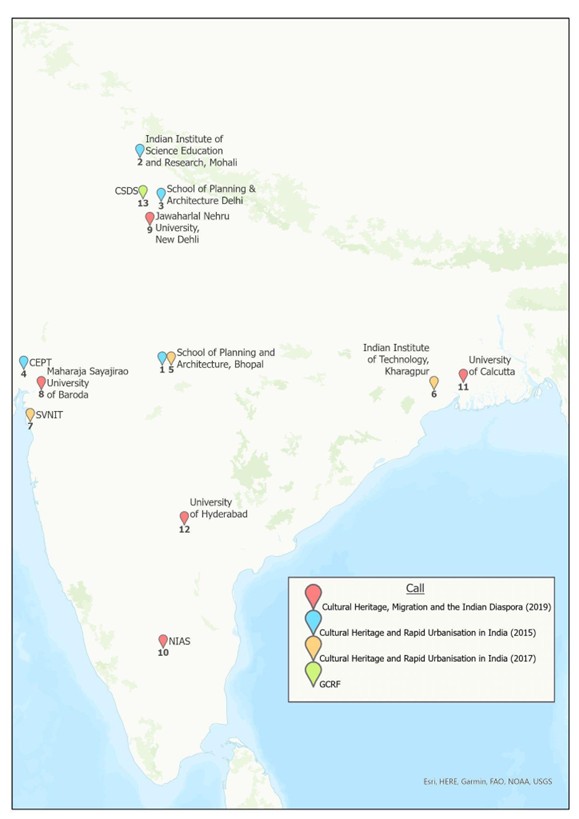
In a scoping exercise undertaken for the Arts and Humanities Research Council (AHRC), UK, in 2021-22, we explored a number of India-based heritage projects funded by the AHRC in partnership with the Newton Fund and Indian Council for Historical Research, since 2015 (figure 1). We were particularly interested in the digital components, which all projects included, even if only a website.

Our exploratory surveys firmly established the divergence in interpreting both CH and digital technologies, which was not surprising. Some projects defined and treated CH as fixed pre-existing material, to be interpreted and presented to audiences through digital technologies. Others re-framed digital formats of CH as components of data, assembling, manipulating, and representing extant archival and other materials. The rest generated digitized CH, effectively altering its nature. Typically, such projects dealt with more ephemeral or less conventional forms of CH.

Fundamental Transformations

Notions of originality remain central to art, architectural and art historical training, and CH practice. Digitization transforms the access and retrieval value of “original” material in physical archives, such as old maps and letters, much lauded in traditional “analog” scholarship, to use value as data. Once the end-user (audience) accesses this data (whether historical facts or stories), it becomes nothing more than bytes occupying valuable space, to be deleted once consumed rather than stored, making it easy to overlook or disregard the source and its context.

For example, in the Safarnama project, the app contained carefully collected and authenticated narratives on “partition memories” in Delhi and Karachi. However, the bite-sized media format meant that users would only explore content once, as snippets. This realization led the team to develop the software and incorporate the ability to download content, which at least meant that users could collect, organize and store (archive) the assembled media.

Digitization also takes away the materiality of the archive, making it more ephemeral. Non-digital materials through, and into which we render CH can (in endless combinations and cycles) be lost, forgotten, sold, recovered, collected, displayed, and stored. Such capacities of digital files are obvious, but maintaining access depends on varied and dynamic software ecologies for existence and sustained end-user access. Digital files created within one software-architecture can be incompatible with, and therefore rendered obsolete, by another. The ethos of software development is constant change.

In another paper, we examined questions of quantity, quality, and reusability of data related to digitization of building-crafts knowledge alongside CARE and FAIR principles of data management. The principles were proposed and adopted by an international consortium of scholars and industry, the former focused on responsible collection, use, and dissemination of data, especially related to vulnerable people and the latter on sustainable data management.

As an example, one AHRC project experimented with methods to capture detailed 3D images of heritage sites and structures in dynamic crowded environments. They used one set of methods to capture the interiors and another for the exteriors, hoping to merge both together and develop holistic imagery for audiences. This proved impossible at first due to issues of software compatibility. Once that was partially resolved, the new software couldn’t handle the sheer volume of data captured—and it was unclear where and for how long such volumes of data would be stored.

New realms of intellectual property remain fuzzy. While the content on digital platforms is governed by licensing and proprietary legal frameworks, it is often hosted on open platforms, through web repositories such as GitHub. Prima facie, such openness appears to challenge the proprietorial nature of archives and other repositories as keepers of knowledge. However, it raises a host of questions about how to maintain a critical understanding of archives.

Digitization may, and should, transform access but should it obliterate the regimes through which the materials were generated and organized and what’s included or excluded? For example, a local coordinator of one project that engaged with artists commented that digital technologies are typically used to document technical skills as forms of intangible heritage and develop artist encyclopedias, saying that “they are hardly used to interrogate the reality that many ‘traditional’ artists hail from marginalized castes.” Similarly, the local coordinator of another project that engaged with communities living in and around a protected heritage site commented on how digital technologies often end up being used to create a record of heritage structures without any reference to their day-to-day setting.

Any and all digital enterprise in CH, we argue, needs to integrate the ambition to use digital methods to not just present but also counter and interrogate the material, its creation, and purpose. Digital platforms and web- and app-based software are now able to manipulate and re-situate information in unprecedented ways. The novelty of such formats can displace original, provocative, and timely considerations of the material. Often, we are so taken by the visual and structural attributes of these formats, that we accept it at face value and lose sight of the tone and content of heritage as a curated message about the past and the present.

Alongside this, digital augmentations and iterations of CH, including storage, have significant financial and infrastructural implications. The creation and maintenance of digital platforms requires either developing “in-house” digital specialization or, more commonly, reliance on private, for-profit platforms. Paying for external provision introduces complexities. Funders, including the AHRC, struggle to devise guidance or policy in relation to software licensing. However, a persistent challenge to projects, and partnerships between academic and non-academic partners, is devising data and software strategies that subsist beyond the life of the funded-research project. Often, the adverse effects of the paucity of longer-term planning around IP issues, sustainability, and data archiving falls disproportionately on the non-academic stakeholder.

While digitization foregrounds the potential and promise of complete openness and equity, maybe this is lost in practice. Or digitization may merely mark the displacement of one set of ethics with another. There is a need for more careful consideration of the implications, complexities, and risks of taking CH materials out of boxes and off shelves and transforming and generating it into data files, which are, in turn, dependent on digital platforms to provide end-user access. However, the question remains of whether heritage-related disciplines are adequately prepared and willing to confront such new ways of working, which have begun to dislodge some of the privileges extant in current forms of research and practice.

Krupa Rajangam is nearing the end of her tenure as a Fulbright Fellow at the Historic Preservation Department, Weitzman School of Design, University of Pennsylvania. Her permanent designation is Founder-Director, Saythu…linking people and heritage, a professional conservation collective based in Bangalore, India.

Deborah Sutton is a Professor in Modern South Asian History at Lancaster University.

Science-Watching: Why Do Batteries Sometimes Catch Fire and Explode?

[from Berkeley Lab News, by Theresa Duque]

Key Takeaways
  • Scientists have gained new insight into why thermal runaway, while rare, could cause a resting battery to overheat and catch fire.
  • In order to better understand how a resting battery might undergo thermal runaway after fast charging, scientists are using a technique called “operando X-ray microtomography” to measure changes in the state of charge at the particle level inside a lithium-ion battery after it’s been charged.
  • Their work shows for the first time that it is possible to directly measure current inside a resting battery even when the external current measurement is zero.
  • Much more work is needed before the findings can be used to develop improved safety protocols.

How likely would an electric vehicle battery self-combust and explode? The chances of that happening are actually pretty slim: Some analysts say that gasoline vehicles are nearly 30 times more likely to catch fire than electric vehicles. But recent news of EVs catching fire while parked have left many consumers – and researchers – scratching their heads over how these rare events could possibly happen.

Researchers have long known that high electric currents can lead to “thermal runaway” – a chain reaction that can cause a battery to overheat, catch fire, and explode. But without a reliable method to measure currents inside a resting battery, it has not been clear why some batteries go into thermal runaway, even when an EV is parked.

Now, by using an imaging technique called “operando X-ray microtomography,” scientists at Lawrence Berkeley National Laboratory (Berkeley Lab) and UC Berkeley have shown that the presence of large local currents inside batteries at rest after fast charging could be one of the causes behind thermal runaway. Their findings were reported in the journal ACS Nano.

“We are the first to capture real-time 3D images that measure changes in the state of charge at the particle level inside a lithium-ion battery after it’s been charged,” said Nitash P. Balsara, the senior author on the study. Balsara is a faculty senior scientist in Berkeley Lab’s Materials Sciences Division and a UC Berkeley professor of chemical and biomolecular engineering.

“What’s exciting about this work is that Nitash Balsara’s group isn’t just looking at images – They’re using the images to determine how batteries work and change in a time-dependent way. This study is a culmination of many years of work,” said co-author Dilworth Y. Parkinson, staff scientist and deputy for photon science operations at Berkeley Lab’s Advanced Light Source (ALS).

The team is also the first to measure ionic currents at the particle level inside the battery electrode.

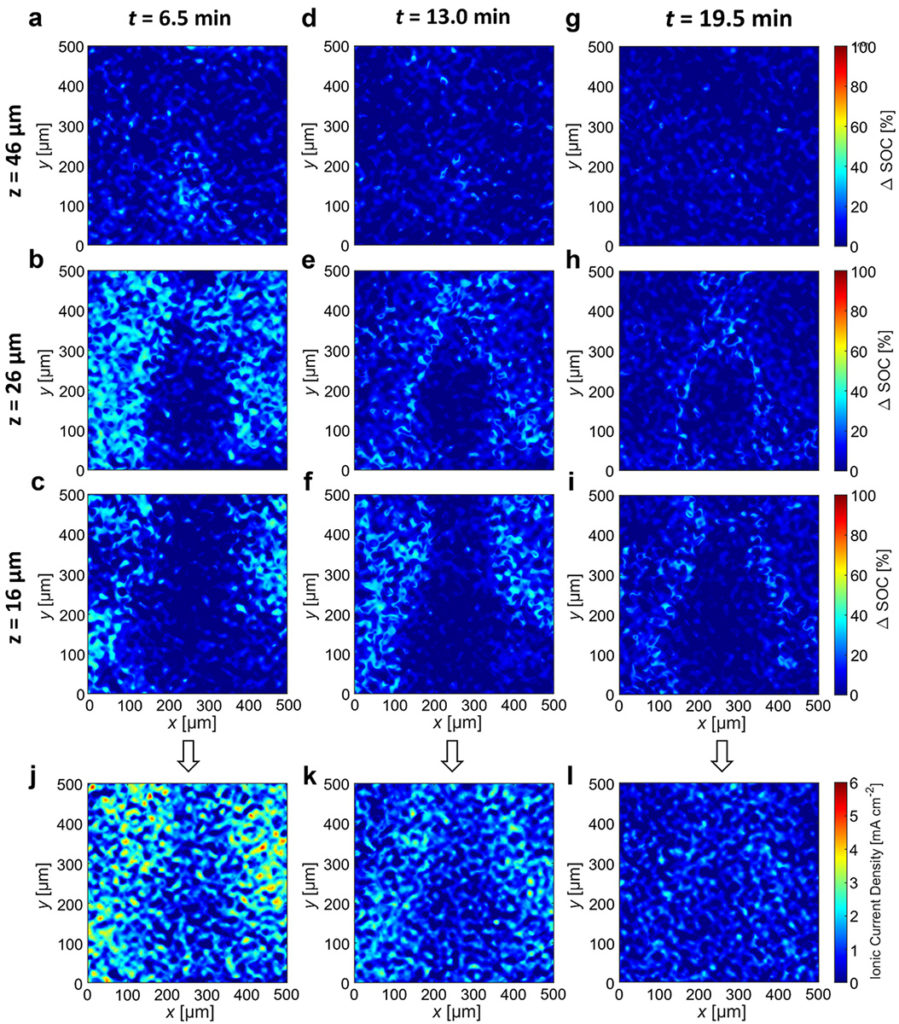
3D microtomography experiments at the Advanced Light Source enabled researchers to pinpoint which particles generated current densities as high as 25 milliamps per centimeter squared inside a resting battery after fast charging. In comparison, the current density required to charge the test battery in 10 minutes was 18 milliamps per centimeter squared. (Credit: Nitash Balsara and Alec S. Ho/Berkeley Lab. Courtesy of ACS Nano)
Measuring a battery’s internal currents

In a lithium-ion battery, the anode component of the electrode is mostly made of graphite. When a healthy battery is charged slowly, lithium ions weave themselves between the layers of graphite sheets in the electrode. In contrast, when the battery is charged rapidly, the lithium ions have a tendency to deposit on the surface of the graphite particles in the form of lithium metal.

“What happens after fast charging when the battery is at rest is a little mysterious,” Balsara said. But the method used for the new study revealed important clues.

Experiments led by first author Alec S. Ho at the ALS show that when graphite is “fully lithiated” or fully charged, it expands a tiny bit, about a 10% change in volume – and that current in the battery at the particle level could be determined by tracking the local lithiation in the electrode. (Ho recently completed his Ph.D. in the Balsara group at UC Berkeley.)

A conventional voltmeter would tell you that when a battery is turned off, and disconnected from both the charging station and the electric motor, the overall current in the battery is zero.

But in the new study, the research team found that after charging the battery in 10 minutes, the local currents in a battery at rest (or currents inside the battery at the particle level) were surprisingly large. Parkinson’s 3D microtomography instrument at the ALS enabled the researchers to pinpoint which particles inside the battery were the “outliers” generating alarming current densities as high as 25 milliamps per centimeter squared. In comparison, the current density required to charge the battery in 10 minutes was 18 milliamps per centimeter squared.

The researchers also learned that the measured internal currents decreased substantially in about 20 minutes. Much more work is needed before their approach can be used to develop improved safety protocols.

Researchers from Argonne National Laboratory also contributed to the work.

The Advanced Light Source is a DOE Office of Science user facility at Berkeley Lab.

The work was supported by the Department of Energy’s Office of Science and Office of Energy Efficiency and Renewable Energy. Additional funding was provided by the National Science Foundation.