World-Watching: 272nd Meeting of the Monetary Policy Committee (“Copom”) of the Central Bank of Brazil Press Release

Copom maintains the Selic rate at 15.00% p.a.

[from the Central Bank of Brazil, 30 July, 2025]

The global environment is more adverse and uncertain due to the economic policy and economic outlook in the United States, mainly regarding its trade and fiscal policies and their effects. Therefore, the behavior and the volatility of different asset classes have been impacted, altering global financial conditions. This scenario requires particular caution from emerging market economies amid heightened geopolitical tensions.

Regarding the domestic scenario, the set of indicators on economic activity has shown some moderation in growth, as expected, but the labor market is still showing strength. In recent releases, headline inflation and measures of underlying inflation remained above the inflation target.

Inflation expectations for 2025 and 2026 collected by the Focus survey remained above the inflation target and stand at 5.1% and 4.4%, respectively. Copom’s inflation projections for the first quarter of 2027, currently the relevant horizon for monetary policy, stand at 3.4% in the reference scenario (Table 1).

The risks to the inflation scenarios, both to the upside and to the downside, continue to be higher than usual. Among the upside risks for the inflation outlook and inflation expectations, it should be emphasized (i) a more prolonged period of de-anchoring of inflation expectations; (ii) a stronger-than-expected resilience of services inflation due to a more positive output gap; and (iii) a conjunction of internal and external economic policies with a stronger-than-expected inflationary impact, for example, through a persistently more depreciated currency. Among the downside risks, it should be noted (i) a greater-than-projected deceleration of domestic economic activity, impacting the inflation scenario; (ii) a steeper global slowdown stemming from the trade shock and the scenario of heightened uncertainty; and (iii) a reduction in commodity prices with disinflationary effects.

The Committee has been closely monitoring the announcements on tariffs by the USA to Brazil, which reinforces its cautious stance in a scenario of heightened uncertainty. Moreover, it continues to monitor how the developments on the fiscal side impact monetary policy and financial assets. The current scenario continues to be marked by de-anchored inflation expectations, high inflation projections, resilience on economic activity and labor market pressures. Ensuring the convergence of inflation to the target in an environment with de-anchored expectations requires a significantly contractionary monetary policy for a very prolonged period.

Copom decided to maintain the Selic rate at 15.00% p.a., and judges that this decision is consistent with the strategy for inflation convergence to a level around its target throughout the relevant horizon for monetary policy. Without compromising its fundamental objective of ensuring price stability, this decision also implies smoothing economic fluctuations and fostering full employment.

The current scenario, marked by heightened uncertainty, requires a cautious stance in monetary policy. If the expected scenario materializes, the Committee foresees a continuation of the interruption of the rate hiking cycle to examine its yet-to-be-seen cumulative impacts, and then evaluate whether the current interest rate level, assuming it stable for a very prolonged period, will be enough to ensure the convergence of inflation to the target. The Committee emphasizes that it will remain vigilant, that future monetary policy steps can be adjusted and that it will not hesitate to resume the rate hiking cycle if appropriate.

The following members of the Committee voted for this decision: Gabriel Muricca Galípolo (Governor), Ailton de Aquino Santos, Diogo Abry Guillen, Gilneu Francisco Astolfi Vivan, Izabela Moreira Correa, Nilton José Schneider David, Paulo Picchetti, Renato Dias de Brito Gomes, and Rodrigo Alves Teixeira.

Table 1

Inflation projections in the reference scenario
Year-over-year IPCA change (%)

Price Index202520261st quarter 2027
IPCA4.93.63.4
IPCA market prices5.13.53.3
IPCA administered prices4.44.03.9

In the reference scenario, the interest rate path is extracted from the Focus survey, and the exchange rate starts at USD/BRL 5.55 and evolves according to the purchasing power parity (PPP). The Committee assumes that oil prices follow approximately the futures market curve for the following six months and then start increasing 2% per year onwards. Moreover, the energy tariff flag is assumed to be “green” in December of the years 2025 and 2026. The value for the exchange rate was obtained according to the usual procedure.

Note: This press release represents the Copom’s best effort to provide an English version of its policy statement. In case of any inconsistency, the original version in Portuguese prevails.
World-Watching: Old Problem, Modern Solution: Emerging Technologies for Anti-Corruption

[from Asia-Pacific Economic Cooperation, 29 July, 2025]

by Emmanuel A. San Andres and Glacer Nino A. Vasquez

Harnessing new tools to strengthen transparency and accountability can help APEC economies combat corruption and build public trust.

The Code of Hammurabi is one of humanity’s oldest surviving legal texts. Etched in basalt nearly four millennia ago, one of the many crimes it proscribes is corruption by a judge, for which the punishment is a hefty fine—“twelve times the fine set by him in the case”—plus removal and perpetual disqualification from office. Today, laws are published online rather than on stone tablets, but corruption remains a scourge across societies.

Thousands of years later, the fight against corruption continues. Corruption scandals continue to make headlines across the region, affecting both public and private institutions. Whether involving procurement fraud or illicit finance flows, these cases underscore how quickly trust can erode when institutions fail to adapt. The need for preventive systems, powered by data, backed by law and enabled by technology, has never been more urgent. Across APEC, the principles of transparency, accountability and integrity remain central to strong public institutions. As economies become more interconnected and more data-driven, emerging technologies are offering new ways to advance these goals.

APEC economies have long relied on oversight mechanisms such as audits, procurement rules, and internal checks to prevent, detect and prosecute corruption. These tools have been effective in fighting corruption, and they remain essential. But at the same time, new technology has also opened new pathways for corruption: The discreet meeting at a coffeeshop may now occur over an encrypted messaging app, and the cash-filled envelope replaced by a cryptocurrency transfer.

As corrupt actors grow more technologically sophisticated, so too must anti-corruption efforts. APEC economies are not new to digital solutions—e-government and e-procurement portals have reduced opportunities for hidden transactions. Beneficial ownership registries and asset tracking systems make it easier to prosecute and penalise incidents of corruption when they do occur. But emerging technologies offer even more powerful tools to prevent, detect and deter corruption.

For example, artificial intelligence and machine learning (AI/ML) enable real-time monitoring, risk scoring, pattern detection, and predictive analytics. These tools can support monitoring and investigation by automating document review and evidence gathering. AI/ML can also enhance institutional capacity through adaptive, personalized training systems.  Meanwhile, advanced data analytics can support the review of large volumes of data, revealing patterns of corrupt activity and informing decision-making. When data from different sources are connected, it becomes easier to understand corruption risks early and act with greater precision.

Blockchain—the technology that enables cryptocurrencies—can be used to create immutable, transparent ledgers for government transactions, supply chain monitoring and secure identity management, making it harder to conceal corrupt activity. Remote sensing and facial recognition technologies also offer potential in compliance monitoring and anomaly detection.

However, implementing these emerging technologies have their share of challenges and risks. The effectiveness of AI/ML systems is only as good as the quality, integrity and objectivity of the data they are fed; biased inputs can produce biased outcomes. Blockchain technology is very energy-intensive, which may hinder its scalability and availability. Facial recognition raises serious concerns over privacy and due process, enabling widespread surveillance without individual consent.

These trends mirror growing international momentum around the digitalization of integrity systems. International organizations are helping lead the way: the OECD is leveraging AI and big data to detect corruption risks and improve compliance, while the World Bank’s Governance Risk Assessment System [archived PDF] uses analytics to uncover fraud in public procurement, with pilots already underway in Brazil. As stewards of major anti-corruption conventions, these institutions are turning innovation into accountability. For APEC economies, this alignment offers a timely opportunity to shape global standards while advancing domestic reform.

It is also important to recognize the central role of human and institutional elements in anti-corruption efforts. Emerging technologies are not a silver bullet; they will only be effective if they are well integrated into government processes and are aligned with the skills of the people who need to use them. Training and capacity building will be essential to bridge capability gaps, while a committed leadership will be needed to implement the legal reforms and oversight structures needed to ensure effective adoption.

Buy-in from anti-corruption stakeholders across government, the private sector and civil society is also crucial to this pursuit. Technologies like AI/ML and advanced analytics require large volumes of reliable data, requiring cooperation and information sharing. Public understanding and trust, ethical use of data and equitable access to technology are all essential to ensuring long-term success.

APEC economies are at different stages of readiness to adopt these emerging technologies. While some economies have yet to develop adequate digital infrastructure, human capital and institutional structures, others are already in a position to expand or integrate more advanced anti-corruption tools into their day-to-day processes. Capacity building, information sharing and dialogue can help narrow this gap while learning from the experiences of those ahead.

This is where regional cooperation can make a difference APEC provides a platform for knowledge sharing, capacity building and policy cooperation. The Anti-Corruption and Transparency Experts Working Group could provide a venue for a collaborative strategy to mainstream emerging technology in anti-corruption work, while building technical capacity for economies that need it. Likewise, the upcoming APEC High-Level Dialogue on Anti-Corruption Cooperation provides an opportunity to reaffirm values and shared commitments in the fight against corruption.

Corruption has existed since the dawn of civilization. As methods to commit corruption have evolved, so must the tools to combat it. People and institutions will always remain at the heart of anti-corruption efforts, but with the right governance and safeguards, emerging technologies can be game-changers in fighting corruption and recovering its proceeds, whether it’s in Babylonian sheqels or in bitcoins.

Emmanuel A. San Andres is a senior analyst, Glacer Niño A. Vasquez is a researcher at the APEC Policy Support Unit. For more on this topic, read the latest issue paper “Technologies for Preventing, Detecting, and Combatting Corruption [archived PDF].

World-Watching: India: Building an Export-Oriented Apparel Sector

[from ICRIER, 28 July, 2025]

The Kotak-ICRIER Centre of Excellence for Agriculture Policy, Sustainability, and Innovations (KICEAPSI) is delighted to present its Agri-Food Trends and Analytics Bulletin (AF-TAB), Volume 5, Issue 1, on “Building an Export-oriented Apparel Sector.” [archived PDF] Amidst an evolving geopolitical landscape and shifting global trade patterns, India’s textiles and apparel (T&A) sector stands at a crucial juncture. The country has a rich cultural heritage in textiles and is one of the few nations with the entire T&A value chain, yet its export share in apparel market remains low and stagnant over the last two decades, at least. With China gradually vacating the export market space and global buyers looking to diversify sourcing, India must act swiftly.

This AF-TAB issue explores this window of opportunity through three interesting articles. The first article, ‘India’s Apparel Sector and the Window of Opportunity’, examines India’s stagnant export performance and the structural constraints that have prevented it from capturing a larger global share. It highlights how fragmentation, poor logistics, and high input costs weigh the sector down, despite strong domestic potential. The second article, ‘Missing the Closet: Is India Exporting What the World Wears?’ analyses India’s export basket against global demand trends. It reveals a mismatch between what India produces–largely cotton-based basics and what the global markets demand—man-made fibres (MMF)-based, fashion-forward garments. This misalignment is most visible in key markets like the U.S. and EU. The third article, ‘PM MITRA Parks—Can They Lift Apparel Exports?’, evaluates the government’s flagship scheme designed to address these inefficiencies. While PM MITRA is a much-needed step to create scale, plug-and-play infrastructure, and attract investment, its success depends on timely execution, policy alignment, and strategic targeting.

Read the bulletin [archived PDF].

Existence and the Problem of Separability

In contracts and legal documents, there is a concept of “separability” which means that clause A is connected to clause B in a way that cannot be undone.

The great twentieth century French philosopher, Gabriel Marcel, has a profound non-separability analysis of existence itself. Marcel wrote:

…We cannot really separate:—

  1. Existence
  2. Consciousness of self as existing
  3. Consciousness of self as bound to a body, as incarnate.
Gabriel Marcel, Being and Having: An Existentialist Diary, Harper Torchbooks, 1965, page 10.

This leads to saying things that are very deep aspects of existential thinking governed by the points above. For example, Marcel wrote, “As I have said elsewhere, the moment I treat my body as an object of scientific knowledge, I banish myself to infinity.” Consider the end of the previous phrase. The very notion that someone, within themselves could go down a route to “banish themselves” in this way, shows you a door into very deep psychological problems. In other words, Marcel is telling you that some psychological problems could have a philosophical or existential root cause and are a type of blunder.

This is not to say that one should avoid scientific thought. Taking a drop of your blood and viewing it under a microscope is not a blunder. However, if you take this to the extreme of trying to analyze everything scientifically, to the exclusion of philosophy in daily life, this is Marcel’s warning.

Marcel’s context for this thinking is given here:

Notes for a Paper to the Philosophical Society

Undated, written in 1927 or 19281

When I affirm that something exists, I always mean that I consider this something as connected with my body, as able to be put in contact with it, however indirect this contact may be. But note must be taken that the priority I thus ascribe to my body depends on the fact that my body is given to me in a way that is not exclusively objective, i.e. on the fact that it is my body. This character, at once mysterious and intimate, of the bond between me and my body (I purposely avoid the word relation) does in fact colour all existential judgments.


What it comes to is this. We cannot really separate:—

  1. Existence
  2. Consciousness of self as existing
  3. Consciousness of self as bound to a body, as incarnate.

From this several important conclusions would seem to follow:

  1. In the first place, the existential point of view about reality cannot, it seems, be other than that of an incarnate personality. In so far as we can imagine a pure understanding, there is, for such an understanding, no possibility of considering things as existent or non-existent.
  2. On the one hand, the problem of the existence of the external world is now changed and perhaps even loses its meaning; I cannot in fact without contradiction think of my body as non-existent, since it is in connection with it (in so far as it is my body) that every existing thing is defined and placed. On the other hand, we ought to ask whether there are valid reasons for giving my body a privileged metaphysical status in comparison with other things.
  3. If this is so, it is permissible to ask whether the union of the soul and body is, in essence, really different from the union between the soul and other existing things. In other words, does not a certain experience of the self, as tied up with the universe, underlie all affirmation of existence?
  4. Inquire whether such an interpretation of the existential leads towards subjectivism.
  5. Shew how idealism tends inevitably to eliminate all existential considerations in view of the fundamental unintelligibility of existence. Idealism versus metaphysics. Values detached from existence: too real to exist.

Existential and personalist interests closely linked. The problem of the immortality of the soul is the pivot of metaphysic.

Every existent is thought of like an obstacle by which we take our bearings—like something we could collide with in certain circumstances—resistent, impenetrable. We think of this impenetrability, no doubt, but we think of it as not completely thinkable.2 Just as my body is thought of in so far as it is a body, but my thought collides with the fact that it is my body.

To say that something exists is not only to say that it belongs to the same system as my body (that it is bound to it by certain connections which reason can define), it is also to say that it is in some way united to me as my body is.

Incarnation—the central ‘given’ of metaphysic. Incarnation is the situation of a being who appears to himself to be, as it were, bound to a body. This ‘given’ is opaque to itself: opposition to the cogito. Of this body, I can neither say that it is I, nor that it is not I, nor that it is for me (object). The opposition of subject and object is found to be transcended from the start. Inversely, if I start from the opposition, treating it as fundamental, I shall find no trick of logical sleight of hand which lets me get back to the original experience, which will inevitably be either eluded or (which comes to the same thing) refused. We are not to object that this experience shews a contingent character: in point of fact, all metaphysical enquiry requires a starting-point of this kind. It can only start from a situation which is mirrored but cannot be understood.

Inquire if incarnation is a fact; it does not seem so to me, it is the ‘given’ starting from which a fact is possible (which is not true of the cogito).

A fundamental predicament which cannot be in a strict sense mastered or analysed. It is exactly this impossibility which is being stated when I declare, confusedly, that I am my body; i.e. I cannot quite treat myself as a term distinct from my body, a term which would be in a definable connection with it. As I have said else-where, the moment I treat my body as an object of scientific know-ledge, I banish myself to infinity.

This is the reason why I cannot think of my death, but only of the standstill of that machine (illam, not banc). It would perhaps be more accurate to say that I cannot anticipate my death, that is, I cannot ask myself what will become of me when the machine is no longer working.3

[1] This paper was never delivered.

[2] It is thought of, but it is never resolved. The opacity of the world is in a certain sense insoluble. The link between opacity and Meinbeit. My idea is opaque to me personally in so far as it is mine. We think of it as an adherence. (Note written Feb. 24th, 1929.)

[3] ‘To be involved.’ (idée d’un engagement) Try to shew in what sense this implies the impossibility (or absolute non-validity of my representing my death. In trying to think of my death I break the rules of the game. But it is radically illegitimate to convert this impossibility into a dogmatic negation. (Note written Feb. 24th, 1929.)

It is evident that this whole train of thought is at the root of le Gouvernail: the first notes on the theme of le Gouvernail were composed a few days after these. (Note written April 13th, 1934.)

Gabriel Marcel, Being and Having: An Existentialist Diary, pages 10-12

The reader should not be afraid of converting this level of discussion to everyday life and everyday slang. For example, when Marcel uses phrases like, “I banish myself to infinity” that should resonate with phrases like “flipping out.”

Take this example from Kierkegaard. There’s a book-seller in Copenhagen and he greets a customer who has just entered his shop. The book-seller turns to his wife and says, “It is I who am speaking, isn’t it?” Kierkegaard’s book-seller seems to have “banished himself” and cannot return.

Economics-Watching: Second-Quarter GDP Growth Estimate Unchanged

[from the Federal Reserve Bank of Atlanta]

The growth rate of real gross domestic product (GDP) is a key indicator of economic activity, but the official estimate is released with a delay. The Federal Reserve Bank of Atlanta’s GDPNow forecasting model provides a “nowcast” of the official estimate prior to its release by estimating GDP growth using a methodology similar to the one used by the U.S. Bureau of Economic Analysis.

GDPNow is not an official forecast of the Atlanta Fed. Rather, it is best viewed as a running estimate of real GDP growth based on available economic data for the current measured quarter. There are no subjective adjustments made to GDPNow—the estimate is based solely on the mathematical results of the model.

Recent forecasts for the GDPNow model are available here [archived PDF]. More extensive numerical details—including underlying source data, forecasts, and model parameters—are available as a separate spreadsheet [archived XLSX]. You can also view an archive of recent commentaries from GDPNow estimates.

Please note that the Atlanta Fed no longer supports the GDPNow app. Download the EconomyNow app to get the latest GDP nowcast and more economic data.

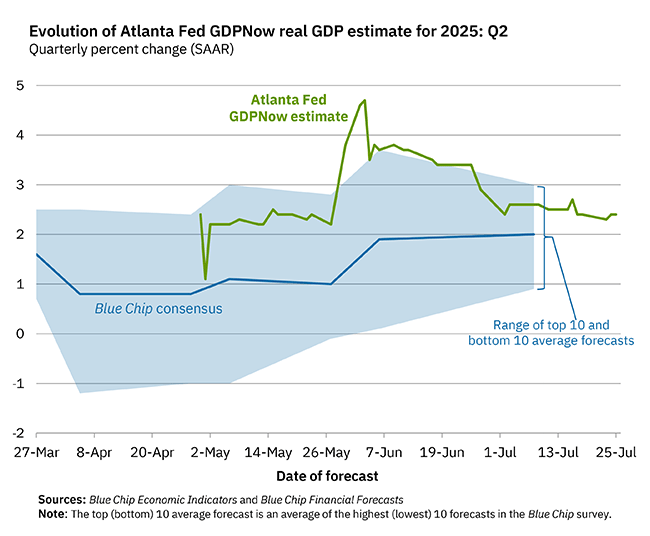
Latest estimate: 2.4 percent — July 25, 2025

The GDPNow model estimate for real GDP growth (seasonally adjusted annual rate) in the second quarter of 2025 is 2.4 percent on July 25, unchanged from July 18 after rounding. The forecasts of the major GDP subcomponents were all unchanged or little changed from their July 18 values after this week’s releases from the U.S. Census Bureau and the National Association of Realtors.

The growth rate of real gross domestic product (GDP) measured by the U.S. Bureau of Economic Analysis (BEA) is a key metric of the pace of economic activity. It is one of the four variables included in the economic projections of Federal Reserve Board members and Bank presidents for every other Federal Open Market Committee (FOMC) meeting. As with many economic statistics, GDP estimates are released with a lag whose timing can be important for policymakers. In preparation for FOMC meetings, policymakers have the Fed Board staff projection of this “advance” estimate at their disposal. These projections—available through 2008 at the Philadelphia Fed’s Real Time Data Center—have generally been more accurate than forecasts from simple statistical models. As stated by economists Jon Faust and Jonathan H. Wright in a 2009 paper, “by mirroring key elements of the data construction machinery of the Bureau of Economic Analysis, the Fed staff forms a relatively precise estimate of what BEA will announce for the previous quarter’s GDP even before it is announced.”

The Atlanta Fed GDPNow model also mimics the methods used by the BEA to estimate real GDP growth. The GDPNow forecast is constructed by aggregating statistical model forecasts of 13 subcomponents that comprise GDP. Other private forecasters use similar approaches to “nowcastGDP growth. However, these forecasts are not updated more than once a month or quarter, are not publicly available, or do not have forecasts of the subcomponents of GDP that add “color” to the top-line number. The Atlanta Fed GDPNow model fills these three voids.

The BEA’s advance estimates of the subcomponents of GDP use publicly released data from the U.S. Census Bureau, U.S. Bureau of Labor Statistics, and other sources. Much of this data is displayed in the BEA’s Key Source Data and Assumptions table that accompanies the “advance” GDP estimate. GDPNow relates these source data to their corresponding GDP subcomponents using a “bridge equation” approach similar to the one described in a Minneapolis Fed [archived PDF] study by Preston J. Miller and Daniel M. Chin. Whenever the monthly source data is not available, the missing values are forecasted using econometric techniques similar to those described in papers by James H. Stock and Mark W. Watson and Domenico Giannone, Lucrezia Reichlin, and David Small. A detailed description of the data sources and methods used in the GDPNow model is provided in an accompanying Atlanta Fed working paper [archived PDF].

As more monthly source data becomes available, the GDPNow forecast for a particular quarter evolves and generally becomes more accurate. That said, the forecasting error can still be substantial just prior to the “advance” GDP estimate release. It is important to emphasize that the Atlanta Fed GDPNow forecast is a model projection not subject to judgmental adjustments. It is not an official forecast of the Federal Reserve Bank of Atlanta, its president, the Federal Reserve System, or the FOMC.

World-Watching: Statement on the Commission’s Status Report in the Climate-Related Disclosure Rules Litigation

[from the U.S. Securities and Exchange Commission]

by Commissioner Caroline A. Crenshaw, July 23, 2025

On April 24, 2025—three months ago—the U.S. Court of Appeals for the Eighth Circuit directed the Commission to provide a status update in the ongoing litigation concerning the Climate-Related Disclosure Rules, which the Commission adopted in March of 2024.[1]

The Court “directed” the Commission to advise whether it “intends to review or reconsider the [R]ules at issue in this case.”[2] And, if the Commission has determined to take no action, the Court ordered the Commission to explain whether it “will adhere to the [R]ules if the petitions for review are denied and, if not, why it will not review or reconsider the [R]ules at this time.”[3]

The Court’s directive was straightforward; our answer is not.

The Commission’s Status Report, filed today, states plainly enough that it has no intention of revisiting the Rules at this time.[4] That, however, is where our responsiveness ends.[5] The Status Report goes on to argue that we cannot expound on what the Commission’s future plans might be in the event the rule-making petitions are denied, because we would be “prejudging” those policy decisions.[6] And, the Status Report explains, any future rule-making should benefit from a court ruling on our statutory authority.[7]

We also weigh in on a number of questions that the Court did not ask of us—for example, we opine that there are “no obstacle[s]” to reaching the merits of the case and that a “live controversy” remains.[8]

This purported response is wholly unresponsive.

The Court asked us in no uncertain terms “will [the Commission] adhere to the [R]ules if the petitions for review are denied[?]” We did not—but should have—answered that question. The unspoken truth under this Commission is that the answer is “no.” Three of the four current Commissioners have been vocal critics of the Rules.[9] They have also withdrawn the Commission from the defense of the Rules in litigation.[10] The Commission simply does not want to say what we all know to be true by now—it has no intention of allowing the Climate-Related Disclosure Rules to go into effect.

Once we acknowledge this answer, the rest of the Commission’s arguments fall away. There are no prejudgment issues, because there is nothing to prejudge. And, we do not need the Court to rule on our statutory authority for the Commission to engage in rule-making. If there is future rule-making in this space—whether to rescind the Rules or otherwise—that rule-making may present different legal issues. Whatever those issues may be, and whomever those aggrieved parties may be, they are not now before the Court. Federal courts are not in the business of giving advisory opinions to agencies.

What is crystal clear, however, is that this Commission is seeking to avoid its legal obligations under the guise of conserving “Commission time and resources.” No matter what, this comes at the expense of judicial resources. As I wrote previously in connection with the Commission’s decision to stop defending these Rules,[11] the Administrative Procedure Act governs the process by which we make and repeal rules. It includes a prescriptive framework for promulgation and rescission. If this Commission wants to rescind, repeal or modify the Rules, which were promulgated by-the-book, then it must do the statutorily-required work. It cannot take the easy way out. It must engage in notice-and-comment rule-making, with the benefit of economic analysis and a public, transparent process, even if inconvenient or if the Commission has other, more pressing priorities.[12] Indeed, other Commissioners have acknowledged that doing the work required to rescind the rule would be a difficult lift.[13] So, instead, we once again ask the Court to do the work for us. By asking the Court to carry water that we should shoulder ourselves, we do a grave disservice to our already taxed judicial system. This is not good governance.

The Commission has effectively ignored the Court’s order and thrown the ball back at the Court. The Court should decline to play these games.


[1] See State of Iowa v. Securities and Exchange Commission, 24-cv-1522 (8th Cir. Apr. 24, 2025) (“Status Update Order”); see also Enhancement and Standardization of Climate-Related Disclosures for Investors [archived PDF], Rel. No. 33-11275 (Mar. 6, 2024), 89 Fed. Reg. 21668 (Mar. 28, 2024) (“Climate-Related Disclosure Rules” or the “Rules”).

[2] Status Update Order.

[3] Id.

[4] Status Report of the Securities and Exchange Commission in Response to the Court’s April 24, 2025 Order, State of Iowa v. Securities and Exchange Commission, 24-cv-1522 (8th Cir. July 23, 2025)(“Status Report”) at 2 (“The Commission does not intend to review or reconsider the Rules at this time.”).

[5] These viewpoints do not reflect upon the efforts of the staff in our Office of the General Counsel.

[6] Status Report at 2.

[7] Id. at 2, 4, 5.

[8] Id. at 2, 3.

[9] See, e.g., Commissioner Hester M. Peirce, Green Regs and Spam: Statement on the Enhancement and Standardization of Climate-Related Disclosures for Investors (Mar. 6, 2025); Commissioner Mark T. Uyeda, A Climate Regulation under the Commission’s Seal: Dissenting Statement on the Enhancement and Standardization of Climate-Related Disclosures for Investors (Mar. 6, 2025); see generally Lesley Clark, “Trump SEC Pick Wants to Ditch Landmark Climate Disclosure Rule,” Politico (Dec. 9, 2024).

[10] See Status Report filed by SEC, State of Iowa v. Securities and Exchange Commission, 24-cv-1522 (8th Cir. Mar. 27, 2025); SEC Press Release No. 2025-58, SEC Votes to End Defense of Climate Disclosure Rules (Mar. 27, 2025) (According to then-Acting Chair Uyeda, “The goal of today’s Commission action and notification to the court is to cease the Commission’s involvement in the defense of the costly and unnecessarily intrusive climate change disclosure rules.”).

[11] Commissioner Caroline A. Crenshaw, Statement Regarding Climate-Related Disclosures Rule Litigation: The Commission has Left the Building (Mar. 27, 2025).

[12] Commissioner Mark T. Uyeda, Remarks at the “SEC Speaks” Conference 2025 (May 19, 2025) (“For the Commission to rescind the climate-related disclosure rule—and address the countless factual findings discussed in that 885-page release—would place a significant strain on the Commission’s resources. This effort would be a difficult lift, and it would potentially take away staff resources needed to advance the regulatory regime with respect to crypto and capital formation.”).

[13] Id.

Wrestling with History: Alexis de Tocqueville

Alexis de Tocqueville, a brilliant French historian, wrote Democracy in America. This book is a supreme example of U.S.-watching.

Another book of his, Recollections, shows him wrestling with history itself. If we remember that Clio is the muse of history, then we might say that Recollections is the chronicle of de Tocqueville’s encounter with her.

The question of human history and what de Tocqueville called “the world’s destiny” are described as follows:

l wrote histories without taking part in public affairs, and politicians whose only concern was to control events without a thought of describing them. And I have invariably noticed that the former see gen­eral causes everywhere, whereas the latter, spend­ing their lives amid the disconnected events of each day, freely attribute everything to particular incidents and think that all the little strings their hands are busy pulling daily are those that control the world’s destiny. Probably both of them are mistaken.

For my part I hate all those absolute systems that make all the events of history depend on great first causes linked together by the chain of fate and thus succeed, so to speak, in banishing men from the history of the human race. Their boasted breadth seems to me narrow, and their mathematical exactness false. I believe, pace the writers who find these sublime theories to feed their vanity and lighten their labours, that many important historical facts can be explained only by accidental circumstances, while many others are inexplicable. Finally, that chance, or rather the concatenation of secondary causes, which we call by that name because we can’t sort them all out, is a very important element in all that we see taking place in the world’s theatre. But I am firmly convinced that chance can do nothing unless the ground has been prepared in advance. Antecedent facts, the nature of institutions, turns of mind and the state of mores are the materials from which chance composes those impromptu events that surprise and terrify us.

Alexis de Tocqueville, Recollections, 1893, Anchor Books, page 78.

De Tocqueville warns us that the world’s destiny is always murky and what he calls a labyrinth and a whirlwind. He says:

Mentally I reviewed the history of our last sixty years and smiled bitterly to myself as I thought of the illusions cherished at the end of each phase of this long revolution; the theories feeding these illusions; our historians’ learned daydreams, and all the ingenious false systems by which men sought to explain a present still unclearly seen and to foresee the unseen future.

Recollections, page 83.

He continues:

Shall we reach, as other prophets as vain perhaps as their predecessors assure us, a more complete and profound social transformation than our fathers ever foresaw or desired, and which we ourselves cannot yet conceive; or may we not simply end up in that intermittent anarchy which is well known to be the chronic incurable disease of old peoples? I cannot tell, and do not know when this long voyage will end; I am tired of mistaking deceptive mists for the bank. And I often wonder whether that solid land we have sought for so long actually exists, and whether it is not our fate the rove the seas forever!

Recollections, pages 83-84.

And yet, with all that profound uncertainty, he offers a very sweeping interpretation of French history from the French Revolution (1789) to the French Revolution of 1848. The famous painting by Eugène Delacroix, Liberty Leading the People (FrenchLa Liberté guidant le peuple), commemorating the July Revolution of 1830, falls in between.

Despite de Tocqueville’s warnings about the slipperiness of historical judgement, he arrives at an extremely precise interpretation of his own:

Seen as a whole from a distance, our history from 1789 to 1830 appears to be forty-one years of deadly struggle between the Ancien Régime with its traditions, memories, hopes and men (i.e. the aristocrats), and the new France led by the middle class. 1830 would seem to have ended the first period of our revolutions, or rather, of our revolution, for it was always one and the same, through its various fortunes and passions, whose beginning our fathers saw and whose end we shall in all probability not see. All that remained of the Ancien Régime was destroyed forever. In 1830 the triumph of the middle class was decisive and so complete that the narrow limits of the bourgeoisie encompassed all political powers, franchises, prerogatives, indeed the whole government, to the exclusion, in law, of all beneath it and, in fact, of all that had once been above it. Thus the bourgeoisie became not only the sole director of society, but also, one might say, its cultivator. It settled into every office, prodigiously increased the number of offices, and made a habit of living off the public Treasury almost as much as from its own industry.

Recollections, page 5.

Reviewing the first sentence from the quote above, one can see a deep characterization of an era, with the conclusion “in 1830 the triumph of the middle class was decisive…” Notice the profound paradox that on one hand de Tocqueville spoke of the elusiveness of history despite providing the definite description of this period. Contrast “seen as a whole from a distance” with one of the themes of his recollections, that it is not given to us to understand history.

Economics-Watching: Kuwait: GDP Returns to Growth in Q1 2025 as Impact of Oil Output Cuts Fades

[from NBK Economic Research, 21 July, 2025]

by Mohammad Al-Shehri, Assistant Economist & Omar Al-Nakib, Head of MENA Research

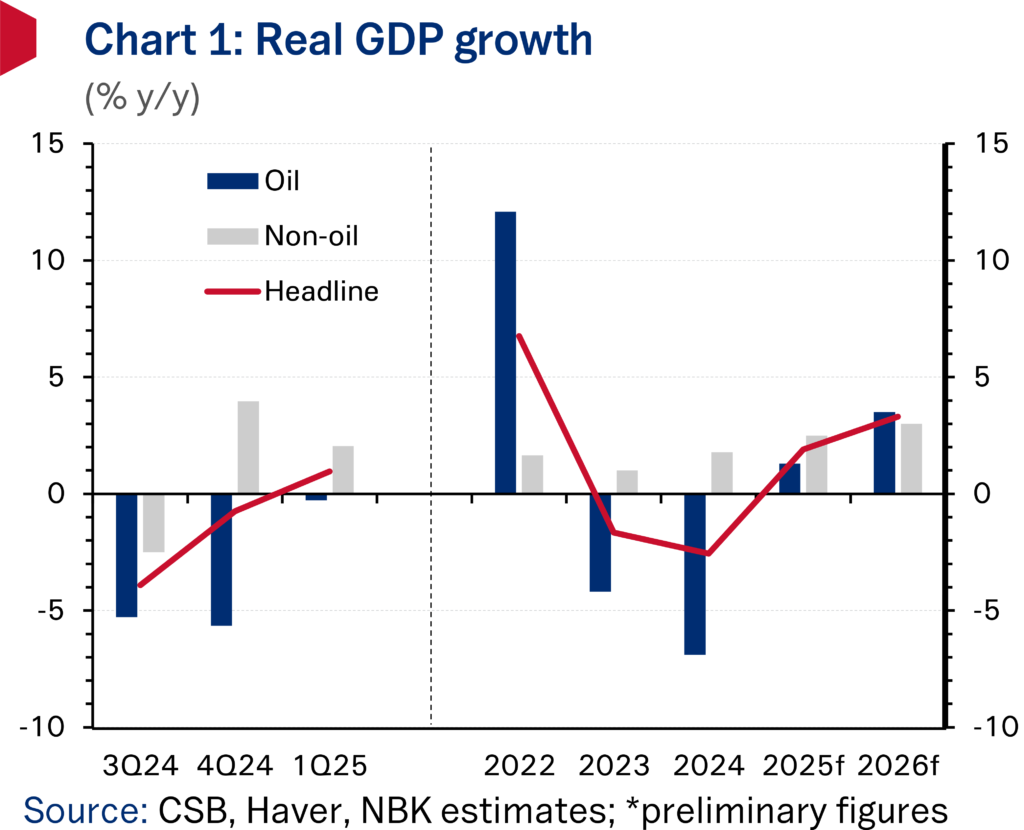
Preliminary official figures show GDP expanding 1% y/y in Q1 2025 following seven consecutive quarters of contraction, helped by a less severe downturn in oil output. With the negative effects of earlier voluntary oil production cuts beginning to fade, oil GDP recorded only a marginal decline, the softest since Q2 2023. Growth in non-oil activity remained positive though eased, weighed by a moderation in the manufacturing, real estate, and transport sectors. The near-term outlook for GDP is one of positive growth, lifted by rising oil production after Kuwait started to restore 135 kb/d of oil output cuts between April and September 2025, while the non-oil sector should also register further steady gains.

Non-oil GDP growth softens in Q1 2025 after strong performance in Q4 2024

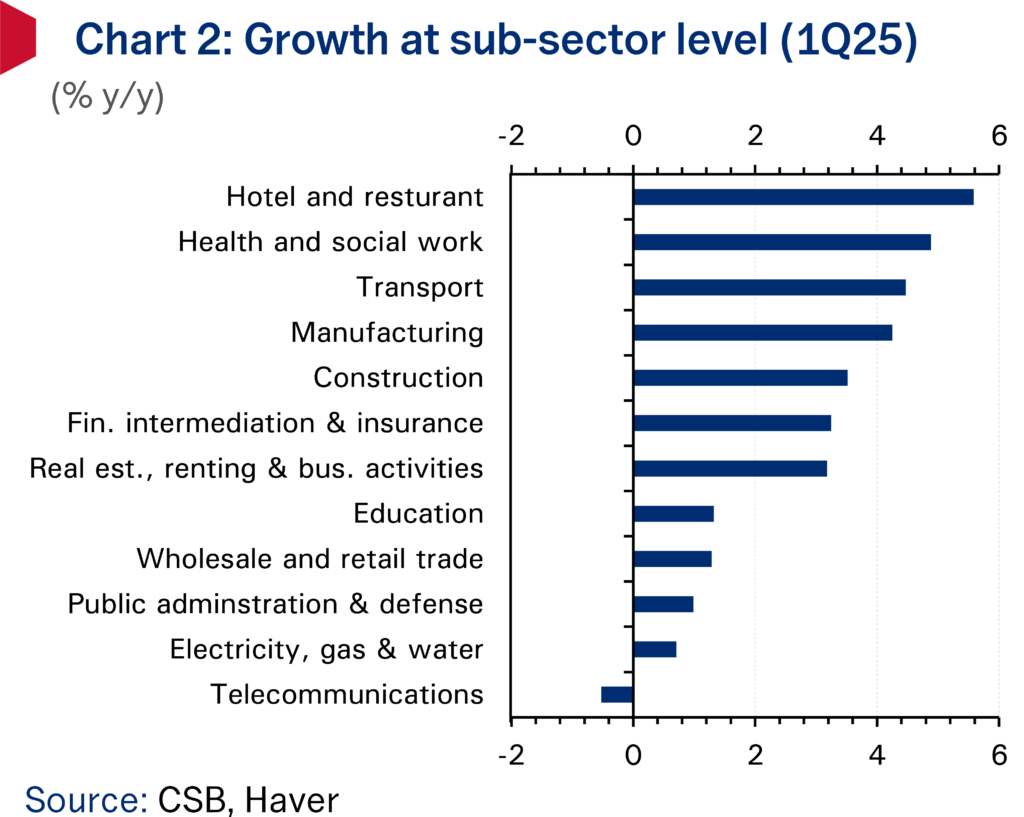
Growth in the non-oil sector weakened in Q1 2025, slowing to 2% y/y compared to 4% recorded in the prior quarter. (Chart 1.) The softer expansion in non-oil activity reflected, among other things, a moderation in the manufacturing sector, where activity grew at a still-solid 4.3% despite a decline in refined petroleum products output but slowed notably from the 12.2% reading registered in Q4 2024. Growth in other sectors including real estate, wholesale & retail trade, transport, and education also slowed. Offsetting the slowdown was stronger expansion in the non-oil economy’s largest segments: public administration and defense as well as financial intermediation and insurance, which grew 1% and 3.2% y/y, respectively. (Chart 2.)

Chart 1: Real GDP growth

Chart 2: Growth at sub-sector level (1Q25)

Oil sector logs marginal contraction, set to return to growth in Q2

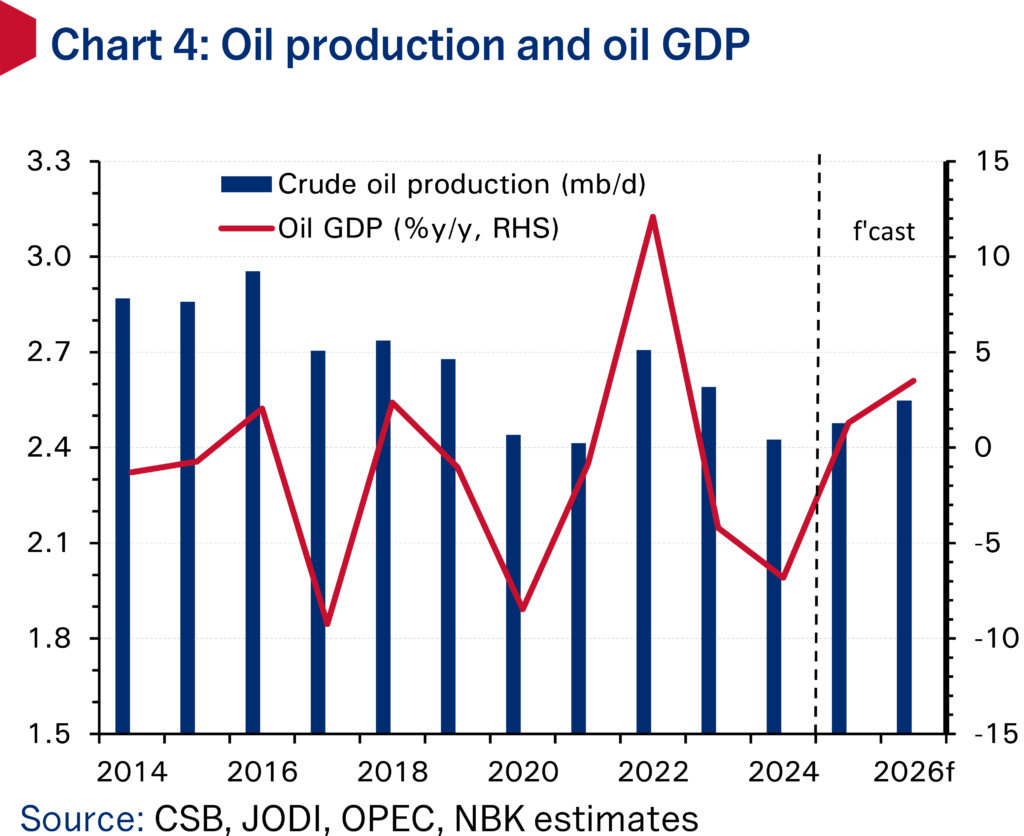
The contraction in oil GDP eased significantly to -0.3% y/y from -5.7% y/y in Q4 2024, registering the softest rate of decline since Kuwait embarked on cutting oil production in Q2 2023 after participating in the voluntary cuts scheme with 7 other OPEC+ members. (Chart 4.) Kuwait’s oil production averaged 2.415 mb/d in Q1 2025, a 0.7% decline from the same quarter last year, according to OPEC secondary sources. However, oil sector fortunes are set to shift in Q2 2025 and thereafter, after the OPEC-8 member alliance started unwinding the 2.2 mb/d voluntary cut tranche in April 2025. Originally planned to be unwound over the course of 18 months, OPEC+ has accelerated the pace of supply hikes with output now on a path to be fully restored in September, a full year ahead of schedule. For Kuwait, crude production rose by 0.5% q/q in Q2 to 2.426 mb/d and is set to accelerate further to average 2.533 mb/d in H2 2025. With the oil market so far able to absorb the additional OPEC and global supply and oil prices currently holding near $70/bbl, an upside risk to our oil sector outlook involves the potential unwinding of the outstanding OPEC-8 voluntary cuts (1.66 mb/d), of which Kuwait’s share is 128 kb/d.

Growth heading back into positive territory in 2025

Growth in total GDP is set to remain on a positive trajectory in the near term, buoyed by further steady expansion in non-oil economic activity and increased oil production. Non-oil GDP is set to benefit from the government’s reform drive which includes the recent passing of the debt law that could catalyze the implementation of key development projects and the potential approval of the ‘mortgagelaw later in 2025, which could spur higher household borrowing and consumer spending. Economic indicators for Q2 2025 pointed to a healthy pace of non-oil economic activity. The key ‘output’ and ‘new orders’ balances in the non-oil private sector PMI gauge both averaged a very robust 57+ in Q2 2025, real estate activity continued to expand at a robust pace with earlier price falls in the residential sector abating, while credit growth stood at a healthy 5.5% y/y in May, and could benefit in coming months if interest rates are reduced further.

Nonetheless, there are also downside risks to the outlook. Local consumer spending growth (according to central bank card transactions data) turned negative in Q1 2025, extending the weakening trend now observed for more than a year. The government’s ongoing fiscal consolidation push will also weigh on wage and job growth. Overall, we see GDP growing 1.9% this year, boosted by expansions in both the oil and non-oil sectors of 1.2% and 2.5%, respectively.

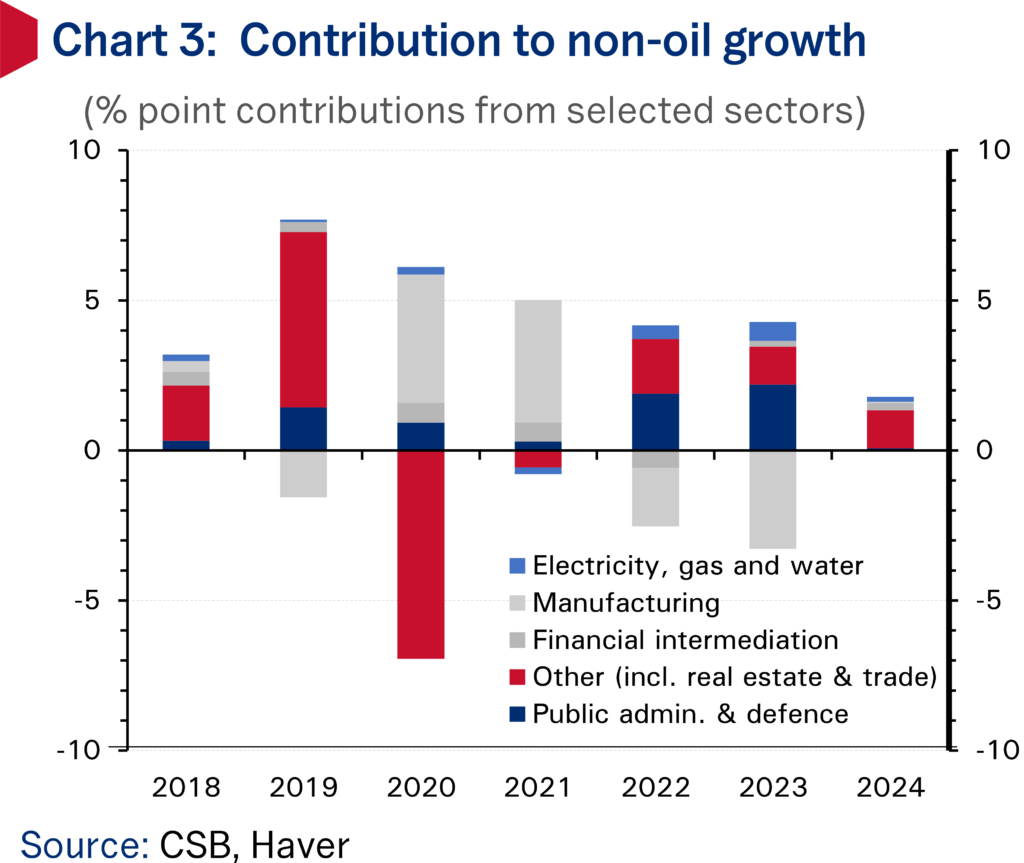
Chart 3: Contribution to non-oil growth

Chart 4: Oil production and oil GDP

Read this article as an archived PDF.

Problems of Perspective, Michel Foucault

Michel Foucault was one of the leading French philosophers of the 20th century. Often considered a postmodernist, he did not believe there was a final perspective that human knowledge could achieve. This immediately contrasts with the outlook of leading physicists like Stephen Hawking. In his 1988 classic, A Brief History of Time, Hawking concludes the book by saying, once science has achieved a theory of everything, which is not far off, we will “know the mind of god.”

In his 1966 key work, The Order of Things: An Archaeology of the Human Sciences (French: Les Mots et les Choses: Une archéologie des sciences humaines), Foucault argued that the so-called order of things is invented, not discovered, by us. This is contrary to scientific thought.

Foucault sets up this limit in his surprising interpretation of the Diego Velázquez masterpiece painting, Las Meninas (Spanish: The Ladies-in-waiting). The painting is deliberately elusive in its use of perspective.

The great German thinker, Jürgen Habermas, explained this Foucault/Velázquez perspective difficulty:

This picture portrays the painter in front of a canvas not visible to the spectator; the painter is evidently looking, as are the two ladies-in-waiting next to him, in the direction of his two models, King Philip IV and his spouse. These two personages standing as models are found outside the frame of the picture; they can be identified by the spectator only with the help of a mirror pictured in the background. The point that Velázquez apparently had in mind is a confusing circumstance of which the spectator becomes aware by inference: The spectator cannot avoid assuming the place and the direction of the gaze of the counterfeit but absent royal pair — toward which the painter captured in the picture gazes — as well as the place and the perspective of Velázquez himself, which is to say, of the .painter who actually produced this picture. For Foucault, in turn, the real point lies in the fact that the classical picture frame is too limited to permit the representation of the act of representing as such — it is this that Velázquez makes clear by showing the gaps within the classical picture frame. left by the lack of reflection on the process of representing itself.29

29. Foucault constructs two different series of absences. On the one hand, the painter in the picture lacks his model, the royal couple standing outside the frame of the picture; the latter are in turn unable to see the picture of themselves that is being painted — they only see the canvas from behind; finally, the spec­tator is missing the center of the scene, that is, the couple standing as models, to which the gaze of the painter and of the courtesans merely directs us. Still more revealing than the absence of the objects being represented is, on the other hand, that of the subjects doing the representing, which is to say, the triple absence of the painter, the model, and the spectator who, located in front of the picture, takes in perspectives of the two others. The painter, Velázquez, actually enters into the picture, but he is not presented exactly in the act of painting — one sees him during a pause and realizes that he will disappear behind the canvas as soon as he takes up his labors again. The faces of the two models can actually be recognized unclearly in a mirror reflection, but they are not to be observed directly during the act of their portrayal. Finally, the act of the spectator is equally unrepresented — the spectator depicted entering into the picture from the right cannot take over this function. (See Foucault, The Order of Things, pp. 3-16, 307-311.)

Critique and Power: Recasting the Foucault/Habermas Debate, Michael Kelly, editor, MIT Press, 1994, pages 67, 77 [archived PDF].

Let us conclude by saying one way of specifying the disagreement between scientists and these thinkers is that sciences see themselves as “objective” while the thinkers feel science lacks objectivity because of the human observer. Kant, centuries ago, argued that concepts like causality, space and time are imposed by the human mind on the world. Similarly, Heisenberg, in Physics and Philosophy: The Revolution in Modern Science, similarly said that science does not finally answer questions about an objective reality, but can only answer questions posed by us.

World-Watching: U.S. Greenlighted H20 Chips Export on Its Own Initiative, China Says

Beijing clarifies its deal with Washington didn’t include NVIDIA’s 4th-best AI chip, disputing widely-reported comments by U.S. Commerce Secretary Howard Lutnick

by Zichen Wang, from Pekingnology

The U.S. greenlighted NVIDIA’s China-specific Artificial Intelligence chip, known as the H20, for export to China on its own initiative, China said on Friday.

In a statement dedicated to the recent U.S. approval of the semiconductor giant’s 4th-best Artificial Intelligence chip, China’s Ministry of Commerce said on its website that in early July, the U.S. had already lifted restrictions on China under the agreement reached between the two countries in London.

“We have taken note that Washington has now taken the initiative to announce it will authorize sales of NVIDIA’s H20 chips to China,” the trade ministry added.

Beijing’s clarification stands in stark contrast to widely reported public comments earlier this week by U.S. Commerce Secretary Howard Lutnick, who told Reuters on Tuesday that “We put that in the trade deal with the magnets,” referring to the agreement made to restart Chinese rare earth shipments to U.S. manufacturers. He did not provide additional details, according to Reuters.

NVIDIA’s H20 was designed to be technologically inferior. The company also sells three other chips that far surpass the H20’s power.

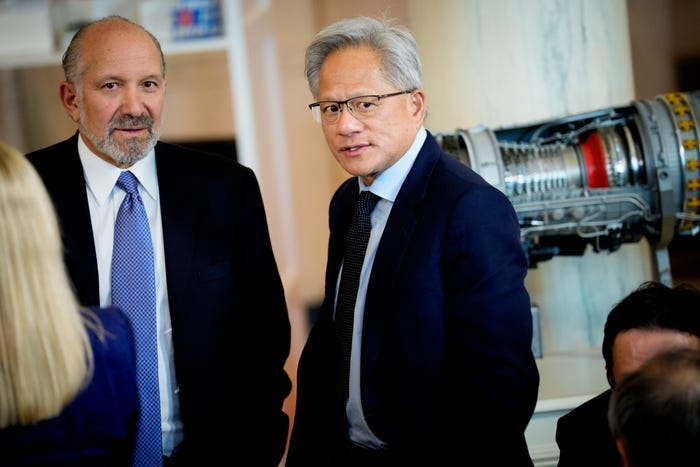
Commerce Secretary Howard Lutnick echoed NVIDIA CEO Jensen Huang’s view of why a U.S. company should sell chips to China. Andrew Harnik/Getty Images

On Monday, July 14, the Silicon Valley company announced in a blog post that the U.S. government had approved the sale of the H20, three months after the Donald Trump administration shut down NVIDIA’s artificial intelligence chip sales to China, after CEO Jensen Huang met President Trump in Washington D.C., and before he departed for Beijing.

Huang dominates Chinese headlines this week with his speech at an industry conference and public events with Chinese AI leaders. He visited China’s Ministry of Commerce and was received by Wang Wentao, the minister, on Thursday.

商务部新闻发言人就美批准对华销售英伟达H20芯片有关情况答记者问

MOFCOM Spokesperson Responds to Questions on the U.S. Approval of NVIDIA H20 Chip Sales to China

2025-07-18 13:43

Question:

U.S. officials have recently stated that Washington’s decision to approve sales of NVIDIA’s H20 chips to China is part of ChinaU.S. economic and trade negotiations. They also claimed that Chinese firms, including Huawei, are already producing equivalent chips domestically and that the United States does not want China to achieve full import substitution. How does the Ministry of Commerce (MOFCOM) view this?

Answer:

Following the ChinaU.S. economic and trade consultations in London, the two sides have maintained close communication, finalized the “London framework,” and moved forward with implementation. China, in accordance with its laws and regulations, approves export applications for controlled items that meet the necessary criteria. In early July, the United States reciprocally lifted the restrictions on China that had been discussed during those talks.

We have taken note that Washington has now taken the initiative to announce it will authorize sales of NVIDIA’s H20 chips to China. Beijing believes the United States should abandon a zero-sum mentality and continue to roll back a range of unwarranted trade and technology restrictions on China.

Cooperation and mutual benefit are the only viable path; suppression and containment lead nowhere. In May, the United States issued new export-control guidelines targeting Huawei’s Ascend chips, tightening restrictions on Chinese semiconductor products under unfounded pretexts. By wielding administrative power to distort fair market competition, these measures severely undermine the legitimate rights and interests of Chinese companies. China has made its position clear and firmly opposes such actions.

We look forward to the United States working with China in a spirit of equality to correct these erroneous practices, foster a sound environment for mutually beneficial cooperation between the two countries’ enterprises, and jointly safeguard the stability of global semiconductor supply chains.