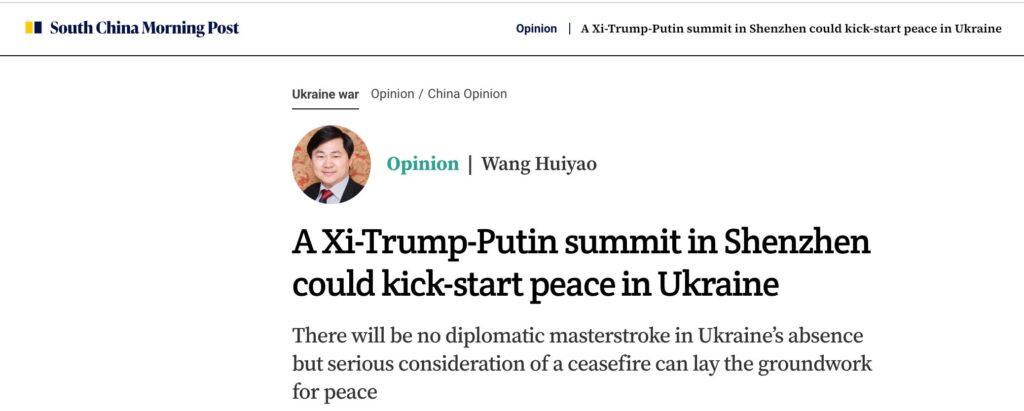
Henry Huiyao Wang: A Xi-Trump-Putin summit in Shenzhen could kick-start peace in Ukraine

CCG’s President says there will be no diplomatic masterstroke in Ukraine’s absence, but serious consideration of a ceasefire can lay the groundwork for peace

[from the Center for China & Globalization, 31 October 2026]

Below is the latest opinion column by Henry Huiyao Wang, founder and President, Center for China and Globalization, published in the South China Morning Post.
At the recent Valdai Discussion Club, I asked Russian President Vladimir Putin if he would be open to meeting Chinese President Xi Jinping and U.S. President Donald Trump at the Asia-Pacific Economic Cooperation (APEC) forum in Shenzhen. I also asked, more broadly, what role China could play in promoting peace in Ukraine, mediating and contributing to peacekeeping.

Putin was receptive, warmly welcoming the idea of a China-hosted meeting. Trump, too, has expressed a willingness to meet Xi and Putin. These expressions of openness offer an opportunity we must seize in pursuit of peace.

Some in the United States and Europe question the value of such a summit. They may fear restoring Putin’s standing or normalising the conflict without yielding any real progress towards an end to the war. That risk is still real but these largely Western fears must be tempered by the very real, very human cost of letting the war continue unabated.

From the very beginning of the war, I have been arguing that China has a constructive role to play. In March 2022, less than three weeks into Russia’s invasion, I wrote an article in The New York Times titled “It’s Time to Offer Russia an Offramp. China Can Help With That.”

In August last year, I extended that train of logic in Foreign Policy, where I proposed a seven-party format for peace negotiations and suggested that a peacekeeping force include troops from European and BRICS countries. A meeting of the three leaders in Shenzhen could help lay the groundwork for these broader diplomatic and peacekeeping efforts.

Without Ukraine’s participation, such a meeting is unlikely to produce a diplomatic masterstroke that ends the war. But the three leaders need not put the war to rest at a table in Shenzhen to make progress. Serious consideration of a ceasefire along the current line of contact—an approach Ukrainian President Volodymyr Zelenskyy has supported—could give peace efforts fresh momentum, leaving the final status of disputed territories for subsequent negotiations.

Further agreement could be sought on the protection of nuclear facilities, or a mutual end to strikes on energy infrastructure, new prisoner exchanges or improved humanitarian access. Of course, issues of sovereignty, security guarantees, Russia’s security concerns and Europe’s security commitments would remain. But these need not all be resolved at once before a ceasefire can begin.

Already, years of war have inflicted immense suffering on both Russia and Ukraine. Neither side achieved its objectives, and both need a dignified way out that protects their core interests. Thus, we must open a path towards peace without requiring either side to concede defeat. China could help bridge this gap by bringing Xi, Trump and Putin together in Shenzhen to explore how a ceasefire and wider negotiations involving Ukraine might work.

The United Nations could stand at the core of such an arrangement by monitoring any ceasefire and preventing a return to fighting by physical peacekeeping if the parties are so inclined.

For a broader negotiation on settlement, I find myself returning to a seven-party format that would bring together the five permanent members of the UN Security Council—China, France, Russia, Britain and the U.S.—alongside Ukraine and the European Union. An understanding reached in Shenzhen could give momentum to this broader negotiating process and free up the Security Council for action.

A peacekeeping force composed entirely of NATO or European troops might be unacceptable to Russia. Yet a mission without European participation would struggle to reassure Ukraine and its neighbours. Any workable arrangement would need to address both concerns.

In my Foreign Policy article, I proposed a peacekeeping force drawing troops from five European countries—Germany, France, Britain, Poland and Italy—and five members of the BRICS grouping, such as China, India and Brazil. And while the exact formulation, from the composition and mandate to the terms of deployment, would need to be negotiated with the consent of Russia and Ukraine, and the agreement of the contributing countries, the core idea remains sound.

As a permanent member of the UN Security Council and the largest contributor of peacekeeping personnel among the five permanent members, China is well positioned to help. Its distinctive role in the global economy and dialogue with Russia, Ukraine, the U.S. and Europe, give it channels through which to coax the parties towards peace. But this process must begin somewhere, and that somewhere could be Shenzhen.

Nor should APEC be the end of the diplomatic effort. With an understanding reached by the leaders in Shenzhen, the Security Council may pick up the momentum by advancing ceasefire and peacekeeping proposals. The Group of 20 could then join the effort to rally support from major economies with an interest in maintaining the deal. Each would play a different role and would not be tasked with settling the entire conflict.

China’s role in the Saudi Arabia-Iran rapprochement in 2023 showed Beijing’s ability to open a door after years of enmity. The Ukraine war is different, and there can be no guarantee of a similar outcome. But diplomacy must begin somewhere, particularly when fighting has brought such destruction.

The central question is whether such a meeting could help bring the war to an end. In that light, any gain in prestige for an individual leader is almost irrelevant. And if the three leaders could agree on practical steps towards peace, they would give the United Nations and the wider international community a material basis upon which peace could be built.

India and the Russia-Ukraine War: The Paradox of Military Dependence, Traditional Loyalty and Strategic Autonomy

[from India in Transition, published by the Center for the Advanced Study of India (CASI) of the University of Pennsylvania, by Arndt Michael]

India, long-established as the world’s most populous democracy, has been quite instrumental over the years in assisting various countries dealing with democratic struggles. This support has included a blend of bilateral and multilateral initiatives, and especially economic development projects. Yet, India’s recent attitude toward the Russian attack on Ukraine and its concomitant behavior in the United Nations Security Council (as a non-permanent member) seems to contradict its support of democracy. By abstaining, rather than explicitly voting in favor of UN resolutions condemning Russian aggression at the beginning of the war, India angered several UN member-countries.

In order to substantiate its abstention from voting, India felt compelled to issue a so-called “Explanation of Vote” (EoV). In it, India asked for a “return to the path of diplomacy” and an immediate cessation of “violence and hostilities.” Crucially, India stated in the EoV that “the contemporary global order has been built on the UN Charter, international law, and respect for the sovereignty and territorial integrity of states…all member states need to honor these principles in finding a constructive way forward. Dialogue is the only answer to settling differences and disputes, however daunting that may appear at this moment.” 

While these statements and the call for dialogue are in accordance with India’s professed stance toward the relevance and objectives enshrined in the UN Charter, the discrepancy between rhetoric and practice is still conspicuous. At first glance, a “good” relationship with Russia seems to be more significant than the expectations of the world-community as represented in the United Nations. And, more importantly, by abstaining, India seemingly violated one of its central foreign and strategic policies: to always strive for strategic autonomy.

However, from a strategic perspective, India is precisely replicating what it did when the Soviet Union invaded Afghanistan. For India, its own national security is at stake, as well as its current and future geostrategic influence in Asia and the world. The military dependence that currently exists between India and Russia is nothing short of gigantic and has created a dangerous conundrum. Since the “Indo–Soviet Treaty of Peace, Friendship and Cooperation” was signed in 1971, defense agreements and long-term supply contracts have been in place. And while India and Russia have shared a strategic relationship since October 2000, this was upgraded in December 2020 to a “Special and Privileged Strategic Partnership.” 

Although there was a marked reduction of Russian imports in past years, official data from the Stockholm International Peace Research Institute (SIPRI) reveal that between 1996-2015, the Russian proportion of Indian military imports was almost 70 percent, and between 2016-20 it still hovered around 49 percent. In fact, 70 percent of all Indian military equipment currently in use has been directly produced in Russia, was manufactured with the majority of parts coming from Russia, or licensed by Russia. In 2020, this included the majority of Indian tanks, the only aircraft carrier (the INS Vikramaditya, a heavily modified Kiev-class aircraft carrier) with all of its combat aircraft MiG-29s, six frigates, four destroyers and the only nuclear-powered submarine. Additionally, eight out of fourteen Indian Navy submarines belong to the Russian Kilo-class. The Indian Air Force flies Sukhoi Su-30MKIs and Mil Mi-17s, which, respectively, constitute the largest share of the combat aircraft and utility helicopters, in addition to Russian tanker planes. India also just recently purchased the S-400 missile system.

Even though India has begun to reorient itself militarily toward other countries—the U.S., Israel, France and Italy—and has substituted foreign imports by slowly developing its own capabilities, a large number of new Indo-Russian projects are in the conceptual or implementation stages. In December 2021, in the frame of the so-called “2+2 Dialogue” (foreign and defense ministers), India and Russia began a new phase in their military–technological cooperation. Incidentally, India has used this very format for furthering cooperation in strategic, security and intelligence issues with four of its key strategic partners: Australia, the U.S., Japan and the newly added Russia. Russia and India agreed upon a further deepening of mutual military relations for ten years (until 2031). What is new is that next to the traditional purchase of Russian weapons systems, many common research projects and the development of new weapons systems—with their production taking place equally in both countries—have been agreed upon. This production includes new frigates, helicopters, submarines, cruise missiles and even Kalashnikovs. 

The depth of this mutual engagement, and especially India’s dependence, highlights a huge dilemma that might not only have drastic strategic consequences, but also long-lasting regional repercussions. The worldwide sanctions issued against Russia aim at the Russian economy and military. When it comes to the procurement of such crucial components as microchips or airline parts, Russia is soon expected to face shortages, essentially crippling its capacity to repair, construct, or have spare parts available (let alone construct new equipment). Unless other countries, such as China, circumvent international sanctions and step-in, the expected Russian inability to take care of its own military will have a spill-over effect. Russia is unlikely to be able to fulfill its contractual obligations toward India, and the lack of spare parts also has the potential to cripple India’s own military with regards to the Russian weapons equipment. The procurement agreements and common projects are, hence, all in jeopardy and India, now more than ever, depends on Russian goodwill. 

Next to military dependence, there are other concomitant effects in the economic and political sphere that influence Indian voting behavior. The worldwide sanctions have already led to dramatic increases in oil and gas prices, with India relying on imports of up to 80 percent. India will, therefore, have to pay much more for such crucial imports. Military imports from other countries aimed at substituting Russian equipment will also be much more expensive. All of this deals the Indian economy another blow—an economy that has been especially hit hard by the COVID-19 pandemic. And politically, Indian hegemony in South Asia has been markedly under pressure, in no small part because of the China–Pakistan axis. In the eyes of India, this axis poses a serious threat to an already highly volatile Indo–Pakistan relationship. In addition, the Indo–China relationship reached a new low in May 2020 when Chinese infrastructure projects along the Himalayan borderlands led to fighting and the killing of soldiers. In addition, the Chinese claims to the South China Sea are categorically disputed by India. Chinese overtures toward Sri Lanka, the Maldives, and especially Pakistan in the frame of the Road Initiative are also regarded with growing discontent, as India claims that China is following a policy of encircling India.

In its 75th year of independence, India is following a classic realpolitik in trying not to alienate Russia while pledging rhetorical support for Ukraine. The contradictory consequence is that Russia has now offered more discounted oil, gas, and investments, while at the same time, the UK has suggested its military relationship with India could be upgraded—and has offered weapons made in the UK. For the Indian political establishment, India cannot forgo Russian support, militarily or as a producer of cheap oil and gas. Going forward, India’s military will need to protect its national security and project Indian influence and power well beyond its borders.

Arndt Michael is a Lecturer in the Department of Political Science, University of Freiburg (Germany), author of the multi-award-winning book India’s Foreign Policy and Regional Multilateralism (Palgrave Macmillan, 2013), and co-editor of Indien Verstehen (Understanding India, Springer, 2016). His articles have been published in Asian Security, Cambridge Review of International Affairs, Harvard Asia Quarterly, India Quarterly and India Review.