Japan Inc. Now Sells No Yen to Invest Abroad

Earnings on Japan’s foreign direct investment (FDI) reached 103% of new FDI in 2022–25. With dividends and retained earnings counted together, Japan Inc. now needs to sell little yen to invest abroad.

[by OKUBO Takuji]

Key takeaways

  • Foreign affiliates now earn about as much as Japan invests abroad each year. Reinvested earnings, dividends and interest together reached 103% of new outward FDI in 2022–25, against 48% in 1996–2000.
  • Dividends from foreign affiliates account for a growing share of Japanese corporate profit. We estimate that foreign affiliates contributed 13.4% of Japan Inc.’s earnings in FY2025, up from 1.7% in FY1996.
  • Corporate investment abroad now involves little net yen selling. After dividends and interest paid home, the estimated outflow has been close to zero since 2022, down from about ¥5 trillion a year, or about 1% of GDP, on average in the 2010s.

Japan’s FDI stock now earns 103% of new investment

It is often said that Japan’s ageing population and slow growth give its companies too few investment opportunities at home. A Japanese government report in 2024 included the following passages.

“Japan’s ageing and shrinking population depresses expected demand at home. Expected returns remain higher abroad, so Japanese companies have accelerated outward direct investment” (my translation). — MATSUBAYASHI Yōichi [松林 洋一], MOF PRI, chapter 8, p.136.

“Companies invested abroad because they saw no promising investments in Japan; they are unlikely to bring back every return. On a cash-flow basis, the external balance is in deficit and is one factor behind the weak yen” (my translation). — KARAKAMA Daisuke [唐鎌 大輔], MOF PRI, chapter 10, pp.178 and 175.

However, my review of recent data shows that while their premise of low growth prospects in Japan is probably still right, the direct investment Japan has accumulated abroad has reached a level where it earns enough to cover Japan’s new investment abroad. This changes the exchange-rate implication even if Japan keeps investing abroad.

As chart 1 shows, earnings on the accumulated investment stock rose from 48% of new outward FDI in 1996–2000 to 103% in 2022–25.

Chart 1
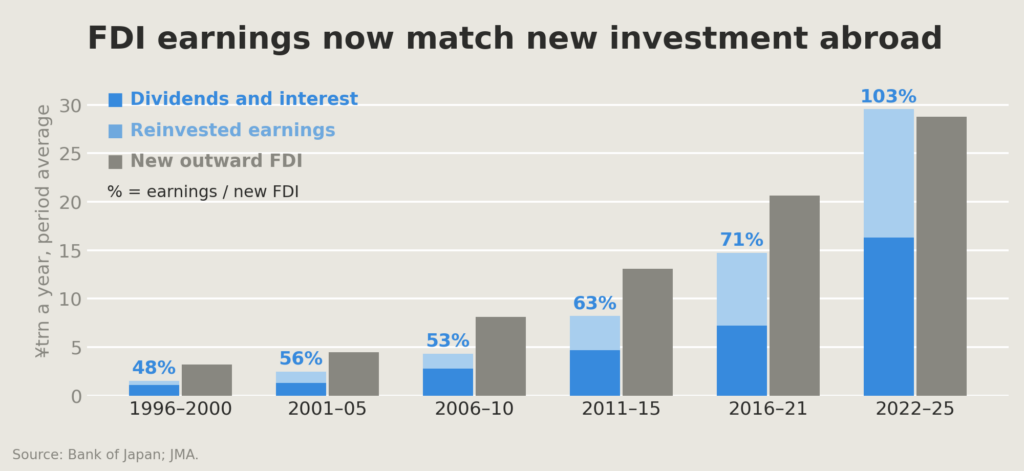
Overseas affiliates pay interest and dividends to their parent companies in Japan. Those dividends have become a sizable part of corporate Japan’s income: we estimate that they made up 13.4% of Japanese corporate profit in FY2025, up from 1.7% in FY1996.

When foreign affiliates retain their earnings on their balance sheets, Japan’s balance of payments statistics record them as FDI from Japan, even though no money crosses the border. While the companies receiving FDI dividends and the companies paying for new FDI are not necessarily the same, Japan Inc. as a whole is now financing its FDI almost entirely from the earnings of its overseas affiliates. At the current level of FDI, little new yen needs to be converted into foreign currencies as Japan goes about investing abroad.

In the rest of this report, I explain how foreign direct investment by Japanese companies evolved, and its near-term outlook. This report is the third in a series on the yen repatriation theme that I have published over the past few weeks, following “Yen Repatriation Starts with the Whale”, on capital flows through Japan’s national pension funds, and “Mrs Watanabe No More”, on Japanese households’ assets invested abroad.

A strong yen helped drive Japan’s first outward FDI boom

Japan’s outward investment was heavily restricted after WWII, requiring case-by-case permission from the government. Approvals became more and more automatic over the years until outward investment became “free in principle” in 1980. Trade friction with the US-led Japanese carmakers to restrain their exports from 1981, pushing them to build factories abroad. The rapid appreciation of the yen was also a factor. The yen strengthened from ¥242 per dollar before the Plaza Accord in September 1985 to ¥121 by the end of 1987. Japanese producers had to move lower value-added work abroad. The strong yen also gave Japanese financial institutions sizable purchasing power for a while, until the stock and property bubbles burst in 1990 and 1991.

All of these factors contributed to a rapid increase in outward FDI through the 1980s and 1990s (chart 2).

Chart 2

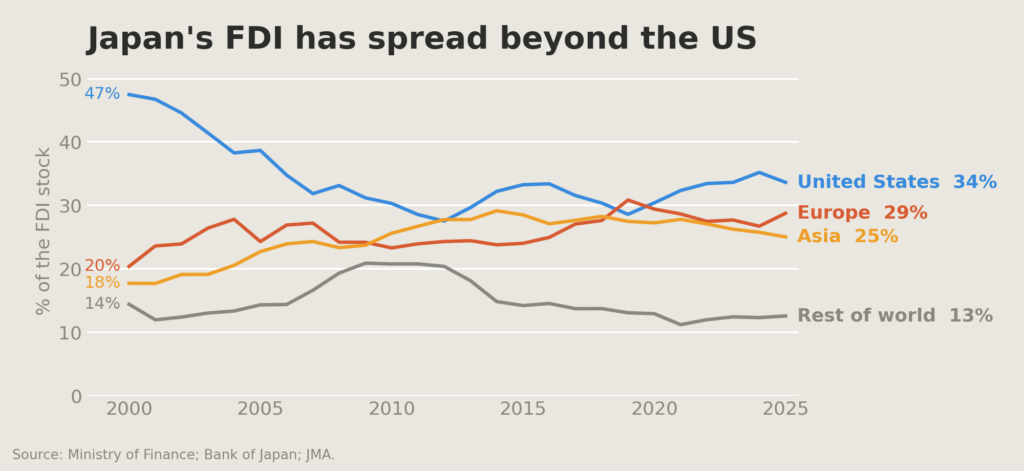
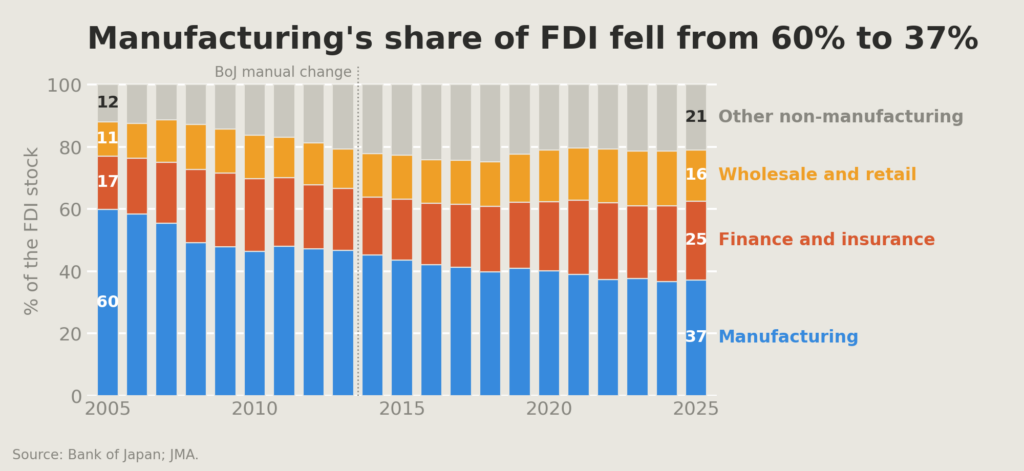
Even after the bubble burst, the strong yen kept pushing manufacturers to move abroad. In 2005, manufacturers accounted for 60% of the FDI stock. As Japanese manufacturers expanded their supply chains abroad, Asia’s share of outward FDI rose from about 12% in FY1986–90 to 19% in FY1995–99, and Asia held 23% of the FDI stock by 2005 (chart 3).

Chart 3
Japan’s outward FDI stock rose to 56% of GDP

The next phase was sustained by a different pressure. With weak growth and low interest rates at home, Japan Inc. kept investing abroad, across a broader range of industries. Between 1995 and 2025, the stock of FDI rose from 9% of Japan’s GDP to 58% (chart 4). In 2025, it is as large as about 38% of the private sector’s domestic fixed capital, on our estimate.

Chart 4

By industry composition and by destination compositions changed over time. Manufacturing’s share of the FDI stock had fallen to 37% by 2025, giving Japan’s FDI more breadth. By destination, we are seeing a revival of FDI toward the United States. It accounted for 34% of the stock in 2025, Europe 29% and Asia 25% (see earlier chart 3).
Thus, after decades of overseas investment, Japan’s FDI stock is now large enough that its earnings are sufficient to finance new investment abroad, at least for now. In the next section, I consider whether this will continue, and in particular whether Japanese companies may bring an even larger share of their overseas earnings back to Japan, given the weak yen, higher borrowing costs in yen and possibly better investment opportunities at home.

The weak yen has slowed offshoring, not reversed it

The real depreciation of the yen over the past 15 years made production in Japan more competitive. There is some evidence that manufacturers are considering bringing production back to Japan. The 2023 manufacturing white paper found more firms shifting production back from China than moving there, and they named the weak yen as one reason. We see some signs of reshoring. Japanese manufacturers’ overseas production ratio rose from 18.0% in FY2011 to 27.2% in FY2023, but it may have started to decline or at least stabilize. The ratio fell to 26.7% in FY2024. A Cabinet Office survey of listed manufacturers puts the ratio at 24.5% in FY2025, and their plan for FY2030 is broadly unchanged at 24.7%. The weak yen seems to have stabilized the wave of offshoring, but I see no firm evidence of a move back onshore yet.

Domestic investment has grown slowly despite the weak yen

There are tentative signs that domestic capital spending is starting to grow again. For three decades it grew at a very low speed. In real terms, private business investment rose only 26% between FY1997 and FY2025, less than 1% a year. In comparison, capital spending grew by about 4% a year on average in the United States. In my view, a weak currency is only one of the factors manufacturers weigh in designing their global production chains. The weak yen makes production in Japan competitive today, but they have also seen the exchange rate swing violently within short periods. Japan also has a shrinking population problem. It started to address it by opening a door to immigration, but the door is only tentatively open. Overall, my view is that the weak yen alone is unlikely to give Japan Inc. sufficient incentive to bring its capital back to Japan and to the yen.

Economic security is bringing some production home

The government is pushing harder than the currency, mostly in the name of economic security, even before the Takaichi government came along. The government currently has a ¥250 trillion domestic investment target for FY2040 and named AI and semiconductors among its 17 strategic fields. Semiconductors are where the money has gone furthest. In November 2024, under the Ishiba government, Japan committed more than ¥10 trillion of public support to AI and semiconductors by FY2030, aiming to draw more than ¥50 trillion of public and private investment over ten years. Japan managed to lure a TSMC plant to Japan, backed by a sizable subsidy. Rapidus, a government-supported Japanese semiconductor maker, has received a sizable subsidy and is building a factory in Hokkaido. Japan’s production of integrated circuits and discrete semiconductors rose from ¥2.7 trillion in 2019 to ¥4.1 trillion in 2025.

Under the name of economic security, the Japanese government is promoting other industries such as batteries, shipbuilding and pharmaceuticals. Defence spending adds to the push. Japan’s defence budget rose from about ¥5 trillion in FY2022 to ¥9.0 trillion in FY2026. Some defence contractors, such as Mitsubishi Heavy Industries, have doubled their defence revenue.

Japan’s industrial-policy record gives reason for caution

The Japanese government and the Ministry of Economy, Trade and Industry (METI), the key agency behind Japan’s industry policy, may claim some expertise in their industrial policies. Empirical studies in the past paint a poor track record, though. Rapidus, the most ambitious semiconductor project, has had no independent cost-benefit assessment (Negrine et al., 2025). While defence and economic security-driven policies have a different logic, I doubt that these industrial policies will succeed in bringing large-scale manufacturing investment back to Japan so long as macro factors such as Japan’s demography remain unfavourable.

FDI no longer appears to drive yen weakness

The weak yen and non-economic geopolitical factors do point to a halt in Japan’s four-decade offshoring trend, although it is a stabilization, rather than an economy-wide reversal of past offshoring. Japan Inc. will continue to invest more abroad, rather than within its borders. Given the sizable growth in the stock of cumulative FDI, Japan Inc. no longer needs to convert yen into overseas currency to keep investing abroad though. Net of dividends and interest paid home, Japan’s FDI sold about ¥5 trillion of yen a year, or about 1% of GDP, on average in the 2010s; since 2022 the net flow has been close to zero. There is also an interesting development in an effort to allow more share-exchange based M&A for cross-border deals that will further reduce the need for Japanese companies to spend their yen to purchase overseas assets. In my view, Japan Inc.’s FDI is no longer a factor to drive the yen weaker.

References

Japan-Watching: Ministry of Finance, Japan

Preliminary determination of Anti-Dumping Duty Investigation of Nickel-added cold-rolled stainless steel coil, sheet, and strip originating in the People’s Republic of China and the Separate Customs Territory of Taiwan, Penghu, Kinmen, and Matsu

  1. Upon receipt of an application from NIPPON STEEL CORPORATION [日本製鉄株式会社], Nippon Yakin Kogyo Co., Ltd. [日本冶金工業株式会社], NAS Stainless Steel Strip MFG. Co., Ltd. [ナス鋼帯株式会社の画像] and NIPPON KINZOKU CO., LTD. [日本金属株式会社] on May 12, 2025, the Ministry of Finance (MOF) [財務省] and the Ministry of Economy, Trade and Industry (METI) [経済産業省] began conducting an investigation since July 22, 2025, to determine whether or not to impose an anti-dumping duty on Nickel-added cold-rolled stainless-steel coil, sheet, and stripa originating in the People’s Republic of Chinab and the Separate Customs Territory of Taiwan, Penghu, Kinmen, and Matsu.
    1. Note: An alloy steel containing 10.5% or more of chromium and containing by weight more than 0.6% nickel. The characteristics of this product are that it combines corrosion resistance, the functionality of steel, and a beautiful and clean design by manufacturing methods. Also, it is used in various fields of demand.
    2. Note: Excluding the regions of Hong Kong and Macau.
  2. MOF and METI have explored objective evidence collected from interested parties, including suppliers in the People’s Republic of China and the Separate Customs Territory of Taiwan, Penghu, Kinmen, and Matsu, providing opportunities for them to present evidence and to express their views. As a result, MOF and METI today made a preliminary determination in the anti-dumping investigation of the product, presuming the fact of the importation of the dumped product and the fact of the material injury to the domestic industry caused by such importation. (Public Notice on June 19, 2026)

    MOF and METI will continue the investigation in accordance with the provisions of the international rules under the WTO Agreements and related domestic laws and regulations, providing the interested parties with an appropriate opportunity to present evidence and express their views relating to the preliminary determination.

    Following the further investigation, the Government of Japan will determine whether or not the product has been imported into Japan at dumped prices and if such dumped imports have caused material injury to the domestic industry, and make a decision whether or not to impose a definitive anti-dumping duty on the product.

    The interim report on preliminary determination offers details of the investigation.
Reference

Public Notice on June 19, 2026 [Archived PDF]

Interim report on preliminary determination [Archived PDF]

[Provisional Translation, June 19, 2026, Ministry of Finance, Ministry of Economy, Trade and Industry]

Extension of the Period of Investigation of Nickel-added cold-rolled stainless steel coil, sheet and strip originating in the People’s Republic of China and the Separate Customs Territory of Taiwan, Penghu, Kinmen, and Matsu

  1. With regard to the Anti-Dumping Duty Investigation on Nickel-added cold-rolled stainless-steel coil, sheet, and stripa originating in the People’s Republic of Chinab and the Separate Customs Territory of Taiwan, Penghu, Kinmen, and Matsu, the Ministry of Finance (MOF) [財務省] and the Ministry of Economy, Trade and Industry (METI) [経済産業省] have decided to extend the period of investigation by three months until September 21, 2026. The purpose of this extension is to carefully review the evidence and relevant documents submitted by interested parties, while ensuring full transparency and fairness throughout the investigation process.
    1. Note: An alloy steel containing 10.5% or more of chromium and containing by weight more than 0.6% nickel. The characteristics of this product are that it combines corrosion resistance, the functionality of steel, and a beautiful and clean design by manufacturing methods. Also, it is used in various fields of demand.
    2. Note: Excluding the regions of Hong Kong, China, and Macau, China.
  2. MOF and METI have been conducting the investigation since July 22, 2025. The investigation was to be concluded within one year, but the period can be extended by six months at most if it is found necessary for special reasons.
Reference

Notice of the Ministry of Finance Relating to the Extension of the Period of Investigation (No. 178, June 19, 2026) [Archived PDF]

[Provisional Translation, June 19, 2026, Ministry of Finance, Ministry of Economy, Trade and Industry]

Issues Re-opened through Liquidity Enhancement Auction on June 19, 2026

SecuritiesIssue NumbersRe-opened Amounts (billion yen face value)
10-Year363133.7
10-Year3648.4
10-Year36534.8
10-Year36927.7
10-Year37048.9
20-Year12875.1
20-Year129110.6
20-Year1329.0
20-Year1332.5
20-Year1364.9
20-Year14216.0
20-Year1436.8
20-Year1532.0
20-Year1549.9
20-Year1590.7
30-Year65.0
30-Year70.1
30-Year135.0
30-Year140.1
30-Year1514.1
30-Year160.2
30-Year1725.6
30-Year194.9
30-Year2053.0
30-Year238.6
30-Year2432.4
30-Year268.9

Result of Liquidity Enhancement Auction on June 19, 2026 (For JGB Market Special Participants)

Auction DateIssue DateAmounts of Competitive Bids (billion yen)Amounts of Bids Accepted (billion yen)Highest Accepted Spread*Allotment for Bids at the Highest Accepted SpreadAverage Accepted Spread*
6/196/221,897.8648.9+0.020%98.6666%+0.016%
Note

These columns indicate the spreads from the reference rate.

Auction Result of Treasury Discount Bills on June 19, 2026

Issue NumberAuction DateIssue DateMaturity DateAmounts of Compet. Bids (billion yen)Amounts of Bids Accepted (billion yen)Lowest Accepted Price (per 100 yen)Yield at the Lowest Accepted PriceAllotment for Bids at the Lowest Accepted PriceWeighted Average Price (per 100 yen)Yield at the Average PriceAmounts of Non-price compet. Auction Ⅰ* (billion yen)
13896/196/229/249,637.503,150.3899.76300.9224%79.2411%99.76600.9107%949.60
Note

For JGB Market Special Participants.

Interest Rate (June 2026)

Date1Y2Y3Y4Y5Y6Y7Y8Y9Y10Y15Y20Y25Y30Y40Y
6/11.123%1.4%1.558%1.775%1.948%2.094%2.243%2.397%2.538%2.682%3.225%3.567%3.871%3.863%3.8%
6/21.114%1.38%1.522%1.722%1.889%2.019%2.157%2.31%2.447%2.577%3.141%3.493%3.801%3.81%3.742%
6/31.126%1.401%1.56%1.767%1.943%2.077%2.219%2.373%2.508%2.645%3.183%3.521%3.817%3.817%3.748%
6/41.148%1.417%1.579%1.787%1.966%2.105%2.242%2.395%2.535%2.671%3.225%3.554%3.835%3.833%3.749%
6/51.14%1.412%1.574%1.778%1.955%2.096%2.233%2.391%2.532%2.669%3.222%3.551%3.838%3.841%3.753%
6/81.144%1.42%1.588%1.793%1.978%2.128%2.274%2.432%2.575%2.715%3.269%3.604%3.878%3.876%3.789%
6/91.146%1.42%1.582%1.784%1.962%2.101%2.242%2.398%2.537%2.669%3.217%3.543%3.824%3.823%3.759%
6/10%1.147%1.426%1.594%1.796%1.971%2.112%2.257%2.412%2.549%2.681%3.218%3.538%3.806%3.811%3.739%
6/111.149%1.427%1.592%1.792%1.963%2.108%2.258%2.411%2.551%2.682%3.23%3.554%3.821%3.823%3.774%
6/121.15%1.417%1.579%1.772%1.938%2.077%2.218%2.373%2.511%2.643%3.189%3.508%3.77%3.767%3.713%
6/151.141%1.409%1.556%1.743%1.901%2.039%2.175%2.322%2.46%2.589%3.143%3.461%3.73%3.725%3.674%
6/161.147%1.414%1.585%1.783%1.945%2.084%2.227%2.382%2.522%2.655%3.206%3.52%3.763%3.747%3.692%
6/171.139%1.398%1.552%1.745%1.897%2.034%2.182%2.335%2.479%2.613%3.17%3.49%3.741%3.709%3.654%
6/181.146%1.4%1.553%1.746%1.898%2.045%2.193%2.353%2.497%2.628%3.19%3.512%3.765%3.737%3.68%

Treasury Discount Bills to Be Auctioned on June 26, 2026

1. Auction Date:June 26, 2026
2. Issue Date:June 29, 2026
3. Maturity Date:September 28, 2026
4. Offering Amount:About 4,100 billion yen
5. Others:The above offering amount may be changed. In such a case, the revised amount will be announced on the day before the auction date.

[Provisional Translation, June 19, 2026, Ministry of Finance]

Japan-Watching: Ministry of Foreign Affairs of Japan

First Meeting of the Study Group on Strengthening Japan-Africa Economic Partnership

At TICAD 9 held last August, Mr. ISHIBA Shigeru (石破 茂), then Prime Minister of Japan, announced the establishment of the “Study Group on Strengthening Japan–Africa Economic Partnership” as one of the concrete initiatives of the Japanese Government’s policy on Africa. The first meeting of this study group is scheduled for June 18 in a hybrid format.

Under the framework of a “Free and Open Indo-Pacific (FOIP)”, this study group will address African economic integration, a top priority for the African Union (AU). Through strengthening economic cooperation between Japan and Africa, the study group aims to support business expansion of Japanese companies in the African market. To this end, the study group will discuss various topics including measures to promote regional economic integration in Africa, review of trade and investment between Japan and Africa, and the strengthening of economic relations between Japan and Africa. The study group will prepare a report by the end of the fiscal year 2027, which will be submitted to the Minister for Foreign Affairs.

(Reference 1) Japanese Members

Prof. WATANABE Yorizumi (渡邊 頼純), Professor Emeritus, Keio University; Dr. KIMURA Fukunari (木村 福成), President, JETRO Asian Economic Research Institute; Mr. FUJITA Ryoji (藤田 亮二), Executive Officer, Toyota Tsusho Corporation (Representative from Keidanren); WATANABE Tatsuro (渡邉 達郎), Managing Executive Officer, Mitsui O.S.K. Lines (Representative from Keizai Doyukai); IGARASHI Katsuya (五十嵐 克也), Director and Head of International Department, the Japan Chamber of Commerce and Industry; and representatives from the Ministry of Foreign Affairs, Ministry of Finance, Ministry of Agriculture, Forestry and Fisheries, and Ministry of Economy, Trade and Industry.

(Reference 2) African Members

Mr. Lacina Koné, Director General and CEO, Smart Africa Alliance; Mr. Kulekani Mathe, CEO, Business Unity South Africa (BUSA); Dr. E. Olawale Ogunkola, Professor of Economics, University of Ibadan, Nigeria; and representatives from the United Nations Economic Commission for Africa (UNECA), the African Continental Free Trade Area (AfCFTA) Secretariat, and the African Union Commission (AUC).

(Note) In addition, relevant Ministries, agencies, and individuals with expertise are expected to attend depending on the agenda.

(Reference 3) Attachment

Establishment of the Study Group on Strengthening Japan-Africa Economic Partnership [Archived PDF]

G7 Evian Summit

Working Session on “Reviving a Balanced, Shared and Sustainable Economic Growth”

On June 17, commencing at 10:30 a.m. (local time. 5:30 p.m. on June 17, Japan time.) for approximately 120 minutes, Ms. TAKAICHI Sanae (高市 早苗), Prime Minister of Japan, attended the G7 Evian Summit Working Session on “Reviving balanced, inclusive, and sustainable economic growth for the benefit of all”. The overview of the session is as follows.

  1. Prime Minister TAKAICHI stated that the G7 and like-minded countries should maintain close communication to reduce uncertainty in the global economy.
    Prime Minister TAKAICHI also stated that it is a common challenge for many countries to promote self-sustaining growth, by addressing non-market policies and practices (NMPPs) and the resulting excess capacity which are drivers of widening global imbalances.
  2. Furthermore, Prime Minister TAKAICHI stated that G7 members and the countries participating in this session should also demonstrate their contribution to reducing imbalances for their own balanced growth as well as for the stability of the global economy and financial markets. Prime Minister TAKAICHI added that making use of data-driven, objective analyses and policy advice by the IMF and the OECD is extremely beneficial in advancing these efforts.
  3. Prime Minister TAKAICHI expressed her hope that the G7 and like-minded countries would lead the global economy through frank discussions. She also stated that she looked forward to discussions at the G20, chaired by President Donald Trump of the United States, on reducing uncertainty in the global economy and becoming stronger and more prosperous together.

Situation in Iran (Signing of a Memorandum of Understanding between the United States and Iran)

(Message from Foreign Minister MOTEGI Toshimitsu [茂木 敏充])

On June 18 (Japan Standard Time), the United States and Iran signed a Memorandum of Understanding and the cessation of hostilities was declared. Japan once again welcomes the fruition of the diplomatic efforts made by the parties as well as the countries that played a role in mediation.

Hereafter, it is important that free and safe navigation through the Strait of Hormuz is swiftly reestablished through the steady implementation of this MoU by all parties. Japan also considers it of critical importance that vessels be able to transit the Strait of Hormuz without being subject to additional costs, as has been the case thus far.

Japan strongly hopes that a final agreement on matters such as Iran’s nuclear issue will be achieved as soon as possible through further negotiations between the United States and Iran. Japan will also support the peaceful resolution of the Iranian nuclear issue including through coordination with the International Atomic Energy Agency (IAEA).

After the conclusion of a final agreement, Japan intends to play an active role in the reconstruction and recovery of the region. Japan will also continue to make every diplomatic effort, in close coordination with the international community, toward the realization of peace and stability throughout the Middle East region.

Parliamentary Vice-Minister for Foreign Affairs ERI’s Visit to the United States

From June 21 to June 24, Ms. ERI Arfiya (英利 アルフィヤ), Parliamentary Vice-Minister for Foreign Affairs of Japan, will visit New York, United States.

During her visit, Parliamentary Vice-Minister ERI will attend the United Nations General Assembly High-Level Meeting on HIV/AIDS and deliver a statement in the meeting. She will also hold meetings with representatives of international organizations.

(Reference) Schedule
June 21Departure from Tokyo
 Arrival at New York
June 22Participation in the United Nations General Assembly High-Level Meeting on HIV/AIDS, etc.
June 23Meetings with representatives of international organizations, etc.
 Departure from New York
June 24Arrival at Tokyo

The 7th Japan-Australia Cyber Policy Dialogue

On June 18, the 7th Japan–Australia Cyber Policy Dialogue was held in Tokyo, Japan.

  1. This whole-of-government meeting was co-chaired by Mr. MIYAKE Fumito (三宅 史人), Ambassador in charge of Cyber Policy and Deputy Director-General of the Foreign Policy Bureau, Ministry of Foreign Affairs (MOFA) of Japan, and Ms. Jessica Hunter, Ambassador for Cyber Affairs and Critical Technology, Department of Foreign Affairs and Trade (DFAT), Australia, with the participation of officials from, on the Japanese side, MOFA, National Cybersecurity Office (NCO), National Police Agency (NPA), Ministry of Defense (MOD), Ministry of Internal Affairs and Communications (MIC) and Ministry of Economy, Trade and Industry (METI), and on the Australian side, DFAT, Department of Industry and Australian Signals Directorate (ASD)’s Australian Cyber Security Centre (ACSC) and Department of Home Affairs (DHA).
  2. At this dialogue, following the enactment of Japan’s Cyber Response Capability Strengthening Act and Necessary Arrangement of Relevant Acts last year, as well as the adoption of its new Cybersecurity Strategy, the two sides exchanged views on broad range of topics, such as each country’s respective cybersecurity strategy and policy, and cooperation at both the bilateral and multilateral levels.
  3. Furthermore, building on the “Japan–Australia Strategic Cyber Partnership” which Ms. TAKAICHI Sanae (高市 早苗), Prime Minister of Japan and the Hon. Anthony Albanese, Prime Minister of Australia concurred on launching at the Japan–Australia Summit Meeting in May of this year, the two sides exchanged views on efforts and cooperation in a wide range of areas including the defense and deterrence of cyber threats, capacity-building, public-private partnerships, and artificial intelligence (AI) and cybersecurity.
  4. Both sides confirmed that they will continue to work closely together in the field of cyber, including through the Japan–Australia Cyber Policy Dialogue.

[from the Ministry of Foreign Affairs of Japan, 18-19 June, 2026]

Japan-Watching Made Simple

Ministry of Economy, Trade and Industry E-mail Service (2019/11/6) JAPAN

Wed 11/6/2019 3:30 AM

Ministry of Economy, Trade and Industry

This e-mail is a free service to inform you about new information on the METI Home Page.

On November 6, the following information was added:

[Press Releases]

FIT-Based Contracts between Household Consumers and Electricity Companies Start to Expire Sequentially [archived PDF]

Decision on Cabinet Order for Stipulating the Enforcement Date of Partial Revision of the Patent Act, etc. [archived PDF]

The 32nd Tokyo International Film Festival to be Held [archived PDF]

METI Parliamentary Vice-Minister Miyamoto Visits Slovakia and France [archived PDF]

The Inaugural TCFD Summit Held in Japan [archived PDF]

——–Ministry of Economy, Trade and Industry——–