Japan Inc. Now Sells No Yen to Invest Abroad

Earnings on Japan’s foreign direct investment (FDI) reached 103% of new FDI in 2022–25. With dividends and retained earnings counted together, Japan Inc. now needs to sell little yen to invest abroad.

[by OKUBO Takuji]

Key takeaways

  • Foreign affiliates now earn about as much as Japan invests abroad each year. Reinvested earnings, dividends and interest together reached 103% of new outward FDI in 2022–25, against 48% in 1996–2000.
  • Dividends from foreign affiliates account for a growing share of Japanese corporate profit. We estimate that foreign affiliates contributed 13.4% of Japan Inc.’s earnings in FY2025, up from 1.7% in FY1996.
  • Corporate investment abroad now involves little net yen selling. After dividends and interest paid home, the estimated outflow has been close to zero since 2022, down from about ¥5 trillion a year, or about 1% of GDP, on average in the 2010s.

Japan’s FDI stock now earns 103% of new investment

It is often said that Japan’s ageing population and slow growth give its companies too few investment opportunities at home. A Japanese government report in 2024 included the following passages.

“Japan’s ageing and shrinking population depresses expected demand at home. Expected returns remain higher abroad, so Japanese companies have accelerated outward direct investment” (my translation). — MATSUBAYASHI Yōichi [松林 洋一], MOF PRI, chapter 8, p.136.

“Companies invested abroad because they saw no promising investments in Japan; they are unlikely to bring back every return. On a cash-flow basis, the external balance is in deficit and is one factor behind the weak yen” (my translation). — KARAKAMA Daisuke [唐鎌 大輔], MOF PRI, chapter 10, pp.178 and 175.

However, my review of recent data shows that while their premise of low growth prospects in Japan is probably still right, the direct investment Japan has accumulated abroad has reached a level where it earns enough to cover Japan’s new investment abroad. This changes the exchange-rate implication even if Japan keeps investing abroad.

As chart 1 shows, earnings on the accumulated investment stock rose from 48% of new outward FDI in 1996–2000 to 103% in 2022–25.

Chart 1
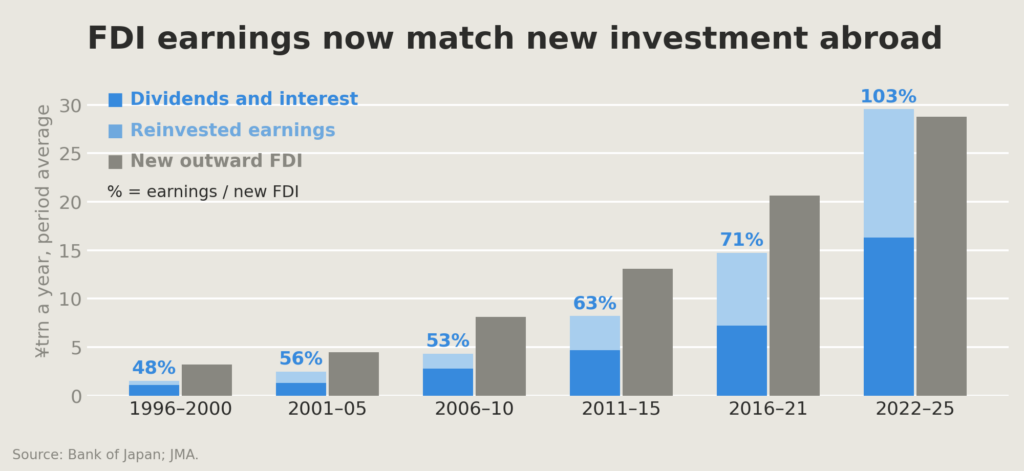
Overseas affiliates pay interest and dividends to their parent companies in Japan. Those dividends have become a sizable part of corporate Japan’s income: we estimate that they made up 13.4% of Japanese corporate profit in FY2025, up from 1.7% in FY1996.

When foreign affiliates retain their earnings on their balance sheets, Japan’s balance of payments statistics record them as FDI from Japan, even though no money crosses the border. While the companies receiving FDI dividends and the companies paying for new FDI are not necessarily the same, Japan Inc. as a whole is now financing its FDI almost entirely from the earnings of its overseas affiliates. At the current level of FDI, little new yen needs to be converted into foreign currencies as Japan goes about investing abroad.

In the rest of this report, I explain how foreign direct investment by Japanese companies evolved, and its near-term outlook. This report is the third in a series on the yen repatriation theme that I have published over the past few weeks, following “Yen Repatriation Starts with the Whale”, on capital flows through Japan’s national pension funds, and “Mrs Watanabe No More”, on Japanese households’ assets invested abroad.

A strong yen helped drive Japan’s first outward FDI boom

Japan’s outward investment was heavily restricted after WWII, requiring case-by-case permission from the government. Approvals became more and more automatic over the years until outward investment became “free in principle” in 1980. Trade friction with the US-led Japanese carmakers to restrain their exports from 1981, pushing them to build factories abroad. The rapid appreciation of the yen was also a factor. The yen strengthened from ¥242 per dollar before the Plaza Accord in September 1985 to ¥121 by the end of 1987. Japanese producers had to move lower value-added work abroad. The strong yen also gave Japanese financial institutions sizable purchasing power for a while, until the stock and property bubbles burst in 1990 and 1991.

All of these factors contributed to a rapid increase in outward FDI through the 1980s and 1990s (chart 2).

Chart 2

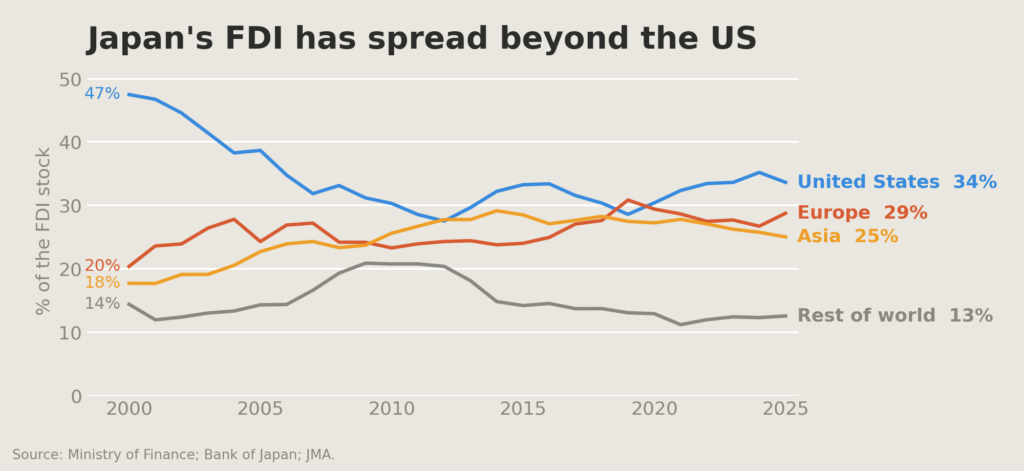
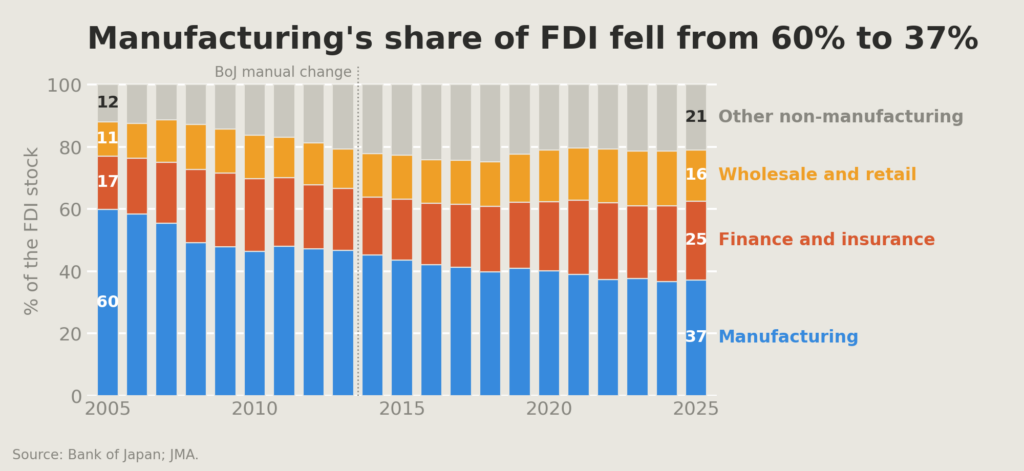
Even after the bubble burst, the strong yen kept pushing manufacturers to move abroad. In 2005, manufacturers accounted for 60% of the FDI stock. As Japanese manufacturers expanded their supply chains abroad, Asia’s share of outward FDI rose from about 12% in FY1986–90 to 19% in FY1995–99, and Asia held 23% of the FDI stock by 2005 (chart 3).

Chart 3
Japan’s outward FDI stock rose to 56% of GDP

The next phase was sustained by a different pressure. With weak growth and low interest rates at home, Japan Inc. kept investing abroad, across a broader range of industries. Between 1995 and 2025, the stock of FDI rose from 9% of Japan’s GDP to 58% (chart 4). In 2025, it is as large as about 38% of the private sector’s domestic fixed capital, on our estimate.

Chart 4

By industry composition and by destination compositions changed over time. Manufacturing’s share of the FDI stock had fallen to 37% by 2025, giving Japan’s FDI more breadth. By destination, we are seeing a revival of FDI toward the United States. It accounted for 34% of the stock in 2025, Europe 29% and Asia 25% (see earlier chart 3).
Thus, after decades of overseas investment, Japan’s FDI stock is now large enough that its earnings are sufficient to finance new investment abroad, at least for now. In the next section, I consider whether this will continue, and in particular whether Japanese companies may bring an even larger share of their overseas earnings back to Japan, given the weak yen, higher borrowing costs in yen and possibly better investment opportunities at home.

The weak yen has slowed offshoring, not reversed it

The real depreciation of the yen over the past 15 years made production in Japan more competitive. There is some evidence that manufacturers are considering bringing production back to Japan. The 2023 manufacturing white paper found more firms shifting production back from China than moving there, and they named the weak yen as one reason. We see some signs of reshoring. Japanese manufacturers’ overseas production ratio rose from 18.0% in FY2011 to 27.2% in FY2023, but it may have started to decline or at least stabilize. The ratio fell to 26.7% in FY2024. A Cabinet Office survey of listed manufacturers puts the ratio at 24.5% in FY2025, and their plan for FY2030 is broadly unchanged at 24.7%. The weak yen seems to have stabilized the wave of offshoring, but I see no firm evidence of a move back onshore yet.

Domestic investment has grown slowly despite the weak yen

There are tentative signs that domestic capital spending is starting to grow again. For three decades it grew at a very low speed. In real terms, private business investment rose only 26% between FY1997 and FY2025, less than 1% a year. In comparison, capital spending grew by about 4% a year on average in the United States. In my view, a weak currency is only one of the factors manufacturers weigh in designing their global production chains. The weak yen makes production in Japan competitive today, but they have also seen the exchange rate swing violently within short periods. Japan also has a shrinking population problem. It started to address it by opening a door to immigration, but the door is only tentatively open. Overall, my view is that the weak yen alone is unlikely to give Japan Inc. sufficient incentive to bring its capital back to Japan and to the yen.

Economic security is bringing some production home

The government is pushing harder than the currency, mostly in the name of economic security, even before the Takaichi government came along. The government currently has a ¥250 trillion domestic investment target for FY2040 and named AI and semiconductors among its 17 strategic fields. Semiconductors are where the money has gone furthest. In November 2024, under the Ishiba government, Japan committed more than ¥10 trillion of public support to AI and semiconductors by FY2030, aiming to draw more than ¥50 trillion of public and private investment over ten years. Japan managed to lure a TSMC plant to Japan, backed by a sizable subsidy. Rapidus, a government-supported Japanese semiconductor maker, has received a sizable subsidy and is building a factory in Hokkaido. Japan’s production of integrated circuits and discrete semiconductors rose from ¥2.7 trillion in 2019 to ¥4.1 trillion in 2025.

Under the name of economic security, the Japanese government is promoting other industries such as batteries, shipbuilding and pharmaceuticals. Defence spending adds to the push. Japan’s defence budget rose from about ¥5 trillion in FY2022 to ¥9.0 trillion in FY2026. Some defence contractors, such as Mitsubishi Heavy Industries, have doubled their defence revenue.

Japan’s industrial-policy record gives reason for caution

The Japanese government and the Ministry of Economy, Trade and Industry (METI), the key agency behind Japan’s industry policy, may claim some expertise in their industrial policies. Empirical studies in the past paint a poor track record, though. Rapidus, the most ambitious semiconductor project, has had no independent cost-benefit assessment (Negrine et al., 2025). While defence and economic security-driven policies have a different logic, I doubt that these industrial policies will succeed in bringing large-scale manufacturing investment back to Japan so long as macro factors such as Japan’s demography remain unfavourable.

FDI no longer appears to drive yen weakness

The weak yen and non-economic geopolitical factors do point to a halt in Japan’s four-decade offshoring trend, although it is a stabilization, rather than an economy-wide reversal of past offshoring. Japan Inc. will continue to invest more abroad, rather than within its borders. Given the sizable growth in the stock of cumulative FDI, Japan Inc. no longer needs to convert yen into overseas currency to keep investing abroad though. Net of dividends and interest paid home, Japan’s FDI sold about ¥5 trillion of yen a year, or about 1% of GDP, on average in the 2010s; since 2022 the net flow has been close to zero. There is also an interesting development in an effort to allow more share-exchange based M&A for cross-border deals that will further reduce the need for Japanese companies to spend their yen to purchase overseas assets. In my view, Japan Inc.’s FDI is no longer a factor to drive the yen weaker.

References

World-Watching: Container Shipping Financial Insight, Nov. 2023

[from Drewry Shipping Consultants]

Driven by weak 3Q23 financial results, the Drewry Container Equity Index decreased 3.7% last month (as of 22 Nov 2023). Additionally, asset prices continue to fall due to the supply-demand imbalance.

  • Container shipping companies’ 3Q23 financial results showcased a sharp dip in profits or even losses. On a group level, eleven liners (which report quarterly results) among our portfolio of 13 companies reported an average slump of 54.6% YoY in their 3Q23 topline. Operating costs declined 18.1% YoY amid falling chartering costs and lowering bunker prices. However, the cost reduction was insufficient to offset the plunge in topline; thus, EBIT contracted 94.1% YoY on average.
  • The Drewry Container Equity Index tumbled 28.1% YTD 2023 (ending 22 November), driven by lowering freight rates (WCI: -30.7% in YTD 2023), which squeezed earnings over the quarters. On the contrary, the S&P 500 posted an 18.4% growth. The Drewry Container Equity Index declined 3.4% in the month ending 22 November 2023. Talking about equity prices individually, APMM’s stock price fell 9.0% amid EBIT loss for its Ocean segment in 3Q23, staff cuts and reduced capex guidance, highlighting APMM’s efforts toward reducing costs faced with the bleak industry outlook. Hapag-Lloyd’s stock price slumped 22.2% as its EBIT margin (3Q23: 5.1%) slid below its pre-pandemic level (3Q19: 7.8%). ZIM became the first carrier to report impairment of assets worth USD 2.0bn in 3Q23, and its stock price fell 18.1%. Meanwhile, China-exposed container companies benefitted from the positive sentiment arising from the proposed fiscal stimulus by the Chinese government, possibly boosting the out-of-China and intra-Asia trades. Asian stocks in the broader index rose 2.0% to 19.4% in the month ending 22 November 2023.
  • Mainly driven by weak earnings prospects, the Drewry Container Equity Index trades at a P/B of 0.5x, a 47.5% discount to its pre-pandemic average (2013-19). We expect freight rates to fall sharply in 2024 and increasingly incur losses. Thus, we expect the multiple to remain suppressed.
  • As the fleet of container shipping companies expands, the charter market softens. For instance, 1-year TC rates declined 14.2% and 52.5% YoY in October for vessels sized 1,110 teu and 8,500 teu. Rates declined more for larger vessels as these constitute the majority of the order book and new deliveries. The YoY decline has continued since October 2022, but rates improved slightly during April-May 2023. However, this was not due to the fundamentally strong market but MSC and CMA CGM’s aggressive chartering of vessels to expand their fleets. Now that the two companies have stopped chartering in vessels, the charter market continues to decline.
  • Driven by the softening charter market, second-hand asset prices are also weakening. In October, on a YoY basis, prices for five-year-old vessels (2,700 teu and 7,200 teu) contracted 30.6% and 31.5%, and for 10-year-old ships, prices tumbled between 36.7% and 53.2%. Contrary to the sale and purchase market, newbuild prices (1,500 teu and 14,000 teu) continue to increase and rose by an average of 2.2% YoY, led by a shortage of capacity in shipyards.
  • The charter market and the S&P market have a direct impact on container shipping companies’ earnings. Costs related to chartering-in slots or vessels from other non-operating vessel owners form a significant portion of container shipping companies’ cost structure. In the 3Q23 results, this cost was reduced,
    marginally relieving downside pressure on the operating margin of container shipping companies. In line with the declining charter market, we expect this trend to continue in 4Q23. We also expect other companies to follow ZIM in reporting impairment losses as prices for older vessels continue to fall.

Read the report [archived PDF] for additional graphs.

Shipping and the World

[from Seatrade Maritime News]

Asyad Dry Dock Expanding Capacity As Demand Grows

Oman shipyard Asyad Dry Dock is expanding its capacity by 20% with a new floating dock as its current facilities are fully utilized.

by Marcus Hand

The shipyard, formerly Oman Drydock Company, is now part of the Asyad Group, the logistics arm of the Oman government. Management of the yard has been combined with shipowner Oman Shipping Company, and overseen by Dr. Irbahim Al Nadhairi, Chief Executive Officer, Shipping & Drydock.

“We have integrated the shipping and drydocking as the shipping service. The companies are still two legal separate entities but then we share the same executive team to be more efficient,” Dr. Ibrahim told Seatrade Maritime News in an interview at Posidonia 2022.

On the shipping side of the business the group owns a fleet of 65 ships with plans to increase the fleet to over 100 vessels over the next five years. He explains that with such a size of fleet the shipowner needed a quality shipyard so it made sense to work together.

Asyad maintains most, if not all its fleet at the shipyard in Oman, accounting for around 15% of its business. While part of the same group Dr. Ibrahim says it does not send its ships to the yard “by default,” and they have to make sure it is competitive as it needs to be for their third-party customers.

Business has been growing for the shipyard and it experienced a spike in the first half of this year as Chinese capacity has been taken out of the market by COVID restrictions pushing work to yards in other parts of the world. “So, we could see there was a big hike in the number of ships, not only for Asyad Dry Dock, but the entire region as well,” Dr. Ibrahim said.

“The next 12 months I believe the ship repair industry will still continue to flourish on our side.”

The shipyard’s two 600,000 DWT drydocks are already operating at full capacity and this year sees it adding a floating dock with the capacity to handle vessels up to Panamax size.

“We’ve recently acquired a floating dock which is of Panamax size and we reckon that about 40% of the business in ship repair is within that Panamax size. The floating dock gives us around 20% extra capacity,” he said. It will increase the number of ships the yard can repair from 200 to around 240.

The floating dock is expected to arrive in Oman in the next six weeks, and following some dredging works be operational by the start of Q4 this year.

Greek owners are major clients of the shipyard and account for around 40% of business, and Dr. Ibrahim said they added two more Greek clients last week. “It seems we have a good reputation in the Greek market and between now and end of Q3 we have 27 ships in orderbook from the Greek market.”

Globally its customer base includes MSC, AP Møller-Mærsk, CMA CGM S.A., Hapag-Lloyd, and Mitsui OSK Lines (株式会社商船三井). Maersk currently has currently two vessels in the yard.

Being able to deliver services efficiently and on time is of critical importance in the financially booming container sector.

“Today when you talk about bringing a container ship into a shipyard time really is money,” Dr. Ibrahim said. If a container ship owner says a ship will be in the yard for 15 days the owner will expect work to be completed in 12 days.

‘Further Action Is Needed’ As MEPC 78 Gets Underway

IMO Secretary General Kitack Lim hailed the 78th session of the Marine Environment Protection Committee as an opportunity to be brave and lead by example on decarbonization.

by Gary Howard

MEPC 78 has a packed agenda with the opportunity to consider and progress IMO’s work on cutting greenhouse gas emissions from ships.

At the last MEPC meeting, a revision process was agreed to strengthen the IMO’s initial GHG strategy which was adopted in 2018. A strengthened version of that initial strategy is due in mid-2023 at MEPC 80.

Speaking to Seatrade Maritime News in May, Stamatis Fradelos, Vice President, Regulatory Affairs at ABS said that important influencers in the IMO like the United States, EU, Canada, Japan, Australia and New Zealand are calling for net zero emissions from shipping by 2050 and introducing a level of ambition for 2040.

“Whilst progress has been made on many of the measures set out in the Initial Strategy, I am sure that we can all agree that further action is needed. Your discussions this week will chart the way forward for the decarbonization of international shipping,” said Lim.

“It is therefore of utmost importance that IMO continues to deliver concrete progress in transitioning international shipping from fossil fuels to low and zero-carbon alternatives.”

Member states at MEPC 78 will also consider adoption of guidelines to support short-term measures on GHG emissions, including correction factors for carbon intensity, EEXI calculation methodology and revised SEEMP.

Calculations on the GHG impact of fuels will be discussed, as ISWG-GHG 11 reports progress on developing lifecycle GHG assessment guidelines. Well-to-wake and tank-to-wake calculations are in scope, with the aim of giving fuel users a full picture of the impact of the production and use of the fuels they choose.

“Your constructive discussions on these topics will enhance the Committee’s evidence-based decision making when further considering proposals for mid-term GHG reduction measures,” Lim told Member States.

“I would like to take this opportunity to express my deepest appreciation to all Member States, and observer delegations, and especially the Chair of the Working Group on reduction of GHG emissions from ships, Mr. Oftedal of Norway, for the extraordinary effort and dedication in ensuring the successful outcome of both intersessional meetings.”

Houston Begins $1.1Bn Ship Channel Widening

The Port of Houston kicked off its the long-awaited billion dollar dredging scheme, the Houston Ship Channel Widening and Improvement Project 11 last week.

by Michele Labrut

The $1.1bn expansion of the Houston Ship Channel, which has been in planning for more than a decade is finally underway.

After more than a decade of planning, Project 11 will allow the ship channel to accommodate an additional 1,400 vessels per year and could generate up to $134bn more annually in economic impact once completed. The channel currently accommodates about 8,200 vessels and 215,000 barges each year, hauling more than 247m tons of cargo.

“This project will enable Port of Houston to continue to grow and respond effectively to whatever the future demand in the supply chain has to offer,” Port of Houston Executive Director Roger Guenther said in a statement.

Port of Houston is a 40-2 km-long complex of nearly 200 private and public industrial terminals along the 583.6 km-long manmade Houston Ship Channel, which connects the port to the Gulf of Mexico.

Project 11 will widen the Houston Ship Channel by 51.8 m along its 41.8 km Galveston Bay reach, to 213.3 m wide. It will also deepen upstream segments from a current depth of 13.7 m to a depth of 14.7 m. Dredging began last week. The Houston Ship Channel winds from the Gulf of Mexico through shallow Galveston Bay and up through the port.

“This project is important on many levels, including improving the efficiency of our nation’s supply chains, promoting navigational safety, and creating environmental benefits through the innovative use of dredged material,” Michael Conner, Assistant Secretary of the Army (Civil Works), said in a statement.

Port of Houston and the Army Corps of Engineers signed an agreement in August giving the port permits to start dredging the federal waterway. Great Lakes Dredge and Dock Co. was awarded a $95m contract in October, which also includes oyster mitigation and construction of a bird island. The channel widening and deepening project is scheduled to be completed in 2025.

EU Transport Commissioner Focuses on ‘Solidarity Lanes’ and Sanctions

As the global food crisis deepens and millions of tons of Ukraine’s grain remain blocked in the Black Sea, EU Transport Commissioner Adina-Ioana Vălean has declared that all transport modes will be considered in setting up new Solidarity Lanes that bypass the Black Sea.

by Paul Bartlett

Her comments come as disrupted grain movements risk a global food crisis.

Speaking to journalists immediately prior to yesterday’s opening ceremony at Posidonia, she said that trucks, tracks, trains, transshipment and storage facilities will all contribute to new supply chains to ensure that exports from one of the world’s largest grain exporters can resume, at least in part, as soon as possible.

She said that the setting up of Solidarity Lanes would have important commercial implications for shipping and could even lead to changes in the sector’s business models. 

Vălean also rejected criticism from prominent Greek shipowners who had claimed earlier in the day that sanctions imposed on Russia in the wake of its invasion on Ukraine won’t work. At a Maritime Leaders Summit staged by Capital Link on Monday, George Prokopiou and Evangelos Marinakis had both said that sanctions against Iran and Venezuela had been shown not to work and similar moves against Russia would not be effective either.

However, other sources pointed to the scale of the sanctions package that has severely impacted the Russian economy by disrupting key revenue generating sectors. Energy exports are the most obvious example and although Russian oil is still easily sold in India and China, for example, it is at deep discounts to global prices.

Meanwhile, LNG exports have also been hit and development of Arctic LNG supply chains have also been severely affected. Within the next few months, Vălean said that Russian oil exports would be further disrupted by the withdrawal of insurance cover on shipping and transport arrangements.