Skip to content
Meta Intelligence

Meta Intelligence

Towards a Composite Understanding of Education

  • About
  • Contact

Tag: collateral (finance)

Stablecoins and Financial Stability

The United States has introduced a new stablecoin regulatory framework, but concerns over the cryptocurrency’s place in the global economy remain.

[from the Federal Reserve Bank of Richmond’s Econ Focus, Fourth Quarter 2025, by Matthew Wells]

Signed into law in July 2025, the Guiding and Establishing National Innovation for U.S. Stablecoins (GENIUS) Act was a huge step forward for the cryptocurrency industry. The bipartisan legislation marked the federal government’s first effort at creating a regulatory framework for cryptocurrencies and signaled that crypto had finally achieved a status and size worthy of the government’s attention.

Stablecoins are digital assets used primarily as currency to buy and sell other cryptocurrencies, such as bitcoin, on blockchains, which are decentralized electronic ledgers. Traditionally, they are viewed as “private money” that has been pegged one-to-one to a state-issued currency, typically the U.S. dollar, although others have been pegged to the euro, the Japanese yen, and the Swiss franc.

While few people use stablecoins to pay for conventional goods and services, the technology is expanding rapidly. The SWIFT payment system is transitioning to the blockchain, allowing banks to settle transactions with stablecoins, and large companies such as PayPal have developed their own stablecoins. Walmart, Amazon, and several large financial institutions are also exploring their potential.

The GENIUS Act gives banking regulators, including the Federal Reserve, oversight authority over the entities that issue stablecoins. However, the law leaves it to those regulators to decide what rules to create and how to implement them. Further, increases in stablecoin demand may impact other sectors of the economy, such as the Treasury market and the global demand for dollars. All these carry potential implications for the stability of stablecoins, as well as the Fed’s efforts to maintain a safe and secure financial system.

Stablecoin Fundamentals

Customers wanting stablecoins pay money through their bank accounts, credit or debit cards, or other payment systems to an entity issuing them. With those stablecoins in hand, users can make purchases or investments wherever they are accepted. When users want to “cash in,” they take whatever stablecoins they have, which could have increased or decreased in number, back to an issuer, where they collect dollars back at a one-to-one rate.

Two of the most popular stablecoins in the crypto space are Tether and USD Coin. Unlike dollars, which are fiat currency (that is, their value is derived from the government’s declaration of their value), they and other stablecoins are backed or collateralized by a range of assets (or reserves), especially cash or U.S. Treasurys. In theory, these reserves can be easily liquidated to pay any customer seeking to redeem stablecoins for dollars.

The GENIUS Act addresses these dollar-pegged and reserve–collateralized stablecoins specifically, but there are other types of stablecoins that fall outside of the act’s definition. Crypto–collateralized stablecoins, for example, are still pegged to a currency but are backed by other digital assets such as Ethereum, making them less stable because of the greater volatility of their reserves. Another example includes algorithmic stablecoins, which attempt to maintain a consistent dollar-pegged value through automated adjustments in value relative to other digital currencies.

Stablecoins are used primarily as an immediate and secure medium of exchange for blockchain-based transactions, particularly the buying and selling of other cryptocurrencies. Unlike traditional payment systems, which can take days to fully settle transactions, stablecoin transactions are settled at any time of day on the blockchain almost instantaneously through “smart contracts,” where the terms of the transaction are written into the code.

Beyond their speed on the blockchain, another benefit of stablecoins is their global reach. They can be used anywhere in the world, including areas where dollars are difficult to acquire. Coupled with the ease with which a user can move stablecoins in and out of crypto markets, their use can reduce the costs and frictions associated with remittances or other international transactions. For individuals in developing countries with persistently high inflation, stablecoins may also be a way to save money that is insulated from swings in the domestic currency.

In a February 2025 speech [archived PDF], Fed Gov. Christopher Waller similarly noted that for some users, stablecoins might also serve as a store of value. Relative to the other, more volatile crypto assets, stablecoins are low risk, “which allows traders to move out of risky positions into safe ones where the safe asset price is known and stable,” he argued. Most stablecoin transactions — more than 80 percent — occur outside of the United States.

To date, these benefits of speed and availability have mostly been enjoyed by individuals active in the cryptocurrency marketplace rather than the average consumer. According to the Fed’s most recent Diary of Consumer Payment Choice [archived PDF], only 3 percent of respondents said they used cryptocurrency as a form of payment in the last month. However, the annual transaction value of stablecoins exceeded $27 trillion in 2024, surpassing that of Visa and Mastercard combined. Further, stablecoins’ current market capitalization is about $267 billion, and Citigroup projects it will grow to between $1.9 trillion and $4 trillion by 2030. Treasury Secretary Scott Bessent made a similar claim in November, suggesting it could reach $3 trillion in the coming years. Motivated by that growth, and its potential implications for the economy, Congress passed the GENIUS Act.

A New Regulatory Framework

The GENIUS Act grants banks, nonbanks, and even nonfinancial institutions with approval from state or federal regulators the ability to issue stablecoins to the public. Under the act, the Office of the Comptroller of the Currency regulates federally qualified issuers with over $10 billion in stablecoins in circulation. If the issuer is a subsidiary of an insured depository institution, such as a bank, it is regulated by the appropriate federal banking agency. All issuers with less than $10 billion in circulation would be regulated at the state level. Regulators would be responsible for conducting annual audit and ensuring compliance with existing anti-money laundering and sanctions requirements.

Crucially, issuers would be required to hold at least one dollar’s worth of reserves for every stablecoin issued. Those reserves mostly come in the form of cash, insured and uninsured deposits, short-term Treasurys, repo agreements, and central bank reserve deposits. However, these issuers would be exempt from the regulatory capital requirements that currently apply to banks, and this holds true even if the issuers are banks engaged in regular banking activities.

Stablecoins are not defined as securities or commodities under the legislation, meaning they are not federally insured and do not have the same protections as traditional bank deposits. In other words, there is no government-backed guarantee a user would be able to get cash back when they want to trade back in their stablecoins. Issuers, as of now, also do not have access to the Fed’s lending facilities.

Proponents of stablecoins argue that government insurance and access to the Fed are not necessary because the assets designated as collateral by the GENIUS Act are highly liquid, and issuers are required to hold as many dollars in reserve as they have stablecoins in circulation. While this would seemingly guarantee stablecoin holders could redeem their coins for cash whenever they choose without any difficulty, not all policymakers or observers agree it would be that easy.

In an October 2025 speech [archived PDF], Fed Gov. Michael Barr argued that “Because stablecoins are not backed by deposit insurance and stablecoin issuers do not have access to central bank liquidity, the quality and liquidity of their reserve assets is critical to their long-run viability.”

He identified several points of vulnerability in those assets. In addition to the potential for some consumers to mistakenly assume all stablecoins — not just those covered by the GENIUS Act — carry the same level of stability, he pointed out that other dollar-pegged assets have not always been able to maintain that one-to-one value. Money market mutual funds, which are listed as one class of asset that can be used as collateral, “broke the buck” in 2008 following Lehman Brothers’ bankruptcy and experienced strains again in March 2020 at the outbreak of the COVID-19 pandemic.

Uninsured deposits, another acceptable reserve asset, were also a risk factor that precipitated the March 2023 banking stress associated with the failure of Silicon Valley Bank and others. The legislation also allows for any medium of exchange authorized by a foreign government to be used as collateral via repo agreements, which until recently in the case of El Salvador included the highly volatile bitcoin.

In an October 2025 speech, Fed Gov. Michael Barr argued that “Because stablecoins are not backed by deposit insurance and stablecoin issuers do not have access to central bank liquidity, the quality and liquidity of their reserve assets is critical to their long-run viability.”

The GENIUS Act prohibits issuers from paying out interest to individuals holding their stablecoins. If stablecoins paid interest, they would have to be treated — and regulated — like securities rather than simply forms of payment. The legislation does, however, allow stablecoin exchanges, known as Virtual Asset Service Providers, to offer “rewards” to users who choose to buy and sell cryptocurrencies or conduct other transactions on their platforms. This creates a potential loophole, as these exchanges, if authorized by regulators, can also be part of the same entity issuing a stablecoin. The platform/issuer can then use the dollars traded for the stablecoins to purchase other assets, likely Treasurys to back the stablecoins, and then pay out rewards to customers with the proceeds from those investments.

Barr noted this area of concern, suggesting issuers “have a high incentive to maximize the return on their reserve assets by extending the risk spectrum as far out as possible. Stretching the boundaries of permissible reserve assets can increase profits in good times but risks a crack in confidence during inevitable bouts of market stress.” To hedge against this possibility, stablecoin issuers are required to publish monthly reports on the composition of their reserve assets, a move intended to give stablecoin holders increased confidence in the issuer’s liquidity.

Parallels to the Free Banking Era

Barr’s argument implies that stablecoins are only as stable as the assets backing them. The United States first established a banking system with a national currency backed by Treasury bonds during the Civil War. Prior to that, in the free banking era from 1836 to 1863, states conducted banking supervision and regulation, and banks issued their own currencies. (See “When Banking Was ‘Free,’” [archived PDF] Econ Focus, First Quarter 2018.) Those paper notes had to be collateralized through state and federal government bonds, and capital and reserve requirements were inconsistent across states.

This meant the country’s economy operated with competing, private currencies. It was difficult for currencies in one part of the country to be redeemed in other parts, and it was often done at a discount; for example, the farther away from the bank issuing the note, the steeper the redemption discount. It wasn’t unusual for citizens to question the collateral backing the various banks’ notes, leading to regular bank runs and failures.

One can draw parallels between the free banking period and today’s stablecoin landscape. First, as of early June, there were 233 stablecoins available on the crypto market. Numerous digital service platforms market themselves as spaces where private companies can create, manage, and distribute their own stablecoins. Bank of America, JPMorgan Chase, Citigroup, and Wells Fargo are considering the idea of a jointly issued stablecoin, as well as their own individual ones.

As was the problem with free banking, some economists question whether consumers will always maintain confidence that they can redeem stablecoins for cash on demand at the promised one-to-one rate. The large banks may be able to issue coins that no one will doubt, but the stablecoin marketplace includes platforms and issuers that are not banks at all, as well as international operators outside the jurisdiction of U.S. financial regulators.

“Smaller companies planning to issue stablecoins under the GENIUS Act to be regulated by one of the states may face market resistance,” says Michael Bordo, an economist at Rutgers University. “Unless there is perfect information about the backing and complete confidence in it, holders may want to discount the stablecoins or avoid them completely, as was the case under free banking in the United States.”

Yale University economist Gary Gorton expresses similar concerns, particularly due to the difficulty in regulating a transnational market. “Let’s suppose that one of the exchanges out there collapses because of fraud. Now everybody’s a little suspicious of these exchanges, and many aren’t even based in the United States,” he says. “That’s the kind of thing that would cause everybody to run.”

Should one stablecoin issuer experience a run where customers doubt its ability to pay back dollars on demand, it is possible others would too, especially if they are all backed by similar assets. This could lead to a crisis that extends beyond the stablecoin space and impacts the wider financial system. In a recent paper co-authored with Jeffery Zhang of the University of Michigan Law School, Gorton argued this outcome is consistent with the nature of short-term debt. Stablecoins are a form of that debt, and because of the laws of supply and demand, their values should fluctuate as the values of the assets backing them fluctuate.

“If one issuer gets in trouble and its stablecoin holders all run on it and ask for cash, it can sell Treasurys and give them the cash,” says Gorton. “But in a systemic event, 500 issuers are under siege and they all sell their Treasurys, and the price of Treasurys goes way down.”

Gorton and Zhang argued such a failure is in keeping with the pattern of systemic crises over the past 200 years, and the solution is not to outlaw stablecoins but to provide a safer alternative where “no one should have an incentive to produce information about the backing for the money (i.e., the banks’ assets); and everyone should know that no one has an incentive to produce that information.” In other words, a stablecoin that is truly stable is one that is accepted at par, anywhere and at any time, no questions asked. Gorton says that a digital currency issued by a central bank would meet these criteria.

Should one stablecoin issuer experience a run where customers doubt its ability to pay back dollars on demand, it is possible others would too, especially if they are all backed by similar assets. This could lead to a crisis that extends beyond the stablecoin space and impacts the wider financial system.

The Road Ahead

Skeptics and supporters alike agree that stablecoin adoption is likely to increase in the coming years. An important question, however, is whether it will attract new users looking for a new form of payment. Certainly, stablecoins offer the advantage of instant transactions, and merchants might have incentive to adopt them to replace credit cards, which currently assess transaction fees between 1.5 percent and 3.5 percent for each purchase. (See “Should Credit Card Fees Be Regulated?” [archived PDF]) However, it may be possible to achieve the benefits of quicker settlements and lower fees with existing payment rails, such as FedNow, raising the possibility that internal U.S. demand may be limited.

In a recent speech [archived PDF], Fed Gov. Stephen Miran acknowledged that stablecoins’ future growth may lie outside the United States. “Because GENIUS Act payment stablecoins do not offer yield and are not backed by federal deposit insurance, I see little prospect of funds broadly fleeing the domestic banking system,” he said. “The real opportunity in stablecoins is to satiate untapped foreign appetite for dollar assets from savers in jurisdictions where dollar access is limited.”

This increased global demand for stablecoins could precipitate increased demand for U.S. Treasurys. Stefan Jacewitz, an economist at the Kansas City Fed, suggested in a recent report that there is still a way to go for any increased adoption of stablecoins to make a meaningful difference in the economy. Circle, the largest U.S.-based stablecoin issuer, currently holds 43 percent of its assets in Treasurys. If all other issuers held that same percentage in Treasurys, it would amount to about $125 billion, which is less than 2 percent of the $6 trillion in outstanding Treasurys.

However, if the projections of increased adoption materialize, Jacewitz acknowledged the possibility that “it could lead to a substantial redistribution of funds” and potentially increase demand for Treasurys such that the increase in stablecoin issuers’ Treasury holdings could outpace the decrease in bank holdings. A 1 percent decrease in bank Treasury holdings — and an accompanying 1 percent decrease in bank lending — translates to a $325 billion reduction in loans into the economy, Jacewitz estimated.

The American Bankers Association and other banking organizations point to this potential for deposits to leave the banking system in calling for regulators to limit the ability of stablecoin issuers and platforms to pay out rewards. The crypto industry disagrees, arguing that banks fear competition, and banks could incentivize their depositors to stay by raising their deposit rate, something they did when they first competed with money market mutual funds.

While there is widespread agreement on the potential for stablecoins to serve an important function for cross-border transactions, concerns about their soundness and stability remain, and they are not just theoretical. Circle held $3.3 billion of its approximately $40 billion in reserves at Silicon Valley Bank when it collapsed in 2023, and its inability to access those reserves triggered a fall in the value of its USD Coin from the one-to-one ratio to below 87 cents on the dollar. In that case, the federal government stepped in and made whole all of Silicon Valley Bank’s depositors, including Circle, which restored its dollar peg.

Bordo argues that in the wake of the free banking era, it still took years of costly bank failures to get to the point where policymakers acted upon the realization that stability in the banking system required much more government intervention, supervision, and regulation than had existed. He notes, “There are always new entities that are going to figure out a way to be outside the regulatory net,” and stablecoins will not be any different.

As with any new financial innovation, the Fed will continue to study stablecoins to ensure that their benefits can be enjoyed by those who want to use them while maintaining overall financial and banking stability.

Readings

Gorton, Gary, and Jeffery Zhang. “Why Financial Crises Recur.” [archived PDF] University of Michigan Law and Economics Research Paper No. 24-069, June 25, 2025.

Jacewitz, Stefan. “Stablecoins Could Increase Treasury Demand, but Only by Reducing Demand for Other Assets.” [archived PDF] Economic Bulletin, Federal Reserve Bank of Kansas City, Aug. 8, 2025.

Spira, Jack, and David Wessel. “What Are Stablecoins, and How Are They Regulated?” [archived PDF] Brookings Commentary, Oct. 24, 2025.

“Stablecoins 2030: Web3 to Wall Street.” [archived PDF] Citi Institute, September 2025.

Download this article [archived PDF].

Related Webinar

PaymentsJournal is offering a webinar entitled “Stablecoins and the Reinvention of Remittance” on Tuesday, May 12, 2026 1:00-2:00 PM EDT.
RSVP for their webinar.

Author David ClarkPosted on May 7, 2026May 8, 2026Categories Economics, Essays, World WatchingTags 2023 United States banking crisis, accounting liquidity, Amazon (company), American Bankers Association, American Civil War, anti-money laundering, asset, audit, bank, bank account, Bank of America, bank reserves, bank run, banknote, bankruptcy of Lehman Brothers, bipartisanship, bitcoin, blockchain, capital (economics), cash, central bank, Christopher Waller, Circle Internet Group, Citigroup, collateral (finance), commodity, company, cost, COVID-19 pandemic, credit card, cryptocurrency, cryptocurrency exchange, currency, customer, debit card, debt, decentralized application, demand, deposit (finance), deposit insurance, developing country, digital asset, digital currency, economic sector, economist, economy, El Salvador, Ethereum, euro (€), Federal Deposit Insurance Corporation, federal government of the United States, Federal Reserve, Federal Reserve Bank of Kansas City, Federal Reserve Bank of Richmond, Federal Reserve Board of Governors, FedNow, fiat money, finance, financial institution, financial system, financial transaction, free banking, Gary Gorton, GENIUS Act, goods, government, government bond, inflation, insurance, interest, investment, Japanese yen (¥), JPMorgan Chase, jurisdiction, ledger, legislation, liquidation, loan, market (economics), Mastercard, Michael Barr (U.S. official), Michael D. Bordo, money, money market fund, non-bank financial institution, Office of the Comptroller of the Currency, payment, payment rail, payment system, PayPal, price, private currency, regulation, regulatory agency, regulatory compliance, remittance, repurchase agreement, Scott Bessent, security (finance), service (economics), smart contract, stablecoin, Stephen Miran, subsidiary, supply (economics), SWIFT, technology, Tether (cryptocurrency), United States, United States Congress, United States Department of the Treasury, United States dollar, United States Secretary of the Treasury, United States Treasury security, University of Michigan Law School, USDC (cryptocurrency), Visa Inc., Walmart, Yale University

Economic-Watching: Center for Global Development: Weekly Development Update

The EU as a Global Actor

Kicking off a new CGD series of policy proposals to inform the European Union’s upcoming development agenda, Mikaela Gavas and W. Gyude Moore suggest a reset of the EU’s international relations narrative. Explore their ideas for how the EU can position itself as a global development player while staying true to its values and focusing on the common good.

Read the full article [archived PDF].

Is There Any Hope for Bipartisan Cooperation on Aid in 2025?

by Charles Kenny, July 15, 2024 (CGD Blog Post)

The gap between parties on international economic policy is often smaller than the gap between consensus positions over time. While the Biden administration has introduced migrant-supporting measures including relief for the undocumented spouses of citizens and community sponsorship of refugees, both parties are far tougher on asylum seekers than Obama or Bush were. Back in the 1990s, President Bill Clinton signed NAFTA, which made it through Congress relying on considerable Republican support. Today, President Trump’s trade war with China has been expanded by President Biden and the tariffs first imposed by President Trump are openly backed by many Congressional Democrats. Again, there is now strong bipartisan agreement that a considerable focus of US overseas investment support ought to be countering China, with Democratic appointees leading the charge for greater flexibility in the US International Development Finance Corporation’s development mandate set during the last Republican administration.

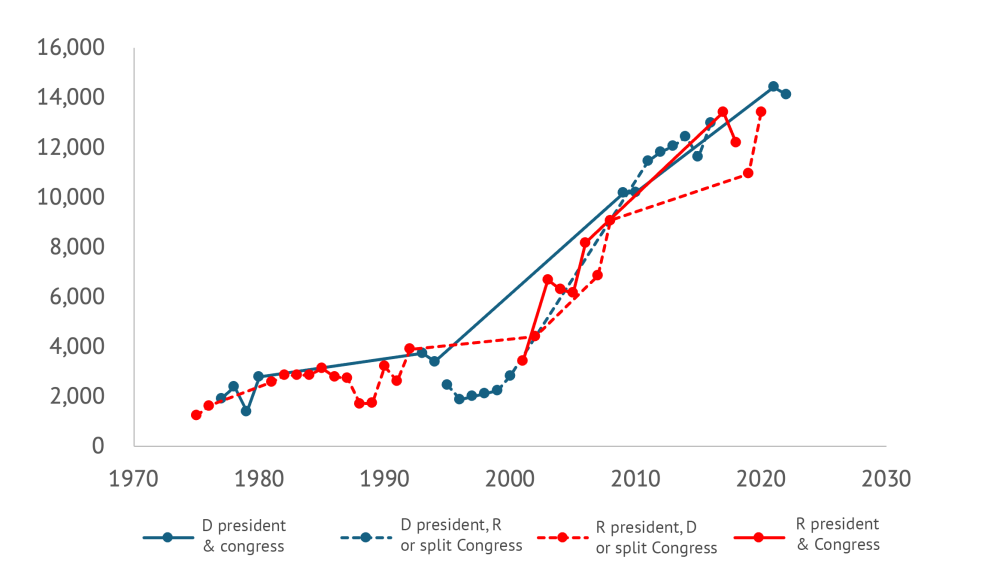
The same applies to aid flows. The figure below shows data on total aid disbursements from the US depending on who is in power: the solid blue line is Democratic control of the presidency and both branches of Congress, the blue dashed line is Democratic control of the presidency and one or neither branch, the solid red line is Republican control of the presidency and both chambers, and the red dashed line is control of the presidency and one or neither chamber. There’s only one data point for each year, of course, but the lines connect between them. The broad picture strongly suggests the trend matters more than who is in power (indeed, remember the Surprise Party?).

Figure 1: US aid disbursements by party control (Current $m)

The potential good news from this is that despite substantive disagreements over topics including the Mexico City Policy, bipartisan cooperation on aid might still be more possible than it might appear from a close-up perspective in the midst of partisan rancor. To repeat the bad news: much of the recent bipartisan movement on foreign economic policy has been to the detriment of developing countries. And there is certainly some talk of sweeping changes, including cuts, that might mean the past is no guide. But perhaps there still space for elements of a positive agenda around aid for the legislative sessions of next year, one that could appeal to at least some people on both sides of the aisle. Examples might include:

Advancing localization: Spending more US aid finance in recipient countries rather than on US contractors has been a hallmark of Samantha Power’s tenure at USAID. But it has Republican antecedents. The Trump administration followed a localization strategy for PEPFAR that significantly increased the number of local partners and a New Partnerships Initiative at USAID designed in part to do the same. And in 2021, US Senators Marco Rubio (R–FL) and Tim Kaine (D–VA) introduced legislation to reduce red tape for local organizations seeking USAID funds. It would be great to see further cooperation on ensuring more development dollars are actually spent in developing countries.

Country focus: All else even somewhat equal, a dollar of foreign assistance simply has a larger impact in poorer countries. The logic that richer countries should be able to look after themselves was a justification for the Trump administration’s “Journey to Self-Reliance”—a philosophy dedicated toward “ending the need for aid.” The Biden administration has continued to produce the “country roadmaps” designed to chart the journey. It would be great to see bipartisan efforts to focus grant resources in particular where they’ll have the greatest impact—in the poorest countries.

Sovereign lending and guarantees: While grants should be focused on poorer countries, loans could be an effective and comparatively low-cost tool to support wealthier countries. The recently passed Ukraine aid package provided resources in the form of partially forgivable loans, and senior Republicans have been pushing the model more widely. More lending and guarantees could be a powerful tool to support infrastructure rollout in middle-income countries. And strengthening the US sovereign loan guarantee program could back development and national security goals at a considerably lower cost than grant-based programs.

MCC reform: The Millennium Challenge Corporation, created during the George W. Bush administration, is running into pipeline challenges—and appropriators have clawed back funding in response. That’s a shame. It is a small but effective aid agency providing resources for development priorities including infrastructure and working with client countries to help them deliver—in fact, it’s a model of successful localization. MCC faces spending challenges in part because it hasn’t increased the size of individual country operations, limits repeat operations, and can only work in countries that pass its “scorecard” of development indicators. The agency wants to address its partner problem by working in richer countries. That’s a sad way to achieve impact and goes against the bipartisan principle that richer developing countries should be weaned off aid flows, not given more. Altering the size of compacts, allowing more repeat compacts, and moving away from a scorecard model towards a model of reward for reform—a specific set of policy changes that need to be completed before funds start flowing—would be a far more effective approach.

Fighting malaria: In the 1958 State of the Union, President Eisenhower said that the US would lead a global effort to eradicate malaria. The time and the tools were not right then, but today there is far greater hope for rapid progress against the disease. George Bush created the President’s Malaria Initiative in 2005, and the US has been a vital contributor to the global fight against the parasite since then. With the arrival of new vaccines in the past couple of years, we could accelerate progress and save hundreds of thousands of children’s lives each year. And with better vaccines, we could move even faster. PEPFAR, the US initiative to provide HIV drugs, has transformed the battle against AIDS worldwide. A similar bipartisan initiative could achieve as much with malaria.

Transparency: Both parties have shown commitment to increasing the transparency of aid finance including around subawards and indirect cost rate data. It would be great if there was a bipartisan consensus on simply publishing all aid contracts.

Beyond aid, the African Growth and Opportunity Act was first passed during the Clinton administration, renewed during the Bush administration and then again under the Obama administration. A bipartisan proposal to renew the trade package once more was launched in the Senate in April this year. Perhaps AGOA could be made even bigger and better. Even amidst partisan rancor, there is plenty a Congress and administration could do to improve US relations with and support to low- and middle-income countries next year.

Undoing Gender Inequality Traps in the Financial Sector: The Case of Colombia

by Mayra Buvinic and Alba Loureiro, July 9, 2024 (CGD Blog Post)

Gender data is needed to gauge the extent to which financial services include and benefit women. However, sex-disaggregated data that tracks access to and use of financial services is still hard to come by, and it is especially rare to have country-level data that captures the universe of financial sector providers (FSPs) and is published on a regular basis.

A notable exception is Colombia, where Banca de Oportunidades (BdO), a public sector technical assistance and advocacy platform, compiles in a centralized data platform anonymized data from all FSPs in partnership with Colombia’s Superintendency of Banks. The 2023 edition, the 13th annual publication, reports on 15 million transactions, 60 percent of them monetary, from the universe of banks, credit and savings cooperatives, microfinance institutions, and fintechs. The report tells a sobering story worth highlighting of the trajectory of women’s financial inclusion because it mirrors much of what we know [archived PDF] about the constraints women face having access to financial services in low- and middle-income countries. The report’s numbers [archived PDF] suggest that:

Expanding access is not enough

Despite almost universal access to financial products, gender gaps persist. In 2023, 19 out of every 20 adult Colombians (or 94.6 percent) reported access to at least one financial product or service. However, women faced less favorable conditions (see below), underscoring that mere access is insufficient.

Gender gaps are evident in both savings and credit 

In 2023, women had 6.5 and 3.7 percentage points (pp) lower access to savings and credit, respectively, than men. While women’s access to savings increased over time–from 75 percent in 2018 to 90.4 percent in 2023–the gender gap widened (from 4.3 pp to 6.5 pp). In the same period, the gender gap in credit narrowed slightly (from 4.8 pp to 3.7 pp) but both men’s and women’s access to credit decreased–for women from 37.7 percent in 2018 to 33.4 percent in 2023. 

Women face access to credit in less favorable conditions than men 

Interest rates are higher for women clients across all loan types, and highest for microcredit–with a 5.4 percent gender gap–which women access more than men. In 2023, women accessed 1,029 million and men accessed 857,000 microcredit loans. More men than women accessed commercial loans (20,000 versus 14,000 loans) while housing loans went equally to women and men. 

Paradoxically, these less favorable conditions coexist with women exhibiting lower credit risks than men

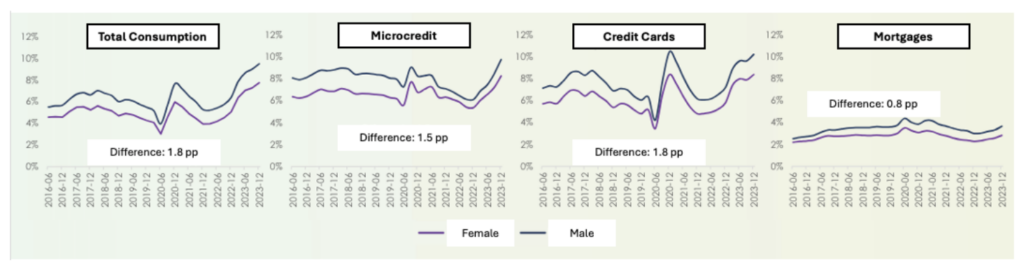
Women have better repayment rates than men across loan types (Figure 1). Women also perform better across insurance products, except for microinsurance, showing lower accident rates. However, female clients have 13.8 pp lower access to insurance products than men. 

Figure 1: Total Repayment Rates, Overdue More Than 30 Days.
Source: The graphic was extracted from the Financial Inclusion PowerPoint (Paola Arias and Jaime Rodriguez, 4 June, 2024) [archived PDF], and the labels were translated from Spanish.

The data implies that women’s good financial behavior is penalized rather than prized, with higher interest rates and lower access to financial products 

This is partly the result of gender biases that affect both the demand and supply of credit and lead to rationing credit to women.

Rationing credit and other financial services to women perpetuates ‘gender inequality traps’ leading to further rationing  

It all starts with women having fewer assets to use as collateral and lower earnings than men (a commonplace fact across financial markets everywhere) which leads them to qualify for smaller loans. In turn, this results in women having less access to credit to increase earnings because of the high costs to lenders of serving customers with small loans, resulting in even lower earnings.

Gender biases that affect the supply and demand for credit reinforce this vicious cycle 

Results from five clever experiments in Colombia done by BdO in collaboration with the Development Bank of Latin America and the Caribbean (CAF) suggest how easily these gender biases reinforce each other:

  1. On the supply side, there are cognitive and perceptual biases (the latter detected by eye-tracking) from financial sector providers–male potential borrowers are ‘ex-ante’ perceived as having higher earnings than similar women. And female bank agents are stricter at evaluating female clients than male clients.
  2. On the demand side, the incorrect assumption that women are higher credit risks than men is reinforced by female clients’ own lower self-confidence and greater self-exclusion from financial services: women do not apply for credit because they anticipate they will be rejected because they have lower earnings. 

Not surprisingly perhaps, women in Colombia score lower than men in a financial health indicator–with an average score of 4.9 for women and 5.6 for men measured in a 0 to10 scale (scored by BdO using data from the 2022 edition of the survey).

To overcome these gender inequality traps, only a combination of strategies will work

Solutions must address both demand– and supply-side constraints and include:

  • Expand access to financial services to all by lowering the costs of serving small and micro borrowers, including women–as a recently announced collaboration between the Bill and Melinda Gates Foundation, the European Investment Bank, and KCB Bank Kenya seeks to pilot in Kenya by lowering the costs of loans to female micro borrowers through digital technology and data, and risk-sharing.
  • Increase women’s self-confidence and combat their self-exclusion from financial services with credit ‘plus’ interventions that include ‘soft skills’ training.
  • Provide customized products that fit women’s needs, including importantly insurance and microinsurance that respond to women’s greater need for mitigating (family) risks.
  • Combat supply-side biases that lead to inefficiencies and exclusions, including incentives to financial sector providers to reach women with financial services.
  • For the above, collect and publish gender data, but data that does not end up sitting on a shelf gathering dust; data that instead is used to make management decisions, which underscores the role of public sector institutions such as BdO in collaborating with and incentivizing financial sector providers, and in measuring, tracking, and reporting progress in financial inclusion.

Fortunately, there is a growing wealth of research that backs up the solutions suggested above. But there is still an important practical research agenda ahead:

  • First is reaching the poorest and excluded with financial services that they may need.  In the case of Colombia, this includes indigenous and Afro-descendent populations in geographically distant regions of the country. This requires building further granularity in the financial inclusion data, following guidelines of intersectionality data in development.
  • There is substantial research on demand-side constraints in women’s access to financial services.  There is comparatively little research on supply-side gender biases and solutions to these biases that can be scaled.
  • Lastly, there is the task of developing financial health indicators that can be easily and widely used disaggregated by gender and other demographic features to monitor an important development outcome from increasing financial access to all.

Disclaimer

CGD blog posts reflect the views of the authors, drawing on prior research and experience in their areas of expertise. CGD is a nonpartisan, independent organization and does not take institutional positions.

Author David ClarkPosted on July 16, 2024July 25, 2025Categories Economics, Essays, World WatchingTags 1958 State of the Union Address, African diaspora, African Growth and Opportunity Act, aid, asset, asylum seeker, bank, Barack Obama, Bill & Melinda Gates Foundation, Bill Clinton, CAF – Development Bank of Latin America and the Caribbean, Center for Global Development, citizenship, collateral (finance), Colombia, cooperative banking, credit, credit risk, customer, demand, Democratic Party (United States), developing country, Dwight D. Eisenhower, economic indicator, economic policy, European Investment Bank, European Union, financial market, financial services, fintech, Florida, foreign direct investment, George W. Bush, HIV, HIV/AIDS, insurance, international development, KCB Bank Kenya Limited, Kenya, loan, malaria, Marco Rubio, Mexico City policy, microcredit, microfinance, microinsurance, migrant worker, Millennium Challenge Corporation, mortgage loan, North American Free Trade Agreement, Presidency of Donald Trump, Presidency of George W. Bush, Presidency of Joe Biden, President of the United States, President's Emergency Plan for AIDS Relief, President's Malaria Initiative, public sector, refugee, Republican Party (United States), Samantha Power, savings account, sexism, supply (economics), supply and demand, Tim Kaine, trade, trade war, transparency (behavior), U.S. International Development Finance Corporation, Ukraine, United States, United States Senate, Virginia
July 2026
M T W T F S S
 12345
6789101112
13141516171819
20212223242526
2728293031  
« Jun    

Categories

  • Essays (373)
    • Cinema (9)
    • Literature (2)
    • Music (2)
    • Podcast (2)
    • Poetry (3)
    • Press Release (28)
    • Video (1)
    • World Watching (164)
      • Economics (114)
      • Education (2)
      • Government (1)
      • Mathematics (2)
      • Science (30)
        • Biology (1)
        • Environment (5)
        • Medicine (5)
        • Philosophy (1)
        • Technology (4)
      • Webinar (5)
      • Zoom Meeting (4)

Tags

  • 19th century
  • 20th century
  • bank
  • China
  • consumer
  • COVID-19 pandemic
  • demand
  • Donald Trump
  • economic indicator
  • economics
  • economy
  • education
  • employment
  • Europe
  • Federal Reserve
  • Federal Reserve Bank of Atlanta
  • finance
  • France
  • Germany
  • Gross Domestic Product
  • Harvard University
  • History
  • India
  • inflation
  • investment
  • Japan [日本]
  • loan
  • London
  • manufacturing
  • market (economics)
  • mathematics
  • monetary policy
  • philosophy
  • physics
  • politics
  • price
  • Russia
  • science
  • tariff
  • technology
  • trade
  • United Kingdom
  • United States
  • Western world
  • World War I
  • About
  • Contact
Meta Intelligence Proudly powered by WordPress