World-Watching: Minutes of the Monetary Policy Committee — Copom

272nd Meeting – July 29-30, 2025

[from the Central Bank of Brazil, 5 August, 2025]

  1. Update of the economic outlook and the Copom’s scenario1
    1. The global environment is more adverse and uncertain due to the economic policy and economic outlook in the United States, mainly regarding its trade and fiscal policies and their effects.
    2. Therefore, the behavior and the volatility of different asset classes have been impacted, altering global financial conditions. This scenario requires particular caution from emerging market economies amid heightened geopolitical tensions.
    3. Regarding the domestic scenario, the set of indicators on economic activity has shown some moderation in growth, as expected, but the labor market is still showing strength.
    4. In recent releases, headline inflation and measures of underlying inflation remained above the inflation target. Inflation expectations for 2025 and 2026 collected by the Focus survey remained above the inflation target and stand at 5.1% and 4.4%, respectively.
  2. Scenarios and risk analysis
    1. The inflation outlook remains challenging in several dimensions. Copom assessed the international scenario, economic activity, aggregate demand, inflation expectations, and current inflation. Copom then discussed inflation projections and expectations before deliberating on the current decision and future communication.
    2. The global environment is more adverse and uncertain. If, on the one hand, the approval of certain trade agreements, along with recent inflation and economic activity data from the U.S., could suggest a reduction in global uncertainty, on the other hand, the U.S. fiscal policy—and, particularly for Brazil, the U.S. trade policy—make the outlook more uncertain and adverse. The increase of trade tariffs by the U.S. to Brazil has significant sectoral impacts and still uncertain aggregate effects that depend on the unfolding of the next steps in the negotiations and the perception of risk inherent to this process. The Committee is closely monitoring the potential impacts on the real economy and financial assets. The prevailing assessment within the Committee is the increased global outlook uncertainty, and, therefore, Copom should maintain a cautious stance. As usual, the Committee will focus on the transmission mechanisms from the external environment to the domestic inflation dynamics and their impact on the outlook.
    3. The domestic economic activity outlook has indicated a certain moderation in growth, while also presenting mixed data across sectors and indicators.
    4. Overall, some moderation in growth is observed, supporting the scenario outlined by the Committee. This moderation, necessary for the widening of the output gap and the convergence of inflation to the target, is aligned with a contractionary monetary policy. Monthly sectoral surveys and more timely consumption data support a gradual slowdown in growth.
    5. At turning points in the economic cycle, it is natural to observe mixed signals from economic indicators—some leading, others lagging—as well as from comparisons between markets, such as the credit and labor markets.
    6. The credit market, which is more sensitive to financial conditions, has shown clearer moderation. A decline in non-earmarked credit granting and an increase in interest and delinquency rates have been observed. Moreover, regarding household credit, there has been an increase in the household debtservice ratio and a deepening of the negative credit flow—that is, households repaying more debt than taking on. It was emphasized during the discussion that some recent measures, such as private payroll-deducted loans, have had less impact than many market participants expected. Given the implementation agenda in this credit line, as well as the effects of introducing and removing taxes on other credit modalities, the Committee believes it should closely monitor upcoming credit data releases.
    7. In contrast to the credit market, the labor market remains dynamic. Both from the perspective of income—with real gains consistently above productivity—and employment—with a significant decrease in the unemployment rate to historically low levels—the labor market has greatly supported consumption and income.
    8. Thus, the Committee assesses that the signals from demand and economic activity so far suggest that the scenario is unfolding as expected and is consistent with the current monetary policy. The Committee reiterates that the aggregate demand slowdown is an essential element of supplydemand rebalancing in the economy and convergence of inflation to the target.
    9. Fiscal policy has a short-term impact, mainly through stimulating aggregate demand, and a more structural dimension, which has the potential to affect perceptions of debt sustainability and influence the term premium in the yield curve. A fiscal policy that acts counter-cyclically and contributes to reducing the risk premium favors the convergence of inflation to the target. Copom reinforced its view that the slowdown in structural reform efforts and fiscal discipline, the increase in earmarked credit, and uncertainties over the public debt stabilization have the potential to raise the economy’s neutral interest rate, with deleterious impacts on the power of monetary policy and, consequently, on the cost of disinflation in terms of activity. The Committee remained firmly convinced that policies must be predictable, credible, and countercyclical. In particular, the Committee’s discussion once again highlighted the need for harmonious fiscal and monetary policy.
    10. Inflation expectations, as measured by different instruments and obtained from various groups of agents, remained above the inflation target at all horizons, maintaining the adverse inflation outlook. For shorter-term horizons, following the release of the most recent data, there has been a decline in inflation expectations. For longer-term horizons, conversely, there has been no significant change in inflation expectations between Copom meetings, even though measures of breakeven inflation extracted from financial assets have declined. The Committee reaffirmed and renewed its commitment to re-anchoring expectations and to conducting a monetary policy that supports such a movement.
    11. De-anchored inflation expectations is a factor of discomfort shared by all Committee members and must be tamed. Copom highlighted that environments with de-anchored expectations increase the disinflation cost in terms of activity. The scenario of inflation convergence to the target becomes more challenging with de-anchored expectations for longer horizons. When discussing this topic, the main conclusion obtained and shared by all members of Copom was that, in an environment of de-anchored expectations—as currently is the case—greater monetary restriction is required for a longer period than would be otherwise appropriate.
    12. The inflation scenario has continued to show downside surprises in recent periods compared with analystsforecasts, but inflation has remained above the target Industrial goods inflation, which has already been showing weaker wholesale price pressures, continued to ease in the more recent period. Food prices also displayed slightly weaker-than-expected dynamics. Finally, services inflation, which has greater inertia, remains above the level required to meet the inflation target, in a context of a positive output gap. Beyond the changes in items, or even short-term oscillations, the core inflation measures have remained above the value consistent with the target achievement for months, corroborating the interpretation that inflation is pressured by demand and requires a contractionary monetary policy for a very prolonged period.
    13. Copom then addressed the projections. In the reference scenario, the interest rate path is extracted from the Focus survey, and the exchange rate starts at USD/BRL 5.552 and evolves according to the purchasing power parity (PPP). The Committee assumes that oil prices follow approximately the futures market curve for the following six months and then start increasing 2% per year onwards. Moreover, the energy tariff flag is assumed to be “green” in December of the years 2025 and 2026.
    14. In the reference scenario, four-quarter inflation projections for 2025 and for 2026 are 4.9% and 3.6%, respectively (Table 1). For the relevant horizon for monetary policy—2027 Q1—the inflation projection based on the reference scenario extracted from the Focus survey remained at 3.4%, above the inflation target.
    15. Regarding the balance of risks, it was assessed that the scenario of greater uncertainty continues to present higher-than-usual upside and downside inflation risks to the inflation outlook. Copom assessed that, among the upside risks for the inflation outlook and inflation expectations, it should be emphasized (i) a more prolonged period of de-anchoring of inflation expectations; (ii) a stronger-than-expected resilience of services inflation due to a more positive output gap; and (iii) a conjunction of internal and external economic policies with a stronger-than-expected inflationary impact, for example, through a persistently more depreciated currency. Among the downside risks, it should be noted (i) a greater-than-projected deceleration of domestic economic activity, impacting the inflation scenario; (ii) a steeper global slowdown stemming from the trade shock and the scenario of heightened uncertainty; and (iii) a reduction in commodity prices with disinflationary effects.
    16. Prospectively, the Committee will continue monitoring the pace of economic activity, which is a fundamental driver of inflation, particularly services inflation; the exchange rate pass-through to inflation, after a process of increased exchange rate volatility; and inflation expectations, which remain de-anchored and are drivers of future inflation behavior. It was emphasized that inflationary vectors remain adverse, such as the economic activity resilience and labor market pressures, de-anchored inflation expectations, and high inflation projections. This scenario prescribes a significantly contractionary monetary policy for a very prolonged period to ensure the convergence of inflation to the target.
  3. Discussion of the conduct of monetary policy
    1. Copom then discussed the conduct of monetary policy, considering the set of projections evaluated, as well as the balance of risks for prospective inflation.
    2. Following a swift and firm interest rate hike cycle, the Committee anticipates, as its monetary policy strategy, continuity of the interruption of the rate hiking cycle to observe the effects of the cycle already implemented. It was emphasized that, once the appropriate interest rate is determined, it should remain at a significantly contractionary level for a very prolonged period due to de-anchored expectations. The Committee emphasizes that it will remain vigilant, that future monetary policy steps can be adjusted and that it will not hesitate to proceed with the rate hiking cycle if appropriate.
  4. Monetary policy decision
    1. The Committee has been closely monitoring with particular attention the announcements regarding the imposition by the U.S. of trade tariffs on Brazil, reinforcing its cautious stance in a scenario of heightened uncertainty. Moreover, it continues to monitor how the developments on the fiscal side impact monetary policy and financial assets. The current scenario continues to be marked by de-anchored inflation expectations, high inflation projections, resilience on economic activity, and labor market pressures. Ensuring the convergence of inflation to the target in an environment with de-anchored expectations requires a significantly contractionary monetary policy for a very prolonged period.
    2. Copom decided to maintain the Selic rate at 15.00% p.a., and judges that this decision is consistent with the strategy for inflation convergence to a level around its target throughout the relevant horizon for monetary policy. Without compromising its fundamental objective of ensuring price stability, this decision also implies smoothing economic fluctuations and fostering full employment.
    3. The current scenario, marked by heightened uncertainty, requires a cautious stance in monetary policy. If the expected scenario materializes, the Committee foresees a continuation of the interruption of the rate hiking cycle to examine its yet-to-be-seen cumulative impacts, and then evaluate whether the current interest rate level, assuming it stable for a very prolonged period, will be enough to ensure the convergence of inflation to the target. The Committee emphasizes that it will remain vigilant, that future monetary policy steps can be adjusted and that it will not hesitate to resume the rate hiking cycle if appropriate.
    4. The following members of the Committee voted for this decision: Gabriel Muricca Galípolo (Governor), Ailton de Aquino Santos, Diogo Abry Guillen, Gilneu Francisco Astolfi Vivan, Izabela Moreira Correa, Nilton José Schneider David, Paulo Picchetti, Renato Dias de Brito Gomes, and Rodrigo Alves Teixeira.
Table 1

Inflation projections in the reference scenario
Year-over-year IPCA change (%)

Price Index202520262027 Q1
IPCA4.93.63.4
IPCA market prices5.13.53.3
IPCA administered prices4.44.03.9
Footnotes

1 Unless explicitly stated otherwise, this update considers changes since the June Copom meeting (271st meeting).

2 It corresponds to the rounded value of the average exchange rate observed over the ten working days ending on the last day of the week prior to the Copom meeting, according to the procedure adopted since the 258th meeting.

Meeting information
Date: July 29-30 2025
Place: BCB Headquarters’ meeting rooms on the 8th floor (7/29 and 7/30 on the morning) and 20th floor (7/30 on the afternoon) – Brasilia – DF – Brazil
Starting and ending times:
July 29: 10:07 AM – 11:37 AM; 2:17 PM – 5:51 PM
July 30: 10:10 AM – 11:13 AM; 2:37PM – 6:34 PM
In attendance:
Members of the Copom
Gabriel Muricca Galípolo – Governor
Ailton de Aquino Santos
Diogo Abry Guillen
Gilneu Francisco Astolfi Vivan
Izabela Moreira Correa
Nilton José Schneider David
Paulo Picchetti
Renato Dias de Brito Gomes
Rodrigo Alves Teixeira
Department Heads in charge of technical presentations (attending on July 29 and on the morning of July 30)
André de Oliveira AmanteOpen Market Operations Department
Euler Pereira Gonçalves de MelloResearch Department (also attending on the afternoon of 7/30)
Fábio Martins Trajano de ArrudaDepartment of Banking Operations and Payments System
Luís Guilherme Siciliano PontesInternational Reserves Department
Marcelo Antonio Thomaz de AragãoDepartment of International Affairs
Ricardo SabbadiniDepartment of Economics
Other participants (attending on July 29 and on the morning of July 30)
Alexandre de CarvalhoOffice of Economic Advisor
André Maurício Trindade da RochaHead of the Financial System Monitoring Department
Angelo Jose Mont Alverne DuarteHead of Office of the Deputy Governor for Licensing and Resolution (attending on the mornings of 7/29 and 7/30)
Arnaldo José Giongo GalvãoPress Office Advisor
Cristiano de Oliveira Lopes CozerGeneral Counsel
Edson Broxado de França TeixeiraHead of Office of the Deputy Governor for Supervision
Eduardo José Araújo LimaHead of Office of the Deputy Governor for Economic Policy
Fernando Alberto G. Sampaio C. RochaHead of the Department of Statistics
Isabela Ribeiro Damaso MaiaHead of the Sustainability and International Portfolio Investors Unit (attending on the mornings of 7/29 and 7/30)
Julio Cesar Costa PintoHead of Office of the Governor
Laura Soledad Cutruffo CompariniDeputy Head of the Department of Economics
Leonardo Martins NogueiraHead of Office of the Deputy Governor for Monetary Policy
Marcos Ribeiro de CastroDeputy Head of the Research Department
Mardilson Fernandes QueirozHead of the Financial System Regulation Department
Olavo Lins Romano PereiraDeputy Head of the Department of International Affairs
Renata Modesto BarretoDeputy Head of the Department of Banking Operations and Payments System
Ricardo da Costa MartinelliDeputy Head of the International Reserves Department
Ricardo Eyer HarrisHead of Office of the Deputy Governor for Regulation
Ricardo Franco MouraHead of the Prudential and Foreign Exchange Regulation Department
Rogerio Antonio LuccaExecutive Secretary
Simone Miranda BurelloAdvisor in the Office of the Deputy Governor for Monetary Policy

The members of Copom analyzed the recent performance and prospects for the Brazilian and international economies, under the monetary policy framework, whose objective is to comply with the inflation targets established by the National Monetary Council. This document represents Copom’s best effort to provide an English version of its policy meeting minutes. In case of inconsistency, the Portuguese version prevails.
Economics-Watching: Kuwait’s Banking Sector Posts Solid Credit Growth in October

[from NBK Group’s Economic Research Department, 21 November, 2024]

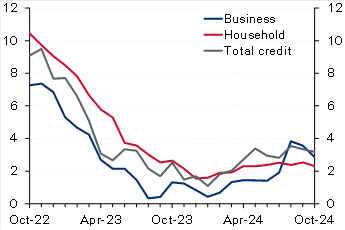
Kuwait: Solid credit growth in October driven by household credit. Domestic credit increased by a solid 0.4% in October, driving up YTD growth to 2.9% (3.2% y/y). The recovery in household credit continued, with growth in October at a solid 0.5%, resulting in a YTD increase of 2.4%. While y/y growth in household credit remains a limited 2.3%, annualized growth over the past four months is a stronger 4.7%. Business credit inched up by 0.2% in October, pushing YTD growth to 3.6% (2.9% y/y). Industry and trade drove business credit growth in October while construction and trade are the fastest growing YTD at 17% and 8%, respectively. In contrast, the oil/gas sector continued its downtrend, deepening the YTD decrease to 13%. Excluding the oil/gas sector, growth in business credit would increase to a relatively good 5% YTD. Looking ahead, the last couple of months of the year (especially December) are usually the weakest for business credit, likely due to increased repayments and write-offs, but it will not be surprising if the recovery in household credit is generally sustained, especially given the commencement of the interest rate-cutting cycle. Meanwhile, driven by a plunge in the volatile public-institution deposits, resident deposits decreased in October, resulting in YTD growth of 2.4% (4.2% y/y). Private-sector deposits inched up in October driving up YTD growth to 4.5% compared with 10% for government deposits while public-institution deposits are a big drag (-14%). Within private-sector KD deposits, CASA showed further signs of stabilization as there was no decrease for the third straight month while the YTD drawdown is a limited 1%.

Chart 1: Kuwait credit growth

(% y/y)

Source: Central Bank of Kuwait (CBK)
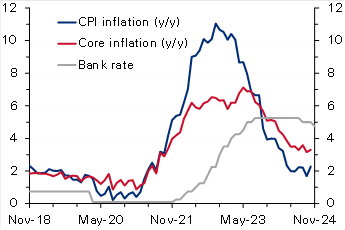
Chart 2: UK inflation

(%)

Source: Haver

Egypt: IMF concludes mission for fourth review, sees external risks. The IMF concluded its visit to Egypt after spending close to 2 weeks, holding several in-person meetings with the Egyptian authorities, private sector, and other stakeholders. The IMF released a statement mentioning that the current ongoing geopolitical tensions in the region in addition to an increasing number of refugees have affected the external sector (Suez Canal receipts down by 70%) and put severe pressure on the fiscal front. The Fund acknowledged the Central Bank of Egypt’s commitment to unify the exchange rate, maintain the flexible exchange rate regime, and keep inflation on a firm downward trend over the medium term by substantially tightening monetary policy. It also highlighted that continued policy discipline was also a key to containing fiscal risks, especially those related to the energy sector. The Fund, as always, re-iterated the need for promoting the private sector mainly through an enhanced tax system and accelerating divestment plans of the state firms. Finally, it also said that the discussions would continue over the coming days to finalize the agreement on the remaining policies and reform plans. However, the release did not provide any clear hints about the conclusion on the government’s earlier request to push the timeline of some of the subsidy moves.

Oman: IMF completes article IV with a strong outlook for the economy in 2025. Oman’s economy continued to expand with growth reaching 1.9% in the first half of 2024 (versus 1.2% in 2023), despite being weighed down by OPEC+ mandated oil production cuts as non-oil GDP grew a stronger 3.8% y/y in H1 (versus 1.8% in 2023). The fiscal and current account balances remain in a comfortable situation evident by a decline in public sector debt and the recent rating upgrade to investment grade. The Fund expects Oman’s economic growth to see a strong rebound in 2025, supported by higher oil production. It also believes that fiscal and current account balances will remain in surplus but at lower levels. Key risks to the outlook stem from oil price volatility and intensifying geopolitical tensions. The IMF also mentioned that further efforts are needed to raise nonhydrocarbon revenues through more tax policy measures and the phasing out of untargeted subsidies which should help in freeing up resources to finance growth under the government’s diversification agenda.

UK: Inflation rises more than forecast, reinforcing BoE’s caution on rate cuts. UK CPI inflation increased to 2.3% y/y in October from 1.7% the previous month, slightly above the market and the Bank of England’s forecast of 2.2%. On a monthly basis too, inflation rose to 0.6%, a seven-month high, from September’s no change. The steep rise was mainly driven by an almost 10% rise in the household energy price cap effective from October. Core inflation also accelerated to 3.3% y/y (0.4% m/m) from 3.2% (0.1% m/m). While goods prices continued to fall (-0.3% y/y), service prices rose at a faster rate of 5% from 4.9%. Recently, the Bank of England had cautioned about inflation quickening next year (projecting a peak rate of 2.8% in Q3 2025), citing the impact of higher insurance contributions and rising minimum wages as outlined in the latest government budget. Therefore, with inflation rising above forecast, the bank will likely slow the pace of monetary easing after delivering two interest rate cuts of 25 bps earlier, with markets now seeing only two additional cuts by the end of 2025.

Eurozone: ECB warns of fiscal and growth risks in its latest Financial Stability Review [archived PDF]. In its most recent Financial Stability Review (November) [archived PDF], the European Central Bank warned that elevated debt and fiscal deficit levels and anemic long-term growth could expose sovereign debt vulnerabilities in the region, stoking concerns of a repeat of the 2011 sovereign debt crisis. Maturing debt being rolled over at much higher borrowing rates raising debt service costs poses risks to countries with little fiscal space and leaves certain governments exposed to market fluctuations. The bank also emphasized the risks of high equity valuations, low liquidity and a greater concentration of exposure among non-banks. Moreover, it sees current geopolitical uncertainties and the possibility of more trade tensions as heightening risks. The Eurozone’s current government debt-to-GDP ratio stands at 88%, but the underlying data suggest a much more precarious situation with Greece, Italy, and France’s ratios at 164%, 137% and 112%. Recently, concerns about France’s high fiscal deficit (around 5.9% of GDP) and elevated debt levels saw yields on the country’s bonds rise steeply, widening the spread gap with German bonds to the highest level in over a decade.

Stock marketsIndexDaily Change (%)YTD Change (%)
Regional
Abu Dhabi (ADI)9,405-0.23-1.80
Bahrain (ASI)2,043-0.373.62
Dubai (DFMGI)4,7610.6117.26
Egypt (EGX 30)30,588-0.33 23.18
GCC (S&P GCC 40)7090.09-0.52
Kuwait (All Share)7,353-0.087.86
KSA (TASI)11,868-0.07-0.83
Oman (MSM 30)4,6090.002.10
Qatar (QE Index)10,4380.12-3.62
International
CSI 3003,9860.2216.17
DAX19,005-0.2913.45
DJIA43,4080.3215.17
Eurostoxx 504,730-0.454.60
FTSE 1008,085-0.174.55
Nikkei 22538,352-0.1614.61
S&P 5005,9170.0024.05
3m interbank rates%Daily Change (bps)YTD Change (bps)
Bahrain5.86-1.29-66.34
Kuwait3.940.00-37.50
Qatar6.000.00-25.00
UAE4.433.81-89.96
Saudi5.50-4.75-73.14
SOFR4.52-0.09-81.13
Bond yields%Daily Change (bps)YTD Change (bps)
Regional
Abu Dhabi 20274.665.0033.9
Oman 20275.496.0033.0
Qatar 20264.686.0016.1
Kuwait 20274.693.0035.0
Saudi 20284.961.0043.9
International 10-year
US Treasury4.411.7755.3
German Bund2.340.3531.2
UK Gilt4.472.6093.0
Japanese Gov’t Bond1.071.045.4
Exchange ratesRateDaily Change (%)YTD Change (%)
KWD per USD0.310.04-0.05
KWD per EUR0.32-0.46-1.98
USD per EUR1.05-0.49-4.47
JPY per USD155.430.5010.19
USD per GBP1.27-0.25-0.62
EGP per USD49.670.3461.00
Commodities$/unitDaily Change (%)YTD Change (%)
Brent crude72.81-0.68-5.49
KEC73.780.74-7.26
WTI68.87-0.75-3.88
Gold2,648.20.8028.40

Disclaimer: While every care has been taken in preparing this publication, National Bank of Kuwait accepts no liability whatsoever for any direct or consequential losses arising from its use. Daily Economic Update is distributed on a complimentary and discretionary basis to NBK clients and associates. This report and previous issues can be found in the “News & Insight / Economic Reports” section of the National Bank of Kuwait’s web site. Please visit their web site, nbk.com, for other bank publications.

Economics-Watching: FTC Action Leads to $18 Million in Refunds for Brigit Consumers Harmed by Deceptive Promises About Cash Advances, Hidden Fees, and Blocked Cancellation

[from the Federal Trade Commission]

Complaint alleges company violated FTC Act and ROSCA with false promises targeting consumers living paycheck-to-paycheck and by failing to deliver cash advances as advertised

The Federal Trade Commission is taking action against personal finance app provider Brigit, alleging that its promises of “instant” cash advances of up to $250 for people living paycheck-to-paycheck were deceptive and that the company locked consumers into a $9.99 monthly membership they couldn’t cancel.

Brigit, also known as Bridge It, Inc., has agreed to settle the FTC’s charges, resulting in a proposed court order that would require the company to pay $18 million in consumer refunds, stop its deceptive marketing promises, and end tactics that prevented customers from cancelling.

“Brigit trapped those consumers least able to afford it into monthly membership plans they struggled to escape from,” said Sam Levine, Director of the FTC’s Bureau of Consumer Protection.  “Companies that offer cash advances and other alternative financial products have to play by the same rules as other businesses or face potential action by the FTC.”

According to the FTC’s complaint [archived PDF], Brigit advertised its cash advance service online, through social media and through broadcast ads with claims that customers who subscribed to the company’s service would have access to “instant” cash advances of up to $250 “whenever you need it,” and could cancel anytime. Consumers could only access the cash advance features when they signed up for the $9.99 per month “Plus” subscription.

The FTC’s complaint, however, charges that consumers were rarely able to get an advance for the promised $250, and in many cases, consumers were not able to receive a cash advance at all. Despite Brigit’s promises that advances would be available with “free instant transfers,” the complaint notes that the company began charging consumers a 99-cent fee for an instant transfer. Consumers who did not pay the fee had to wait up to three business days for their advances.

In addition, the complaint charges that while Brigit claimed to offer “non-recourse” advances with no fees or interest, the company prevented consumers who had an open advance from cancelling their subscription and continued to withdraw $9.99 monthly from their bank account until the advance was paid off. Such monthly charges created significant additional hardship for consumers already struggling to pay off a cash advance.

Even when consumers without an open cash advance attempted to cancel the paid subscription, the complaint charges that the company employed dark patterns—manipulative design tricks—to create a confusing and misleading cancellation process that prevented consumers from cancelling their subscriptions, instead of offering a simple mechanism to cancel, as required by the Restore Online Shoppers’ Confidence Act (ROSCA) [archived PDF].

The proposed settlement order [archived PDF], which must be approved by a federal judge before it can go into effect, would require Brigit to pay $18 million to the FTC to be used to provide refunds to consumers. In addition, the order would prohibit Brigit from misleading consumers about how much money is available through their advances, how fast the money would be available, any fees associated with delivery, and consumers’ ability to cancel their service. The order would also require the company to make clear disclosures about its subscription products and provide a simple mechanism for consumers to cancel.

The Commission vote authorizing the staff to file the complaint and stipulated final order was 3-0. The FTC filed the complaint and final order in the U.S. District Court for the Southern District of New York.

NOTE: The Commission files a complaint when it has “reason to believe” that the named defendants are violating or are about to violate the law and it appears to the Commission that a proceeding is in the public interest. Stipulated final orders have the force of law when approved and signed by the District Court judge.

The staff attorneys on this matter were Patrick Roy, Mark Glassman and James Doty of the FTC’s Bureau of Consumer Protection.

Education and the Question of Intuition

An intuition pump is a thought experiment structured to allow the thinker to use his or her intuition to develop an answer to a problem. The phrase was popularized in the 1991 book Consciousness Explained by Tufts philosophy and neuroscience professor, Daniel Dennett.

We argue in this education-completing book, that our intuitions are puzzling in a way that “intuition pump” talk does not cope with at all.

Let’s go immediately to the example of simple versus compound interest in basic finance.

You borrow $100.00 for a year at an annual interest of 100%, without compounding and hence simple. A year passes and you owe the lender the initial $100 plus one hundred percent of this amount (i.e., another hundred). In a year, you owe $200.00, and every year thereafter, if the lender is willing to extend the loan, you owe another hundred to “rent” the initial hundred.

This is written as A+iA, where A is the initial amount (i.e., $100.00) and i is the interest. This can be re-written as A(1+i)n where n is the number of years. Thus, if n=1, you owe: A(1+i), which is 100×2 (i.e., the $200 we just saw). There’s nothing tricky in this.

You then are introduced to compound interest (i.e., where the interest accumulates interest). You can see where compounding by 6 months (semi-annually, or half a year) or 12 months involves dividing the n (the exponent over 1+i) by 12 months, two half-years or 365 days. You could routinely go to days and hours and minutes and seconds and nanoseconds and you could calculate interest payments compounding for each case.

But here is where your intuition falters and fails: suppose you compound continuously?

You get to the number e as growth factor where e=2.71823

Simple algebra does show that at 100% interest, $100 of a loan becomes $100 multiplied by e1 (hundred percent=1) or just e (i.e., you owe $100e).

This gives you $271.82.

So what has happened?

At one hundred percent simple interest you owe $200.00 to the lender. Continuous compounding means you owe $271.82. Instead of owing $100 in interest, you owe $171.82. Your interest bill has gone up by $71.82 or about 72 percent.

Does that seem intuitive? Probably not.

How could one ever apply an “intuition pump” to this arithmetic? We get to the 72% increase in interest by using e which has nothing very intuitive about it. Thus it’s not clear that “intuition pumps” will work here.

You use compound interest arithmetic to get a number which you would never have been able to estimate based on standard intuition since like the 22/7 or 3.14 for π (pi), there’s nothing to “recommend” 2.71823 in and of itself. This means that the link between computational arithmetic understanding and your “gut” or “sixth sense” is feeble at best.

By exploring this way of thinking you could deepen your “meta-intelligence” (i.e., perspective-enhancement). The British economist Pigou (Keynes’s teacher) says that people have a “defective telescopic facility” (i.e., have a poor or even erroneous sense of time-distance).

How one might strengthen one’s sense of time-distance or “far horizons” is not clear.

Third Quarter 2019: Interest Rate Shift Helped Housing but Hurt Bank Net Interest Margins

(from the Federal Reserve Bank of San Francisco)

First Glance 12L provides a first look at banking and economic conditions within the 12th District. The report, “Interest Rate Shift Helped Housing but Hurt Bank Net Interest Margins,” [Archived PDF] notes that District banks’ average quarterly net interest margin slipped as lower interest rates and loan-to-asset ratios weighed on asset yields. The shifting asset mix contributed to margin compression but benefitted average liquidity and risk-based capital ratios. Districtwide loan and job growth cooled but remained above average, and lower interest rates boosted home prices, affordability, and homebuilding. In addition to supervisory hot topics, the report covers wildfire-related risks in California.

Read the full report [Archived PDF].

Education and “Then and Now” Thinking

Ben Shalom Bernanke was Chairman of the Board of Governors of the Federal Reserve System from February 1, 2006, to January 31, 2014.

In many interviews in financial and economic periodicals, he blurts out the fact that his guide in the years surrounding the Great Recession of 2008, in his decisions by the advice of Walter Bagehot of the Economist of London whose main book is called Lombard Street [Project Gutenberg ebook] from 1873:

Lombard Street is known for its analysis of the Bank of England’s response to the Overend-Gurney crisis. Bagehot’s advice (sometimes referred to as “Bagehot’s dictum”) for the lender of last resort during a credit crunch may be summarized by  as follows:

  • Lend freely.
  • At a high rate of interest.
  • On good banking securities.

(Nonetheless, other economists emphasize that many of these ideas were spelled out earlier by Henry Thornton’s book The Paper Credit of Great Britain [archived PDF].)

Bagehot’s dictum has been summarized by as follows: “To avert panic, central banks should lend early and freely (i.e., without limit), to solvent firms, against good collateral, and at ‘high rates’.”

In Bagehot’s own words (Lombard Street [Project Gutenberg ebook], Chapter 7, paragraphs 57–58), lending by the central bank in order to stop a banking panic should follow two rules:

First. That these loans should only be made at a very high rate of interest. This will operate as a heavy fine on unreasonable timidity, and will prevent the greatest number of applications by persons who do not require it. The rate should be raised early in the panic, so that the fine may be paid early; that no one may borrow out of idle precaution without paying well for it; that the Banking reserve may be protected as far as possible.

Secondly. That at this rate these advances should be made on all good banking securities, and as largely as the public ask for them. The reason is plain. The object is to stay alarm, and nothing therefore should be done to cause alarm. But the way to cause alarm is to refuse some one who has good security to offer… No advances indeed need be made by which the Bank will ultimately lose. The amount of bad business in commercial countries is an infinitesimally small fraction of the whole business… The great majority, the majority to be protected, are the ‘sound’ people, the people who have good security to offer. If it is known that the Bank of England is freely advancing on what in ordinary times is reckoned a good security—on what is then commonly pledged and easily convertible—the alarm of the solvent merchants and bankers will be stayed. But if securities, really good and usually convertible, are refused by the Bank, the alarm will not abate, the other loans made will fail in obtaining their end, and the panic will become worse and worse.

We have to ask ourselves: how is it possible that advice from 1873 (i.e., Bagehot’s Lombard Street [Project Gutenberg ebook] crisis-management for that time) can be applicable in 2008?

Does this confirm the off-handed comment in This Time is Different by Ken Rogoff of Harvard that there must be true-but-opaque deep rhythms in history including financial history? Otherwise advice would be useless due to the passage of time and useful patterns would not be discernible.

In fact, Lawrence Summers at Treasury “deluged” Mexico and Latin America with loans to avert an earlier banking crisis following Bagehot’s advice. The logic is that investors must sense that Mexico, etc. will be bailed out at all costs. The idea is to avert a “downward spiral of confidence” by means of visible massive interventions.

Education should always ponder these “then and now” puzzles as part of a beneficial “argument without end.”