Words and Reality and Change: What Is a Fluctuation?

Ludwig Boltzmann who died in 1906 was a giant in the history of physics.

His name is associated with various fields like statistical mechanics, entropy and so on.

A standard physics overview book called Introducing Quantum Theory (2007, Icon/Totem Books) shows a “cartoon” of Boltzmann which says, “I also introduced the controversial notion of fluctuations.” (page 25)

In common parlance, some common synonyms of fluctuate are oscillate, sway, swing, undulate, vibrate and waver. While all these words mean “to move from one direction to its opposite,” fluctuate suggests (sort of) constant irregular changes of level, intensity or value. Pulses and some pulsations suggest themselves as related.

Expressions like “Boltzmann brains” refer to this great physicist Boltzmann and you can find this notion described here: “Boltzmann Brain.”

Notice that the word “fluctuation” occurs four times in one of the paragraphs of the article “Boltzmann Brain,” as you can see:

“In 1931, astronomer Arthur Eddington pointed out that, because a large fluctuation is exponentially less probable than a small fluctuation, observers in Boltzmann universes will be vastly outnumbered by observers in smaller fluctuations. Physicist Richard Feynman published a similar counterargument within his widely read 1964 Feynman Lectures on Physics. By 2004, physicists had pushed Eddington’s observation to its logical conclusion: the most numerous observers in an eternity of thermal fluctuations would be minimal “Boltzmann brains” popping up in an otherwise featureless universe.”

You may remember perhaps you’ve also heard the term, perhaps on a PBS Nova episode on quantum fluctuation.

In the classic history of science book, The Merely Personal by Dr. Jeremy Bernstein (Ivan Dee, Chicago, 2001), one encounters the word fluctuation all over:

“This uniform density of matter …and fluctuations from the average are what would produce the unwanted instability.”

“So Einstein chose the cosmological constant…” (page 83 of Bernstein’s book)

Suppose we allow our minds to be restless and turn to economics to “change the lens” we are using to look at the world, since lens-changing is one of the pillars of Meta Intelligence.

What do we see?

In 1927, Keynes’s professor Arthur Cecil Pigou (died in 1959) published the famous work, Industrial Fluctuations.

In 1915, twelve years earlier, the famous Sir Dennis Holme Robertson (died in 1963) published A Study of Industrial Fluctuation.

The word fluctuation seems to be migrating to or resonating in economics.

The larger point (i.e., the Meta Intelligent one): is the use of this word a linguistic accident or fashion or is something basic being discovered about how some “things” “jump around” in the world?

Is the world seen as more “jumpy” or has it become more jumpy due to global integration or disintegration or in going to the deeper levels of physics with the replacement of a Newtonian world by an Einsteinian one?

The phenomena of change—call it “change-ology” whooshes up in front of us and a Meta Intelligent student of the world would immediately ponder fluctuations versus blips versus oscillations versus jumps and saltations (used in biology) and so on. What about pulsations? Gyrations?

This immediately places in front of you the question of the relationship of languages (words, numbers, images) to events.

The point is not to nail down some final answer. Our task here is not to delve into fields like physics or economics or whatever but to notice the very terms we are using across fields and in daily life (i.e., stock price fluctuations).

Notice, say, how the next blog post on oil price dynamics begins:

“Our oil price decomposition, reported weekly, examines what’s behind recent fluctuations in oil prices…”

The real point is to keep pondering and “sniffing” (i.e., Meta Intelligence), since MI is an awareness quest before all.

Science and Its Discontents: The Case of Natsume Sōseki (夏目 漱石) in Japan

Natsume Sōseki (夏目 漱石) is and was the most prestigious and respected novelist in modern Japan and every student has to engage with such novels of his as Botchan (坊っちゃん, “Young Master”) and Kokoro (こゝろ, or in post-war orthography こころ, “Heart”). Sōseki died in 1916.

Sōseki’s feeling that the modern world is some kind of runaway train with no brakes is expressed clearly in his 1913 novel, Kōjin (行人 , “The Wayfarer”).

One of Sōseki’s dialogues in the novel is about the current science and technology world, which was quite visible already then, and has a very nerve-racking or frightening tempo of a turbulent tsunami.

One character says:

“Now what you call insecurity is the insecurity of the entire human race, and it isn’t peculiar to you alone. Constant motion and flow is our very fate.

“Man’s insecurity stems from the advance of science. Never once has science, which never ceases to move forward, allowed us to pause. From walking to ricksha, from ricksha to carriage, from carriage to train, from train to automobile, from there on to the dirigible, further on to the airplane, and further on and on, no matter how far we may go, it won’t let us take a breath. How far it will sweep us along, nobody knows for sure. It is really frightening.”

Yes, it is frightening, indeed, I agreed.

“It is frightening because the fate that the whole of humanity will reach in several centuries, I must go through—in my own lifetime—and at that all alone. That’s why it is frightening. In short, I gather within myself the whole insecurity of the human race, and distill that insecurity down into every moment, that is the fright that I am experiencing.”

(Natsume Sōseki, Kōjin [行人], Charles E. Tuttle Company, 1991, 9th printing, page 285)

Comment: There’s no need to dismiss these feelings as Luddite. They represent a reaction to the vertiginous or dizzying pace of the modern techno-protean change machine with no pause button.

Notice that Sōseki’s life (1867-1916) is basically congruent with Globalization I (i.e., the period of 1870-1913) discussed in the previous essay on Arthur Lewis’s classic Growth and Fluctuations, 1870-1913.

Sōseki has been, like his spokesmen in the citation above, swept up into a change-storm which led to a globalization backlash from 1914-1945, the era of deglobalization. WWI is the beginning bookend of all this.

Notice that the micro world of feelings and moods in the novel are resonant with the macro world though people at a certain time, such as the Sōseki protagonists, are not rigorous or prophetic theoreticians but rather groping in the dark.

Science and Its Limits

The outstanding physics theoretician Max Tegmark of MIT tells the story of how Ernest Rutherford’s 1933 prediction about atomic energy (i.e., that is was “moonshine”)—was refuted before 24 hours had passed when Szilard (the Hungarian genius) realized that a nuclear chain reaction could be set in motion getting around Rutherford’s pessimistic prediction of only a few hours before:

“In London, where Southampton Row passes Russell Square, across from the British Museum in Bloomsbury, Leo Szilard waited irritably one gray Depression morning for the stoplight to change. A trace of rain had fallen during the night; Tuesday, September 12, 1933, dawned cool, humid and dull. Drizzling rain would begin again in early afternoon. When Szilard told the story later he never mentioned his destination that morning. He may have had none; he often walked to think. In any case another destination intervened. The stoplight changed to green. Szilard stepped off the curb. As he crossed the street time cracked open before him and he saw a way to the future, death into the world and all our woes, the shape of things to come…”

(Richard Rhodes, The Making of the Atomic Bomb)

This Tegmark/Szilard “refutation” of Rutherford in our times reminds one of MIT’s AI pioneer, Prof. Marvin Minsky’s limitless and perhaps too rosy predictions for AI and human intelligence in the sixties and seventies.

A student pursuing education has to live with the paradox and puzzle that unpredicted surprises and leaps do occur in the world of science and they are astonishing. It is true at the same time, that the realm of science (i.e., “how” questions) cannot address “why” questions. The question “how was I born?” cannot replace “why was I born?”

Both of these questions have possible answers at various levels and are subject to hierarchies.

Steven Jay Gould, the late Harvard biologist, had a felicitous phrase, “separate magisteria” (i.e., separate realms or domains) to describe this gap between the pursuit of personal meaning (human quest) and the pursuit of (tentative) accuracy (scientific quest).

Physics AI Predicts That Earth Goes Around the Sun

from Nature Briefing:

Hello Nature readers,

Today we learn that a computer Copernicus has rediscovered that Earth orbits the Sun, ponder the size of the proton and see a scientific glassblower at work.

Physicists have designed artificial intelligence that thinks like the astronomer Nicolaus Copernicus by realizing the Sun must be at the center of the Solar System. (NASA/JPL/SPL)

AI ‘Discovers’ That Earth Orbits the Sun [PDF]

A neural network that teaches itself the laws of physics could help to solve some of physics’ deepest questions. But first it has to start with the basics, just like the rest of us. The algorithm has worked out that it should place the Sun at the centre of the Solar System, based on how movements of the Sun and Mars appear from Earth.

The machine-learning system differs from others because it’s not a black that spits out a result based on reasoning that’s almost impossible to unpick. Instead, researchers designed a kind of ‘lobotomizedneural network that is split into two halves and joined by just a handful of connections. That forces the learning half to simplify its findings before handing them over to the half that makes and tests new predictions.

Next FDA Chief Will Face Ongoing Challenges

U.S. President Donald Trump has nominated radiation oncologist Stephen Hahn to lead the Food and Drug Administration (FDA). If the Senate confirms Hahn, who is the chief medical executive of the University of Texas MD Anderson Cancer Center, he’ll be leading the agency at the centre of a national debate over e-cigarettes, prompted by a mysterious vaping-related illness [archived PDF] that has made more than 2,000 people sick. A former FDA chief says Hahn’s biggest challenge will be navigating a regulatory agency under the Trump administration, which has pledged to roll back regulations.


Do We Know How Big a Proton Is?
[PDF]

A long-awaited experimental result has found the proton to be about 5% smaller than the previously accepted value. The finding seems to spell the end of the ‘proton radius puzzle’: the measurements disagreed if you probed the proton with ordinary hydrogen, or with exotic hydrogen built out of muons instead of electrons. But solving the mystery will be bittersweet: some scientists had hoped the difference might have indicated exciting new physics behind how electrons and muons behave.

Contingency Plans for Research After Brexit

The United Kingdom should boost funding for basic research and create an equivalent of the prestigious European Research Council (ERC) if it doesn’t remain part of the European Union’s flagship Horizon Europe research-funding program [archived PDF]. That’s the conclusion of an independent review of how UK science could adapt and collaborate internationally after Brexit — now scheduled for January 31, 2020.

Nature’s 150th anniversary

A Century and a Half of Research and Discovery

This week is a special one for all of us at Nature: it’s 150 years since our first issue, published in November 1869. We’ve been working for well over a year on the delights of our anniversary issue, which you can explore in full online.

10 Extraordinary Nature Papers

A series of in-depth articles from specialists in the relevant fields assesses the importance and lasting impact of 10 key papers from Nature’s archive. Among them, the structure of DNA, the discovery of the hole in the ozone layer above Antarctica, our first meeting with Australopithecus and this year’s Nobel-winning work detecting an exoplanet around a Sun-like star.

A Network of Science

The multidisciplinary scope of Nature is revealed by an analysis of more than 88,000 papers Nature has published since 1900, and their co-citations in other articles. Take a journey through a 3D network of Nature’s archive in an interactive graphic. Or, let us fly you through it in this spectacular 5-minute video.

Then dig deeper into what scientists learnt from analyzing tens of millions of scientific articles for this project.

150 Years of Nature, in Graphics

An analysis of the Nature archive reveals the rise of multi-author papers, the boom in biochemistry and cell biology, and the ebb and flow of physical chemistry since the journal’s first issue in 1869. The evolution in science is mirrored in the top keywords used in titles and abstracts: they were ‘aurora’, ‘Sun’, ‘meteor’, ‘water’ and ‘Earth’ in the 1870s, and ‘cell’, ‘quantum’, ‘DNA’, ‘protein’ and ‘receptor’ in the 2010s.

Evidence in Pursuit of Truth

A century and a half has seen momentous changes in science, and Nature has changed along with it in many ways, says an Editorial in the anniversary edition. But in other respects, Nature now is just the same as it was at the start: it will continue in its mission to stand up for research, serve the global research community and communicate the results of science around the world.

Features & Opinion

Nature covers: from paste-up to Photoshop

Nature creative director Kelly Krause takes you on a tour of the archive to enjoy some of the journal’s most iconic covers, each of which speaks to how science itself has evolved. Plus, she touches on those that didn’t quite hit the mark, such as an occasion of “Photoshop malfeasance” that led to Dolly the sheep sporting the wrong leg.

Podcast: Nature bigwigs spill the tea

In this anniversary edition of BackchatNature editor-in-chief Magdalena Skipper, chief magazine editor Helen Pearson and editorial vice president Ritu Dhand take a look back at how the journal has evolved over 150 years, and discuss the part that Nature can play in today’s society. The panel also pick a few of their favorite research papers that Nature has published, and think about where science might be headed in the next 150 years.

Where I Work

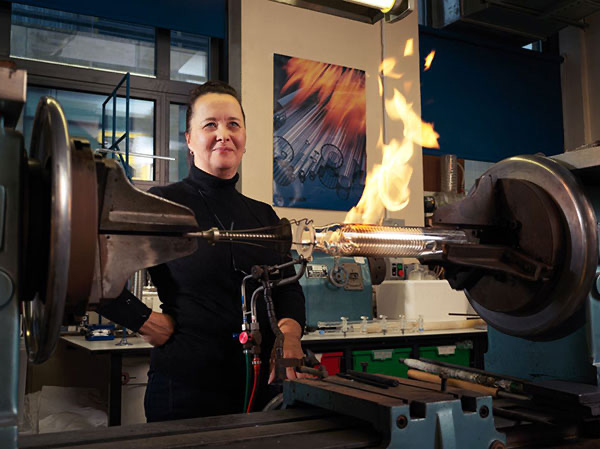
Scientific glassblower Terri Adams uses fire and heavy machinery to hand-craft delicate scientific glass apparatus. “My workbench hosts an array of tools for working with glass, many of which were custom-made for specific jobs,” says Adams. “Each tool reminds me of what I first used it for and makes me consider how I might use it again.” (Leonora Saunders for Nature)

Quote of the Day

“At the very least … we should probably consider no longer naming *new* species after awful humans.”

Scientists should stop naming animals after terrible people — and consider renaming the ones that already are, argues marine conservation biologist and science writer David Shiffman. (Scientific American)

Yesterday was Marie Skłodowska Curie’s birthday, and for the occasion, digital colorist Marina Amaral breathed new life into a photo of Curie in her laboratory

(If you have recommended people before and you want them to count, please ask them to email me with your details and I will make it happen!) Your feedback, as always, is very welcome at briefing@nature.com.

Flora Graham, senior editor, Nature Briefing

Scientism and Its Discontents: Movie About Hawking

Scientism is the view that science is truth and the rest is false, idiotic, or childish.

There’s a wonderful scene in the 2014 movie, The Theory of Everything (Eddie Redmayne plays Hawking) where the young Hawking is courting his wife to be at an evening party and he represents the quest for the theory of everything, hence the name of the movie.

His girlfriend expresses doubts about this and speaks a few words from the William Butler Yeats (died in 1939) poem “The Song of the Happy Shepherd” [full text]:

“Seek, then,
No learning from the starry men,
Who follow with the optic glass
The whirling ways of stars that pass —”

The poet (and Hawking’s fiancee in the film) are suspicious of the science-and-nothing-else cosmologists and astronomers “who follow with the optic glass the whirling ways of stars that pass.”

William Butler Yeats (13 June, 1865–28 January, 1939) was an Irish poet and one of the foremost figures of 20th-century literature. A pillar of the Irish literary establishment, he helped to found the Abbey Theatre, and in his later years served two terms as a Senator of the Irish Free State.

Yeats says in his works, “Education is not the filling of a pail, but rather the lighting of a fire.”

Our desire to “re-enchant” education might cause us to modify this Yeats aphorism slightly, “Education is not merely the filling of a pail, but rather the lighting of a fire.”

Education and the Question of a “Scheme of Things”

The French classic The Thibaults (Les Thibault) from 1922 has a dialog about the presence or absence of “a scheme of things” behind everything. This Roger Martin du Gard (died 1958, Nobel 1937) classic gives us an insight into the relationship between education and this “scheme of things.”

First:

The Thibaults is a multi-volume roman-fleuve (saga novel) by Roger Martin du Gard, which follows the fortunes of two brothers, Antoine and Jacques Thibault, from their upbringing in a prosperous Catholic bourgeois family to the end of the First World War.

Antione, one of the Thibault brothers, has a conversation with a priest at the very end of the novel:

“I talked just now about a Universal Order and a Scheme of Things…actually we’ve as many reasons to question the existence of a Scheme of Things as to take it for granted. From his actual viewpoint, the human animal I am observes an immense tangle of conflicting forces. But do these forces obey a universal law outside themselves, distinct from them? Or do they, rather, obey—so to speak—internal laws, each atom being a law unto itself, that compels it to work out a ‘personal destiny’? I see these forces obeying laws which do not control them from outside but join up with them, but do nothing more than in some way stimulate them…And anyhow, what a jumble it is, the course of natural phenomena! I’d just as soon believe that causes spring from each other ad infinitum, each cause being the effect of another cause, and each effect the cause of other effects.

“Why should one want to assume at all costs a Scheme of Things?

“It’s only another bait form our logic-ridden minds. Why try to find a common ‘purpose’ in the movements of atoms endlessly clashing and glancing off each other? Personally, I’ve often told myself that everything happens just as if nothing led to anything, as if nothing had a meaning.”

Antione shook his head. “that blind appeal—to what? To that problematic Scheme of Things! To a deaf and dumb abstraction, that takes no heed of us.”

(Roger Martin du Gard, The Thibaults, Bantam Modern Classic, 1968, pages 768-770)

All bodies of knowledge like religion, philosophy, science posit a scheme of things which is perhaps subtle or occluded (“The Occluded Imam” or “mystery of the Holy Trinity”) or “the mind of God” (Steven Hawking’s way of getting at this) or “the Method of Absolute Doubt” leading to final certainty (Descartes).

String theory talks this way too.

In our own educational remediation effort, we are agnostic about any Scheme of Things and do not try to link books, lectures, courses to some pre-existing schema or “final layer underlying everything” at all.

Students create an evolving overview by “circum-spective” “walking around” or meta-intelligence and there is no ultimate “Eureka moment” where “everything is illuminated” (to use the title of the contemporary novel by that name.) We also do not deny the possibility of the existence of a Scheme of Things. Education thought of this way is an exploration and quest that does not end and there does not have to be a final “knowledge map“ or “truth atlas” other than home-made student “composite sketches” which are tentative and not final or “apodictic.”