Price Revolutions and Their Historical Impact

In 1996, leading economic historian, David Hackett Fischer, published The Great Wave: Price Revolutions and the Rhythm of History. If you ponder the subtitle, you may grasp the work’s ambition.

Nobel Prize-winning economist Paul Krugman has been arguing with Fischer for many years that, in making the transition from business to historical cycles, Fischer’s position is problematic.

There are, of course, detailed histories of prices, such as Thomas Tooke’s A History of Prices and of the State of the Circulation during the Years 1793–1856 (6 volumes, 1838–1857).

In the first four volumes he treats (a) of the prices of corn, and the circumstances affecting prices; (b) the prices of produce other than corn; and (c) the state of the circulation. The two final volumes, written with William Newmarch, deal with railways, free trade, banking in Europe and the effects of new discoveries of gold.

Wikipedia (links added)

Tooke-type price histories are one thing, but what about Fischer’s price revolutions? Max Weber (who predates Fischer by almost a century) seems to endorse this concept. In Weber’s General Economic History (German: Wirtschaftsgeschichte), he writes:

The great price revolution of the 16th and 17th centuries provided a powerful lever for the specifically capitalistic tendencies of seeking profit through cheapening production and lowering the price. This revolution is rightly ascribed to the continuous inflow of precious metals, in consequence of the great overseas discoveries. It lasted from the thirties of the 16th century down to the time of the Thirty Years’ War, but affected different branches of economic life in quite different ways. In the case of agricultural products an almost universal rise in price set in, making it possible for them to go over to production for the market. It was quite otherwise with the course of prices for industrial products. By and large these remained stable or rose in price relatively little, thus really falling, in comparison with the agricultural products. This relative decline was made possible only through a shift in technology and economics, and exerted a pressure in the direction of increasing profit by repeated cheapening of production. Thus the development did not follow the order that capitalism set in first and the decline in prices followed, but the reverse; first the prices fell relatively and then came capitalism.

Max Weber, General Economic History, Collier Books (3rd printing), 1966, pages 230-231.

Notice the last sentence above, Weber explicitly describes price revolutions exactly as Fischer argues.

In the history books we read, the emphasis is always on colorful personalities, inventions and other more theatrical events. This obviously omits the idea of phenomena like price revolutions. We cannot explain history merely by these personalities; we need to zoom out and view the larger picture.

The Interconnectedness of Everything and How It Should Influence Our Thinking

Max Weber, considered to be the father of modern sociology alongside Émile Durkheim, wrote a classic of economic history, General Economic History (GermanWirtschaftsgeschichte).

Weber concludes chapter 25 (“Free Wholesale Trade”) with:

The railway is the most revolutionary instrumentality known to history, for economic life in general and not merely for commerce, but the railway was dependent on the age of iron; and it also like so many other things, was the plaything of princely and courtier interests.

Max Weber, General Economic History, Collier Books, Third Printing, 1966, page 221.

Zooming out you may intuit that these narrow gauge explanations are inadequate but much better than nothing. We are faced with the problem of connecting railroads and the Iron Age to larger transformations from which these railroads were born.

Your high school history book might mention Abraham Darby III; to quote Wikipedia:

He built the largest cast iron structure of his era: the first cast-iron bridge ever built, as a crossing over the Severn near Coalbrookdale. The bridge made it possible for the village of Ironbridge to grow up around it, with the area being subsequently named Ironbridge Gorge.

He was the third of four men of the same name, all English ironmasters, from several generations of a Quaker family that played a pivotal role in the Industrial Revolution. Without James Watt, there would be no steam engine; without which, there would be no railroad. Watt in turn improved upon the Newcomen atmospheric engine, while consulting other scientists.

Despite the brilliance of Watt’s engine, however, without the financial backing of Matthew Boulton, it might have been a failure.

If you read Watt and Boulton’s correspondence, Watt is always thinking locally, whereas Boulton is already talking about selling the invention globally. This is the ecosystem in which Weber’s economic observations reside.

Weber leads up to the point of the importance of railroads by discussing the evolution of land transport.

Land transport also remained as before. The post produced no change; it merely forwarded letters and small packages, but did not concern itself with large scale production, which was decisive for economic life.

Only the roads underwent an extraordinary improvement, through the construction of turnpikes. In this the French government under Sully took the lead, while England leased the roads to private enterprisers who collected tolls for their use. The building of the turnpikes wrought a revolution in commercial life comparable to no other before the appearance of the railways. There is no comparison between the present density of road traffic and that of this period. In 1793, 70,000 horses went through the little town of Lüneburg while as late as 1846 only 40,000 were used in freight transport in all Germany. The costs of land carriage amounted to ten or twenty times the freight on the railways at a later time, and were three to four times as high as the charges for inland shipping at the same period. A half billion ton-kilometers was the highest figure for transportation for the movement on land in Germany, while in 1913, 67 billions were carried on the railroads.

Max Weber, General Economic History, Collier Books, Third Printing, 1966, page 221.

Weber also connects railroads with the atmosphere of speculation:

Such speculation underwent an enormous expansion with the building of railroads; these provided the paper which first unchained the speculative urge. Under the head of goods, grains, and a few colonial products available in large volume, and then other goods, were drawn into the circle of exchange speculation during the 19th century.

Max Weber, General Economic History, Collier Books, Third Printing, 1966, page 219-220.

Everything is connected to everything else, and without realizing this truth and sensing the underlying transformations, you cannot get a clear signal from history.

Economics-Watching: Why Businesses Say Tariffs Have a Delayed Effect on Inflation

[from the Federal Reserve Bank of Richmond, 8 August, 2025]

by R. Andrew BauerRenee Haltom and Matthew Martin

Regional Matters

Ever since new tariffs were enacted in early 2025, a key policy question has been what is the extent to which businesses will pass tariff costs through to prices, and when? The effects of a tariff are rarely straightforward, given, among other things, competitive dynamics and the challenges of implementation, but the historically large and changing nature of these tariffs have created additional levels of uncertainty over the effects.

In uncertain times, anecdotal evidence from businesses can be especially insightful. We are learning how businesses are reacting to tariffs through the Richmond Fed’s business surveys as well as through hundreds of one-on-one conversations with Fifth District businesses since the start of 2025.

These conversations showcase that navigating tariffs is a complex and sometimes protracted process for firms, particularly when there is uncertainty. Firms describe several reasons they may not have experienced the full impact of proposed tariffs yet (even when goods and countries they deal with are subject to them), as well as reasons that even when they have incurred tariff-related cost increases, there can be a delayed impact on pricing decisions.

Reasons Firms May Not Have Incurred Tariffs Yet

Business contacts describe several strategies or circumstances that can delay or reduce the tariffs on inputs or other imported items. These include the following:

As our monthly business surveys have found, many firms report deploying more than one strategy to delay tariffs. Notably, many of these delays are only temporary.

Reasons Tariffs May Have a Delayed Impact on Prices

Even when firms have incurred tariffs, they give several reasons why tariffs may not be immediately reflected in the prices they charge for their products. These include the following:

  • Waiting for tariff policy to clarify. Higher prices could reduce demand for goods and services and/or lead firms to lose market share, so many firms said they are hesitant to increase prices until they’re sure tariffs will remain in place. For example, a large national retailer said if tariffs are finalized at a sufficiently low level, they’ll absorb what they’ve incurred to date, but if high tariffs stick, they’ll have to raise prices. A steel fabricator for industrial equipment described being reluctant to raise prices on the 10 percent cost increases they’d seen thus far but would have to raise prices should the increases reach 12 to 13 percent. A grocery store chain was reluctant to raise prices and instead might reduce margins, which had recovered in recent years, to maintain their customer base. Some firms explicitly noted a strategy to both raise prices over time and pursue efficiency gains to cut costs and completely restore margins within a year or two.
  • Elasticity testing. Firms reported testing across goods whether consumers will accept price increases. A furniture manufacturer said he’s seen competitors pass along just 5 percentage points of the tariffs at a time so it isn’t such a huge shock to customers, though in that sector, “We all end in the same place which is the customer bearing most of it.” A national retailer said most firms are doing a version of stair-stepping tariffs through, e.g., raising prices a small amount once or twice to see if consumer demand holds, and if so, trying again two months later. This retailer said prices were going up very marginally in early summer, would increase more in July and August, and would be up by 3 to 5 percent by the end of Q4 and into 2026. Another national retailer said they would start testing the extent to which demand falls with price increases, e.g., when the first items that were subject to tariffs—in this case back to school items—hit shelves in late July.
  • Blind margin. Some firms reported attempting to pass through cost in less noticeable ways. While any price increase to consumers will be captured in measures of aggregate inflation, the fact that price increases may occur on non-tariffed goods might make it difficult to directly relate price increases to tariffs. An outdoor goods retailer said, “Unless it’s a branded item where everyone knows the price, if something goes for $18, it can also go for $19.” A national retailer plans to print new shelf labels with updated pricing, which will be less noticeable for consumers compared to multiple new price stickers layered on top. This takes time (akin to a textbook “menu cost” in economics), so it will not be reflected in prices until July and August. A grocery store said their goal was to increase average prices across the store but focus on less visible prices.
  • Selling out of preexisting inventory: Many firms noted they still have production inventory from before tariffs were announced, so they do not need to raise prices as long as they still sell these lower cost goods. A national retailer noted they have at least 25 weeks of inventory on hand for most imported products. A firm that produces grocery items said they will decide how much to raise prices as they get closer to selling tariff-affected products. Similarly, retailers order seasonal items quarters in advance. Many were receiving items for fall and winter when the new tariffs were going into effect in the spring. They paid the tariff then, but we won’t see the price increase until those items hit the shelves in the fall or winter. One retailer speculated that seasonal décor items will look the most like a one-time increase.
  • Pre-established prices. Many firms face infrequent pricing due to factors like annual contracts or pre-sales. For example, a dealer of farm equipment gets half its sales through incentivized pre-sales to lock in demand and smooth around crop cycles. They noted that while it would be difficult to retroactively ask those customers to pay for part of the tariff, they will pass tariffs directly through on spare parts. A steel fabricator for industrial equipment has a contract for steel through Q3, so they haven’t been impacted yet by price increases. However, they will face new costs once that contract expires.

In general, compared to small firms, large firms have more ability to negotiate with vendors, temporarily absorb costs, burn cash, wait for strategic opportunity, and test things out. This matters because large firms often lead pricing behavior among firms, so these strategic choices may influence the response of inflation to tariffs more generally. Even within firm size, one often hears that negotiations on price vary considerably by relationship and item.

Conclusion

A key question surrounding tariffs is whether any effects on inflation will resemble a short-lived price increase—as in the simplest textbook model of tariffs—or a more sustained increase to inflation that may warrant tighter Fed monetary policy. When asked in May what will determine the answer, Fed Chair Jerome Powell cited three factors [archived PDF]: 1) the size of the tariff effects; 2) how long it takes to work their way through to prices; and 3) whether inflation expectations remain anchored. The insights shared above suggest the process from proposed tariffs to the prices set by firms is far from instantaneous or clear-cut, particularly when tariff policy is changing.

Sensing from businesses suggests that the impact of tariffs on their price-setting [archived PDF] has been lagged, but it is starting to play out. Nonetheless, it remains highly uncertain how tariffs will impact consumer inflation. The discussion above makes clear that firms are nimble and innovative in the face of challenge, and they are concerned about losing customers in the current environment, particularly consumer-facing firms. We will continue to learn from our business contacts and share their insights.


Views expressed are those of the author(s) and do not necessarily reflect those of the Federal Reserve Bank of Richmond or the Federal Reserve System.

Economics-Watching: FedViews for January 2023

[from the Federal Reserve Bank of San Francisco]

Adam Shapiro, vice president at the Federal Reserve Bank of San Francisco, stated his views on the current economy and the outlook as of January 12, 2023.

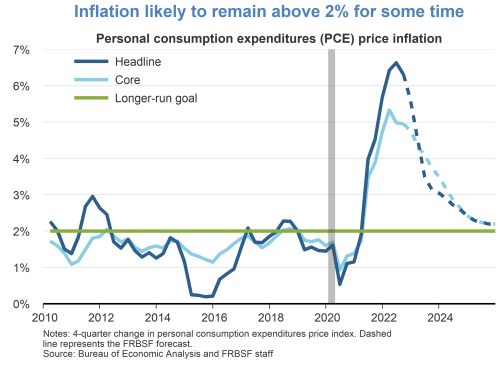
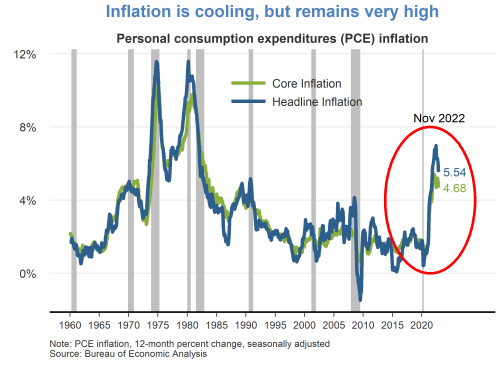
  • While continuing to cool over the last several months, 12-month inflation remains at historically high levels. The headline personal consumption expenditures (PCE) price index rose 5.5% in November 2022 from a year earlier. This marks a decline in inflation to a level last observed in October 2021, but still well above the Fed’s longer-run goal of 2%. A portion of the inflation moderation is attributable to recent declines in energy prices. Core PCE inflation, which removes food and energy prices, has shown less easing.
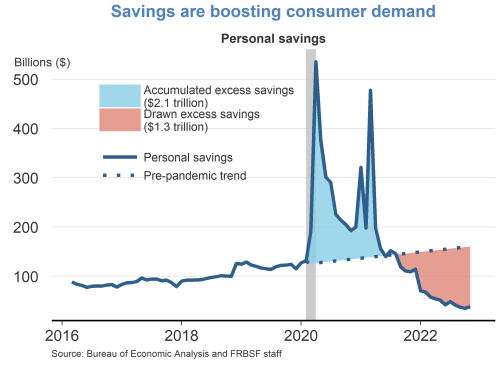
  • Owing to fiscal relief efforts and lower household spending over the course of the pandemic, consumers accumulated over $2 trillion dollars in excess savings, based on pre-pandemic trends. Since then, consumers have drawn down over half of this excess savings which has helped support recent growth in personal consumption expenditures. A considerable amount of accumulated savings remains for some consumers to support spending in 2023.
  • In the wake of the pandemic, consumer spending patterns shifted away from services towards goods. While there appears to be some normalization of spending behavior, this shift has generally persisted. Real goods spending remains significantly above its pre-pandemic trend, driven by strong demand for durables such as furniture, electronics, and recreational goods. Spending on services has shown a resurgence but remains below its pre-pandemic trend.
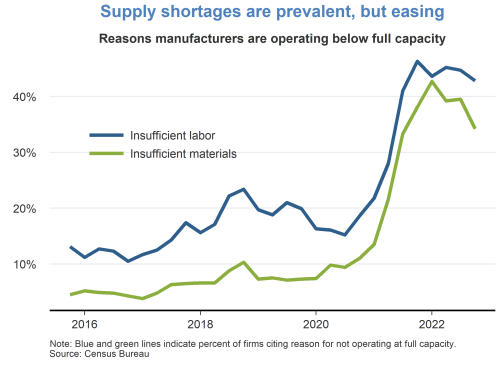
  • Supply chain bottlenecks for materials and labor remain a constraint on production, although there are some recent signs of easing. The fraction of manufacturers who reported operating below capacity due to insufficient materials peaked in late 2021 and has moderately declined over the past year. However, the fraction of manufacturers reporting insufficient labor has persisted at high levels.
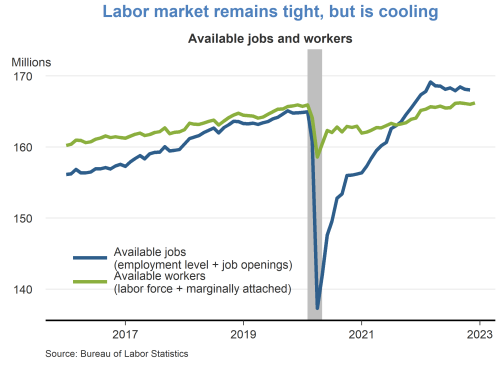
  • The labor market remains tight, despite some signs of cooling. The number of available jobs remains well above the number of available workers, although vacancy postings have been trending down in recent months. The tight labor market has put continued upward pressure on wages and labor market turnover.
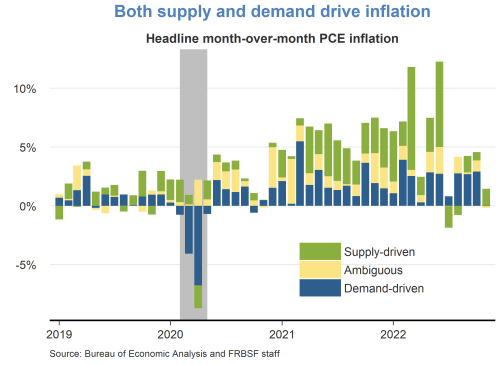
  • A decomposition of headline PCE inflation into supply– and demand-driven components shows that both supply and demand factors are responsible for the recent rise in inflation. The surge in inflation in early 2021 was mainly due to an increase in demand-driven factors. Subsequently, supply factors became more prevalent for the remainder of 2021. Supply-driven inflation has moderated significantly over recent months, while demand-driven inflation remains elevated.
  • The Federal Open Market Committee (FOMC) raised the federal funds rate by 50 basis points at the December meeting to a range of 4.25 to 4.5%. This cycle of continued rate increases since March of last year represents the fastest pace of monetary policy tightening in 40 years. The increase in the federal funds rate has been accompanied by a gradual reduction in the size of the Federal Reserve’s balance sheet.
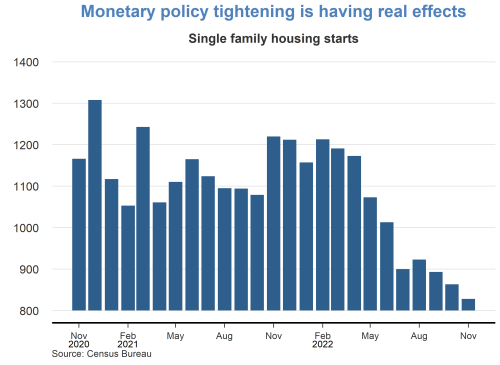
  • Economic activity in sectors such as housing, which is sensitive to rising interest rates, has slowed considerably in recent months. Housing starts have fallen steadily over the past year, as have other housing market indicators, such as existing home sales and house prices.
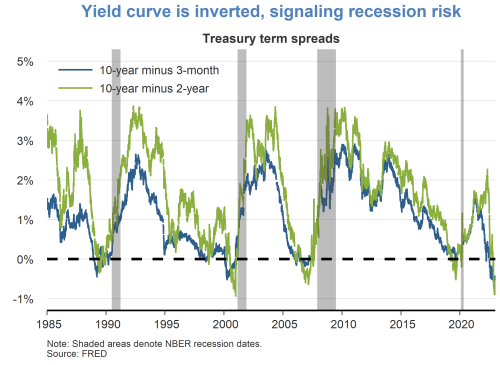
  • Although the labor market is currently very strong, financial markets are pointing to some downside risks. Namely, the difference between longer- and shorter-term interest rates has turned negative, which historically tends to occur immediately preceding recessions. It remains unclear whether lower longer-term yields are indicative of anticipated slower growth or lower inflation.
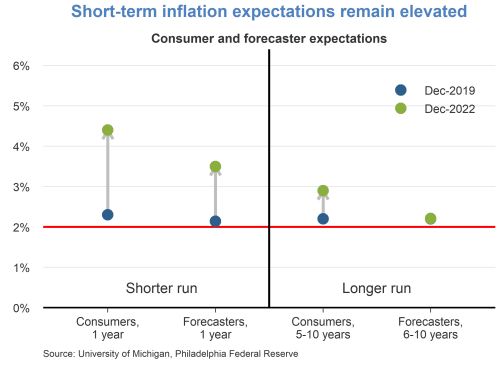
  • Short-term inflation expectations remain elevated relative to their pre-pandemic levels in December 2019. Consumers are expecting prices to rise 5% this year, while professional forecasters are expecting prices to rise 3.5%. Longer-term inflation expectations remain more subdued, indicating that both consumers and professionals believe inflation pressures will eventually dissipate.
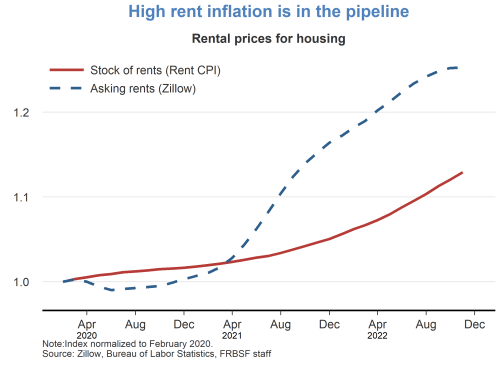
  • Rent inflation is expected to remain high over the next year. The prices for asking rents have grown quite substantially over the last two years. As new leases begin and existing leases are renewed, these higher asking rents will flow into the stock of rental units, putting upward pressure on rent inflation.
  • We are expecting inflation to moderate over the next few years as monetary policy continues to restrain demand and supply bottlenecks continue to ease. We anticipate that it will take some time for inflation to reach the Fed’s longer-run goal of 2%.
Inflation is cooling, but remains very high
Savings are boosting consumer demand
Goods consumption remains elevated
Supply shortages are prevalent, but easing
Labor market remains tight, but is cooling
Both supply and demand drive inflation
Monetary policy tightening is having real effects
Yield curve is inverted, signaling recession risk
Short-term inflation expectations remain elevated
High rent inflation is in the pipeline
Inflation likely to remain above 2% for some time

[Archived PDF]

Read other issues from FedViews.

Countries and Deep Patternings: China

China’s High-Level Equilibrium Trap as a Concept

The Pattern of the Chinese Past
Mark Elvin
Paperback: 348 pages
Publisher: Stanford University Press; 1st edition (June 1, 1973)

The 1973 classic work in Sinology, Mark Elvin’s The Pattern of the Chinese Past gives the student an “exemplum” in the kind of scholarship that might be called “pattern-seeking.” Without such attempts, all of history becomes formless and shapeless and an endless parade of “routs and rallies,” and “crimes and follies and misfortunes” (in Edward Gibbon’s catchphrase).

Professor Elvin renders Chinese history through an economic perspective instead of using the common dynastic classification by attempting to answer three questions:

  1. What contributed to the continuity of the Chinese empire?
  2. Why was the Chinese economy the most advanced in the world from the Song dynasty (960-1279) up until the latter half of the Qing dynasty (mid-1800s)?
  3. Why did China fail to maintain her technological advantage after the mid-fourteenth century while advancing economically?

In the first section of the book, the author elucidates the staying power of the Chinese empire was due to the following factors. The economics of defense in relation to the size of empire and the power of its neighbors never became an extreme burden that it rendered the state impotent for any consecutively long period of time. It was always able to reformulate itself after a short disunity or rule by a foreign power of the whole, which only happened twice within a two thousand year period (Mongol and Manchu rule). Two other factors that contributed to the continuity of the Chinese state include a relatively isolated existence from the rest of the Eurasian landmass and the important placed on cultural unity, beginning with the first emperor’s destruction of local records in order to quell local loyalties (pp. 21-22). Both of these factors had been built up over time through a revolution in communication and transportation.

The second section of the book analyses the causes of the economic revolution that occurred between the 8th and 12th centuries and the technological growth that accompanied it. The transformation of agriculture, especially in the south, was the major impetus that fueled the economic growth of this period. This revolution in agriculture had four aspects.

  1. The preparation of soil became more effective as a result of improved or new tools and the extensive use of manure and lime as fertilizer.
  2. Seed improvements allowed for double cropping.
  3. Improvements in hydraulic techniques and irrigation networks.
  4. Specialization in crops other than basic food grains (p.118).

Improvements in transportation and communications were almost as important as agriculture in growing the economy. Water transport saw big gains and led to the golden age of geographic studies and cartography, with envoys traveling as far away as Africa. Money and credit matured during this time helping to expand the economy. Paper money made its first appearance in 1024. Improvements in science, medicine, and technology also occurred during this period. However, despite all these advancements, “this period was the climax and also the end of many preceding centuries of scientific and technical progress” (p. 179). Although the Chinese economy continued to advance from the 14th century on, albeit on a smaller scale, it was not accompanied by improvements in technology.

The last section deals with this phenomenon, describing the distinctive characteristics of this late traditional period (1300-1800), and then proceeding to point out why technological advancements did not keep pace with the growth in the economy. This period sees a rise of small market towns in the sixteenth century and a decline in contact with the non-Chinese world around the middle of the fifteenth century. Also, by the eighteenth century serfdom disappeared, aiding population growth, which had reached 400 million by the mid-1800s. Elvin interestingly points out that the highly sophisticated metaphysics that evaded Chinese intellectual thought during the Ming and Qing dynasties negated any deep scientific inquiry (p. 233). In the attempt to explain the lack of technological advancement, Elvin disputes a number of conventional explanations. Contrary to popular belief, there was enough capital during this period to finance simple technological advances, also there was minimal political obstacles to economic growth.

In short, Elvin believes “that in late traditional China economic forces developed in such a way as to make profitable invention more and more difficult. With falling surplus in agriculture, and so falling per capita income and per capita demand, with cheapening labor but increasingly expensive resources and capital, with farming and transport technologies so good that no simple improvements could be made, rational strategy for peasants and merchants alike tended in the direction not so much of labor-saving machinery as of economizing on resources and fixed capital. Huge but nearly static markets created no bottlenecks in the production system that might have prompted creativity” (p. 314). This condition is what he terms as a “high-level equilibrium trap.” The term “trap” to describe the condition of late imperial China’s technological advancement in relation to the economy is similar to Escape from Predicament, Thomas Metzger’s analysis of the “predicament” that confronted Chinese intellectual thought from the Song through to the end of the Qing dynasty. Both explanations have at their core the idea of late imperial China not being able to generate real sustainable progress internally, stating that it was the Chinese response to the Western threat in the mid to late 1800s that finally brought the needed change.