Being at Home in the World/Universe

The French philosopher Maurice Merleau-Ponty provided an introduction to the problem of being at home when he wrote:

“The world is not what I think, but what I live through. I am open to the world, I have no doubt that I am in communication with it, but I do not possess it; it is inexhaustible. ‘There is a world’, or rather: “There is the world’; I can never completely account for this ever-reiterated assertion in my life.”

Joseph J. Kockelmans (Editor), Phenomenology: The Philosophy of Edmund Husserl and Its Interpretation, Anchor Books Edition, 1967, page 369.

Remy C. Kwant, in his essay “Merleau-Ponty and Phenomenology”, commented:

For, according to him, the original lies buried in a dimension of darkness in such a way that it cannot be brought to light. Our existence is interwoven with the world, is a dialogue with the world. This dialogue reaches its most profound point there where the first and most original meaning arises, a meaning that is pre-conscious and pre-personal. Whatever is in our consciousness, whatever comes to light, becomes lucid, originates also in this darkness. As we have seen, man is able to obtain a measure of knowledge regarding this dark depth. He is able to divine something about the mysterious dialogue between the body-subject and the world. However, according to Merleau-Ponty, an absolute illumination of the phenomenal field is in principle impossible. All man can do is to erect some pointers in a darkness which resists full illumination.

Joseph J. Kockelmans (Editor), Phenomenology: The Philosophy of Edmund Husserl and Its Interpretation, Anchor Books Edition, 1967, page 390-391.

We sense that the interaction between ourselves and the world at every level may not be explainable. Therefore, we seek emotional or psychological shelter. The three levels of shelter are:

  1. hearth and home
  2. a sense of belonging
  3. gods

Think of the song, “A House Is Not a Home”, sung by Dionne Warwick. “A chair is still a chair / Even though there’s no one sitting thereBut a room is not a house
/ And a house is not a home
” depicts the human longing for shelter via hearth and home. The French philosopher Bruno Latour referred to this as a “parliament of things.”

Consider “Gimme Shelter” by The Rolling Stones, as well as the novel (and later film) The Sheltering Sky by Paul Bowles. Both of these cover the deep issue of shelter.

Heidegger’s essay “Building Dwelling Thinking” (German: Bauen Wohnen Denken) states:

In what follows we shall try to think about dwelling and building. This thinking about building does not presume to discover architectural ideas, let alone to give rules for building. This venture in thought does not view building as an art or as a technique of construction; rather it traces building back into that domain to which everything that is belongs. We ask:

  1.   What is it to dwell?
  2.   How does building belong to dwelling?
I

We attain to dwelling, so it seems, only by means of building. The latter, building, has the former, dwelling, as its goal. Still, not every building is a dwelling. Bridges and hangars, stadiums and power stations are buildings but not dwellings; railway stations and highways, dams and market halls are built, but they are not dwelling places. Even so, these buildings are in the domain of our dwelling. That domain extends over these buildings and yet is not limited to the dwelling place. The truck driver is at home on the highway, but he does not have his shelter there; the working woman is at home in the spinning mill, but does not have her dwelling place there; the chief engineer is at home in the power station, but he does not dwell there. These buildings house man. He inhabits them and yet does not dwell in them, when to dwell means merely that we take shelter in them. In today’s housing shortage even this much is reassuring and to the good; residential buildings do indeed provide shelter; today’s houses may even be well planned, easy to keep, attractively cheap, open to air, light, and sun, but—do the houses in themselves hold any guarantee that dwelling occurs in them? Yet those buildings that are not dwelling places remain in turn determined by dwelling insofar as they serve man’s dwelling. Thus dwelling would in any case be the end that presides over all building. Dwelling and building are related as end and means. However, as long as this is all we have in mind, we take dwelling and building as two separate activities, an idea that has something correct in it. Yet at the same time by the means-end schema we block our view of the essential relations. For building is not merely a means and a way toward dwelling—to build is in itself already to dwell. Who tells us this? Who gives us a standard at all by which we can take the measure of the nature of dwelling and building?

Martin Heidegger, Poetry, Language, Thought, (translated by Albert Hofstadter), Harper & Row, 1975, pages 145-146.

Stuart Kauffman comes at this from a different angle:

Who are we? Where did we come from? Why are we here? Did Neanderthal, Homo habilis, or Homo erectus ask? Around which fire in the past 3 million years of hominid evolution did these questions first arise? Who knows.

Somewhere along our path, paradise has been lost, lost to the Western mind, and in the spreading world civilization, lost to our collective mind. John Milton must have been the last superb poet of Western civilization who could have sought to justify the ways of God to man in those early years foreshadowing the modern era. Paradise has been lost, not to sin, but to science. Once, a scant few centuries ago, we of the West believed ourselves the chosen of God, made in his image, keeping his word in a creation wrought by his love for us. Now, only 400 years later, we find ourselves on a tiny planet, on the edge of a humdrum galaxy among billions like it scattered across vast megaparsecs, around the curvature of space-time back to the Big Bang. We are but accidents, we’re told. Purpose and value are ours alone to make. Without Satan and God, the universe now appears the neutral home of matter, dark and light, and is utterly indifferent. We bustle, but are no longer at home in the ancient sense.

Stuart Kauffman, At Home in the Universe: The Search for the Laws of Self-Organization and Complexity, Oxford University Press, 1995, page 4.

Kauffman comes to grips with this problem with the final line above. He continues:


In this new view of life, organisms are not merely tinkered-together contraptions, bricolage, in Jacob’s phrase. Evolution is not merely “chance caught on the wing,” in Monod’s evocative image. The history of life captures the natural order, on which selection is privileged to act. If this idea is true, many features of organisms are not merely historical accidents, but also reflections of the profound order that evolution has further molded. If true, we are at home in the universe in ways not imagined since Darwin stood natural theology on is head with his blind watchmaker.

Stuart Kauffman, At Home in the Universe: The Search for the Laws of Self-Organization and Complexity, Oxford University Press, 1995, pages 25-26.

Kauffman wants to complete the Darwinian revolution by adding self-organization and complexity to natural selection. In his vision, this will begin to produce a holistic picture of who we are. This will perhaps allow us to feel “We are all at home in the universe, poised to sanctify by our best, brief, only stay.” [page 30.]

Zooming out from this, we can see a meta-intelligent sense in which science believes it can convert mysteries into problems using math. In contrast to this, philosophers believe the opposite, that the problems are becoming more mysterious.
Why Is Technological History So Misleading?

We are conditioned to think of technological history in a very binary way. For thousands of years before motorized transportation, we think of horses and wind-powered ships. We also sense that if we brought great historical minds from before the industrial revolution to a modern city, most likely they would be stunned by the technology surrounding them. Think of a world of medical science before anesthesia and germ theory.

Let’s modify this binary view of human history. David F. Noble gives us a more accurate view:

Augustine, the chief author of Christian orthodoxy, wrote in The City of God, “there have been discovered and perfected, by the natural genius of man, innumerable arts and skills which minister not only to the necessities of life but also to human enjoyment.” Augustine recognized the “astonishing achievements” that had taken place in cloth-making, navigation, architecture, agriculture, ceramics, medicine, weaponry and fortification, animal husbandry, and food preparation; in mathematics, astronomy, and philosophy; as well as in language, writing, music, theater, painting, and sculpture. But he emphasized again that “in saying this, of course, I am thinking only of the nature of the human mind as a glory of this mortal life, not of faith and the way of truth that leads to eternal life… And, remember, all these favors taken together are but the fragmentary solace allowed us in a life condemned to misery.”5

5 St. Augustine, The City of God (Garden City, N.Y.: Doubleday, 1958), pp. 526, 527.

David F. Noble, The Religion of Technology: The Divinity of Man and the Spirit of Invention, Penguin Books, 1999 (originally 1997), pages 11-12.

Note that Augustine wrote The City of God in 426 AD, meaning that even 1600 years ago, they had already made colossal advances. The prejudice that we have, given our scientific training, is utterly misleading. Rather than being blinded by Biblical explanations of how the world came to be, Augustine lauded these scientific advancements. We think of Thomas Edison and the lightbulb, rather than, “Let there be light.”

There are various levels of empirical and artisanal knowledge. In cooking, we rarely worry about molecules that make up ingredients. All these daily life pillars Augustine lists cannot be overlooked, even as we unlock the submicroscopic world of quantum mechanics.

Is It Good to Be a Detached Observer?

The famous Dutch historian, Pieter Geyl, in his Napoleon, for and against (Dutch, Napoleon: voor en tegen in de Franse geschiedschrijving) teaches us that there are “arguments without end.” One example is the question surrounding the concept of detachment. Aristotle, in his Nicomachean Ethics, proposes “eudaimonia,” a Greek word literally translating to the state or condition of good spirit coming from imperturbability. This sense of things is all over the Western tradition. Think of the line from the British poet, Alexander Pope, “For Fools rush in where Angels fear to tread.” (An Essay on Criticism, 1711). You see from this that fools lack detachment and act on impulse.

We get a confirmation of Geyl’s arguments without end when we remember that almost every love song recommends the opposite. For example, “Fools Rush In (Where Angels Fear to Tread)” originally made famous by Frank Sinatra and later Elvis Presley, offers us the line “But wise men never fall in love / So how are they to know.” From this, we can interpret that wise men can be foolish and foolish people can be wise. You may also have in the back of your mind Tennyson’s “Tis better to have loved and lost / Than never to have loved at all.” It is not wise to be careful always.

We get a twist on this in the Rodgers & Hammerstein musical South Pacific. Think of “Some Enchanted Evening”:

Who can explain it?
Who can tell you why?
Fools give you reasons—
Wise men never try.

Fools give you reasons because they think everything can be explained, where wise men realize this is not always true. The larger point, from existential thinker Gabriel Marcel, is that all the phenomena of life that are explainable are themselves wrapped up in a larger mystery. He discusses the question of detachment in Being and Having: An Existentialist Diary, which we covered in “Existence and the Problem of Separability” and “Is the World Broken?”.

Marcel says:

March 8th [1929]

I am more and more struck by the difference between the two modes of detachment: the one is that of the spectator, the other of the saint. The detachment of the saint springs, as one might say, from the very core of reality; it completely excludes curiosity about the universe. This detachment is the highest form of participation. The detachment of the spectator is just the opposite, it is desertion, not only in thought but in act. Herein, I think, lies the kind of fatality which seems to weigh on all ancient philosophy—it is essentially the philosophy of the spectator.

But one thing must be noted: the belief that one can escape pure spectatorship by devotion to a practical science, which cannot quite clearly formulate it as yet. I should express it by saying that the modifications which such a science imposes on reality have no other result (metaphysically of course than of making that science in some sense a stranger to reality. The word ‘alienation’ exactly expresses what I mean. ‘I am not watching a show’—I will repeat these words to myself every day. A fundamental spiritual fact.

The interdependence of spiritual destinies, the plan of salvation; for me, that is the sublime and unique feature of Catholicism.

I was just thinking a moment ago that the spectator-attitude corresponds to a form of lust; and more than that, it corresponds to the act by which the subject appropriates the world for himself. And I now perceive the deep truth of Bérulle’s theocentrism. We are here to serve; yes, the idea of service, in every sense, must be thoroughly examined.

Also perceived this morning, but still in a confused way, that there is profane knowledge and sacred knowledge (whereas previously I have wrongly tended to assert that all knowledge was pro-fane. It isn’t true, profane is a supremely informative word). Inquire on what conditions knowledge ceases to be profane.

Incredible how thronged these days are spiritually! My life is being illuminated right into the depths of the past, and not my life only.

Every time we give way to ourselves we may unawares be laying an additional limitation on ourselves, forging our own chain. That is the metaphysical justification for asceticism. I never understood that till now.

Reality as mystery, intelligible solely as mystery. This also applies to myself.

Gabriel MarcelBeing and Having: An Existentialist Diary, Harper Torchbooks, 1965, pages 20-21.

Notice this discussion starts by analyzing modes of detachment and concludes with Marcel talking about reality and himself as mystery. This brings us full circle to Geyl and his concept of arguments without end because trying to define pros and cons of detachment and what is a mystery is ultimately undecidable. This may remind you of Gödel’s incompleteness theorems, that finding a complete and consistent set of axioms for all mathematics is impossible.

Economics-Watching: Second-Quarter GDP Growth Estimate Unchanged

[from the Federal Reserve Bank of Atlanta]

The growth rate of real gross domestic product (GDP) is a key indicator of economic activity, but the official estimate is released with a delay. The Federal Reserve Bank of Atlanta’s GDPNow forecasting model provides a “nowcast” of the official estimate prior to its release by estimating GDP growth using a methodology similar to the one used by the U.S. Bureau of Economic Analysis.

GDPNow is not an official forecast of the Atlanta Fed. Rather, it is best viewed as a running estimate of real GDP growth based on available economic data for the current measured quarter. There are no subjective adjustments made to GDPNow—the estimate is based solely on the mathematical results of the model.

Recent forecasts for the GDPNow model are available here [archived PDF]. More extensive numerical details—including underlying source data, forecasts, and model parameters—are available as a separate spreadsheet [archived XLSX]. You can also view an archive of recent commentaries from GDPNow estimates.

Please note that the Atlanta Fed no longer supports the GDPNow app. Download the EconomyNow app to get the latest GDP nowcast and more economic data.

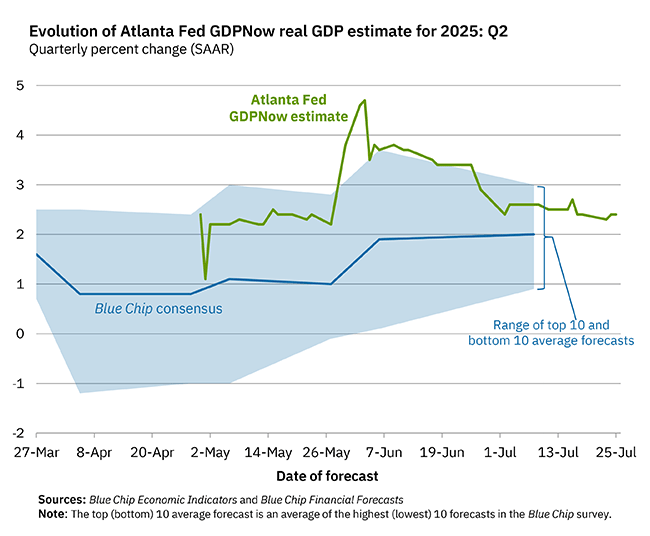
Latest estimate: 2.4 percent — July 25, 2025

The GDPNow model estimate for real GDP growth (seasonally adjusted annual rate) in the second quarter of 2025 is 2.4 percent on July 25, unchanged from July 18 after rounding. The forecasts of the major GDP subcomponents were all unchanged or little changed from their July 18 values after this week’s releases from the U.S. Census Bureau and the National Association of Realtors.

The growth rate of real gross domestic product (GDP) measured by the U.S. Bureau of Economic Analysis (BEA) is a key metric of the pace of economic activity. It is one of the four variables included in the economic projections of Federal Reserve Board members and Bank presidents for every other Federal Open Market Committee (FOMC) meeting. As with many economic statistics, GDP estimates are released with a lag whose timing can be important for policymakers. In preparation for FOMC meetings, policymakers have the Fed Board staff projection of this “advance” estimate at their disposal. These projections—available through 2008 at the Philadelphia Fed’s Real Time Data Center—have generally been more accurate than forecasts from simple statistical models. As stated by economists Jon Faust and Jonathan H. Wright in a 2009 paper, “by mirroring key elements of the data construction machinery of the Bureau of Economic Analysis, the Fed staff forms a relatively precise estimate of what BEA will announce for the previous quarter’s GDP even before it is announced.”

The Atlanta Fed GDPNow model also mimics the methods used by the BEA to estimate real GDP growth. The GDPNow forecast is constructed by aggregating statistical model forecasts of 13 subcomponents that comprise GDP. Other private forecasters use similar approaches to “nowcastGDP growth. However, these forecasts are not updated more than once a month or quarter, are not publicly available, or do not have forecasts of the subcomponents of GDP that add “color” to the top-line number. The Atlanta Fed GDPNow model fills these three voids.

The BEA’s advance estimates of the subcomponents of GDP use publicly released data from the U.S. Census Bureau, U.S. Bureau of Labor Statistics, and other sources. Much of this data is displayed in the BEA’s Key Source Data and Assumptions table that accompanies the “advance” GDP estimate. GDPNow relates these source data to their corresponding GDP subcomponents using a “bridge equation” approach similar to the one described in a Minneapolis Fed [archived PDF] study by Preston J. Miller and Daniel M. Chin. Whenever the monthly source data is not available, the missing values are forecasted using econometric techniques similar to those described in papers by James H. Stock and Mark W. Watson and Domenico Giannone, Lucrezia Reichlin, and David Small. A detailed description of the data sources and methods used in the GDPNow model is provided in an accompanying Atlanta Fed working paper [archived PDF].

As more monthly source data becomes available, the GDPNow forecast for a particular quarter evolves and generally becomes more accurate. That said, the forecasting error can still be substantial just prior to the “advance” GDP estimate release. It is important to emphasize that the Atlanta Fed GDPNow forecast is a model projection not subject to judgmental adjustments. It is not an official forecast of the Federal Reserve Bank of Atlanta, its president, the Federal Reserve System, or the FOMC.

Wrestling with History: Alexis de Tocqueville

Alexis de Tocqueville, a brilliant French historian, wrote Democracy in America. This book is a supreme example of U.S.-watching.

Another book of his, Recollections, shows him wrestling with history itself. If we remember that Clio is the muse of history, then we might say that Recollections is the chronicle of de Tocqueville’s encounter with her.

The question of human history and what de Tocqueville called “the world’s destiny” are described as follows:

l wrote histories without taking part in public affairs, and politicians whose only concern was to control events without a thought of describing them. And I have invariably noticed that the former see gen­eral causes everywhere, whereas the latter, spend­ing their lives amid the disconnected events of each day, freely attribute everything to particular incidents and think that all the little strings their hands are busy pulling daily are those that control the world’s destiny. Probably both of them are mistaken.

For my part I hate all those absolute systems that make all the events of history depend on great first causes linked together by the chain of fate and thus succeed, so to speak, in banishing men from the history of the human race. Their boasted breadth seems to me narrow, and their mathematical exactness false. I believe, pace the writers who find these sublime theories to feed their vanity and lighten their labours, that many important historical facts can be explained only by accidental circumstances, while many others are inexplicable. Finally, that chance, or rather the concatenation of secondary causes, which we call by that name because we can’t sort them all out, is a very important element in all that we see taking place in the world’s theatre. But I am firmly convinced that chance can do nothing unless the ground has been prepared in advance. Antecedent facts, the nature of institutions, turns of mind and the state of mores are the materials from which chance composes those impromptu events that surprise and terrify us.

Alexis de Tocqueville, Recollections, 1893, Anchor Books, page 78.

De Tocqueville warns us that the world’s destiny is always murky and what he calls a labyrinth and a whirlwind. He says:

Mentally I reviewed the history of our last sixty years and smiled bitterly to myself as I thought of the illusions cherished at the end of each phase of this long revolution; the theories feeding these illusions; our historians’ learned daydreams, and all the ingenious false systems by which men sought to explain a present still unclearly seen and to foresee the unseen future.

Recollections, page 83.

He continues:

Shall we reach, as other prophets as vain perhaps as their predecessors assure us, a more complete and profound social transformation than our fathers ever foresaw or desired, and which we ourselves cannot yet conceive; or may we not simply end up in that intermittent anarchy which is well known to be the chronic incurable disease of old peoples? I cannot tell, and do not know when this long voyage will end; I am tired of mistaking deceptive mists for the bank. And I often wonder whether that solid land we have sought for so long actually exists, and whether it is not our fate the rove the seas forever!

Recollections, pages 83-84.

And yet, with all that profound uncertainty, he offers a very sweeping interpretation of French history from the French Revolution (1789) to the French Revolution of 1848. The famous painting by Eugène Delacroix, Liberty Leading the People (FrenchLa Liberté guidant le peuple), commemorating the July Revolution of 1830, falls in between.

Despite de Tocqueville’s warnings about the slipperiness of historical judgement, he arrives at an extremely precise interpretation of his own:

Seen as a whole from a distance, our history from 1789 to 1830 appears to be forty-one years of deadly struggle between the Ancien Régime with its traditions, memories, hopes and men (i.e. the aristocrats), and the new France led by the middle class. 1830 would seem to have ended the first period of our revolutions, or rather, of our revolution, for it was always one and the same, through its various fortunes and passions, whose beginning our fathers saw and whose end we shall in all probability not see. All that remained of the Ancien Régime was destroyed forever. In 1830 the triumph of the middle class was decisive and so complete that the narrow limits of the bourgeoisie encompassed all political powers, franchises, prerogatives, indeed the whole government, to the exclusion, in law, of all beneath it and, in fact, of all that had once been above it. Thus the bourgeoisie became not only the sole director of society, but also, one might say, its cultivator. It settled into every office, prodigiously increased the number of offices, and made a habit of living off the public Treasury almost as much as from its own industry.

Recollections, page 5.

Reviewing the first sentence from the quote above, one can see a deep characterization of an era, with the conclusion “in 1830 the triumph of the middle class was decisive…” Notice the profound paradox that on one hand de Tocqueville spoke of the elusiveness of history despite providing the definite description of this period. Contrast “seen as a whole from a distance” with one of the themes of his recollections, that it is not given to us to understand history.

Kierkegaard and Existence

There are various striking intuitions about human existence. For example, in his brilliant memoirs, Speak, Memory, Nabokov begins with the deep reflection where human existence is compared to a baby in a cradle, rocking, completely vulnerable and uncertain. All of this is bracketed by two episodes of infinite darkness. The first episode took place before you were born and the second takes place after you’re gone. Your existence is a temporary flame, like that of a lit match.

A MetaIntelligent comment on this would be that the profound ingenuity of the 19th century mathematicians analyzing the size and nature of infinity (e.g., Richard Dedekind or Georg Cantor) cannot in the last analysis wrestle down human existence into mathematics.

The modern progenitor of this kind of human existence-watching is the Danish genius Søren Kierkegaard. In one of his masterpieces, Concluding Unscientific Postscript to Philosophical Fragments (1846), he makes the claim that knowledge, theory, speculative thinking and infinity-watching à la Dedekind and Cantor, cannot possibly explain human existence, because it subsumes all of these.

In 2025, this would mean that the Kierkegaard sense of things would tell you that neuroscience can never really explain how existence is sensed by a living person.

Kierkegaard writes, “in my view the misfortune of the age was precisely that it had too much knowledge, had forgotten what existence means, and what inwardness signifies.” He continues, “for a knowledge-seeker, when he has finished studying China he can take up Persia; when he has studied French he can begin Italian; and then go on to astronomy, the veterinary sciences, and so forth, and always be sure of a reputation as a tremendous fellow.”

By way of contrast, “inwardness in love does not consist in consummating seven marriages with Danish maidens, then cutting loose on the French, the Italian, and so forth, but consists in loving one and the same woman, and yet being constantly renewed in the same love, making it always new in the luxuriant flowering of the mood.” (Concluding Unscientific Postscript to Philosophical Fragments, page 232.)

Kierkegaard’s kind of existence-watching can be understood as a turning-upside-down of the famous phrase from Descartes, “I think, therefore I am.” For Kierkegaard, “I am, therefore I think.” Notice that “I think” is an epistemological statement or knowledge-watching. “I am” is an ontological statement.

This existentialist tradition of putting ontology before epistemology finds its culmination in Heidegger. As he says in his opus, Being and Time (1927), “human being is ultimately the being for whom being itself is an issue.”

Songs as Another Kind of Parallel University

Meta Intelligence is a heterodox view of education where formal education (courses, diplomas, universities, fields) are incomplete and limited without adding informal education which is part of your life such as movies, songs, conversations and images (paintings, posters, etc). Your “lifeworld” (Edmund Husserl’s apt coinage) fuses all the kinds of education where the word education means thought-provoking and illuminating. Even personal experience counts such as illnesses or bad marriages! Only via this Meta Intelligence will you achieve a glimpsed “holism.” (Meta Intelligence is that meta-field outside fields, borders and boundaries.)

Take songs.

Think back to Jim Morrison’s classic tune, “Riders on the Storm” which begins:

“Riders on the storm
Riders on the storm
Into this house, we’re born
Into this world, we’re thrown
Like a dog without a bone
An actor out on loan
Riders on the storm”

This song (by the Doors), expresses in a simple way Heidegger’s notion of human existence as partly governed by “Geworfenheit” which derives from “werfen,” to throw. “Geworfenheit” means “thrownness.” Jim Morrison and his band the Doors are songphilosophers without (probably) being Heidegger’s acolytes. Max Weber, one of the fathers of modern sociology, uses the word “disenchantment” to describe the modern world, “Entzauberung” in German, where “zauber” means “magicality” and “ent” means “removal of,” and “ung” means “condition of being.” The magic here does not mean something like a card trick but rather sacred mysteries, perhaps like the feeling a medieval European felt on entering a cathedral.

Enchantment in the West survived in our notions of romantic love and was associated with the songs and outlook of the medieval troubadours. Such romantic enchantment which is fading from our culture in favor of sex is still celebrated in the classic Rogers and Hammerstein song, “Some Enchanted Evening” from the forties musical and fifties movie, South Pacific.

The song lyrics give you the philosophy of romantic love as the last stand of enchantment:

“Some enchanted evening, you may see a stranger,
You may see a stranger across a crowded room,
And somehow you know, you know even then,
That somehow you’ll see here again and again.
Some enchanted evening, someone may be laughing,
You may hear her laughing across a crowded room,
And night after night, as strange as it seems,
The sound of her laughter will sing in your dreams.

“Who can explain it, who can tell you why?
Fools give you reasons, wise men never try.

“Some enchanted evening, when you find your true love,
When you hear her call you across a crowded room,
Then fly to her side and make her your own,
Or all through your life you may dream all alone.

“Once you have found her, never let her go,
Once you have found her, never let her go.”

Notice that “chant” is a component of enchantment.

One could say that conventional enchantment has been transferred to the world of science and mathematics where a deep beauty is intuited. Professor Frank Wilczek of MIT (Nobel Prize) wrote several books on this intersection of science and the quest for beauty whereas Sabine Hossenfelder of Germany has argued, per contra, that this will be a “bum steer.”

You should sense that like movies, songs give you a “side window” or back door into thinking and knowledge, which should be center stage and not depreciated.

Mathematics and the World: London Mathematical Laboratory

Stability of Heteroclinic Cycles in Rings of Coupled Oscillators

[from the London Mathematical Laboratory]

Complex networks of interconnected physical systems arise in many areas of mathematics, science and engineering. Many such systems exhibit heteroclinic cyclesdynamical trajectories that show a roughly periodic behavior, with non-convergent time averages. In these systems, average quantities fluctuate continuously, although the fluctuations slow down as the dynamics repeatedly and systematically approach a set of fixed points. Despite this general understanding, key open questions remain concerning the existence and stability of such cycles in general dynamical networks.

In a new paper [archived PDF], LML Fellow Claire Postlethwaite and Rob Sturman of the University of Leeds investigate a family of coupled map lattices defined on ring networks and establish stability properties of the possible families of heteroclinic cycles. To begin, they first consider a simple system of N coupled systems, each system based on the logistic map, and coupling between systems determined by a parameter γ. If γ = 0, each node independently follows logistic map dynamics, showing stable periodic cycles or chaotic behavior. The authors design the coupling between systems to have a general inhibitory effect, driving the dynamics toward zero. Intuitively, this should encourage oscillatory behavior, as nodes can alternately be active (take a non-zero value), and hence inhibit those nodes to which it is connected to, decay, when other nodes in turn inhibit them; and finally grow again to an active state as the nodes inhibiting them decay in turn. In the simple case of N = 3, for example, this dynamics leads to a trajectory which cycles between three fixed points.

The authors then extend earlier work to consider larger networks of coupled systems as described by a directed graph, describing how to find the fixed points and heteroclinic connections for such a system. In general, they show, this procedure results in highly complex and difficult to analyze heteroclinic network. Simplifying to the special case of N-node directed graphs with one-way nearest neighbor coupling, they successfully derive results for the dynamic stability of subcycles within this network, establishing that only one of the subcycles can ever be stable.

Overall, this work demonstrates that heteroclinic networks can typically arise in the phase space dynamics of certain types of symmetric graphs with inhibitory coupling. Moreover, it establishes that at most one of the subcycles can be stable (and hence observable in simulations) for an open set of parameters. Interestingly, Postlethwaite and Sturman find that the dynamics associated with such cycles are not ergodic, so that long-term averages do not converge. In particular, averaged observed quantities such as Lyapunov exponents are ill-defined, and will oscillate at a progressively slower rate.

In addition, the authors also address the more general question of whether or not a stable heteroclinic cycle is likely to be found in the corresponding phase space dynamics of a randomly generated physical network of nodes. In preliminary investigations using randomly generated Erdős–Rényi graphs, they find that the probability of existence of heteroclinic cycles increases both as the number of nodes in the physical network increases, and also as the density of edges in the physical network decreases. However, even in cases where the probability of existence of heteroclinic cycles is high, there is also a high chance of the existence of a stable fixed point in the phase space. From this they conclude that the question of the stability of the heteroclinic cycle is important in determining whether or not the heteroclinic cycle, and associated slowing down of trajectories, will be observed in the phase space associated with a randomly generated graph.

The paper is available as a pre-print here [archived PDF].

Education and Word and Number Hidden Vagueness

These mini-essays help students of any age to re-understand education in a deeper and more connected way.

They look for “circum-spective” intelligence. (Not in the sense of prudential or cautious but in the sense of “around-looking.”)

One of the things to begin to see is that explaining things in schools is misleading “ab initio” (i.e., from the beginning).

Let’s do an example:

In basic algebra, you’re asked: what happens to (x2 – 1)/(x – 1) as x “goes to” (i.e., becomes) 1.

If you look at the numerator (thing on top), x2 is also 1 (since 1 times 1 is 1) and (1 – 1) is zero. The denominator is also (1 – 1) and zero.

Thus you get 0 divided by 0.

You’re then told that’s a no-no and that’s because zeros and infinities lead to all kinds of arithmetic “bad behavior” or singularities.

You’re then supposed to see that x2 – 1 can be re-written as (x – 1)(x + 1) and since “like cancels like,” you cancel the x – 1 is the numerator and denominator and “get rid” of it.

This leaves simply x + 1. So, as x goes to 1, x + 1 goes to 2 and you have a “legitimate” answer and have bypassed the impasse of 0 acting badly (i.e., zero divided by zero).

If you re-understand all this more slowly you’ll see that there are endless potential confusions:

For example: you cannot say that (x2 – 1)/(x – 1) = x + 1 since looking at the two sides of the equal sign shows different expressions which are not equal.

They’re also not really equivalent.

You could say that coming up with x + 1 is a workaround or a “reduced form” or a “downstream rewrite” of (x2 – 1)/(x – 1).

This reminds us of the endless confusions in high school science: if you combine hydrogen gas (H2) with oxygen gas (O2) you don’t get water (H2O). Water is the result of a chemical reaction giving you a compound.

A mixture is not a compound. Chemistry is based on this distinction.

Math and science for that matter, are based on taking a formula or expression (like the one we saw above) and “de-cluttering” it or “shaking loose” a variant form which is not identical and not the same but functionally equivalent in a restricted way.

A lot of students who fail to follow high school or college science sense these and other “language and number” problems of hidden vagueness.
School courses punish students who “muse” to themselves about hidden vagueness. This behavior is pre-defined as “bad woolgathering” but we turn this upside down and claim it is potentially “good woolgathering” and might lead to enchantment which then underlies progress in getting past one’s fear of something like math or science or anything else.

One is surrounded by this layer of reality on all sides, what Wittgenstein calls “philosophy problems which are really language games.”

Think of daily life: you say to someone: “you can count one me.” You mean trust, rely on, depend on, where count on is a “set phrase.” (The origin of the phrase and how it became a set phrase is probably unknowable and lost in the mists of time.)

“You can count on me” does not mean you can stand on me and then count something…one, two, three.

In other words in all kinds of language (English, say, or math as a language) one is constantly “skating over” such logic-and-nuance-and-meaning issues.

The genius Kurt Gödel (Einstein’s walk around buddy at Princeton) saw this in a deep way and said that it’s deeply surprising that languages work at all (spoken, written or mathematical) since the bilateral sharing of these ambiguities would seem deadly to any clarity at all and communication itself would seem a rather unlikely outcome.

You could also say that drama giants of the twentieth century like Pinter, Ionesco and Beckett, intuit these difficulties which then underlie their plays.

All of this together gives you a more “composite” “circum-spective” view of what is really happening in knowledge acquisition.

Knot Theory and the Strangeness of Reality

The subfield of “knot theory” in math as a kind of geometry of “twistiness” gives us a deep “meta-intelligent” signal or lesson.

Meta-intelligent means “perspective-challenging” with or without full details of any subfield itself.

Consider this overview or comment on “knot theory” now:

“In mathematical knot theory, you throw everything out that’s related to mechanics,” Dunkel (MIT math professor) says. “You don’t care about whether you have a stiff versus soft fiber—it’s the same knot from a mathematician’s point of view. But we wanted to see if we could add something to the mathematical modeling of knots that accounts for their mechanical properties, to be able to say why one knot is stronger than another.”

But you immediately think: in the real world knots are not only twisted up in mathematically definable ways but are in fact actual shoelaces, neckties, ropes, etc, that have chemical and molecular properties before you describe their twist-and-tighten or slide-and-grip “shapes.”

Which is the real: the math or the “ropiness” of the ropes or the “laciness” of the laces?

The relationship between things and numbers is elusive.

Mathematicians have long been intrigued by knots, so much so that physical knots have inspired an entire subfield of topology known as knot theory—the study of theoretical knots whose ends, unlike actual knots, are joined to form a continuous pattern.

In knot theory, mathematicians seek to describe a knot in mathematical terms, along with all the ways that it can be twisted or deformed while still retaining its topology, or general geometry.

MIT mathematicians and engineers have developed a mathematical model that predicts how stable a knot is, based on several key properties, including the number of crossings involved and the direction in which the rope segments twist as the knot is pulled tight.

“These subtle differences between knots critically determine whether a knot is strong or not,” says Jörn Dunkel, associate professor of mathematics at MIT. “With this model, you should be able to look at two knots that are almost identical, and be able to say which is the better one.”

“Empirical knowledge refined over centuries has crystallized out what the best knots are,” adds Mathias Kolle, the Rockwell International Career Development Associate Professor at MIT. “And now the model shows why.”

As per usual in science, one is dazzled by the ingenuity of the quest and the formulations but puzzled by the larger implications since we can never decide whether math “made” us or we “made” (i.e., invented) math.