Digitizing Heritage: Exploring the Transformation of Culture to Data

[from India in Transition by the Center for the Advanced Study of India at the University of Pennsylvania, 1 September 2025]

by Krupa Rajangam & Deborah Sutton

“Oh that. We just took some undergraduate history students on board as interns. They provided the content and it was done.

The co-founder of a digital heritage initiative promoting interactive user interfaces offered these opening remarks. Speaking at a Delhi-based museum, he had been asked about the information provided to users as they moved their hands across an interactive board, revealing images and narratives relating to the Indian freedom movement. His response clarified that the physical and digital components of such installations—for example, the 3D-modeling software and hardware, scanning equipment and its resolution and the user interface—were more carefully designed and calibrated than the content they provided.

Contemporary cultural heritage (CH) is rife with digital innovation. The COVID pandemic accelerated this transformation as archivists and curators worked to develop content that would reach remote, locked-down audiences. Within significant limits, digital platforms can democratize and facilitate access to materials previously inaccessible. Instead of being physically siloed, digitized material—as data components and not just content on culture—can be reproduced, combined, and circulated infinitely to achieve a reach previously considered impossible. Accessibility and malleability remain one of the great boons of digital formats. But here, we consider the information economy of CH practice as it exists—and not its extraordinary and often hypothetical potential—in two, overlapping realms of digitized CH: for-profit business enterprises and academic side-hustles, related to more mainstream academic research.

In the former, questions of what is shared are often less significant than the appeal of the format. In the latter, innovation is often the result of short-term projects that languish, abandoned after project completion, and rarely find audiences. Our research builds on our individual experiences and the findings of a scoping exercise examining a number of India-based heritage projects conducted in 2021-22. It suggests the need for more careful consideration of the implications of transforming CH materials into forms of data; the change impacts everything from how we understand “originality” to the reliance on for-profit services to deliver heritage material to the public.

As digitized representations of CH and access to such formats become more widespread, are we, as CH practitioners and academics, giving enough thought to how digital technologies are reshaping the nature of CH and its audience? Beyond questions of wider reach, are we sufficiently acknowledging how these changes challenge a continued focus on originality and notions of academy as primary controllers of access to knowledge and its validity, both in research and practice?

Digitizing for Dissemination

In 2019, one of us—Deborah Sutton—developed a software platform, Safarnama, including an app and authored experiences around Delhi’s CH. The project subsequently extended to Karachi. Generating “original” content, such as audio-visual clips and old photos, to be hosted on the app platform, was key to its attractiveness and usefulness, but permissions proved tricky. Some collaborators who were initially keen to contribute content quietly withdrew, likely due to the unfamiliar format and unknown reach. The app format also raised other questions. Would incorporating content from non-digital but published scholarship require authorial permission or only acknowledgement?

In 2020, Krupa Rajangam held a sponsored incubation at the NSRCEL, a business incubator located at the Indian Institute of Management-Bangalore, to develop a web interface that would host geo-locationed stories of marginalized histories by drawing on both historical facts and lived experiences. Corporate mentors remained skeptical of her ability to source “original” content on an ongoing basis, i.e., content that was both authenticated and validated. They repeatedly advised her to focus on the format, user experience, and appeal for “mass markets” so her prototype would find audiences. Both projects equally raised questions over who would consume the content and what constitutes the public or audience.

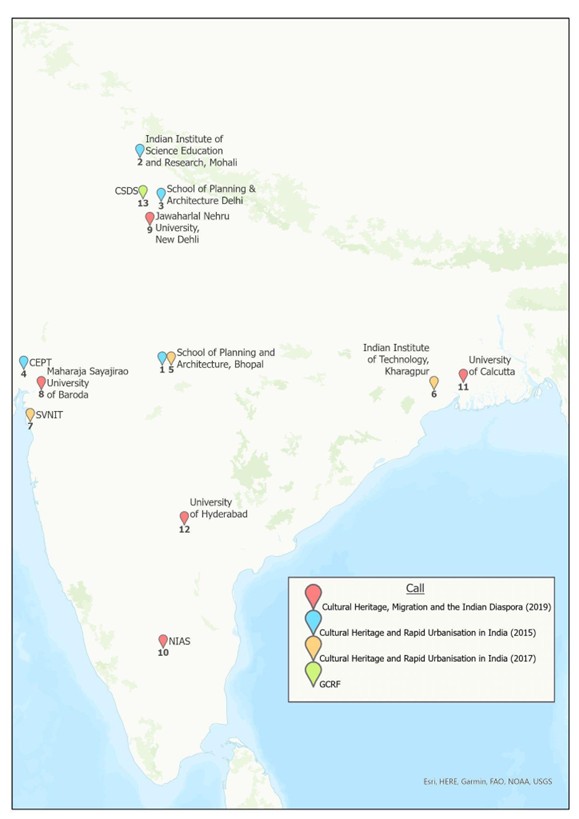
In a scoping exercise undertaken for the Arts and Humanities Research Council (AHRC), UK, in 2021-22, we explored a number of India-based heritage projects funded by the AHRC in partnership with the Newton Fund and Indian Council for Historical Research, since 2015 (figure 1). We were particularly interested in the digital components, which all projects included, even if only a website.

Our exploratory surveys firmly established the divergence in interpreting both CH and digital technologies, which was not surprising. Some projects defined and treated CH as fixed pre-existing material, to be interpreted and presented to audiences through digital technologies. Others re-framed digital formats of CH as components of data, assembling, manipulating, and representing extant archival and other materials. The rest generated digitized CH, effectively altering its nature. Typically, such projects dealt with more ephemeral or less conventional forms of CH.
Fundamental Transformations

Notions of originality remain central to art, architectural and art historical training, and CH practice. Digitization transforms the access and retrieval value of “original” material in physical archives, such as old maps and letters, much lauded in traditional “analog” scholarship, to use value as data. Once the end-user (audience) accesses this data (whether historical facts or stories), it becomes nothing more than bytes occupying valuable space, to be deleted once consumed rather than stored, making it easy to overlook or disregard the source and its context.

For example, in the Safarnama project, the app contained carefully collected and authenticated narratives on “partition memories” in Delhi and Karachi. However, the bite-sized media format meant that users would only explore content once, as snippets. This realization led the team to develop the software and incorporate the ability to download content, which at least meant that users could collect, organize and store (archive) the assembled media.

Digitization also takes away the materiality of the archive, making it more ephemeral. Non-digital materials through, and into which we render CH can (in endless combinations and cycles) be lost, forgotten, sold, recovered, collected, displayed, and stored. Such capacities of digital files are obvious, but maintaining access depends on varied and dynamic software ecologies for existence and sustained end-user access. Digital files created within one software-architecture can be incompatible with, and therefore rendered obsolete, by another. The ethos of software development is constant change.

In another paper, we examined questions of quantity, quality, and reusability of data related to digitization of building-crafts knowledge alongside CARE and FAIR principles of data management. The principles were proposed and adopted by an international consortium of scholars and industry, the former focused on responsible collection, use, and dissemination of data, especially related to vulnerable people and the latter on sustainable data management.

As an example, one AHRC project experimented with methods to capture detailed 3D images of heritage sites and structures in dynamic crowded environments. They used one set of methods to capture the interiors and another for the exteriors, hoping to merge both together and develop holistic imagery for audiences. This proved impossible at first due to issues of software compatibility. Once that was partially resolved, the new software couldn’t handle the sheer volume of data captured—and it was unclear where and for how long such volumes of data would be stored.

New realms of intellectual property remain fuzzy. While the content on digital platforms is governed by licensing and proprietary legal frameworks, it is often hosted on open platforms, through web repositories such as GitHub. Prima facie, such openness appears to challenge the proprietorial nature of archives and other repositories as keepers of knowledge. However, it raises a host of questions about how to maintain a critical understanding of archives.

Digitization may, and should, transform access but should it obliterate the regimes through which the materials were generated and organized and what’s included or excluded? For example, a local coordinator of one project that engaged with artists commented that digital technologies are typically used to document technical skills as forms of intangible heritage and develop artist encyclopedias, saying that “they are hardly used to interrogate the reality that many ‘traditional’ artists hail from marginalized castes.” Similarly, the local coordinator of another project that engaged with communities living in and around a protected heritage site commented on how digital technologies often end up being used to create a record of heritage structures without any reference to their day-to-day setting.

Any and all digital enterprise in CH, we argue, needs to integrate the ambition to use digital methods to not just present but also counter and interrogate the material, its creation, and purpose. Digital platforms and web- and app-based software are now able to manipulate and re-situate information in unprecedented ways. The novelty of such formats can displace original, provocative, and timely considerations of the material. Often, we are so taken by the visual and structural attributes of these formats, that we accept it at face value and lose sight of the tone and content of heritage as a curated message about the past and the present.

Alongside this, digital augmentations and iterations of CH, including storage, have significant financial and infrastructural implications. The creation and maintenance of digital platforms requires either developing “in-house” digital specialization or, more commonly, reliance on private, for-profit platforms. Paying for external provision introduces complexities. Funders, including the AHRC, struggle to devise guidance or policy in relation to software licensing. However, a persistent challenge to projects, and partnerships between academic and non-academic partners, is devising data and software strategies that subsist beyond the life of the funded-research project. Often, the adverse effects of the paucity of longer-term planning around IP issues, sustainability, and data archiving falls disproportionately on the non-academic stakeholder.

While digitization foregrounds the potential and promise of complete openness and equity, maybe this is lost in practice. Or digitization may merely mark the displacement of one set of ethics with another. There is a need for more careful consideration of the implications, complexities, and risks of taking CH materials out of boxes and off shelves and transforming and generating it into data files, which are, in turn, dependent on digital platforms to provide end-user access. However, the question remains of whether heritage-related disciplines are adequately prepared and willing to confront such new ways of working, which have begun to dislodge some of the privileges extant in current forms of research and practice.

Krupa Rajangam is nearing the end of her tenure as a Fulbright Fellow at the Historic Preservation Department, Weitzman School of Design, University of Pennsylvania. Her permanent designation is Founder-Director, Saythu…linking people and heritage, a professional conservation collective based in Bangalore, India.

Deborah Sutton is a Professor in Modern South Asian History at Lancaster University.

What Do We Mean by “Spheres of Existence”?

The classic Hollywood film, How Green Was My Valley, is set in a Welsh coal-mining community over a hundred years ago. The spiritual head of the community, played by Walter Pidgeon, is walking along a hillside with a young boy who was traumatized after being injured in an accident. After some small talk, Pidgeon’s character tells the boy that prayer will help him heal. He explains that this isn’t mumbling in a church; what he means by prayer is the deepest possible communication with oneself, thus existentializing it.

This whole dimension derives from the existence-watchers Pascal and Kierkegaard. For example, Kierkegaard writes, “My principal thought was that in our age, because of the great increase of knowledge, we had forgotten what it means to exist, and what inwardness signifies.” (Quoted from “Truth Is Subjectivity”, a section in Concluding Unscientific Postscript to Philosophical Fragments.) Note that when you watch a very gifted scientific analyst, like Robert Lawrence Kuhn, whose PBS series Closer to Truth, represents the opposite of Kierkegaard’s inwardness.

In “Realms and Domains: Levels and Confusion”, we presented realms and domains as ways of shaping knowledge. Kierkegaard utilizes the word “sphere” to communicate a similar concept. Think of the term in geometry or as a “sphere of influence” in geopolitics.

Kierkegaard tells us, “There are thus three spheres of existence: the aesthetic, the ethical, the religious.” Let’s explain these three spheres. By “aesthetic,” he means the pursuit of wine, women and song as a life. The European academic song, “Gaudeamus igitur” embodies this philosophy. In the Eugene O’Neill play, Long Day’s Journey into Night, one of the characters exclaims, “In vino veritas!” (Latin: in wine, there is truth.)

By ethical, Kierkegaard is not describing a great concern for morality. He means, rather, the sense of camaraderie felt by someone for their fellows. A strong example of this occurs in the film, The Third Man. Trevor Howard plays a conscientious Royal Military Police officer, whose mission is to catch the elusive criminal played by Orson Welles. Howard’s officer’s entire existence is characterized by his desire to protect the public and his men. One could says this protectiveness is his bottom line.

To understand what Kierkegaard means by the religious, we quote, “Existence constitutes the highest interest of the existing individual, and his interest in his existence constitutes his reality. What reality is, cannot be expressed in the language of abstraction.” In The Third Man, the criminal’s girlfriend embodies the religious sphere. Her every task in daily life can be described by the previous quote.

Kierkegaard also has a very penetrating analysis of humor and irony, given his spheres of existence. Think of a comedian like Woody Allen, who has the intelligence to glimpse the profundity of existence but this wavelength makes him intensely anxious, provoking humor. These jokes are escapist, attempting to flee the tension of existence.

Finally, there are existence-watchers like the great American author Walker Percy. In his masterpiece, The Moviegoer, he depicts a current world so fragmented, adrift and soul-crushing that the protagonist tries to find his salvation in going to movies. He sees the experience of viewing the movie as being part of a congregation. Kierkegaard writes, “In our age it is believed that knowledge settles everything, and that if a man only acquires a knowledge of the truth, the more briefly and the more quickly the better, he is helped. But to exist and to know are two very different things.”

World-Watching: Old Problem, Modern Solution: Emerging Technologies for Anti-Corruption

[from Asia-Pacific Economic Cooperation, 29 July, 2025]

by Emmanuel A. San Andres and Glacer Nino A. Vasquez

Harnessing new tools to strengthen transparency and accountability can help APEC economies combat corruption and build public trust.

The Code of Hammurabi is one of humanity’s oldest surviving legal texts. Etched in basalt nearly four millennia ago, one of the many crimes it proscribes is corruption by a judge, for which the punishment is a hefty fine—“twelve times the fine set by him in the case”—plus removal and perpetual disqualification from office. Today, laws are published online rather than on stone tablets, but corruption remains a scourge across societies.

Thousands of years later, the fight against corruption continues. Corruption scandals continue to make headlines across the region, affecting both public and private institutions. Whether involving procurement fraud or illicit finance flows, these cases underscore how quickly trust can erode when institutions fail to adapt. The need for preventive systems, powered by data, backed by law and enabled by technology, has never been more urgent. Across APEC, the principles of transparency, accountability and integrity remain central to strong public institutions. As economies become more interconnected and more data-driven, emerging technologies are offering new ways to advance these goals.

APEC economies have long relied on oversight mechanisms such as audits, procurement rules, and internal checks to prevent, detect and prosecute corruption. These tools have been effective in fighting corruption, and they remain essential. But at the same time, new technology has also opened new pathways for corruption: The discreet meeting at a coffeeshop may now occur over an encrypted messaging app, and the cash-filled envelope replaced by a cryptocurrency transfer.

As corrupt actors grow more technologically sophisticated, so too must anti-corruption efforts. APEC economies are not new to digital solutions—e-government and e-procurement portals have reduced opportunities for hidden transactions. Beneficial ownership registries and asset tracking systems make it easier to prosecute and penalise incidents of corruption when they do occur. But emerging technologies offer even more powerful tools to prevent, detect and deter corruption.

For example, artificial intelligence and machine learning (AI/ML) enable real-time monitoring, risk scoring, pattern detection, and predictive analytics. These tools can support monitoring and investigation by automating document review and evidence gathering. AI/ML can also enhance institutional capacity through adaptive, personalized training systems.  Meanwhile, advanced data analytics can support the review of large volumes of data, revealing patterns of corrupt activity and informing decision-making. When data from different sources are connected, it becomes easier to understand corruption risks early and act with greater precision.

Blockchain—the technology that enables cryptocurrencies—can be used to create immutable, transparent ledgers for government transactions, supply chain monitoring and secure identity management, making it harder to conceal corrupt activity. Remote sensing and facial recognition technologies also offer potential in compliance monitoring and anomaly detection.

However, implementing these emerging technologies have their share of challenges and risks. The effectiveness of AI/ML systems is only as good as the quality, integrity and objectivity of the data they are fed; biased inputs can produce biased outcomes. Blockchain technology is very energy-intensive, which may hinder its scalability and availability. Facial recognition raises serious concerns over privacy and due process, enabling widespread surveillance without individual consent.

These trends mirror growing international momentum around the digitalization of integrity systems. International organizations are helping lead the way: the OECD is leveraging AI and big data to detect corruption risks and improve compliance, while the World Bank’s Governance Risk Assessment System [archived PDF] uses analytics to uncover fraud in public procurement, with pilots already underway in Brazil. As stewards of major anti-corruption conventions, these institutions are turning innovation into accountability. For APEC economies, this alignment offers a timely opportunity to shape global standards while advancing domestic reform.

It is also important to recognize the central role of human and institutional elements in anti-corruption efforts. Emerging technologies are not a silver bullet; they will only be effective if they are well integrated into government processes and are aligned with the skills of the people who need to use them. Training and capacity building will be essential to bridge capability gaps, while a committed leadership will be needed to implement the legal reforms and oversight structures needed to ensure effective adoption.

Buy-in from anti-corruption stakeholders across government, the private sector and civil society is also crucial to this pursuit. Technologies like AI/ML and advanced analytics require large volumes of reliable data, requiring cooperation and information sharing. Public understanding and trust, ethical use of data and equitable access to technology are all essential to ensuring long-term success.

APEC economies are at different stages of readiness to adopt these emerging technologies. While some economies have yet to develop adequate digital infrastructure, human capital and institutional structures, others are already in a position to expand or integrate more advanced anti-corruption tools into their day-to-day processes. Capacity building, information sharing and dialogue can help narrow this gap while learning from the experiences of those ahead.

This is where regional cooperation can make a difference APEC provides a platform for knowledge sharing, capacity building and policy cooperation. The Anti-Corruption and Transparency Experts Working Group could provide a venue for a collaborative strategy to mainstream emerging technology in anti-corruption work, while building technical capacity for economies that need it. Likewise, the upcoming APEC High-Level Dialogue on Anti-Corruption Cooperation provides an opportunity to reaffirm values and shared commitments in the fight against corruption.

Corruption has existed since the dawn of civilization. As methods to commit corruption have evolved, so must the tools to combat it. People and institutions will always remain at the heart of anti-corruption efforts, but with the right governance and safeguards, emerging technologies can be game-changers in fighting corruption and recovering its proceeds, whether it’s in Babylonian sheqels or in bitcoins.

Emmanuel A. San Andres is a senior analyst, Glacer Niño A. Vasquez is a researcher at the APEC Policy Support Unit. For more on this topic, read the latest issue paper “Technologies for Preventing, Detecting, and Combatting Corruption [archived PDF].

Education and Spontaneous Learning

We give you examples of being receptive to the world around you and learning to see and hear as a form of education:

There is a show on PBS called Stories from the Stage. People come forward to a microphone on a stage and tell personal stories from their past, stories that they consider important, informative, educational (in the widest sense), and usable by the listener. One of the early “people at the mic” on stage is a teenage girl who says something, in a plaintive sorrowful voice, like: “I have been waiting far too long…to wait for someone…to see me.”

This perplexed girl is unwittingly raising the question of a deep human hunger: the hunger for “personhood.” At a young age, this primordial hunger expresses itself as somebody befriending me (i.e., the speaker needs a real friend) so that the befriended person comes into clearer focus to themselves, achieving personhood.

Very intelligent philosophers like Emmanuel Levinas of France have spent their entire lives trying to understand the connections between countenances (how a person “wears a face”), personhood, interactive life, etc.

In his book, The Face of the Other (the girl wants somebody to notice her and her face and like her and “smile upon her”) Levinas has a deep analysis of all these human yearnings and self-definitional journeys and quests:

“The Face of the Other” is an evocative phrase used by Emmanuel Levinas, an important twentieth-century philosopher.

  • “Other” (sometimes capitalized, sometimes not) usually translates the French word autrui, which means “the other person” or “someone else” (other than oneself). It is thus the personal other, the other person, whoever it is, that each of us encounters directly, or experiences the traces of, every day. Of course, we encounter a multiplicity of others, but Levinas more often uses the singular “other” to emphasize that we encounter others one at a time, face to face.
  • By “face,” Levinas means the human face (or in French, visage), but not thought of or experienced as a physical or aesthetic object. Rather, the first, usual, unreflective encounter with the face is the living presence of another person.

Thus, when we come “face to face” with another person, the experience is a social and ethical one (rather than intellectual, aesthetic, or merely physical). “Living presence,” for Levinas, would imply that the other person (as someone genuinely other than myself) is exposed to me—that is, is vulnerably present—and expresses him or herself simply by being there as an undeniable reality that I cannot reduce to images or ideas in my head.

This impossibility of capturing the other conceptually or otherwise reveals the other’s “infinity” (i.e., irreducibility to a finite [bounded] entity over which I can have power).

The other person is, of course, exposed and expressive in other ways than through the literal face (e.g., through speech, gesture, action, and bodily presence generally), but the face is the most exposed, most vulnerable, and most expressive aspect of the other’s presence.

Thus, a student could be channel surfing on TV, observe this young girl saying these things on Stories from the Stage, and expand one’s understanding of this entire set of hungers and self-identity efforts and go (say) from the moment of TV watching to reading Levinas.

This is a simple example from the current world of TV where a certain particular “cri de coeur” (French: “cry from the heart”) of a girl you don’t know at all could deepen and widen your understanding by following the thread to Levinas and other profound people. The girl’s plaint where she’s “waiting for someone to see me” becomes much deeper and can be understood on a larger canvas which is exactly what we want.

Many experiences from daily life, from walking around, from moments on TV, from tiny incidents, can be pathways to higher understanding and learning if you can see and hear “with the third eye and the third ear.” (Theodore Reik talks about “listening with the third ear.”)

Education is a kind of “applied awareness.”

“The View From Nowhere” Problem

The phrase “view from nowhere” comes from the title of a 1986 classic philosophy book by Professor Thomas Nagel. It tries to wrestle with the paradox that the human ability to take a “detached view” (abstract theory, say) is potentially misleading since the person behind the detachment is a real person embodied and somewhere.

A theoretician like Richard Feynman (the great physicist) has a nervous system, a brain, a body and uses his hand to write equations on the blackboard. One is trained to focus on the equations since that’s the physics. The person, the physicist is a detail, a distraction, an irrelevance. However this can’t be true since the physicistRichard Feynman in this example—represents a human way of looking at things, at a time and place, no matter how heterodox or offbeat the view.

The human “style” of “being-in-the-world” comes into the equations and to the very idea of equating.

Human beings have the unique ability to view the world in a detached way: We can think about the world in terms that transcend our own experience or interest, and consider the world from a vantage point that is, in Nagel’s words, “nowhere in particular.” At the same time, each of us is a particular person in a particular place, each with his own “personal” view of the world, a view that we can recognize as just one aspect of the whole. How do we reconcile these two standpoints—intellectually, morally, and practically?

To what extent are they irreconcilable and to what extent can they be integrated? Thomas Nagel’s ambitious and lively book tackles this fundamental issue, arguing that our divided nature is the root of a whole range of philosophical problems, touching, as it does, every aspect of human life. He deals with its manifestations in such fields of philosophy as: the mind-body problem, personal identity, knowledge and skepticism, thought and reality, free will, ethics, the relation between moral and other values, the meaning of life, and death.

Excessive objectification has been a malady of recent analytic philosophy, claims Nagel, it has led to implausible forms of reductionism in the philosophy of mind and elsewhere.

The solution is not to inhibit the objectifying impulse, but to insist that it learn to live alongside the internal perspectives that cannot be either discarded or objectified. Reconciliation between the two standpoints, in the end, is not always possible.

Table of Contents for The View from Nowhere book:

I. Introduction
II. Mind
III. Mind and Body
IV. The Objective Self
V. Knowledge
VI. Thought and Reality
VII. Freedom
VIII. Value
IX. Ethics
X. Living Right and Living Well
XI. Birth, Death, and the Meaning of Life