Price Revolutions and Their Historical Impact

In 1996, leading economic historian, David Hackett Fischer, published The Great Wave: Price Revolutions and the Rhythm of History. If you ponder the subtitle, you may grasp the work’s ambition.

Nobel Prize-winning economist Paul Krugman has been arguing with Fischer for many years that, in making the transition from business to historical cycles, Fischer’s position is problematic.

There are, of course, detailed histories of prices, such as Thomas Tooke’s A History of Prices and of the State of the Circulation during the Years 1793–1856 (6 volumes, 1838–1857).

In the first four volumes he treats (a) of the prices of corn, and the circumstances affecting prices; (b) the prices of produce other than corn; and (c) the state of the circulation. The two final volumes, written with William Newmarch, deal with railways, free trade, banking in Europe and the effects of new discoveries of gold.

Wikipedia (links added)

Tooke-type price histories are one thing, but what about Fischer’s price revolutions? Max Weber (who predates Fischer by almost a century) seems to endorse this concept. In Weber’s General Economic History (German: Wirtschaftsgeschichte), he writes:

The great price revolution of the 16th and 17th centuries provided a powerful lever for the specifically capitalistic tendencies of seeking profit through cheapening production and lowering the price. This revolution is rightly ascribed to the continuous inflow of precious metals, in consequence of the great overseas discoveries. It lasted from the thirties of the 16th century down to the time of the Thirty Years’ War, but affected different branches of economic life in quite different ways. In the case of agricultural products an almost universal rise in price set in, making it possible for them to go over to production for the market. It was quite otherwise with the course of prices for industrial products. By and large these remained stable or rose in price relatively little, thus really falling, in comparison with the agricultural products. This relative decline was made possible only through a shift in technology and economics, and exerted a pressure in the direction of increasing profit by repeated cheapening of production. Thus the development did not follow the order that capitalism set in first and the decline in prices followed, but the reverse; first the prices fell relatively and then came capitalism.

Max Weber, General Economic History, Collier Books (3rd printing), 1966, pages 230-231.

Notice the last sentence above, Weber explicitly describes price revolutions exactly as Fischer argues.

In the history books we read, the emphasis is always on colorful personalities, inventions and other more theatrical events. This obviously omits the idea of phenomena like price revolutions. We cannot explain history merely by these personalities; we need to zoom out and view the larger picture.

World-Watching: Minutes of the Monetary Policy Committee — Copom

272nd Meeting – July 29-30, 2025

[from the Central Bank of Brazil, 5 August, 2025]

  1. Update of the economic outlook and the Copom’s scenario1
    1. The global environment is more adverse and uncertain due to the economic policy and economic outlook in the United States, mainly regarding its trade and fiscal policies and their effects.
    2. Therefore, the behavior and the volatility of different asset classes have been impacted, altering global financial conditions. This scenario requires particular caution from emerging market economies amid heightened geopolitical tensions.
    3. Regarding the domestic scenario, the set of indicators on economic activity has shown some moderation in growth, as expected, but the labor market is still showing strength.
    4. In recent releases, headline inflation and measures of underlying inflation remained above the inflation target. Inflation expectations for 2025 and 2026 collected by the Focus survey remained above the inflation target and stand at 5.1% and 4.4%, respectively.
  2. Scenarios and risk analysis
    1. The inflation outlook remains challenging in several dimensions. Copom assessed the international scenario, economic activity, aggregate demand, inflation expectations, and current inflation. Copom then discussed inflation projections and expectations before deliberating on the current decision and future communication.
    2. The global environment is more adverse and uncertain. If, on the one hand, the approval of certain trade agreements, along with recent inflation and economic activity data from the U.S., could suggest a reduction in global uncertainty, on the other hand, the U.S. fiscal policy—and, particularly for Brazil, the U.S. trade policy—make the outlook more uncertain and adverse. The increase of trade tariffs by the U.S. to Brazil has significant sectoral impacts and still uncertain aggregate effects that depend on the unfolding of the next steps in the negotiations and the perception of risk inherent to this process. The Committee is closely monitoring the potential impacts on the real economy and financial assets. The prevailing assessment within the Committee is the increased global outlook uncertainty, and, therefore, Copom should maintain a cautious stance. As usual, the Committee will focus on the transmission mechanisms from the external environment to the domestic inflation dynamics and their impact on the outlook.
    3. The domestic economic activity outlook has indicated a certain moderation in growth, while also presenting mixed data across sectors and indicators.
    4. Overall, some moderation in growth is observed, supporting the scenario outlined by the Committee. This moderation, necessary for the widening of the output gap and the convergence of inflation to the target, is aligned with a contractionary monetary policy. Monthly sectoral surveys and more timely consumption data support a gradual slowdown in growth.
    5. At turning points in the economic cycle, it is natural to observe mixed signals from economic indicators—some leading, others lagging—as well as from comparisons between markets, such as the credit and labor markets.
    6. The credit market, which is more sensitive to financial conditions, has shown clearer moderation. A decline in non-earmarked credit granting and an increase in interest and delinquency rates have been observed. Moreover, regarding household credit, there has been an increase in the household debtservice ratio and a deepening of the negative credit flow—that is, households repaying more debt than taking on. It was emphasized during the discussion that some recent measures, such as private payroll-deducted loans, have had less impact than many market participants expected. Given the implementation agenda in this credit line, as well as the effects of introducing and removing taxes on other credit modalities, the Committee believes it should closely monitor upcoming credit data releases.
    7. In contrast to the credit market, the labor market remains dynamic. Both from the perspective of income—with real gains consistently above productivity—and employment—with a significant decrease in the unemployment rate to historically low levels—the labor market has greatly supported consumption and income.
    8. Thus, the Committee assesses that the signals from demand and economic activity so far suggest that the scenario is unfolding as expected and is consistent with the current monetary policy. The Committee reiterates that the aggregate demand slowdown is an essential element of supplydemand rebalancing in the economy and convergence of inflation to the target.
    9. Fiscal policy has a short-term impact, mainly through stimulating aggregate demand, and a more structural dimension, which has the potential to affect perceptions of debt sustainability and influence the term premium in the yield curve. A fiscal policy that acts counter-cyclically and contributes to reducing the risk premium favors the convergence of inflation to the target. Copom reinforced its view that the slowdown in structural reform efforts and fiscal discipline, the increase in earmarked credit, and uncertainties over the public debt stabilization have the potential to raise the economy’s neutral interest rate, with deleterious impacts on the power of monetary policy and, consequently, on the cost of disinflation in terms of activity. The Committee remained firmly convinced that policies must be predictable, credible, and countercyclical. In particular, the Committee’s discussion once again highlighted the need for harmonious fiscal and monetary policy.
    10. Inflation expectations, as measured by different instruments and obtained from various groups of agents, remained above the inflation target at all horizons, maintaining the adverse inflation outlook. For shorter-term horizons, following the release of the most recent data, there has been a decline in inflation expectations. For longer-term horizons, conversely, there has been no significant change in inflation expectations between Copom meetings, even though measures of breakeven inflation extracted from financial assets have declined. The Committee reaffirmed and renewed its commitment to re-anchoring expectations and to conducting a monetary policy that supports such a movement.
    11. De-anchored inflation expectations is a factor of discomfort shared by all Committee members and must be tamed. Copom highlighted that environments with de-anchored expectations increase the disinflation cost in terms of activity. The scenario of inflation convergence to the target becomes more challenging with de-anchored expectations for longer horizons. When discussing this topic, the main conclusion obtained and shared by all members of Copom was that, in an environment of de-anchored expectations—as currently is the case—greater monetary restriction is required for a longer period than would be otherwise appropriate.
    12. The inflation scenario has continued to show downside surprises in recent periods compared with analystsforecasts, but inflation has remained above the target Industrial goods inflation, which has already been showing weaker wholesale price pressures, continued to ease in the more recent period. Food prices also displayed slightly weaker-than-expected dynamics. Finally, services inflation, which has greater inertia, remains above the level required to meet the inflation target, in a context of a positive output gap. Beyond the changes in items, or even short-term oscillations, the core inflation measures have remained above the value consistent with the target achievement for months, corroborating the interpretation that inflation is pressured by demand and requires a contractionary monetary policy for a very prolonged period.
    13. Copom then addressed the projections. In the reference scenario, the interest rate path is extracted from the Focus survey, and the exchange rate starts at USD/BRL 5.552 and evolves according to the purchasing power parity (PPP). The Committee assumes that oil prices follow approximately the futures market curve for the following six months and then start increasing 2% per year onwards. Moreover, the energy tariff flag is assumed to be “green” in December of the years 2025 and 2026.
    14. In the reference scenario, four-quarter inflation projections for 2025 and for 2026 are 4.9% and 3.6%, respectively (Table 1). For the relevant horizon for monetary policy—2027 Q1—the inflation projection based on the reference scenario extracted from the Focus survey remained at 3.4%, above the inflation target.
    15. Regarding the balance of risks, it was assessed that the scenario of greater uncertainty continues to present higher-than-usual upside and downside inflation risks to the inflation outlook. Copom assessed that, among the upside risks for the inflation outlook and inflation expectations, it should be emphasized (i) a more prolonged period of de-anchoring of inflation expectations; (ii) a stronger-than-expected resilience of services inflation due to a more positive output gap; and (iii) a conjunction of internal and external economic policies with a stronger-than-expected inflationary impact, for example, through a persistently more depreciated currency. Among the downside risks, it should be noted (i) a greater-than-projected deceleration of domestic economic activity, impacting the inflation scenario; (ii) a steeper global slowdown stemming from the trade shock and the scenario of heightened uncertainty; and (iii) a reduction in commodity prices with disinflationary effects.
    16. Prospectively, the Committee will continue monitoring the pace of economic activity, which is a fundamental driver of inflation, particularly services inflation; the exchange rate pass-through to inflation, after a process of increased exchange rate volatility; and inflation expectations, which remain de-anchored and are drivers of future inflation behavior. It was emphasized that inflationary vectors remain adverse, such as the economic activity resilience and labor market pressures, de-anchored inflation expectations, and high inflation projections. This scenario prescribes a significantly contractionary monetary policy for a very prolonged period to ensure the convergence of inflation to the target.
  3. Discussion of the conduct of monetary policy
    1. Copom then discussed the conduct of monetary policy, considering the set of projections evaluated, as well as the balance of risks for prospective inflation.
    2. Following a swift and firm interest rate hike cycle, the Committee anticipates, as its monetary policy strategy, continuity of the interruption of the rate hiking cycle to observe the effects of the cycle already implemented. It was emphasized that, once the appropriate interest rate is determined, it should remain at a significantly contractionary level for a very prolonged period due to de-anchored expectations. The Committee emphasizes that it will remain vigilant, that future monetary policy steps can be adjusted and that it will not hesitate to proceed with the rate hiking cycle if appropriate.
  4. Monetary policy decision
    1. The Committee has been closely monitoring with particular attention the announcements regarding the imposition by the U.S. of trade tariffs on Brazil, reinforcing its cautious stance in a scenario of heightened uncertainty. Moreover, it continues to monitor how the developments on the fiscal side impact monetary policy and financial assets. The current scenario continues to be marked by de-anchored inflation expectations, high inflation projections, resilience on economic activity, and labor market pressures. Ensuring the convergence of inflation to the target in an environment with de-anchored expectations requires a significantly contractionary monetary policy for a very prolonged period.
    2. Copom decided to maintain the Selic rate at 15.00% p.a., and judges that this decision is consistent with the strategy for inflation convergence to a level around its target throughout the relevant horizon for monetary policy. Without compromising its fundamental objective of ensuring price stability, this decision also implies smoothing economic fluctuations and fostering full employment.
    3. The current scenario, marked by heightened uncertainty, requires a cautious stance in monetary policy. If the expected scenario materializes, the Committee foresees a continuation of the interruption of the rate hiking cycle to examine its yet-to-be-seen cumulative impacts, and then evaluate whether the current interest rate level, assuming it stable for a very prolonged period, will be enough to ensure the convergence of inflation to the target. The Committee emphasizes that it will remain vigilant, that future monetary policy steps can be adjusted and that it will not hesitate to resume the rate hiking cycle if appropriate.
    4. The following members of the Committee voted for this decision: Gabriel Muricca Galípolo (Governor), Ailton de Aquino Santos, Diogo Abry Guillen, Gilneu Francisco Astolfi Vivan, Izabela Moreira Correa, Nilton José Schneider David, Paulo Picchetti, Renato Dias de Brito Gomes, and Rodrigo Alves Teixeira.
Table 1

Inflation projections in the reference scenario
Year-over-year IPCA change (%)

Price Index202520262027 Q1
IPCA4.93.63.4
IPCA market prices5.13.53.3
IPCA administered prices4.44.03.9
Footnotes

1 Unless explicitly stated otherwise, this update considers changes since the June Copom meeting (271st meeting).

2 It corresponds to the rounded value of the average exchange rate observed over the ten working days ending on the last day of the week prior to the Copom meeting, according to the procedure adopted since the 258th meeting.

Meeting information
Date: July 29-30 2025
Place: BCB Headquarters’ meeting rooms on the 8th floor (7/29 and 7/30 on the morning) and 20th floor (7/30 on the afternoon) – Brasilia – DF – Brazil
Starting and ending times:
July 29: 10:07 AM – 11:37 AM; 2:17 PM – 5:51 PM
July 30: 10:10 AM – 11:13 AM; 2:37PM – 6:34 PM
In attendance:
Members of the Copom
Gabriel Muricca Galípolo – Governor
Ailton de Aquino Santos
Diogo Abry Guillen
Gilneu Francisco Astolfi Vivan
Izabela Moreira Correa
Nilton José Schneider David
Paulo Picchetti
Renato Dias de Brito Gomes
Rodrigo Alves Teixeira
Department Heads in charge of technical presentations (attending on July 29 and on the morning of July 30)
André de Oliveira AmanteOpen Market Operations Department
Euler Pereira Gonçalves de MelloResearch Department (also attending on the afternoon of 7/30)
Fábio Martins Trajano de ArrudaDepartment of Banking Operations and Payments System
Luís Guilherme Siciliano PontesInternational Reserves Department
Marcelo Antonio Thomaz de AragãoDepartment of International Affairs
Ricardo SabbadiniDepartment of Economics
Other participants (attending on July 29 and on the morning of July 30)
Alexandre de CarvalhoOffice of Economic Advisor
André Maurício Trindade da RochaHead of the Financial System Monitoring Department
Angelo Jose Mont Alverne DuarteHead of Office of the Deputy Governor for Licensing and Resolution (attending on the mornings of 7/29 and 7/30)
Arnaldo José Giongo GalvãoPress Office Advisor
Cristiano de Oliveira Lopes CozerGeneral Counsel
Edson Broxado de França TeixeiraHead of Office of the Deputy Governor for Supervision
Eduardo José Araújo LimaHead of Office of the Deputy Governor for Economic Policy
Fernando Alberto G. Sampaio C. RochaHead of the Department of Statistics
Isabela Ribeiro Damaso MaiaHead of the Sustainability and International Portfolio Investors Unit (attending on the mornings of 7/29 and 7/30)
Julio Cesar Costa PintoHead of Office of the Governor
Laura Soledad Cutruffo CompariniDeputy Head of the Department of Economics
Leonardo Martins NogueiraHead of Office of the Deputy Governor for Monetary Policy
Marcos Ribeiro de CastroDeputy Head of the Research Department
Mardilson Fernandes QueirozHead of the Financial System Regulation Department
Olavo Lins Romano PereiraDeputy Head of the Department of International Affairs
Renata Modesto BarretoDeputy Head of the Department of Banking Operations and Payments System
Ricardo da Costa MartinelliDeputy Head of the International Reserves Department
Ricardo Eyer HarrisHead of Office of the Deputy Governor for Regulation
Ricardo Franco MouraHead of the Prudential and Foreign Exchange Regulation Department
Rogerio Antonio LuccaExecutive Secretary
Simone Miranda BurelloAdvisor in the Office of the Deputy Governor for Monetary Policy

The members of Copom analyzed the recent performance and prospects for the Brazilian and international economies, under the monetary policy framework, whose objective is to comply with the inflation targets established by the National Monetary Council. This document represents Copom’s best effort to provide an English version of its policy meeting minutes. In case of inconsistency, the Portuguese version prevails.

World-Watching: 272nd Meeting of the Monetary Policy Committee (“Copom”) of the Central Bank of Brazil Press Release

Copom maintains the Selic rate at 15.00% p.a.

[from the Central Bank of Brazil, 30 July, 2025]

The global environment is more adverse and uncertain due to the economic policy and economic outlook in the United States, mainly regarding its trade and fiscal policies and their effects. Therefore, the behavior and the volatility of different asset classes have been impacted, altering global financial conditions. This scenario requires particular caution from emerging market economies amid heightened geopolitical tensions.

Regarding the domestic scenario, the set of indicators on economic activity has shown some moderation in growth, as expected, but the labor market is still showing strength. In recent releases, headline inflation and measures of underlying inflation remained above the inflation target.

Inflation expectations for 2025 and 2026 collected by the Focus survey remained above the inflation target and stand at 5.1% and 4.4%, respectively. Copom’s inflation projections for the first quarter of 2027, currently the relevant horizon for monetary policy, stand at 3.4% in the reference scenario (Table 1).

The risks to the inflation scenarios, both to the upside and to the downside, continue to be higher than usual. Among the upside risks for the inflation outlook and inflation expectations, it should be emphasized (i) a more prolonged period of de-anchoring of inflation expectations; (ii) a stronger-than-expected resilience of services inflation due to a more positive output gap; and (iii) a conjunction of internal and external economic policies with a stronger-than-expected inflationary impact, for example, through a persistently more depreciated currency. Among the downside risks, it should be noted (i) a greater-than-projected deceleration of domestic economic activity, impacting the inflation scenario; (ii) a steeper global slowdown stemming from the trade shock and the scenario of heightened uncertainty; and (iii) a reduction in commodity prices with disinflationary effects.

The Committee has been closely monitoring the announcements on tariffs by the USA to Brazil, which reinforces its cautious stance in a scenario of heightened uncertainty. Moreover, it continues to monitor how the developments on the fiscal side impact monetary policy and financial assets. The current scenario continues to be marked by de-anchored inflation expectations, high inflation projections, resilience on economic activity and labor market pressures. Ensuring the convergence of inflation to the target in an environment with de-anchored expectations requires a significantly contractionary monetary policy for a very prolonged period.

Copom decided to maintain the Selic rate at 15.00% p.a., and judges that this decision is consistent with the strategy for inflation convergence to a level around its target throughout the relevant horizon for monetary policy. Without compromising its fundamental objective of ensuring price stability, this decision also implies smoothing economic fluctuations and fostering full employment.

The current scenario, marked by heightened uncertainty, requires a cautious stance in monetary policy. If the expected scenario materializes, the Committee foresees a continuation of the interruption of the rate hiking cycle to examine its yet-to-be-seen cumulative impacts, and then evaluate whether the current interest rate level, assuming it stable for a very prolonged period, will be enough to ensure the convergence of inflation to the target. The Committee emphasizes that it will remain vigilant, that future monetary policy steps can be adjusted and that it will not hesitate to resume the rate hiking cycle if appropriate.

The following members of the Committee voted for this decision: Gabriel Muricca Galípolo (Governor), Ailton de Aquino Santos, Diogo Abry Guillen, Gilneu Francisco Astolfi Vivan, Izabela Moreira Correa, Nilton José Schneider David, Paulo Picchetti, Renato Dias de Brito Gomes, and Rodrigo Alves Teixeira.

Table 1

Inflation projections in the reference scenario
Year-over-year IPCA change (%)

Price Index202520261st quarter 2027
IPCA4.93.63.4
IPCA market prices5.13.53.3
IPCA administered prices4.44.03.9

In the reference scenario, the interest rate path is extracted from the Focus survey, and the exchange rate starts at USD/BRL 5.55 and evolves according to the purchasing power parity (PPP). The Committee assumes that oil prices follow approximately the futures market curve for the following six months and then start increasing 2% per year onwards. Moreover, the energy tariff flag is assumed to be “green” in December of the years 2025 and 2026. The value for the exchange rate was obtained according to the usual procedure.

Note: This press release represents the Copom’s best effort to provide an English version of its policy statement. In case of any inconsistency, the original version in Portuguese prevails.

Economics-Watching: Does Monetary Policy Affect Non-Mining Business Investment in Australia?

[from the Reserve Bank of Australia, by Gulnara Nolan, Jonathan Hambur and Philip Vermeulen]

Summary

Business investment is a key driver of economic growth. When investment is strong, workers have access to more capital and equipment, making them more productive and able to contribute to stronger productivity growth. Business investment is also thought to be an important driver of economic cycles and stimulating business investment is one of the key mechanisms through which monetary policy is thought to work.

However, non-mining business investment in Australia was fairly weak over much of the 2010s, despite declines in interest rates and moderate economic growth. While several explanations have been put forward, one potential explanation is that monetary policy is not very effective at stimulating business investment or has become less effective over time.

This study examines the effect of monetary policy changes on non-mining business investment using a variety of national and firm-level investment data, exploring both the aggregate effect of monetary policy and the channels through which monetary policy affects investment.

Abstract

We provide new evidence on the effect of monetary policy on investment in Australia using firm-level data. We find that contractionary monetary policy makes firms less likely to invest and lowers the amount they invest if they do so. The effects are similar for young and old firms, indicating that the decline in the number of young firms in Australia over time is unlikely to have weakened the effect of monetary policy. The effects are also broadly similar for smaller and larger firms. This suggests that evidence that some, particularly large, firms have sticky hurdle rates does not mean that they do not respond to monetary policy. It also suggests that overseas findings that expansionary monetary policy lessens competition by supporting the largest firms likely do not apply to Australia. We find evidence that financially constrained firms, and sectors that are more dependent on external finance, are more responsive to monetary policy, highlighting the important role of cash flow and financing constraints in the transmission of monetary policy. Finally, we find evidence that monetary policy affects firms’ actual and expected investment contemporaneously, suggesting that expectations are reactive and will tend to lag over the cycle.

Read the full paper [archived PDF].

FRBSF Economic Letter: Can Monetary Policy Tame Rent Inflation?

[from the Federal Reserve Bank of San Francisco Economic Letter]

by Zheng Liu and Mollie Pepper

Rent inflation has surged since early 2021. Because the cost of housing is an important component of total U.S. consumer spending, high rent inflation has contributed to elevated levels of overall inflation. Evidence suggests that, as monetary policy tightening cools housing markets, it can also reduce rent inflation, although this tends to adjust relatively slowly. A policy tightening equivalent to a 1 percentage point increase in the federal funds rate could reduce rent inflation as much as 3.2 percentage points over 2½ years.

“We’ve had a time of red-hot housing market all over the country… Shelter inflation is going to remain high for some time. We’re looking for it to come down, but it’s not exactly clear when that will happen. Hope for the best, plan for the worst.”

Federal Reserve Chair Jerome Powell (2022)

The rapid run-up of shelter costs—both house prices and rents—during the recovery from the pandemic has raised questions about how inflation pressures might affect housing affordability. Since March 2022, the Federal Reserve has rapidly lifted its federal funds rate target from near zero to over 4%, and policymakers have signaled that they are open to keeping the monetary policy stance sufficiently restrictive to return inflation to the longer-run goal of 2% on average. The tightened financial conditions following those policy changes, especially the surge in mortgage interest rates, have helped cool house price growth. However, rent inflation remains elevated.

This Economic Letter examines the effectiveness of monetary policy tightening for reducing rent inflation. We estimate that, during the period from 1988 to 2019, a policy tightening equivalent to a 1 percentage point increase in the federal funds rate can reduce rent inflation—measured by 12-month percentage changes in the personal consumption expenditures (PCE) housing price index—by about 3.2 percentage points, but the full impact takes about 2½ years to materialize. Based on housing costs’ share in total PCE, this translates to a reduction in headline PCE inflation of about 0.5 percentage point over the same time horizon.

Rising housing costs

Following the COVID-19 recession, house prices and rents both surged in the United States. For example, the 12-month growth rate of Standard & Poor’s CoreLogic Case-Shiller Home Price Index accelerated from about 10% in December 2020 to over 20% in March 2022. After the Federal Reserve started raising the target for the federal funds rate in March, house price growth has slowed significantly, to about 9% in October 2022.

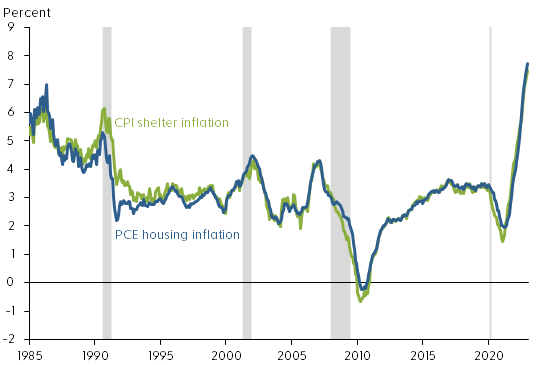
Rent inflation also accelerated during the pandemic period. Figure 1 shows that rent inflation—measured using 12-month changes in the PCE housing price index and including rents for tenant-occupied housing and imputed rents for owner-occupied housing—rose from a low point of about 2% in early 2021 to 7.7% by December 2022, the highest level since 1986. During the same period, rent inflation measured by 12-month changes in the shelter component of the consumer price index (CPI) experienced a similar increase. Thus, following the tightening of monetary policy, house price growth has slowed but rent inflation continues to rise.

Figure 1: PCE and CPI measures of rent inflation
Source: Bureau of Economic Analysis, Bureau of Labor Statistics, and Haver Analytics.
Note: Twelve-month percentage changes. Gray shading indicates NBER recession dates.

Economic theory suggests that some common forces such as changes in housing demand can drive both rents and house prices. For example, the expansion of remote work since the COVID-19 pandemic has increased demand for housing, raising both house prices and rents (Kmetz, Mondragon, and Wieland 2022). To the extent that the stream of current and future rents reflects the fundamental value of a house, house prices can be a leading indicator of future rent inflation (Lansing, Oliveira, and Shapiro 2022). Thus, monetary policy can affect both house prices and rents by cooling housing demand.

Housing demand responds to changes in financial conditions, such as increases in mortgage interest rates. However, theory suggests that house prices are more sensitive than rental prices to changes in financial conditions, because home purchases typically require longer-term mortgage financing. In addition, unlike rents, house prices can be partly driven by investor sentiments or beliefs, which explains the observed larger swings in house prices than in rents over business cycles (Dong et al. 2022). Long-term rental contracts can also contribute to slow adjustments in rent inflation.

Rent inflation is an important contributor to overall inflation because housing costs are an important component of total consumption expenditures. On average, housing expenditures represent about 15% of total PCE and 25% of the services component of PCE. In CPI, shelter costs represent an even larger share, accounting for about 30% of total consumption of all urban consumers and about 40% of core consumption expenditures excluding volatile food and energy components.

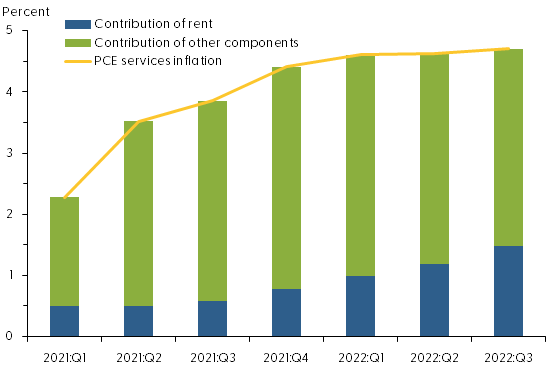
The contribution of rent inflation to overall PCE inflation has increased since early 2021. As Figure 2 shows, in the first quarter of 2021, rent inflation accounted for about 22% of the four-quarter change in the PCE services price index, excluding energy: 0.5 of the 2.3 percentage points increase in service prices was attributable to rent inflation. By the third quarter of 2022, the contribution of rent inflation had climbed to about one-third, or 1.5 of the 4.7 percentage point increase in service prices.

Figure 2: Rising contribution of rent inflation to services inflation
Source: Bureau of Economic Analysis, Haver Analytics, and authors’ calculations.
Note: Four-quarter changes in PCE services price index excluding energy.

Measuring policy effects

Given the rising contribution of rent inflation to overall inflation, it is important to assess the quantitative effects of monetary policy tightening on rent inflation.

For our analysis, we use a measure of monetary policy surprises constructed by Bauer and Swanson (2022). Their measure focuses on high-frequency changes in financial market indicators within a short period surrounding the Federal Open Market Committee (FOMC) policy announcements. If the public fully anticipates a policy change, then the financial market would not react to new policy announcements. However, if the market does react to an announcement, then the policy change must contain a surprise element. Thus, changes in financial market indicators, such as the price of Eurodollar futures, in a narrow window around an FOMC announcement can capture policy surprises. In practice, however, the data constructed this way are not complete surprises because they can be predicted by some macro and financial variables shortly before FOMC announcements. We follow the approach of Bauer and Swanson (2022) to purge the influences of those macro and financial variables from the measure of policy surprises. We use the resulting quarterly time series to measure monetary policy shocks, with a sample period from 1988 to 2019.

We then use a local projections model—a statistical tool proposed by Jordà (2005)—to project how rent inflation responds over time to a tightening of monetary policy equivalent to a 1 percentage point unanticipated increase in the federal funds rate in a given quarter. The model takes into account how monetary policy shocks interact with other macroeconomic variables, including lags of rent inflation, real GDP growth, and core PCE inflation.

In the final step, we compute the responses of rent inflation relative to its preshock level over a period up to 20 quarters after the initial increase in the federal funds rate.

Gradual impact of policy tightening on rent inflation

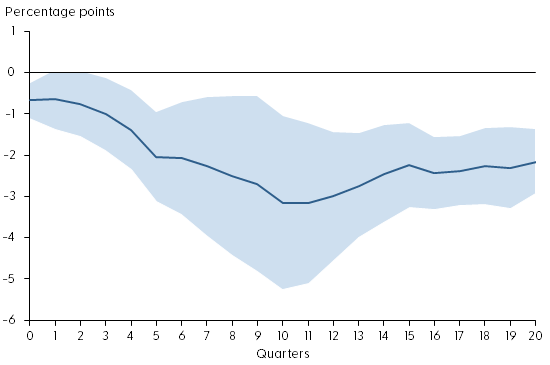
Figure 3 shows the response of rent inflation during the first 20 quarters after an unanticipated tightening of monetary policy (solid blue line). The shaded area shows the confidence band, indicating the statistical uncertainty in estimating the responses. Under the assumption that the model is correct, the shaded area contains the actual value of the rent inflation responses to the monetary policy shock roughly two-thirds of the time. The policy shock is normalized such that it is equivalent to a 1 percentage point unanticipated increase in the federal funds rate.

Figure 3: Response of rent inflation to monetary policy tightening
Source: Bureau of Economic Analysis, Bauer and Swanson (2022), and authors’ calculations.
Note: Response of rent inflation to a monetary policy shock equivalent to a 1 percentage point surprise increase in the federal funds rate. Shaded region shows 68% confidence band around the estimate.

The figure shows that monetary policy tightening has significant and gradual effects on rent inflation. On impact, a 1 percentage point increase in the federal funds rate reduces rent inflation about 0.6 percentage point relative to its preshock level. Over time, rent inflation declines gradually, falling about 3.2 percentage points in the 10 quarters following the impact. The slow adjustment in rent inflation partly reflects the stickiness in nominal rents due to long-term rental contracts. Since housing expenditures account for about 15% of total PCE, this estimate translates to a reduction in headline PCE inflation of about 0.5 percentage point, stemming from the decline in rent inflation over a period of 2½ years.

The rent component of PCE is measured based on average rents, including those locked in long-term rental contracts, which are slow to adjust to changes in economic and financial conditions. Rents on new leases, however, are more flexible. For example, the 12-month growth in Zillow’s observed rent index, which measures changes in asking rents on new leases, has slowed significantly since March 2022 (see Figure 4). Asking rents are typically a leading indicator of future average rents. Thus, the slowdown in asking rent growth could portend lower future rent inflation.

Figure 4: Year-over-year observed rent growth starting to slow
Source: Zillow and Haver Analytics.
Note: Twelve-month percentage changes in Zillow’s observed rent index. Gray shading indicates NBER recession dates.

Conclusion

Rents are an important component of consumer expenditures. Recent surges in rent inflation have led to concerns that overall inflation might stay persistently high despite tightening of monetary policy. We present evidence that monetary policy tightening is effective for reducing rent inflation, although the full impact takes time to materialize. A policy tightening equivalent to a 1 percentage point increase in the federal funds rate can reduce rent inflation up to 3.2 percentage points over the course of 2½ years. This translates to a maximum reduction in headline PCE inflation of about 0.5 percentage point over the same time horizon. Although average rents are slow to respond to policy changes, growth of asking rents on new leases has started to slow following recent monetary policy tightening. Our finding suggests that this tightening will gradually bring rent inflation down over time, thereby helping to reduce overall inflation.

Zheng Liu — Vice President and Director of the Center for Pacific Basin Studies, Economic Research Department, Federal Reserve Bank of San Francisco

Mollie Pepper — Research Associate, Economic Research Department, Federal Reserve Bank of San Francisco

[Archived PDF]

Federal Reserve Review of Monetary Policy Strategy, Tools, and Communications: Some Preliminary Views

(Speech by Governor Lael Brainard, at the Presentation of the 2019 William F. Butler Award New York Association for Business Economics, New York, New York)

It is a pleasure to be here with you. It is an honor to join the 45 outstanding economic researchers and practitioners who are past recipients of the William F. Butler Award. I want to express my deep appreciation to the New York Association for Business Economics (NYABE) and NYABE President Julia Coronado.

I will offer my preliminary views on the Federal Reserve’s review of its monetary policy strategy, tools, and communications after first touching briefly on the economic outlook. These remarks represent my own views. The framework review is ongoing and will extend into 2020, and no conclusions have been reached at this time.1

Outlook and Policy

There are good reasons to expect the economy to grow at a pace modestly above potential over the next year or so, supported by strong consumers and a healthy job market, despite persistent uncertainty about trade conflict and disappointing foreign growth. Recent data provide some reassurance that consumer spending continues to expand at a healthy pace despite some slowing in retail sales. Consumer sentiment remains solid, and the employment picture is positive. Housing seems to have turned a corner and is poised for growth following several weak quarters.

Business investment remains downbeat, restrained by weak growth abroad and trade conflict. But there is little sign so far that the softness in trade, manufacturing, and business investment is affecting consumer spending, and the effect on services has been limited.

Employment remains strong. The employment-to-population ratio for prime-age adults has moved up to its pre-recession peak, and the three-month moving average of the unemployment rate is near a 50-year low.2 Monthly job gains remain above the pace needed to absorb new entrants into the labor force despite some slowing since last year. And initial claims for unemployment insurance—a useful real-time indicator historically—remain very low despite some modest increases.

Data on inflation have come in about as I expected, on balance, in recent months. Inflation remains below the Federal Reserve’s 2 percent symmetric objective, which has been true for most of the past seven years. The price index for core personal consumption expenditures (PCE), which excludes food and energy prices and is a better indicator of future inflation than overall PCE prices, increased 1.7 percent over the 12 months through September.

Foreign growth remains subdued. While there are signs that the decline in euro-area manufacturing is stabilizing, the latest indicators on economic activity in China remain sluggish, and the news in Japan and in many emerging markets has been disappointing. Overall, it appears third-quarter foreign growth was weak, and the latest indicators point to little improvement in the fourth quarter.

More broadly, the balance of risks remains to the downside, although there has been some improvement in risk sentiment in recent weeks. The risk of a disorderly Brexit in the near future has declined significantly, and there is some hope that a U.S.China trade truce could avert additional tariffs. While risks remain, financial market indicators suggest market participants see a diminution in such risks, and probabilities of recessions from models using market data have declined.

The baseline is for continued moderate expansion, a strong labor market, and inflation moving gradually to our symmetric 2 percent objective. The Federal Open Market Committee (FOMC) has taken significant action to provide insurance against the risks associated with trade conflict and weak foreign growth against a backdrop of muted inflation. Since July, the Committee has lowered the target range for the federal funds rate by ¾ percentage point, to the current range of 1½ to 1¾ percent. It will take some time for the full effect of this accommodation to work its way through economic activity, the labor market, and inflation. I will be watching the data carefully for signs of a material change to the outlook that could prompt me to reassess the appropriate path of policy.

Review

The Federal Reserve is conducting a review of our monetary policy strategy, tools, and communications to make sure we are well positioned to advance our statutory goals of maximum employment and price stability.3 Three key features of today’s new normal call for a reassessment of our monetary policy strategy: the neutral rate is very low here and abroad, trend inflation is running below target, and the sensitivity of price inflation to resource utilization is very low.4

First, trend inflation is below target.5 Underlying trend inflation appears to be running a few tenths below the Committee’s symmetric 2 percent objective, according to various statistical filters. This raises the risk that households and businesses could come to expect inflation to run persistently below our target and change their behavior in a way that reinforces that expectation. Indeed, with inflation having fallen short of 2 percent for most of the past seven years, inflation expectations may have declined, as suggested by some survey-based measures of long-run inflation expectations and by market-based measures of inflation compensation.

Second, the sensitivity of price inflation to resource utilization is very low. This is what economists mean when they say that the Phillips curve is flat. A flat Phillips curve has the important advantage of allowing employment to continue expanding for longer without generating inflationary pressures, thereby providing greater opportunities to more people. But it also makes it harder to achieve our 2 percent inflation objective on a sustained basis when inflation expectations have drifted below 2 percent.

Third, the long-run neutral rate of interest is very low, which means that we are likely to see more frequent and prolonged episodes when the federal funds rate is stuck at its effective lower bound (ELB).6 The neutral rate is the level of the federal funds rate that would keep the economy at full employment and 2 percent inflation if no tailwinds or headwinds were buffeting the economy. A variety of forces have likely contributed to a decline in the neutral rate, including demographic trends in many large economies, some slowing in the rate of productivity growth, and increases in the demand for safe assets. When looking at the Federal Reserve’s Summary of Economic Projections (SEP), it is striking that the Committee’s median projection of the longer-run federal funds rate has moved down from 4¼ percent to 2½ percent over the past seven years.7 A similar decline can be seen among private forecasts.8 This decline means the conventional policy buffer is likely to be only about half of the 4½ to 5 percentage points by which the FOMC has typically cut the federal funds rate to counter recessionary pressures over the past five decades.

This large loss of policy space will tend to increase the frequency or length of periods when the policy rate is pinned at the ELB, unemployment is elevated, and inflation is below target.9 In turn, the experience of frequent or extended periods of low inflation at the ELB risks eroding inflation expectations and further compressing the conventional policy space. The risk is a downward spiral where conventional policy space gets compressed even further, the ELB binds even more frequently, and it becomes increasingly difficult to move inflation expectations and inflation back up to target. While consumers and businesses might see very low inflation as having benefits at the individual level, at the aggregate level, inflation that is too low can make it very challenging for monetary policy to cut the short-term nominal interest rate sufficiently to cushion the economy effectively.10

The experience of Japan and of the euro area more recently suggests that this risk is real. Indeed, the fact that Japan and the euro area are struggling with this challenging triad further complicates our task, because there are important potential spillovers from monetary policy in other major economies to our own economy through exchange rate and yield curve channels.11

In light of the likelihood of more frequent episodes at the ELB, our monetary policy review should advance two goals. First, monetary policy should achieve average inflation outcomes of 2 percent over time to re-anchor inflation expectations at our target. Second, we need to expand policy space to buffer the economy from adverse developments at the ELB.

Achieving the Inflation Target

The apparent slippage in trend inflation below our target calls for some adjustments to our monetary policy strategy and communications. In this context and as part of our review, my colleagues and I have been discussing how to better anchor inflation expectations firmly at our objective. In particular, it may be helpful to specify that policy aims to achieve inflation outcomes that average 2 percent over time or over the cycle. Given the persistent shortfall of inflation from its target over recent years, this would imply supporting inflation a bit above 2 percent for some time to compensate for the period of underperformance.

One class of strategies that has been proposed to address this issue are formal “makeup” rules that seek to compensate for past inflation deviations from target. For instance, under price-level targeting, policy seeks to stabilize the price level around a constant growth path that is consistent with the inflation objective.12 Under average inflation targeting, policy seeks to return the average of inflation to the target over some specified period.13

To be successful, formal makeup strategies require that financial market participants, households, and businesses understand in advance and believe, to some degree, that policy will compensate for past misses. I suspect policymakers would find communications to be quite challenging with rigid forms of makeup strategies, because of what have been called time-inconsistency problems. For example, if inflation has been running well below—or above—target for a sustained period, when the time arrives to maintain inflation commensurately above—or below—2 percent for the same amount of time, economic conditions will typically be inconsistent with implementing the promised action. Analysis also suggests it could take many years with a formal average inflation targeting framework to return inflation to target following an ELB episode, although this depends on difficult-to-assess modeling assumptions and the particulars of the strategy.14

Thus, while formal average inflation targeting rules have some attractive properties in theory, they could be challenging to implement in practice. I prefer a more flexible approach that would anchor inflation expectations at 2 percent by achieving inflation outcomes that average 2 percent over time or over the cycle. For instance, following five years when the public has observed inflation outcomes in the range of 1½ to 2 percent, to avoid a decline in expectations, the Committee would target inflation outcomes in a range of, say, 2 to 2½ percent for the subsequent five years to achieve inflation outcomes of 2 percent on average overall. Flexible inflation averaging could bring some of the benefits of a formal average inflation targeting rule, but it would be simpler to communicate. By committing to achieve inflation outcomes that average 2 percent over time, the Committee would make clear in advance that it would accommodate rather than offset modest upward pressures to inflation in what could be described as a process of opportunistic reflation.15

Policy at the ELB

Second, the Committee is examining what monetary policy tools are likely to be effective in providing accommodation when the federal funds rate is at the ELB.16 In my view, the review should make clear that the Committee will actively employ its full toolkit so that the ELB is not an impediment to providing accommodation in the face of significant economic disruptions.

The importance and challenge of providing accommodation when the policy rate reaches the ELB should not be understated. In my own experience on the international response to the financial crisis, I was struck that the ELB proved to be a severe impediment to the provision of policy accommodation initially. Once conventional policy reached the ELB, the long delays necessitated for policymakers in nearly every jurisdiction to develop consensus and take action on unconventional policy sapped confidence, tightened financial conditions, and weakened recovery. Economic conditions in the euro area and elsewhere suffered for longer than necessary in part because of the lengthy process of building agreement to act decisively with a broader set of tools.

Despite delays and uncertainties, the balance of evidence suggests forward guidance and balance sheet policies were effective in easing financial conditions and providing accommodation following the global financial crisis.17 Accordingly, these tools should remain part of the Committee’s toolkit. However, the quantitative asset purchase policies that were used following the crisis proved to be lumpy both to initiate at the ELB and to calibrate over the course of the recovery. This lumpiness tends to create discontinuities in the provision of accommodation that can be costly. To the extent that the public is uncertain about the conditions that might trigger asset purchases and how long the purchases would be sustained, it undercuts the efficacy of the policy. Similarly, significant frictions associated with the normalization process can arise as the end of the asset purchase program approaches.

For these reasons, I have been interested in exploring approaches that expand the space for targeting interest rates in a more continuous fashion as an extension of our conventional policy space and in a way that reinforces forward guidance on the policy rate.18 In particular, there may be advantages to an approach that caps interest rates on Treasury securities at the short-to-medium range of the maturity spectrum—yield curve caps—in tandem with forward guidance that conditions liftoff from the ELB on employment and inflation outcomes.

To be specific, once the policy rate declines to the ELB, this approach would smoothly move to capping interest rates on the short-to-medium segment of the yield curve. The yield curve ceilings would transmit additional accommodation through the longer rates that are relevant for households and businesses in a manner that is more continuous than quantitative asset purchases. Moreover, if the horizon on the interest rate caps is set so as to reinforce forward guidance on the policy rate, doing so would augment the credibility of the yield curve caps and thereby diminish concerns about an open-ended balance sheet commitment. In addition, once the targeted outcome is achieved, and the caps expire, any securities that were acquired under the program would roll off organically, unwinding the policy smoothly and predictably. This is important, as it could potentially avoid some of the tantrum dynamics that have led to premature steepening at the long end of the yield curve in several jurisdictions.

Forward guidance on the policy rate will also be important in providing accommodation at the ELB. As we saw in the United States at the end of 2015 and again toward the second half of 2016, there tends to be strong pressure to “normalize” or lift off from the ELB preemptively based on historical relationships between inflation and employment. A better alternative would have been to delay liftoff until we had achieved our targets. Indeed, recent research suggests that forward guidance that commits to delay the liftoff from the ELB until full employment and 2 percent inflation have been achieved on a sustained basis—say over the course of a year—could improve performance on our dual-mandate goals.19

To reinforce this commitment, the forward guidance on the policy rate could be implemented in tandem with yield curve caps. For example, as the federal funds rate approaches the ELB, the Committee could commit to refrain from lifting off the ELB until full employment and 2 percent inflation are sustained for a year. Based on its assessment of how long this is likely take, the Committee would then commit to capping rates out the yield curve for a period consistent with the expected horizon of the outcome-based forward guidance. If the outlook shifts materially, the Committee could reassess how long it will take to get inflation back to 2 percent and adjust policy accordingly. One benefit of this approach is that the forward guidance and the yield curve ceilings would reinforce each other.

The combination of a commitment to condition liftoff on the sustained achievement of our employment and inflation objectives with yield curve caps targeted at the same horizon has the potential to work well in many circumstances. For very severe recessions, such as the financial crisis, such an approach could be augmented with purchases of 10-year Treasury securities to provide further accommodation at the long end of the yield curve. Presumably, the requisite scale of such purchases—when combined with medium-term yield curve ceilings and forward guidance on the policy rate—would be relatively smaller than if the longer-term asset purchases were used alone.

Monetary Policy and Financial Stability

Before closing, it is important to recall another important lesson of the financial crisis: The stability of the financial system is important to the achievement of the statutory goals of full employment and 2 percent inflation. In that regard, the changes in the macroeconomic environment that underlie our monetary policy review may have some implications for financial stability. Historically, when the Phillips curve was steeper, inflation tended to rise as the economy heated up, which prompted the Federal Reserve to raise interest rates. In turn, the interest rate increases would have the effect of tightening financial conditions more broadly. With a flat Phillips curve, inflation does not rise as much as resource utilization tightens, and interest rates are less likely to rise to restrictive levels. The resulting lower-for-longer interest rates, along with sustained high rates of resource utilization, are conducive to increasing risk appetite, which could prompt reach-for-yield behavior and incentives to take on additional debt, leading to financial imbalances as an expansion extends.

To the extent that the combination of a low neutral rate, a flat Phillips curve, and low underlying inflation may lead financial stability risks to become more tightly linked to the business cycle, it would be preferable to use tools other than tightening monetary policy to temper the financial cycle. In particular, active use of macroprudential tools such as the countercyclical buffer is vital to enable monetary policy to stay focused on achieving maximum employment and average inflation of 2 percent on a sustained basis.

Conclusion

The Federal Reserve’s commitment to adapt our monetary policy strategy to changing circumstances has enabled us to support the U.S. economy throughout the expansion, which is now in its 11th year. In light of the decline in the neutral rate, low trend inflation, and low sensitivity of inflation to slack as well as the consequent greater frequency of the policy rate being at the effective lower bound, this is an important time to review our monetary policy strategy, tools, and communications in order to improve the achievement of our statutory goals. I have offered some preliminary thoughts on how we could bolster inflation expectations by achieving inflation outcomes of 2 percent on average over time and, when policy is constrained by the ELB, how we could combine forward guidance on the policy rate with caps on the short-to-medium segment of the yield curve to buffer the economy against adverse developments.


  1. I am grateful to Ivan Vidangos of the Federal Reserve Board for assistance in preparing this text. These remarks represent my own views, which do not necessarily represent those of the Federal Reserve Board or the Federal Open Market Committee. (return to text)
  2. Claudia Sahm shows that a ½ percentage point increase in the three-month moving average of the unemployment rate relative to the previous year’s low is a good real-time recession indicator. See Claudia Sahm (2019), “Direct Stimulus Payments to Individuals” [archived PDF], Policy Proposal, The Hamilton Project at the Brookings Institution (Washington: THP, May 16). (return to text)
  3. Information about the review of monetary policy strategy, tools, and communications is available on the Board’s website. Also see Richard H. Clarida (2019), “The Federal Reserve’s Review of Its Monetary Policy Strategy, Tools, and Communication Practices” [archived PDF], speech delivered at the 2019 U.S. Monetary Policy Forum, sponsored by the Initiative on Global Markets at the University of Chicago Booth School of Business, New York, February 22; and Jerome H. Powell (2019), “Monetary Policy: Normalization and the Road Ahead” [archived PDF] speech delivered at the 2019 SIEPR Economic Summit, Stanford Institute of Economic Policy Research, Stanford, Calif., March 8. (return to text)
  4. See Lael Brainard (2016), “The ‘New Normal’ and What It Means for Monetary Policy” [archived PDF] speech delivered at the Chicago Council on Global Affairs, Chicago, September 12. (return to text)
  5. See Lael Brainard (2017), “Understanding the Disconnect between Employment and Inflation with a Low Neutral Rate” [archived PDF], speech delivered at the Economic Club of New York, September 5; and James H. Stock and Mark W. Watson (2007), “Why Has U.S. Inflation Become Harder to Forecast?” [archived PDF], Journal of Money, Credit and Banking, vol. 39 (s1, February), pp. 3–33. (return to text)
  6. See Lael Brainard (2015), “Normalizing Monetary Policy When the Neutral Interest Rate Is Low” [archived PDF] speech delivered at the Stanford Institute for Economic Policy Research, Stanford, Calif., December 1. (return to text)
  7. The projection materials for the Federal Reserve’s SEP are available on the Board’s website. (return to text)
  8. For example, the Blue Chip Consensus long-run projection for the three-month Treasury bill has declined from 3.6 percent in October 2012 to 2.4 percent in October 2019. See Wolters Kluwer (2019), Blue Chip Economic Indicators, vol. 44 (October 10); and Wolters Kluwer (2012), Blue Chip Economic Indicators, vol. 37 (October 10). (return to text)
  9. See Michael Kiley and John Roberts (2017), “Monetary Policy in a Low Interest Rate World” [archived PDF], Brookings Papers on Economic Activity, Spring, pp. 317–72; Eric Swanson (2018), “The Federal Reserve Is Not Very Constrained by the Lower Bound on Nominal Interest Rates” [archived PDF] NBER Working Paper Series 25123 (Cambridge, Mass.: National Bureau of Economic Research, October); and Hess Chung, Etienne Gagnon, Taisuke Nakata, Matthias Paustian, Bernd Schlusche, James Trevino, Diego Vilán, and Wei Zheng (2019), “Monetary Policy Options at the Effective Lower Bound: Assessing the Federal Reserve’s Current Policy Toolkit” [archived PDF], Finance and Economics Discussion Series 2019-003 (Washington: Board of Governors of the Federal Reserve System, January). (return to text)
  10. The important observation that some consumers and businesses see low inflation as having benefits emerged from listening to a diverse range of perspectives, including representatives of consumer, labor, business, community, and other groups during the Fed Listens events; for details, see this page. (return to text)
  11. See Lael Brainard (2017), “Cross-Border Spillovers of Balance Sheet Normalization” [archived PDF] speech delivered at the National Bureau of Economic Research’s Monetary Economics Summer Institute, Cambridge, Mass., July 13. (return to text)
  12. See, for example, James Bullard (2018), “A Primer on Price Level Targeting in the U.S.” [archived PDF], a presentation before the CFA Society of St. Louis, St. Louis, Mo., January 10. (return to text)
  13. See, for example, Lars Svensson (2019), “Monetary Policy Strategies for the Federal Reserve” [archived PDF] presented at “Conference on Monetary Policy Strategy, Tools and Communication Practices,” sponsored by the Federal Reserve Bank of Chicago, Chicago, June 5. (return to text)
  14. See Board of Governors of the Federal Reserve System (2019), “Minutes of the Federal Open Market Committee, September 17–18, 2019,” press release, October 9; and David Reifschneider and David Wilcox (2019), “Average Inflation Targeting Would Be a Weak Tool for the Fed to Deal with Recession and Chronic Low Inflation” [archived PDF] Policy Brief PB19-16 (Washington: Peterson Institute for International Economics, November). (return to text)
  15. See Janice C. Eberly, James H. Stock, and Jonathan H. Wright (2019), “The Federal Reserve’s Current Framework for Monetary Policy: A Review and Assessment” [archived PDF] paper presented at “Conference on Monetary Policy Strategy, Tools and Communication Practices,” sponsored by the Federal Reserve Bank of Chicago, Chicago, June 4. (return to text)
  16. See Board of Governors of the Federal Reserve System (2019), “Minutes of the Federal Open Market Committee, July 31–August 1, 2018” [archived PDF] press release, August 1; and Board of Governors (2019), “Minutes of the Federal Open Market Committee, October 29–30, 2019” [archived PDF] press release, October 30. (return to text)
  17. For details on purchases of securities by the Federal Reserve, see this page. For a discussion of forward guidance, see this page. See, for example, Simon Gilchrist and Egon Zakrajšek (2013), “The Impact of the Federal Reserve’s Large-Scale Asset Purchase Programs on Corporate Credit Risk,” Journal of Money, Credit and Banking, vol. 45, (s2, December), pp. 29–57; Simon Gilchrist, David López-Salido, and Egon Zakrajšek (2015), “Monetary Policy and Real Borrowing Costs at the Zero Lower Bound,” American Economic Journal: Macroeconomics, vol. 7 (January), pp. 77–109; Jing Cynthia Wu and Fan Dora Xia (2016), “Measuring the Macroeconomic Impact of Monetary Policy at the Zero Lower Bound,” Journal of Money, Credit and Banking, vol. 48 (March–April), pp. 253–91; and Stefania D’Amico and Iryna Kaminska (2019), “Credit Easing versus Quantitative Easing: Evidence from Corporate and Government Bond Purchase Programs” [archived PDF], Bank of England Staff Working Paper Series 825 (London: Bank of England, September). (return to text)
  18. See Board of Governors of the Federal Reserve System (2010), “Strategies for Targeting Interest Rates Out the Yield Curve,” memorandum to the Federal Open Market Committee, October 13, available at this page; and Ben Bernanke (2016), “What Tools Does The Fed Have Left? Part 2: Targeting Longer-Term Interest Rates” [archived PDF] blog post, Brookings Institution, March 24. (return to text)
  19. See Ben Bernanke, Michael Kiley, and John Roberts (2019), “Monetary Policy Strategies for a Low-Rate Environment” [archived PDF], Finance and Economics Discussion Series 2019-009 (Washington: Board of Governors of the Federal Reserve System) and Chung and others, “Monetary Policy Options at the Effective Lower Bound,” in note 9. (return to text)