Being at Home in the World/Universe

The French philosopher Maurice Merleau-Ponty provided an introduction to the problem of being at home when he wrote:

“The world is not what I think, but what I live through. I am open to the world, I have no doubt that I am in communication with it, but I do not possess it; it is inexhaustible. ‘There is a world’, or rather: “There is the world’; I can never completely account for this ever-reiterated assertion in my life.”

Joseph J. Kockelmans (Editor), Phenomenology: The Philosophy of Edmund Husserl and Its Interpretation, Anchor Books Edition, 1967, page 369.

Remy C. Kwant, in his essay “Merleau-Ponty and Phenomenology”, commented:

For, according to him, the original lies buried in a dimension of darkness in such a way that it cannot be brought to light. Our existence is interwoven with the world, is a dialogue with the world. This dialogue reaches its most profound point there where the first and most original meaning arises, a meaning that is pre-conscious and pre-personal. Whatever is in our consciousness, whatever comes to light, becomes lucid, originates also in this darkness. As we have seen, man is able to obtain a measure of knowledge regarding this dark depth. He is able to divine something about the mysterious dialogue between the body-subject and the world. However, according to Merleau-Ponty, an absolute illumination of the phenomenal field is in principle impossible. All man can do is to erect some pointers in a darkness which resists full illumination.

Joseph J. Kockelmans (Editor), Phenomenology: The Philosophy of Edmund Husserl and Its Interpretation, Anchor Books Edition, 1967, page 390-391.

We sense that the interaction between ourselves and the world at every level may not be explainable. Therefore, we seek emotional or psychological shelter. The three levels of shelter are:

  1. hearth and home
  2. a sense of belonging
  3. gods

Think of the song, “A House Is Not a Home”, sung by Dionne Warwick. “A chair is still a chair / Even though there’s no one sitting thereBut a room is not a house
/ And a house is not a home
” depicts the human longing for shelter via hearth and home. The French philosopher Bruno Latour referred to this as a “parliament of things.”

Consider “Gimme Shelter” by The Rolling Stones, as well as the novel (and later film) The Sheltering Sky by Paul Bowles. Both of these cover the deep issue of shelter.

Heidegger’s essay “Building Dwelling Thinking” (German: Bauen Wohnen Denken) states:

In what follows we shall try to think about dwelling and building. This thinking about building does not presume to discover architectural ideas, let alone to give rules for building. This venture in thought does not view building as an art or as a technique of construction; rather it traces building back into that domain to which everything that is belongs. We ask:

  1.   What is it to dwell?
  2.   How does building belong to dwelling?
I

We attain to dwelling, so it seems, only by means of building. The latter, building, has the former, dwelling, as its goal. Still, not every building is a dwelling. Bridges and hangars, stadiums and power stations are buildings but not dwellings; railway stations and highways, dams and market halls are built, but they are not dwelling places. Even so, these buildings are in the domain of our dwelling. That domain extends over these buildings and yet is not limited to the dwelling place. The truck driver is at home on the highway, but he does not have his shelter there; the working woman is at home in the spinning mill, but does not have her dwelling place there; the chief engineer is at home in the power station, but he does not dwell there. These buildings house man. He inhabits them and yet does not dwell in them, when to dwell means merely that we take shelter in them. In today’s housing shortage even this much is reassuring and to the good; residential buildings do indeed provide shelter; today’s houses may even be well planned, easy to keep, attractively cheap, open to air, light, and sun, but—do the houses in themselves hold any guarantee that dwelling occurs in them? Yet those buildings that are not dwelling places remain in turn determined by dwelling insofar as they serve man’s dwelling. Thus dwelling would in any case be the end that presides over all building. Dwelling and building are related as end and means. However, as long as this is all we have in mind, we take dwelling and building as two separate activities, an idea that has something correct in it. Yet at the same time by the means-end schema we block our view of the essential relations. For building is not merely a means and a way toward dwelling—to build is in itself already to dwell. Who tells us this? Who gives us a standard at all by which we can take the measure of the nature of dwelling and building?

Martin Heidegger, Poetry, Language, Thought, (translated by Albert Hofstadter), Harper & Row, 1975, pages 145-146.

Stuart Kauffman comes at this from a different angle:

Who are we? Where did we come from? Why are we here? Did Neanderthal, Homo habilis, or Homo erectus ask? Around which fire in the past 3 million years of hominid evolution did these questions first arise? Who knows.

Somewhere along our path, paradise has been lost, lost to the Western mind, and in the spreading world civilization, lost to our collective mind. John Milton must have been the last superb poet of Western civilization who could have sought to justify the ways of God to man in those early years foreshadowing the modern era. Paradise has been lost, not to sin, but to science. Once, a scant few centuries ago, we of the West believed ourselves the chosen of God, made in his image, keeping his word in a creation wrought by his love for us. Now, only 400 years later, we find ourselves on a tiny planet, on the edge of a humdrum galaxy among billions like it scattered across vast megaparsecs, around the curvature of space-time back to the Big Bang. We are but accidents, we’re told. Purpose and value are ours alone to make. Without Satan and God, the universe now appears the neutral home of matter, dark and light, and is utterly indifferent. We bustle, but are no longer at home in the ancient sense.

Stuart Kauffman, At Home in the Universe: The Search for the Laws of Self-Organization and Complexity, Oxford University Press, 1995, page 4.

Kauffman comes to grips with this problem with the final line above. He continues:


In this new view of life, organisms are not merely tinkered-together contraptions, bricolage, in Jacob’s phrase. Evolution is not merely “chance caught on the wing,” in Monod’s evocative image. The history of life captures the natural order, on which selection is privileged to act. If this idea is true, many features of organisms are not merely historical accidents, but also reflections of the profound order that evolution has further molded. If true, we are at home in the universe in ways not imagined since Darwin stood natural theology on is head with his blind watchmaker.

Stuart Kauffman, At Home in the Universe: The Search for the Laws of Self-Organization and Complexity, Oxford University Press, 1995, pages 25-26.

Kauffman wants to complete the Darwinian revolution by adding self-organization and complexity to natural selection. In his vision, this will begin to produce a holistic picture of who we are. This will perhaps allow us to feel “We are all at home in the universe, poised to sanctify by our best, brief, only stay.” [page 30.]

Zooming out from this, we can see a meta-intelligent sense in which science believes it can convert mysteries into problems using math. In contrast to this, philosophers believe the opposite, that the problems are becoming more mysterious.
Digitizing Heritage: Exploring the Transformation of Culture to Data

[from India in Transition by the Center for the Advanced Study of India at the University of Pennsylvania, 1 September 2025]

by Krupa Rajangam & Deborah Sutton

“Oh that. We just took some undergraduate history students on board as interns. They provided the content and it was done.

The co-founder of a digital heritage initiative promoting interactive user interfaces offered these opening remarks. Speaking at a Delhi-based museum, he had been asked about the information provided to users as they moved their hands across an interactive board, revealing images and narratives relating to the Indian freedom movement. His response clarified that the physical and digital components of such installations—for example, the 3D-modeling software and hardware, scanning equipment and its resolution and the user interface—were more carefully designed and calibrated than the content they provided.

Contemporary cultural heritage (CH) is rife with digital innovation. The COVID pandemic accelerated this transformation as archivists and curators worked to develop content that would reach remote, locked-down audiences. Within significant limits, digital platforms can democratize and facilitate access to materials previously inaccessible. Instead of being physically siloed, digitized material—as data components and not just content on culture—can be reproduced, combined, and circulated infinitely to achieve a reach previously considered impossible. Accessibility and malleability remain one of the great boons of digital formats. But here, we consider the information economy of CH practice as it exists—and not its extraordinary and often hypothetical potential—in two, overlapping realms of digitized CH: for-profit business enterprises and academic side-hustles, related to more mainstream academic research.

In the former, questions of what is shared are often less significant than the appeal of the format. In the latter, innovation is often the result of short-term projects that languish, abandoned after project completion, and rarely find audiences. Our research builds on our individual experiences and the findings of a scoping exercise examining a number of India-based heritage projects conducted in 2021-22. It suggests the need for more careful consideration of the implications of transforming CH materials into forms of data; the change impacts everything from how we understand “originality” to the reliance on for-profit services to deliver heritage material to the public.

As digitized representations of CH and access to such formats become more widespread, are we, as CH practitioners and academics, giving enough thought to how digital technologies are reshaping the nature of CH and its audience? Beyond questions of wider reach, are we sufficiently acknowledging how these changes challenge a continued focus on originality and notions of academy as primary controllers of access to knowledge and its validity, both in research and practice?

Digitizing for Dissemination

In 2019, one of us—Deborah Sutton—developed a software platform, Safarnama, including an app and authored experiences around Delhi’s CH. The project subsequently extended to Karachi. Generating “original” content, such as audio-visual clips and old photos, to be hosted on the app platform, was key to its attractiveness and usefulness, but permissions proved tricky. Some collaborators who were initially keen to contribute content quietly withdrew, likely due to the unfamiliar format and unknown reach. The app format also raised other questions. Would incorporating content from non-digital but published scholarship require authorial permission or only acknowledgement?

In 2020, Krupa Rajangam held a sponsored incubation at the NSRCEL, a business incubator located at the Indian Institute of Management-Bangalore, to develop a web interface that would host geo-locationed stories of marginalized histories by drawing on both historical facts and lived experiences. Corporate mentors remained skeptical of her ability to source “original” content on an ongoing basis, i.e., content that was both authenticated and validated. They repeatedly advised her to focus on the format, user experience, and appeal for “mass markets” so her prototype would find audiences. Both projects equally raised questions over who would consume the content and what constitutes the public or audience.

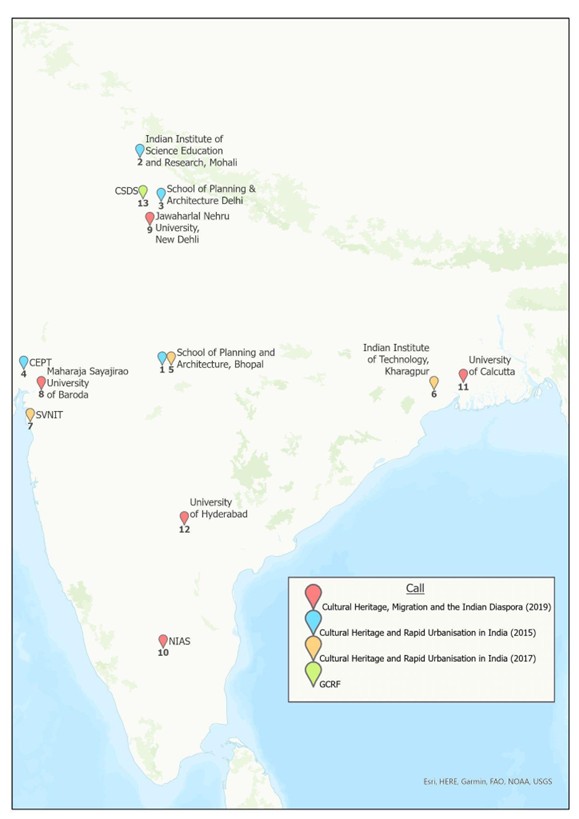
In a scoping exercise undertaken for the Arts and Humanities Research Council (AHRC), UK, in 2021-22, we explored a number of India-based heritage projects funded by the AHRC in partnership with the Newton Fund and Indian Council for Historical Research, since 2015 (figure 1). We were particularly interested in the digital components, which all projects included, even if only a website.

Our exploratory surveys firmly established the divergence in interpreting both CH and digital technologies, which was not surprising. Some projects defined and treated CH as fixed pre-existing material, to be interpreted and presented to audiences through digital technologies. Others re-framed digital formats of CH as components of data, assembling, manipulating, and representing extant archival and other materials. The rest generated digitized CH, effectively altering its nature. Typically, such projects dealt with more ephemeral or less conventional forms of CH.

Fundamental Transformations

Notions of originality remain central to art, architectural and art historical training, and CH practice. Digitization transforms the access and retrieval value of “original” material in physical archives, such as old maps and letters, much lauded in traditional “analog” scholarship, to use value as data. Once the end-user (audience) accesses this data (whether historical facts or stories), it becomes nothing more than bytes occupying valuable space, to be deleted once consumed rather than stored, making it easy to overlook or disregard the source and its context.

For example, in the Safarnama project, the app contained carefully collected and authenticated narratives on “partition memories” in Delhi and Karachi. However, the bite-sized media format meant that users would only explore content once, as snippets. This realization led the team to develop the software and incorporate the ability to download content, which at least meant that users could collect, organize and store (archive) the assembled media.

Digitization also takes away the materiality of the archive, making it more ephemeral. Non-digital materials through, and into which we render CH can (in endless combinations and cycles) be lost, forgotten, sold, recovered, collected, displayed, and stored. Such capacities of digital files are obvious, but maintaining access depends on varied and dynamic software ecologies for existence and sustained end-user access. Digital files created within one software-architecture can be incompatible with, and therefore rendered obsolete, by another. The ethos of software development is constant change.

In another paper, we examined questions of quantity, quality, and reusability of data related to digitization of building-crafts knowledge alongside CARE and FAIR principles of data management. The principles were proposed and adopted by an international consortium of scholars and industry, the former focused on responsible collection, use, and dissemination of data, especially related to vulnerable people and the latter on sustainable data management.

As an example, one AHRC project experimented with methods to capture detailed 3D images of heritage sites and structures in dynamic crowded environments. They used one set of methods to capture the interiors and another for the exteriors, hoping to merge both together and develop holistic imagery for audiences. This proved impossible at first due to issues of software compatibility. Once that was partially resolved, the new software couldn’t handle the sheer volume of data captured—and it was unclear where and for how long such volumes of data would be stored.

New realms of intellectual property remain fuzzy. While the content on digital platforms is governed by licensing and proprietary legal frameworks, it is often hosted on open platforms, through web repositories such as GitHub. Prima facie, such openness appears to challenge the proprietorial nature of archives and other repositories as keepers of knowledge. However, it raises a host of questions about how to maintain a critical understanding of archives.

Digitization may, and should, transform access but should it obliterate the regimes through which the materials were generated and organized and what’s included or excluded? For example, a local coordinator of one project that engaged with artists commented that digital technologies are typically used to document technical skills as forms of intangible heritage and develop artist encyclopedias, saying that “they are hardly used to interrogate the reality that many ‘traditional’ artists hail from marginalized castes.” Similarly, the local coordinator of another project that engaged with communities living in and around a protected heritage site commented on how digital technologies often end up being used to create a record of heritage structures without any reference to their day-to-day setting.

Any and all digital enterprise in CH, we argue, needs to integrate the ambition to use digital methods to not just present but also counter and interrogate the material, its creation, and purpose. Digital platforms and web- and app-based software are now able to manipulate and re-situate information in unprecedented ways. The novelty of such formats can displace original, provocative, and timely considerations of the material. Often, we are so taken by the visual and structural attributes of these formats, that we accept it at face value and lose sight of the tone and content of heritage as a curated message about the past and the present.

Alongside this, digital augmentations and iterations of CH, including storage, have significant financial and infrastructural implications. The creation and maintenance of digital platforms requires either developing “in-house” digital specialization or, more commonly, reliance on private, for-profit platforms. Paying for external provision introduces complexities. Funders, including the AHRC, struggle to devise guidance or policy in relation to software licensing. However, a persistent challenge to projects, and partnerships between academic and non-academic partners, is devising data and software strategies that subsist beyond the life of the funded-research project. Often, the adverse effects of the paucity of longer-term planning around IP issues, sustainability, and data archiving falls disproportionately on the non-academic stakeholder.

While digitization foregrounds the potential and promise of complete openness and equity, maybe this is lost in practice. Or digitization may merely mark the displacement of one set of ethics with another. There is a need for more careful consideration of the implications, complexities, and risks of taking CH materials out of boxes and off shelves and transforming and generating it into data files, which are, in turn, dependent on digital platforms to provide end-user access. However, the question remains of whether heritage-related disciplines are adequately prepared and willing to confront such new ways of working, which have begun to dislodge some of the privileges extant in current forms of research and practice.

Krupa Rajangam is nearing the end of her tenure as a Fulbright Fellow at the Historic Preservation Department, Weitzman School of Design, University of Pennsylvania. Her permanent designation is Founder-Director, Saythu…linking people and heritage, a professional conservation collective based in Bangalore, India.

Deborah Sutton is a Professor in Modern South Asian History at Lancaster University.

Why Is Technological History So Misleading?

We are conditioned to think of technological history in a very binary way. For thousands of years before motorized transportation, we think of horses and wind-powered ships. We also sense that if we brought great historical minds from before the industrial revolution to a modern city, most likely they would be stunned by the technology surrounding them. Think of a world of medical science before anesthesia and germ theory.

Let’s modify this binary view of human history. David F. Noble gives us a more accurate view:

Augustine, the chief author of Christian orthodoxy, wrote in The City of God, “there have been discovered and perfected, by the natural genius of man, innumerable arts and skills which minister not only to the necessities of life but also to human enjoyment.” Augustine recognized the “astonishing achievements” that had taken place in cloth-making, navigation, architecture, agriculture, ceramics, medicine, weaponry and fortification, animal husbandry, and food preparation; in mathematics, astronomy, and philosophy; as well as in language, writing, music, theater, painting, and sculpture. But he emphasized again that “in saying this, of course, I am thinking only of the nature of the human mind as a glory of this mortal life, not of faith and the way of truth that leads to eternal life… And, remember, all these favors taken together are but the fragmentary solace allowed us in a life condemned to misery.”5

5 St. Augustine, The City of God (Garden City, N.Y.: Doubleday, 1958), pp. 526, 527.

David F. Noble, The Religion of Technology: The Divinity of Man and the Spirit of Invention, Penguin Books, 1999 (originally 1997), pages 11-12.

Note that Augustine wrote The City of God in 426 AD, meaning that even 1600 years ago, they had already made colossal advances. The prejudice that we have, given our scientific training, is utterly misleading. Rather than being blinded by Biblical explanations of how the world came to be, Augustine lauded these scientific advancements. We think of Thomas Edison and the lightbulb, rather than, “Let there be light.”

There are various levels of empirical and artisanal knowledge. In cooking, we rarely worry about molecules that make up ingredients. All these daily life pillars Augustine lists cannot be overlooked, even as we unlock the submicroscopic world of quantum mechanics.

Two Kinds of Extra Understanding: Pre and Post

We argue here in this proposal for an educational remedy that two dimensions of understanding must be added to “retro-fit” education.

In the first addition, call it pre-understanding, a student is given an overview not only of the field but of his or her life as well as the “techno-commercial” environment that characterizes the globe.

Pre-understanding includes such “overall cautions” offered to you by Calderón de la Barca’s 17th century classic Spanish play, Life is a Dream (SpanishLa vida es sueño). A student would perhaps ask: “what would it be like if I faced this “dreamlike quality” of life, as shown by the Spanish play, and suddenly realized that a life of “perfect myopia” is not what I want.

Hannah Arendt warns similarly of a life “like a leaf in the whirlwind of time.”

Again, I, the student ask: do I want such a Hannah Arendt-type leaf-in-the-whirlwind-like life, buried further under Calderón de la Barca’s “dream state”?

But that’s not all: while I’m learning about these “life dangers,” all around me from my block to the whole world, humanity does its “techno-commerce” via container ships and robots, hundreds of millions of vehicles and smartphones, multilateral exchange rates, and tariff policies. Real understanding has one eye on the personal and the other on the impersonal and not one or the other.

All of these personal and impersonal layers of the full truth must be faced and followed, “en face,” as they say in French (i.e., “without blinking”).

Call all this pre-understanding which includes of course a sense of how my “field” or major or concentration fits into the “architecture of knowledge” and not in isolation without connections or a “ramification structure.”

Post-understanding comes from the other end: my lifelong effort, after just about all that I learned about the six wives of King Henry VIII and the “mean value theorem”/Rolle’s theorem in freshman math, have been completely forgotten and have utterly evaporated in my mind, to re-understand my life and times and book-learning.

Pre-and post-understanding together allows the Wittgenstein phenomenon of “light falls gradually over the whole.”

Without these deeper dimensions of educational remedy, the student as a person would mostly stumble from “pillar to post” with “perfect myopia.” Education mostly adds to all the “fragmentariness” of the modern world and is in that sense, incomplete or even disorienting.

Education in this deep sense is supposed to be the antidote to this overall sense of modern “shapelessness,” to use Kierkegaard’s term.

“Nervous Breakdowns” for Countries or Regions?

Hannah Arendt who became world famous with her Eichmann in Jerusalem 1960s book, says in her essays that Europe in the twentieth century was determined by a kind of national “nervous breakdown” in and centered on Germany.

If we allow for the fact that this is a “façon de parler” (way of expressing something) and not a rigorous comparison (a country is not one person writ large) Arendt’s figure of speech is suggestive and evocative.

Here’s an example. In 1919, Walter Gropius (died in 1969) gave a speech to students of his “Bauhaus” school, which sounds like a person picking up on a kind of national nervous breakdown:

First of all, Walter Adolph Georg Gropius was a German architect and founder of the Bauhaus School, who, along with Alvar Aalto, Ludwig Mies van der Rohe, Le Corbusier and Frank Lloyd Wright, is widely regarded as one of the pioneering masters of modernist architecture. He is a founder of Bauhaus in Weimar.

Gropius says (July 1919, speech to Bauhaus students):

“We find ourselves in a tremendous catastrophe of world history, a transformation of the whole of life and the whole of inner man.
We now have to forget the time before the war, which was totally different.

The more quickly we adapt to the new changed world, to its new, if austere beauties, the sooner the individual will be able to find his subjective happiness.
We will be more spiritual and profound as a result of the German distress.
As the economic opportunities sink, the spiritual ones have already risen enormously.”

(quoted in German Expressionism, University of California Press, 1990, edited by Rose-Carol Washton Long, page 250, “July 1919 Gropius speech to Bauhaus students”).

We are reminded of Kierkegaard’s (died in 1855) anatomy of the kinds of human despair in his The Sickness unto Death.

The Gropius despair is a bit different because it mirrors a real or imagined German national catastrophe which is folded into a “catastrophe of world history.”

World War I and its aftermath loom as a kind of infinite “desolation row” for Gropius and we cannot judge what percentage of the despair is German and what percentage has to do with Gropius’s subjective state of mind.

In any case, we do have the sense of a “nervous breakdown” atmosphere, nationally and personally.

Might we also wonder if Anglo-America is flirting with such a “nervous breakdown” in 2019?

Education and the Question of Fecklessness

We propose in Meta Intelligence an education that is completely global and cosmopolitan from Day 1.

The problem with education as a confusing area of activity is revealed to us in an episode of the great Japanese novel, The Makioka Sisters.

The Makioka Sisters (細雪 [Sasameyuki], “Light Snow”) is a novel by Japanese writer Jun’ichirō Tanizaki (died in 1965) that was serialized from 1943 to 1948. It follows the lives of the wealthy Makioka family of Osaka from the autumn of 1936 to April 1941, focusing on the family’s attempts to find a husband for the third sister, Yukiko.

In the novel, there’s a description of a “failed educational odyssey:”

“Mimaki was an old court family. The present viscount, the son, was well along in years. Mimaki Minoru, son by a concubine, was a graduate of the Peers School and had studied physics at the Imperial University, which he left to go to France.  In Paris he studied painting for a time, and French cooking for a time, and numerous other things, none for very long.

“Going on to America, he studied aeronautics in a not-too-famous state university, and he did finally take a degree, it seemed.

“After graduation, he continued to wander about the United States, and on to Mexico and South America. With his allowance from home cut off in the course of these wanderings, he made a living as a cook and even as a bellboy. He also returned to painting and even tried his hand at architecture.

“Following his whims and relying on his undeniable cleverness, he tried everything. He abandoned aeronautics when he left school.”

(The Makioka Sisters, Vintage Books, 1985, Seidensticker translation, page 473-474)

This person winds up dabbling in architecture after his return to Japan.

This episode in Tanizaki’s great novel gives us a “flashlight” or “searchlight” into the whole problem of educational confusion.  Is this simply a case of one person’s “fecklessness?”  Is this just a case of what’s called “failure to launch” (see the movie by this name)?

Or is it partly perhaps that education as a “lockstep system” of schools, exams, courses, semesters, quizzes and grades is very “inhospitable” to “searchers?”

If we call everyone who “stumbles around” a dilettante and a feckless failure, we might be unnecessarily “binary,” exclusionary and unaware of the problem of “cold educational ecosystems” which punish exploring for those who are not “born specialists.”  Winners and losers are too polarized as an educational judgment, perhaps.

The classic German novel about youthful confusions is Fontane’s classic Irrungen, Wirrungen (Trials and Tribulations, 1888) and perhaps an argument could be made that the coldly “binary view” of “successes” versus “the feckless” causes the loss of many young people who had various kinds of emotional resistance to education as an “Olympics” of sorts, with “winners and losers.”  This might be seen as a kind of overly narrow kind of “edu-brutality” which is intolerant of more difficult adjustment stories for young people, which are not uncommon.

Movies as an Off-Campus “Open University:” Antonioni’s La Notte (The Night, 1961)

Michelangelo Antonioni was an Italian film director, screenwriter, editor, painter, and short story author.  

Antonioni died on July 30, 2007 (aged 94) in Rome, the same day that another renowned film director, Ingmar Bergman, also died.

He is best known for his “trilogy on modernity and its discontents”—L’AvventuraLa Notte, and L’Eclisse from the early sixties.

One “hidden pillar” of the world Antonioni depicts in his movies is that “you are what you read.” This gives the viewer a “meta-intelligent” (latent overview signal) handle on the world being depicted:

In La Notte of 1961, Antonioni starts with an image of the Pirelli Tower in Milano, the most famous skyscraper of its time in Italy. In contrast to the impressiveness of the building, the characters in his movies are trying to “navigate” boredom and the enveloping sense of ennui.

One of the characters in the movie is said to be reading the masterpiece by Herman Broch, The Slkeepwalkers:

The Sleepwalkers (original title Die Schlafwandler), is a 1930s novel in three parts, by the Austrian novelist and essayist Hermann Broch

Opening in 1888, the first part is built around a young Prussian army officer; the second in 1903 around a Luxembourger bookkeeper; and the third in 1918 around an Alsatian wine dealer.  Each is in a sense a sleepwalker, living between vanishing and emerging ethical systems just as the somnambulist exists in a state between sleeping and waking.  Together they present a panorama of German society and its progressive deterioration of values that culminated in defeat and collapse at the end of World War I.

Antonioni implies the characters he depicts are a new version of “sleepwalker.”

When the movie starts, the characters played by Marcello Mastroianni and Jeanne Moreau visit a friend in the hospital who mentions his new work on Adorno.  Adorno (1903-1969) was a German-Jewish theoretician who wants to understand how the world has gone off the rails leading to WWII and the death factories of the Nazis.  He argues that this is connected (paradoxically) to the relentless rationality of “The Enlightenment” and works in a “dialectical” way (i.e., something becomes its opposite).

In the movie, there’s a scene where the author played by Mastroianni is at a book talk concerning his new book.

In other words, the world Antonioni is depicting, a kind of “odyssey” of ennui made confusing by gleaming architecture such as the Pirelli Tower of Nervi (built from 1955-1958) shown in the opening shot of the movie.

The books mentioned in the movie confirm the director’s “you are what you read” motif.

The recent book: The Sleepwalkers: How Europe Went to War in 1914 by Christopher Clark is consistent with this sense of things.