Japan-Watching: Still Dreaming: Kon Satoshi’s “Paprika” and Other Visions

by Miyamoto Yūko [宮本 裕子]
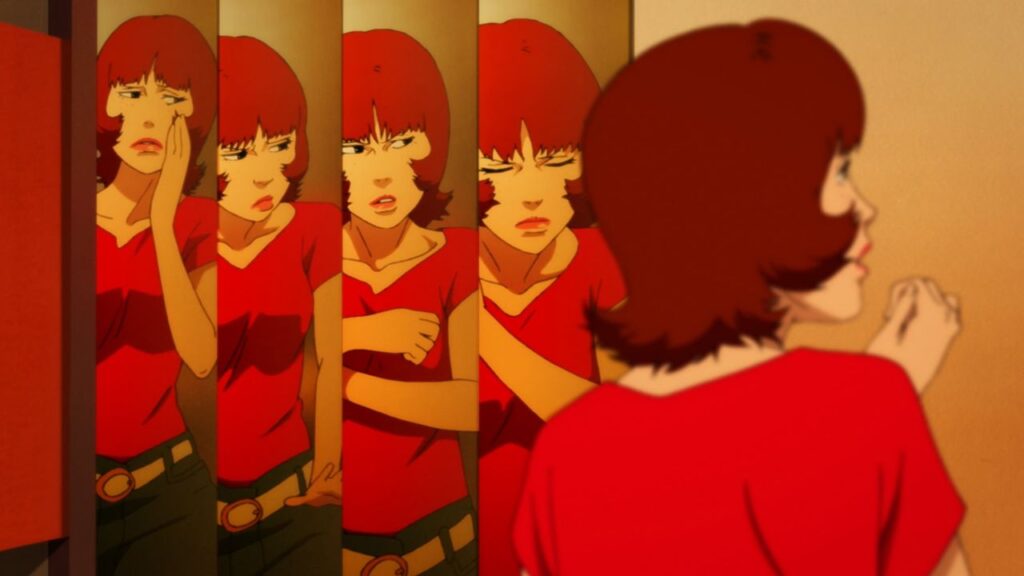
Anime (アニメ) director KON Satoshi (今 敏) died in 2010 at the age of 46, but his works remain highly influential. His final film Paprika, released 20 years ago, highlights his preoccupations with the divided self and the blurring of the lines between dreams and reality.

Dream Analysis

After starting out as a manga artist in 1985, KON Satoshi [今 敏] honed his skills in the anime production teams of OSHII Mamoru [押井 守] and ŌTOMO Katsuhiro [大友 克洋], and then made his feature-length direction debut with Perfect Blue, which was released in Japan in 1998. His fourth feature, the 2006 Paprika, is an adaptation of the novel of the same name by TSUTSUI Yasutaka [筒井 康隆]. Kon was public in his admiration of the book and he is said to have aimed to produce “something like the novel Paprika” in his previous anime. Indeed, Kon’s Paprika adaptation has many factors in common with his earlier works.

KON Satoshi [今 敏]

KON Satoshi [今 敏] in Venice in September 2006, when Paprika was showing in competition at the Venice International Film Festival. (© Reuters)

Tsutsui studied psychology at university, and motifs and ideas from Freudian and Jungian psychoanalysis feature regularly in his novels. Dream analysis plays a central role in the story in Paprika. In psychoanalysis, psychologically repressed material is thought to be banished to the unconscious before emerging in a different form in dreams. Analysis of dreams has been seen as a valuable way of resolving psychological problems by bringing the repressed matter into the open.

Paprika is set in a near-future Japan, where it is possible to monitor other people’s dreams on a screen. The main character is a therapist called Chiba Atsuko, who provides treatment via her alter ego Paprika, a dream detective. The technology is abused, however, forcing people to experience nightmares, and eventually these flood into the real world.

While Kon follows the broad outline of the original work, his adaptation incorporates numerous changes. The biggest of these is the chaotic parade of electronic goodsbeckoning cats (“maneki-neko” [招き猫]), Buddhist statues, torii gates [鳥居], and other marching objects. This symbolizes nightmares spilling out of control, but there is nothing like it in Tsutsui’s book. Kon explained that the parade is made up of old-fashioned appliances and forgotten religious and traditional elements.

In Freud’s The Uncanny, he describes the titular subject as something familiar that has been estranged through repression. In the film, the members of the parade have become estranged from the conscious minds of people today, but are resurrected, and symbolize the uncanny nature of nightmares.


The parade that invades the dreams of patients. (© 2006 Madhouse/Sony Pictures Entertainment Japan, Inc.)

Integrating the Self

Alongside its Freudian elements, Kon’s Paprika shows Jungian influences. Carl Jung did not think that it was best to bring repressed aspects of the psyche under control, instead emphasizing the importance of integrating them into the self. This integration process can be seen in several of the characters.

While Konakawa, a character suffering from anxiety issues, searches through his dreams together with Paprika, he realizes that a mysterious person he repeatedly encounters is an old friend with whom he once shared the ambition of becoming a film director. This friend, who died of illness, appears in Konakawa’s dreams as his other self—the one who wanted to be a director. Konakawa overcomes his anxiety by recognizing and reconciliating with the repressed and forgotten self, represented by his old friend.

The division and antagonism between Chiba Atsuko and her alter ego Paprika are similar to those seen between Konakawa and his old friend. In the original book, Paprika was Chiba in disguise as a dream detective, but in Kon’s anime, they are like entirely different characters. In the finale, when dreams are flooding into the real world, they divide completely, existing at the same time in the same space. After this split, Chiba comes together again temporarily with the uninhibited Paprika when she no longer holds back her suppressed love for her colleague Tokita Kōsaku.
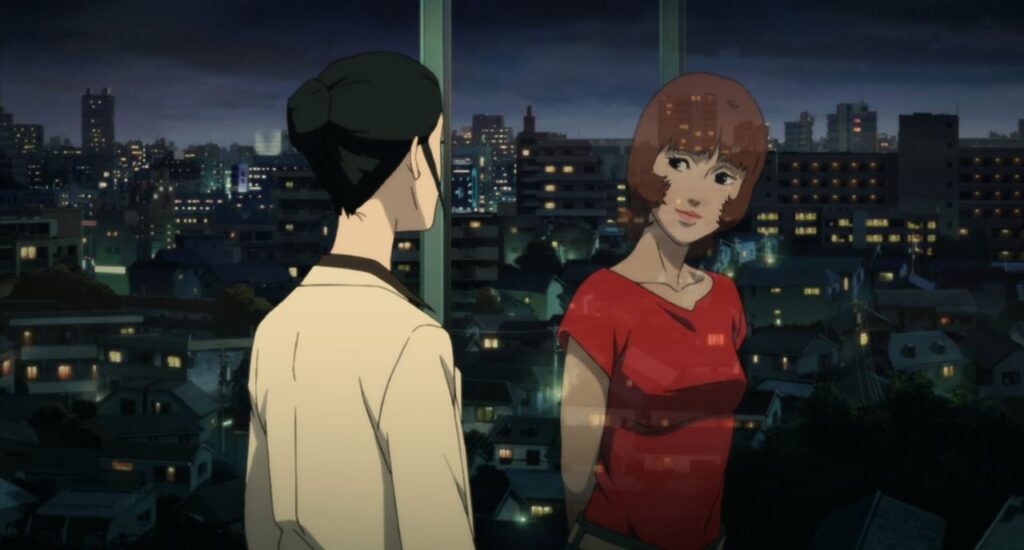
Chiba Atsuko with her divided self Paprika reflected in the glass. (© 2006 Madhouse/Sony Pictures Entertainment Japan, Inc.)

Chiba and Paprika do not divide in Tsutsui’s novel, and Konakawa’s old friend does not represent another self. This aspect of the divided self, added by Kon during the adaptation process, can be taken as a Jungian motif.

Books by the late KAWAI Hayao [河合 隼雄], renowned as a Jungian psychologist, were widely read in Japan from the 1980s until the 1990s, and Kon was among his readers. He is said to have become an avid reader of the psychologist for a time because he wanted to understand the music and lyrics of HIRASAWA Susumu (平沢 進), the former vocalist of the techno-pop band P-Model, who was influenced by Kawai. Hirasawa later created soundtracks for anime by Kon, including Paprika.

Kon also stated that he was influenced by the novels of MURAKAMI Haruki (村上 春樹), who himself developed a friendly relationship with Kawai through interviews and other encounters. Kon is said to have claimed that he was the only person who could adapt A Wild Sheep Chase [羊をめぐる冒険] and The Wind-Up Bird Chronicle [ねじまき鳥クロニクル] to anime.

Kon’s Themes

The anime Paprika could be seen as a later stage in the Kawai-led Jungian psychology boom in Japan, as well as a culmination of Kon’s characteristic themes. For example, the following aspects regularly appear in Kon’s work.

First, there is the depiction of another self. These include Chiba and Paprika in Paprika, Chiyoko and the old woman who appears at key moments and symbolizes Chiyoko’s future self in Millennium Actress (2002), and idol-turned-actress Mima and the apparition of her former pop star self in Perfect Blue.

Second, there are departures from heterosexual norms. In Paprika, the title character announces the wedding of Tokita and Chiba, which maintains the existence of this free-spirited “dream detective,” so that the film deviates subtly from the typical closed ending of heterosexual marriage. The ending of Millennium Actress suggests that Chiyoko’s long search for an artist she meets in her youth is her goal in itself, rather than a romantic relationship with him. In Tokyo Godfathers [東京ゴッドファーザーズ] (2003), alongside a caricatured depiction of a transgender character, we see the struggles of heterosexual couples and their families.

The third aspect is how media and technology blur the lines between reality and the unreal world. In Paprika, the DC Mini device erodes the boundary between reality and the dreams it is used to view, while Mima’s double in Perfect Blue appears in mirrors, PC monitors, and internet browsers. In Millennium Actress, Chiyoko’s acting roles are intertwined with her real life. In Kon’s anime series Paranoia Agent [妄想代理人] (2004), rumors transform into reality through the actions of the mass media and the characters, who in themselves are a kind of media commodity.

During a scene in Paprika when Konakawa goes to the movie theater, posters for Kon’s other films are on display. This shot shows Millennium Actress and Perfect Blue. (© 2006 Madhouse/Sony Pictures Entertainment Japan, Inc.)

Robot Adventure?

While there are clearly repeating themes in Kon’s works, Dreaming Machine [夢みる機械], which remains unfinished due to his sudden death from cancer, shows signs of an apparent major change of course. At one point it was announced that another director would complete the movie, but the producer later backtracked, saying that there was no director capable of realizing Kon’s vision.

Based on the remaining materials, this appeared set to be an action-adventure story about robots hunting down precious electricity in a near-future setting when humans are extinct. Paprika was also set in the near future, but Dreaming Machine features more overtly futuristic urban landscapes. The main characters are smaller, cartoonish robots, compared with the relatively tall humans of Kon’s other films. While it seems to have been aiming for a different kind of movie in terms of both content and visuals, was this really going to be a standard adventure story, without any twists?

Kon said that one of his influences was the manga [漫画] creator MOROHOSHI Daijirō (諸星 大二郎). In a short 1974 work by Morohoshi, also called “Dreaming Machine” (“Yume miru kikai [夢みる機械]”), robots go about their daily lives in the place of humans, who dream in a form of suspended animation. Kon’s unpublished 1984 manga Toriko covered similar ground. Can it be simple coincidence that his unfinished work has the same title as Morohoshi’s manga?

Beyond what looks on the surface like a robot action adventure, in Dreaming Machine,  Kon may have planned to depict a world of cryofrozen, dreaming humans. Or perhaps the robots were intended to be controlled consciously or subconsciously by humans. This is pure speculation, but I cannot help thinking that Kon may have intended to continue his theme of technology blurring the boundaries between dreams, or fantasy, and reality.

Some people may consider it unproductive to imagine what Kon’s works may have been, but this imaginative act helps carry his vision forward. Kon’s direct and indirect influence can be found in films like Darren Aronofsky’s Requiem for a Dream (2000) and Black Swan (2010), Christopher Nolan’s Inception (2010), and Edgar Wright’s Last Night in Soho (2021). While we will never see another KON Satoshi (今 敏) film, his vision lives on.

(Originally published in Japanese on July 10, 2026. Banner image from Paprika; © 2006 Madhouse/Sony Pictures Entertainment Japan, Inc.)

Japan-Watching: Economics in the Age of AI

A Thought Experiment Envisioning A “Fully Automated Society”

from REITI, by IKEUCHI Kenta [池内 健太], Senior Fellow (Policy Economist)

In a world where human labor has become unnecessary because of AI, what should be the focus of the study of economics? In the future, if AI and robots have become capable of producing all goods and services necessary for our society, what kind of economic problems could remain?

Of course, a fully automated society is not predicted for the near future. This article imagines such an extreme type of society as a thought experiment designed to consider economic systems in the age of AI. Here, a fully automated society refers not only to one in which corporate production is automated, but also to one in which the legislative, administrative, and judicial functions of government are substantially supported—and in some cases automated—by AI.

I started thinking about this matter when I heard from a researcher acquaintance that a paper concerning AI’s impact on employment had caused quite a stir on X, and I decided to read it out of curiosity. The paper discussed the possibility that AI-driven job cuts could reduce workers’ incomes, weaken consumer demand, and ultimately backfire on firms themselves (Falk and Tsoukalas 2026). Companies may earn higher profits in the short term by taking advantage of AI to cut back on personnel costs. However, if most companies follow that same approach, overall market demand would weaken because workers are also consumers.

The purpose of this article is not to question the validity of that paper’s argument. Rather, the focus is on what economic problems would remain in a future society if AI not only partially replaces human labor but also produces most goods and services.

Scarcity Will Continue to Be a Problem

There has already been extensive research regarding the impact of AI on employment. For example, Acemoğlu and Restrepo (2019) argued that while automation may replace existing human jobs, it may also create new ones. Moreover, the possibility that technological advances could free humans from labor and greatly alleviate economic problems was discussed long ago by Keynes (1930).

If AI and robots become capable of producing goods and services on a sufficiently large scale, would economic problems disappear? That would not necessarily be the case. Even in a fully automated society, scarce resources such as land, location, natural environments, energy, and rare metals will remain limited. Moreover, social status, influence, and political decision-making power are deeply connected to human intentions and perception, and cannot simply be delegated to AI. More land will not become available simply because more people wish to live in convenient urban locations. Quiet natural environments, advanced healthcare resources, social attention, and political influence also cannot be maximized for everyone at the same time.

Therefore, even in a fully automated society, some economic problems will remain. However, the main focus will shift from the “problem of insufficient ordinary commodities” to “how to allocate fundamentally scarce resources.” As production capacity increases, the value of true scarcity only becomes clearer.

In that case, the roles of markets and prices will still exist. Prices are not merely figures that allow for corporate earnings; they convey information about which resources are scarce and to what extent, how much demand there is for those resources, and what supply constraints there are. That perspective connects to a classic argument made by Hayek (1945), who argued that prices function as a mechanism through which dispersed information can be aggregated.

However, if AI becomes deeply integrated into the market, the concept of price itself may change. At present, prices serve as one-dimensional signals representing the levels of various factors, such as scarcity, quality, demand, supply, environmental impact, and future risks, expressed in terms of a single metric, that is, monetary value. If AI agents become capable of processing large volumes of information on behalf of consumers and companies, it is possible that multi-dimensional market signals that convey information concerning all those various factors, including quality, environmental impact, congestion, delivery time, reliability and social impact may come into use. Narita (2025) also discussed the possibility that the roles of money and prices may change, with more diverse evaluation standards becoming involved in economic coordination.

For People to Enjoy Affluence

In a fully automated society, how people participate in the market and society will become more important than ever. If the premise that people earn income through labor becomes obsolete, it will be necessary to develop a mechanism whereby purchasing power is distributed to everyone. In this context, universal basic income (UBI) may be reframed not only as relief for the unemployed, but as a form of fundamental purchasing power used by people to express their preferences. Managi [馬奈木 俊介] (2025) also pointed out that governance over the equitable distribution of the benefits of AI is essential.

Moreover, UBI may not be limited to simple monetary payments. In the future, UBI may take the form of a system combining other benefits as well, including energy use quotas, rights of access to basic healthcare services and education, and rights to refuse or control the use of personal data. In a fully automated society, UBI would therefore be a matter not only of how much to provide, but also of what kinds of access to guarantee and over what time horizon.

Another important issue is whether it is appropriate to treat people merely as consumers. In a fully automated society, the need for people to work for a living may diminish. However, even without such a necessity, humans will likely still possess the desire to create or to be creative. It is human nature to try new things and to try to surprise or impress other people. The spirit of fun and curiosity, a desire for self-expression, an inquisitive mind, and an appetite for challenges are deeply and fundamentally connected to human nature. Therefore, when designing a future UBI system, it will be important to treat people not merely as consumers but as agents who can participate in creation and exploration.

Additionally, the question of who owns and controls AI systems, robots, foundation models, and computing infrastructure is also a major issue. Even if a certain level of income is distributed to everyone, there may remain a power gap between those who control AI systems and robots and those who merely have access to them, in place of the income gap that currently exists in society.

All of the above-mentioned points for debate are relevant to the study of economics. How scarce resources should be allocated, how to guarantee people’s range of choices, and how to design ownership and controlling rights are problems central to economics. A fully automated society is not a near-future prediction. However, this extreme thought experiment serves as a useful guide for considering economic systems in the age of AI. Economics in the age of AI is not about discarding the intellectual legacy of economics, but about inheriting it and extending it toward a new society.

References

June 12, 2026

Two Kinds of Extra Understanding: Pre and Post

We argue here in this proposal for an educational remedy that two dimensions of understanding must be added to “retro-fit” education.

In the first addition, call it pre-understanding, a student is given an overview not only of the field but of his or her life as well as the “techno-commercial” environment that characterizes the globe.

Pre-understanding includes such “overall cautions” offered to you by Calderón de la Barca’s 17th century classic Spanish play, Life is a Dream (SpanishLa vida es sueño). A student would perhaps ask: “what would it be like if I faced this “dreamlike quality” of life, as shown by the Spanish play, and suddenly realized that a life of “perfect myopia” is not what I want.

Hannah Arendt warns similarly of a life “like a leaf in the whirlwind of time.”

Again, I, the student ask: do I want such a Hannah Arendt-type leaf-in-the-whirlwind-like life, buried further under Calderón de la Barca’s “dream state”?

But that’s not all: while I’m learning about these “life dangers,” all around me from my block to the whole world, humanity does its “techno-commerce” via container ships and robots, hundreds of millions of vehicles and smartphones, multilateral exchange rates, and tariff policies. Real understanding has one eye on the personal and the other on the impersonal and not one or the other.

All of these personal and impersonal layers of the full truth must be faced and followed, “en face,” as they say in French (i.e., “without blinking”).

Call all this pre-understanding which includes of course a sense of how my “field” or major or concentration fits into the “architecture of knowledge” and not in isolation without connections or a “ramification structure.”

Post-understanding comes from the other end: my lifelong effort, after just about all that I learned about the six wives of King Henry VIII and the “mean value theorem”/Rolle’s theorem in freshman math, have been completely forgotten and have utterly evaporated in my mind, to re-understand my life and times and book-learning.

Pre-and post-understanding together allows the Wittgenstein phenomenon of “light falls gradually over the whole.”

Without these deeper dimensions of educational remedy, the student as a person would mostly stumble from “pillar to post” with “perfect myopia.” Education mostly adds to all the “fragmentariness” of the modern world and is in that sense, incomplete or even disorienting.

Education in this deep sense is supposed to be the antidote to this overall sense of modern “shapelessness,” to use Kierkegaard’s term.