Skip to content
Meta Intelligence

Meta Intelligence

Towards a Composite Understanding of Education

  • About
  • Contact

Tag: credit risk

Economic-Watching: Center for Global Development: Weekly Development Update

The EU as a Global Actor

Kicking off a new CGD series of policy proposals to inform the European Union’s upcoming development agenda, Mikaela Gavas and W. Gyude Moore suggest a reset of the EU’s international relations narrative. Explore their ideas for how the EU can position itself as a global development player while staying true to its values and focusing on the common good.

Read the full article [archived PDF].

Is There Any Hope for Bipartisan Cooperation on Aid in 2025?

by Charles Kenny, July 15, 2024 (CGD Blog Post)

The gap between parties on international economic policy is often smaller than the gap between consensus positions over time. While the Biden administration has introduced migrant-supporting measures including relief for the undocumented spouses of citizens and community sponsorship of refugees, both parties are far tougher on asylum seekers than Obama or Bush were. Back in the 1990s, President Bill Clinton signed NAFTA, which made it through Congress relying on considerable Republican support. Today, President Trump’s trade war with China has been expanded by President Biden and the tariffs first imposed by President Trump are openly backed by many Congressional Democrats. Again, there is now strong bipartisan agreement that a considerable focus of US overseas investment support ought to be countering China, with Democratic appointees leading the charge for greater flexibility in the US International Development Finance Corporation’s development mandate set during the last Republican administration.

The same applies to aid flows. The figure below shows data on total aid disbursements from the US depending on who is in power: the solid blue line is Democratic control of the presidency and both branches of Congress, the blue dashed line is Democratic control of the presidency and one or neither branch, the solid red line is Republican control of the presidency and both chambers, and the red dashed line is control of the presidency and one or neither chamber. There’s only one data point for each year, of course, but the lines connect between them. The broad picture strongly suggests the trend matters more than who is in power (indeed, remember the Surprise Party?).

Figure 1: US aid disbursements by party control (Current $m)
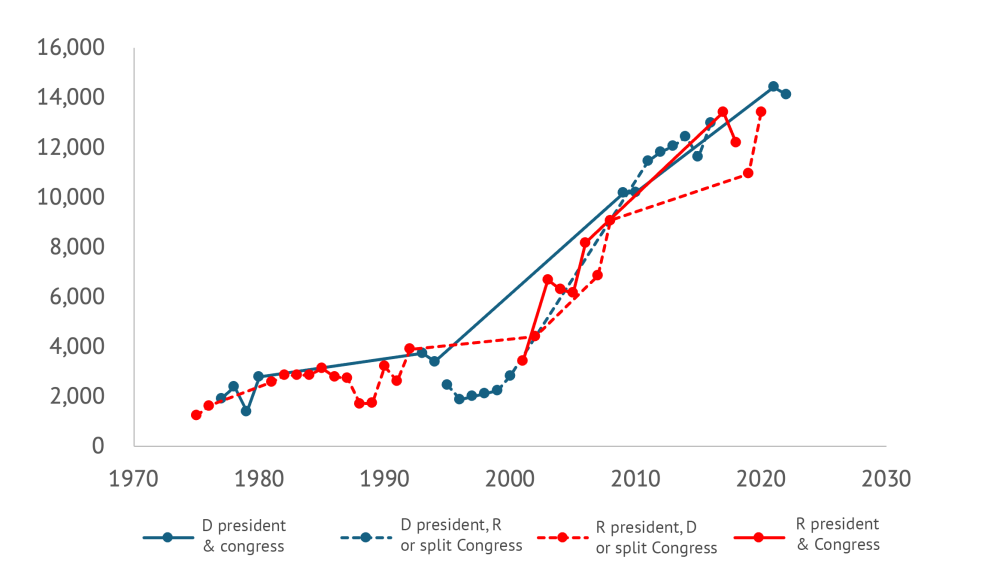
The potential good news from this is that despite substantive disagreements over topics including the Mexico City Policy, bipartisan cooperation on aid might still be more possible than it might appear from a close-up perspective in the midst of partisan rancor. To repeat the bad news: much of the recent bipartisan movement on foreign economic policy has been to the detriment of developing countries. And there is certainly some talk of sweeping changes, including cuts, that might mean the past is no guide. But perhaps there still space for elements of a positive agenda around aid for the legislative sessions of next year, one that could appeal to at least some people on both sides of the aisle. Examples might include:

Advancing localization: Spending more US aid finance in recipient countries rather than on US contractors has been a hallmark of Samantha Power’s tenure at USAID. But it has Republican antecedents. The Trump administration followed a localization strategy for PEPFAR that significantly increased the number of local partners and a New Partnerships Initiative at USAID designed in part to do the same. And in 2021, US Senators Marco Rubio (R–FL) and Tim Kaine (D–VA) introduced legislation to reduce red tape for local organizations seeking USAID funds. It would be great to see further cooperation on ensuring more development dollars are actually spent in developing countries.

Country focus: All else even somewhat equal, a dollar of foreign assistance simply has a larger impact in poorer countries. The logic that richer countries should be able to look after themselves was a justification for the Trump administration’s “Journey to Self-Reliance”—a philosophy dedicated toward “ending the need for aid.” The Biden administration has continued to produce the “country roadmaps” designed to chart the journey. It would be great to see bipartisan efforts to focus grant resources in particular where they’ll have the greatest impact—in the poorest countries.

Sovereign lending and guarantees: While grants should be focused on poorer countries, loans could be an effective and comparatively low-cost tool to support wealthier countries. The recently passed Ukraine aid package provided resources in the form of partially forgivable loans, and senior Republicans have been pushing the model more widely. More lending and guarantees could be a powerful tool to support infrastructure rollout in middle-income countries. And strengthening the US sovereign loan guarantee program could back development and national security goals at a considerably lower cost than grant-based programs.

MCC reform: The Millennium Challenge Corporation, created during the George W. Bush administration, is running into pipeline challenges—and appropriators have clawed back funding in response. That’s a shame. It is a small but effective aid agency providing resources for development priorities including infrastructure and working with client countries to help them deliver—in fact, it’s a model of successful localization. MCC faces spending challenges in part because it hasn’t increased the size of individual country operations, limits repeat operations, and can only work in countries that pass its “scorecard” of development indicators. The agency wants to address its partner problem by working in richer countries. That’s a sad way to achieve impact and goes against the bipartisan principle that richer developing countries should be weaned off aid flows, not given more. Altering the size of compacts, allowing more repeat compacts, and moving away from a scorecard model towards a model of reward for reform—a specific set of policy changes that need to be completed before funds start flowing—would be a far more effective approach.

Fighting malaria: In the 1958 State of the Union, President Eisenhower said that the US would lead a global effort to eradicate malaria. The time and the tools were not right then, but today there is far greater hope for rapid progress against the disease. George Bush created the President’s Malaria Initiative in 2005, and the US has been a vital contributor to the global fight against the parasite since then. With the arrival of new vaccines in the past couple of years, we could accelerate progress and save hundreds of thousands of children’s lives each year. And with better vaccines, we could move even faster. PEPFAR, the US initiative to provide HIV drugs, has transformed the battle against AIDS worldwide. A similar bipartisan initiative could achieve as much with malaria.

Transparency: Both parties have shown commitment to increasing the transparency of aid finance including around subawards and indirect cost rate data. It would be great if there was a bipartisan consensus on simply publishing all aid contracts.

Beyond aid, the African Growth and Opportunity Act was first passed during the Clinton administration, renewed during the Bush administration and then again under the Obama administration. A bipartisan proposal to renew the trade package once more was launched in the Senate in April this year. Perhaps AGOA could be made even bigger and better. Even amidst partisan rancor, there is plenty a Congress and administration could do to improve US relations with and support to low- and middle-income countries next year.

Undoing Gender Inequality Traps in the Financial Sector: The Case of Colombia

by Mayra Buvinic and Alba Loureiro, July 9, 2024 (CGD Blog Post)

Gender data is needed to gauge the extent to which financial services include and benefit women. However, sex-disaggregated data that tracks access to and use of financial services is still hard to come by, and it is especially rare to have country-level data that captures the universe of financial sector providers (FSPs) and is published on a regular basis.

A notable exception is Colombia, where Banca de Oportunidades (BdO), a public sector technical assistance and advocacy platform, compiles in a centralized data platform anonymized data from all FSPs in partnership with Colombia’s Superintendency of Banks. The 2023 edition, the 13th annual publication, reports on 15 million transactions, 60 percent of them monetary, from the universe of banks, credit and savings cooperatives, microfinance institutions, and fintechs. The report tells a sobering story worth highlighting of the trajectory of women’s financial inclusion because it mirrors much of what we know [archived PDF] about the constraints women face having access to financial services in low- and middle-income countries. The report’s numbers [archived PDF] suggest that:

Expanding access is not enough

Despite almost universal access to financial products, gender gaps persist. In 2023, 19 out of every 20 adult Colombians (or 94.6 percent) reported access to at least one financial product or service. However, women faced less favorable conditions (see below), underscoring that mere access is insufficient.

Gender gaps are evident in both savings and credit 

In 2023, women had 6.5 and 3.7 percentage points (pp) lower access to savings and credit, respectively, than men. While women’s access to savings increased over time–from 75 percent in 2018 to 90.4 percent in 2023–the gender gap widened (from 4.3 pp to 6.5 pp). In the same period, the gender gap in credit narrowed slightly (from 4.8 pp to 3.7 pp) but both men’s and women’s access to credit decreased–for women from 37.7 percent in 2018 to 33.4 percent in 2023. 

Women face access to credit in less favorable conditions than men 

Interest rates are higher for women clients across all loan types, and highest for microcredit–with a 5.4 percent gender gap–which women access more than men. In 2023, women accessed 1,029 million and men accessed 857,000 microcredit loans. More men than women accessed commercial loans (20,000 versus 14,000 loans) while housing loans went equally to women and men. 

Paradoxically, these less favorable conditions coexist with women exhibiting lower credit risks than men

Women have better repayment rates than men across loan types (Figure 1). Women also perform better across insurance products, except for microinsurance, showing lower accident rates. However, female clients have 13.8 pp lower access to insurance products than men. 

Figure 1: Total Repayment Rates, Overdue More Than 30 Days.
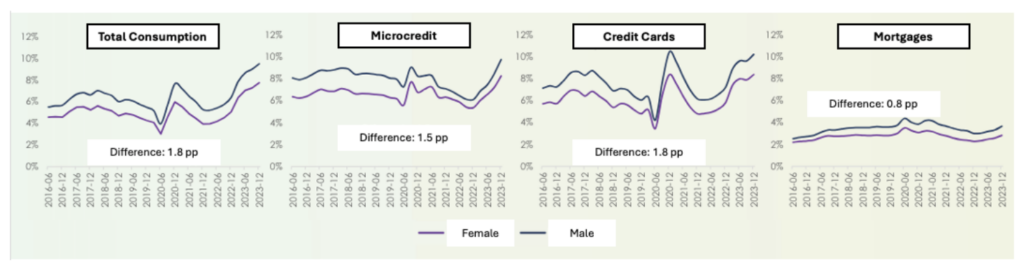
Source: The graphic was extracted from the Financial Inclusion PowerPoint (Paola Arias and Jaime Rodriguez, 4 June, 2024) [archived PDF], and the labels were translated from Spanish.

The data implies that women’s good financial behavior is penalized rather than prized, with higher interest rates and lower access to financial products 

This is partly the result of gender biases that affect both the demand and supply of credit and lead to rationing credit to women.

Rationing credit and other financial services to women perpetuates ‘gender inequality traps’ leading to further rationing  

It all starts with women having fewer assets to use as collateral and lower earnings than men (a commonplace fact across financial markets everywhere) which leads them to qualify for smaller loans. In turn, this results in women having less access to credit to increase earnings because of the high costs to lenders of serving customers with small loans, resulting in even lower earnings.

Gender biases that affect the supply and demand for credit reinforce this vicious cycle 

Results from five clever experiments in Colombia done by BdO in collaboration with the Development Bank of Latin America and the Caribbean (CAF) suggest how easily these gender biases reinforce each other:

  1. On the supply side, there are cognitive and perceptual biases (the latter detected by eye-tracking) from financial sector providers–male potential borrowers are ‘ex-ante’ perceived as having higher earnings than similar women. And female bank agents are stricter at evaluating female clients than male clients.
  2. On the demand side, the incorrect assumption that women are higher credit risks than men is reinforced by female clients’ own lower self-confidence and greater self-exclusion from financial services: women do not apply for credit because they anticipate they will be rejected because they have lower earnings. 

Not surprisingly perhaps, women in Colombia score lower than men in a financial health indicator–with an average score of 4.9 for women and 5.6 for men measured in a 0 to10 scale (scored by BdO using data from the 2022 edition of the survey).

To overcome these gender inequality traps, only a combination of strategies will work

Solutions must address both demand– and supply-side constraints and include:

  • Expand access to financial services to all by lowering the costs of serving small and micro borrowers, including women–as a recently announced collaboration between the Bill and Melinda Gates Foundation, the European Investment Bank, and KCB Bank Kenya seeks to pilot in Kenya by lowering the costs of loans to female micro borrowers through digital technology and data, and risk-sharing.
  • Increase women’s self-confidence and combat their self-exclusion from financial services with credit ‘plus’ interventions that include ‘soft skills’ training.
  • Provide customized products that fit women’s needs, including importantly insurance and microinsurance that respond to women’s greater need for mitigating (family) risks.
  • Combat supply-side biases that lead to inefficiencies and exclusions, including incentives to financial sector providers to reach women with financial services.
  • For the above, collect and publish gender data, but data that does not end up sitting on a shelf gathering dust; data that instead is used to make management decisions, which underscores the role of public sector institutions such as BdO in collaborating with and incentivizing financial sector providers, and in measuring, tracking, and reporting progress in financial inclusion.

Fortunately, there is a growing wealth of research that backs up the solutions suggested above. But there is still an important practical research agenda ahead:

  • First is reaching the poorest and excluded with financial services that they may need.  In the case of Colombia, this includes indigenous and Afro-descendent populations in geographically distant regions of the country. This requires building further granularity in the financial inclusion data, following guidelines of intersectionality data in development.
  • There is substantial research on demand-side constraints in women’s access to financial services.  There is comparatively little research on supply-side gender biases and solutions to these biases that can be scaled.
  • Lastly, there is the task of developing financial health indicators that can be easily and widely used disaggregated by gender and other demographic features to monitor an important development outcome from increasing financial access to all.

Disclaimer

CGD blog posts reflect the views of the authors, drawing on prior research and experience in their areas of expertise. CGD is a nonpartisan, independent organization and does not take institutional positions.

Author David ClarkPosted on July 16, 2024July 25, 2025Categories Economics, Essays, World WatchingTags 1958 State of the Union Address, African diaspora, African Growth and Opportunity Act, aid, asset, asylum seeker, bank, Barack Obama, Bill & Melinda Gates Foundation, Bill Clinton, CAF – Development Bank of Latin America and the Caribbean, Center for Global Development, citizenship, collateral (finance), Colombia, cooperative banking, credit, credit risk, customer, demand, Democratic Party (United States), developing country, Dwight D. Eisenhower, economic indicator, economic policy, European Investment Bank, European Union, financial market, financial services, fintech, Florida, foreign direct investment, George W. Bush, HIV, HIV/AIDS, insurance, international development, KCB Bank Kenya Limited, Kenya, loan, malaria, Marco Rubio, Mexico City policy, microcredit, microfinance, microinsurance, migrant worker, Millennium Challenge Corporation, mortgage loan, North American Free Trade Agreement, Presidency of Donald Trump, Presidency of George W. Bush, Presidency of Joe Biden, President of the United States, President's Emergency Plan for AIDS Relief, President's Malaria Initiative, public sector, refugee, Republican Party (United States), Samantha Power, savings account, sexism, supply (economics), supply and demand, Tim Kaine, trade, trade war, transparency (behavior), U.S. International Development Finance Corporation, Ukraine, United States, United States Senate, Virginia

Economics—Atlanta Fed’s November Notes from the Vault

Financial System of the Future

Notes from the Vault
Larry D. Wall
November 2019

The financial services business is an information technology business that operates in an environment with substantial government involvement. The state of both technology and government intervention have evolved considerably since the financial crisis that began in 2007, with potentially large implications for the future financial system. With that in mind, the Atlanta Fed recently hosted the workshop Financial System of the Future, which was cosponsored by the Center for the Economic Analysis of Risk (CEAR) at Georgia State University.

This post reviews many of the papers and presentations from the workshop dealing with both financial regulation and innovations in financial technology. It also reviews one of the keynote speeches on the important topic of corporate governance. A companion macroblog post summarizes the workshop’s discussion of digital currencies.

Post-crisis changes in regulation

Some banks had difficulty obtaining adequate funding from private financial markets during the crisis of 2007–08, despite being well capitalized by that period’s capital standards. In part, these funding difficulties were a result of bank depositors fearing that banks had not adequately provisioned for their credit losses.

A paper by University of Michigan professors Thomas Flanagan and Amiyatosh Purnanandam examines the question “Why Do Banks Hide Losses?” [PDF] with a particular focus on the role of shareholder monitoring and management incentives. One problem in conducting such a study is that of separating bad investment decisions from deceptive accounting. This paper exploits an unexpected change in regulation in India to help provide such separation. This regulatory change forced all of the banks in that country to detail the extent of their underreporting of loan losses in 2015. The paper finds that weaker shareholder monitoring and higher-power executive compensation contracts are associated with more underreporting of loan losses.1 This paper helps us to understand how banks exploit accounting discretion over loan losses and reinforces the importance of supervisory oversight.

The funding problems encountered by U.S. banks led to runs and ultimately the collapse of a few banks, but these problems had a significant effect on the operations of some banks that survived. One measure of the vulnerability of a bank to a funding shock was its reliance on uninsured, wholesale deposits from large institutions. Professors Sudheer Chava of Georgia Institute of Technology, Rohan Ganduri of Emory University, Linghang Zeng of Babson College, and graduate student Nikhil Paradkar of Georgia Tech examine one effect of these shocks in their paper “Shocked by Bank Funding Shocks: Evidence from 500 Million Consumer Credit Cards” [PDF]. The paper finds that banks that were more exposed to wholesale funding shocks made larger cuts in consumer credit lines than other banks. The authors further find that these cutbacks were made to the most credit-constrained customers (those with lower credit scores and higher utilization of their credit line). The results also suggest that these credit-constrained consumers responded by cutting back their consumption. Overall, these results provide additional support for regulatory policies intended to strengthen banks so that they can continue lending through future crises.

The Federal Reserve was created in 1913 in large part to provide a source of liquidity during periods of stress in bank lending markets. Yet banks proved surprisingly resistant to borrowing from the Fed’s discount window at the start of the funding problems in the fall of 2007. In an attempt to overcome this reluctance to borrow, the Fed created the Term Auction Facility (TAF) in December 2007. A paper by professors Yunzhi Hu of the University of North Carolina at Chapel Hill and Hanzhe Zhang from Michigan State University examines the TAF in a paper titled “Overcoming Borrowing Stigma: The Design of Lending-of-Last-Resort Policies” [PDF]. This paper develops a simple model in which TAF funding is preferred by stronger banks because the funds are only available with a delay (that is, the funds will not help a bank facing an immediate run) and because TAF gives stronger banks the potential to borrow at lower costs. The paper also provides evidence that when both the discount window and TAF were available, the weakest banks borrowed from the discount window and the relatively stronger banks bid for TAF funds. The results of this study may help to inform the Fed’s policies on the provision of emergency liquidity in the future.

In the post-crisis period, the bank supervisors agreed to adopt new liquidity rules and strengthen existing capital requirements at the Basel Committee on Banking Supervision. A paper by Harvard University professor Daniel Roberts and Federal Reserve Bank of New York economists Asani Sarkar and Or Shachar examines the Basel liquidity requirements in the paper “Bank Liquidity Creation, Systemic Risk, and Basel Liquidity Regulations” [PDF]. The paper finds that the new regulation has the cost of reducing bank liquidity creation in normal times but also results in more resilient banks in a crisis. The authors estimate both the costs and benefits of the regulation and find that the benefits in terms of a more stable financial system exceed the costs of the reduction in liquidity.

Josef Schroth, an economist at the Bank of Canada, analyzes the question of how regulators could use capital regulation to smooth bank lending through a recession and financial crisis in his paper “Macroprudential Policy with Capital Buffers” [PDF]. Banks in his model hold sufficient capital in most periods but have insufficient capital to retain uninsured market funding during crises, which leads to severe credit crunches. Bank regulators can smooth lending by requiring banks to hold more capital during good times, also allowing banks to operate with reduced capital during a crisis and rebuild their capital gradually after a crisis. The paper’s findings are consistent with the Basel III’s creation of a capital conservation buffer and countercyclical capital buffer.

Issues related to bank capital have been the subject of ongoing discussion among academics, bankers, and regulators since the crisis. Bank of Finland economists Gene Ambrocio and Esa Jokivuolle, along with professors Iftekhar Hasan from Fordham University and Kim Ristolainen from the University of Turku, surveyed the views of banking and finance academics and reported the results in the paper “Are Bank Capital Requirements Optimally Set? Evidence from Researchers’ Views” [PDF] (slide deck [PDF]). The survey obtained results from 149 leading academic researchers. It found that most respondents believe that higher capital ratios would reduce the likelihood of a crisis and the social costs associated with a crisis. Most respondents thought an increase of 5 percentage points in capital would increase the average cost of capital and reduce bank lending. However, a majority said that this reduction in lending would result in “minimal to no change” in economic activity.

Fintech lending

Banks have historically been important suppliers of credit to consumers and small businesses. However, since the crisis, lending by some fintech firms to these borrowers has grown rapidly. The conference addressed a variety of questions such as the sources of competitive advantage to fintech lenders; competition between fintech lenders, small banks, and large banks; and the impact of fintech lending on consumers. Additionally, the conference looked at post-crisis changes in bank securitization rules, which may have some relevance to fintech lenders’ efforts to fund their loans.

Banks, especially large banks, have long used statistical analysis to help them predict the credit riskiness of consumers and small businesses. However, fintech firms have promoted their use of machine learning techniques as resulting in better credit analysis. Economist J. Christina Wang and former research associate Charles B. Perkins from the Federal Reserve Bank of Boston explore the value added of some machine learning techniques in their paper “How Magic a Bullet Is Machine Learning for Credit Analysis? An Exploration with Fintech Lending Data” [PDF]. In particular, they examine the contribution of tree-based models using data from LendingClub, a fintech lender. Tree-based models provide easily understood decision rules that are valuable for demonstrating compliance with U.S. fair lending rules. The results indicate that tree-based machine learning improves prediction accuracy, in part by uncovering notable interactive effects. These models benefit from additional data (albeit only up to about 5,000 observations) and from the addition of more predictors. However, exactly which tree-based approach worked best varied across different subgroups of consumers.

Many large banks retreated from some types of retail and small business lending. In part, this pullback was likely to due to a combination of the increased riskiness of these loans and the tightening of bank capital requirements. However, fintech lenders have been expanding into some of the same spaces, raising the question of whether the reduced lending by big banks was due in part to competitive pressure from fintech firms. It also raises the question of whether smaller banks were also retreating due to increased competition or expanding to help fill the void left by the larger banks. Two papers examine the rise of fintechs in two different lending markets and analyze what developments in these markets tell us about big versus small banks.

Professors Taylor Begley from Washington University in St. Louis and Kandarp Srinivasan from Northeastern University focus on mortgage market lending in their paper “Small Bank Lending in the Era of Fintech and Shadow Banking: A Sideshow?” [PDF]. Their paper observes that fintech lenders rely largely on government-supported loan securitization programs such as those of Fannie Mae, Freddie Mac, and the Federal Housing Administration. However, not all mortgage loans qualify for these programs in large part due to limits on the maximum size of the loan. Thus, fintech mortgage lenders were able to take nationwide market share in government-supported loans from the large banks. Nevertheless, it was the small banks that stepped in to provide mortgage loans that did not qualify for government-supported securitization. As a result, small banks have proven more responsive to the withdrawal of bigger banks and have maintained nearly constant market share through the period from 2009 to 2013.

The paper “What Is Fueling the Fintech Lending Revolution? Local Banking Market Structure and Fintech Market Penetration” [PDF] by professor Tetyana Balyuk of Emory University and professors Allen N. Berger and John Hackney from the University of South Carolina studies the rise of fintech lenders in small business lending. The authors find that fintech lenders’ market penetration is associated with lower small bank market shares, consistent with the decline of small banks over time and helping to explain fintech lenders’ success. They also find evidence that small banks tend to make safer loans than fintech firms. Finally, looking at the contribution of different lenders to employment, the authors find that fintech matters most for the smallest businesses, small banks matter more for larger small businesses, and neither matters for large businesses.

As fintech lending has grown, the question of whether it is good for consumers has also arisen. This may be a trick question. We have long known that if people are given a choice, some will use it wisely and others will not. Last year’s CEAR–CenFIS conference provided some evidence of how consumers manage their finances after borrowing from fintech lenders (see “Winners and Losers of Marketplace Lending: Evidence From Borrower Credit Dynamics” [PDF] and “The Real Effects of Financial Technology: Marketplace Lending and Personal Bankruptcy” [PDF]). This year, Federal Reserve Board economists Traci Mach and Timothy Dore provided additional evidence in the paper “Marketplace Lending and Consumer Credit Outcomes: Evidence from Prosper” [PDF]. The authors were able to match application data from one lender to credit bureau data. They find that relative to applicants without an origination, borrowers see an increase in their credit scores and total debt, but decreases in their delinquency rates. The increase in mortgage debt balances was especially notable.

An important issue for any type of lender is its access to funding. Banks fund their loans with a combination: (a) their own liabilities in the form of deposits and other market borrowings and (b) loan sales to investors. The risk with on-balance-sheet lending is that too many loans will turn bad, the bank will suffer large loan losses, and depositors will flee the bank. Although some fintech firms fund loans with their own liabilities, most of their loans are funded by sales to investors. The advantage to the loan originator of selling loans is that, if the loan goes bad, the buyers of the loan bear the credit losses. However, such sales can lead to concerns that the bank or fintech originating a loan will not be as careful in underwriting and monitoring as they would be with the loans they retain on their own books. The result can be similar to that discussed in the Chava et al. paper, where originators have to reduce their lending volume.

One alternative that may have the effect of improving banks’ incentives and thereby mitigating investor concerns is that of having the bank retain part of the credit risk on the loans it sells. Professor Martin Hibbeln and graduate student Werner Osterkamp from the University of Duisburg-Essen study the effect of bank loan retention in their paper “The Impact of Skin in the Game on Bank Behavior in the Securitization Market” [PDF]. The authors exploit changes in European Union regulations to study loans sold by European banks in the securitization market. They find evidence that retention of part of the risk of a loan does not improve the quality of the loans being securitized.

Corporate governance

The role of shareholders in corporate governance is important for both financial and non-financial firms. The last few decades have seen shareholder governance power increasingly concentrated in institutional investors such as mutual funds and pension funds. Although a few of these institutional funds are explicitly focused on corporate governance issues, most are not. However, even the funds that are not focused on governance nevertheless have an interest in participating in governance decisions. The problem for these investors is how to keep up with the many issues requiring a shareholder vote. The answer for a large fraction of institutional investors is to seek information and advice from proxy advisory firms. The role of these advisory firms was the topic of Carnegie Mellon University professor Chester Spatt’s dinner speech titled “Proxy Advisory Firms, Governance, Market Failure, and Regulation” [PDF] (See also his related paper [PDF].)

Spatt observed that the importance of proxy advisory firms is easy to understand. All shareholders in a firm face the same questions, and there is similarity in questions across firms. However, any one shareholder obtains only a small fraction of the gains from better governance while potentially paying all of the costs of analysis. In this setting, proxy advisory firms are a predictable market solution to a potential free-riding problem. The increasing returns to scale that arise in this setting also naturally lends itself to the development of a monopoly—or in this case, a duopoly. The result can be reduced incentives for the two proxy advisory firms to avoid factual mistakes and increased power for the advisers to impose their philosophy on firms. Spatt discussed a variety of steps the Securities and Exchange Commission has taken and further actions that could mitigate these concerns. However, the problem of what to do about the role of institutions and proxy advisers in corporate governance is one that may not be totally solvable, but rather requires careful management over time.

Conclusion

The post-crisis period has seen dramatic changes in both information technology and government regulation. The papers presented recently at a workshop at the Atlanta Fed analyzed a number of these changes and contribute to our understanding of how the financial system is likely to evolve in the future.

Larry D. Wall is executive director of the Center for Financial Innovation and Stability at the Atlanta Fed. The author thanks Brian Robertson for helpful comments. The view expressed here are the author’s and not necessarily those of the Federal Reserve Bank of Atlanta or the Federal Reserve System. If you wish to comment on this post, please email atl.nftv.mailbox@atl.frb.org.

1 For further discussion on banks’ reporting of loan losses, see Larry’s recent post on changes to U.S. accounting rules.

Author David ClarkPosted on December 14, 2020August 5, 2025Categories Economics, Essays, Press Release, World WatchingTags accounting, Babson College, balance sheet, bank, Bank of Canada, Bank of Finland, Basel Committee on Banking Supervision, Basel III, capital (economics), Carnegie Mellon University, Center for Financial Innovation and Stability (CenFIS), Center for the Economic Analysis of Risk (CEAR), competition, consumer, corporate governance, credit, credit analysis, credit bureau, credit crunch, credit risk, credit score, creditor, customer, debt, debtor, deposit account, digital currency, duopoly, economic interventionism, economist, Emory University, employment, Europe, European Union, Fannie Mae, Federal Housing Administration (FHA), Federal Reserve, Federal Reserve Bank of Atlanta, Federal Reserve Bank of Boston, Federal Reserve Bank of New York, Federal Reserve Board of Governors, financial crisis, Financial crisis of 2007–2008, financial market, financial regulation, financial services, financial system, Fordham University, Freddie Mac, Georgia Institute of Technology, Georgia State University, Georgia Tech, Harvard University, India, information technology, institutional investor, investment, investor, LendingClub, liability (financial accounting), line of credit, loan, loan origination, loan sale, machine learning, market (economics), market penetration, market share, monopoly, mortgage loan, mutual fund, Northeastern University, pension fund, philosophy, proxy firm, recession, regulation, retail, securitization, shareholder, technology, Term Auction Facility, U.S. Securities and Exchange Commission, underwriting, University of Duisburg-Essen, University of Michigan, University of North Carolina at Chapel Hill, University of South Carolina, University of Turku, voting, Washington University in St. Louis
December 2025
M T W T F S S
1234567
891011121314
15161718192021
22232425262728
293031  
« Oct    

Categories

  • Essays (358)
    • Cinema (9)
    • Podcast (2)
    • Poetry (2)
    • Press Release (28)
    • Video (1)
    • World Watching (158)
      • Economics (110)
      • Education (2)
      • Government (1)
      • Mathematics (2)
      • Science (29)
        • Biology (1)
        • Environment (5)
        • Medicine (5)
        • Philosophy (1)
        • Technology (4)
      • Webinar (5)
      • Zoom Meeting (4)

Tags

  • 19th century
  • 20th century
  • bank
  • Bureau of Economic Analysis
  • China
  • consumer
  • COVID-19 pandemic
  • demand
  • Donald Trump
  • economic indicator
  • economics
  • economy
  • education
  • employment
  • Europe
  • Federal Reserve
  • Federal Reserve Bank of Atlanta
  • finance
  • France
  • Germany
  • Gross Domestic Product
  • Harvard University
  • History
  • India
  • inflation
  • interest rate
  • investment
  • Japan
  • loan
  • London
  • market (economics)
  • mathematics
  • monetary policy
  • philosophy
  • politics
  • Russia
  • science
  • supply chain
  • tariff
  • technology
  • trade
  • United Kingdom
  • United States
  • Western world
  • World War I
  • About
  • Contact
Meta Intelligence Proudly powered by WordPress