World-Watching: Minutes of the Monetary Policy Committee — Copom

272nd Meeting – July 29-30, 2025

[from the Central Bank of Brazil, 5 August, 2025]

  1. Update of the economic outlook and the Copom’s scenario1
    1. The global environment is more adverse and uncertain due to the economic policy and economic outlook in the United States, mainly regarding its trade and fiscal policies and their effects.
    2. Therefore, the behavior and the volatility of different asset classes have been impacted, altering global financial conditions. This scenario requires particular caution from emerging market economies amid heightened geopolitical tensions.
    3. Regarding the domestic scenario, the set of indicators on economic activity has shown some moderation in growth, as expected, but the labor market is still showing strength.
    4. In recent releases, headline inflation and measures of underlying inflation remained above the inflation target. Inflation expectations for 2025 and 2026 collected by the Focus survey remained above the inflation target and stand at 5.1% and 4.4%, respectively.
  2. Scenarios and risk analysis
    1. The inflation outlook remains challenging in several dimensions. Copom assessed the international scenario, economic activity, aggregate demand, inflation expectations, and current inflation. Copom then discussed inflation projections and expectations before deliberating on the current decision and future communication.
    2. The global environment is more adverse and uncertain. If, on the one hand, the approval of certain trade agreements, along with recent inflation and economic activity data from the U.S., could suggest a reduction in global uncertainty, on the other hand, the U.S. fiscal policy—and, particularly for Brazil, the U.S. trade policy—make the outlook more uncertain and adverse. The increase of trade tariffs by the U.S. to Brazil has significant sectoral impacts and still uncertain aggregate effects that depend on the unfolding of the next steps in the negotiations and the perception of risk inherent to this process. The Committee is closely monitoring the potential impacts on the real economy and financial assets. The prevailing assessment within the Committee is the increased global outlook uncertainty, and, therefore, Copom should maintain a cautious stance. As usual, the Committee will focus on the transmission mechanisms from the external environment to the domestic inflation dynamics and their impact on the outlook.
    3. The domestic economic activity outlook has indicated a certain moderation in growth, while also presenting mixed data across sectors and indicators.
    4. Overall, some moderation in growth is observed, supporting the scenario outlined by the Committee. This moderation, necessary for the widening of the output gap and the convergence of inflation to the target, is aligned with a contractionary monetary policy. Monthly sectoral surveys and more timely consumption data support a gradual slowdown in growth.
    5. At turning points in the economic cycle, it is natural to observe mixed signals from economic indicators—some leading, others lagging—as well as from comparisons between markets, such as the credit and labor markets.
    6. The credit market, which is more sensitive to financial conditions, has shown clearer moderation. A decline in non-earmarked credit granting and an increase in interest and delinquency rates have been observed. Moreover, regarding household credit, there has been an increase in the household debtservice ratio and a deepening of the negative credit flow—that is, households repaying more debt than taking on. It was emphasized during the discussion that some recent measures, such as private payroll-deducted loans, have had less impact than many market participants expected. Given the implementation agenda in this credit line, as well as the effects of introducing and removing taxes on other credit modalities, the Committee believes it should closely monitor upcoming credit data releases.
    7. In contrast to the credit market, the labor market remains dynamic. Both from the perspective of income—with real gains consistently above productivity—and employment—with a significant decrease in the unemployment rate to historically low levels—the labor market has greatly supported consumption and income.
    8. Thus, the Committee assesses that the signals from demand and economic activity so far suggest that the scenario is unfolding as expected and is consistent with the current monetary policy. The Committee reiterates that the aggregate demand slowdown is an essential element of supplydemand rebalancing in the economy and convergence of inflation to the target.
    9. Fiscal policy has a short-term impact, mainly through stimulating aggregate demand, and a more structural dimension, which has the potential to affect perceptions of debt sustainability and influence the term premium in the yield curve. A fiscal policy that acts counter-cyclically and contributes to reducing the risk premium favors the convergence of inflation to the target. Copom reinforced its view that the slowdown in structural reform efforts and fiscal discipline, the increase in earmarked credit, and uncertainties over the public debt stabilization have the potential to raise the economy’s neutral interest rate, with deleterious impacts on the power of monetary policy and, consequently, on the cost of disinflation in terms of activity. The Committee remained firmly convinced that policies must be predictable, credible, and countercyclical. In particular, the Committee’s discussion once again highlighted the need for harmonious fiscal and monetary policy.
    10. Inflation expectations, as measured by different instruments and obtained from various groups of agents, remained above the inflation target at all horizons, maintaining the adverse inflation outlook. For shorter-term horizons, following the release of the most recent data, there has been a decline in inflation expectations. For longer-term horizons, conversely, there has been no significant change in inflation expectations between Copom meetings, even though measures of breakeven inflation extracted from financial assets have declined. The Committee reaffirmed and renewed its commitment to re-anchoring expectations and to conducting a monetary policy that supports such a movement.
    11. De-anchored inflation expectations is a factor of discomfort shared by all Committee members and must be tamed. Copom highlighted that environments with de-anchored expectations increase the disinflation cost in terms of activity. The scenario of inflation convergence to the target becomes more challenging with de-anchored expectations for longer horizons. When discussing this topic, the main conclusion obtained and shared by all members of Copom was that, in an environment of de-anchored expectations—as currently is the case—greater monetary restriction is required for a longer period than would be otherwise appropriate.
    12. The inflation scenario has continued to show downside surprises in recent periods compared with analystsforecasts, but inflation has remained above the target Industrial goods inflation, which has already been showing weaker wholesale price pressures, continued to ease in the more recent period. Food prices also displayed slightly weaker-than-expected dynamics. Finally, services inflation, which has greater inertia, remains above the level required to meet the inflation target, in a context of a positive output gap. Beyond the changes in items, or even short-term oscillations, the core inflation measures have remained above the value consistent with the target achievement for months, corroborating the interpretation that inflation is pressured by demand and requires a contractionary monetary policy for a very prolonged period.
    13. Copom then addressed the projections. In the reference scenario, the interest rate path is extracted from the Focus survey, and the exchange rate starts at USD/BRL 5.552 and evolves according to the purchasing power parity (PPP). The Committee assumes that oil prices follow approximately the futures market curve for the following six months and then start increasing 2% per year onwards. Moreover, the energy tariff flag is assumed to be “green” in December of the years 2025 and 2026.
    14. In the reference scenario, four-quarter inflation projections for 2025 and for 2026 are 4.9% and 3.6%, respectively (Table 1). For the relevant horizon for monetary policy—2027 Q1—the inflation projection based on the reference scenario extracted from the Focus survey remained at 3.4%, above the inflation target.
    15. Regarding the balance of risks, it was assessed that the scenario of greater uncertainty continues to present higher-than-usual upside and downside inflation risks to the inflation outlook. Copom assessed that, among the upside risks for the inflation outlook and inflation expectations, it should be emphasized (i) a more prolonged period of de-anchoring of inflation expectations; (ii) a stronger-than-expected resilience of services inflation due to a more positive output gap; and (iii) a conjunction of internal and external economic policies with a stronger-than-expected inflationary impact, for example, through a persistently more depreciated currency. Among the downside risks, it should be noted (i) a greater-than-projected deceleration of domestic economic activity, impacting the inflation scenario; (ii) a steeper global slowdown stemming from the trade shock and the scenario of heightened uncertainty; and (iii) a reduction in commodity prices with disinflationary effects.
    16. Prospectively, the Committee will continue monitoring the pace of economic activity, which is a fundamental driver of inflation, particularly services inflation; the exchange rate pass-through to inflation, after a process of increased exchange rate volatility; and inflation expectations, which remain de-anchored and are drivers of future inflation behavior. It was emphasized that inflationary vectors remain adverse, such as the economic activity resilience and labor market pressures, de-anchored inflation expectations, and high inflation projections. This scenario prescribes a significantly contractionary monetary policy for a very prolonged period to ensure the convergence of inflation to the target.
  3. Discussion of the conduct of monetary policy
    1. Copom then discussed the conduct of monetary policy, considering the set of projections evaluated, as well as the balance of risks for prospective inflation.
    2. Following a swift and firm interest rate hike cycle, the Committee anticipates, as its monetary policy strategy, continuity of the interruption of the rate hiking cycle to observe the effects of the cycle already implemented. It was emphasized that, once the appropriate interest rate is determined, it should remain at a significantly contractionary level for a very prolonged period due to de-anchored expectations. The Committee emphasizes that it will remain vigilant, that future monetary policy steps can be adjusted and that it will not hesitate to proceed with the rate hiking cycle if appropriate.
  4. Monetary policy decision
    1. The Committee has been closely monitoring with particular attention the announcements regarding the imposition by the U.S. of trade tariffs on Brazil, reinforcing its cautious stance in a scenario of heightened uncertainty. Moreover, it continues to monitor how the developments on the fiscal side impact monetary policy and financial assets. The current scenario continues to be marked by de-anchored inflation expectations, high inflation projections, resilience on economic activity, and labor market pressures. Ensuring the convergence of inflation to the target in an environment with de-anchored expectations requires a significantly contractionary monetary policy for a very prolonged period.
    2. Copom decided to maintain the Selic rate at 15.00% p.a., and judges that this decision is consistent with the strategy for inflation convergence to a level around its target throughout the relevant horizon for monetary policy. Without compromising its fundamental objective of ensuring price stability, this decision also implies smoothing economic fluctuations and fostering full employment.
    3. The current scenario, marked by heightened uncertainty, requires a cautious stance in monetary policy. If the expected scenario materializes, the Committee foresees a continuation of the interruption of the rate hiking cycle to examine its yet-to-be-seen cumulative impacts, and then evaluate whether the current interest rate level, assuming it stable for a very prolonged period, will be enough to ensure the convergence of inflation to the target. The Committee emphasizes that it will remain vigilant, that future monetary policy steps can be adjusted and that it will not hesitate to resume the rate hiking cycle if appropriate.
    4. The following members of the Committee voted for this decision: Gabriel Muricca Galípolo (Governor), Ailton de Aquino Santos, Diogo Abry Guillen, Gilneu Francisco Astolfi Vivan, Izabela Moreira Correa, Nilton José Schneider David, Paulo Picchetti, Renato Dias de Brito Gomes, and Rodrigo Alves Teixeira.
Table 1

Inflation projections in the reference scenario
Year-over-year IPCA change (%)

Price Index202520262027 Q1
IPCA4.93.63.4
IPCA market prices5.13.53.3
IPCA administered prices4.44.03.9
Footnotes

1 Unless explicitly stated otherwise, this update considers changes since the June Copom meeting (271st meeting).

2 It corresponds to the rounded value of the average exchange rate observed over the ten working days ending on the last day of the week prior to the Copom meeting, according to the procedure adopted since the 258th meeting.

Meeting information
Date: July 29-30 2025
Place: BCB Headquarters’ meeting rooms on the 8th floor (7/29 and 7/30 on the morning) and 20th floor (7/30 on the afternoon) – Brasilia – DF – Brazil
Starting and ending times:
July 29: 10:07 AM – 11:37 AM; 2:17 PM – 5:51 PM
July 30: 10:10 AM – 11:13 AM; 2:37PM – 6:34 PM
In attendance:
Members of the Copom
Gabriel Muricca Galípolo – Governor
Ailton de Aquino Santos
Diogo Abry Guillen
Gilneu Francisco Astolfi Vivan
Izabela Moreira Correa
Nilton José Schneider David
Paulo Picchetti
Renato Dias de Brito Gomes
Rodrigo Alves Teixeira
Department Heads in charge of technical presentations (attending on July 29 and on the morning of July 30)
André de Oliveira AmanteOpen Market Operations Department
Euler Pereira Gonçalves de MelloResearch Department (also attending on the afternoon of 7/30)
Fábio Martins Trajano de ArrudaDepartment of Banking Operations and Payments System
Luís Guilherme Siciliano PontesInternational Reserves Department
Marcelo Antonio Thomaz de AragãoDepartment of International Affairs
Ricardo SabbadiniDepartment of Economics
Other participants (attending on July 29 and on the morning of July 30)
Alexandre de CarvalhoOffice of Economic Advisor
André Maurício Trindade da RochaHead of the Financial System Monitoring Department
Angelo Jose Mont Alverne DuarteHead of Office of the Deputy Governor for Licensing and Resolution (attending on the mornings of 7/29 and 7/30)
Arnaldo José Giongo GalvãoPress Office Advisor
Cristiano de Oliveira Lopes CozerGeneral Counsel
Edson Broxado de França TeixeiraHead of Office of the Deputy Governor for Supervision
Eduardo José Araújo LimaHead of Office of the Deputy Governor for Economic Policy
Fernando Alberto G. Sampaio C. RochaHead of the Department of Statistics
Isabela Ribeiro Damaso MaiaHead of the Sustainability and International Portfolio Investors Unit (attending on the mornings of 7/29 and 7/30)
Julio Cesar Costa PintoHead of Office of the Governor
Laura Soledad Cutruffo CompariniDeputy Head of the Department of Economics
Leonardo Martins NogueiraHead of Office of the Deputy Governor for Monetary Policy
Marcos Ribeiro de CastroDeputy Head of the Research Department
Mardilson Fernandes QueirozHead of the Financial System Regulation Department
Olavo Lins Romano PereiraDeputy Head of the Department of International Affairs
Renata Modesto BarretoDeputy Head of the Department of Banking Operations and Payments System
Ricardo da Costa MartinelliDeputy Head of the International Reserves Department
Ricardo Eyer HarrisHead of Office of the Deputy Governor for Regulation
Ricardo Franco MouraHead of the Prudential and Foreign Exchange Regulation Department
Rogerio Antonio LuccaExecutive Secretary
Simone Miranda BurelloAdvisor in the Office of the Deputy Governor for Monetary Policy

The members of Copom analyzed the recent performance and prospects for the Brazilian and international economies, under the monetary policy framework, whose objective is to comply with the inflation targets established by the National Monetary Council. This document represents Copom’s best effort to provide an English version of its policy meeting minutes. In case of inconsistency, the Portuguese version prevails.
Economics-Watching: Global Data Tracks Decade-Long Decline in Check Payments

[by Claire Greene, payments risk expert in the Retail Payments Risk Forum at the Federal Reserve Bank of Atlanta]

From around the world, we have more evidence that people are shifting from checks to other means of non-cash payments. Using data from the Bank for International Settlements (BIS), my Atlanta Fed colleagues Antar Diallo and Oz Shy found that from 2012 to 2021, in all 20 countries they examined, the number of checks declined as the number of cashless payments increased. Since checks are cashless payment instruments, it’s notable that the total of cashless payments increased even as a component of this calculation declined.

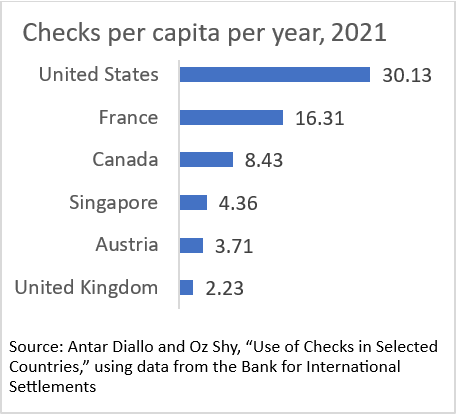
Among the 20 countries that reported the number and value of these payments to the BIS, the United States had by far the highest per capita use of checks per year in 2021: 30 checks. Only six countries reported more than two per capita (chart below), another 12 between zero and two. Belgium and South Africa reported zero.

Yikes, you say, 30 checks per person per year in 2021! How is that possible? Most checks in the United States—about two-thirds—are estimated to be written by businesses, according to the Atlanta Fed’s Check Sample Survey. That would put the average number of checks that U.S. consumers write at about 10 per year on average, which is in line with the findings of the 2021 Survey and Diary of Consumer Payment Choice.

Given the high per capita use in the United States, it makes sense that our year-over-year decline from 2012 has been slower than that for other countries. The per-year decline in the number of U.S. checks from 2012 to 2021 was slower than the decline for all the other high-use countries listed in the chart. The United States was down 6.7 percent per year from 2012 to 2021, compared to down 8.8 percent per year for Canada at the slow end and down 17.4 percent per year for Austria at the quick end.

No way around it: we love our checks, and our response to innovation has been tepid compared to that of other countries.

Germany-Watching: Economics (U.S. Money Market Fund Reform)

from Deutsche Bundesbank Eurosystem’s Bundesbank Research Centre:

You Can’t Always Get What You Want (Where You Want It): Cross-Border Effects of the U.S. Money Market Fund Reform [PDF]

Authors: Daniel Fricke, Stefan Greppmair, Karol Paludkiewicz

Non-technical summary
Research Question

Money market funds (MMFs) are an important part of the growing segment of non-bank financial intermediaries. This paper contributes to this literature by analyzing the cross-border effects of the 2014 U.S. MMF reform, which was implemented several years prior to the EU Regulation. We study whether euro area MMFs received inflows as a consequence of the reform and investigate the (unintended) economic effects on the basis of the non-synchronized implementation dates of the regulatory changes in the U.S. and the EU.

Contribution

To the best of our knowledge, we are the first to examine the cross-border effects of the 2014 U.S. MMF reform. Prior work has shown that the reform led to a substantial decline of the institutional prime segment in the U.S. (MMFs that invest primarily in non-sovereign debt instruments). Moreover, these funds increased their risk-taking due to the increased competition and newly imposed liquidity restrictions left these funds more prone to large outflows (run risks).

Results

We document both positive and negative effects of the U.S. reform on institutional MMFs in the euro area. These funds, particularly those from the prime segment, experienced substantial inflows from foreign investors around the implementation of the U.S. reform and we show that these cross-border flows were largely motivated by the search for money-like instruments. While euro area MMFs reduced their risk-taking, the industry as a whole has become more concentrated and possibly more exposed to run risks. This risk materialized in the COVID-19 induced stress period during which these funds faced large outflows by foreign investors.

Read the full discussion paper [archived PDF].

Climate Policy: Loss and Damage from Climate Change

(from Social Watch and Global Policy Watch’s UN Monitor)

Loss and Damage from Climate Change: How Much Should Rich Countries Pay?

(Download UN Monitor #10 [archived PDF])

“The wealthy countries must begin providing public climate finance at the scale necessary to support not only adaptation but loss and damage as well, and they must do so in accordance with their responsibility and capacity to act.” This is the main message of a technical report titled “Can Climate Change-Fueled Loss and Damage Ever Be Fair?” launched on the eve of the UN Climate Change Conference (COP25) to be held in Madrid from 2 to 13 December.

The U.S. and the EU owe more than half the cost of repairing future damage says the report, authored by Civil Society Review, an independent group that produces figures on what a “fair share” among countries of the global effort to tackle climate change should look like.

“The poorer countries are bearing the overwhelming majority of the human and social costs of climate change. Consider only one tragic incident—the Cyclones Idai and Kenneth—which caused more than $3 billion in economic damages in Mozambique alone, roughly 20% of its GDP, with lasting implications, not to mention the loss of lives and livelihoods” argues the report. “Given ongoing and deepening climate impacts, to ensure justice and fairness, COP25 must as an urgent matter operationalize loss and damage financing via a facility designed to receive and disburse resources at scale to developing countries.”

The UN Framework Convention on Climate Change (UNFCCC) has defined loss and damage to include harms resulting from sudden-onset events (climate disasters, such as cyclones) as well as slow-onset processes (such as sea level rise). Loss and damage can occur in human systems (such as livelihoods) as well as natural systems (such as biodiversity).

Eight weeks after Hurricane Dorian—the most intense tropical cyclone to ever strike the Bahamas—Prime Minister of Barbados, Mia Amor Mottley, spoke at the United Nations Secretary General’s Climate Action Summit. She said: “For us, our best practice traditionally was to share the risk before disaster strikes, and just over a decade ago we established the Caribbean Catastrophic Risk Insurance Facility. But, the devastation of Hurricane Dorian marks a new chapter for us. Because, as the international community will find out, the CCRIF will not meet the needs of climate refugees or, indeed, will it be sufficient to meet the needs of rebuilding. No longer can we, therefore, consider this as an appropriate mechanism…There will be a growing crisis of affordability of insurance.”

An April 2019 report from ActionAid revealed the insurance and other market based mechanisms fail to meet human rights criteria for responding to loss and damage associated with climate change. The impact of extreme natural disasters is equivalent to an annual global USD$520 billion loss, and forces approximately 26 million people into poverty each year.

Michelle Bachelet, UN High Commissioner for Human Rights, recently warned that the climate crisis is the greatest ever threat to human rights. It threatens the rights to life, health, housing and a clean and safe environment. The UN Human Rights Council has recognized that climate change “poses an immediate and far reaching threat to people and communities around the world and has implications for the full enjoyment of human rights.” In the Paris Agreement, parties to the UN Framework Convention on Climate Change (UNFCCC) acknowledged that they should—when taking action to address climate change—respect, promote and consider their respective obligations with regard to human rights. This includes the right to health, the rights of indigenous peoples, local communities, migrants, children, persons with disabilities and people in vulnerable situations and the right to development, as well as gender equality, the empowerment of women and intergenerational equity. Tackling loss and damage will require a human-rights centered approach that promotes justice and equity.

Across and within countries, the highest per capita carbon emissions are attributable to the wealthiest people, this because individual emissions generally parallel disparities of income and wealth. While the world’s richest 10% cause 50% of emissions, they also claim 52% of the world’s wealth. The world’s poorest 50% contribute approximately 10% of global emissions and receive about 8% of global income. Wealth increases adaptive capacity. All this means that those most responsible for climate change are relatively insulated from its impacts.

Between 1850 and 2002, countries in the Global North emitted three times as many greenhouse gas (GHG) emissions as did the countries in the Global South, where approximately 85% of the global population resides. The average CO2 emissions (metric tons per capita) of citizens in countries most vulnerable to climate change impacts, for example, Mozambique (0.3), Malawi, (0.1), and Zimbabwe (0.9), pale in comparison to the average emissions of a person in the U.S. (15.5), Canada (15.3), Australia (15.8), or UK (6).

In the 1980s, oil companies like Exxon and Shell carried out internal assessments of the carbon dioxide released by fossil fuels, and forecast the planetary consequences of these emissions, including the inundation of entire low-lying countries, the disappearance of specific ecosystems or habitat destruction, destructive floods, the inundation of low-lying farmland, and widespread water stress.

Nevertheless, the same companies and countries have pursued high reliance on GHG emissions, often at the expense of communities where fossil fuels are found (where oil spills, pollution, land grabs, and displacement is widespread) and certainly at the expense of public understanding, even as climate change harms and risks increased. Chevron, Exxon, BP and Shell together are behind more than 10% of the world’s carbon emissions since 1966. They originated in the Global North and its governments continue to provide them with financial subsidies and tax breaks.

Responsibility for, and capacity to act on, mitigation, adaptation and loss and damage varies tremendously across nations and among classes. It must also be recognized that the Nationally Determined Contributions (climate action plans or NDCs) that have thus far been proposed by the world’s nations are not even close to being sufficient, putting us on track for approximately 4°C of warming. They are also altogether out of proportion to national capacity and responsibility, with the developing countries generally proposing to do their fair shares, and developed countries proposed far too little.

Unfortunately, as Kevin Anderson (Professor of Energy and Climate Change at the University of Manchester and a former Director of the Tyndall Centre for Climate Change Research) has said: “a 4°C future is incompatible with an organized global community, is likely to be beyond ‘adaptation,’ is devastating to the majority of ecosystems, and has a high probability of not being stable.”

Equity analysis

The report assess countries’ NDCs against the demands of a 1.5°C pathway using two ‘fair share’ benchmarks, as in the previous reports of the Civil Society Equity Review coalition. These ‘fair share’ benchmarks are grounded in the principle-based claims that countries should act in accordance with their responsibility for causing the climate problem and their capacity to help solve it. These principles are both well-established within the climate negotiations and built into both the UNFCCC and the Paris Agreement.

To be consistent with the UNFCCC’s equity principles—the wealthier countries must urgently and dramatically deepen their own emissions reduction efforts, contribute to mitigation, adaptation and addressing loss and damage initiatives in developing countries; and support additional sustainable actions outside their own borders that enable climate-compatible sustainable development in developing countries.

For example, consider the European Union, whose fair share of the global emission reduction effort in 2030 is roughly about 22% of the global total, or about 8 Gigatons of CO2 equivalent (GtCO2eq). Since its total emissions are less than 5 GtCO2eq, the EU would have to reduce its emissions by approximately 160% per cent below 1990 levels by 2030 if it were to meet its fair share entirely through domestic reductions. It is not physically possible to reduce emissions by more than 100% domestically. So, the only way in which the EU can meet its fair share is by funding mitigation, adaptation and loss and damage efforts in developing countries.

Today’s mitigation commitments are insufficient to prevent unmanageable climate change, and—coming on top of historic emissions—they are setting in motion devastating changes to our climate and natural environment. These impacts are already prevalent, even with our current global average surface temperature rise of about 1°C. Impacts include droughts, firestorms, shifting seasons, sea-level rise, salt-water intrusion, glacial retreat, the spread of vector borne diseases, and devastation from cyclones and other extreme weather events. Some of these impacts can be minimized through adaptation measures designed to increase resilience to inevitable impacts.

These measures include, for example, renewing mangroves to prevent erosion and reduce flooding caused by storms, regulating new construction so that buildings can withstand tomorrow’s severe weather, using scarce water resources efficiently, building flood defenses, and setting aside land corridors to help species migrate. It is also crucial with such solutions that forest dwelling and indigenous peoples be given enforceable land rights, for not only are such rights matters of basic justice, they are also pragmatic recognitions of the fact that indigenous peoples have successfully protected key ecosystems.

Tackling underlying social injustices and inequalities—including through technological and financial transfers, as well as though capacity building—would also contribute to increasing resilience. Other climate impacts, however, are unavoidable, unmanageable or unpredictable, leading to a huge degree of loss and damage. Experts estimate the financial damage also will reach at least USD$300-700 billion by 2030, but the loss of locally sustained livelihoods, relationships and connections to ancestral lands are incalculable.

Failure to reduce GHG emissions now—through energy efficiency, waste reduction, renewable energy generation, reduced consumption, sustainable agriculture and transport—will only deepen impacts in the future. Avoidable impacts require urgent adaptation measures. At the same time, unavoidable and unmanageable change impacts—such as loss of homes, livelihoods, crops, heat and water stress, displacement, and infrastructure damage—need adequate responses through well-resourced disaster response plans and social protection policies.

For loss and damage financing, developed countries have a considerable responsibility and capacity to pay for harms that are already occurring. Of course, many harms will be irreparable in financial terms. However, where monetary contributions can help restore the livelihoods or homes of individuals exposed to climate change impacts, they must be paid. Just as the EU’s fair share of the global mitigation effort is approximately 22% in 2030, it could be held accountable for that same share of the financial support for such incidents of loss and damage in that year.

The table below provides an illustrative quantification of this simple application of fair shares to loss and damage estimates, and how they change if we compute the contribution to global climate change from the start of the industrial revolution in 1850 or from 1950.

Table 1: Countries’ Share of Global Responsibility and Capacity in 2019, the time of Cyclones Idai and Kenneth, as illustrative application of a fair share approach to Loss and Damage funding requirements.

Country/Group of CountriesFair Share (%) 1950 Medium BenchmarkFair Share (%) 1850 High Benchmark
USA30.4%40.7%
European Union23.9%23.2%
Japan6.8%7.8%
Rest of OECD7.4%8.8%
China10.4%7.2%
India0.5%0.04%
Rest of the World20.6%12.3%
Total100%100%

The advantage of setting out responsibility and capacity to act in such numerical terms is to drive equitable and robust action today. Responsible and capable countries must—of course—ensure that those most able to pay towards loss and damage repairs are called upon to do so through domestic legislation that ensures correlated progressive responsibility. However, it should also motivate mitigation action to ensure that harms are not deepened in the future.

In the Equity analysis used here, capacity—a nation’s financial ability to contribute to solving the climate problem—can be captured by a quantitative benchmark defined in a more or less progressive way, making the definition of national capacity dependent on national income distribution. This means a country’s capacity is calculated in a manner that can explicitly account for the income of the wealthy more strongly than that of the poor, and can exclude the incomes of the poorest altogether. Similarly, responsibility—a nation’s contribution to the planetary GHG burden—can be based on cumulative GHG emissions since a range of historical start years, and can consider the emissions arising from luxury consumption more strongly than emissions from the fulfillment of basic needs, and can altogether exclude the survival emissions of the poorest. Of course, the ‘right’ level of progressivity, like the ‘right’ start year, are matters for deliberation and debate.1

The report acknowledges “the difficulties in estimating financial loss and damage and the limited data we currently have,” but it recommends nevertheless “a minimal goal of providing at least USD$300 billion per year by 2030 of financing for loss and damage through the UNFCCC’s Warsaw International Mechanism for Loss and Damage (WIM).” Given that this corresponds to a conservative estimate of damage costs, the report further recommends “the formalization of a global obligation to revise this figure upward as observed and forecast damages increase.”

The new finance facility should provide “public climate financing and new and innovative sources of financing, in addition to budget contributions from rich countries, that can truly generate additional resources (such as air and maritime levies, Climate Damages Tax on oil, gas and coal extraction, a Financial Transaction Tax) at a progressive scale to reach at least USD$300 billion by 2030.” This means aiming for at least USD$150 billion by 2025 and ratcheting up commitments on an annual basis. Ambition targets should be revised based on the level of quantified and quantifiable harms experienced.

Further, developing countries who face climate emergencies should benefit from immediate debt relief–in the form of an interest-free moratorium on debt payments. This would open up resources currently earmarked for debt repayments to immediate emergency relief and reconstruction.

Finally, a financial architecture needs to be set up that ensures funding reaches the marginalized communities in developing countries, and that such communities have decision making say over reconstruction plans. Funds should reach communities in an efficient and effective manner, taking into account existing institutions as appropriate.

Currently, the Paris Rulebook allows countries to count non-grant instruments as climate finance, including commercial loans, equity, guarantees and insurance. Under these rules, the United States could give a USD$50 million commercial loan to Malawi for a climate mitigation project. This loan would have to be repaid at market interest rates—a net profit for the U.S.—so its grant-equivalence is $0. But under the Paris Rulebook, the U.S. could report the loan’s face value ($50 million) as climate finance. This is not acceptable. COP25 must ensure that the WIM has robust outcomes and sufficient authority to deliver a fair and ambitious outcome for the poorest and most vulnerable in relation to loss & damage.

Note
  1. For more details, including how progressivity is calculated and a description of the standard data sets upon which those calculations are based, see the reference project page.  For an interactive experience and a finer set of controls, see the Climate Equity Reference Calculator. (return to text)

Download UN Monitor #10 [archived PDF]