Charting a Course on Immune Response

[from LLNL’s Science & Technology Review, by Sheridan Hyland]
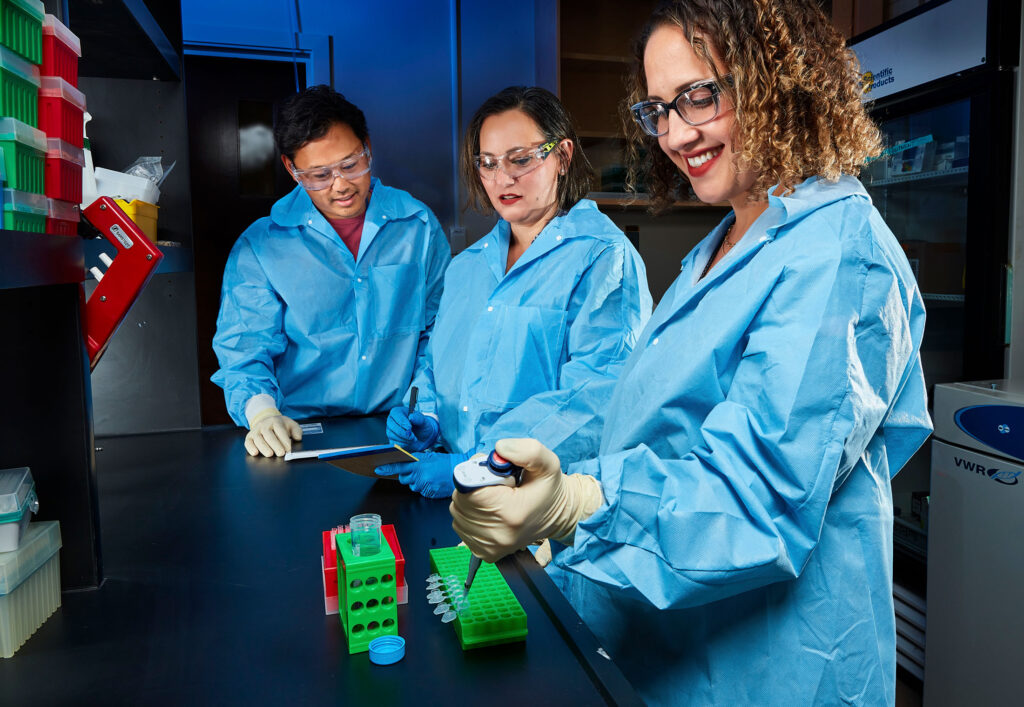
Lawrence Livermore scientists Dina Weilhammer (right), Feliza Bourguet (middle), and Nicholas Hum (left) prep samples for analysis to study Rift Valley fever virus behavior and immune response.

Respiratory diseases can balloon from a few cases to epidemics or pandemics, making them a consideration in national security planning and preparation. Understanding how a pathogen behaves in different circumstances and environments is complex and depends upon many factors, including genetics. COVID-19 remains a stark example of how understanding of pathogen behavior can be tenuous. Scientists continue to grapple with answering questions of why some carriers are asymptomatic while others produce symptoms of the disease, why some of the infected suffer the effects of long COVID while others do not, and why some individuals passed away and others survived. COVID-19 is only one example of a pathogen that raises questions among medical researchers: Valley Fever, variations of encephalitis, and other diseases also present additional challenges. 

Lawrence Livermore scientists are taking a comprehensive approach to understanding pathogen behavior and immune system response, building on past research that focused on individual molecules and interactions. Dina Weilhammer, a staff scientist in Livermore’s Biosciences Division, explains, “We’ve made significant inroads in understanding how the immune system recognizes foreign agents such as bacteria and viruses, as well as how the immune system can separate what should be eliminated and what should be protected. Today’s biotechnology tools can overcome earlier limitations. They enable us to interrogate the immune system more holistically than ever before to address questions and uncover unexpected considerations and answers.”

Through its research, the Livermore team—which includes Weilhammer, Nicholas Hum, Aimy Sebastian, Oscar Davalos, Margarita Rangel, Deepa Murugesh, Bria Gorman, Gregory Lum, Nicole Leon, Patrick Hurley, and Ashlee Phillips—is sharpening its understanding of the differences between one immune system that clears infection compared to another that cannot. Using a combination of controlled pathogen exposure; single-cell RNA sequencing (scRNA-seq); spatial transcriptomics to collect data; and computational platforms to organize, analyze, and interpret the data, the Laboratory is developing an immune system atlas that could help the medical field better understand and predict disease outcomes in the future.
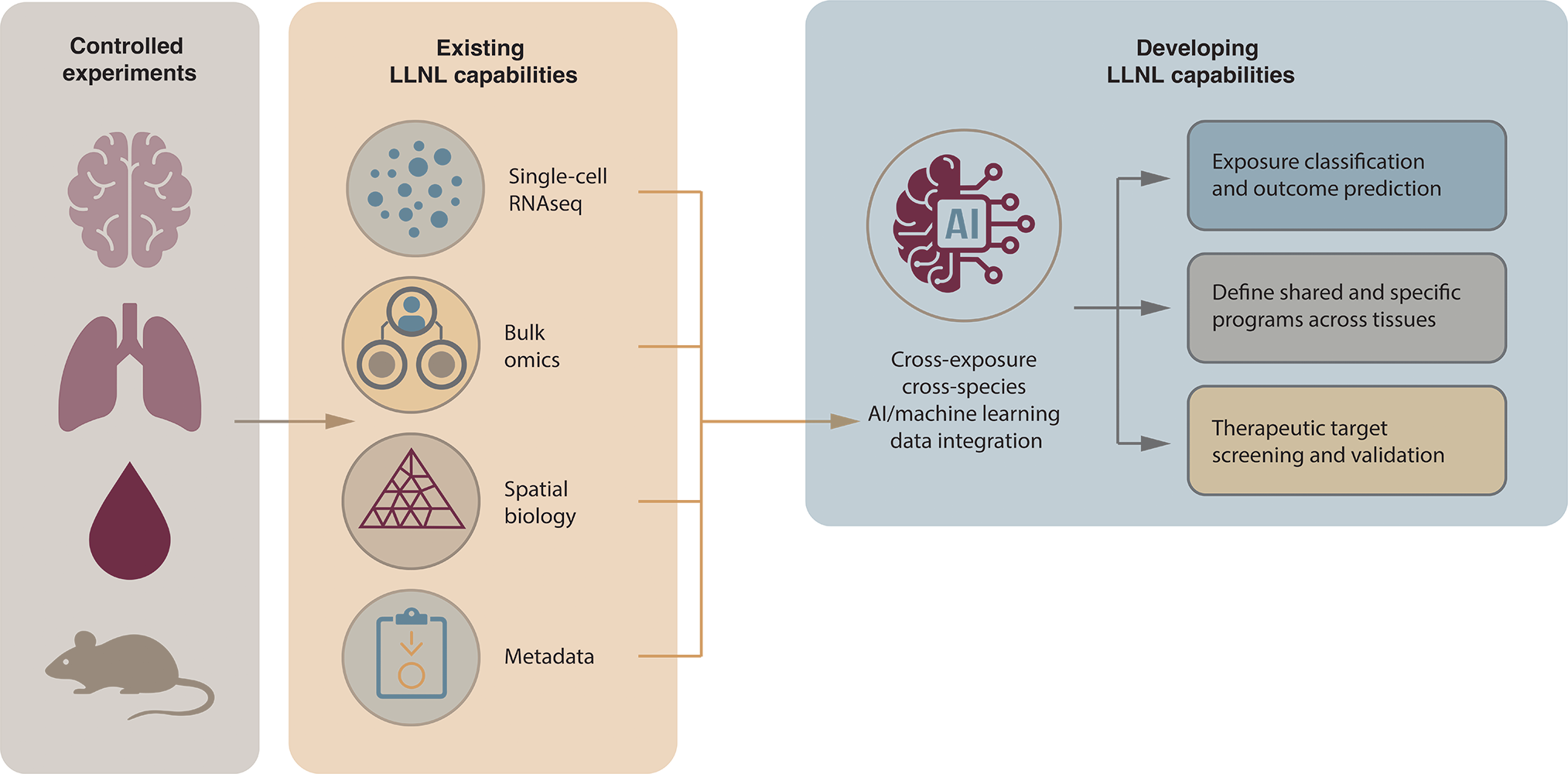
Livermore’s biologists combine multiple tools and research methods— controlled pathogen exposure, single-cell RNA sequencing, spatial transcriptomics, and AI integration of data—to understand how different pathogens that impact the lungs, brain, and blood behave in different environments and how an individual’s immune system responds. As studies progress, the data could be used to predict disease outcomes in individuals and offer therapeutic screening, validation, and treatment options.

Mapping the Methodology

To address their research questions, scientists developing the immune atlas have focused on pathogens that impact the lungs and brain. “We have viral, fungal, and bacterial models of disease that specifically target the lungs,” says Hum, a staff scientist. “At the same time, many diseases do not start in the lungs but can still affect them over time through systemic immune and inflammatory responses. The next natural question is how signals from elsewhere in the body reshape the lung environment and influence lung function.” Data from multiple techniques combine to provide a fuller picture of immune system response.
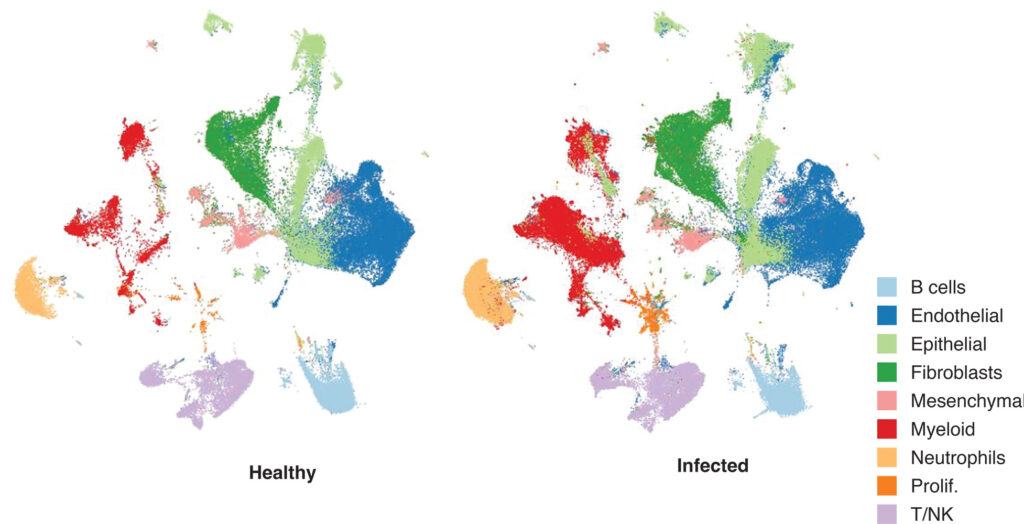
Using uniform manifold approximation and projection (UMAP), Livermore biologists can create a visualization of cell clusters in experimental groups. Pictured here, a variety of cells in mice have been identified in a healthy (left) and infected (right) lung, including epithelial cells in the airways; endothelial cells in the blood vessels; fibroblasts that provide structural integrity and tissue remodeling; and immune cells (lymphoid and myeloid), which identify defense and inflammatory response. Myeloid cells demonstrate the largest difference observed between healthy and infected cell tissue.

Experiments in which mice are exposed to a known pathogen under managed conditions (controlled pathogen exposure), enable researchers to study the development of an infection and the immune system response. By controlling the exact strain of the pathogen, the dosage levels, routes of exposure, timing, host factors, and environment, the team can establish potential cause and effect related to the immune system’s immediate response after infection, which cell populations respond first, how the disease progresses, and what leads to recovery or more severe illness. Another tool, scRNA-seq, measures gene expression in individual cells rather than averaging signals across an entire tissue sample, enabling researchers to identify which cells are inflammatory compared to which cells are behaving normally. In traditional bulk RNA sequencing, RNA extracted from thousands or millions of cells is pooled together before sequencing, obscuring differences among rare or functionally distinct cell populations. In contrast, scRNA-seq preserves cell-specific transcriptional information, enabling researchers to resolve how immune and nonimmune cells respond uniquely to infection and injury. To perform the analysis, lung tissue is first dissociated into a suspension of individual cells. Using a microfluidic droplet platform, single cells are encapsulated together with gel beads carrying unique molecular barcodes. Inside each droplet, messenger RNA released from the lysed (ruptured or broken) lung cell is captured and reverse-transcribed into complementary DNA (cDNA). During this process, each transcript receives both a cell-specific barcode and a unique molecular identifier (UMI), allowing researchers to distinguish where RNA molecules originated while also correcting for amplification bias introduced during polymerase chain reaction (PCR) amplification.
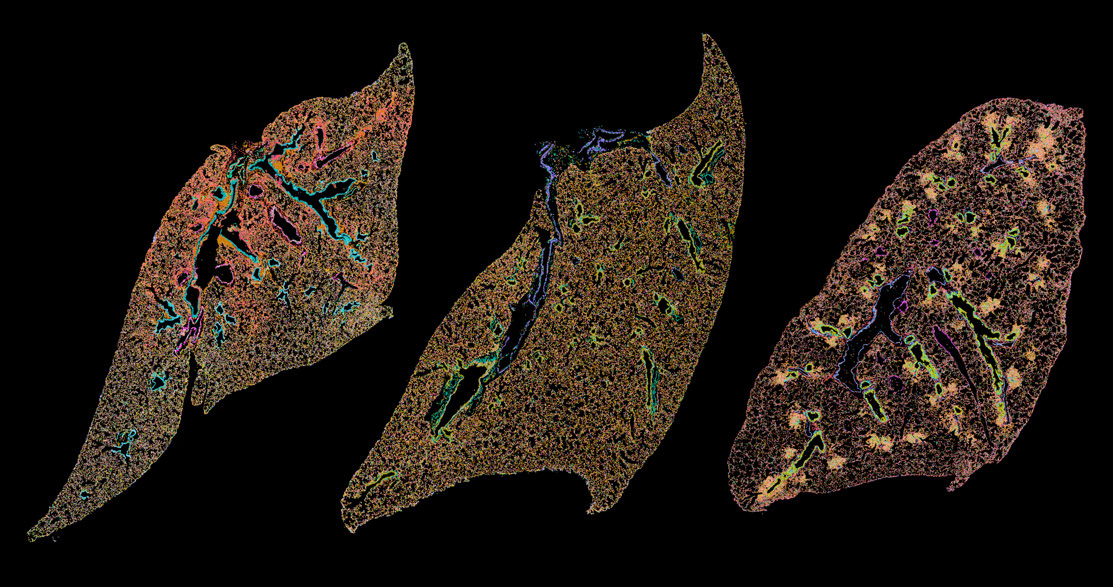
Livermore’s high-performance computing tools enable visualization of pathogens and immune response in tissue cells, as well as patterns of host responses across different disease states. The UMAP plot pictured here shows cell behavior across healthy and diseased conditions (from left to right: viral, bacterial, or fungal infection) in a mouse lung, based on single-cell RNA sequencing data from animal studies. Each dot represents a single cell, colored by its general cell-type identity. Spatial transcriptomic maps can also reveal the cellular neighborhoods that emerge during disease.

After barcoding and amplification, the team breaks the droplets and sequences the pooled cDNA libraries at high depth, generating hundreds of millions to billions of reads per experiment. Using computational pipelines to align the reads to the genome, Livermore’s scientists reconstruct transcriptomes for tens of thousands of individual cells simultaneously. The team uses graph-based clustering and dimensionality-reduction approaches such as uniform manifold approximation and projection (UMAP) to identify distinct cellular populations in infected and noninfected cells and visualize transcriptional relationships across experimental conditions.

A third method the team applies is spatial transcriptomics, which measures gene activity in specific locations in the tissue. Cells do not act in isolation from each other, and in the case of infection, cancer, or tissue repair, location in the tissue is important. For example, a macrophage near a blood vessel could behave differently from one next to a damaged epithelium (densely packed cells that cover external body surfaces such as skin, line internal cavities and organs, and form glands). In infection studies, spatial transcriptomics, a visual representation of the location and clusters of different cell populations, can show where inflammatory cells accumulate, where antiviral or antimicrobial genes are activated, how immune cells organize around lesions and infected areas, how responses differ between damaged tissue and nearby healthy tissue, and how cell neighborhoods change over time. In the lung specifically, spatial transcriptomics can reveal inflammatory cells clustered around infected airways, repair programs in surrounding tissue, and distinguish immune zones in severe compared to mild diseases.

Exploring New Ground

Livermore’s biologists have conducted several individual studies on Valley fever (Coccidioides posadasii), Rift Valley fever virus, Venezuelan equine encephalitis virus, influenza, respiratory syncytial virus, bacterial pneumonia (Streptococcus pneumoniae), and COVID-19. “Our work didn’t start with the intent to generate an immune atlas,” says Sebastian, a Livermore staff scientist. “We were working on individual projects and asking specific questions. However, as we started to generate more data, we began to discuss standardizing the process of how and when we collect data and putting it into one big data set.” The immune atlas combines the data gathered from cells’ immune responses to the different diseases and then uses computational software to build visualization tools that map the varying responses across infected and noninfected cells. 

Using scRNA-seq and spatial transcriptomics, the team sought to answer how the immune system responds inside an infected organ and why that response shifts from protective to damaging. “As we pulled together the data from millions of reads, we saw what cells were doing for tens of thousands of reads compared to other cells,” says Hum. “By putting the pictures together, we can tell the difference between a T cell and a normal epithelial cell, for example. And from this stage, once we have the resolution of what the cells are doing and how many there are, we can start comparing all the different time points, trajectories, and infection models.” Through several studies, the Livermore team found that severe disease is often driven not just by the pathogen itself but by specific immune programs that become harmful. The team’s methods helped identify which cells responded first (such as microglia in the brain and resident lung macrophages and stromal cells in the lungs), which cells entered later, where the cells went in the tissue, and whether they were helping or harming the individual.

To analyze this data and compare results across pathogens and different parts of the tissues being studied, Livermore’s team used a variety of computational tools. In each study, they collected data at multiple infection stages, looking for when changes occurred and when recovery signatures began to appear. Since every experiment was slightly different, the team integrated and visualized the data sets such that they could be superimposed over each other and compared. “As we quantify what cells enter and at what point in time, we can study how their profiles change,” says Sebastian. “For example, in a blood system, monocytes enter and differentiate into multiple subtypes. Some of these are highly correlated with better outcomes, while others are not. We want to identify what’s considered a good response compared to a bad response.” The comparisons indicated that the type of cells entering the lung in response to infection can influence the outcome.
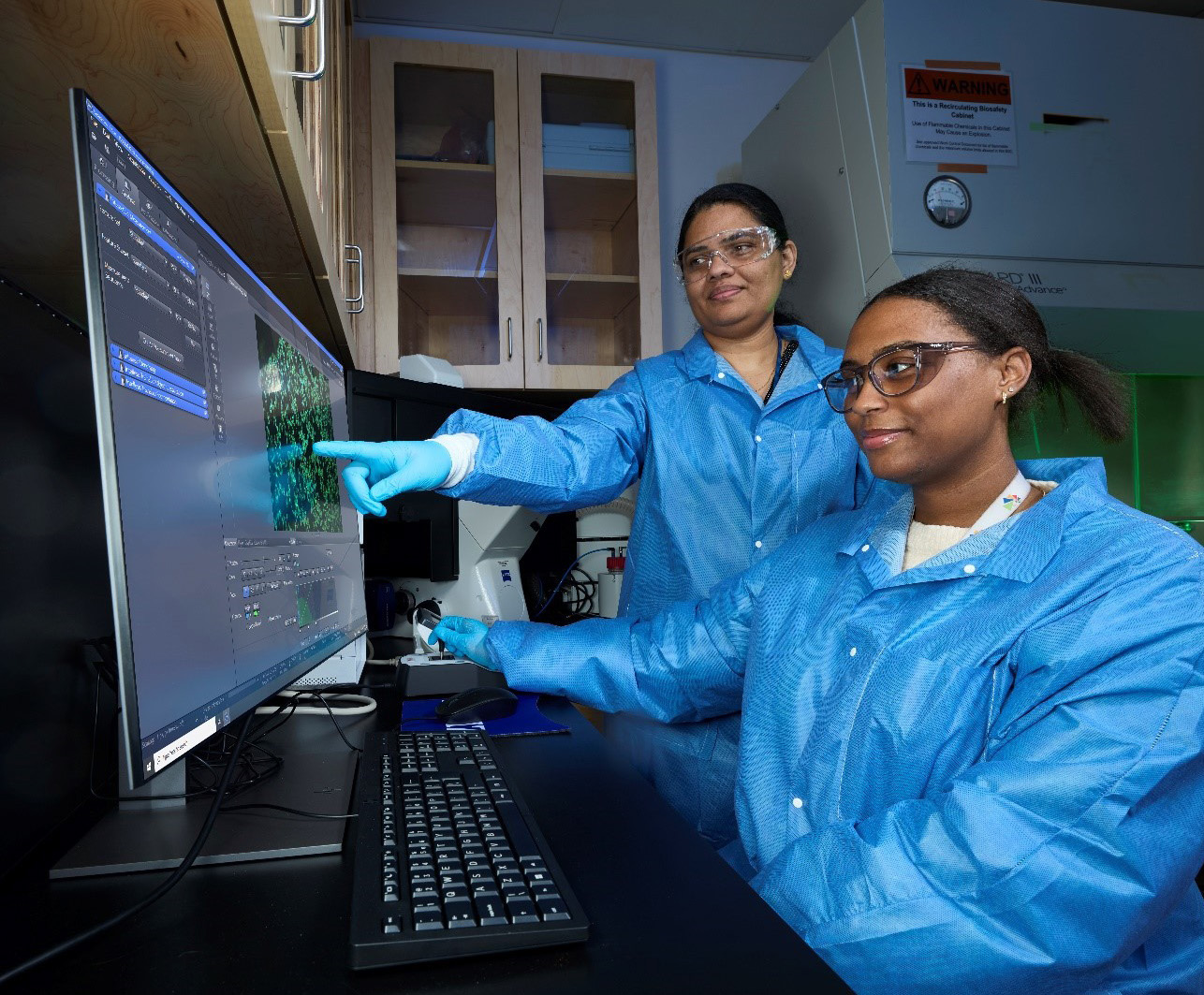
Team members Bria Gorman and Aimy Sebastian examine spatial transcriptomic data from a mouse lung.

A series of computational tools have helped parse and present the data, including both R– and Python-based approaches for scRNA-seq, spatial transcriptomics, and multi-omic integration analyses. For scRNA-seq analyses, the team uses Seurat in R and Scanpy in Python, while spatial transcriptomic analyses are performed using Seurat in R and Squidpy in Python. Additional tools such as Scenic, Slingshot, and CellChat are used to identify gene regulatory patterns, examine changes in cell states and differentiation, and explore how cells may communicate with one another. Graph-based clustering methods were applied to define cellular populations, and UMAP is used for dimensionality reduction and visualization of cellular and molecular patterns across experimental conditions.

While still in the early stages of research, the team is already seeing interesting, sometimes unexpected, results. One macrophage population repeatedly shows up in multiple infection models, particularly lethal infections. These macrophages express many extracellular matrix proteins and matrix-remodeling enzymes that are more commonly associated with cell types such as fibroblasts. “We don’t know exactly what they do yet, but we can clearly see a correlation between some lethal infections and macrophages coming in and moving toward this kind of profile,” says Sebastian.

Charting a New Course

As the Laboratory looks toward future research opportunities, a key focus is to understand what patterns and results in mice can translate to humans. Weilhammer says, “Comparing infections in which the test subjects recover from the disease versus succumb to it is useful. In our mouse models of COVID, we saw young animals recover from infections while aged animals did not. However, that’s not the whole story—we’re also interested in how the genetic background of the host can impact the trajectory of the disease.” In the COVID-19 pandemic, even though younger people suffered less severe illness compared to more elderly people, this outcome was not universally the case—many young people also had severe infections, difficult recoveries, and fatalities. “We think it’s highly likely that there’s a strong genetic component behind why some people do well following infection and others do not,” continues Weilhammer. 

In future studies, the team plans to integrate AI and deep learning models more significantly into their data analysis process and to help better predict an individual’s treatment needs and recovery path. “The basic research is difficult to pursue unless someone has all the experimental and computational capabilities that we have at Lawrence Livermore,” says Hum. “We’re still working toward the point where we can identify which illness someone has and how severe it might be from just a cough or other common symptom.”

[Archived PDF of article]

Chance and Necessity

If you free-associate the word “chance,” you may arrive at “I’ll take my chances” before potentially arriving at Thomas Bayes’ “Doctrine of Chances”. Jacques Monod was an early explorer of the collision of probability and chance in biology.

THE PRINCE OF CHANCE

Jacques Monod grew up just down the coast from Monte Carlo in Cannes, France, another town famous for its casinos and, later, its film festival. Graced with movie star looks—one prominent French journalist described him as a “prince” who resembled Hollywood icon Henry Fonda, as well as considerable musical talent, and an exceptional intellect, Monod struggled to decide on a career path through his twenties. After distinguishing himself in the French Resistance, Monod rose to fame not as an actor or musician, but as a brilliant biologist. He shared the 1965 Nobel Prize in Physiology or Medicine for seminal discoveries about how genes work.

A pioneer in the field of molecular biology, Monod was privy to the blizzard of discoveries in the 1950s and early 1960s about the molecules that determined the characteristics of living things—what Monod and others dubbed “the secrets of life.” He kept close company with a relatively small international community of leading researchers. For example, when James Watson and Francis Crick cracked the structure of DNA (deoxyribonucleic acid) in 1953, Monod was one of the first with whom Watson shared the breakthrough.

But as a Frenchman steeped in his culture’s deep philosophical traditions, Monod was interested in science for more than just science’s sake. After the war, Monod befriended France’s leading philosopher-writer Albert Camus, and the two men pondered questions of human existence in Left Bank cafés. Monod felt that the public misunderstood the principal purpose of science as being the creation of technology. Rather, Monod believed technology was merely a by-product. He said, “the most important results of science have been to change the relationship of man to the universe, or the way he sees himself in the universe”—a relationship of equally intense interest to his friend Camus.

Monod thought that there were profound philosophical implications of the new molecular biology, particularly in the realm of heredity, which had gone largely unnoted in the broader culture. Several years after his Nobel Prize and Camus’ untimely death, he decided to write a book to try to bring the meaning of modern biology to laypersons.

“[T]he ‘secret of life’…has been laid bare,” he wrote.

“This, a considerable event, ought certainly to make itself strongly felt in contemporary thinking.”

Monod used several chapters to describe the insights that had very recently emerged from the study of DNA and the deciphering of the genetic code. He understood this knowledge would be unfamiliar to most readers, so he included an appendix with chemical structures of proteins and nucleic acids, and a primer on how the genetic code worked.

In a matter-of-fact style, he explained genetic mutations as accidental alterations—substitutions, additions, deletions, or rearrangements—in the text of DNA, in the sequence of the long strings of chemical bases (ACTTGATAA, etc.) that make up genes.

Then, almost without warning, he turned to the broader implications of how mutations arise in DNA. It is worth quoting him at length for after 111 pages of background, he delivered one of the most powerful ideas in five centuries of science (all italics are original):

“We call these events accidental; we say they are random occurrences. And since they constitute the only possible source of modifications in the genetic text, itself the sole repository of the organism’s hereditary structure, it necessarily follows that chance alone is at the source of every innovation, of all creation in the biosphere.

“Pure chance, absolutely free but blind, at the very root of the stupendous edifice of evolution: this central concept of modern biology is no longer one among other possible or even conceivable hypotheses. It is today the sole conceivable hypothesis, the only one that squares with observed and tested fact. And nothing warrants the supposition—or the hope—that on this score our position is likely ever to be revised.

“There is no scientific concept, in any of the sciences, more destructive of anthropocentrism than this one.”

In essence, heretofore obscure discoveries in biochemistry and genetics (largely studied at that time in simple bacteria) had upended two millennia of philosophy and religion that put humans at the center or apex of creation. “Man was the product of an incalculable number of fortuitous events,” Monod wrote. “The result of a huge Monte Carlo game, where our number eventually did come out, when it might not well have appeared.”

Le Hasard et la nécessité (Chance and Necessity) appeared in France in October 1970. It was a fairly technical book with several chapters on philosophy and genetics, and those appendices full of chemical diagrams. A first-time author, Monod did not know what reactions to expect.

The merde hit the fan.

The book received dozens of reviews across France and quickly became a bestseller—second only to the French translation of Erich Segal’s Love Story (this was France after all. After it was translated into English, reviews and interviews with Monod were featured in several of the most prominent British and American newspapers and magazines.

Many commentators immediately recognized the threat chance posed to traditional ideas of humanity’s origins and purpose. To Arthur Peacocke, a British biochemist turned prominent theologian, Monod had put forth “one of the strongest and most influential attacks of the century on theism.” A flurry of articles and books appeared with titles such as Anti-Chance: A Reply to Monod’s Chance and Necessity, Beyond Chance and Necessity, and God, Chance, and Necessity. Monod was invited to debate philosophers and theologians both in France and abroad, on television, radio, and in print.

American Calvinist theologian and pastor R.C. Sproul summed up the high stakes posed by chance in the first page of his book Not A Chance:

“It is not necessary for chance to rule in order to supplant God. Indeed, chance requires little authority at all if it is to depose God; all it needs to do the job is to exist. The mere existence of chance is enough to rip God from his cosmic throne. Chance does not need to rule; it does not need to be sovereign. If it exists as a mere impotent, humble servant, it leaves God not only out of date, but out of a job.” More than two hundred pages later, Sproul concluded:

“Chance as a real force is a myth. It has no basis in reality and no place in scientific inquiry. For science and philosophy to continue to advance in knowledge, chance must be demythologized once and for all.”

Sproul and other critics argued that what scientists perceived as chance merely reflected a lack of knowledge of true causes. Perhaps that was the expression of hope to which Monod alluded—the hope that as scientists learned more, our position on the role of chance would somehow be revised.

A SECOND CHANCE

The ensuing fifty years have not played out as either Monod or his detractors hoped. The Frenchman thought that the new insights from molecular biology should be a turning point for modern society-away from traditional beliefs about causes in the natural world toward one that embraced randomness and our chance existence.

Ha! Fat chance. The excitement and fuss stirred by Chance and Necessity simmered down, and Monod passed away a few years later. Surveys reveal that the majority of Americans, for example, continue to believe that everything on earth happens for His reasons.

But Monod’s critics should take no comfort. The province of chance in the biosphere and human life has been revised, although not at all in the scope or direction that they hoped.

The domain of chance has expanded into realms neither Monod nor anyone else imagined.

As we have learned much more about the history and workings of the planet, we have been startled to discover how the course of life has been buffeted by a variety of cosmological and geological accidents—without which we would not be here. As we have explored human history, we have seen how pandemics, droughts, and other civilization-changing episodes have been triggered by random, singular events in nature that easily might not have happened. And as we have probed human biology and the factors that impact our individual lives, we have caught chance red-handed, reigning over the often-thin line between life and death.

This book tells the stories that Monod could not—of astonishing discoveries from the planetary to the molecular scale, from great upheavals across the globe to the machinery of chance that operates within every cell of every creature, including ourselves. And while these discoveries vaporize the comforts of anthropocentrism, the story of chance, I hope you will come to agree, is much more than highfalutin philosophy or the refutation of theologians’ wishful thinking.

I hope that you are awed—awed by the power and the drama of asteroids slamming into the planet, of continents colliding, and of the rapid rising and falling of ice and oceans; awed by the realization that we live on (and are at the mercy of a planet that is far more unstable than our short lives perceive; awed by the knowledge of how random chance is at the source of all of the beautiful and wondrous creatures with whom we share the planet; awed by the unique invisible accidents that made each one of us; and awed by the fact that we humans, recent descendants of bands of hunter-gatherers who persevered through a period of exceptional chaos, have in just the last fifty years or so, figured all of this out!

My goal here is to be comprehensible without being comprehensive. It is almost trivial to claim that the world is the way it is or that we are here because of a long chain of chance, albeit fortunate, events. The explanatory power I seek comes from specificity. It is essential to unpack some of those events to appreciate how they shape the direction of life. The layout of the book follows a simple three-part logic. I’ll begin with inanimate, external chance events that have shaped the conditions for life (Part One, “Stuff Happens”), and then turn to the internal random mechanism within every creature that generates the adaptations to those conditions (Part Two, “A World of Mistakes”). Then, I bring the story to the personal level (Part Three, “23 and You”) and how chance impacts our natural lives, as well as our deaths. Our chance-driven existence shatters long-held beliefs about humanity’s place and raises challenging questions about the meaning and purpose of our lives. In the Afterword, I’ll offer some possible replies with the help of some special guests.

This is a relatively small book for a really big idea. Science has given us a handful of really big ideas over the centuries, but they have been received in funny ways. Darwin had a huge idea that was very simple to understand, and even though the evidence is massive and everywhere, many refuse to believe it. Einstein had a brand new idea, and even though few understand it or the evidence for it, most everyone seems to believe it. Monod had a great idea, but these days most people (other than scholars) have not heard of it, or of him.

My greatest hope, then, is that this short book might be chance’s second chance.

Sean B. Carroll, A Series of Fortunate Events: Chance and the Making of the Planet, Life, and You, Princeton University Press, 2020, pp. 6-12.

Modern biology as described by Monod pushes the linkage of probability, randomness and chance to the center. At the time, this was a very radical and profound way of looking at biology. If we combine Monod’s biology with theoretical physics like Lawrence Krauss’ A Universe from Nothing: Why There Is Something Rather than Nothing, we realize that accidentality is the bedrock on which our knowledge of the universe is built.

Education and Causality Changes

Scientific classification
Kingdom:Animalia
Phylum:Chordata
Class:Mammalia
Order:Primates
Suborder:Haplorhini
Infraorder:Simiiformes
Family:Hominidae
Subfamily:Homininae
Tribe:Hominini
Genus:Homo
Species:H. naledi
Binomial name:Homo naledi
Berger et al., 2015

The box above shows you, if you reflect for a moment, how involved and hierarchical taxonomy can be. The box refers to the tremendous fossil finds around 2013 outside Johannesburg, South Africa by Professor Lee Berger of Witwatersrand University and his team and associates in caves nearby.

The fossil finds are determined to be “homo” and not “australo” as you see in the table above (to the right of the word genus).

The PBS NOVA program “Dawn of Humanity” (2015), is about the story of these fossil finds and the interpretations of the finds which are deeply instructive for all knowledge-seekers, students, etc. because they leave behind any idea of a linear clearly branching “tree of life” in favor of the “bushiness” of evolution (no clear tree structure) and the whole process finally seen as a “braided stream.” This refers to a geological concept of the multiple pathways and reticulations of glacial ice and snow melt going down a mountain valley to a lake. The rivulets, channels, are crisscrossing in a “fluvial” flow pattern that is so complex one doesn’t know exactly which “exact” water went into the lake. If you say the lake is “homo sapiens” (humanity) and the swirling bushy tangled flow is the evolutionary raw material, some final causality is elusive.
When a “braided stream” (this kind of glacial water flow) metaphor gets fused with a “bushiness” one, then one sees that the random factors and endless crisscrossing obscures linear mono-causal explanations as we always imagined.

If you imagine a time when these concepts are applied to history, economy, and society you can begin to sense many “causality revolutions” in front of us where today’s textbooks will seem charmingly naive.

Every student, enrolled or not, should ponder the concepts of “braided stream” taxonomy (shown in the initial table above) and “bushiness” as opposed to tree structure. The student might also “walk around” these metaphors and ask what they imply for the “fractal geometry of nature” (a twig is like a little tree or branch on a bigger tree or branch and so on).