World-Watching: Old Problem, Modern Solution: Emerging Technologies for Anti-Corruption

[from Asia-Pacific Economic Cooperation, 29 July, 2025]

by Emmanuel A. San Andres and Glacer Nino A. Vasquez

Harnessing new tools to strengthen transparency and accountability can help APEC economies combat corruption and build public trust.

The Code of Hammurabi is one of humanity’s oldest surviving legal texts. Etched in basalt nearly four millennia ago, one of the many crimes it proscribes is corruption by a judge, for which the punishment is a hefty fine—“twelve times the fine set by him in the case”—plus removal and perpetual disqualification from office. Today, laws are published online rather than on stone tablets, but corruption remains a scourge across societies.

Thousands of years later, the fight against corruption continues. Corruption scandals continue to make headlines across the region, affecting both public and private institutions. Whether involving procurement fraud or illicit finance flows, these cases underscore how quickly trust can erode when institutions fail to adapt. The need for preventive systems, powered by data, backed by law and enabled by technology, has never been more urgent. Across APEC, the principles of transparency, accountability and integrity remain central to strong public institutions. As economies become more interconnected and more data-driven, emerging technologies are offering new ways to advance these goals.

APEC economies have long relied on oversight mechanisms such as audits, procurement rules, and internal checks to prevent, detect and prosecute corruption. These tools have been effective in fighting corruption, and they remain essential. But at the same time, new technology has also opened new pathways for corruption: The discreet meeting at a coffeeshop may now occur over an encrypted messaging app, and the cash-filled envelope replaced by a cryptocurrency transfer.

As corrupt actors grow more technologically sophisticated, so too must anti-corruption efforts. APEC economies are not new to digital solutions—e-government and e-procurement portals have reduced opportunities for hidden transactions. Beneficial ownership registries and asset tracking systems make it easier to prosecute and penalise incidents of corruption when they do occur. But emerging technologies offer even more powerful tools to prevent, detect and deter corruption.

For example, artificial intelligence and machine learning (AI/ML) enable real-time monitoring, risk scoring, pattern detection, and predictive analytics. These tools can support monitoring and investigation by automating document review and evidence gathering. AI/ML can also enhance institutional capacity through adaptive, personalized training systems.  Meanwhile, advanced data analytics can support the review of large volumes of data, revealing patterns of corrupt activity and informing decision-making. When data from different sources are connected, it becomes easier to understand corruption risks early and act with greater precision.

Blockchain—the technology that enables cryptocurrencies—can be used to create immutable, transparent ledgers for government transactions, supply chain monitoring and secure identity management, making it harder to conceal corrupt activity. Remote sensing and facial recognition technologies also offer potential in compliance monitoring and anomaly detection.

However, implementing these emerging technologies have their share of challenges and risks. The effectiveness of AI/ML systems is only as good as the quality, integrity and objectivity of the data they are fed; biased inputs can produce biased outcomes. Blockchain technology is very energy-intensive, which may hinder its scalability and availability. Facial recognition raises serious concerns over privacy and due process, enabling widespread surveillance without individual consent.

These trends mirror growing international momentum around the digitalization of integrity systems. International organizations are helping lead the way: the OECD is leveraging AI and big data to detect corruption risks and improve compliance, while the World Bank’s Governance Risk Assessment System [archived PDF] uses analytics to uncover fraud in public procurement, with pilots already underway in Brazil. As stewards of major anti-corruption conventions, these institutions are turning innovation into accountability. For APEC economies, this alignment offers a timely opportunity to shape global standards while advancing domestic reform.

It is also important to recognize the central role of human and institutional elements in anti-corruption efforts. Emerging technologies are not a silver bullet; they will only be effective if they are well integrated into government processes and are aligned with the skills of the people who need to use them. Training and capacity building will be essential to bridge capability gaps, while a committed leadership will be needed to implement the legal reforms and oversight structures needed to ensure effective adoption.

Buy-in from anti-corruption stakeholders across government, the private sector and civil society is also crucial to this pursuit. Technologies like AI/ML and advanced analytics require large volumes of reliable data, requiring cooperation and information sharing. Public understanding and trust, ethical use of data and equitable access to technology are all essential to ensuring long-term success.

APEC economies are at different stages of readiness to adopt these emerging technologies. While some economies have yet to develop adequate digital infrastructure, human capital and institutional structures, others are already in a position to expand or integrate more advanced anti-corruption tools into their day-to-day processes. Capacity building, information sharing and dialogue can help narrow this gap while learning from the experiences of those ahead.

This is where regional cooperation can make a difference APEC provides a platform for knowledge sharing, capacity building and policy cooperation. The Anti-Corruption and Transparency Experts Working Group could provide a venue for a collaborative strategy to mainstream emerging technology in anti-corruption work, while building technical capacity for economies that need it. Likewise, the upcoming APEC High-Level Dialogue on Anti-Corruption Cooperation provides an opportunity to reaffirm values and shared commitments in the fight against corruption.

Corruption has existed since the dawn of civilization. As methods to commit corruption have evolved, so must the tools to combat it. People and institutions will always remain at the heart of anti-corruption efforts, but with the right governance and safeguards, emerging technologies can be game-changers in fighting corruption and recovering its proceeds, whether it’s in Babylonian sheqels or in bitcoins.

Emmanuel A. San Andres is a senior analyst, Glacer Niño A. Vasquez is a researcher at the APEC Policy Support Unit. For more on this topic, read the latest issue paper “Technologies for Preventing, Detecting, and Combatting Corruption [archived PDF].

World-Watching: Statement on the Commission’s Status Report in the Climate-Related Disclosure Rules Litigation

[from the U.S. Securities and Exchange Commission]

by Commissioner Caroline A. Crenshaw, July 23, 2025

On April 24, 2025—three months ago—the U.S. Court of Appeals for the Eighth Circuit directed the Commission to provide a status update in the ongoing litigation concerning the Climate-Related Disclosure Rules, which the Commission adopted in March of 2024.[1]

The Court “directed” the Commission to advise whether it “intends to review or reconsider the [R]ules at issue in this case.”[2] And, if the Commission has determined to take no action, the Court ordered the Commission to explain whether it “will adhere to the [R]ules if the petitions for review are denied and, if not, why it will not review or reconsider the [R]ules at this time.”[3]

The Court’s directive was straightforward; our answer is not.

The Commission’s Status Report, filed today, states plainly enough that it has no intention of revisiting the Rules at this time.[4] That, however, is where our responsiveness ends.[5] The Status Report goes on to argue that we cannot expound on what the Commission’s future plans might be in the event the rule-making petitions are denied, because we would be “prejudging” those policy decisions.[6] And, the Status Report explains, any future rule-making should benefit from a court ruling on our statutory authority.[7]

We also weigh in on a number of questions that the Court did not ask of us—for example, we opine that there are “no obstacle[s]” to reaching the merits of the case and that a “live controversy” remains.[8]

This purported response is wholly unresponsive.

The Court asked us in no uncertain terms “will [the Commission] adhere to the [R]ules if the petitions for review are denied[?]” We did not—but should have—answered that question. The unspoken truth under this Commission is that the answer is “no.” Three of the four current Commissioners have been vocal critics of the Rules.[9] They have also withdrawn the Commission from the defense of the Rules in litigation.[10] The Commission simply does not want to say what we all know to be true by now—it has no intention of allowing the Climate-Related Disclosure Rules to go into effect.

Once we acknowledge this answer, the rest of the Commission’s arguments fall away. There are no prejudgment issues, because there is nothing to prejudge. And, we do not need the Court to rule on our statutory authority for the Commission to engage in rule-making. If there is future rule-making in this space—whether to rescind the Rules or otherwise—that rule-making may present different legal issues. Whatever those issues may be, and whomever those aggrieved parties may be, they are not now before the Court. Federal courts are not in the business of giving advisory opinions to agencies.

What is crystal clear, however, is that this Commission is seeking to avoid its legal obligations under the guise of conserving “Commission time and resources.” No matter what, this comes at the expense of judicial resources. As I wrote previously in connection with the Commission’s decision to stop defending these Rules,[11] the Administrative Procedure Act governs the process by which we make and repeal rules. It includes a prescriptive framework for promulgation and rescission. If this Commission wants to rescind, repeal or modify the Rules, which were promulgated by-the-book, then it must do the statutorily-required work. It cannot take the easy way out. It must engage in notice-and-comment rule-making, with the benefit of economic analysis and a public, transparent process, even if inconvenient or if the Commission has other, more pressing priorities.[12] Indeed, other Commissioners have acknowledged that doing the work required to rescind the rule would be a difficult lift.[13] So, instead, we once again ask the Court to do the work for us. By asking the Court to carry water that we should shoulder ourselves, we do a grave disservice to our already taxed judicial system. This is not good governance.

The Commission has effectively ignored the Court’s order and thrown the ball back at the Court. The Court should decline to play these games.


[1] See State of Iowa v. Securities and Exchange Commission, 24-cv-1522 (8th Cir. Apr. 24, 2025) (“Status Update Order”); see also Enhancement and Standardization of Climate-Related Disclosures for Investors [archived PDF], Rel. No. 33-11275 (Mar. 6, 2024), 89 Fed. Reg. 21668 (Mar. 28, 2024) (“Climate-Related Disclosure Rules” or the “Rules”).

[2] Status Update Order.

[3] Id.

[4] Status Report of the Securities and Exchange Commission in Response to the Court’s April 24, 2025 Order, State of Iowa v. Securities and Exchange Commission, 24-cv-1522 (8th Cir. July 23, 2025)(“Status Report”) at 2 (“The Commission does not intend to review or reconsider the Rules at this time.”).

[5] These viewpoints do not reflect upon the efforts of the staff in our Office of the General Counsel.

[6] Status Report at 2.

[7] Id. at 2, 4, 5.

[8] Id. at 2, 3.

[9] See, e.g., Commissioner Hester M. Peirce, Green Regs and Spam: Statement on the Enhancement and Standardization of Climate-Related Disclosures for Investors (Mar. 6, 2025); Commissioner Mark T. Uyeda, A Climate Regulation under the Commission’s Seal: Dissenting Statement on the Enhancement and Standardization of Climate-Related Disclosures for Investors (Mar. 6, 2025); see generally Lesley Clark, “Trump SEC Pick Wants to Ditch Landmark Climate Disclosure Rule,” Politico (Dec. 9, 2024).

[10] See Status Report filed by SEC, State of Iowa v. Securities and Exchange Commission, 24-cv-1522 (8th Cir. Mar. 27, 2025); SEC Press Release No. 2025-58, SEC Votes to End Defense of Climate Disclosure Rules (Mar. 27, 2025) (According to then-Acting Chair Uyeda, “The goal of today’s Commission action and notification to the court is to cease the Commission’s involvement in the defense of the costly and unnecessarily intrusive climate change disclosure rules.”).

[11] Commissioner Caroline A. Crenshaw, Statement Regarding Climate-Related Disclosures Rule Litigation: The Commission has Left the Building (Mar. 27, 2025).

[12] Commissioner Mark T. Uyeda, Remarks at the “SEC Speaks” Conference 2025 (May 19, 2025) (“For the Commission to rescind the climate-related disclosure rule—and address the countless factual findings discussed in that 885-page release—would place a significant strain on the Commission’s resources. This effort would be a difficult lift, and it would potentially take away staff resources needed to advance the regulatory regime with respect to crypto and capital formation.”).

[13] Id.

Wrestling with History: Alexis de Tocqueville

Alexis de Tocqueville, a brilliant French historian, wrote Democracy in America. This book is a supreme example of U.S.-watching.

Another book of his, Recollections, shows him wrestling with history itself. If we remember that Clio is the muse of history, then we might say that Recollections is the chronicle of de Tocqueville’s encounter with her.

The question of human history and what de Tocqueville called “the world’s destiny” are described as follows:

l wrote histories without taking part in public affairs, and politicians whose only concern was to control events without a thought of describing them. And I have invariably noticed that the former see gen­eral causes everywhere, whereas the latter, spend­ing their lives amid the disconnected events of each day, freely attribute everything to particular incidents and think that all the little strings their hands are busy pulling daily are those that control the world’s destiny. Probably both of them are mistaken.

For my part I hate all those absolute systems that make all the events of history depend on great first causes linked together by the chain of fate and thus succeed, so to speak, in banishing men from the history of the human race. Their boasted breadth seems to me narrow, and their mathematical exactness false. I believe, pace the writers who find these sublime theories to feed their vanity and lighten their labours, that many important historical facts can be explained only by accidental circumstances, while many others are inexplicable. Finally, that chance, or rather the concatenation of secondary causes, which we call by that name because we can’t sort them all out, is a very important element in all that we see taking place in the world’s theatre. But I am firmly convinced that chance can do nothing unless the ground has been prepared in advance. Antecedent facts, the nature of institutions, turns of mind and the state of mores are the materials from which chance composes those impromptu events that surprise and terrify us.

Alexis de Tocqueville, Recollections, 1893, Anchor Books, page 78.

De Tocqueville warns us that the world’s destiny is always murky and what he calls a labyrinth and a whirlwind. He says:

Mentally I reviewed the history of our last sixty years and smiled bitterly to myself as I thought of the illusions cherished at the end of each phase of this long revolution; the theories feeding these illusions; our historians’ learned daydreams, and all the ingenious false systems by which men sought to explain a present still unclearly seen and to foresee the unseen future.

Recollections, page 83.

He continues:

Shall we reach, as other prophets as vain perhaps as their predecessors assure us, a more complete and profound social transformation than our fathers ever foresaw or desired, and which we ourselves cannot yet conceive; or may we not simply end up in that intermittent anarchy which is well known to be the chronic incurable disease of old peoples? I cannot tell, and do not know when this long voyage will end; I am tired of mistaking deceptive mists for the bank. And I often wonder whether that solid land we have sought for so long actually exists, and whether it is not our fate the rove the seas forever!

Recollections, pages 83-84.

And yet, with all that profound uncertainty, he offers a very sweeping interpretation of French history from the French Revolution (1789) to the French Revolution of 1848. The famous painting by Eugène Delacroix, Liberty Leading the People (FrenchLa Liberté guidant le peuple), commemorating the July Revolution of 1830, falls in between.

Despite de Tocqueville’s warnings about the slipperiness of historical judgement, he arrives at an extremely precise interpretation of his own:

Seen as a whole from a distance, our history from 1789 to 1830 appears to be forty-one years of deadly struggle between the Ancien Régime with its traditions, memories, hopes and men (i.e. the aristocrats), and the new France led by the middle class. 1830 would seem to have ended the first period of our revolutions, or rather, of our revolution, for it was always one and the same, through its various fortunes and passions, whose beginning our fathers saw and whose end we shall in all probability not see. All that remained of the Ancien Régime was destroyed forever. In 1830 the triumph of the middle class was decisive and so complete that the narrow limits of the bourgeoisie encompassed all political powers, franchises, prerogatives, indeed the whole government, to the exclusion, in law, of all beneath it and, in fact, of all that had once been above it. Thus the bourgeoisie became not only the sole director of society, but also, one might say, its cultivator. It settled into every office, prodigiously increased the number of offices, and made a habit of living off the public Treasury almost as much as from its own industry.

Recollections, page 5.

Reviewing the first sentence from the quote above, one can see a deep characterization of an era, with the conclusion “in 1830 the triumph of the middle class was decisive…” Notice the profound paradox that on one hand de Tocqueville spoke of the elusiveness of history despite providing the definite description of this period. Contrast “seen as a whole from a distance” with one of the themes of his recollections, that it is not given to us to understand history.

Economics-Watching: Kuwait: GDP Returns to Growth in Q1 2025 as Impact of Oil Output Cuts Fades

[from NBK Economic Research, 21 July, 2025]

by Mohammad Al-Shehri, Assistant Economist & Omar Al-Nakib, Head of MENA Research

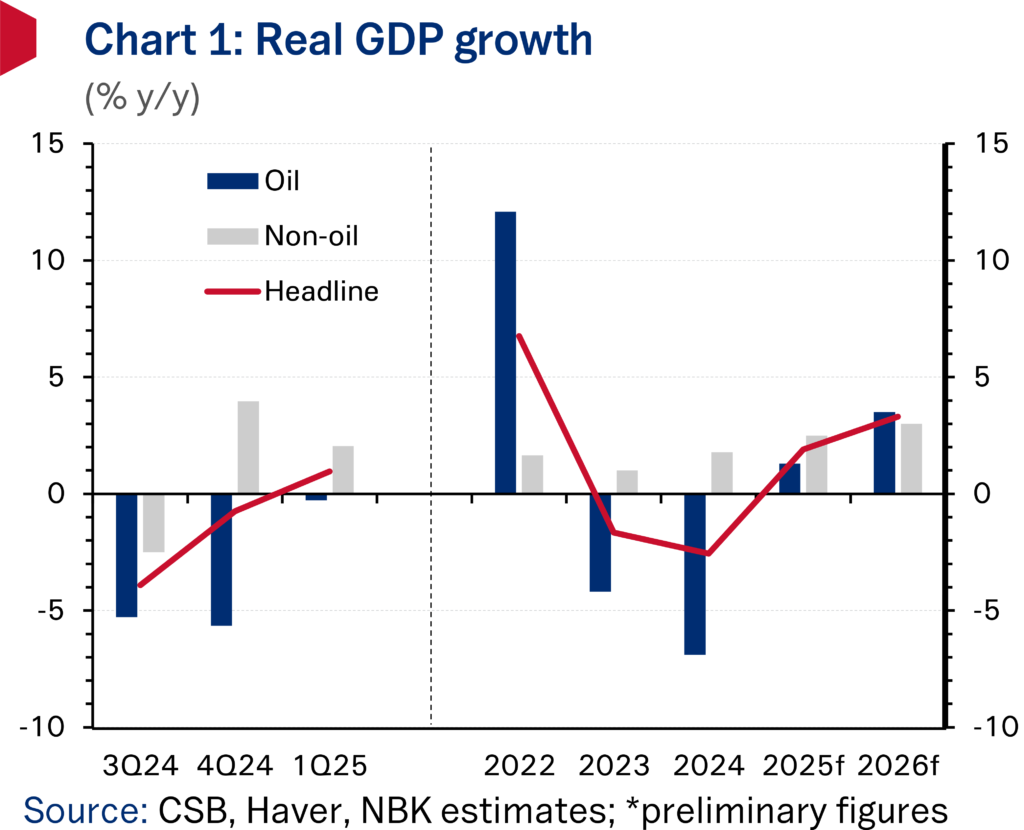
Preliminary official figures show GDP expanding 1% y/y in Q1 2025 following seven consecutive quarters of contraction, helped by a less severe downturn in oil output. With the negative effects of earlier voluntary oil production cuts beginning to fade, oil GDP recorded only a marginal decline, the softest since Q2 2023. Growth in non-oil activity remained positive though eased, weighed by a moderation in the manufacturing, real estate, and transport sectors. The near-term outlook for GDP is one of positive growth, lifted by rising oil production after Kuwait started to restore 135 kb/d of oil output cuts between April and September 2025, while the non-oil sector should also register further steady gains.

Non-oil GDP growth softens in Q1 2025 after strong performance in Q4 2024

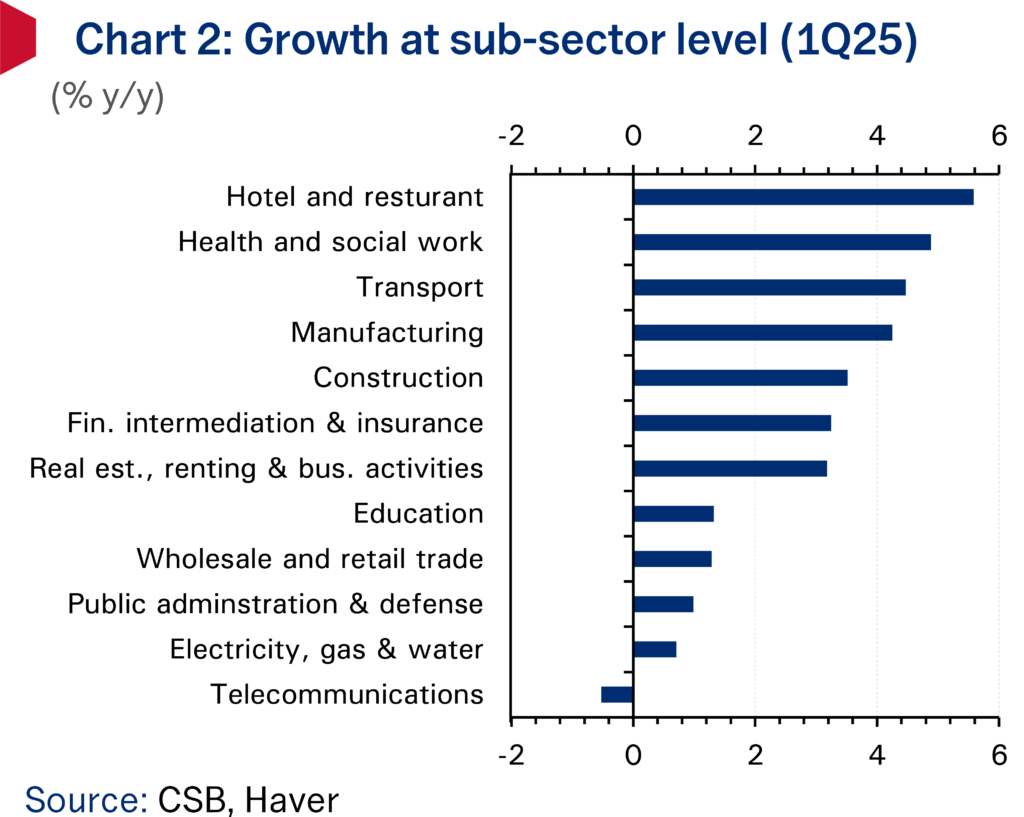
Growth in the non-oil sector weakened in Q1 2025, slowing to 2% y/y compared to 4% recorded in the prior quarter. (Chart 1.) The softer expansion in non-oil activity reflected, among other things, a moderation in the manufacturing sector, where activity grew at a still-solid 4.3% despite a decline in refined petroleum products output but slowed notably from the 12.2% reading registered in Q4 2024. Growth in other sectors including real estate, wholesale & retail trade, transport, and education also slowed. Offsetting the slowdown was stronger expansion in the non-oil economy’s largest segments: public administration and defense as well as financial intermediation and insurance, which grew 1% and 3.2% y/y, respectively. (Chart 2.)

Chart 1: Real GDP growth

Chart 2: Growth at sub-sector level (1Q25)

Oil sector logs marginal contraction, set to return to growth in Q2

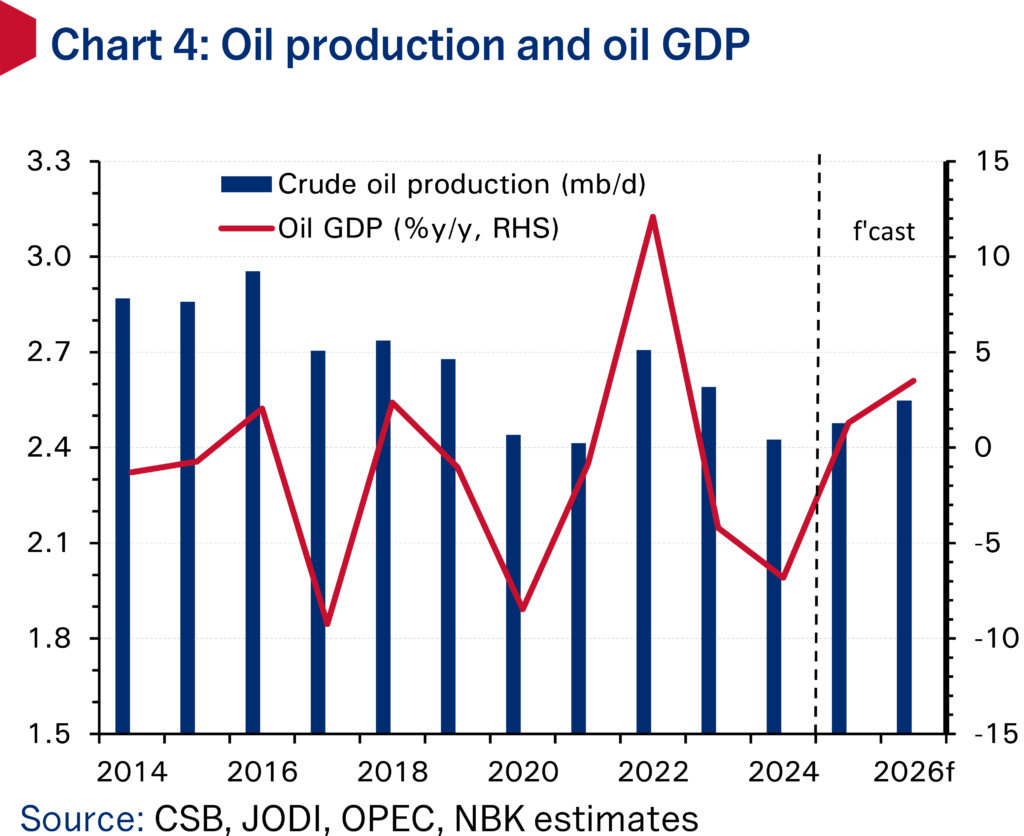
The contraction in oil GDP eased significantly to -0.3% y/y from -5.7% y/y in Q4 2024, registering the softest rate of decline since Kuwait embarked on cutting oil production in Q2 2023 after participating in the voluntary cuts scheme with 7 other OPEC+ members. (Chart 4.) Kuwait’s oil production averaged 2.415 mb/d in Q1 2025, a 0.7% decline from the same quarter last year, according to OPEC secondary sources. However, oil sector fortunes are set to shift in Q2 2025 and thereafter, after the OPEC-8 member alliance started unwinding the 2.2 mb/d voluntary cut tranche in April 2025. Originally planned to be unwound over the course of 18 months, OPEC+ has accelerated the pace of supply hikes with output now on a path to be fully restored in September, a full year ahead of schedule. For Kuwait, crude production rose by 0.5% q/q in Q2 to 2.426 mb/d and is set to accelerate further to average 2.533 mb/d in H2 2025. With the oil market so far able to absorb the additional OPEC and global supply and oil prices currently holding near $70/bbl, an upside risk to our oil sector outlook involves the potential unwinding of the outstanding OPEC-8 voluntary cuts (1.66 mb/d), of which Kuwait’s share is 128 kb/d.

Growth heading back into positive territory in 2025

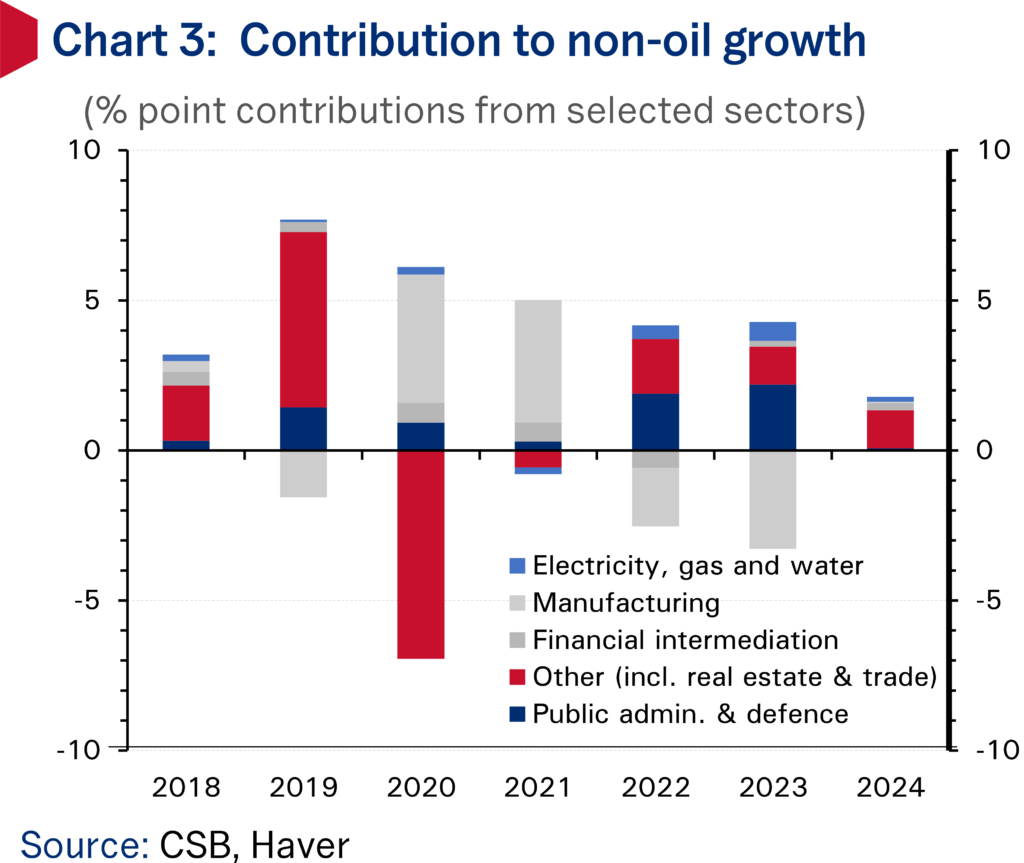
Growth in total GDP is set to remain on a positive trajectory in the near term, buoyed by further steady expansion in non-oil economic activity and increased oil production. Non-oil GDP is set to benefit from the government’s reform drive which includes the recent passing of the debt law that could catalyze the implementation of key development projects and the potential approval of the ‘mortgagelaw later in 2025, which could spur higher household borrowing and consumer spending. Economic indicators for Q2 2025 pointed to a healthy pace of non-oil economic activity. The key ‘output’ and ‘new orders’ balances in the non-oil private sector PMI gauge both averaged a very robust 57+ in Q2 2025, real estate activity continued to expand at a robust pace with earlier price falls in the residential sector abating, while credit growth stood at a healthy 5.5% y/y in May, and could benefit in coming months if interest rates are reduced further.

Nonetheless, there are also downside risks to the outlook. Local consumer spending growth (according to central bank card transactions data) turned negative in Q1 2025, extending the weakening trend now observed for more than a year. The government’s ongoing fiscal consolidation push will also weigh on wage and job growth. Overall, we see GDP growing 1.9% this year, boosted by expansions in both the oil and non-oil sectors of 1.2% and 2.5%, respectively.

Chart 3: Contribution to non-oil growth

Chart 4: Oil production and oil GDP

Read this article as an archived PDF.

Novels as Another University: Joseph Conrad

One can say that the first wave of imperial “neocons” was not the group that got the U.S. into the Iraq War (2003) but the group described by Warren Zimmerman in his classic book on the rise of the American Empire from the 1890s onwards:

First Great Triumph

How Five Americans Made Their Country a World Power.

By Warren Zimmermann.

Illustrated. 562 pp. New York: Farrar, Straus & Giroux

Americans like to pretend that they have no imperial past,” Warren Zimmermann tells us in First Great Triumph: How Five Americans Made Their Country a World Power. But they do.

The United States had been expanding its borders from the moment of its birth, though its reach had been confined to the North American continent until 1898, when American soldiers and sailors joined Cuban and Filipino rebels in a successful war against Spain. When the war was won, the United States acquired a “protectorate” in Cuba and annexed Hawaii, the Philippine Islands, Guam, Puerto Rico and Hawaii. “In 15 weeks,” Zimmermann notes, “the United States had gained island possessions on both the Atlantic and Pacific sides of its continental mass. It had put under its protection and control more than 10 million people: whites, blacks, Hispanics, Indians, Polynesians, Chinese, Japanese and the polyethnic peoples of the Philippine archipelago.”

John Hay, at the time the American ambassador to Britain, writing to his friend Theodore Roosevelt in Cuba, referred to the war against Spain as “a splendid little war, begun with the highest motives, carried on with magnificent intelligence and spirit, favored by that Fortune which loves the brave.” He hoped that the war’s aftermath would be concluded “with that fine good nature, which is, after all, the distinguishing trait of the American character.” More than a century later, we are still asking ourselves just how splendid that little war and its consequences really were.

Zimmermann, a career diplomat and a former United States ambassador to Yugoslavia, begins his brilliantly readable book about the war and its aftermath with biographical sketches of the five men — Alfred T. Mahan, Theodore Roosevelt, Henry Cabot Lodge, John Hay and Elihu Root — who played a leading role in making “their country a world power.”

Ironically, it turns out that any reader of Joseph Conrad’s (died in 1924) famous novel Nostromo from 1904 would have encountered the “manifesto” of the American Empire, very clearly enunciated by one of the characters in the novel:

“Time itself has got to wait on the greatest country in the whole of God’s universe. We shall be giving the word for everything; industry, trade, law, journalism, art, politics and religion, from Cape Horn clear over to Smith’s Sound (i.e., Canada/Greenland), and beyond too, if anything worth taking hold of turns up at the North Pole. And then we shall have the leisure to take in hand the outlying islands and continents of the earth.

“We shall run the world’s business whether the world likes it or not. The world can’t help it—and neither can we, I guess.”

Joseph Conrad, Nostromo, Penguin Books, 2007, pages 62/63

The political stances of Conrad which seem so denunciatory of imperialism here in Nostromo seem very disrespectful of Africans in his Heart of Darkness as Chinua Achebe (Nigerian novelist, author of Things Fall Apart) and other Africans have shown and decried. Thus one sees layer upon layer of contradiction both in American empire-mongering and Conrad’s anticipation of it in his novel Nostromo.