Science-Watching: Nature Contents: 21 November 2019

From Nature:

Editorial

Researchers Must Unite Against U.S. Environment Agency’s Attack on Scientific Evidence

[Archived PDF]

Human Germline Editing Needs One Message

[Archived PDF]

How California Can Use Its Research Muscle To Keep the Lights On

[Archived PDF]

World View

Stop the Science Training That Demands ‘Don’t Ask’

Jerry Ravetz

[Archived PDF]

News Round-Up

Hong Kong Violence, Deadly Bushfires and an Asteroid Farewell

[Archived PDF]

News

Rare Bird’s Detection Highlights Promise of ‘Environmental DNA’ 

Dyani Lewis

[Archived PDF]

Italy’s Plan to Create €300-Million Research Agency Draws Fire

Marta Paterlini

[Archived PDF]

‘Make Ebola a Thing of the Past’: First Vaccine Against Deadly Virus Approved

Ewen Callaway

[Archived PDF]

A Whole New World: Astronomers Draw First Global Map of Titan

Jonathan O’Callaghan

[Archived PDF]

Every Butterfly in the United States and Canada Now Has a Genome Sequence

Ewen Callaway

[Archived PDF]

Features

The Science Institutions Hiring Integrity Inspectors To Vet Their Papers

Alison Abbott

[Archived PDF]

How Two Intruders From Interstellar Space Are Upending Astronomy

Alexandra Witze

[Archived PDF]

Multimedia

Nature Podcast 21 November 2019

This week, an antibiotic that targets difficult-to-treat bacteria, and a roundup of the latest science news.

[Archived MP3]

Book Review

How We Probe and Pollute the Cosmos

Meg Urry

[Archived PDF]

How Stigma Subverts Public Health

Julie Pulerwitz

[Archived PDF]

The Art of Rest, Hive Minds, and Traversing Canada: Books in Brief

Andrew Robinson

[Archived PDF]

Comment

Disaster-Zone Research Needs a Code of Conduct

JC Gaillard & Lori Peek

[Archived PDF]

Feature

A Message for Mentors From Dissatisfied Graduate Students

Chris Woolston

[Archived PDF]

Technology Feature

Got Mutation? ‘Base Editors’ Fix Genomes One Nucleotide at a Time

Sandeep Ravindran

[Archived PDF]

Where I Work

Engineering a Dream Workspace

Kendall Powell

[Archived PDF]

Economics—Apple Card’s Fintech Problem; Improving AI-Based Recommendations; IBM & Nazi Germany

from Harvard Business School Working Knowledge:

Gender Bias Complaints against Apple Card Signal a Dark Side to Fintech

The possibility that Apple Card applicants were subject to gender bias opens a new frontier for the financial services sector in which regulators are largely absent, argues Karen Mills.

It’s No Joke: AI Beats Humans at Making You Laugh

New research shows people don’t trust recommendations made by machines—and that’s a problem for marketers who increasingly rely on AI-based technology to persuade consumers. Michael H. Yeomans explains how businesses can overcome that bias.

Do TV Debates Sway Voters?

As Democratic presidential candidates prepare for another debate, Vincent Pons reports that TV forums don’t influence voters.

Lessons from IBM in Nazi Germany

Geoffrey Jones discusses his case study, “Thomas J. Watson, IBM and Nazi Germany,” exploring the options and responsibilities of multinationals with investments in politically reprehensible regimes.

For Better Ideas, Bring the Right People to the Brainstorm

Better ideas emerge when extroverts and people open to new experiences put their heads together, according to research by Rembrand M. Koning. But what about introverts?

Should Non-Compete Clauses Be Abolished?

Non-compete clauses prevent workers from bringing secrets with them to competitors. But increasingly NCCs are unnecessarily restricting job mobility for low-level employees. Should they be banned? asks James Heskett.

Design Rules, Volume 2: How Technology Shapes Organizations series

Working papers by Carliss Y. Baldwin and Kim B. Clark explain how and why different types of technology design pose different opportunities and challenges for organizations and can become vital forces of innovation.

Economics—Policy Options: Increase Tax Rates on Capital Gains & Dividends

from Penn Wharton (University of Pennsylvania) Budget Model:

Policy Options: Increase Tax Rates on Capital Gains & Dividends

We estimate the budgetary and economic effects of increasing the top rate on long-term capital gains and qualified dividends from 20 percent to 24.2 percent, which is enacted on January 1st, 2021. We project that it will raise around $60 billion of additional revenue on a conventional basis over the 10-year budget window and increase GDP by 0.1 percent by 2050. [Archived PDF]

The Impact of Elite Schools / Digital Governance in Real Time / How Think Tanks Communicate

from the Center for Global Development:

The (Under) Performance of Elite Public Schools

Policymakers often claim elite public schools are vehicles for social mobility, but do these schools live up to the hype? Aisha Ali, Lee Crawfurd, and Susannah Hares review the evidence on the effects on the kids who attend elite schools—and those who don’t—and find that there are only small learning gains at high costs.

Read More →

Towards Real-Time Digital Governance

To improve public services, citizens need to be at the forefront of these efforts. In a new note, Alan Gelb, Neeraj Mittal, and Anit Mukherjee consider how digital technologies can play a supporting role, offering new opportunities for scalable, rapid feedback for better service delivery and accountability.

Read More →

The Evolution of Think Tank Research and Impact

What do think tanks exist to do? Influencing policy requires more than just research outputs, Helen Dempster writes. She outlines four target areas for research impact and the role of communications in amplifying this impact.

Read More →

Podcast

How Significant Is Household Headship? Agnes Quisumbing and Dominique van de Walle

Oct. 1 [archived MP3]

Parenting by the Data: Emily Oster

Aug. 16 [archived MP3]

Prospects for Prosper Africa

Jul. 15 [archived MP3]

View All →

Research

The New Economy of Africa: Opportunities for Nigeria’s Emerging Technology Sector

Vijaya Ramachandran, Jennifer Obado-Joel, Razaq Fatai, Junaid Sadiq Masood, Blessing Omakwu — Nov. 12 [archived PDF]

Lending Terms for IFAD Projects

Scott Morris, Jessie Lu — Nov. 12 [archived PDF]

Taxing “Bads”: An Overview of Research Initiatives

Ruth Lopert — Nov. 12 [archived PDF]

View All →

Blog

Where Policy and Research Meet: Takeaways from Workshops on CGD’s New Policy Decision Tree for Financial Inclusion

Liliana Rojas-Suarez, Diego Castrillón, Alejandro Fiorito — Nov. 18

Comments on World Bank Global Platform to Strengthen Education Financing

Barbara Bruns — Nov. 18

Bolivia’s Antipoverty Successes Are Going to Face Funding Challenges Thanks to Falling Gas Prices

Kyle Navis — Nov. 15

What Does China’s Investment in Africa Mean for Europe?

Hannah Timmis, Mikaela Gavas — Nov. 14

Is CGD Marxist? Responding to Red-Baiting from the World Bank

Justin Sandefur — Nov. 13

A Quick Guide to 100+ Publications by Economics Nobel Winner Abhijit Banerjee

David Evans — Nov. 12

The Future of IFAD Assistance

Scott Morris, Jessie Lu — Nov. 12

How Tough Is It to Be a Tech Entrepreneur in Nigeria? Results from a New Survey

Vijaya Ramachandran, Junaid Sadiq Masood — Nov. 12

View All →

Germany Watching

from Deutsche Bank Research, the new edition of Focus Germany:

Economic Weakness, Political Turbulence [PDF]

German exports and global trade have been moving in lockstep recently and more or less ground to a halt in YoY terms. We found that the Bundesbank’s leading indicator for global industrial production leads German exports by 4 to 5 months. Recent declines in this indicator do speak against a recovery in German exports before the end of Q1 2020, despite recent signs of stabilization in German foreign order intake. (Also included in this issue: house prices in Germany, labor market, automotive industry and German politics.)

If you have any further questions, please do not hesitate to contact Deutsche Bank Research.

Physics AI Predicts That Earth Goes Around the Sun

from Nature Briefing:

Hello Nature readers,

Today we learn that a computer Copernicus has rediscovered that Earth orbits the Sun, ponder the size of the proton and see a scientific glassblower at work.

Physicists have designed artificial intelligence that thinks like the astronomer Nicolaus Copernicus by realizing the Sun must be at the center of the Solar System. (NASA/JPL/SPL)

AI ‘Discovers’ That Earth Orbits the Sun [PDF]

A neural network that teaches itself the laws of physics could help to solve some of physics’ deepest questions. But first it has to start with the basics, just like the rest of us. The algorithm has worked out that it should place the Sun at the centre of the Solar System, based on how movements of the Sun and Mars appear from Earth.

The machine-learning system differs from others because it’s not a black that spits out a result based on reasoning that’s almost impossible to unpick. Instead, researchers designed a kind of ‘lobotomizedneural network that is split into two halves and joined by just a handful of connections. That forces the learning half to simplify its findings before handing them over to the half that makes and tests new predictions.

Next FDA Chief Will Face Ongoing Challenges

U.S. President Donald Trump has nominated radiation oncologist Stephen Hahn to lead the Food and Drug Administration (FDA). If the Senate confirms Hahn, who is the chief medical executive of the University of Texas MD Anderson Cancer Center, he’ll be leading the agency at the centre of a national debate over e-cigarettes, prompted by a mysterious vaping-related illness [archived PDF] that has made more than 2,000 people sick. A former FDA chief says Hahn’s biggest challenge will be navigating a regulatory agency under the Trump administration, which has pledged to roll back regulations.


Do We Know How Big a Proton Is?
[PDF]

A long-awaited experimental result has found the proton to be about 5% smaller than the previously accepted value. The finding seems to spell the end of the ‘proton radius puzzle’: the measurements disagreed if you probed the proton with ordinary hydrogen, or with exotic hydrogen built out of muons instead of electrons. But solving the mystery will be bittersweet: some scientists had hoped the difference might have indicated exciting new physics behind how electrons and muons behave.

Contingency Plans for Research After Brexit

The United Kingdom should boost funding for basic research and create an equivalent of the prestigious European Research Council (ERC) if it doesn’t remain part of the European Union’s flagship Horizon Europe research-funding program [archived PDF]. That’s the conclusion of an independent review of how UK science could adapt and collaborate internationally after Brexit — now scheduled for January 31, 2020.

Nature’s 150th anniversary

A Century and a Half of Research and Discovery

This week is a special one for all of us at Nature: it’s 150 years since our first issue, published in November 1869. We’ve been working for well over a year on the delights of our anniversary issue, which you can explore in full online.

10 Extraordinary Nature Papers

A series of in-depth articles from specialists in the relevant fields assesses the importance and lasting impact of 10 key papers from Nature’s archive. Among them, the structure of DNA, the discovery of the hole in the ozone layer above Antarctica, our first meeting with Australopithecus and this year’s Nobel-winning work detecting an exoplanet around a Sun-like star.

A Network of Science

The multidisciplinary scope of Nature is revealed by an analysis of more than 88,000 papers Nature has published since 1900, and their co-citations in other articles. Take a journey through a 3D network of Nature’s archive in an interactive graphic. Or, let us fly you through it in this spectacular 5-minute video.

Then dig deeper into what scientists learnt from analyzing tens of millions of scientific articles for this project.

150 Years of Nature, in Graphics

An analysis of the Nature archive reveals the rise of multi-author papers, the boom in biochemistry and cell biology, and the ebb and flow of physical chemistry since the journal’s first issue in 1869. The evolution in science is mirrored in the top keywords used in titles and abstracts: they were ‘aurora’, ‘Sun’, ‘meteor’, ‘water’ and ‘Earth’ in the 1870s, and ‘cell’, ‘quantum’, ‘DNA’, ‘protein’ and ‘receptor’ in the 2010s.

Evidence in Pursuit of Truth

A century and a half has seen momentous changes in science, and Nature has changed along with it in many ways, says an Editorial in the anniversary edition. But in other respects, Nature now is just the same as it was at the start: it will continue in its mission to stand up for research, serve the global research community and communicate the results of science around the world.

Features & Opinion

Nature covers: from paste-up to Photoshop

Nature creative director Kelly Krause takes you on a tour of the archive to enjoy some of the journal’s most iconic covers, each of which speaks to how science itself has evolved. Plus, she touches on those that didn’t quite hit the mark, such as an occasion of “Photoshop malfeasance” that led to Dolly the sheep sporting the wrong leg.

Podcast: Nature bigwigs spill the tea

In this anniversary edition of BackchatNature editor-in-chief Magdalena Skipper, chief magazine editor Helen Pearson and editorial vice president Ritu Dhand take a look back at how the journal has evolved over 150 years, and discuss the part that Nature can play in today’s society. The panel also pick a few of their favorite research papers that Nature has published, and think about where science might be headed in the next 150 years.

Where I Work

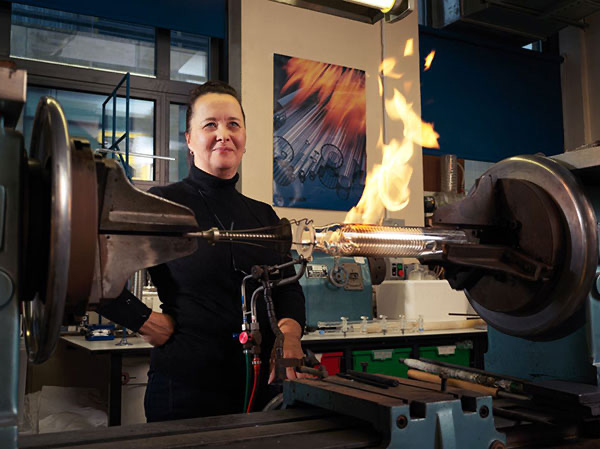
Scientific glassblower Terri Adams uses fire and heavy machinery to hand-craft delicate scientific glass apparatus. “My workbench hosts an array of tools for working with glass, many of which were custom-made for specific jobs,” says Adams. “Each tool reminds me of what I first used it for and makes me consider how I might use it again.” (Leonora Saunders for Nature)

Quote of the Day

“At the very least … we should probably consider no longer naming *new* species after awful humans.”

Scientists should stop naming animals after terrible people — and consider renaming the ones that already are, argues marine conservation biologist and science writer David Shiffman. (Scientific American)

Yesterday was Marie Skłodowska Curie’s birthday, and for the occasion, digital colorist Marina Amaral breathed new life into a photo of Curie in her laboratory

(If you have recommended people before and you want them to count, please ask them to email me with your details and I will make it happen!) Your feedback, as always, is very welcome at briefing@nature.com.

Flora Graham, senior editor, Nature Briefing

Podcast-Alert: Cars, Steel & National Security

Listen to The Sound of Economics

Guntram Wolff is joined by Alan Beattie, the author of the FT’s new Trade Secrets newsletter, and by André Sapir, Bruegel’s very own trade expert to discuss President Trump’s tariffs and whether or not they’re working.

Bruegel has launched an updated series of the Sound of Economics, hosted by Bruegel’s Director Guntram Wolff, Deputy Director Maria Demertzis and former Economist journalist Nicholas Barrett. Subscribe on iTunes, Spotify or Google Podcasts.

Previous Episodes

How to Make the European Green Deal Work

The European Green Deal will be a defining feature of Ursula Von der Leyen’s incoming Commission. But will carbon border taxes and single carbon prices be enough to make Europe climate-neutral by 2050? This week, Nicholas Barrett and Guntram Wolff discuss Bruegel’s new paper “How to make the European Green Deal Work” [Archived PDF] with Grégory Claeys and Simone TagliapietraListen here.

How Not to Spend It

Digital banking has made our lives easier, but why are people use mobile banking more likely to be overdrawn? This week Maria Demertzis and Nicholas Barrett are joined by Annamaria Lusardi, Denit Trust Endowed Chair of Economics and Accountancy from George Washington University School of Business to discuss financial literacy. Listen here.

World-Watching: India

(from ICRIER Newsletter | November 2019 | Vol. III, Issue 11)

The November 2019 issue of the Newsletter provides a quick recap of ICRIER’s research and policy engagements during the month of October 2019.

Three research reports were released by ICRIER last month in the areas of competition, trade and investment and climate change (See below).

ICRIER also organized consultation workshops, dissemination and outreach events during the month. ICRIER researchers published several articles in leading newspapers and other media platforms on a variety of current issues such as growth, agriculture, trade, FTAs, RCEP, single use plastics and the Economics Nobel. We sincerely hope that you will take a few moments to glance through these updates and engage further with anything that interests you. We hope you enjoy the newsletter’s new format. As always, we welcome your valuable feedback.

Competition Issues in India’s Mobile Handset Industry

(Rajat Kathuria, Mansi Kedia and Kaushambi Bagchi)

Mobile phones have been the key to India’s technology revolution. India is the second largest mobile phone market globally, next only to China. At the end of 2018, the estimated number of smart phone users in India was 337 million, compared to 2.53 billion users worldwide. One would imagine that the exponential increase in cheaper smart phone models would displace the market for feature phones; to the contrary, feature phones continue to dominate the Indian market. While smart phone and feature phone shipments in 2018 Q3 were about the same, a comparison of growth rates shows that both phablets (large screen smartphones) and regular smartphones eclipse feature phones.

Read more (archived PDF).

Exploring Trade and Investment Opportunities between India and Select African and Asian Economies

(Anirudh Shingal, Neha Gupta, Minakshee Das, Akshaya Aggarwal and Varsha Jain)

Using descriptive statistical analysis, this study examines trade and investment opportunities between India and 41 African and Asian economies (mostly LDCs) by focusing on the latter’s export opportunities in the Indian market and on India’s investment opportunities in the selected countries. It also discusses barriers to realizing the identified trade and investment opportunities between India and the selected economies, based on a review of the existing literature.

Read more (archived PDF).

Financing Resilience against Natural Disasters

(Saon Ray, Samridhi Jain and Vasundhara Thakur)

Disaster Risk Resilience can be interpreted as global policies working for improving disaster risk reduction. The Sendai Framework for Disaster Risk Reduction is the guiding principle for efforts to improve resilience worldwide. This report links the global efforts for disaster risk reduction with resilient infrastructure. The report analyses the applicability of popular instruments for emerging economies, the role of the private sector, and challenges to implementation of resilience framework. It maps the evolution and status of disaster risk financing in India.

Read more (archived PDF).

ICANN 66 Pre-Meeting Briefing

ICRIER hosted the ICANN 66 Pre-Meeting Briefing on 18th October 2019 for its Indian stakeholders. This edition of the Pre-Meeting Briefing looked closely at the developments between ICANN 65 and ICANN 66 and highlighted some of the key policy discussions currently underway at ICANN. The event witnessed participation from various stakeholders from India, including representatives from the Ministry of Electronics & Information Technology (MeitY), National Internet Exchange of India (‘.in’ registry) along with Indian representatives active in various policy development processes at ICANN. ICANN 65 was held in Montreal, Canada, between 2-7 November 2019. ICRIER will also be hosting the ICANN 66 Readout during the first week of December 2019 to highlight some of the key takeaways from ICANN 66.

Read more [archived PDF].

Dissemination of the India-LDCs Trade and Investment Study

ICRIER organised Dissemination of the Report Exploring Trade and Investment Opportunities between India and Select African and Asian Economies on October 14, 2019 at Magnolia Hall, India Habitat Centre, Lodhi Road, New Delhi.

Welcome remarks were delivered by Dr. Rajat Kathuria, Director & CE, ICRIER and the Introductory Session was Chaired by Dr. Jayant Dasgupta, IAS (Retd.) Former Ambassador of India to the WTO. Dr. Anirudh Shingal, Sr. Fellow, ICRIER presented the key findings of the report, which was followed by a Panel discussion Chaired by Dr. Arpita Mukherjee, Professor, ICRIER.

Read more [archived PDF] [Presentation PDF] [Report PDF]

Market Incentives, Direct Income Support for Farmers are far more Effective in Increasing Agricultural Productivity

(Ashok Gulati, Sakshi Gupta)

Read article [archived PDF]

Cities at Crossroads: Single-use Plastic only Part of the Challenge

(Isher Judge Ahluwalia, Almitra Patel)

Read article [archived PDF]

From Plate to Plough: Agri-Policy Lessons from China

(Ashok Gulati & Sakshi Gupta)

Read article [archived PDF]

Growth, Income, Poverty and the Nobel

(Alok Sheel)

Read article [archived PDF]

Understanding the RCEP with Rajat Kathuria

(Rajat Kathuria)

Listen to podcast [archived MP3 audio] [PDF transcript]

The Five-trillion Math

(Alok Sheel)

Read article [archived PDF]

Has PM-Kisan Belied Expectations?

(Siraj Hussain)

Read article [archived PDF]

How Government Can Control Sudden Spike in Prices of Onion and Tomato

(Ashok Gulati & Harsh Wardhan)

Read article [archived PDF]

Best of Business Standard Opinion: Corporate Tax Cuts, Pollution Challenge…

(Durgesh K. Rai)

Read article [archived PDF]

India’s Trade with its FTA Partners: Experiences, Challenges…

(Durgesh K. Rai)

Read article [archived PDF]

India’s Trade Policy Should Lend an Ear to a Wider Range of Voices

(Ujjwal Krishna & Amrita Saha)

Read article [archived PDF]

Monsoon’s Late Surge Helps, But Floods Hurt Crop Prospects

(Siraj Hussain)

Read article [archived PDF]

U.S. Energy-Related Carbon Dioxide Emissions, 2018 release

The U.S. Energy Information Administration (EIA) has released its analysis of 2018 energy-related carbon dioxide emissions. According to the report, U.S. carbon dioxide (CO2) emissions from the consumption of fossil fuels were 5,269 million metric tons (MMmt) in 2018, an increase of 2.7% (139 MMmt) from the 2017 level. Despite this increase, energy-related CO2 emissions have declined in 6 of the past 10 years. This analysis is based on data contained in the October 2019 Monthly Energy Review.

See the full report [archived PDF].

World Watching: U.S.-China Tariffs

(from the PIIE Insider)

News and Analysis from the Peterson Institute for International Economics
November 13, 2019

They Saved the Worst for Last: Why Trump’s Impending December Tariffs on China Should Be Rolled Back

The terms and deadlines of President Donald Trump’s trade war with China are hard to follow, but one thing is clear: American consumers and businesses should welcome a rollback of impending final rounds of China tariffs as part of a possible “phase 1” deal to be announced later in November, say Mary E. Lovely and Yang Liang. Washington has acted against China to punish it for preventing US access to the Chinese market and for violating US intellectual property rights.  Beijing is reportedly demanding that impending December tariffs be dropped before they sign any deal. Trump says he hasn’t decided how many tariffs might be lifted.

Key Takeaways

Read the full story at PIIE [archived PDF].