Digitizing Heritage: Exploring the Transformation of Culture to Data

[from India in Transition by the Center for the Advanced Study of India at the University of Pennsylvania, 1 September 2025]

by Krupa Rajangam & Deborah Sutton

“Oh that. We just took some undergraduate history students on board as interns. They provided the content and it was done.

The co-founder of a digital heritage initiative promoting interactive user interfaces offered these opening remarks. Speaking at a Delhi-based museum, he had been asked about the information provided to users as they moved their hands across an interactive board, revealing images and narratives relating to the Indian freedom movement. His response clarified that the physical and digital components of such installations—for example, the 3D-modeling software and hardware, scanning equipment and its resolution and the user interface—were more carefully designed and calibrated than the content they provided.

Contemporary cultural heritage (CH) is rife with digital innovation. The COVID pandemic accelerated this transformation as archivists and curators worked to develop content that would reach remote, locked-down audiences. Within significant limits, digital platforms can democratize and facilitate access to materials previously inaccessible. Instead of being physically siloed, digitized material—as data components and not just content on culture—can be reproduced, combined, and circulated infinitely to achieve a reach previously considered impossible. Accessibility and malleability remain one of the great boons of digital formats. But here, we consider the information economy of CH practice as it exists—and not its extraordinary and often hypothetical potential—in two, overlapping realms of digitized CH: for-profit business enterprises and academic side-hustles, related to more mainstream academic research.

In the former, questions of what is shared are often less significant than the appeal of the format. In the latter, innovation is often the result of short-term projects that languish, abandoned after project completion, and rarely find audiences. Our research builds on our individual experiences and the findings of a scoping exercise examining a number of India-based heritage projects conducted in 2021-22. It suggests the need for more careful consideration of the implications of transforming CH materials into forms of data; the change impacts everything from how we understand “originality” to the reliance on for-profit services to deliver heritage material to the public.

As digitized representations of CH and access to such formats become more widespread, are we, as CH practitioners and academics, giving enough thought to how digital technologies are reshaping the nature of CH and its audience? Beyond questions of wider reach, are we sufficiently acknowledging how these changes challenge a continued focus on originality and notions of academy as primary controllers of access to knowledge and its validity, both in research and practice?

Digitizing for Dissemination

In 2019, one of us—Deborah Sutton—developed a software platform, Safarnama, including an app and authored experiences around Delhi’s CH. The project subsequently extended to Karachi. Generating “original” content, such as audio-visual clips and old photos, to be hosted on the app platform, was key to its attractiveness and usefulness, but permissions proved tricky. Some collaborators who were initially keen to contribute content quietly withdrew, likely due to the unfamiliar format and unknown reach. The app format also raised other questions. Would incorporating content from non-digital but published scholarship require authorial permission or only acknowledgement?

In 2020, Krupa Rajangam held a sponsored incubation at the NSRCEL, a business incubator located at the Indian Institute of Management-Bangalore, to develop a web interface that would host geo-locationed stories of marginalized histories by drawing on both historical facts and lived experiences. Corporate mentors remained skeptical of her ability to source “original” content on an ongoing basis, i.e., content that was both authenticated and validated. They repeatedly advised her to focus on the format, user experience, and appeal for “mass markets” so her prototype would find audiences. Both projects equally raised questions over who would consume the content and what constitutes the public or audience.

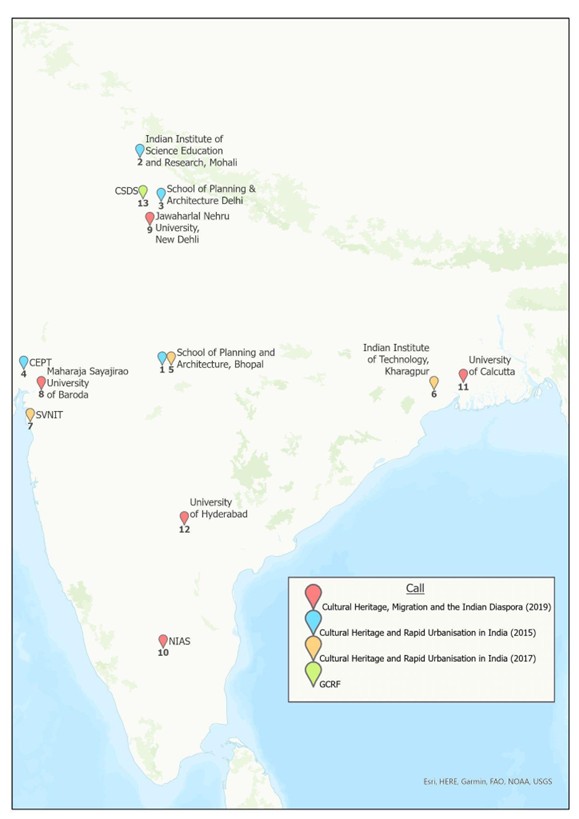
In a scoping exercise undertaken for the Arts and Humanities Research Council (AHRC), UK, in 2021-22, we explored a number of India-based heritage projects funded by the AHRC in partnership with the Newton Fund and Indian Council for Historical Research, since 2015 (figure 1). We were particularly interested in the digital components, which all projects included, even if only a website.

Our exploratory surveys firmly established the divergence in interpreting both CH and digital technologies, which was not surprising. Some projects defined and treated CH as fixed pre-existing material, to be interpreted and presented to audiences through digital technologies. Others re-framed digital formats of CH as components of data, assembling, manipulating, and representing extant archival and other materials. The rest generated digitized CH, effectively altering its nature. Typically, such projects dealt with more ephemeral or less conventional forms of CH.
Fundamental Transformations

Notions of originality remain central to art, architectural and art historical training, and CH practice. Digitization transforms the access and retrieval value of “original” material in physical archives, such as old maps and letters, much lauded in traditional “analog” scholarship, to use value as data. Once the end-user (audience) accesses this data (whether historical facts or stories), it becomes nothing more than bytes occupying valuable space, to be deleted once consumed rather than stored, making it easy to overlook or disregard the source and its context.

For example, in the Safarnama project, the app contained carefully collected and authenticated narratives on “partition memories” in Delhi and Karachi. However, the bite-sized media format meant that users would only explore content once, as snippets. This realization led the team to develop the software and incorporate the ability to download content, which at least meant that users could collect, organize and store (archive) the assembled media.

Digitization also takes away the materiality of the archive, making it more ephemeral. Non-digital materials through, and into which we render CH can (in endless combinations and cycles) be lost, forgotten, sold, recovered, collected, displayed, and stored. Such capacities of digital files are obvious, but maintaining access depends on varied and dynamic software ecologies for existence and sustained end-user access. Digital files created within one software-architecture can be incompatible with, and therefore rendered obsolete, by another. The ethos of software development is constant change.

In another paper, we examined questions of quantity, quality, and reusability of data related to digitization of building-crafts knowledge alongside CARE and FAIR principles of data management. The principles were proposed and adopted by an international consortium of scholars and industry, the former focused on responsible collection, use, and dissemination of data, especially related to vulnerable people and the latter on sustainable data management.

As an example, one AHRC project experimented with methods to capture detailed 3D images of heritage sites and structures in dynamic crowded environments. They used one set of methods to capture the interiors and another for the exteriors, hoping to merge both together and develop holistic imagery for audiences. This proved impossible at first due to issues of software compatibility. Once that was partially resolved, the new software couldn’t handle the sheer volume of data captured—and it was unclear where and for how long such volumes of data would be stored.

New realms of intellectual property remain fuzzy. While the content on digital platforms is governed by licensing and proprietary legal frameworks, it is often hosted on open platforms, through web repositories such as GitHub. Prima facie, such openness appears to challenge the proprietorial nature of archives and other repositories as keepers of knowledge. However, it raises a host of questions about how to maintain a critical understanding of archives.

Digitization may, and should, transform access but should it obliterate the regimes through which the materials were generated and organized and what’s included or excluded? For example, a local coordinator of one project that engaged with artists commented that digital technologies are typically used to document technical skills as forms of intangible heritage and develop artist encyclopedias, saying that “they are hardly used to interrogate the reality that many ‘traditional’ artists hail from marginalized castes.” Similarly, the local coordinator of another project that engaged with communities living in and around a protected heritage site commented on how digital technologies often end up being used to create a record of heritage structures without any reference to their day-to-day setting.

Any and all digital enterprise in CH, we argue, needs to integrate the ambition to use digital methods to not just present but also counter and interrogate the material, its creation, and purpose. Digital platforms and web- and app-based software are now able to manipulate and re-situate information in unprecedented ways. The novelty of such formats can displace original, provocative, and timely considerations of the material. Often, we are so taken by the visual and structural attributes of these formats, that we accept it at face value and lose sight of the tone and content of heritage as a curated message about the past and the present.

Alongside this, digital augmentations and iterations of CH, including storage, have significant financial and infrastructural implications. The creation and maintenance of digital platforms requires either developing “in-house” digital specialization or, more commonly, reliance on private, for-profit platforms. Paying for external provision introduces complexities. Funders, including the AHRC, struggle to devise guidance or policy in relation to software licensing. However, a persistent challenge to projects, and partnerships between academic and non-academic partners, is devising data and software strategies that subsist beyond the life of the funded-research project. Often, the adverse effects of the paucity of longer-term planning around IP issues, sustainability, and data archiving falls disproportionately on the non-academic stakeholder.

While digitization foregrounds the potential and promise of complete openness and equity, maybe this is lost in practice. Or digitization may merely mark the displacement of one set of ethics with another. There is a need for more careful consideration of the implications, complexities, and risks of taking CH materials out of boxes and off shelves and transforming and generating it into data files, which are, in turn, dependent on digital platforms to provide end-user access. However, the question remains of whether heritage-related disciplines are adequately prepared and willing to confront such new ways of working, which have begun to dislodge some of the privileges extant in current forms of research and practice.

Krupa Rajangam is nearing the end of her tenure as a Fulbright Fellow at the Historic Preservation Department, Weitzman School of Design, University of Pennsylvania. Her permanent designation is Founder-Director, Saythu…linking people and heritage, a professional conservation collective based in Bangalore, India.

Deborah Sutton is a Professor in Modern South Asian History at Lancaster University.

Realms and Domains: Levels and Confusion

Are we governed by words or numbers? Martin Heidegger’s star pupil, Hans-Georg Gadamer, points a penetrating flashlight at this question of words vs. numbers when he writes, “It is obvious that not mathematics but the linguistic nature of people is the basis of human civilization.”

According to Gadamer, our primary way of being is interpretative rather than computative. Our fundamental function is to cope, not to theorize. He argues, we can never finally step outside the traditions and practices of our culture. As one critic stated, “the metaphysical aid of a view from nowhere is seen by Gadamer as a questionable illusion that can have damaging consequences for a culture. It is not that scientific methods are mistaken—he thinks that science is involved an unstoppable dynamic which cannot be halted by philosophical or other objections…Gadamer gives a central role to art in questioning the dominance of the methods of the natural sciences. The artwork is not something to be determined by concepts, but something which ‘happens’ via its reception in real social contexts…”

Think about the interaction between words and numbers in the opening of Vladimir Nabokov’s memoir, Speak, Memory:

The cradle rocks above an abyss, and common sense tells us that our existence is but a brief crack of light between two eternities of darkness. Although the two are identical twins, man, as a rule, views the prenatal abyss with more calm than the one he is heading for (at some forty-five hundred heartbeats an hour).

Vladimir Nabokov, Speak, Memory, Vintage Books, 1989, page 19.

Note how Nabokov describes our existence above. Think about the word “eternities”? It brings to mind infinity. For example, in algebra, 1/x goes to infinity as 1 approaches zero. Nabokov also states that man is doing all this infinity-watching which he describes in heartbeats per hour.

Another issue in this realm and domain confusion is provided by Gabriel Marcel, when he writes, “We must carefully avoid all confusion between the mysterious and the unknowable.” Marcel continues:

A problem is something which I meet, which I find complete before me, but which I can therefore lay siege to and reduce. But a mystery is something in which I myself am involved, and it can therefore only be thought of as “a sphere where the distinction between what is in me and what is before me loses its meaning and its initial validity”. A genuine problem is subject to an appropriate technique by the exercise of which it is defined; whereas a mystery, by definition, transcends every conceivable technique. It is, no doubt, always possible (logically and psychologically) to degrade a mystery so as to turn it into a problem. But this is a fundamentally vicious proceeding, whose springs might perhaps be discovered in a kind of corruption of the intelligence. The problem of evil, as the philosophers have called it, supplies us with a particularly instructive example of this degradation.

Just because it is the essence of mystery to be recognized or capable of recognition, it may also be ignored and actively denied. It then becomes reduced to something I have “heard talked about” but which I refuse as only “being for other people”; and that in virtue of an illusion which these “others” are deceived by, but which I myself claim to have detected.

We must carefully avoid all confusion between the mysterious and the unknowable. The unknowable is in fact only the limiting case of the problematic, which cannot be actualized without contradiction. The recognition of mystery, on the contrary, is an essentially positive act of the mind, the supremely positive act in virtue of which all positivity may perhaps be strictly defined. In this sphere everything seems to go on as if I found myself acting on an intuition which I possess without immediately knowing myself to possess it— an intuition which cannot be, strictly speaking, self-conscious and which can grasp itself only through the modes of experience in which its image is reflected, and which it lights up by being thus reflected in them.

Gabriel Marcel, The Mystery of Being, Vol. 1: Reflection & MysteryHarper Torchbooks, 1965, page 260-261.

A final profound confusion is the body as a physical item vs. a means of expression. Picture Fred Astaire dancing opposite Ginger Rogers. You have both the movements of his dance and what he conveys through body language. In order to dance, you have the biochemical fuel (food) to enable the biomechanical movement of the dance. The courtship expressed through his movements is something different. Marcel describes it thus:

We should recall, at this point, what we said in an earlier lecture about the body; the latter is not merely an instrument, it presents us with a kind of reality which is quite different from the reality of any sort of apparatus, in so far as it, my body, is also my way of being in the world.

Gabriel Marcel, page 257.

See also “Existence and the Problem of Separability”, “Is It Good to Be a Detached Observer?” and “Arguments Without End: A Few Simple Examples” which also reference Marcel.

Heidegger vs. Marx as World Watchers

Marx (1818-1883) implies that the foundation of human reality is econo-technical, and on that basis society creates thoughts and philosophies, art and poems. This explanation seems appealing when we think of the economic development of China in our time, for example, or the rise of computers and software.

In a way, Heidegger (1889-1976) turns this upside down. At the basis of world history is society producing culture. You can make a simple “cartoon” and say that for Marx, economics shapes everything, and for Heidegger culture replaces economics.

For example, in his book, What Is Called Thinking? (English translation, 1968, Harper & Row), Heidegger argues the foundation of all Western thinking and culture comes from axioms such as logos [Ancient Greekλόγος] (from which we have logic, cosmology, psychology, epistemology, etc.), as well as legein (the Greek verb λέγειν, “to speak”).

Heidegger states (on page 204), “Without the λέγειν of that logic, modern man would have to make do without his automobile. There would be no airplanes, no turbines, no Atomic Energy Commission.”

Our MI comment on this is that any monocausal explanation of how mankind went from Neanderthal to the Manhattan skyline is completely inadequate. You must create a “double-helix” of Marx and Heidegger, adding the dimensions of surprise and unintended consequences. Without the physics concepts of emergence and complexity, we have no possibility of understanding how we got to now. In the site tagline, we use the word “composite” as a reference to this kind of deeper understanding.

Japanese Philosopher KARATANI Kōjin (柄谷 行人) Awarded the 2022 Berggruen Prize

An expansive thinker who crosses boundaries.

[from Nōema Magazine, by Nathan Gardels, Editor-in-Chief]

KARATANI Kōjin has been named this year’s laureate for the $1 million Berggruen Prize for Culture and Philosophy. An expansive thinker who straddles East and West while crossing disciplinary boundaries, Karatani is not only one of Japan’s most esteemed literary critics, but a highly original mind who has turned key suppositions of Western philosophy on their heads.

In Karatani’s sharpest departure from conventional wisdom, he locates the origins of philosophy not in Athens, but in the earlier Ionian culture that greatly influenced the so-called “pre-Socratic thinkers” such as Heraclitus and Parmenides. Their ideas centered on the flux of constant change, in which “matter moves itself” without the gods, and the oneness of all being—a philosophical outlook closer to Daoist and Buddhist thought than to Plato’s later metaphysics, which posited that, as Karatani puts it, “the soul rules matter.”

In the political realm, Karatani contrasts the form of self-rule from Ionian times based on free and equal reciprocity among all inhabitants — “isonomia” — with what he calls the “degraded democracy” of Athens that rested on slavery and conquest. He considers the former the better foundation for a just polity.

In a novel twist on classical categorizations, Karatani regards Socrates himself as fitting into the pre-Socratic mold. “If one wants to properly consider the pre-Socratics, one must include Socrates in their number,” he writes. “Socrates was the last person to try to re-institute Ionian thought in politics.”

A Degraded Form of Democracy in Athens

For Karatani, Athenian democracy was debased because it was “constrained by the distinctions between public and private, and spiritual and manual labor,” a duality of existence that Socrates and the pre-Socratics sought to dismantle. As a result, by Karatani’s reading, Socrates was both held in contempt by the “aristocratic faction,” which sought to preserve its privileges built on the labor of others, and condemned to death by a narrow-minded mobocracy for his idiosyncratic insistence on autonomy and liberty in pursuit of truth.

Appalled at Socrates’ fate, Plato blamed democracy for giving birth to demagoguery and tyranny, radically rejecting the idea of rule by the masses and proposing instead a political order governed by philosophers. In Karatani’s reckoning, Plato then “took as his life’s work driving out the Ionian spirit that touched off Athenian democracy”—in short, throwing out the baby with the bathwater but maintaining the disassociations, such as citizen and slave, that follow from the distinction between public and private grounded in an apprehension of reality that separates the spiritual from the material.

In order to refute “Platonic metaphysics,” Karatani argues, “it is precisely Socrates that is required.”

Turning Marx On His Head

In his seminal work, The Structure of World History, Karatani flips Marx’s core tenet that the economic “mode of production” is the substructure of society that determines all else. He postulates instead that it is the ever-shifting “modes of exchange” among capital, the state and nation which together shape the social order.

For Karatani, historically cultivated norms and beliefs about fairness and justice, including universal religions, compel the state to regulate inequality within the mythic commonality of the nation, which sees itself as whole people, tempering the logic of the unfettered market. As he sees it, the siren call of reciprocity and equality has remained deeply resonant throughout the ages, drawing history toward a return to the original ideal of isonomia.

Expanding the Space of Civil Society

Not an armchair philosopher, Karatani has actively promoted a modern form of the kind of reciprocity he saw in ancient Ionian culture, which he calls “associationism.” In practical terms in Japan, this entails the activation of civil society, such as through citizens’ assemblies, that would exercise self-rule from the bottom up.

In the wake of the Fukushima nuclear accident in 2011, Karatani famously called for “a society where people demonstrate” that would expand the space of civil society and constrict the collusive power of Japan’s political, bureaucratic and corporate establishment. Like other activists, he blamed this closed system of governance that shuts out the voices of ordinary citizens for fatally mismanaging the nuclear power industry in a country where earthquakes and tsunamis are an ever-present danger.

An Expansive Mind

Along with The Structure of World History (2014) and Isonomia and The Origins of Philosophy (2017), the breadth of Karatani’s interests and erudition are readily evident in the titles of his many other books. These include Nation and Aesthetics: On Kant and Freud (2017), History and Repetition (2011), Transcritique: On Kant and Marx (2003), Architecture As Metaphor: Language, Number, Money (1995) and Origins of Modern Japanese Literature (1993).

The prize ceremony will be held in Tokyo in the spring.

Interesting Intuition from Marx

There’s an intriguing and puzzling quote from Marx which is very informative in a completely unexpected way, when Marx says:

Life is not determined by consciousness, but consciousness by life.”
(The German Ideology, International Publishers, 1970, page 47)

This seems to fit Marx’s obsession with practical circumstances as the “driver” and ideas and subjective states of mind as secondary or even derivative. For Marx, culture and consciousness are “epiphenomena” like the foam on a wave.

In a different way, modern philosophers have their own versions of this:

  1. For Wittgenstein, “forms of life” come first before all else.
  2. For Husserl, “the life-world” comes before theory.
  3. For Heidegger, “being-in-the-world” comes before theory.

Marx’s reduction of everything to material circumstances as primary causes of everything would seem to these other philosophers as a kind of extremist monomania on Marx’s part, as when he says:

We do not set out from what men say, imagine, conceive, nor from men as narrated, thought of, imagined, conceived, in order to arrive at men in the flesh. We set out from real, active men, and on the basis of their real life-process we demonstrate the development of the ideological reflexes and echoes of this life-process. Their material life-process dominates.

The phantoms formed in the human brain are also, necessarily, sublimates of their material life-process which is empirically verifiable and bound to material premises. Morality, religion, metaphysics, all the rest of ideology and their corresponding forms of consciousness, thus no longer retain the semblance of independence.

Karl Marx with Friedrich Engels, The German Ideology, page 47

This idea from Marx is both suggestive and obsessive and maniacal at the same time, what the French call an “idée fixe” or fixation.

It is more accurate to say perhaps that life and consciousness are a “double helix.”