Science and Its Limits

The outstanding physics theoretician Max Tegmark of MIT tells the story of how Ernest Rutherford’s 1933 prediction about atomic energy (i.e., that is was “moonshine”)—was refuted before 24 hours had passed when Szilard (the Hungarian genius) realized that a nuclear chain reaction could be set in motion getting around Rutherford’s pessimistic prediction of only a few hours before:

“In London, where Southampton Row passes Russell Square, across from the British Museum in Bloomsbury, Leo Szilard waited irritably one gray Depression morning for the stoplight to change. A trace of rain had fallen during the night; Tuesday, September 12, 1933, dawned cool, humid and dull. Drizzling rain would begin again in early afternoon. When Szilard told the story later he never mentioned his destination that morning. He may have had none; he often walked to think. In any case another destination intervened. The stoplight changed to green. Szilard stepped off the curb. As he crossed the street time cracked open before him and he saw a way to the future, death into the world and all our woes, the shape of things to come…”

(Richard Rhodes, The Making of the Atomic Bomb)

This Tegmark/Szilard “refutation” of Rutherford in our times reminds one of MIT’s AI pioneer, Prof. Marvin Minsky’s limitless and perhaps too rosy predictions for AI and human intelligence in the sixties and seventies.

A student pursuing education has to live with the paradox and puzzle that unpredicted surprises and leaps do occur in the world of science and they are astonishing. It is true at the same time, that the realm of science (i.e., “how” questions) cannot address “why” questions. The question “how was I born?” cannot replace “why was I born?”

Both of these questions have possible answers at various levels and are subject to hierarchies.

Steven Jay Gould, the late Harvard biologist, had a felicitous phrase, “separate magisteria” (i.e., separate realms or domains) to describe this gap between the pursuit of personal meaning (human quest) and the pursuit of (tentative) accuracy (scientific quest).

Reports of Rising Police-Society Conflict in China

Interview with Suzanne Scoggins (November 25, 2019)

China is facing a rising tide of conflict between the nation’s police officers and the public. While protest events receive considerable media attention, lower-profile conflicts between police officers and residents also make their way onto the internet, shaping perceptions of the police. The ubiquity of live events streamed on the internet helps illuminate the nature of statesociety conflict in China and the challenges faced by local law enforcement.

Simone McGuinness spoke with Suzanne Scoggins, a fellow with the National Asia Research Program (NARP), about the reports of rising policesociety conflict in China. Dr. Scoggins discusses how the Chinese Communist Party has responded to the upsurge, what channels Chinese citizens are utilizing to express their concerns, and what the implications are for the rest of the world.

What is the current state of police-society relations in China?

Reports of police violence have been on the rise, although this does not necessarily mean that violence is increasing. It does, however, mean that the media is more willing to report violence and that more incidents of violence are appearing on social media.

What we can now study is the nature of that violence—some are big events such as riots or attacks against the police, but there are also smaller events. For example, we see reports of passengers on trains who get into arguments with transit police. They may fight because one of the passengers is not in the right seat or is carrying something prohibited. Rather than complying with the officer, the passenger ends up getting into some sort of violent altercation. This kind of violence is typically being captured by cellphone cameras, and sometimes it makes the news.

The nature of the conflict matters. If somebody is on a train and sitting in a seat that they did not pay for, then it is usually obvious to the people reading about or watching the incident that the civilian is at fault. But if it is chengguan (城管, “city administration”) telling an elderly woman to stop selling her food on the street and the chengguan becomes violent, then public perceptions may be very different. It is that second type of violence that can be threatening to the state. The public’s response to the type of conflict can vary considerably.

What are the implications for China as a whole?

Regarding what this means for China, it’s not good for the regime to sustain this kind of conflict between street-level officers or state agents and the public. It lowers people’s trust in the agents of the government, and people may assume that the police cannot enforce public security. There are many state agents who might be involved in a conflict, such as the chengguan, the xiejing (auxiliary officer), or the official police. The type of agent almost doesn’t matter because the uniforms often look similar.

When information goes up online of state agents behaving poorly, it makes the state a little more vulnerable. Even people who were not at the event might see it on social media or in the news and think, “Oh, this is happening in my community, or in my province, or across the nation.” This violates public expectations about how the police or other state agents should act. People should be able to trust the police and go to them when they have problems.

How has the Chinese government responded to the increase in reporting violence?

There is a twofold approach. The first is through censorship. When negative videos go up online or when the media reports an incident, the government will go in and take it down. We see this over time. Even while collecting my research, some of the videos that were initially available online are no longer accessible simply because they have been censored. The government is removing many different types of content, not only violence. Censors are also interested in removing any sort of misinformation that might spread on social media.

If step one is to take the video or report down, step two is to counteract any negative opinion by using police propaganda. This is also referred to as “public relations,” and the goal is to present a better image of the police. Recently, the Ministry of Public Security put a lot of money and resources into their social media presence. Many police stations have a social media account on WeChat or Weibo (微博, “microblogging”) and aim to present a more positive, friendly image of the police. The ministry also teamed up with CCTV to produce television content. This has been going on for some time, but recently shows have become more sophisticated.

There is one program, for example, called Police Training Camp. It is a reality show where police officers are challenged with various tasks, and the production is very glossy. The ministry also produces other sorts of specials featuring police who are out in the field helping people. It shows the police officers working really long shifts, interacting positively with the public, and really making a difference in people’s lives. In this way, the government is counteracting negative opinions about police violence or misconduct.

In general, I will say that it is difficult for people in any society to get justice with police officers because of the way legal systems are structured and the power police hold in local government politics. In China, one of the things people are doing beyond reaching out to local governments or pursuing mediation is calling an official hotline.

This is a direct channel to the Ministry of Public Security, and all these calls are reviewed. There is not a whole lot that citizens can do about specific corruption claims. But if somebody has a particular goal, then the hotline is slightly more effective because it allows citizens to alert the ministry. However, many people do not know about the hotline, so the ministry is trying to increase awareness and also help staff the call center so that it can more effectively field calls.

As for how much relief people feel when they use these channels, this depends on what their goal is. If the goal is to get somebody fired, then the hotline may not work. But if someone is looking to air their grievances, then it may be helpful.

What are the implications of increased police-society conflict in China for the rest of the world? What can the United States or other countries do to improve the situation?

These are really sticky issues that are difficult to solve. When discussing policesociety conflict, it is important to step back and think about who the police are—the enforcement agents of the state. So by their very nature, there will be conflict between police and society, and that is true in every country. In China, it really depends on where and what type of police climate we are talking about.

Xinjiang, for instance, has a very different police climate than other regions in China. There is a different type of policing and police presence. Chinese leaders certainly do not want any international intervention in Xinjiang. They see this as an internal issue. While some governments in Europe and the United States might want to intervene, that is going to be a nonstarter for China.

As for police problems more generally, I would say that if China is able to reduce some of the policesociety conflict in other areas of the country, then this is good for the international community because it leads to a more stable government. We also know that there is a fair amount of international cooperation between police groups. China has police liaisons that travel and learn about practices and technology in different countries. The police in these groups attend conferences and take delegates abroad.

There are also police delegations from other nations that go to China to learn about and exchange best practices. But that work will not necessarily address the underlying issues that we see in a lot of the stations scattered throughout China outside the big cities like Beijing (北京) or Shanghai (上海). Those are the areas with insufficient training or manpower. Those issues must be addressed internally by the Ministry of Public Security.

How is the Chinese government improving its policing capabilities?

Recently, the ministry has tried to overcome manpower and other ground-level policing problems by using surveillance cameras and artificial intelligence. Networks of cameras are appearing all over the country, and police are using body cameras for recording interactions with the public. This type of surveillance is not just in large cities but also in smaller ones. Of course, it is not enough to just put the cameras up—you also need to train officers to use that technology properly. This process takes time, but it is one way that the ministry hopes to overcome on-the-ground problems such as the low number of police per capita.

How might the Hong Kong protests influence or change policing tactics in China?

The situation in Hong Kong is unlikely to change policing tactics in China, which are generally more aggressive in controlling protests than most of what we have seen thus far in Hong Kong. It is more likely that things will go in the other direction, with mainland tactics being used in Hong Kong, especially if we continue to observe increased pressure to bring the protestors in check.

Suzanne Scoggins is an Assistant Professor of Political Science at Clark University. She is also a 2019 National Asia Research Program (NARP) Fellow. Dr. Scoggins holds a Ph.D. in Political Science from the University of California, Berkeley, and her book manuscript Policing in the Shadow of Protest is forthcoming from Cornell University Press. Her research has appeared in Comparative Politics, The China Quarterly, Asian Survey, PS: Political Science and Politics, and the China Law and Society Review.

This interview was conducted by Simone McGuinness, the Public Affairs Intern at NBR.

Economics—Apple Card’s Fintech Problem; Improving AI-Based Recommendations; IBM & Nazi Germany

from Harvard Business School Working Knowledge:

Gender Bias Complaints against Apple Card Signal a Dark Side to Fintech

The possibility that Apple Card applicants were subject to gender bias opens a new frontier for the financial services sector in which regulators are largely absent, argues Karen Mills.

It’s No Joke: AI Beats Humans at Making You Laugh

New research shows people don’t trust recommendations made by machines—and that’s a problem for marketers who increasingly rely on AI-based technology to persuade consumers. Michael H. Yeomans explains how businesses can overcome that bias.

Do TV Debates Sway Voters?

As Democratic presidential candidates prepare for another debate, Vincent Pons reports that TV forums don’t influence voters.

Lessons from IBM in Nazi Germany

Geoffrey Jones discusses his case study, “Thomas J. Watson, IBM and Nazi Germany,” exploring the options and responsibilities of multinationals with investments in politically reprehensible regimes.

For Better Ideas, Bring the Right People to the Brainstorm

Better ideas emerge when extroverts and people open to new experiences put their heads together, according to research by Rembrand M. Koning. But what about introverts?

Should Non-Compete Clauses Be Abolished?

Non-compete clauses prevent workers from bringing secrets with them to competitors. But increasingly NCCs are unnecessarily restricting job mobility for low-level employees. Should they be banned? asks James Heskett.

Design Rules, Volume 2: How Technology Shapes Organizations series

Working papers by Carliss Y. Baldwin and Kim B. Clark explain how and why different types of technology design pose different opportunities and challenges for organizations and can become vital forces of innovation.

Physics AI Predicts That Earth Goes Around the Sun

from Nature Briefing:

Hello Nature readers,

Today we learn that a computer Copernicus has rediscovered that Earth orbits the Sun, ponder the size of the proton and see a scientific glassblower at work.

Physicists have designed artificial intelligence that thinks like the astronomer Nicolaus Copernicus by realizing the Sun must be at the center of the Solar System. (NASA/JPL/SPL)

AI ‘Discovers’ That Earth Orbits the Sun [PDF]

A neural network that teaches itself the laws of physics could help to solve some of physics’ deepest questions. But first it has to start with the basics, just like the rest of us. The algorithm has worked out that it should place the Sun at the centre of the Solar System, based on how movements of the Sun and Mars appear from Earth.

The machine-learning system differs from others because it’s not a black that spits out a result based on reasoning that’s almost impossible to unpick. Instead, researchers designed a kind of ‘lobotomizedneural network that is split into two halves and joined by just a handful of connections. That forces the learning half to simplify its findings before handing them over to the half that makes and tests new predictions.

Next FDA Chief Will Face Ongoing Challenges

U.S. President Donald Trump has nominated radiation oncologist Stephen Hahn to lead the Food and Drug Administration (FDA). If the Senate confirms Hahn, who is the chief medical executive of the University of Texas MD Anderson Cancer Center, he’ll be leading the agency at the centre of a national debate over e-cigarettes, prompted by a mysterious vaping-related illness [archived PDF] that has made more than 2,000 people sick. A former FDA chief says Hahn’s biggest challenge will be navigating a regulatory agency under the Trump administration, which has pledged to roll back regulations.


Do We Know How Big a Proton Is?
[PDF]

A long-awaited experimental result has found the proton to be about 5% smaller than the previously accepted value. The finding seems to spell the end of the ‘proton radius puzzle’: the measurements disagreed if you probed the proton with ordinary hydrogen, or with exotic hydrogen built out of muons instead of electrons. But solving the mystery will be bittersweet: some scientists had hoped the difference might have indicated exciting new physics behind how electrons and muons behave.

Contingency Plans for Research After Brexit

The United Kingdom should boost funding for basic research and create an equivalent of the prestigious European Research Council (ERC) if it doesn’t remain part of the European Union’s flagship Horizon Europe research-funding program [archived PDF]. That’s the conclusion of an independent review of how UK science could adapt and collaborate internationally after Brexit — now scheduled for January 31, 2020.

Nature’s 150th anniversary

A Century and a Half of Research and Discovery

This week is a special one for all of us at Nature: it’s 150 years since our first issue, published in November 1869. We’ve been working for well over a year on the delights of our anniversary issue, which you can explore in full online.

10 Extraordinary Nature Papers

A series of in-depth articles from specialists in the relevant fields assesses the importance and lasting impact of 10 key papers from Nature’s archive. Among them, the structure of DNA, the discovery of the hole in the ozone layer above Antarctica, our first meeting with Australopithecus and this year’s Nobel-winning work detecting an exoplanet around a Sun-like star.

A Network of Science

The multidisciplinary scope of Nature is revealed by an analysis of more than 88,000 papers Nature has published since 1900, and their co-citations in other articles. Take a journey through a 3D network of Nature’s archive in an interactive graphic. Or, let us fly you through it in this spectacular 5-minute video.

Then dig deeper into what scientists learnt from analyzing tens of millions of scientific articles for this project.

150 Years of Nature, in Graphics

An analysis of the Nature archive reveals the rise of multi-author papers, the boom in biochemistry and cell biology, and the ebb and flow of physical chemistry since the journal’s first issue in 1869. The evolution in science is mirrored in the top keywords used in titles and abstracts: they were ‘aurora’, ‘Sun’, ‘meteor’, ‘water’ and ‘Earth’ in the 1870s, and ‘cell’, ‘quantum’, ‘DNA’, ‘protein’ and ‘receptor’ in the 2010s.

Evidence in Pursuit of Truth

A century and a half has seen momentous changes in science, and Nature has changed along with it in many ways, says an Editorial in the anniversary edition. But in other respects, Nature now is just the same as it was at the start: it will continue in its mission to stand up for research, serve the global research community and communicate the results of science around the world.

Features & Opinion

Nature covers: from paste-up to Photoshop

Nature creative director Kelly Krause takes you on a tour of the archive to enjoy some of the journal’s most iconic covers, each of which speaks to how science itself has evolved. Plus, she touches on those that didn’t quite hit the mark, such as an occasion of “Photoshop malfeasance” that led to Dolly the sheep sporting the wrong leg.

Podcast: Nature bigwigs spill the tea

In this anniversary edition of BackchatNature editor-in-chief Magdalena Skipper, chief magazine editor Helen Pearson and editorial vice president Ritu Dhand take a look back at how the journal has evolved over 150 years, and discuss the part that Nature can play in today’s society. The panel also pick a few of their favorite research papers that Nature has published, and think about where science might be headed in the next 150 years.

Where I Work

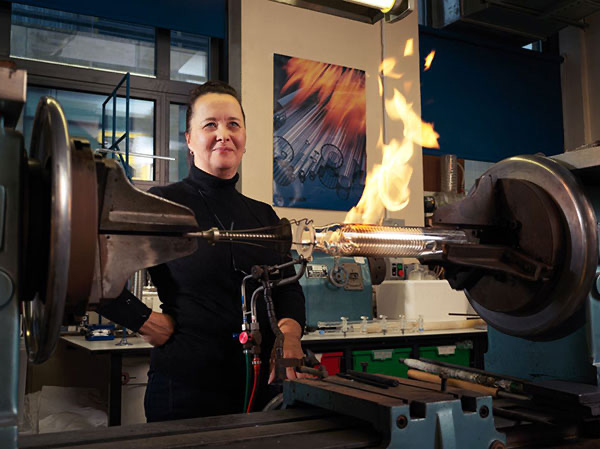
Scientific glassblower Terri Adams uses fire and heavy machinery to hand-craft delicate scientific glass apparatus. “My workbench hosts an array of tools for working with glass, many of which were custom-made for specific jobs,” says Adams. “Each tool reminds me of what I first used it for and makes me consider how I might use it again.” (Leonora Saunders for Nature)

Quote of the Day

“At the very least … we should probably consider no longer naming *new* species after awful humans.”

Scientists should stop naming animals after terrible people — and consider renaming the ones that already are, argues marine conservation biologist and science writer David Shiffman. (Scientific American)

Yesterday was Marie Skłodowska Curie’s birthday, and for the occasion, digital colorist Marina Amaral breathed new life into a photo of Curie in her laboratory

(If you have recommended people before and you want them to count, please ask them to email me with your details and I will make it happen!) Your feedback, as always, is very welcome at briefing@nature.com.

Flora Graham, senior editor, Nature Briefing