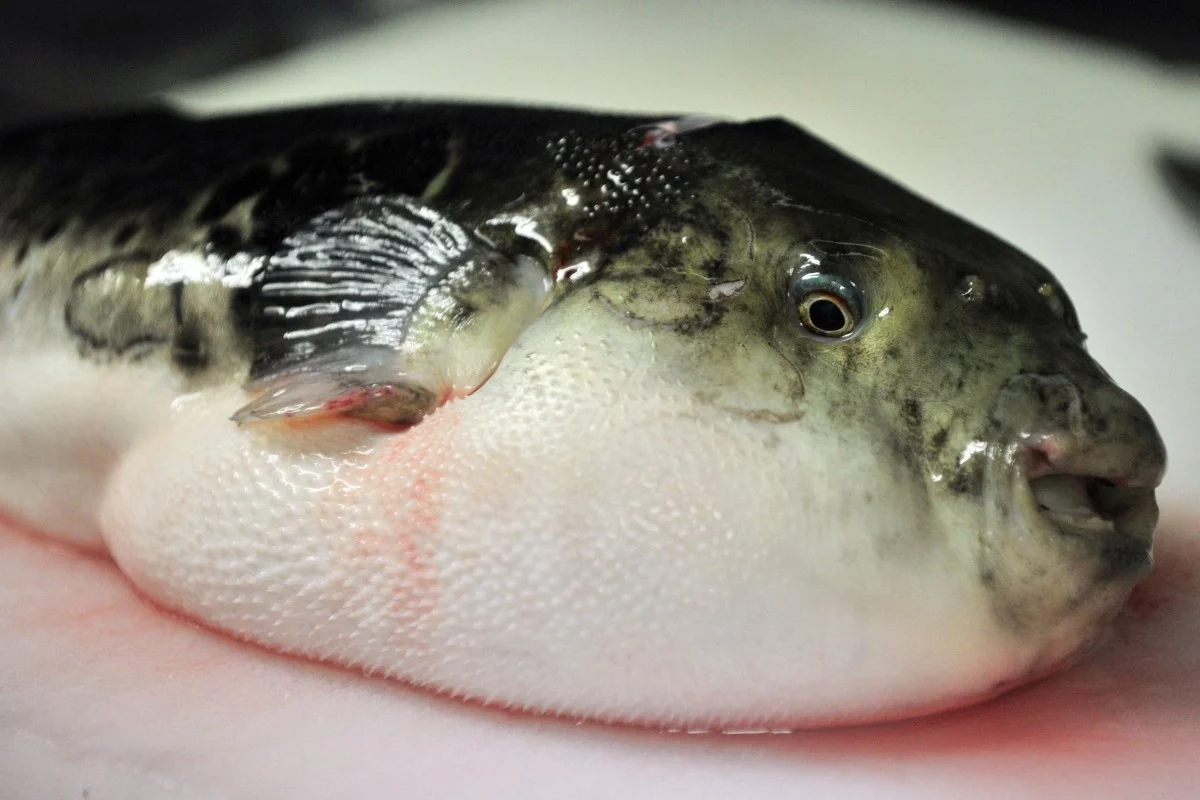
Japan’s Deadliest Delicacy Is Getting More Dangerous

Rising sea temperatures are pushing pufferfish species together, spawning hybrids that even specialist chefs cannot safely prepare

[from South China Morning Post]

by Julian Ryall

Japan’s most dangerous delicacy is getting harder to prepare safely as warming seas push different pufferfish species into the same waters, where they are inbreeding to produce hybrids whose lethal toxins are not yet fully understood.

Fugu – the collective Japanese name for several species of edible pufferfish – is prized as much for the danger surrounding its preparation as for its subtle flavour.

Many species contain tetrodotoxin, a powerful neurotoxin with no known antidote that can cause paralysis, respiratory failure and death.

Since 1958, anyone wishing to prepare pufferfish for public consumption has had to obtain a licence first, a process that takes at least two years and defeats roughly two-thirds of those who attempt it.
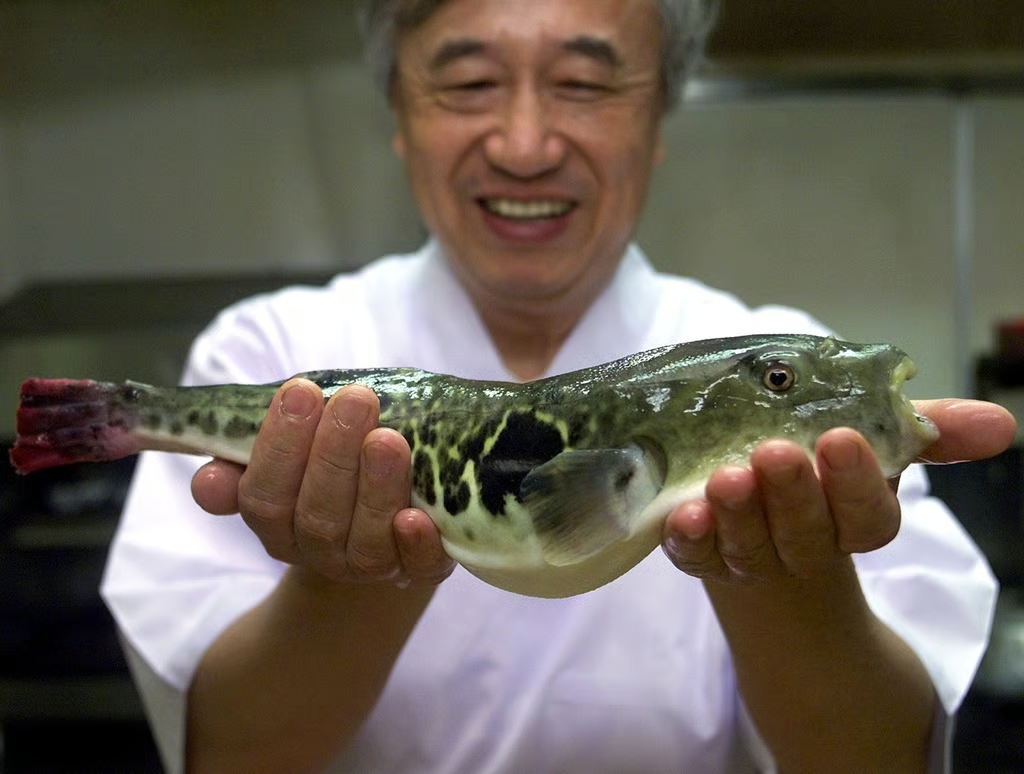
A restaurateur shows off a “fugu”, or pufferfish, at a restaurant in Shimonoseki, Japan. Photo: AP

Chefs learn to strip out the fish’s liver, ovaries, eyes and skin – tissues where the poison concentrates – with the precision of a brain surgeon and the nerve of a bomb-disposal technician.

But that hard-won expertise is now being undermined by climate-induced interbreeding, as experts say Japan’s coastal waters are heating up at roughly twice the global average rate.

Spotted pufferfish, once largely confined to the Sea of Japan, have spent the past decade steadily pushing northward in search of cooler currents. Some slipped through the Tsugaru Strait – the channel separating Honshu from far northern Hokkaido – where they have met and mated with the region’s native pufferfish species.

The resulting hybrids now make up as much as 40 per cent of local catches, according to a recent study of fish caught off Fukushima and Ibaraki prefectures.

“We started seeing these spotted fugu on the Pacific coast in 2012 as temperatures in the Sea of Japan became too high for them,” said Professor Hiroshi Takahashi of the National Fisheries University in Shimonoseki, Yamaguchi prefecture.

Temperatures in the waters there were “among the fastest rising anywhere in the world”, he told This Week in Asia, adding that the changes in pufferfish had been happening just as fast.
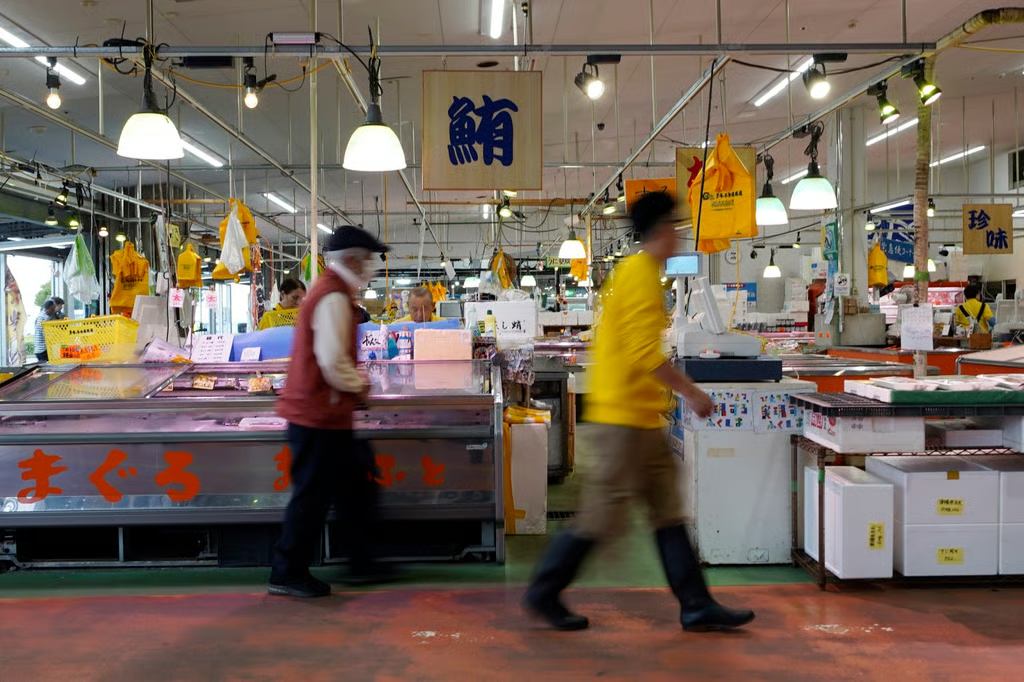
Customers visit a seafood market in Japan’s Fukushima prefecture. Photo: AP

Some spotted pufferfish had ventured down the east coast as far south as Tokyo Bay, Takahashi said, only to be driven north again as those waters also warmed.

Tiger pufferfish had likewise moved north from their usual range to interbreed with common pufferfish in and around Tokyo Bay, he added.

The trouble is not that hybrids are more toxic than their ancestors, it is that nobody yet knows how interbreeding has affected the distribution of toxins.

Each species of pufferfish stores tetrodotoxin in a different combination of organs and Japan’s health ministry has not yet been able to establish which parts of the new hybrids are safe to eat and which are not.

Until it does, the government has banned the sale or consumption of hybrid fugu – but this ban is almost impossible to enforce.

“They are very hard to identify,” said Takahashi, whose team has developed a DNA test capable of distinguishing hybrid fish and hopes to make the technology commercially available to fishermen who currently have no reliable way of screening their catch.
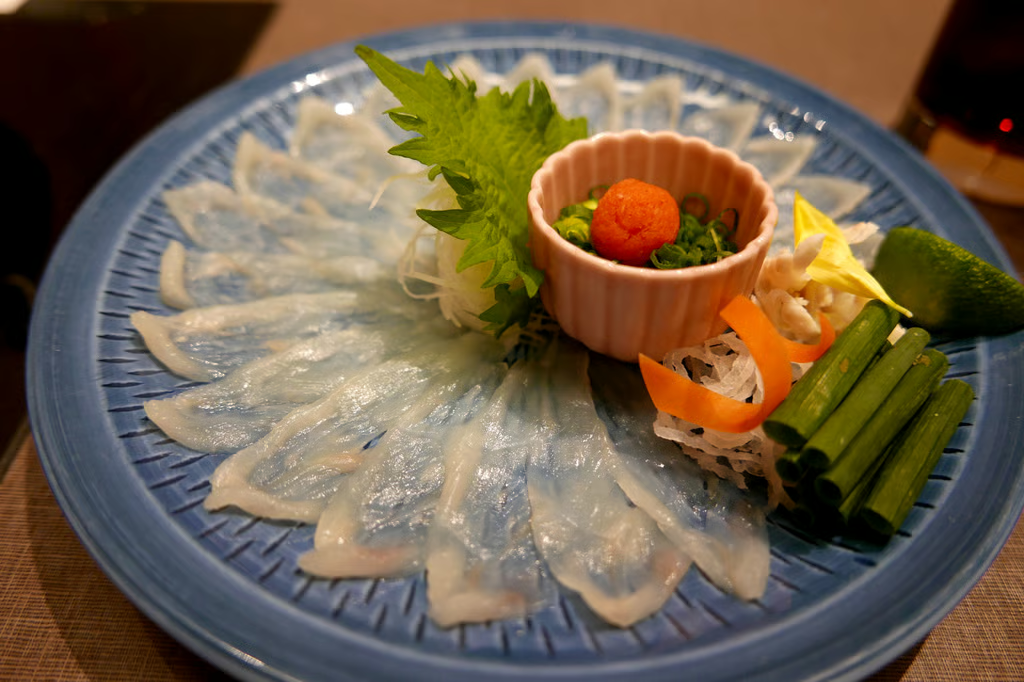
Pufferfish, or “fugu”, sashimi prepared for eating at a restaurant in Japan. Photo: Shutterstock

Fatal attraction

None of this is likely to diminish fugu’s deadly mystique. The dish has been eaten in Japan for centuries, enjoyed despite – or because of – the risks involved.

Every year, new tales emerge of amateur anglers preparing the fish to eat against the advice of anxious relatives and not surviving the attempt.

Diners speak of a faint numbness in the lips as evidence of a narrow escape and the emperor of Japan is barred from eating fugu altogether, lest even a licensed chef makes a mistake.

Urban legend holds that chefs who do poison a customer are honour-bound to end their own life, with their own knife, in atonement – though this is a myth.

For their part, Japanese restaurateurs are, perhaps unsurprisingly, keen to play down the risks.

A spokeswoman for Miyawaki Fugu Club, an upscale restaurant in Tokyo’s Ginza district, said its chef works exclusively with farmed tiger pufferfish from a long-established supplier, which she insisted were “completely safe”.

James Reimer, a professor of marine biology at the University of the Ryukyus, said the fugu phenomenon fit a wider pattern of marine life relocating in response to global warming.

“What happens to marine ecosystems is one of the hot-button issues of the day, particularly in Japan, because the waters here are warming at twice the global average rate,” he said.

During fieldwork off the Izu peninsula, south of Tokyo, three years ago, local fishermen told him that they had lost virtually their entire kelp crop and that the abalone once abundant in those waters had vanished.

A sea turtles in waters off Japan’s Amami Islands. Turtles are increasingly venturing farther north, fishermen say. Photo: Shutterstock

In their place, they said they were seeing far more sea turtles, as well as large schools of brightly coloured fusiliers – the prefectural fish of Okinawa, some 1,400km (870 miles) to the south.

“Last year, our summer in Okinawa was 30 days longer than average, and we had 120 days when the water temperature was around 30 degrees Celsius (86 degrees Fahrenheit),” Reimer said.

He warns that the picture is not simply one of fish and other marine life swimming steadily north in search of more comfortable temperatures, however.

Global warming is also destabilising weather patterns, making them less predictable. Waters off Kyushu, the southernmost of Japan’s main islands, that might otherwise suit certain species are increasingly prone to temperature swings that could make them unsuitable after all.

Even so, the broader direction is unmistakable. Kyushu’s waters have seen a marked rise in shark sightings in recent years, including large tiger sharks – one more sign of the changes occurring beneath the surface of Japan’s seas.

Some Historical Notes on the Three Quests of China: Dignity, Stability, Understanding

Dignity Quest

In “The Philosopher,” a chapter in the 1922 travel book On a Chinese Screen, W. Somerset Maugham comments, “He was the greatest authority in China on Confucian learning.”

The philosopher mentioned above tells Maugham: 

“I took the Ph.D. in Berlin, you know,” he said.  “And afterwards I studied in Oxford.   …  But his study of Western philosophy had only served in the end to satisfy him that wisdom after all was to be found within the limits of the Confucian canon.  He accepted its philosophy with conviction.  If Confucianism gained so firm a hold on the Chinese it is because it explained and expressed them as no other system of thought could do.  He loathed the modern cry for individualism.  For him society was the unit, and the family the foundation of society.  He upheld the old China and the old school, monarchy, and the rigid canon of Confucius.  He grew violent and bitter as he spoke of the students fresh from foreign universities, who with sacrilegious hands tore down the oldest civilization in the world. ”

“But you, do you know what you are doing?” he exclaimed. “What is the reason for which you deem yourselves our betters? Have you excelled us in arts or letters? Have our thinkers been less profound than yours? Has our civilization been less elaborate, less complicated, less refined than yours? Why, when you lived in caves and clothed yourselves with skins we were a cultured people. Do you know that we tried an experiment which is unique in the history of the world? We sought to rule this great country not by force, but by wisdom. And for centuries we succeeded. Then why does the white man despise the yellow? Shall I tell you? Because he has invented the machine gun. That is your superiority. We are a defenseless horde and you can blow us into eternity. You have shattered the dream of our philosophers that the world could be governed by the power of law and order. And now you are teaching our young men your secret. You have thrust your hideous inventions upon us. Do you not know that we have a genius for mechanics? Do you not know that there are in this country four hundred millions of the most practical and industrious people in the world? Do you think it will take us long to learn? And what will become of your superiority when the yellow man can make as good guns as the white and fire them as straight? You have appealed to the machine gun and by the machine gun shall you be judged.”

Stability Quest

  1. The decade of the 1850s gives a most revealing picture of the Chinese sense of things falling apart.  The Taiping Rebellion, convulsed China in the 1850s. It was a utopian movement which wants to go backwards and forwards at the same time and arrive at a historical paradise.

  2. From 1859-1860, the Second Opium War racks China. The British extract more concessions from the Chinese by the Treaty of Tientsin, a tremendous new humiliation for the Chinese. As part of British “shock and awe” of that time the Summer Palace in Beijing is burned down.

  3. In Chinese society, to add to this misery, there is a tremendous conflict in China between the Hakka (客家, “Guest People”) with the Punti (本地, “Native/Original People”) called the Hakka–Punti conflict, and is referred to in the movie The Hawaiians, based on the James Michener novel.

  4. All of this Chinese turmoil and national weakness is itself taking place in a global context that is threatening. Commodore Perry and his “Black Ships” sail into Edo Bay (now Tokyo Bay) in 1853, to dictate terms to the Japanese which amount to “trade or die” (an American “shock and awe”).

  5. In 1857-1858, India convulses with the Indian Mutiny, which has been described as the opening chapter of the Indian Independence Movement. The Indian Mutiny, also known as the Sepoy Mutiny, was put down with shocking brutality. The Chinese watching the event, feel rage about the insouciant attitude of Westerners towards non-Western people.(A recent masterpiece Human Smoke by Nicholson Baker shows you the same insouciant attitude in the Bengal Famine of the 1940s and with Churchill’s dismissive comments about the human misery.) The Chinese who were studying news reports coming out of India suddenly learnt that control of India in 1858 was transferred permanently from the East India Company to the Crown, showing that the British could change the rules of the game at will.

  6. In the 19th century Chinese and Japanese thinkers came up with two definitive slogans, which they used to orient themselves.

    Slogan One

    “Western Technology, Eastern Ethics.” What is the balance point between West and the East? Xi Jinping (习近平) is also trying to find a balance. How American must a Chinese Silicon Valley have to be?

    Slogan Two

    “Rich Country, Strong Army.” How fast could China become a rich country with a strong army, without provoking a global backlash—think Chinese leaders since Mao.

  7. Certain opaque and chaotic phenomena in Chinese history haunt the Chinese mind. Mao was reading Chinese historians all his life to try to understand these phenomena. Chinese schoolboys are trying to understand the rebellion called the An Lu-Shan (安禄山) of 755-763, which takes place in the middle of the Tang Dynasty and plunges China into chaos. Leaders, scholars and schoolchildren of China want to decipher the events of this very classic rebellion in Chinese history and to understand what they are always trying to understand: how things go bad. An Lu-Shan was of Turkish and Sogdian origins, which created another kind of nervousness: turmoil in China coming from non-Chinese ethnic groups. Chinese brutality toward both the Tibetans and the Muslims within China echo these anxieties. This classical rebellion is interpreted by Chinese as the beginning of the end of the Tang Dynasty, the first Chinese Golden Age. China’s preoccupation with stability comes from its insecurity about national turmoil such as the An Lu-Shan Rebellion case, which could merge with foreign threats creating a nightmare for China.

  8. China was conquered by the Mongols who created the Yuan Dynasty circa 1300 A.D. China was conquered by the Manchus from 1644-1911. The Japanese assaulted China in the 1930s. Europeans colonized and broke China into pieces in the 19th century. The ultimate symbol of China’s defeat was the two Opium Wars—1839 and 1859—by the British. The tremendous humiliation suffered by the Chinese is masterfully conveyed by Arthur Waley’s classic book, The Opium War Through Chinese Eyes.

Quest to Understand

China and Charles Darwin, by James Pusey, captures the perplexity of the Western intellectual impact on China in the last few lines of the book. “But Charles Darwin honestly entered those mixtures in Chinese heads and made them different. So his influence was real. Chinese of course confused Darwin’s ideas and were confused by them, and of course they got confused in Chinese directions, but small wonder. Every people has gotten confused. For the fact of the matter is, when all is said and done, that no one knows what to make of evolution.”

Many Western ideas and philosophies are troubling and destabilizing for the Chinese such as, individualism before society and family; marriage based on romantic love alone; a society based on innovate-or-die.

The Chinese quest for such modes of stability has a perennial quality.