Economics-Watching: Kuwait: GDP Returns to Growth in Q1 2025 as Impact of Oil Output Cuts Fades

[from NBK Economic Research, 21 July, 2025]

by Mohammad Al-Shehri, Assistant Economist & Omar Al-Nakib, Head of MENA Research

Preliminary official figures show GDP expanding 1% y/y in Q1 2025 following seven consecutive quarters of contraction, helped by a less severe downturn in oil output. With the negative effects of earlier voluntary oil production cuts beginning to fade, oil GDP recorded only a marginal decline, the softest since Q2 2023. Growth in non-oil activity remained positive though eased, weighed by a moderation in the manufacturing, real estate, and transport sectors. The near-term outlook for GDP is one of positive growth, lifted by rising oil production after Kuwait started to restore 135 kb/d of oil output cuts between April and September 2025, while the non-oil sector should also register further steady gains.

Non-oil GDP growth softens in Q1 2025 after strong performance in Q4 2024

Growth in the non-oil sector weakened in Q1 2025, slowing to 2% y/y compared to 4% recorded in the prior quarter. (Chart 1.) The softer expansion in non-oil activity reflected, among other things, a moderation in the manufacturing sector, where activity grew at a still-solid 4.3% despite a decline in refined petroleum products output but slowed notably from the 12.2% reading registered in Q4 2024. Growth in other sectors including real estate, wholesale & retail trade, transport, and education also slowed. Offsetting the slowdown was stronger expansion in the non-oil economy’s largest segments: public administration and defense as well as financial intermediation and insurance, which grew 1% and 3.2% y/y, respectively. (Chart 2.)
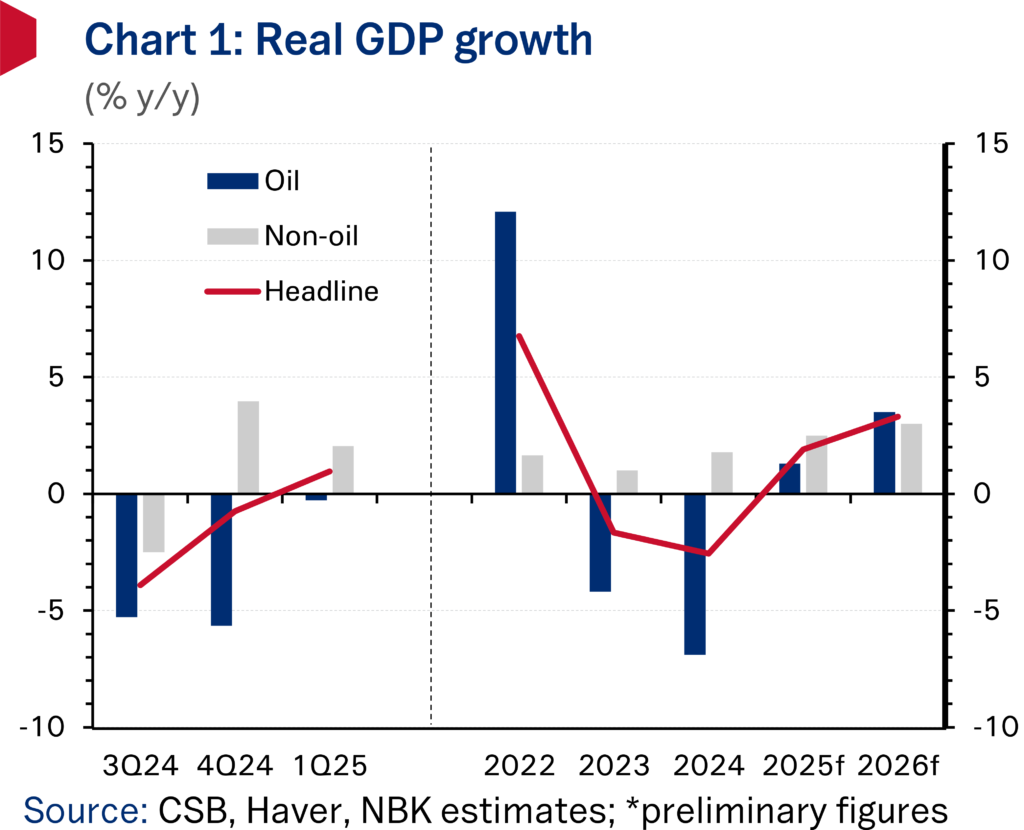
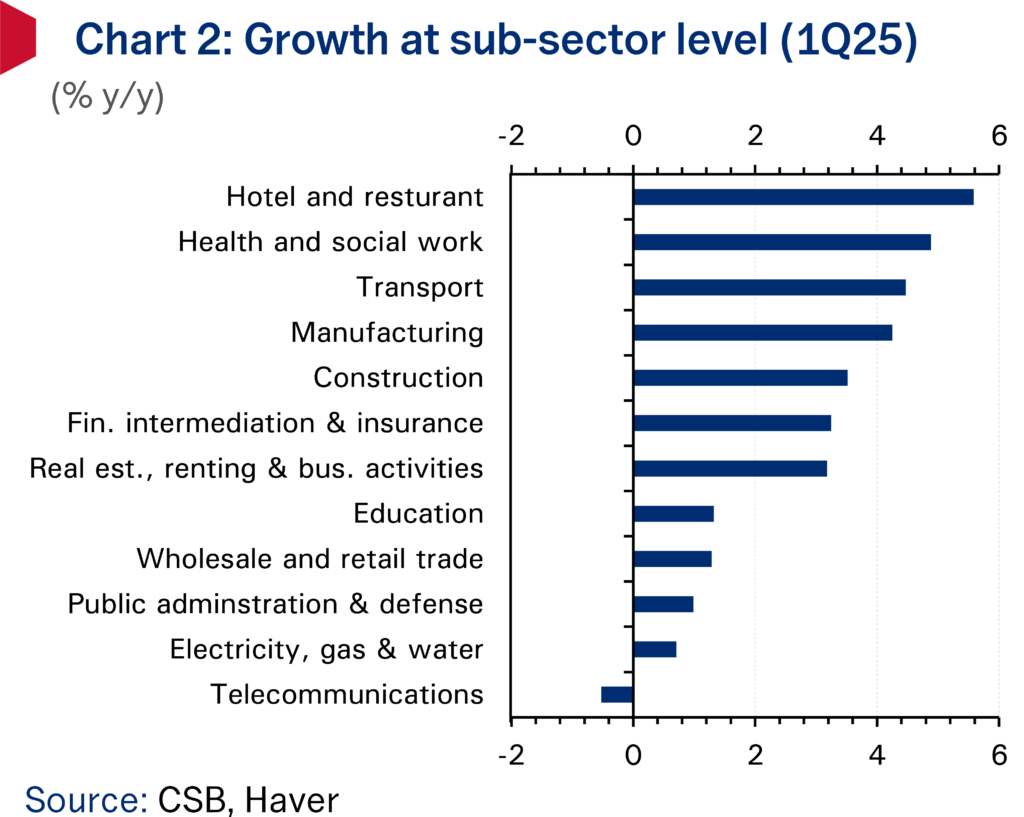
Chart 1: Real GDP growth

Chart 2: Growth at sub-sector level (1Q25)

Oil sector logs marginal contraction, set to return to growth in Q2

The contraction in oil GDP eased significantly to -0.3% y/y from -5.7% y/y in Q4 2024, registering the softest rate of decline since Kuwait embarked on cutting oil production in Q2 2023 after participating in the voluntary cuts scheme with 7 other OPEC+ members. (Chart 4.) Kuwait’s oil production averaged 2.415 mb/d in Q1 2025, a 0.7% decline from the same quarter last year, according to OPEC secondary sources. However, oil sector fortunes are set to shift in Q2 2025 and thereafter, after the OPEC-8 member alliance started unwinding the 2.2 mb/d voluntary cut tranche in April 2025. Originally planned to be unwound over the course of 18 months, OPEC+ has accelerated the pace of supply hikes with output now on a path to be fully restored in September, a full year ahead of schedule. For Kuwait, crude production rose by 0.5% q/q in Q2 to 2.426 mb/d and is set to accelerate further to average 2.533 mb/d in H2 2025. With the oil market so far able to absorb the additional OPEC and global supply and oil prices currently holding near $70/bbl, an upside risk to our oil sector outlook involves the potential unwinding of the outstanding OPEC-8 voluntary cuts (1.66 mb/d), of which Kuwait’s share is 128 kb/d.

Growth heading back into positive territory in 2025

Growth in total GDP is set to remain on a positive trajectory in the near term, buoyed by further steady expansion in non-oil economic activity and increased oil production. Non-oil GDP is set to benefit from the government’s reform drive which includes the recent passing of the debt law that could catalyze the implementation of key development projects and the potential approval of the ‘mortgagelaw later in 2025, which could spur higher household borrowing and consumer spending. Economic indicators for Q2 2025 pointed to a healthy pace of non-oil economic activity. The key ‘output’ and ‘new orders’ balances in the non-oil private sector PMI gauge both averaged a very robust 57+ in Q2 2025, real estate activity continued to expand at a robust pace with earlier price falls in the residential sector abating, while credit growth stood at a healthy 5.5% y/y in May, and could benefit in coming months if interest rates are reduced further.

Nonetheless, there are also downside risks to the outlook. Local consumer spending growth (according to central bank card transactions data) turned negative in Q1 2025, extending the weakening trend now observed for more than a year. The government’s ongoing fiscal consolidation push will also weigh on wage and job growth. Overall, we see GDP growing 1.9% this year, boosted by expansions in both the oil and non-oil sectors of 1.2% and 2.5%, respectively.
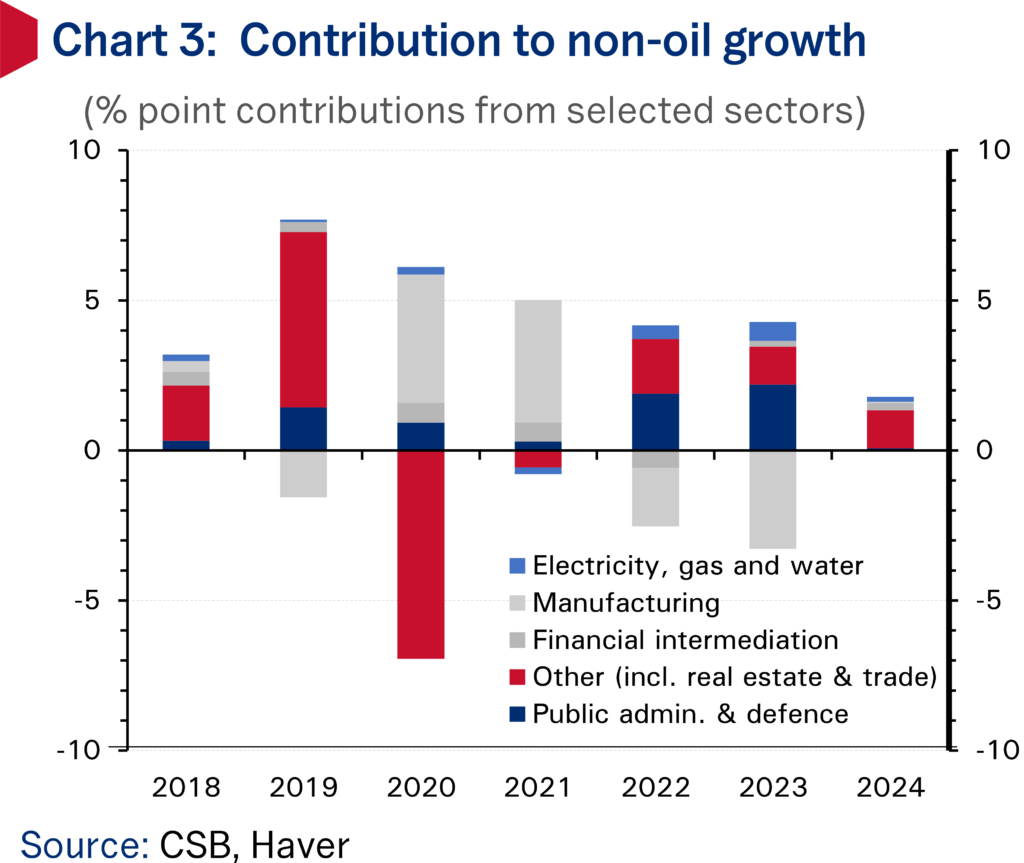
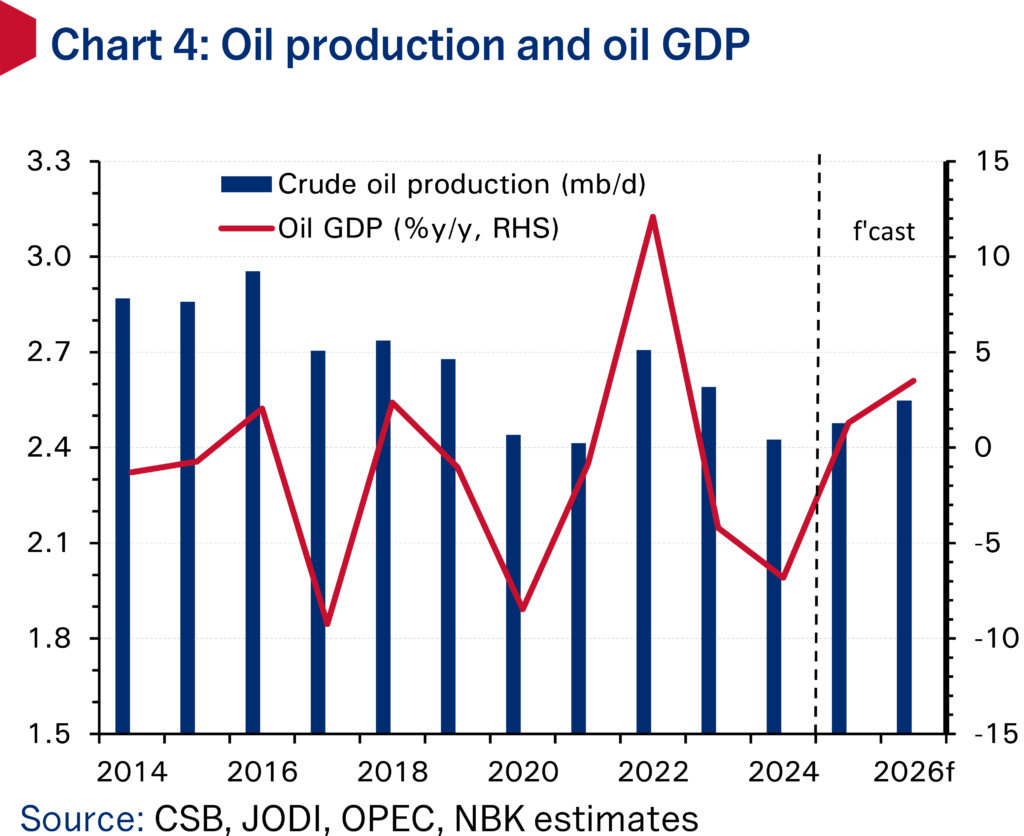
Chart 3: Contribution to non-oil growth

Chart 4: Oil production and oil GDP

Read this article as an archived PDF.

Carbon-Watching: Will Civilization Collapse Because It’s Running Out of Oil?

[from the Post Carbon Institute]

Abstract

This paper [Archived PDF] assesses how much oil remains to be produced, and whether this poses a significant constraint to global development. We describe the different categories of oil and related liquid fuels, and show that public-domain by-country and global proved (1P) oil reserves data, such as from the EIA or BP Statistical Review, are very misleading and should not be used. Better data are oil consultancy proved-plus-probable (2P) reserves. These data are generally backdated, i.e. with later changes in a field’s estimated volume being attributed to the date of field discovery. Even some of these data, we suggest, need reduction by some 300 Gb for probable overstatement of Middle East OPEC reserves, and likewise by 100 Gb for overstatement of FSU (floating storage unit) reserves. The statistic that best assesses ‘how much oil is left to produce’ is a region’s estimated ultimately recoverable resource (URR) for each of its various categories of oil, from which production to-date needs to be subtracted. We use Hubbert linearization to estimate the global URR for four aggregate classes of oil, and show that these range from 2500 Gb for conventional oil to 5000 Gb for ‘all-liquids’. Subtracting oil produced to-date gives estimates of global reserves of conventional oil at about half the EIA estimate. We then use our estimated URR values, combined with the observation that oil production in a region usually reaches one or more maxima when roughly half its URR has been produced, to forecast the expected dates of global resource-limited production maxima of these classes of oil. These dates range from 2019 (i.e., already past) for conventional oil to around 2040 for ‘all-liquids’. These oil production maxima are likely to have significant economic, political and sustainability consequences. Our forecasts differ sharply from those of the EIA, but our resource-limited production maxima roughly match the mainly demand-driven maxima envisaged in the IEA’s 2021 ‘Stated Policies’ scenario. Finally, in agreement with others, our forecasts indicate that the IPCC’s ‘high-CO2’ scenarios appear infeasible by assuming unrealistically high rates of oil production, but also indicate that considerable oil must be left in the ground if climate change targets are to be met. As the world seeks to move towards sustainability, these perspectives on the future availability of oil are important to take into account.

Read the full paper. [Archived PDF]

Press Release: World Energy Outlook 2019 Highlights Deep Disparities in the Global Energy System

Rapid and widespread changes across all parts of the energy system are needed to put the world on a path to a secure and sustainable energy future

Deep disparities define today’s energy world. The dissonance between well-supplied oil markets and growing geopolitical tensions and uncertainties. The gap between the ever-higher amounts of greenhouse gas emissions being produced and the insufficiency of stated policies to curb those emissions in line with international climate targets. The gap between the promise of energy for all and the lack of electricity access for 850 million people around the world.

The World Energy Outlook 2019, the International Energy Agency’s flagship publication, explores these widening fractures in detail. It explains the impact of today’s decisions on tomorrow’s energy systems, and describes a pathway that enables the world to meet climate, energy access and air quality goals while maintaining a strong focus on the reliability and affordability of energy for a growing global population.

As ever, decisions made by governments remain critical for the future of the energy system. This is evident in the divergences between WEO scenarios that map out different routes the world could follow over the coming decades, depending on the policies, investments, technologies and other choices that decision makers pursue today. Together, these scenarios seek to address a fundamental issue – how to get from where we are now to where we want to go.

The path the world is on right now is shown by the Current Policies Scenario, which provides a baseline picture of how global energy systems would evolve if governments make no changes to their existing policies. In this scenario, energy demand rises by 1.3% a year to 2040, resulting in strains across all aspects of energy markets and a continued strong upward march in energy-related emissions.

The Stated Policies Scenario, formerly known as the New Policies Scenario, incorporates today’s policy intentions and targets in addition to existing measures. The aim is to hold up a mirror to today’s plans and illustrate their consequences. The future outlined in this scenario is still well off track from the aim of a secure and sustainable energy future. It describes a world in 2040 where hundreds of millions of people still go without access to electricity, where pollution-related premature deaths remain around today’s elevated levels, and where CO2 emissions would lock in severe impacts from climate change.

The Sustainable Development Scenario indicates what needs to be done differently to fully achieve climate and other energy goals that policy makers around the world have set themselves. Achieving this scenario – a path fully aligned with the Paris Agreement aim of holding the rise in global temperatures to well below 2°C and pursuing efforts to limit it to 1.5°C – requires rapid and widespread changes across all parts of the energy system. Sharp emission cuts are achieved thanks to multiple fuels and technologies providing efficient and cost-effective energy services for all.

“What comes through with crystal clarity in this year’s World Energy Outlook is there is no single or simple solution to transforming global energy systems,” said Dr. Fatih Birol, the IEA’s Executive Director. “Many technologies and fuels have a part to play across all sectors of the economy. For this to happen, we need strong leadership from policy makers, as governments hold the clearest responsibility to act and have the greatest scope to shape the future.”

In the Stated Policies Scenario, energy demand increases by 1% per year to 2040. Low-carbon sources, led by solar PV, supply more than half of this growth, and natural gas accounts for another third. Oil demand flattens out in the 2030s, and coal use edges lower. Some parts of the energy sector, led by electricity, undergo rapid transformations. Some countries, notably those with “net zero” aspirations, go far in reshaping all aspects of their supply and consumption.

However, the momentum behind clean energy is insufficient to offset the effects of an expanding global economy and growing population. The rise in emissions slows but does not peak before 2040.

Shale output from the United States is set to stay higher for longer than previously projected, reshaping global markets, trade flows and security. In the Stated Policies Scenario, annual U.S. production growth slows from the breakneck pace seen in recent years, but the United States still accounts for 85% of the increase in global oil production to 2030, and for 30% of the increase in gas. By 2025, total U.S. shale output (oil and gas) overtakes total oil and gas production from Russia.

“The shale revolution highlights that rapid change in the energy system is possible when an initial push to develop new technologies is complemented by strong market incentives and large-scale investment,” said Dr. Birol. “The effects have been striking, with U.S. shale now acting as a strong counterweight to efforts to manage oil markets.”

The higher U.S. output pushes down the share of OPEC members and Russia in total oil production, which drops to 47% in 2030, from 55% in the mid-2000s. But whichever pathway the energy system follows, the world is set to rely heavily on oil supply from the Middle East for years to come.

Alongside the immense task of putting emissions on a sustainable trajectory, energy security remains paramount for governments around the globe. Traditional risks have not gone away, and new hazards such as cybersecurity and extreme weather require constant vigilance. Meanwhile, the continued transformation of the electricity sector requires policy makers to move fast to keep pace with technological change and the rising need for the flexible operation of power systems.

“The world urgently needs to put a laser-like focus on bringing down global emissions. This calls for a grand coalition encompassing governments, investors, companies and everyone else who is committed to tackling climate change,” said Dr. Birol. “Our Sustainable Development Scenario is tailor-made to help guide the members of such a coalition in their efforts to address the massive climate challenge that faces us all.”

A sharp pick-up in energy efficiency improvements is the element that does the most to bring the world towards the Sustainable Development Scenario. Right now, efficiency improvements are slowing: the 1.2% rate in 2018 is around half the average seen since 2010 and remains far below the 3% rate that would be needed.

Electricity is one of the few energy sources that sees rising consumption over the next two decades in the Sustainable Development Scenario. Electricity’s share of final consumption overtakes that of oil, today’s leader, by 2040. Wind and solar PV provide almost all the increase in electricity generation.

Putting electricity systems on a sustainable path will require more than just adding more renewables. The world also needs to focus on the emissions that are “locked in” to existing systems. Over the past 20 years, Asia has accounted for 90% of all coal-fired capacity built worldwide, and these plants potentially have long operational lifetimes ahead of them. This year’s WEO considers three options to bring down emissions from the existing global coal fleet: to retrofit plants with carbon capture, utilisation and storage or biomass co-firing equipment; to repurpose them to focus on providing system adequacy and flexibility; or to retire them earlier.

Access the 2019 World Energy Outlook report.

About the IEA: The International Energy Agency, the global energy authority, was founded in 1974 to help its member countries co-ordinate a collective response to major oil supply disruptions. Its mission has evolved and rests today on three main pillars: working to ensure global energy security; expanding energy cooperation and dialogue around the world; and promoting an environmentally sustainable energy future.

International Energy Agency Press Office
31-35 Rue de la Fédération, Paris, 75015