The phrase “view from nowhere” comes from the title of a 1986 classic philosophy book by Professor Thomas Nagel. It tries to wrestle with the paradox that the human ability to take a “detached view” (abstract theory, say) is potentially misleading since the person behind the detachment is a real person embodied and somewhere.
The human “style” of “being-in-the-world” comes into the equations and to the very idea of equating.
Human beings have the unique ability to view the world in a detached way: We can think about the world in terms that transcend our own experience or interest, and consider the world from a vantage point that is, in Nagel’s words, “nowhere in particular.” At the same time, each of us is a particular person in a particular place, each with his own “personal” view of the world, a view that we can recognize as just one aspect of the whole. How do we reconcile these two standpoints—intellectually, morally, and practically?
To what extent are they irreconcilable and to what extent can they be integrated? Thomas Nagel’s ambitious and lively book tackles this fundamental issue, arguing that our divided nature is the root of a whole range of philosophical problems, touching, as it does, every aspect of human life. He deals with its manifestations in such fields of philosophy as: the mind-body problem, personal identity, knowledge and skepticism, thought and reality, free will, ethics, the relation between moral and other values, the meaning of life, and death.
The solution is not to inhibit the objectifying impulse, but to insist that it learn to live alongside the internal perspectives that cannot be either discarded or objectified. Reconciliation between the two standpoints, in the end, is not always possible.
A neural network that teaches itself the laws of physics could help to solve some of physics’ deepest questions. But first it has to start with the basics, just like the rest of us. The algorithm has worked out that it should place the Sun at the centre of the Solar System, based on how movements of the Sun and Mars appear from Earth.
The machine-learning system differs from others because it’s not a black that spits out a result based on reasoning that’s almost impossible to unpick. Instead, researchers designed a kind of ‘lobotomized’ neural network that is split into two halves and joined by just a handful of connections. That forces the learning half to simplify its findings before handing them over to the half that makes and tests new predictions.
A long-awaited experimental result has found the proton to be about 5% smaller than the previously accepted value. The finding seems to spell the end of the ‘protonradius puzzle’: the measurements disagreed if you probed the proton with ordinary hydrogen, or with exotichydrogen built out of muons instead of electrons. But solving the mystery will be bittersweet: some scientists had hoped the difference might have indicated exciting new physics behind how electrons and muons behave.
This week is a special one for all of us at Nature: it’s 150 years since our first issue, published in November 1869. We’ve been working for well over a year on the delights of our anniversary issue, which you can explore in full online.
A century and a half has seen momentous changes in science, and Nature has changed along with it in many ways, says an Editorial in the anniversary edition. But in other respects, Nature now is just the same as it was at the start: it will continue in its mission to stand up for research, serve the global research community and communicate the results of science around the world.
Nature creative director Kelly Krause takes you on a tour of the archive to enjoy some of the journal’s most iconic covers, each of which speaks to how science itself has evolved. Plus, she touches on those that didn’t quite hit the mark, such as an occasion of “Photoshop malfeasance” that led to Dolly the sheep sporting the wrong leg.
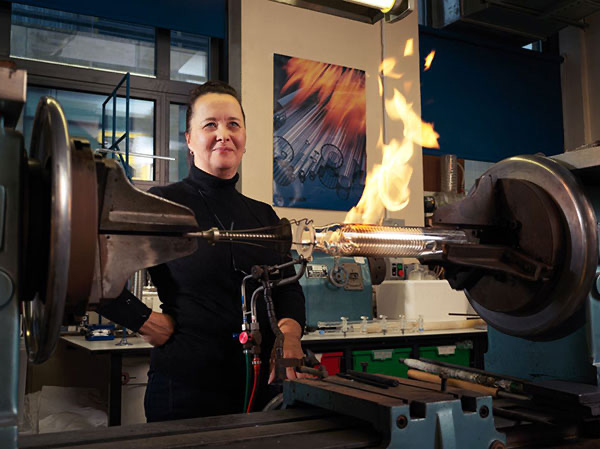
Scientific glassblower Terri Adams uses fire and heavy machinery to hand-craft delicate scientific glass apparatus. “My workbench hosts an array of tools for working with glass, many of which were custom-made for specific jobs,” says Adams. “Each tool reminds me of what I first used it for and makes me consider how I might use it again.” (Leonora Saunders for Nature)
(If you have recommended people before and you want them to count, please ask them to email me with your details and I will make it happen!) Your feedback, as always, is very welcome at briefing@nature.com.
We sometimes use the phrase “epochal waters” to refer to the deepest layers of the past which we “swimmers” at the surface of the ocean don’t see or know. “Epochal waters” are latent, currents are closer to the surface.
“In essence, Les mots et les choses (Foucault’s The Order of Things) maintains that every period is characterized by an underground configuration that delineates its culture, a grid of knowledge making possible every scientific discourse, every production of statements. Foucault designates this historical a priori as an episteme, deeply basic to defining and limiting what any period can—or cannot—think.
Each science develops within the framework of an episteme, and therefore is linked in part with other sciences contemporary with it.
(Didier Eribon, Michel Foucault, Harvard University Press, 1991, page 158)
Take a simple example. A discussion comes up about what man is or does or thinks or knows. In today’s episteme or pre-definition, one thinks immediately not of man in terms of language or the invention of gods, but in terms of computational genomics, big data, bipedalism (walking upright on two legs). Its assumed in advance via an invisible episteme, that science and technology. physics, genetics, big data, chemistry and biology hold the answer and the rest is sort of outdated. This feeling is automatic and reflexive like breathing and might be called “mental breathing.”
One’s thoughts are immediately sent in certain directions or grooves, a process that is automatic and more like a “mental reflex” than a freely chosen “analytical frame.” The thinker has been “trained” in advance and the episteme pre-decides what is thinkable and what is not.
There are deep episteme that underlie all analyses: for example, in the Anglo-American tradition of looking at things, the phrase “human nature” inevitably comes in as a deus ex machina (i.e., sudden way of clinching an argument, the “magic factor” that has been there all along). If you ask why are you suddenly “importing” the concept of “human nature,” the person who uses the phrase has no idea. It’s in the “epochal water” or Foucault’s episteme, and it suddenly swims up from below at the sea floor.
Another quick example: In the Anglo-American mind, there’s a belief from “way down and far away” that failure in life is mostly about individual behavior (laziness, alcoholism, etc.) and personal “stances” while “circum-stances” are an excuse. This way of sequencing acceptable explanations is deeply pre-established in a way that is itself hard to explain. It serves to “frame the picture” in advance. These are all “epochal water“ or episteme phenomena.