
Her potential-growth example implies a neutral rate around 2.8%, above the Bank’s published 2.5% ceiling and well above today’s 1.25% policy rate.
[by OKUBO Takuji]
Key Takeaways
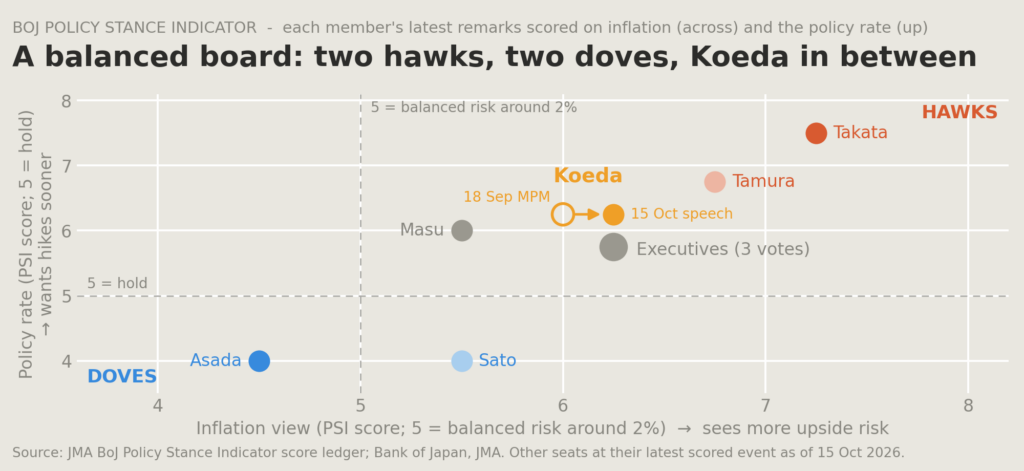
- Koeda, probably the most influential swing vote on the board, seemed slightly more hawkish in her speech on October 15. She stopped just short of calling the 2% target achieved.
- Her conceptual example of a neutral rate, potential growth plus 2%, points to a neutral rate well above 2%. While she is not in a hurry to push for hikes as the two hawks are, she seems open to a protracted hiking cycle.
- I continue to think an October hike is out of the question. Koeda’s openness to a hike marginally raises the possibility of a December hike. I still consider it highly unlikely, though.
Why Koeda matters
On October 15, 2026, KOEDA Junko [小枝淳子] made her 3rd speech since she joined the BoJ policy board in 2025. She is an ex-IMF academic and yield curve specialist. She is probably the most important and influential swing vote in the current BoJ board. In her speech [archived PDF] and the following press conference (Japan Macro Advisors’ unofficial transcript), she sounded more open to continued rate increases than the three BoJ executives, although she was careful not to give any indication of the timing of the next move.
The board is balanced at both ends
As you can see in chart 1, the board is evenly balanced with two hawks at top-right and two doves at bottom-left (if you are unfamiliar with the BoJ-Policy Stance Indicator framework, please see the Japan Macro Advisors primer). That leaves KOEDA Junko [小枝 淳子] and MASU Kazuyuki [増 一行] between the two ends, sitting with the three BoJ executives: the Governor and two Deputy Governors. As BoJ executives tend to vote together, Koeda and Masu cast critical swing votes.
Chart 1
Koeda sounded more hawkish than before
In her speech [archived PDF] and the following press conference (see the Japan Macro Advisors unofficial transcript), she seemed slightly more hawkish than I anticipated. Koeda judges trend inflation to be already about 2% overall and increasingly well-anchored. She stopped just short of saying the 2% target has been achieved. She said:
“For about a year now I have described underlying inflation as roughly 2% on the whole, and I have kept checking how firmly it is taking hold. On the CPI, as I noted at Chart 11, broad-based price increases have continued for several years, and the distribution of year-on-year changes by item also suggests that this is becoming established. Wages, too, have shown stable increases overall. For these reasons, I think Japan’s inflation is becoming more persistently entrenched than before.” [Kumamoto speech, 15 October 2026, Japan Macro Advisors translation]
Koeda also offered a simplified concept of the neutral rate as the potential growth rate plus the 2% inflation target. As the Bank’s latest potential-growth estimate is about 0.8%, this could put the nominal neutral rate at 2.8%, exceeding the top of the Bank’s published nominal range of 1.1–2.5%. She did offer another version that put the neutral rate at a lower level, but it was clear that she wanted to give a higher version of a potential neutral rate.
To be clear, she did not endorse 2.8% as a policy-rate destination. At the press conference, she said the potential-growth rule does not always hold and declined to give a point estimate. But her intention was most likely to nudge the neutral rate range higher.
Koeda was clear in her message that she is open to a rate hike. She said: “I do not think we need to be overly cautious about raising rates.” [speech, Japan Macro Advisors translation]
But she was quite evasive regarding the timing of the next hike. In the press conference, reporters repeatedly asked for her view on a back-to-back rate hike, a veiled way of asking whether an October hike is possible. She was quite firm in repeating her stance that she does not have any particular pace in mind. This was an interesting contrast with Governor Ueda’s dismissive comment on the possibility of a successive or oversized rate hike (see the Japan Macro Advisors September 18 report). That does not mean she endorsed consecutive hikes. It means she left the option more open than Ueda did.
Conclusion: More open to multiple hikes
By choosing potential growth plus 2% as an example of the neutral rate, Koeda seems to be creating more space for the policy rate to eventually rise above 2%, in my view. In terms of the timing for the next hike, she was non-committal. I would still consider an October hike out of the question, but her non-committal attitude does marginally raise the possibility of a December hike, although I still consider it highly unlikely.